light YAMAHA XMAX 250 2008 User Guide
[x] Cancel search | Manufacturer: YAMAHA, Model Year: 2008, Model line: XMAX 250, Model: YAMAHA XMAX 250 2008Pages: 88, PDF Size: 2.76 MB
Page 25 of 88
NOTE:
Even if the key is turned from “ON” to
“OFF” with the hazard lighting on, the
hazard lighting will continue to flash
regardless of the hazard switch posi-
tion. To cancel the hazard lighting, the
key must be turned to “ON” and the
hazard switch must be set to the “h”
position.
The hazard lighting is used in case of
an emergency or to warn other drivers
when your scooter is stopped where
it might be a traffic hazard.
ECA10060
CAUTION:
Do not use the hazard light for an
extended length of time, otherwise
the battery may discharge.
EAU12720
Start switch “g”
With the sidestand up, push this
switch while applying the front or rear
brake to crank the engine with the
starter.
ECA10050
CAUTION:
See page 5-1 for starting instruc-
tions prior to starting the engine.
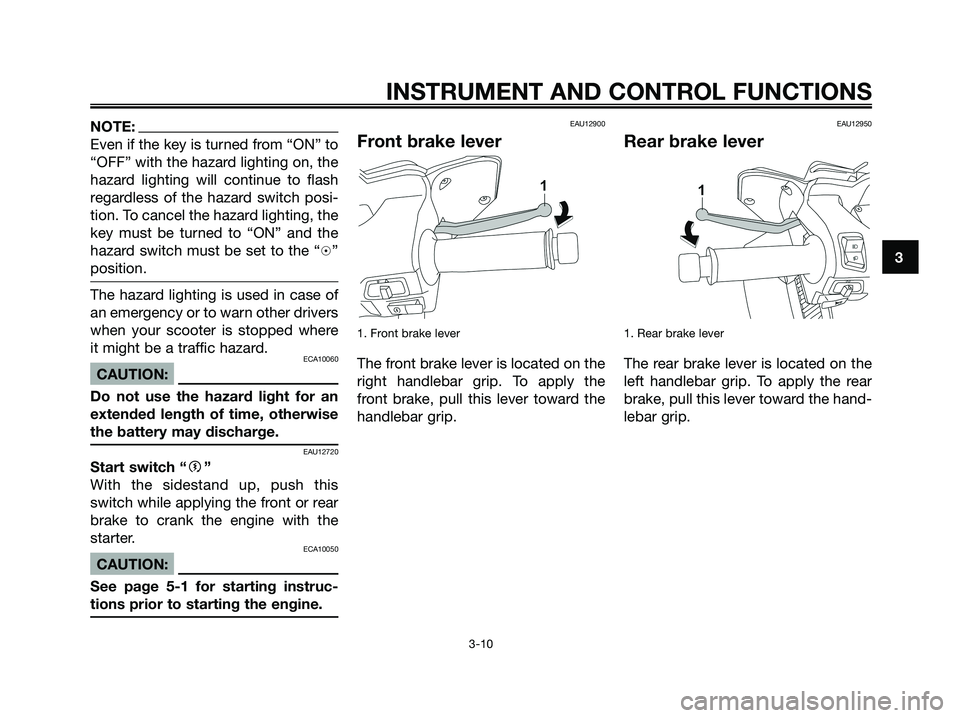
EAU12900
Front brake lever
1. Front brake lever
The front brake lever is located on the
right handlebar grip. To apply the
front brake, pull this lever toward the
handlebar grip.
EAU12950
Rear brake lever
1. Rear brake lever
The rear brake lever is located on the
left handlebar grip. To apply the rear
brake, pull this lever toward the hand-
lebar grip.
INSTRUMENT AND CONTROL FUNCTIONS
3-10
3
1C0-F8199-E4.qxd 22/11/07 05:41 Página 25
Page 33 of 88
EWA10240
s s
WARNING
The vehicle must not be ridden with
the sidestand down, or if the sides-
tand cannot be properly moved up
(or does not stay up), otherwise the
sidestand could contact the ground
and distract the operator, resulting
in a possible loss of control. Yama-
ha’s ignition circuit cut-off system
has been designed to assist the
operator in fulfilling the responsibi-
lity of raising the sidestand before
starting off. Therefore, check this
system regularly as described
below and have a Yamaha dealer
repair it if it does not function pro-
perly.
EAU15372
Ignition circuit cut-off
system
The ignition circuit cut-off system
(comprising the sidestand switch and
brake light switches) has the following
functions.
●It prevents starting when the
sidestand is up, but neither brake
is applied.
●It prevents starting when either
brake is applied, but the sides-
tand is still down.
●It cuts the running engine when
the sidestand is moved down.
Periodically check the operation of
the ignition circuit cut-off system
according to the following procedure.
EWA10250
s s
WARNING
If a malfunction is noted, have a
Yamaha dealer check the system
before riding.
INSTRUMENT AND CONTROL FUNCTIONS
3-18
3
1C0-F8199-E4.qxd 22/11/07 05:41 Página 33
Page 37 of 88
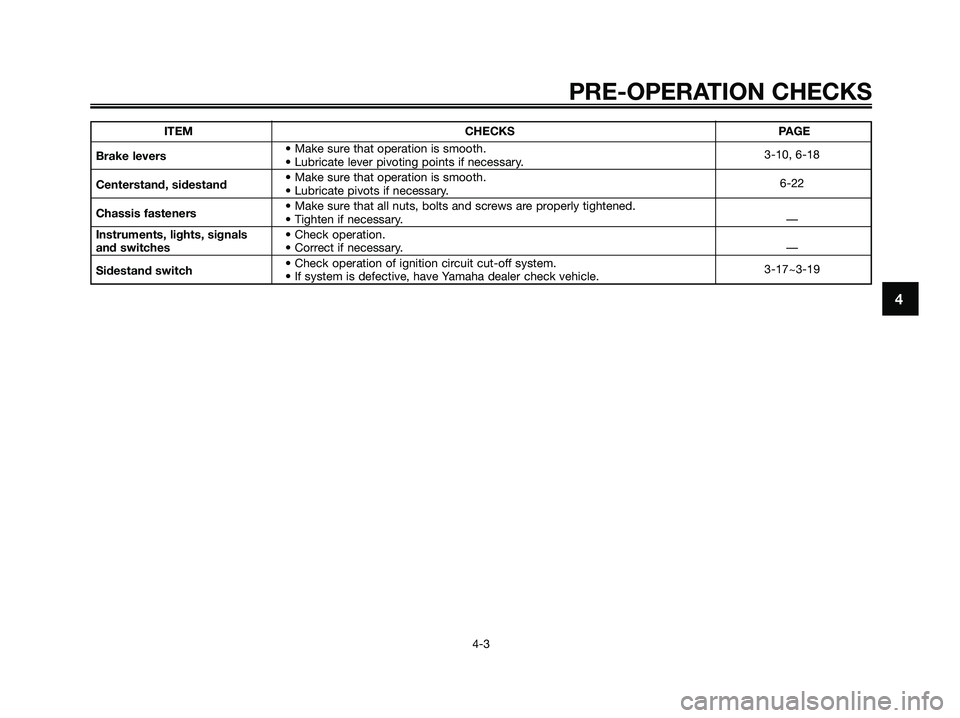
ITEM CHECKS PAGE
Brake levers• Make sure that operation is smooth.
• Lubricate lever pivoting points if necessary.3-10, 6-18
Centerstand, sidestand• Make sure that operation is smooth.
• Lubricate pivots if necessary.6-22
Chassis fasteners• Make sure that all nuts, bolts and screws are properly tightened.
• Tighten if necessary.—
Instruments, lights, signals • Check operation.
and switches• Correct if necessary.—
Sidestand switch• Check operation of ignition circuit cut-off system.
• If system is defective, have Yamaha dealer check vehicle.3-17~3-19
PRE-OPERATION CHECKS
4-3
4
1C0-F8199-E4.qxd 22/11/07 05:41 Página 37
Page 38 of 88
EAU15980
EWA10870
s s
WARNING
●Become thoroughly familiar
with all operating controls and
their functions before riding.
Consult a Yamaha dealer
regarding any control or func-
tion that you do not thoroughly
understand.
●Never start the engine or ope-
rate it in a closed area for any
length of time. Exhaust fumes
are poisonous, and inhaling
them can cause loss of cons-
ciousness and death within a
short time. Always make sure
that there is adequate ventila-
tion.
●For safety, always start the
engine with the centerstand
down.
EAUM2230
Starting the engineECA10250
CAUTION:
See page 5-4 for engine break-in
instructions prior to operating the
vehicle for the first time.
In order for the ignition circuit cut-off
system to enable starting, the sides-
tand must be up.
EWA10290
s s
WARNING
●Before starting the engine,
check the function of the igni-
tion circuit cut-off system
according to the procedure
described on page 3-18.
●Never ride with the sidestand
down.
1. Turn the key to “ON”.ECAM1080
CAUTION:
The following warning lights and
indicator light should come on for a
few seconds, then go off.
●Fuel level warning light
●Engine trouble warning light
●Immobilizer system indicator
lightIf a warning or indicator light does
not go off, see page 3-3 for the
corresponding warning and indica-
tor light circuit check.
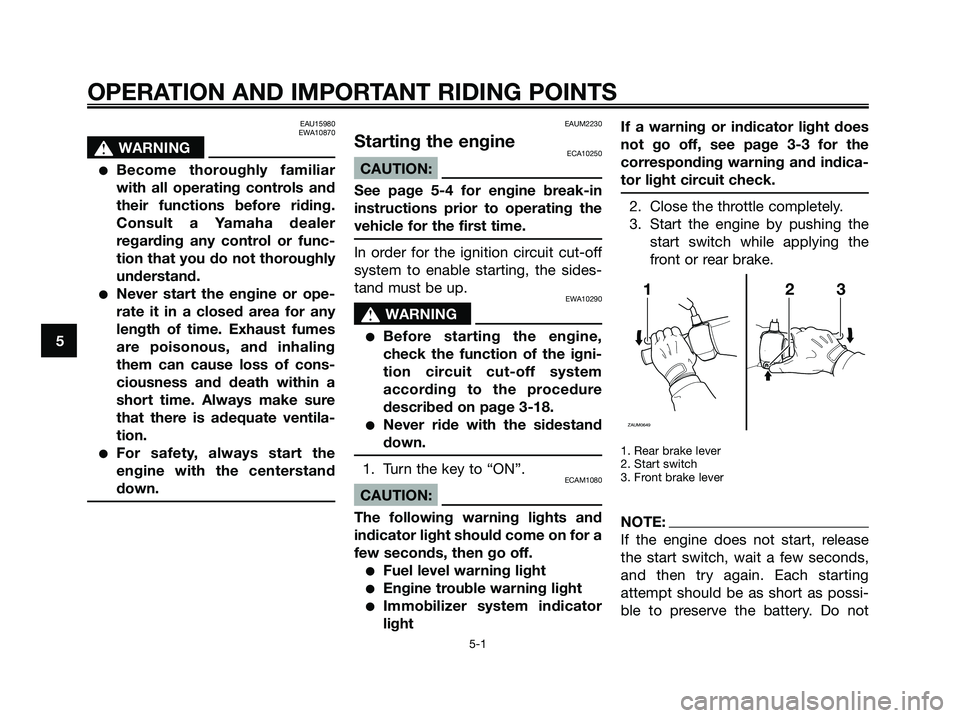
2. Close the throttle completely.
3. Start the engine by pushing the
start switch while applying the
front or rear brake.
1. Rear brake lever
2. Start switch
3. Front brake lever
NOTE:
If the engine does not start, release
the start switch, wait a few seconds,
and then try again. Each starting
attempt should be as short as possi-
ble to preserve the battery. Do not
123
ZAUM0649
OPERATION AND IMPORTANT RIDING POINTS
5-1
5
1C0-F8199-E4.qxd 22/11/07 05:41 Página 38
Page 40 of 88
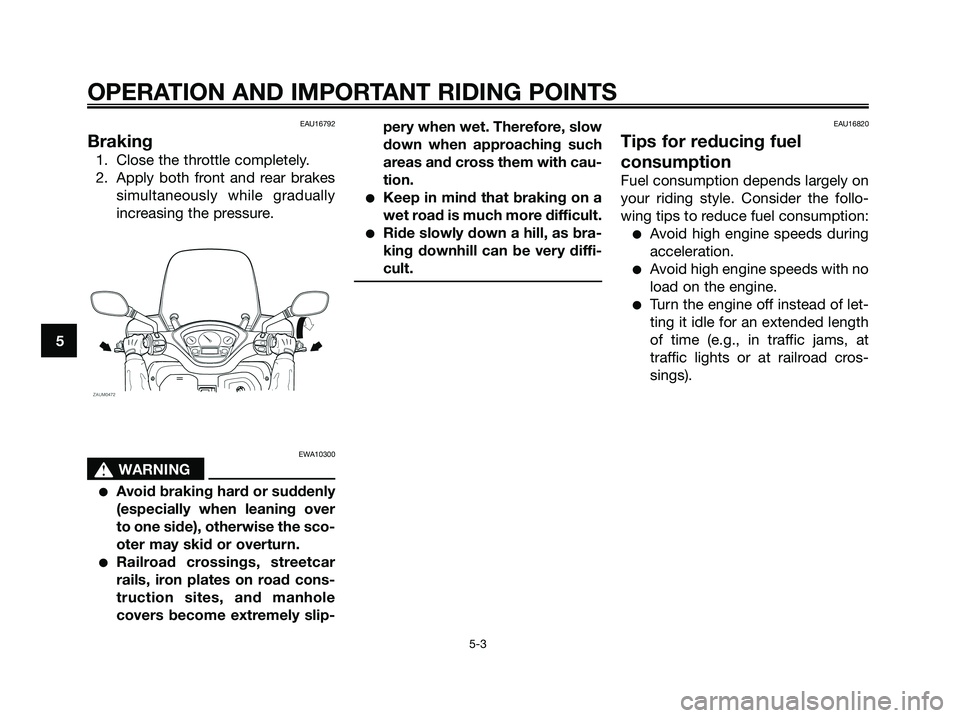
EAU16792
Braking
1. Close the throttle completely.
2. Apply both front and rear brakes
simultaneously while gradually
increasing the pressure.
EWA10300
s s
WARNING
●Avoid braking hard or suddenly
(especially when leaning over
to one side), otherwise the sco-
oter may skid or overturn.
●Railroad crossings, streetcar
rails, iron plates on road cons-
truction sites, and manhole
covers become extremely slip-pery when wet. Therefore, slow
down when approaching such
areas and cross them with cau-
tion.
●Keep in mind that braking on a
wet road is much more difficult.
●Ride slowly down a hill, as bra-
king downhill can be very diffi-
cult.
EAU16820
Tips for reducing fuel
consumption
Fuel consumption depends largely on
your riding style. Consider the follo-
wing tips to reduce fuel consumption:
●Avoid high engine speeds during
acceleration.
●Avoid high engine speeds with no
load on the engine.
●Turn the engine off instead of let-
ting it idle for an extended length
of time (e.g., in traffic jams, at
traffic lights or at railroad cros-
sings).
OPERATION AND IMPORTANT RIDING POINTS
5-3
5
1C0-F8199-E4.qxd 22/11/07 05:41 Página 40
Page 46 of 88
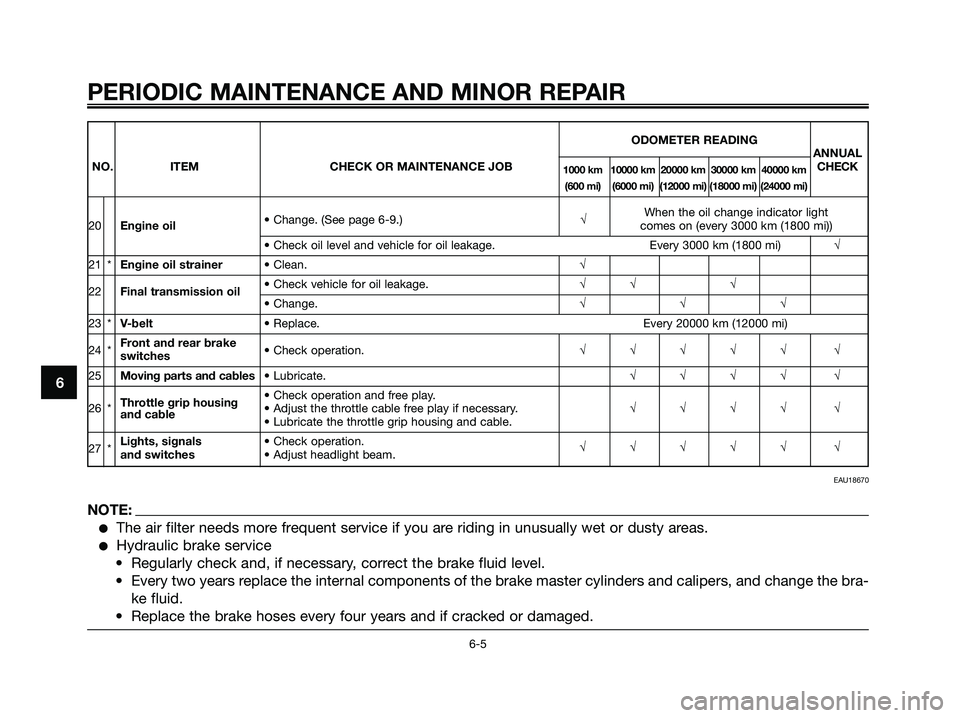
ODOMETER READING
ANNUAL
NO. ITEM CHECK OR MAINTENANCE JOB
1000 km 10000 km 20000 km 30000 km 40000 kmCHECK
(600 mi) (6000 mi) (12000 mi) (18000 mi) (24000 mi)
• Change. (See page 6-9.)√When the oil change indicator light 20Engine oilcomes on (every 3000 km (1800 mi))
• Check oil level and vehicle for oil leakage. Every 3000 km (1800 mi)√
21 *Engine oil strainer• Clean.√
22Final transmission oil• Check vehicle for oil leakage.√√ √• Change.√√√
23 *V-belt• Replace. Every 20000 km (12000 mi)
24 *Front and rear brake
• Check operation.√√√√√ √
switches
25Moving parts and cables• Lubricate.√√√√ √
Throttle grip housing• Check operation and free play.
26 * • Adjust the throttle cable free play if necessary.√√√√ √
and cable
• Lubricate the throttle grip housing and cable.
27 *Lights, signals • Check operation.
and switches• Adjust headlight beam.√√√√√ √
PERIODIC MAINTENANCE AND MINOR REPAIR
6-5
6
EAU18670
NOTE:
●The air filter needs more frequent service if you are riding in unusually wet or dusty areas.
●Hydraulic brake service
• Regularly check and, if necessary, correct the brake fluid level.
• Every two years replace the internal components of the brake master cylinders and calipers, and change the bra-
ke fluid.
• Replace the brake hoses every four years and if cracked or damaged.
1C0-F8199-E4.qxd 22/11/07 05:41 Página 46
Page 47 of 88
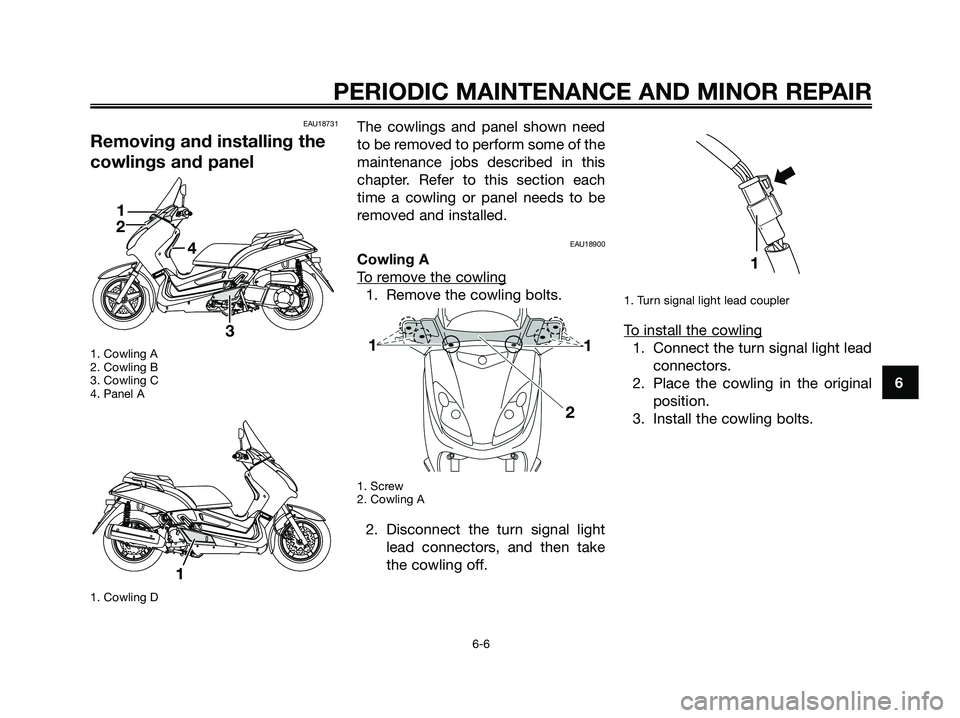
EAU18731
Removing and installing the
cowlings and panel
1. Cowling A
2. Cowling B
3. Cowling C
4. Panel A
1. Cowling D
The cowlings and panel shown need
to be removed to perform some of the
maintenance jobs described in this
chapter. Refer to this section each
time a cowling or panel needs to be
removed and installed.
EAU18900
Cowling A
T
o remove the cowling
1. Remove the cowling bolts.
1. Screw
2. Cowling A
2. Disconnect the turn signal light
lead connectors, and then take
the cowling off.
1. Turn signal light lead coupler
To install the cowling
1. Connect the turn signal light lead
connectors.
2. Place the cowling in the original
position.
3. Install the cowling bolts.
1
1
1
2
4
3
PERIODIC MAINTENANCE AND MINOR REPAIR
6-6
6
1C0-F8199-E4.qxd 22/11/07 05:41 Página 47
Page 50 of 88
the spark plug is a medium-to-
light tan (the ideal color when the
vehicle is ridden normally).
NOTE:
If the spark plug shows a distinctly
different color, the engine could be
operating improperly. Do not attempt
to diagnose such problems yourself.
Instead, have a Yamaha dealer check
the vehicle.
2. Check the spark plug for electro-
de erosion and excessive carbon
or other deposits, and replace it if
necessary.
To install the spark plug
1. Measure the spark plug gap with
a wire thickness gauge and, if
necessary, adjust the gap to spe-
cification.
2. Clean the surface of the sparkplug gasket and its mating surfa-
ce, and then wipe off any grime
from the spark plug threads.
3. Install the spark plug with the
spark plug wrench, and then
tighten it to the specified torque.NOTE:
If a torque wrench is not available
when installing a spark plug, a good
estimate of the correct torque is
1/4~1/2 turn past finger tight. Howe-
ver, the spark plug should be tighte-
ned to the specified torque as soon
as possible.
4. Install the spark plug cap.
5. Install the cowling.
EAUM1550
Engine oil
The engine oil level should be chec-
ked before each ride. In addition, the
oil must be changed at the intervals
specified in the periodic maintenance
and lubrication chart and when the
service indicator light comes on.
To check the engine oil level
1. Place the scooter on the centers-
tand.
NOTE:
Make sure that the scooter is positio-
ned straight up when checking the oil
level. A slight tilt to the side can result
in a false reading.
2. Start the engine, warm it up for
several minutes, and then turn it
off.
Tightening torque:
Spark plug:
17.5 Nm (1.75 m·kgf, 12.5 ft·lbf)
Spark plug gap:
0.8 -0.9 mm (0.031 -0.035 in)
Specified spark plug:
NGK/DPR8EA-9
PERIODIC MAINTENANCE AND MINOR REPAIR
6-9
6
1C0-F8199-E4.qxd 22/11/07 05:41 Página 50
Page 53 of 88
6. Add the specified amount of the
recommended final transmission
oil, and then install and tighten
the oil filler cap.
EWA11310
s s
WARNING
●Make sure that no foreign
material enters the final trans-
mission case.
●Make sure that no oil gets on
the tire or wheel.
7. Check the final transmission case
for oil leakage. If oil is leaking,
check for the cause.
EAU20070
Coolant
The coolant level should be checked
before each ride. In addition, the coo-
lant must be changed at the intervals
specified in the periodic maintenance
and lubrication chart.
EAUS1273
To check the coolant level
1. Place the vehicle on a level surfa-
ce and hold it in an upright posi-
tion.
NOTE:
●The coolant level must be chec-
ked on a cold engine since the
level varies with engine tempera-
ture.
●Make sure that the vehicle is
positioned straight up when
checking the coolant level. A
slight tilt to the side can result in
a false reading.
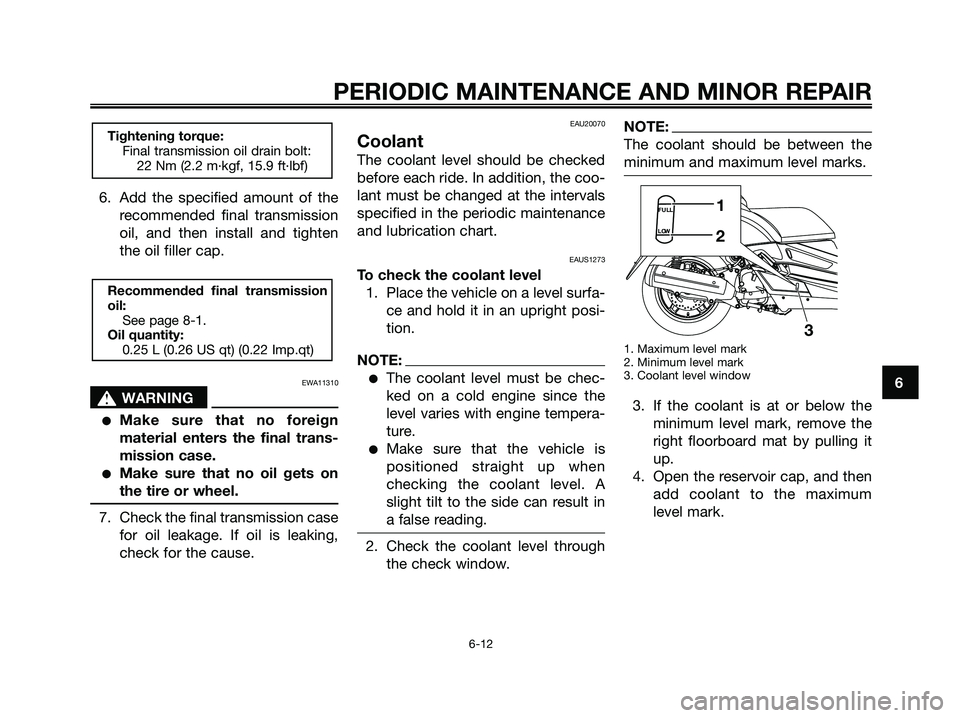
2. Check the coolant level through
the check window.
NOTE:
The coolant should be between the
minimum and maximum level marks.
1. Maximum level mark
2. Minimum level mark
3. Coolant level window
3. If the coolant is at or below the
minimum level mark, remove the
right floorboard mat by pulling it
up.
4. Open the reservoir cap, and then
add coolant to the maximum
level mark.
3
FULL1
LOW2
Recommended final transmission
oil:
See page 8-1.
Oil quantity:
0.25 L (0.26 US qt) (0.22 Imp.qt)
Tightening torque:
Final transmission oil drain bolt:
22 Nm (2.2 m·kgf, 15.9 ft·lbf)
PERIODIC MAINTENANCE AND MINOR REPAIR
6-12
6
1C0-F8199-E4.qxd 22/11/07 05:41 Página 53
Page 67 of 88
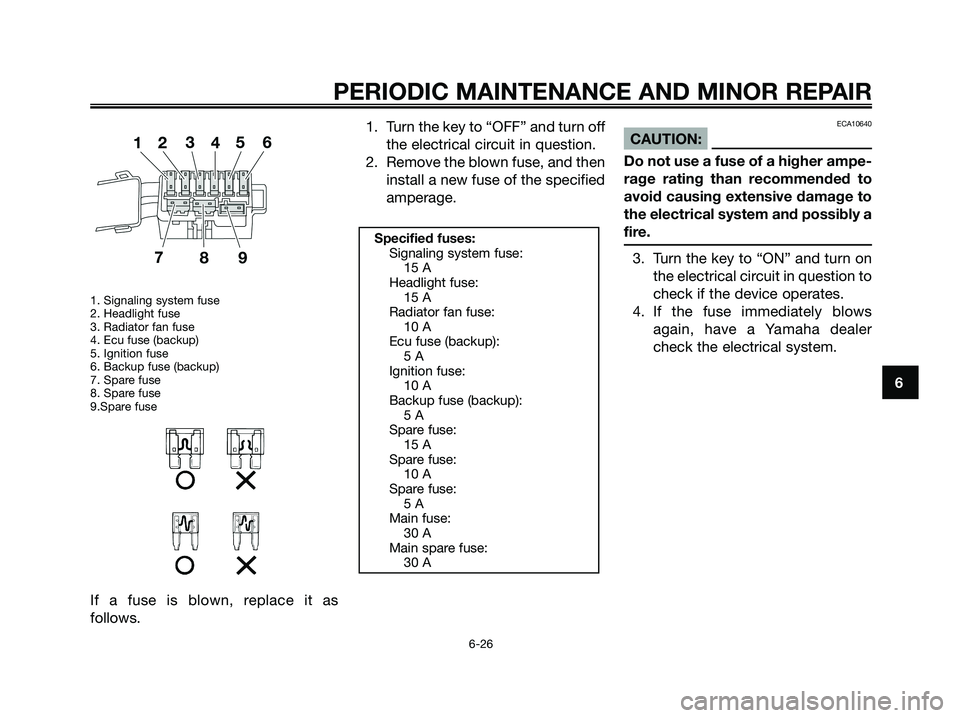
1. Signaling system fuse
2. Headlight fuse
3. Radiator fan fuse
4. Ecu fuse (backup)
5. Ignition fuse
6. Backup fuse (backup)
7. Spare fuse
8. Spare fuse
9.Spare fuse
If a fuse is blown, replace it as
follows.1. Turn the key to “OFF” and turn off
the electrical circuit in question.
2. Remove the blown fuse, and then
install a new fuse of the specified
amperage.
ECA10640
CAUTION:
Do not use a fuse of a higher ampe-
rage rating than recommended to
avoid causing extensive damage to
the electrical system and possibly a
fire.
3. Turn the key to “ON” and turn on
the electrical circuit in question to
check if the device operates.
4. If the fuse immediately blows
again, have a Yamaha dealer
check the electrical system.
Specified fuses:
Signaling system fuse:
15 A
Headlight fuse:
15 A
Radiator fan fuse:
10 A
Ecu fuse (backup):
5 A
Ignition fuse:
10 A
Backup fuse (backup):
5 A
Spare fuse:
15 A
Spare fuse:
10 A
Spare fuse:
5 A
Main fuse:
30 A
Main spare fuse:
30 A
PERIODIC MAINTENANCE AND MINOR REPAIR
6-26
6
1C0-F8199-E4.qxd 22/11/07 05:41 Página 67