check engine light YAMAHA XMAX 250 2014 Owners Manual
[x] Cancel search | Manufacturer: YAMAHA, Model Year: 2014, Model line: XMAX 250, Model: YAMAHA XMAX 250 2014Pages: 96, PDF Size: 8.03 MB
Page 5 of 96

Table of contents
Safety information............................1-1
Further safe-riding points ................1-5
Description........................................2-1
Left view ..........................................2-1
Right view........................................2-2
Controls and instruments ................2-3
Instrument and control functions....3-1
Immobilizer system .........................3-1
Main switch/steering lock ...............3-2
Indicator lights and warning
lights ............................................3-4
Multi-function meter unit .................3-6
Handlebar switches.......................3-14
Front brake lever ...........................3-15
Rear brake lever ............................3-16
ABS (for ABS models) ...................3-16
Fuel tank cap.................................3-17
Fuel................................................3-18
Catalytic converters .....................3-19
Seat ...............................................3-20
Storage compartments .................3-21
Adjusting the shock absorber
assemblies .................................3-22
Sidestand ......................................3-23
Ignition circuit cut-off system........3-24
For your safety – pre-operation
checks...............................................4-1
Operation and important riding
points.................................................5-1
Starting the engine ..........................5-2
Starting off.......................................5-3
Acceleration and deceleration.........5-3
Braking ............................................5-4
Tips for reducing fuel
consumption ................................5-5
Engine break-in ...............................5-5
Parking ............................................5-6
Periodic maintenance and
adjustment........................................6-1
Owner’s tool kit ...............................6-2Periodic maintenance chart for the
emission control system.............. 6-3
General maintenance and
lubrication chart........................... 6-4
Removing and installing panels ...... 6-7
Checking the spark plug ................. 6-9
Engine oil ...................................... 6-10
Final transmission oil .................... 6-12
Coolant ......................................... 6-13
Air filter and V-belt case air filter
elements and check hoses........ 6-14
Checking the throttle grip free
play ............................................ 6-16
Valve clearance ............................. 6-16
Tires .............................................. 6-17
Cast wheels .................................. 6-19
Checking the front and rear brake
lever free play ............................ 6-19
Checking the front and rear brake
pads........................................... 6-20
Checking the brake fluid level....... 6-21
Changing the brake fluid............... 6-22
Checking and lubricating the
cables ........................................ 6-23
Checking and lubricating the
throttle grip and cable ............... 6-23
Lubricating the front and rear
brake levers ............................... 6-24
Checking and lubricating the
centerstand and sidestand ........ 6-24
Checking the front fork ................. 6-25
Checking the steering ................... 6-25
Checking the wheel bearings ....... 6-26
Battery .......................................... 6-26
Replacing the fuses ...................... 6-28
Replacing a headlight bulb ........... 6-30
Auxiliary lights ............................... 6-30
Tail/brake light .............................. 6-31
Front turn signal light .................... 6-31
Replacing a rear turn signal light
bulb............................................ 6-32
Replacing the license plate light
bulb............................................ 6-33
Troubleshooting ............................ 6-33
Troubleshooting charts ................. 6-34
U2DLE2E0.book Page 1 Thursday, July 2, 2015 6:20 PM
Page 18 of 96
Instrument and control functions
3-4
3
EAU49398
Indicator lights and warning
lights
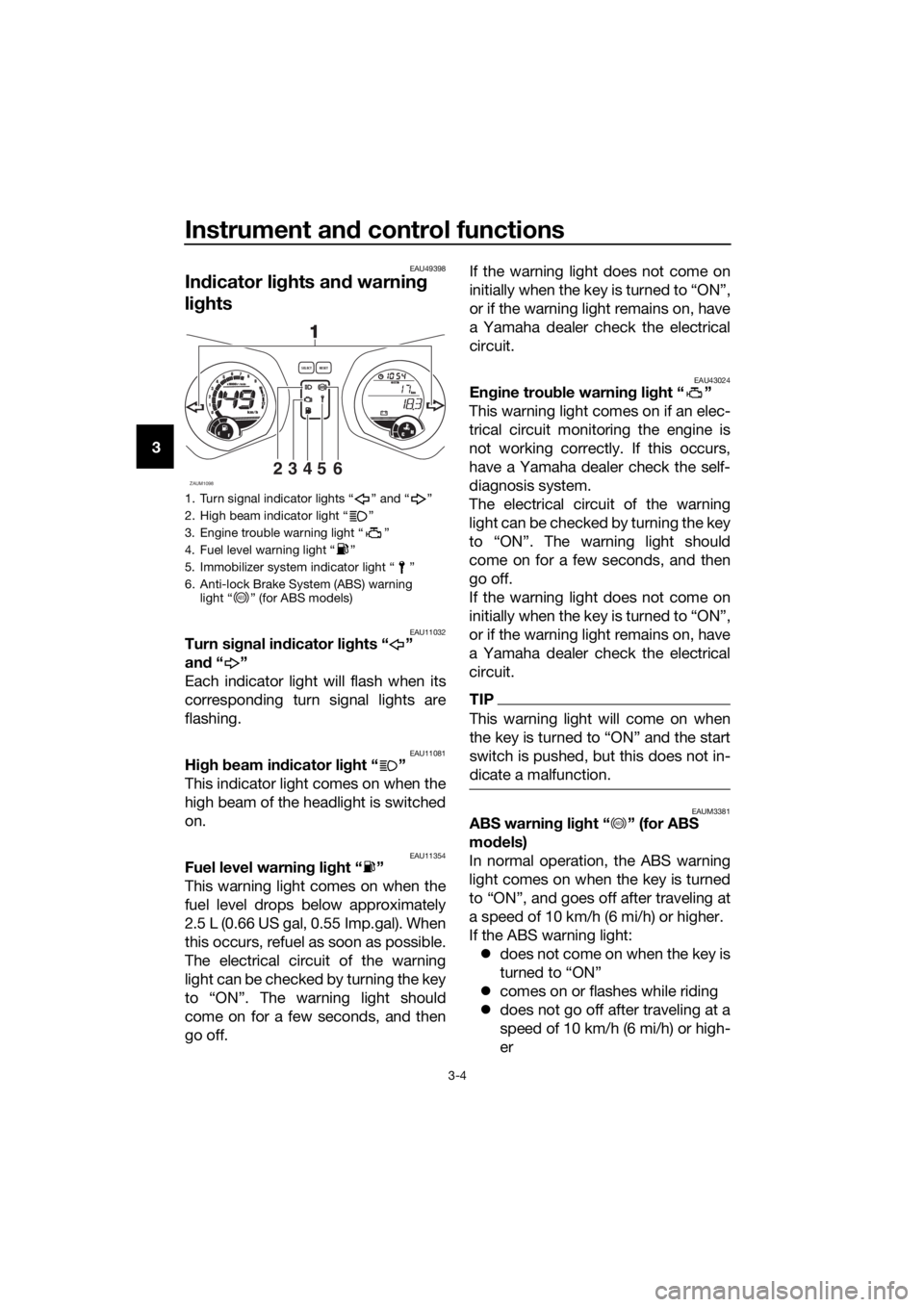
EAU11032Turn signal indicator lights “ ”
and“”
Each indicator light will flash when its
corresponding turn signal lights are
flashing.
EAU11081High beam indicator light “ ”
This indicator light comes on when the
high beam of the headlight is switched
on.
EAU11354Fuel level warning light “ ”
This warning light comes on when the
fuel level drops below approximately
2.5 L (0.66 US gal, 0.55 Imp.gal). When
this occurs, refuel as soon as possible.
The electrical circuit of the warning
light can be checked by turning the key
to “ON”. The warning light should
come on for a few seconds, and then
go off.If the warning light does not come on
initially when the key is turned to “ON”,
or if the warning light remains on, have
a Yamaha dealer check the electrical
circuit.
EAU43024Engine trouble warning light “ ”
This warning light comes on if an elec-
trical circuit monitoring the engine is
not working correctly. If this occurs,
have a Yamaha dealer check the self-
diagnosis system.
The electrical circuit of the warning
light can be checked by turning the key
to “ON”. The warning light should
come on for a few seconds, and then
go off.
If the warning light does not come on
initially when the key is turned to “ON”,
or if the warning light remains on, have
a Yamaha dealer check the electrical
circuit.
TIP
This warning light will come on when
switch is pushed, but this does not in-
dicate a malfunction.
EAUM3381ABS warning light “ ” (for ABS
models)
In normal operation, the ABS warning
light comes on when the key is turned
to “ON”, and goes off after traveling at
a speed of 10 km/h (6 mi/h) or higher.
If the ABS warning light:
does not come on when the key is
turned to “ON”
comes on or flashes while riding
does not go off after traveling at a
speed of 10 km/h (6 mi/h) or high-
er
1. Turn signal indicator lights “ ” and “ ”
2. High beam indicator light “ ”
3. Engine trouble warning light “ ”
4. Fuel level warning light “ ”
5. Immobilizer system indicator light “ ”
6. Anti-lock Brake System (ABS) warning
light “ ” (for ABS models)
ZAUM109823456
98765432111 10
12
0
1000r/minx
km/h
E
FCH
kmOdoOdoSELECTRESET
11
ABS
ABS
U2DLE2E0.book Page 4 Thursday, July 2, 2015 6:20 PM
Page 19 of 96
Instrument and control functions
3-5
3 The ABS may not work correctly. If any
of the above occurs, have a Yamaha
dealer check the system as soon as
possible. (See page 3-16 for an expla-
nation of the ABS.)
WARNING
EWA16041
If the ABS warning light does not go
off after traveling at a speed of 10
km/h (6 mi/h) or higher, or if the
warning light comes on or flashes
while riding, the brake system re-
verts to conventional braking. If ei-
ther of the above occurs, or if the
warning light does not come on at
all, use extra caution to avoid possi-
ble wheel lock during emergency
braking. Have a Yamaha dealer
check the brake system and electri-
cal circuits as soon as possible.
TIP
The ABS warning light may come on
while accelerating the engine with the
scooter on its centerstand, but this
does not indicate a malfunction.
EAU26879Immobilizer system indicator
light “ ”
When the key is turned to “OFF” and
30 seconds have passed, the indicator
light will start flashing indicating the im-
mobilizer system is enabled. After 24
hours have passed, the indicator light
will stop flashing, however the immobi-
lizer system is still enabled.
The electrical circuit of the indicator
light can be checked by turning the key
to “ON”. The indicator light should
come on for a few seconds, and then
go off.If the indicator light does not come on
initially when the key is turned to “ON”,
or if the indicator light remains on, have
a Yamaha dealer check the electrical
circuit.
The self-diagnosis device also detects
problems in the immobilizer system
circuits. (See page 3-13 for an explana-
tion of the self-diagnosis device.)
U2DLE2E0.book Page 5 Thursday, July 2, 2015 6:20 PM
Page 27 of 96
Instrument and control functions
3-13
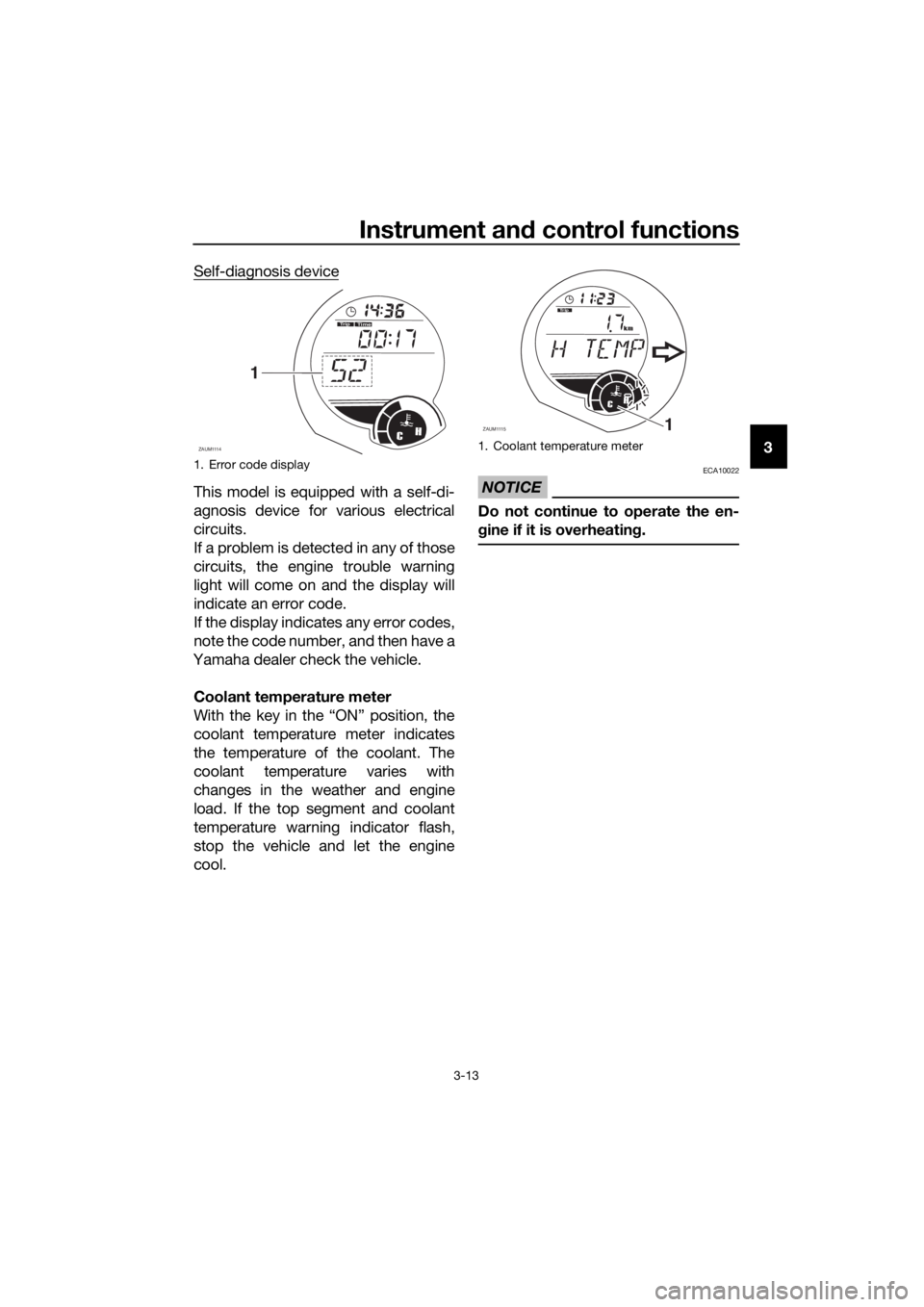
3 Self-diagnosis device
This model is equipped with a self-di-
agnosis device for various electrical
circuits.
If a problem is detected in any of those
circuits, the engine trouble warning
light will come on and the display will
indicate an error code.
If the display indicates any error codes,
note the code number, and then have a
Yamaha dealer check the vehicle.
Coolant temperature meter
With the key in the “ON” position, the
coolant temperature meter indicates
the temperature of the coolant. The
coolant temperature varies with
changes in the weather and engine
load. If the top segment and coolant
temperature warning indicator flash,
stop the vehicle and let the engine
cool.NOTICE
ECA10022
Do not continue to operate the en-
gine if it is overheating.
1. Error code display
ZAUM1114
T
rip
CH
Time
1
1. Coolant temperature meter
ZAUM11151
CH
km
Trip
U2DLE2E0.book Page 13 Thursday, July 2, 2015 6:20 PM
Page 38 of 96

Instrument and control functions
3-24
3
EAU66760
Ignition circuit cut-off system
The ignition circuit cut-off system
(comprising the sidestand switch and
brake light switches) has the following
functions.
It prevents starting when the side-
stand is up, but neither brake is
applied.
It prevents starting when either
brake is applied, but the sidestand
is still down.
It cuts the running engine when
the sidestand is moved down.
Periodically check the operation of the
ignition circuit cut-off system accord-
ing to the following procedure.
U2DLE2E0.book Page 24 Thursday, July 2, 2015 6:20 PM
Page 43 of 96
Operation and important riding points
5-2
5
EAUM3350
Starting the engine
NOTICE
ECA10251
See page 5-5 for engine break-in in-
structions prior to operating the ve-
hicle for the first time.
In order for the ignition circuit cut-off
system to enable starting, the side-
stand must be up.
See page 3-24 for more information.
1. Turn the key to “ON”.
The following warning light, indi-
cator light and indicators should
come on for a few seconds, then
go off.
Engine trouble warning light
Immobilizer system indicator
light
V-belt replacement indicator
Oil change indicator
Fuel level warning light
NOTICE
ECA11834
If a warning or indicator light does
not come on initially when the key is
turned to “ON”, or if a warning or in-
dicator light remains on, see page
3-4 for the corresponding warning
and indicator light circuit check.
For ABS models:
The ABS warning light should
come on when the main switch is
turned to “ON” and then go off af-
ter traveling at a speed of 10 km/h
(6 mi/h) or higher.
NOTICE
ECA17682
If the ABS warning light does not
come on and then go off as ex-
plained above, see page 3-4 for the
warning light circuit check.
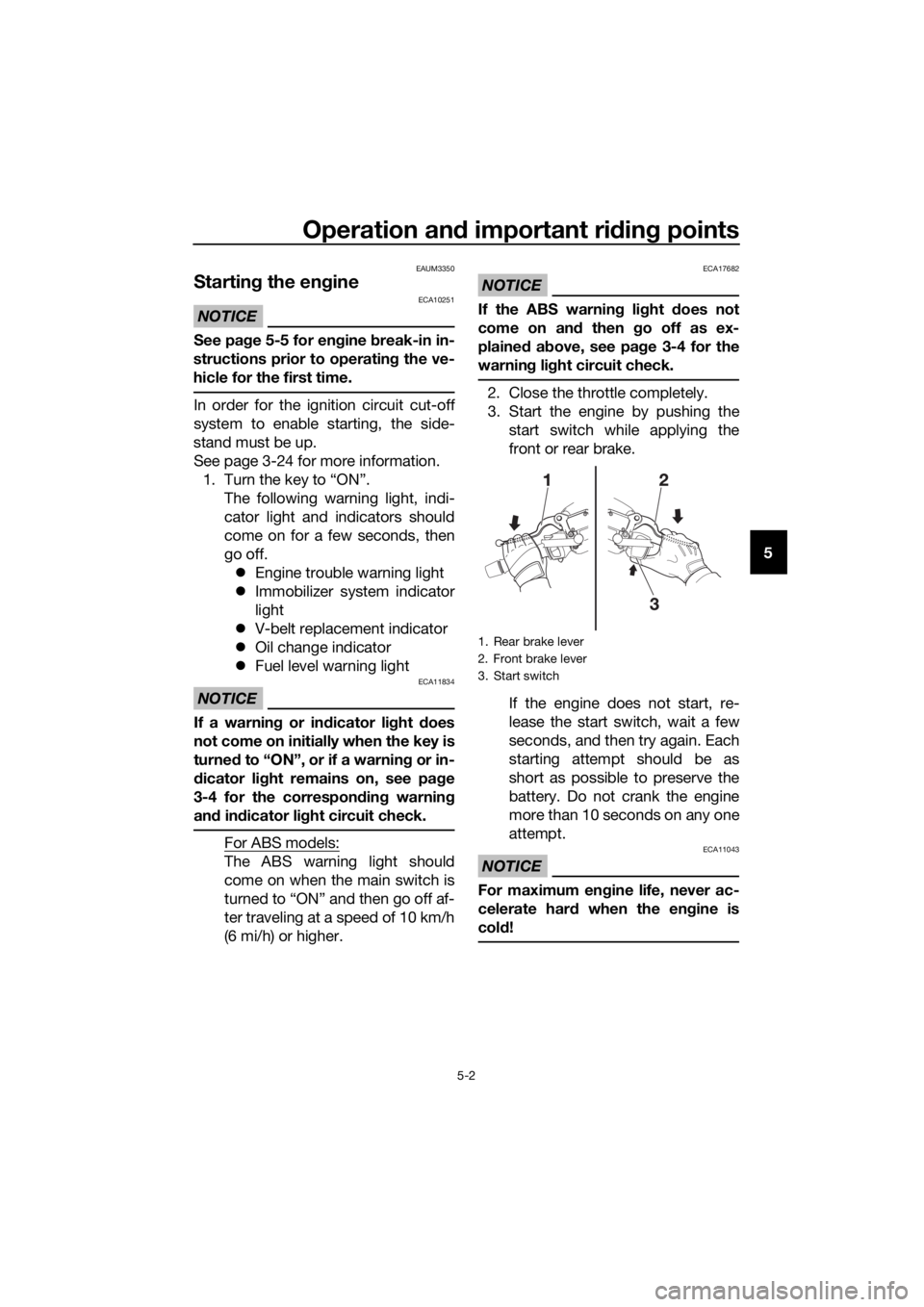
2. Close the throttle completely.
3. Start the engine by pushing the
start switch while applying the
front or rear brake.
If the engine does not start, re-
lease the start switch, wait a few
seconds, and then try again. Each
starting attempt should be as
short as possible to preserve the
battery. Do not crank the engine
more than 10 seconds on any one
attempt.
NOTICE
ECA11043
For maximum engine life, never ac-
celerate hard when the engine is
cold!
1. Rear brake lever
2. Front brake lever
3. Start switch
U2DLE2E0.book Page 2 Thursday, July 2, 2015 6:20 PM
Page 46 of 96
Operation and important riding points
5-5
5
EAU16821
Tips for reducing fuel con-
sumption
Fuel consumption depends largely on
your riding style. Consider the follow-
ing tips to reduce fuel consumption:
Avoid high engine speeds during
acceleration.
Avoid high engine speeds with no
load on the engine.
Turn the engine off instead of let-
ting it idle for an extended length
of time (e.g., in traffic jams, at traf-
fic lights or at railroad crossings).
EAU16842
Engine break-in
There is never a more important period
in the life of your engine than the period
between 0 and 1600 km (1000 mi). For
this reason, you should read the fol-
lowing material carefully.
Since the engine is brand new, do not
put an excessive load on it for the first
1600 km (1000 mi). The various parts in
the engine wear and polish themselves
to the correct operating clearances.
During this period, prolonged full-throt-
tle operation or any condition that
might result in engine overheating
must be avoided.
EAUS1811
0–1000 km (0–600 mi)
Avoid prolonged operation above 4000
r/min. NOTICE: After 1000 km (600
mi) of operation, be sure to replace
the engine oil and final transmission
oil.
[ECA11662]
1000–1600 km (600–1000 mi)
Avoid prolonged operation above 6000
r/min.
1600 km (1000 mi) and beyond
The vehicle can now be operated nor-
mally.
NOTICE
ECA10311
Keep the engine speed out of
the tachometer red zone.
If any engine trouble should oc-
cur during the engine break-in
period, immediately have a
Yamaha dealer check the vehi-
cle.
U2DLE2E0.book Page 5 Thursday, July 2, 2015 6:20 PM
Page 52 of 96
Periodic maintenance and adjustment
6-5
6
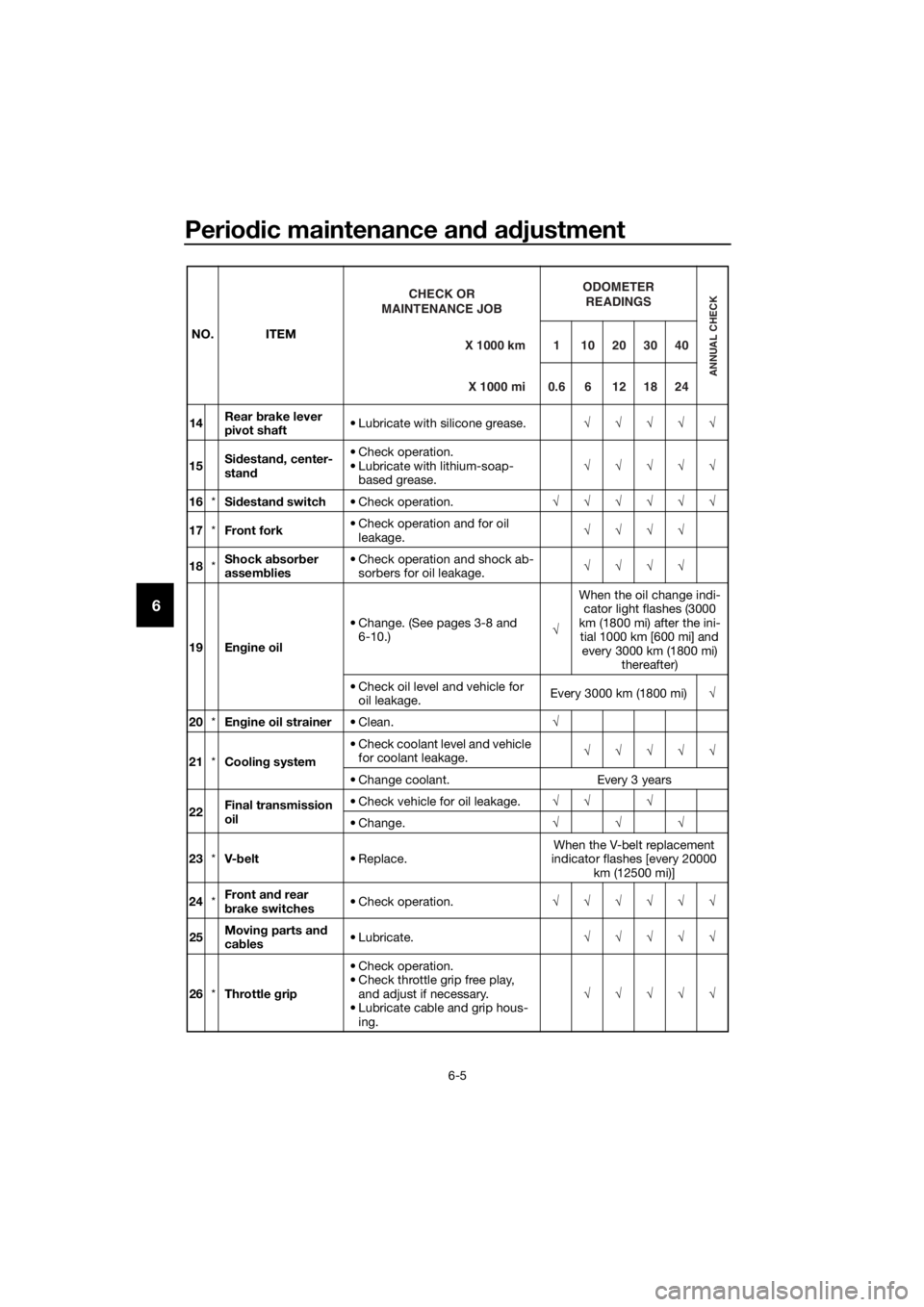
14Rear brake lever
pivot shaft• Lubricate with silicone grease.√√√√√
15Sidestand, center-
stand• Check operation.
• Lubricate with lithium-soap-
based grease.√√√√√
16*Sidestand switch• Check operation.√√√√√√
17*Front fork• Check operation and for oil
leakage.√√√√
18*Shock absorber
assemblies• Check operation and shock ab-
sorbers for oil leakage.√√√√
19 Engine oil• Change. (See pages 3-8 and
6-10.)√When the oil change indi-
cator light flashes (3000
km (1800 mi) after the ini-
tial 1000 km [600 mi] and
every 3000 km (1800 mi)
thereafter)
• Check oil level and vehicle for
oil leakage.Every 3000 km (1800 mi)√
20*Engine oil strainer• Clean.√
21*Cooling system• Check coolant level and vehicle
for coolant leakage.√√√√√
• Change coolant. Every 3 years
22Final transmission
oil• Check vehicle for oil leakage.√√ √
• Change.√√√
23*V-belt• Replace.When the V-belt replacement
indicator flashes [every 20000
km (12500 mi)]
24*Front and rear
b
rake switches• Check operation.√√√√√√
25Moving parts and
cables• Lubricate.√√√√√
26*Throttle grip• Check operation.
• Check throttle grip free play,
and adjust if necessary.
• Lubricate cable and grip hous-
ing.√√√√√ NO. ITEM
X 1000 km CHECK OR
MAINTENANCE JOB
X 1000 miODOMETER
READINGS
ANNUAL CHECK
110203040
0.6 6 12 18 24
U2DLE2E0.book Page 5 Thursday, July 2, 2015 6:20 PM
Page 53 of 96
Periodic maintenance and adjustment
6-6
6
EAU38263
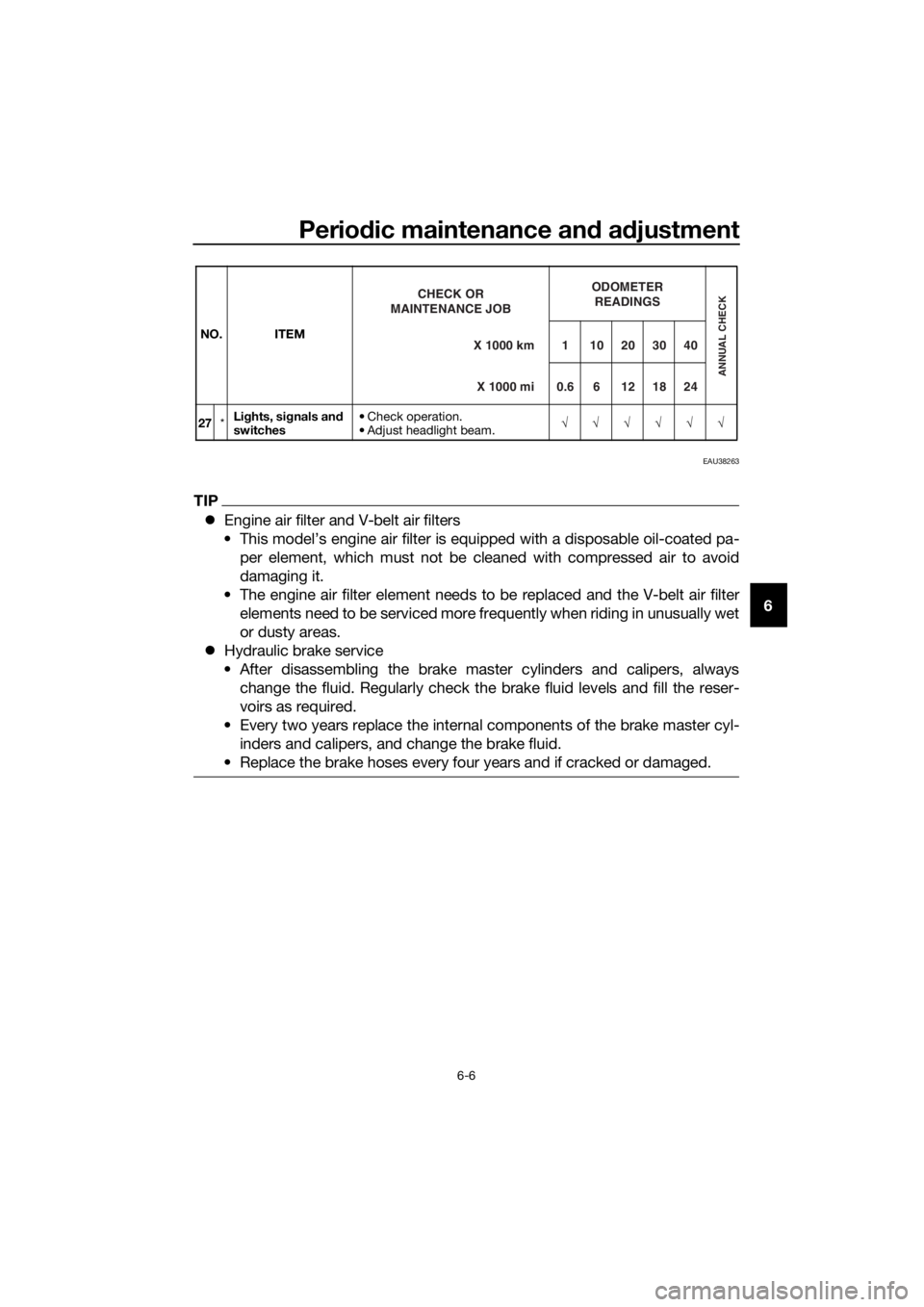
TIP
Engine air filter and V-belt air filters
• This model’s engine air filter is equipped with a disposable oil-coated pa-
per element, which must not be cleaned with compressed air to avoid
damaging it.
• The engine air filter element needs to be replaced and the V-belt air filter
elements need to be serviced more frequently when riding in unusually wet
or dusty areas.
Hydraulic brake service
• After disassembling the brake master cylinders and calipers, always
change the fluid. Regularly check the brake fluid levels and fill the reser-
voirs as required.
• Every two years replace the internal components of the brake master cyl-
inders and calipers, and change the brake fluid.
• Replace the brake hoses every four years and if cracked or damaged.
27*Lights, signals and
switches• Check operation.
• Adjust headlight beam.√√√√√√ NO. ITEM
X 1000 km CHECK OR
MAINTENANCE JOB
X 1000 mi
ODOMETER
READINGS
ANNUAL CHECK
110203040
0.66121824
U2DLE2E0.book Page 6 Thursday, July 2, 2015 6:20 PM
Page 56 of 96
Periodic maintenance and adjustment
6-9
6
EAUM3360
Checking the spark plug
The spark plug is an important engine
component, which is easy to check.
Since heat and deposits will cause any
spark plug to slowly erode, the spark
plug should be removed and checked
in accordance with the periodic main-
tenance and lubrication chart. In addi-
tion, the condition of the spark plug
can reveal the condition of the engine.
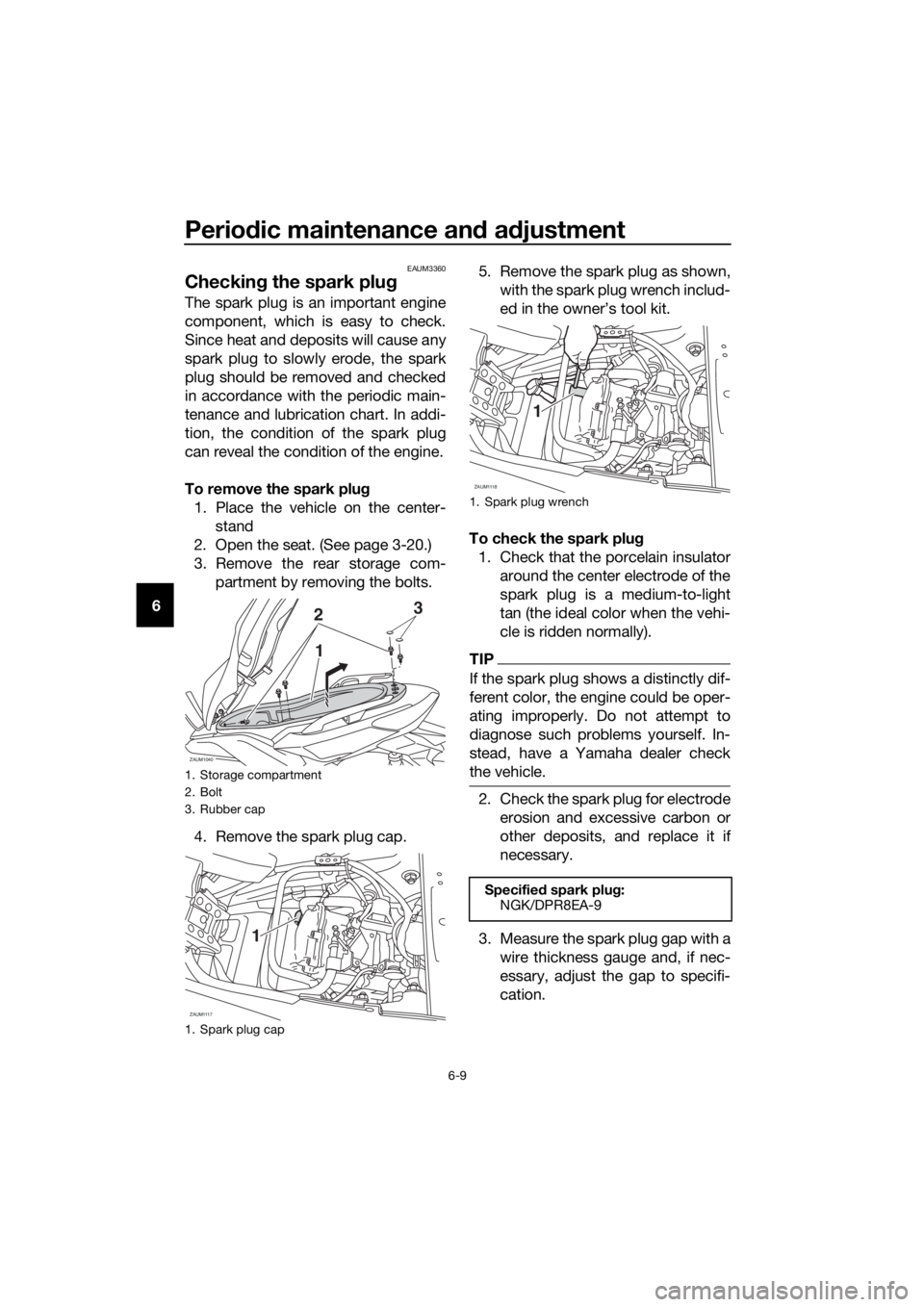
To remove the spark plug
1. Place the vehicle on the center-
stand
2. Open the seat. (See page 3-20.)
3. Remove the rear storage com-
partment by removing the bolts.
4. Remove the spark plug cap.5. Remove the spark plug as shown,
with the spark plug wrench includ-
ed in the owner’s tool kit.
To check the spark plug
1. Check that the porcelain insulator
around the center electrode of the
spark plug is a medium-to-light
tan (the ideal color when the vehi-
cle is ridden normally).
TIP
If the spark plug shows a distinctly dif-
ferent color, the engine could be oper-
ating improperly. Do not attempt to
diagnose such problems yourself. In-
stead, have a Yamaha dealer check
the vehicle.
2. Check the spark plug for electrode
erosion and excessive carbon or
other deposits, and replace it if
necessary.
3. Measure the spark plug gap with a
wire thickness gauge and, if nec-
essary, adjust the gap to specifi-
cation.
1. Storage compartment
2. Bolt
3. Rubber cap
1. Spark plug cap
ZAUM1040
23
1
ZAUM1117
1
1. Spark plug wrench
Specified spark plug:
NGK/DPR8EA-9
ZAUM1118
1
U2DLE2E0.book Page 9 Thursday, July 2, 2015 6:20 PM