engine YAMAHA XMAX 300 2018 Service Manual
[x] Cancel search | Manufacturer: YAMAHA, Model Year: 2018, Model line: XMAX 300, Model: YAMAHA XMAX 300 2018Pages: 116, PDF Size: 7.14 MB
Page 77 of 116
Periodic maintenance and adjustment
7-14
7 be protected against frost and
corrosion. If water has been
added to the coolant, have a
Yamaha dealer check the anti-
freeze content of the coolant as
soon as possible, otherwise the
effectiveness of the coolant will
be reduced.
[ECA10473]
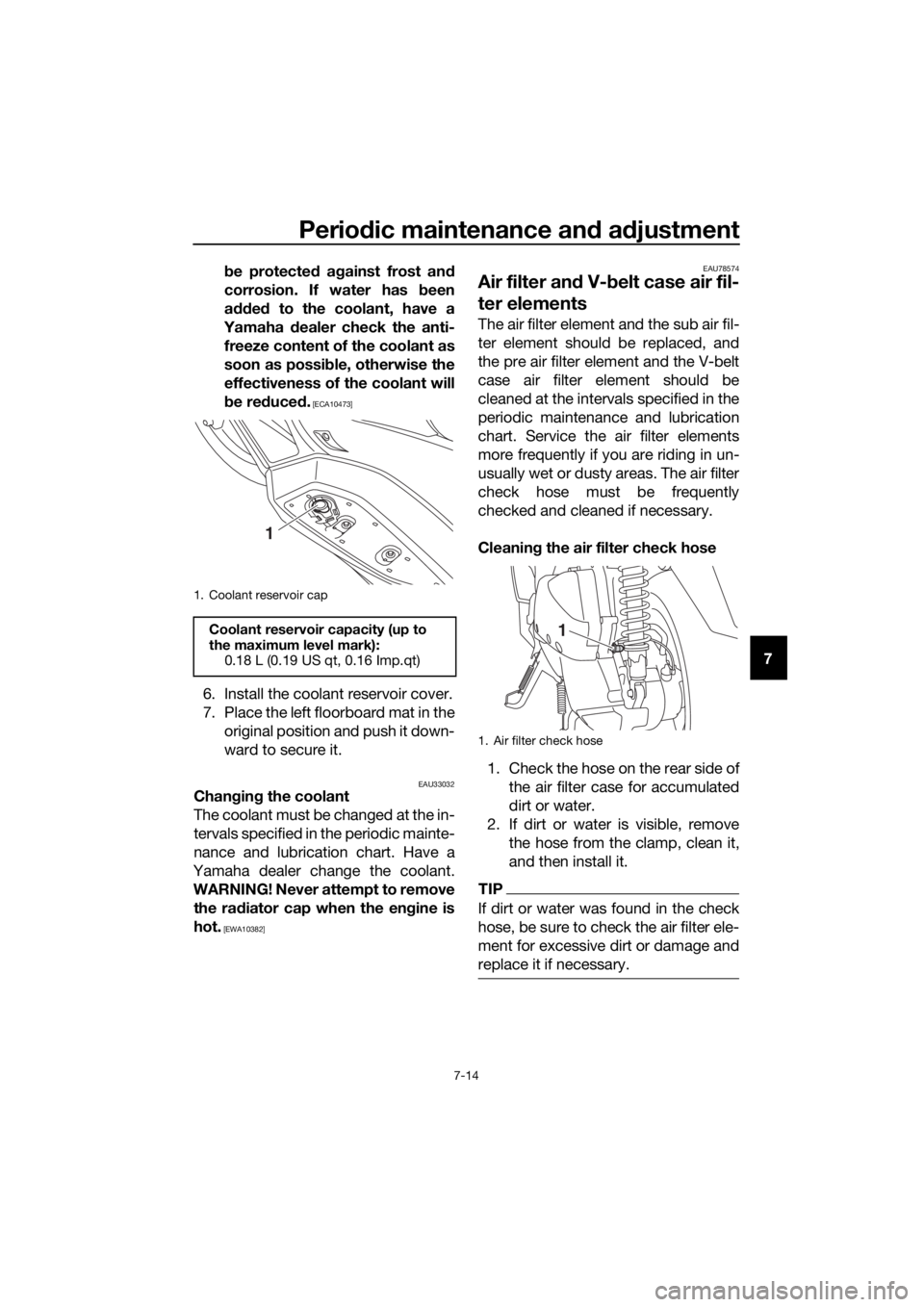
6. Install the coolant reservoir cover.
7. Place the left floorboard mat in the
original position and push it down-
ward to secure it.
EAU33032Changing the coolant
The coolant must be changed at the in-
tervals specified in the periodic mainte-
nance and lubrication chart. Have a
Yamaha dealer change the coolant.
WARNING! Never attempt to remove
the radiator cap when the engine is
hot.
[EWA10382]EAU78574
Air filter and V-belt case air fil-
ter elements
The air filter element and the sub air fil-
ter element should be replaced, and
the pre air filter element and the V-belt
case air filter element should be
cleaned at the intervals specified in the
periodic maintenance and lubrication
chart. Service the air filter elements
more frequently if you are riding in un-
usually wet or dusty areas. The air filter
check hose must be frequently
checked and cleaned if necessary.
Cleaning the air filter check hose
1. Check the hose on the rear side of
the air filter case for accumulated
dirt or water.
2. If dirt or water is visible, remove
the hose from the clamp, clean it,
and then install it.
TIP
If dirt or water was found in the check
hose, be sure to check the air filter ele-
ment for excessive dirt or damage and
replace it if necessary.
1. Coolant reservoir cap
Coolant reservoir capacity (up to
the maximum level mark):
0.18 L (0.19 US qt, 0.16 Imp.qt)
1
1. Air filter check hose
1
UBY3E0E0.book Page 14 Friday, September 15, 2017 3:59 PM
Page 78 of 116
Periodic maintenance and adjustment
7-15
7Replacing the air filter element and
sub air filter element and cleaning
the pre air filter element
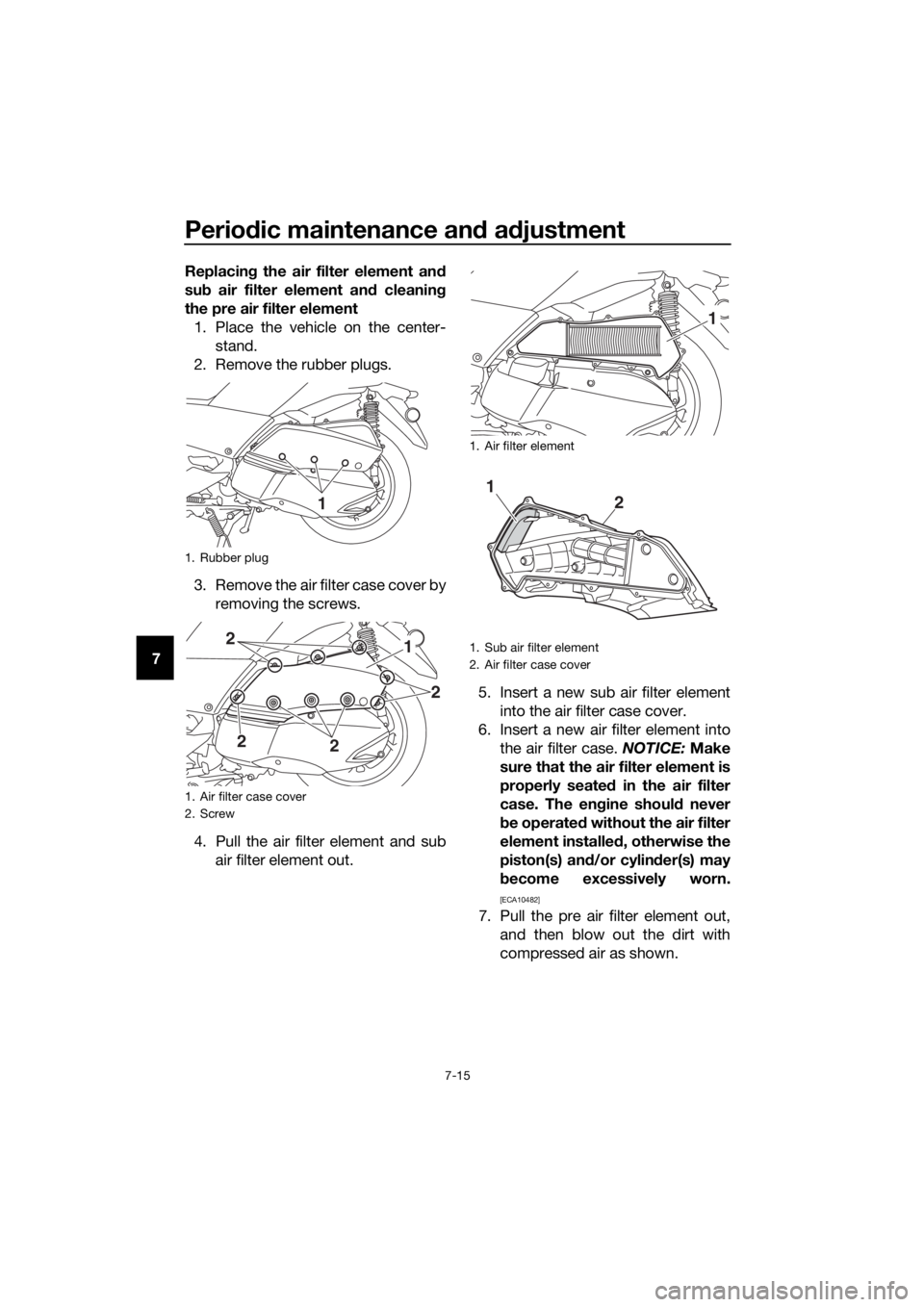
1. Place the vehicle on the center-
stand.
2. Remove the rubber plugs.
3. Remove the air filter case cover by
removing the screws.
4. Pull the air filter element and sub
air filter element out.5. Insert a new sub air filter element
into the air filter case cover.
6. Insert a new air filter element into
the air filter case. NOTICE: Make
sure that the air filter element is
properly seated in the air filter
case. The engine should never
be operated without the air filter
element installed, otherwise the
piston(s) and/or cylinder(s) may
become excessively worn.
[ECA10482]
7. Pull the pre air filter element out,
and then blow out the dirt with
compressed air as shown.
1. Rubber plug
1. Air filter case cover
2. Screw
1
1
2
2
2 2
1. Air filter element
1. Sub air filter element
2. Air filter case cover
1
1
2
UBY3E0E0.book Page 15 Friday, September 15, 2017 3:59 PM
Page 82 of 116
Periodic maintenance and adjustment
7-19
7
EAU21403
Valve clearance
The valves are an important engine
component, and since valve clearance
changes with use, they must be
checked and adjusted at the intervals
specified in the periodic maintenance
chart. Unadjusted valves can result in
improper air-fuel mixture, engine
noise, and eventually engine damage.
To prevent this from occurring, have
your Yamaha dealer check and adjust
the valve clearance at regular intervals.
TIP
This service must be performed when
the engine is cold.
EAU69760
Tires
Tires are the only contact between the
vehicle and the road. Safety in all con-
ditions of riding depends on a relatively
small area of road contact. Therefore, it
is essential to maintain the tires in good
condition at all times and replace them
at the appropriate time with the speci-
fied tires.
Tire air pressure
The tire air pressure should be
checked and, if necessary, adjusted
before each ride.
WARNING
EWA10504
Operation of this vehicle with im-
proper tire pressure may cause se-
vere injury or death from loss of
control.
The tire air pressure must be
checked and adjusted on cold
tires (i.e., when the temperature
of the tires equals the ambient
temperature).
The tire air pressure must be
adjusted in accordance with the
riding speed and with the total
weight of rider, passenger, car-
go, and accessories approved
for this model.
UBY3E0E0.book Page 19 Friday, September 15, 2017 3:59 PM
Page 98 of 116
Periodic maintenance and adjustment
7-35
7
EAU60701
Troubleshooting
Although Yamaha vehicles receive a
thorough inspection before shipment
from the factory, trouble may occur
during operation. Any problem in the
fuel, compression, or ignition systems,
for example, can cause poor starting
and loss of power.
The following troubleshooting charts
represent quick and easy procedures
for checking these vital systems your-
self. However, should your vehicle re-
quire any repair, take it to a Yamaha
dealer, whose skilled technicians have
the necessary tools, experience, and
know-how to service the vehicle prop-
erly.
Use only genuine Yamaha replace-
ment parts. Imitation parts may look
like Yamaha parts, but they are often
inferior, have a shorter service life and
can lead to expensive repair bills.
WARNING
EWA15142
When checking the fuel system, do
not smoke, and make sure there are
no open flames or sparks in the ar-
ea, including pilot lights from water
heaters or furnaces. Gasoline or
gasoline vapors can ignite or ex-
plode, causing severe injury or prop-
erty damage.
EAU76551Smart key system troubleshooting
Please check the following items when
the smart key system does not work.
Is the smart key turned on? (See
page 3-5.)
Is the smart key battery dis-
charged? (See page 3-6.)Is the smart key battery installed
correctly? (See page 3-6.)
Is the smart key being used in a lo-
cation with strong radio waves or
other electromagnetic noise? (See
page 3-1.)
Are you using the smart key that is
registered to the vehicle?
Is the vehicle battery discharged?
When the vehicle battery is dis-
charged, the smart key system will
not operate. Please have the vehi-
cle battery charged or replaced.
(See page 7-29.)
If the smart key system does not work
after checking the above items, have a
Yamaha dealer check the smart key
system.
TIP
See Emergency mode on page 7-38
for information on starting the engine
without the smart key.
UBY3E0E0.book Page 35 Friday, September 15, 2017 3:59 PM
Page 99 of 116
Periodic maintenance and adjustment
7-36
7
EAU68020
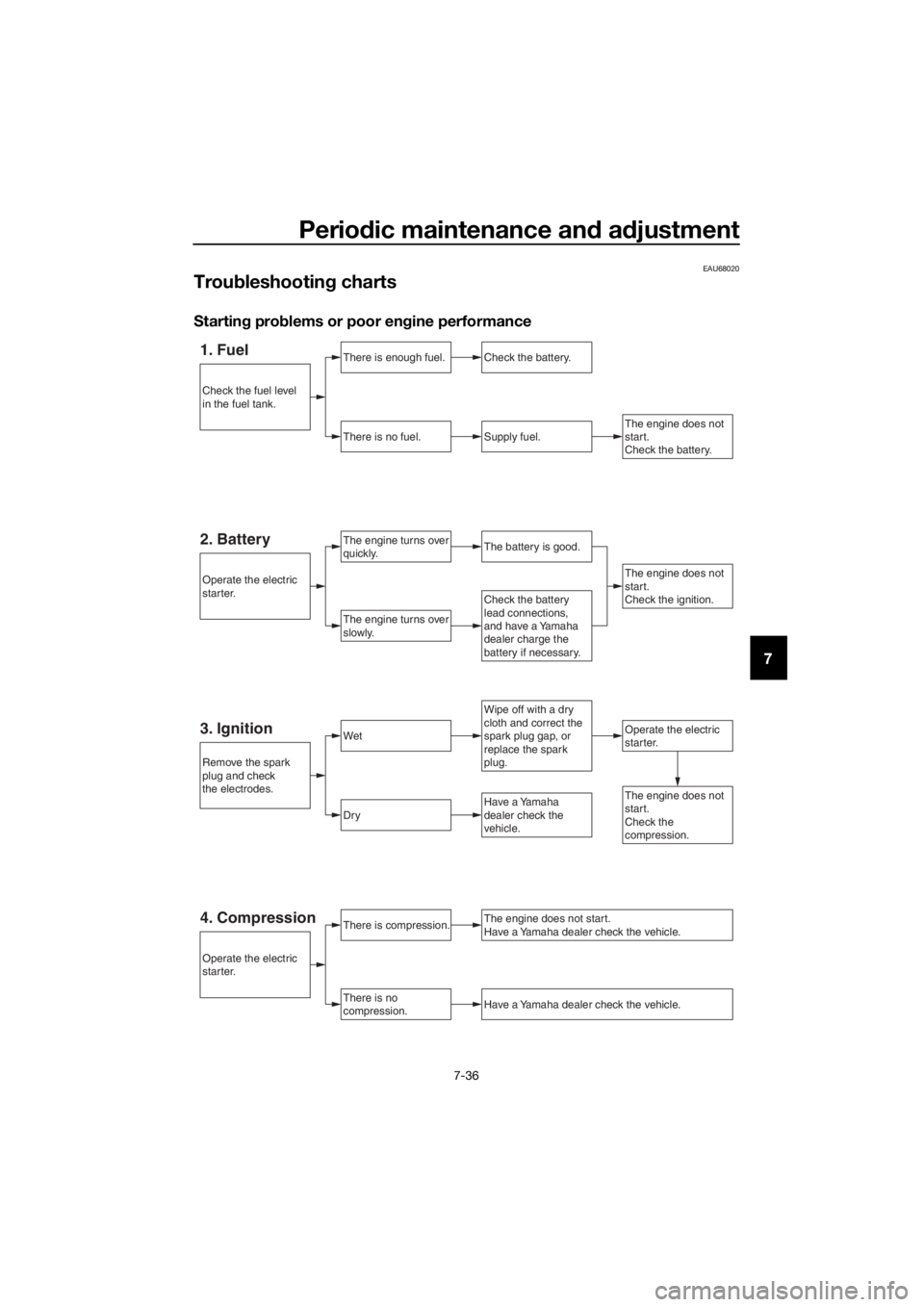
Troubleshooting charts
Starting problems or poor engine performance
1. FuelThere is enough fuel.
There is no fuel.
Check the battery.
Supply fuel.
The engine turns over
quickly.
The engine turns over
slowly.
Operate the electric
starter.
The engine does not
start.
Check the battery.
Wipe off with a dry
cloth and correct the
spark plug gap, or
replace the spark
plug.
Check the battery
lead connections,
and have a Yamaha
dealer charge the
battery if necessary.
2. BatteryThe battery is good.
The engine does not
start.
Check the ignition.
3. IgnitionWet
Dry
There is compression.
There is no
compression.
The engine does not start.
Have a Yamaha dealer check the vehicle.
Have a Yamaha dealer check the vehicle.
The engine does not
start.
Check the
compression.Have a Yamaha
dealer check the
vehicle.
Remove the spark
plug and check
the electrodes.
Operate the electric
starter.
Operate the electric
starter.
Check the fuel level
in the fuel tank.
4. Compression
UBY3E0E0.book Page 36 Friday, September 15, 2017 3:59 PM
Page 100 of 116
Periodic maintenance and adjustment
7-37
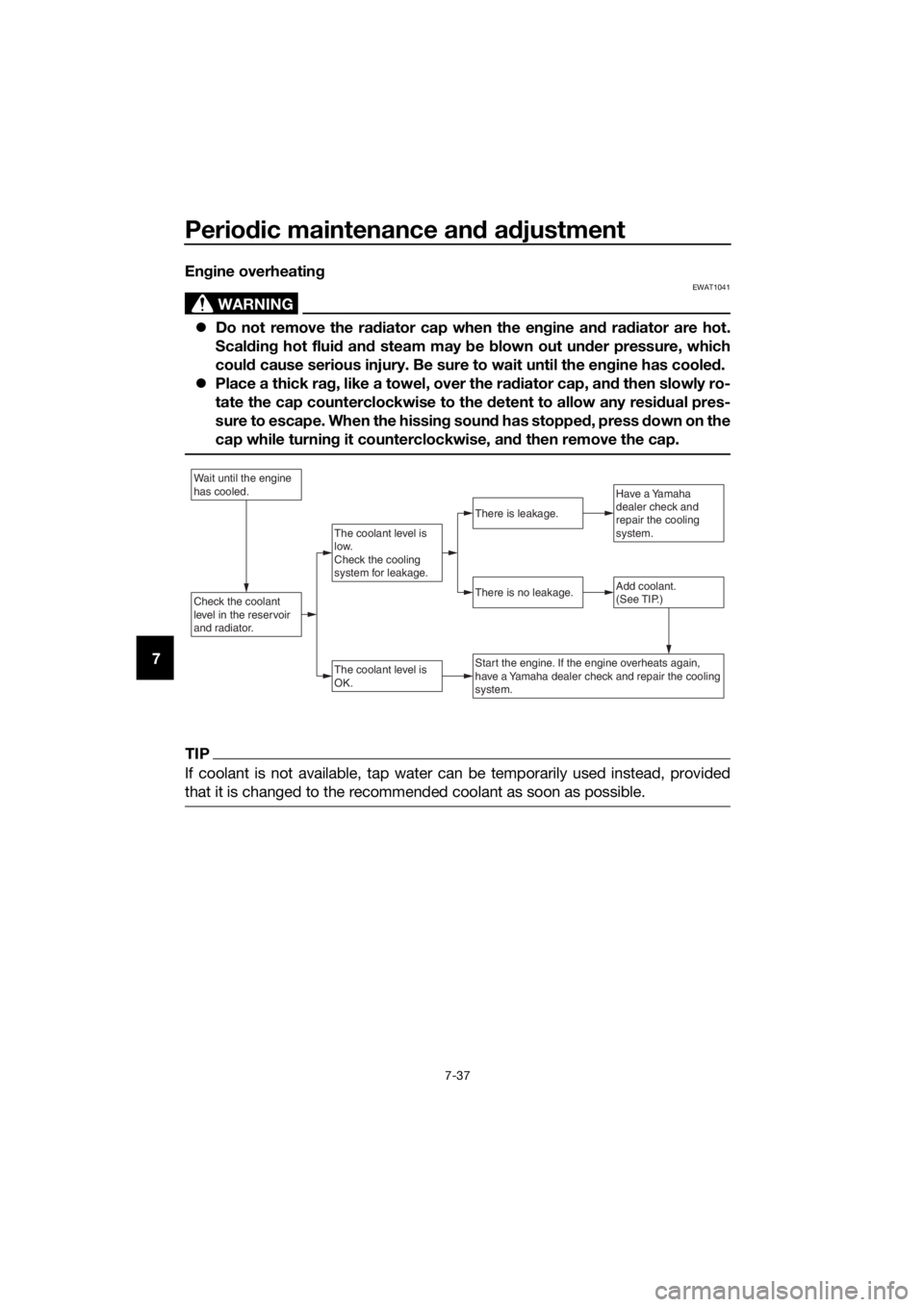
7Engine overheating
WARNING
EWAT1041
Do not remove the radiator cap when the engine and radiator are hot.
Scalding hot fluid and steam may be blown out under pressure, which
could cause serious injury. Be sure to wait until the engine has cooled.
Place a thick rag, like a towel, over the radiator cap, and then slowly ro-
tate the cap counterclockwise to the detent to allow any residual pres-
sure to escape. When the hissing sound has stopped, press down on the
cap while turning it counterclockwise, and then remove the cap.
TIP
If coolant is not available, tap water can be temporarily used instead, provided
that it is changed to the recommended coolant as soon as possible.
Wait until the engine
has cooled.
Check the coolant
level in the reservoir
and radiator.Add coolant.
(See TIP.)
The coolant level is
OK.
There is no leakage.
There is leakage.
The coolant level is
low.
Check the cooling
system for leakage.
Have a Yamaha
dealer check and
repair the cooling
system.
Start the engine. If the engine overheats again,
have a Yamaha dealer check and repair the cooling
system.
UBY3E0E0.book Page 37 Friday, September 15, 2017 3:59 PM
Page 101 of 116
Periodic maintenance and adjustment
7-38
7
EAU76561
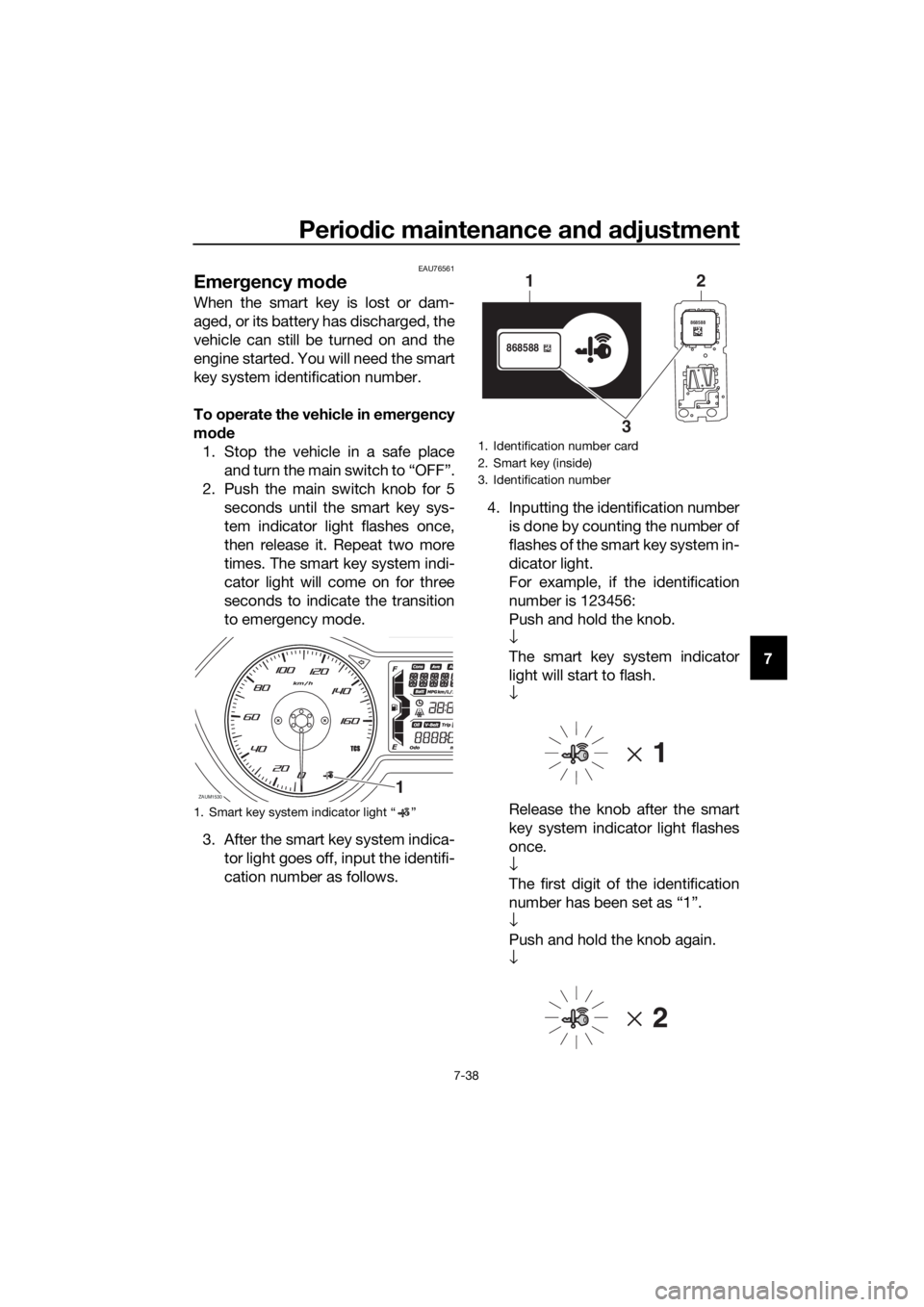
Emergency mode
When the smart key is lost or dam-
aged, or its battery has discharged, the
vehicle can still be turned on and the
engine started. You will need the smart
key system identification number.
To operate the vehicle in emergency
mode
1. Stop the vehicle in a safe place
and turn the main switch to “OFF”.
2. Push the main switch knob for 5
seconds until the smart key sys-
tem indicator light flashes once,
then release it. Repeat two more
times. The smart key system indi-
cator light will come on for three
seconds to indicate the transition
to emergency mode.
3. After the smart key system indica-
tor light goes off, input the identifi-
cation number as follows.4. Inputting the identification number
is done by counting the number of
flashes of the smart key system in-
dicator light.
For example, if the identification
number is 123456:
Push and hold the knob.
↓
The smart key system indicator
light will start to flash.
↓
Release the knob after the smart
key system indicator light flashes
once.
↓
The first digit of the identification
number has been set as “1”.
↓
Push and hold the knob again.
↓
1. Smart key system indicator light “ ”
ZAUM15301
1. Identification number card
2. Smart key (inside)
3. Identification number
868588
868588
1
32
UBY3E0E0.book Page 38 Friday, September 15, 2017 3:59 PM
Page 103 of 116
Scooter care and storage
8-1
8
EAU37834
Matte color caution
NOTICE
ECA15193
Some models are equipped with
matte colored finished parts. Be
sure to consult a Yamaha dealer for
advice on what products to use be-
fore cleaning the vehicle. Using a
brush, harsh chemical products or
cleaning compounds when cleaning
these parts will scratch or damage
their surface. Wax also should not
be applied to any matte colored fin-
ished parts.
EAUN1000
Care
While the open design of a scooter re-
veals the attractiveness of the technol-
ogy, it also makes it more vulnerable.
Rust and corrosion can develop even if
high-quality components are used. A
rusty exhaust pipe may go unnoticed
on a car, however, it detracts from the
overall appearance of a scooter. Fre-
quent and proper care does not only
comply with the terms of the warranty,
but it will also keep your scooter look-
ing good, extend its life and optimize
its performance.
Before cleaning
1. Cover the muffler outlet with a
plastic bag after the engine has
cooled down.
2. Make sure that all caps and cov-
ers as well as all electrical cou-
plers and connectors, including
the spark plug cap, are tightly in-
stalled.
3. Remove extremely stubborn dirt,
like oil burnt onto the crankcase,
with a degreasing agent and a
brush, but never apply such prod-
ucts onto seals, gaskets and
wheel axles. Always rinse the dirt
and degreaser off with water.
Cleaning
NOTICE
ECA10784
Avoid using strong acidic wheel
cleaners, especially on spoked
wheels. If such products are
used on hard-to-remove dirt, do
not leave the cleaner on the af-
fected area any longer than in-
UBY3E0E0.book Page 1 Friday, September 15, 2017 3:59 PM
Page 106 of 116

Scooter care and storage
8-4
8
EAU36564
Storage
Short-term
Always store your scooter in a cool, dry
place and, if necessary, protect it
against dust with a porous cover. Be
sure the engine and the exhaust sys-
tem are cool before covering the
scooter.
NOTICE
ECA10821
Storing the scooter in a poorly
ventilated room or covering it
with a tarp, while it is still wet,
will allow water and humidity to
seep in and cause rust.
To prevent corrosion, avoid
damp cellars, stables (because
of the presence of ammonia)
and areas where strong chemi-
cals are stored.
Long-term
Before storing your scooter for several
months:
1. Follow all the instructions in the
“Care” section of this chapter.
2. Fill up the fuel tank and add fuel
stabilizer (if available) to prevent
the fuel tank from rusting and the
fuel from deteriorating.
3. Perform the following steps to
protect the cylinder, piston rings,
etc. from corrosion.
a. Remove the spark plug cap
and spark plug.
b. Pour a teaspoonful of engine
oil into the spark plug bore.
c. Install the spark plug cap onto
the spark plug, and then place
the spark plug on the cylinderhead so that the electrodes are
grounded. (This will limit spark-
ing during the next step.)
d. Turn the engine over several
times with the starter. (This will
coat the cylinder wall with oil.)
e. Remove the spark plug cap
from the spark plug, and then
install the spark plug and the
spark plug cap. WARNING! To
prevent damage or injury
from sparking, make sure to
ground the spark plug elec-
trodes while turning the en-
gine over.
[EWA10952]
4. Lubricate all control cables and
the pivoting points of all levers and
pedals as well as of the side-
stand/centerstand.
5. Check and, if necessary, correct
the tire air pressure, and then lift
the scooter so that both of its
wheels are off the ground. Alterna-
tively, turn the wheels a little every
month in order to prevent the tires
from becoming degraded in one
spot.
6. Cover the muffler outlet with a
plastic bag to prevent moisture
from entering it.
7. Remove the battery and fully
charge it. Store it in a cool, dry
place and charge it once a month.
Do not store the battery in an ex-
cessively cold or warm place [less
than 0 °C (30 °F) or more than 30
°C (90 °F)]. For more information
on storing the battery, see page
7-29.
UBY3E0E0.book Page 4 Friday, September 15, 2017 3:59 PM
Page 108 of 116

Specifications
9-1
9
Dimensions:
Overall length:
2185 mm (86.0 in)
Overall width:
775 mm (30.5 in)
Overall height:
1415/1465 mm (55.7/57.7 in)
Seat height:
795 mm (31.3 in)
Wheelbase:
1540 mm (60.6 in)
Ground clearance:
135 mm (5.31 in)
Minimum turning radius:
2.6 m (8.53 ft)
Weight:
Curb weight:
179 kg (395 lb)
Engine:
Combustion cycle:
4-stroke
Cooling system:
Liquid cooled
Valve train:
SOHC
Number of cylinders:
Single cylinder
Displacement:
292 cm³
Bore × stroke:
70.0 × 75.9 mm (2.76 × 2.99 in)
Compression ratio:
10.9 : 1
Starting system:
Electric starter
Lubrication system:
Wet sump
Engine oil:
Recommended brand:
YAMALUBE
SAE viscosity grades:
10W-40
Recommended engine oil grade:
API service SG type or higher, JASO
standard MA or MB
Engine oil quantity:
Oil change:
1.50 L (1.59 US qt, 1.32 Imp.qt)
With oil filter removal:
1.60 L (1.69 US qt, 1.41 Imp.qt)
Final transmission oil:
Type:
SAE 10W-30 type SE motor oil
Quantity:
0.20 L (0.21 US qt, 0.18 Imp.qt)
Coolant quantity:
Coolant reservoir (up to the maximum level
mark):
0.18 L (0.19 US qt, 0.16 Imp.qt)
Radiator (including all routes):
1.10 L (1.16 US qt, 0.97 Imp.qt)
Air filter:
Air filter element:
Oil-coated paper element
Fuel:
Recommended fuel:
Premium unleaded gasoline (Gasohol [E10]
acceptable)
Fuel tank capacity:
13 L (3.4 US gal, 2.9 Imp.gal)
Fuel reserve amount:
2.4 L (0.63 US gal, 0.53 Imp.gal)
Fuel injection:
Throttle body:
ID mark:
B741 00
Spark plug(s):
Manufacturer/model:
NGK/LMAR8A-9
Spark plug gap:
0.8–0.9 mm (0.031–0.035 in)
Clutch:
Clutch type:
Dry, centrifugal, shoe
Drivetrain:
Primary reduction ratio:
1.000
Final drive:
Gear
Secondary reduction ratio:
7.590 (48/18 x 37/13)
Transmission type:
V-belt automatic
Chassis:
Frame type:
Underbone
Caster angle:
26.5 °
Trail:
95 mm (3.7 in)
UBY3E0E0.book Page 1 Friday, September 15, 2017 3:59 PM