check oil YAMAHA XMAX 300 2018 Owners Manual
[x] Cancel search | Manufacturer: YAMAHA, Model Year: 2018, Model line: XMAX 300, Model: YAMAHA XMAX 300 2018Pages: 116, PDF Size: 7.14 MB
Page 5 of 116

Table of contents
Safety information............................1-1
Further safe-riding points ................1-5
Description........................................2-1
Left view ..........................................2-1
Right view........................................2-2
Controls and instruments ................2-3
Smart key system ............................3-1
Smart key system............................3-1
Operating range of the smart key
system .........................................3-2
Handling of the smart key and
mechanical keys ..........................3-3
Smart key ........................................3-5
Replacing the smart key battery .....3-6
Main switch .....................................3-8
Instrument and control functions....4-1
Indicator lights and warning
lights ............................................4-1
Speedometer...................................4-2
Tachometer .....................................4-3
Multi-function display......................4-3
Handlebar switches.......................4-12
Front brake lever ...........................4-13
Rear brake lever ............................4-14
ABS ...............................................4-14
Traction control system.................4-15
Fuel tank cap.................................4-17
Fuel................................................4-18
Fuel tank overflow hose ................4-19
Catalytic converters .....................4-20
Storage compartments .................4-20
Windshield.....................................4-22
Handlebar position .......................4-25
Adjusting the shock absorber
assemblies .................................4-25
Sidestand ......................................4-26
Ignition circuit cut-off system........4-27
Auxiliary DC jack ..........................4-29For your safety – pre-operation
checks............................................... 5-1
Operation and important riding
points................................................. 6-1
Starting the engine.......................... 6-2
Starting off ...................................... 6-3
Acceleration and deceleration ........ 6-3
Braking............................................ 6-4
Tips for reducing fuel
consumption................................ 6-5
Engine break-in ............................... 6-5
Parking ............................................ 6-6
Periodic maintenance and
adjustment........................................ 7-1
Owner’s tool kit ............................... 7-2
Periodic maintenance chart for the
emission control system.............. 7-3
General maintenance and
lubrication chart........................... 7-4
Removing and installing the
panel ............................................ 7-7
Checking the spark plug ................. 7-8
Canister........................................... 7-9
Engine oil and oil filter element ....... 7-9
Final transmission oil .................... 7-12
Coolant ......................................... 7-13
Air filter and V-belt case air filter
elements .................................... 7-14
Checking the throttle grip free
play ............................................ 7-18
Valve clearance ............................. 7-19
Tires .............................................. 7-19
Cast wheels .................................. 7-21
Checking the front and rear brake
lever free play ............................ 7-22
Checking the front and rear brake
pads........................................... 7-23
Checking the brake fluid level....... 7-23
Changing the brake fluid............... 7-24
Checking the V-belt ...................... 7-25
Checking and lubricating the
cables ........................................ 7-25
Checking and lubricating the
throttle grip and cable ............... 7-26
UBY3E0E0.book Page 1 Friday, September 15, 2017 3:59 PM
Page 13 of 116
Description
2-2
2
EAU63391
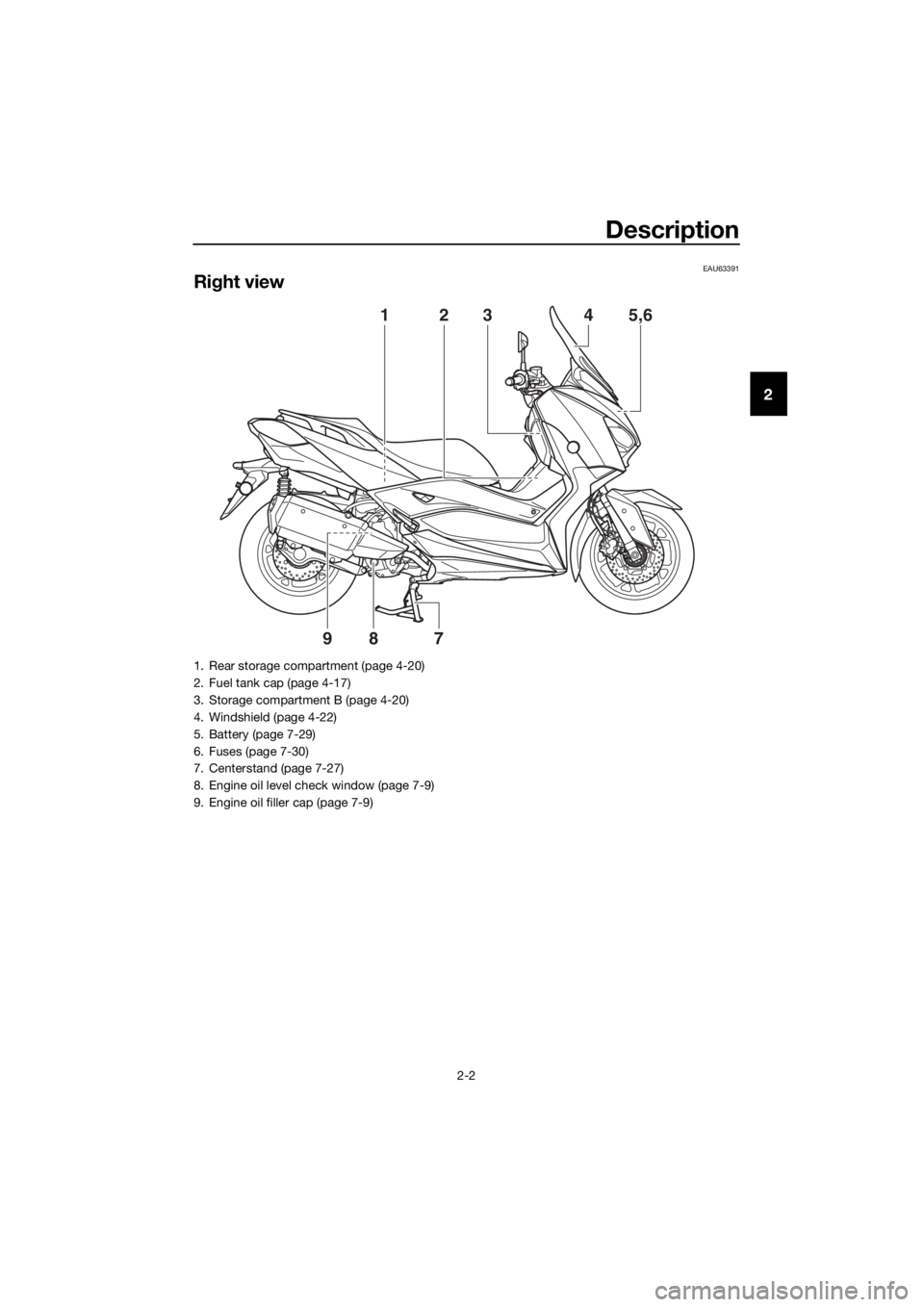
Right view
2345,61
987
1. Rear storage compartment (page 4-20)
2. Fuel tank cap (page 4-17)
3. Storage compartment B (page 4-20)
4. Windshield (page 4-22)
5. Battery (page 7-29)
6. Fuses (page 7-30)
7. Centerstand (page 7-27)
8. Engine oil level check window (page 7-9)
9. Engine oil filler cap (page 7-9)
UBY3E0E0.book Page 2 Friday, September 15, 2017 3:59 PM
Page 18 of 116
Smart key system
3-4
3Included with the vehicle is one smart
key, two mechanical keys, and one
identification number card. The identi-
fication number can also be found on
the inside of the smart key itself.
If the vehicle battery is discharged, the
mechanical key can be used to open
the seat. Carry one mechanical key
in addition to the smart key.
If the smart key is lost or the smart key
battery has discharged, the identifica-
tion number can be used to operate
the vehicle in emergency mode. (See
page 7-38.) Write down the identifi-
cation number in case of emergen-
cy.
If the smart key is lost and the smart
key system identification number is un-
known, the entire smart key system will
need to be replaced at considerable
cost. Keep the identification number
card in a safe place.
NOTICE
ECA21573
The smart key has precision elec-
tronic components. Observe the fol-
lowing precautions to prevent
possible malfunction or damage.
Do not place or store the smart
key in a storage compartment.
The smart key may be damaged
from road vibrations or exces-
sive heat.
Do not drop, bend, or subject
the smart key to strong impacts.
Do not submerge the smart key
in water or other liquids.
Do not place heavy items or ex-
cessive stress on the smart key.Do not leave the smart key in a
place exposed to direct sun-
light, high temperature or high
humidity.
Do not grind or attempt to mod-
ify the smart key.
Keep the smart key away from
strong magnetic fields and
magnetic objects such as key
hold
ers, TVs, and computers.
Keep the smart key away from
electric medical equipment.
Do not allow oils, polishing
agents, fuel, or any strong
chemicals to come in contact
with the smart key. The smart
key body may become discol-
ored or cracked.
TIP
The smart key battery life is ap-
proximately two years, but this
may vary according to operating
conditions.
Replace the smart key battery
when the smart key system indi-
cator light flashes for 20 seconds
when the vehicle is turned on, or
when the smart key indicator light
does not come on when the smart
key button is pushed. (See page
3-6.) After changing the smart key
battery, if the smart key system
still does not operate, check the
vehicle battery and then have a
Yamaha dealer check the vehicle.
If the smart key continually re-
ceives radio waves, the smart key
battery will discharge quickly. (For
example, when placed in the vicin-
ity of electrical products such as
televisions, radios, or computers.)
UBY3E0E0.book Page 4 Friday, September 15, 2017 3:59 PM
Page 31 of 116
Instrument and control functions
4-5
4 When approximately 2.4 L (0.63
US gal, 0.53 Imp.gal) of fuel re-
mains in the fuel tank, the last seg-
ment of the fuel meter will start
flashing. The display will automat-
ically change to the fuel reserve
tripmeter “F Trip” and start count-
ing the distance traveled from that
point.
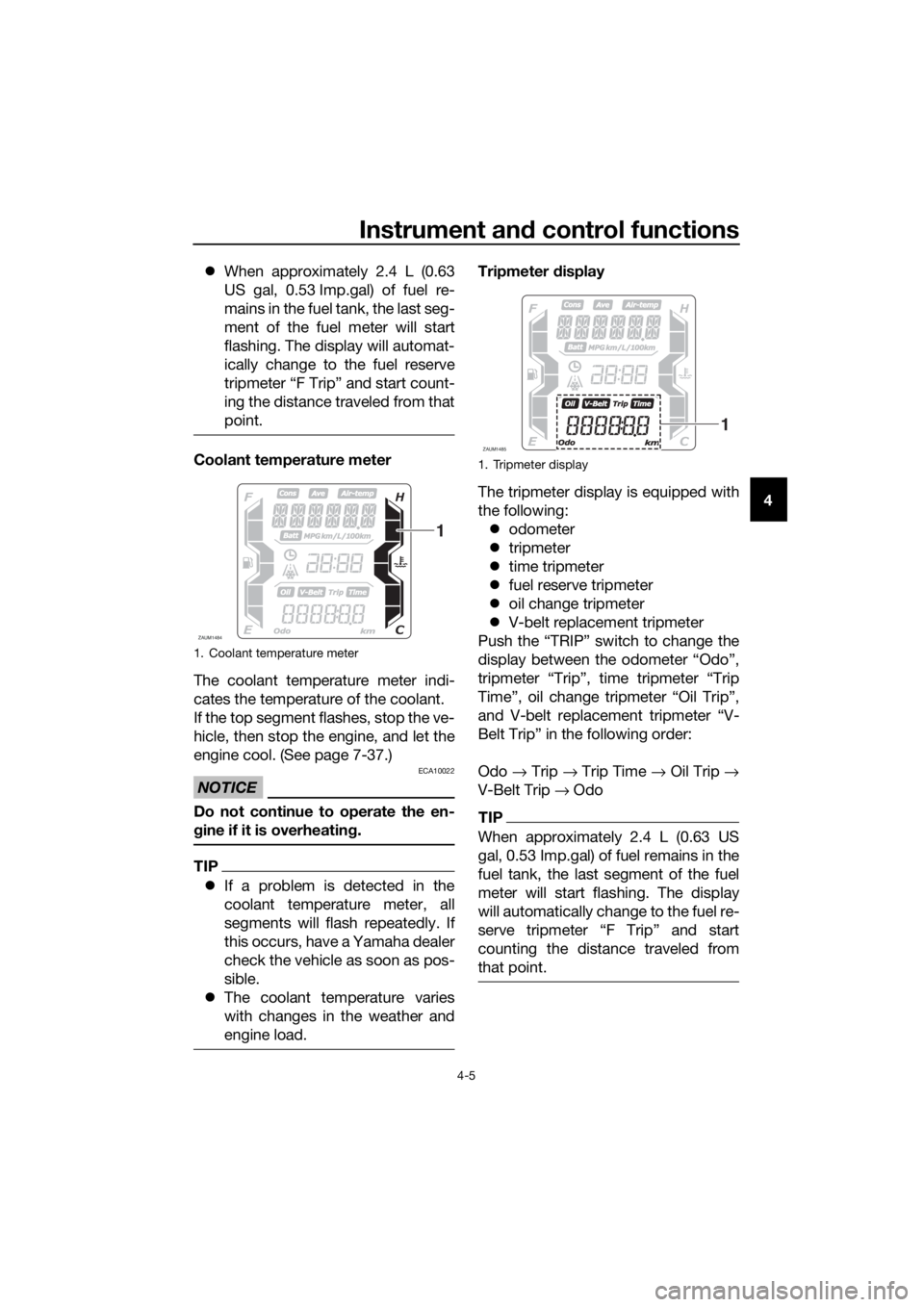
Coolant temperature meter
The coolant temperature meter indi-
cates the temperature of the coolant.
If the top segment flashes, stop the ve-
hicle, then stop the engine, and let the
engine cool. (See page 7-37.)
NOTICE
ECA10022
Do not continue to operate the en-
gine if it is overheating.
TIP
If a problem is detected in the
coolant temperature meter, all
segments will flash repeatedly. If
this occurs, have a Yamaha dealer
check the vehicle as soon as pos-
sible.
The coolant temperature varies
with changes in the weather and
engine load.
Tripmeter display
The tripmeter display is equipped with
the following:
odometer
tripmeter
time tripmeter
fuel reserve tripmeter
oil change tripmeter
V-belt replacement tripmeter
Push the “TRIP” switch to change the
display between the odometer “Odo”,
tripmeter “Trip”, time tripmeter “Trip
Time”, oil change tripmeter “Oil Trip”,
and V-belt replacement tripmeter “V-
Belt Trip” in the following order:
Odo → Trip → Trip Time → Oil Trip →
V-Belt Trip → Odo
TIP
When approximately 2.4 L (0.63 US
gal, 0.53 Imp.gal) of fuel remains in the
fuel tank, the last segment of the fuel
meter will start flashing. The display
will automatically change to the fuel re-
counting the distance traveled from
that point.
1. Coolant temperature meter
ZAUM1484
1
1. Tripmeter display
ZAUM1485
1
UBY3E0E0.book Page 5 Friday, September 15, 2017 3:59 PM
Page 56 of 116
For your safety – pre-operation checks
5-1
5
EAU63440
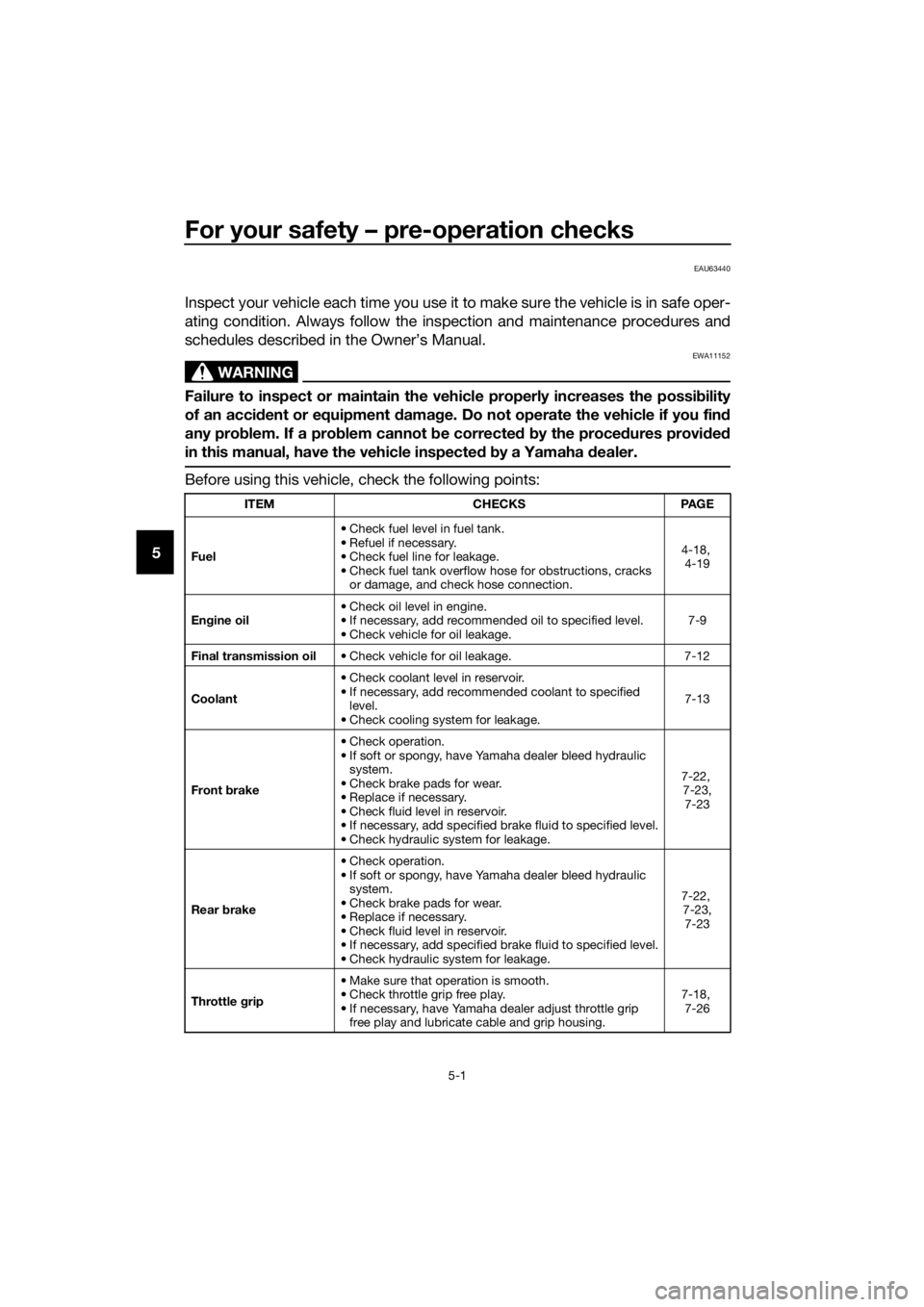
Inspect your vehicle each time you use it to make sure the vehicle is in safe oper-
ating condition. Always follow the inspection and maintenance procedures and
schedules described in the Owner’s Manual.
WARNING
EWA11152
Failure to inspect or maintain the vehicle properly increases the possibility
of an accident or equipment damage. Do not operate the vehicle if you find
any problem. If a problem cannot be corrected by the procedures provided
in this manual, have the vehicle inspected by a Yamaha dealer.
Before using this vehicle, check the following points:
ITEM CHECKS PAGE
Fuel• Check fuel level in fuel tank.
• Refuel if necessary.
• Check fuel line for leakage.
• Check fuel tank overflow hose for obstructions, cracks
or damage, and check hose connection.4-18,
4-19
Engine oil• Check oil level in engine.
• If necessary, add recommended oil to specified level.
• Check vehicle for oil leakage.7-9
Final transmission oil• Check vehicle for oil leakage. 7-12
Coolant• Check coolant level in reservoir.
• If necessary, add recommended coolant to specified
level.
• Check cooling system for leakage.7-13
Front brake• Check operation.
• If soft or spongy, have Yamaha dealer bleed hydraulic
system.
• Check brake pads for wear.
• Replace if necessary.
• Check fluid level in reservoir.
• If necessary, add specified brake fluid to specified level.
• Check hydraulic system for leakage.7-22,
7-23,
7-23
Rear brake• Check operation.
• If soft or spongy, have Yamaha dealer bleed hydraulic
system.
• Check brake pads for wear.
• Replace if necessary.
• Check fluid level in reservoir.
• If necessary, add specified brake fluid to specified level.
• Check hydraulic system for leakage.7-22,
7-23,
7-23
Throttle grip• Make sure that operation is smooth.
• Check throttle grip free play.
• If necessary, have Yamaha dealer adjust throttle grip
free play and lubricate cable and grip housing.7-18,
7-26
UBY3E0E0.book Page 1 Friday, September 15, 2017 3:59 PM
Page 62 of 116
Operation and important riding points
6-5
6
EAU16821
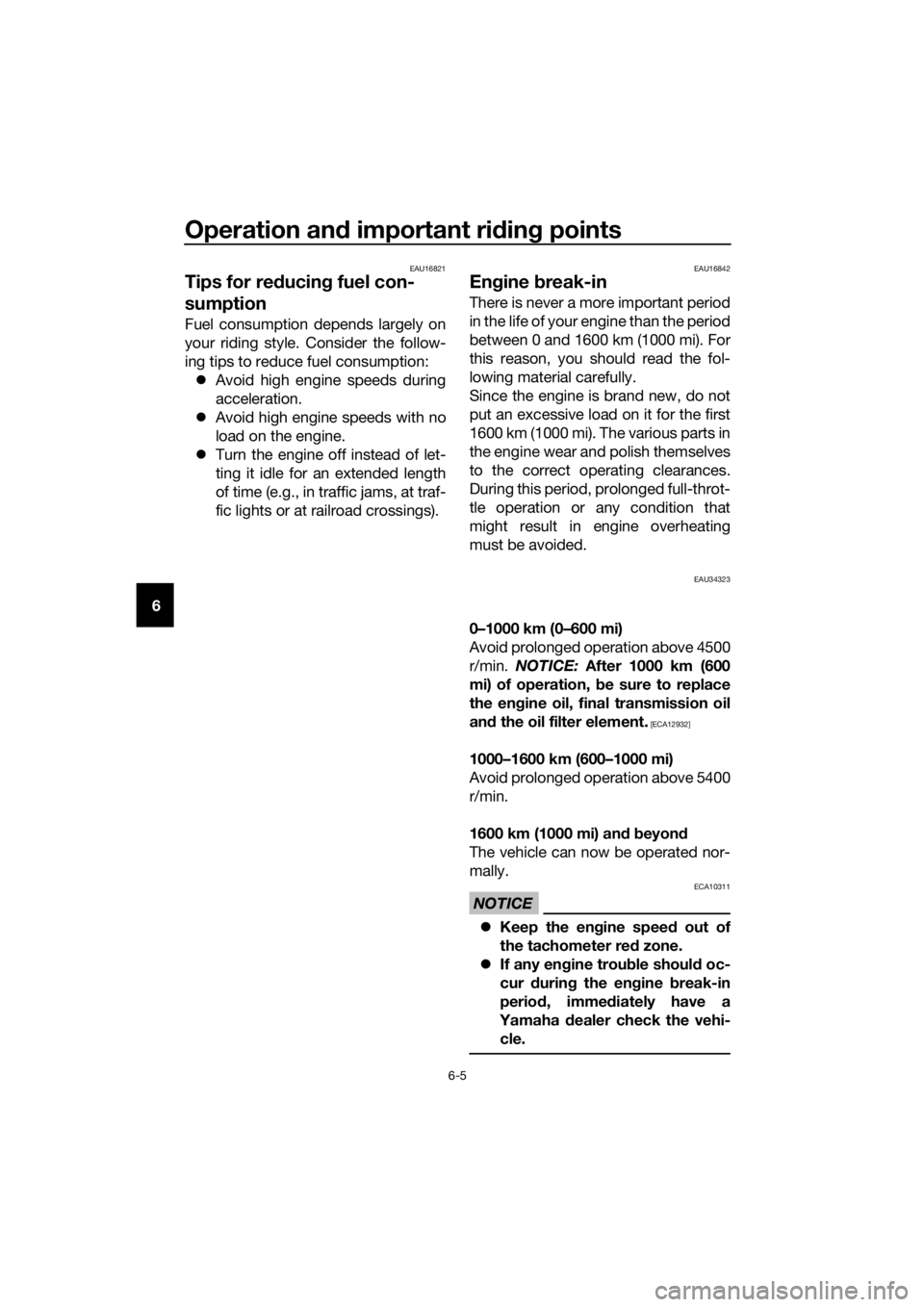
Tips for reducing fuel con-
sumption
Fuel consumption depends largely on
your riding style. Consider the follow-
ing tips to reduce fuel consumption:
Avoid high engine speeds during
acceleration.
Avoid high engine speeds with no
load on the engine.
Turn the engine off instead of let-
ting it idle for an extended length
of time (e.g., in traffic jams, at traf-
fic lights or at railroad crossings).
EAU16842
Engine break-in
There is never a more important period
in the life of your engine than the period
between 0 and 1600 km (1000 mi). For
this reason, you should read the fol-
lowing material carefully.
Since the engine is brand new, do not
put an excessive load on it for the first
1600 km (1000 mi). The various parts in
the engine wear and polish themselves
to the correct operating clearances.
During this period, prolonged full-throt-
tle operation or any condition that
might result in engine overheating
must be avoided.
EAU34323
0–1000 km (0–600 mi)
Avoid prolonged operation above 4500
r/min. NOTICE: After 1000 km (600
mi) of operation, be sure to replace
the engine oil, final transmission oil
and the oil filter element.
[ECA12932]
1000–1600 km (600–1000 mi)
Avoid prolonged operation above 5400
r/min.
1600 km (1000 mi) and beyond
The vehicle can now be operated nor-
mally.
NOTICE
ECA10311
Keep the engine speed out of
the tachometer red zone.
If any engine trouble should oc-
cur during the engine break-in
period, immediately have a
Yamaha dealer check the vehi-
cle.
UBY3E0E0.book Page 5 Friday, September 15, 2017 3:59 PM
Page 68 of 116

Periodic maintenance and adjustment
7-5
7
14*Steering bearings• Check bearing assemblies for
looseness.√√ √
• Moderately repack with lithium-
soap-based grease.√√
15*Chassis fasteners• Make sure that all nuts, bolts
and screws are properly tight-
ened.√√√√√
16Front and rear
brake lever pivot
shaft• Lubricate with silicone grease.√√√√√
17Sidestand, center-
stand• Check operation.
• Lubricate with lithium-soap-
based grease.√√√√√
18*Sidestand switch• Check operation and replace if
necessary.√√√√√√
19*Front fork• Check operation and for oil
leakage.
• Replace if necessary.√√√√
20*Shock absorber
assemblies• Check operation and for oil
leakage.
• Replace if necessary.√√√√
21 Engine oil• Change (warm engine before
draining).
• Check oil level and vehicle for
oil leakage.At the initial interval and
when the oil change indi-
cator flashes or comes
on.√
22Engine oil filter el-
ement• Replace.√√√
23*Final transmission
oil• Check vehicle for oil leakage.√√√√√
• Change.√√√
24
*Cooling system• Check coolant level and vehicle
for coolant leakage.√√√√√
• Change. Every 3 years
25*V-belt• Replace.When the V-belt replacement
indicator flashes [every 20000
km (12000 mi)]
26*Front and rear
brake switches• Check operation.√√√√√√ NO. ITEM
X 1000 km CHECK OR
MAINTENANCE JOB
X 1000 miODOMETER
READINGS
ANNUAL CHECK
110203040
0.6 6 12 18 24
UBY3E0E0.book Page 5 Friday, September 15, 2017 3:59 PM
Page 69 of 116
Periodic maintenance and adjustment
7-6
7
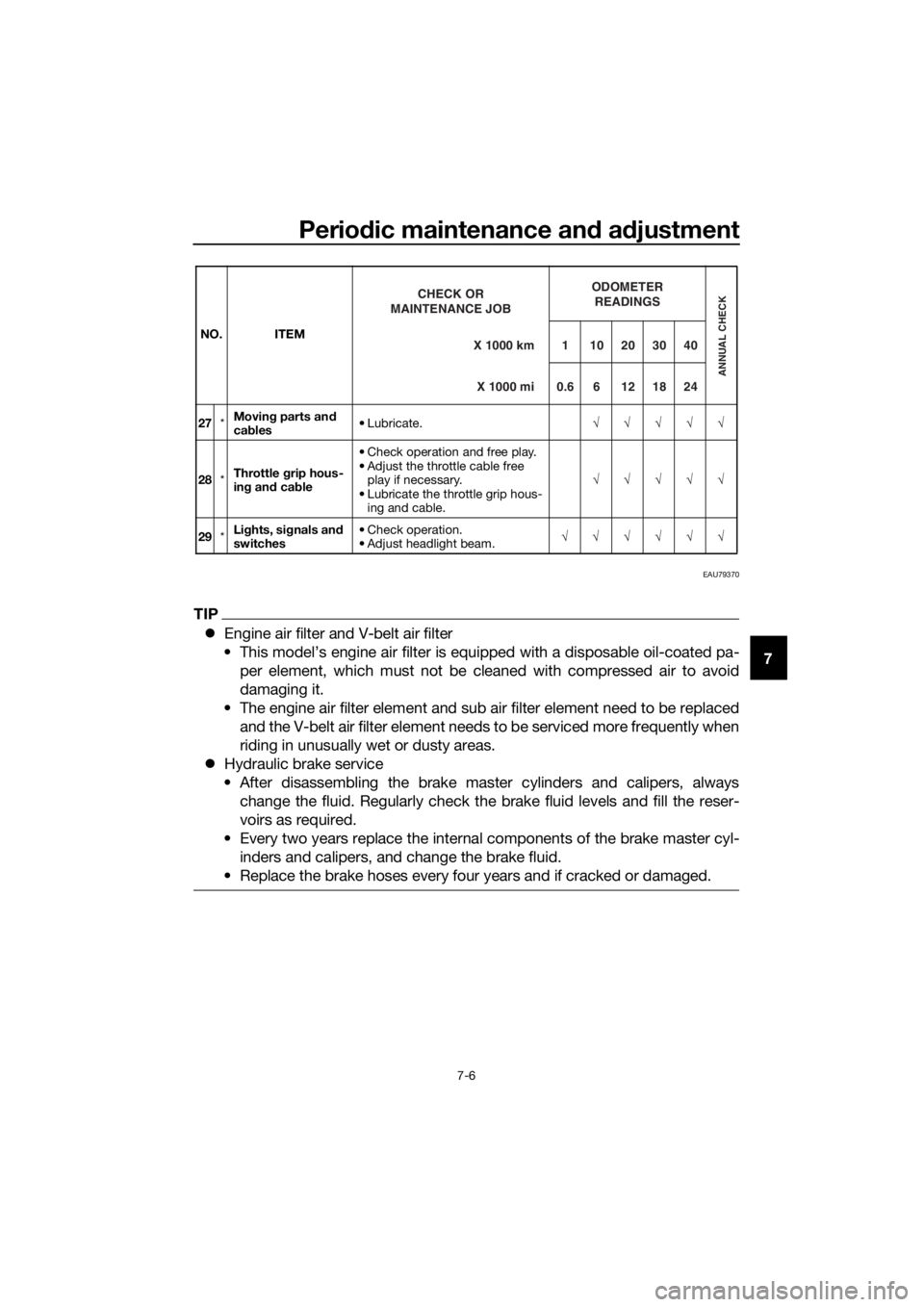
EAU79370
TIP
Engine air filter and V-belt air filter
• This model’s engine air filter is equipped with a disposable oil-coated pa-
per element, which must not be cleaned with compressed air to avoid
damaging it.
• The engine air filter element and sub air filter element need to be replaced
and the V-belt air filter element needs to be serviced more frequently when
riding in unusually wet or dusty areas.
Hydraulic brake service
• After disassembling the brake master cylinders and calipers, always
change the fluid. Regularly check the brake fluid levels and fill the reser-
voirs as required.
• Every two years replace the internal components of the brake master cyl-
inders and calipers, and change the brake fluid.
• Replace the brake hoses every four years and if cracked or damaged.
27*Moving parts and
cables• Lubricate.√√√√√
28*Throttle grip hous-
ing and cable• Check operation and free play.
• Adjust the throttle cable free
play if necessary.
• Lubricate the throttle grip hous-
ing and cable.√√√√√
29*Lights, signals and
switches• Check operation.
• Adjust headlight beam.√√√√√√ NO. ITEM
X 1000 km CHECK OR
MAINTENANCE JOB
X 1000 mi
ODOMETER
READINGS
ANNUAL CHECK
110203040
0.66121824
UBY3E0E0.book Page 6 Friday, September 15, 2017 3:59 PM
Page 72 of 116
Periodic maintenance and adjustment
7-9
7
EAU36112
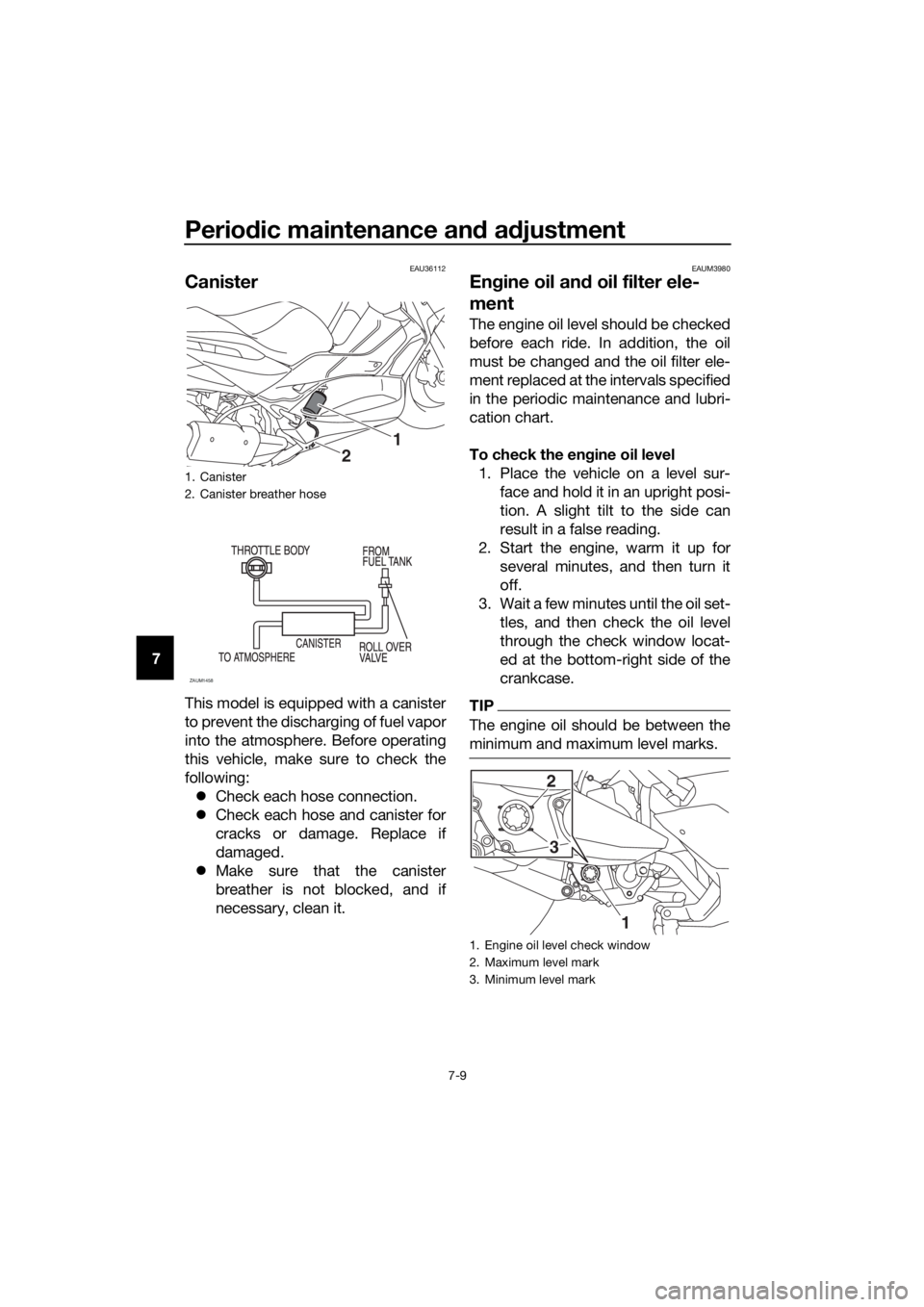
Canister
This model is equipped with a canister
to prevent the discharging of fuel vapor
into the atmosphere. Before operating
this vehicle, make sure to check the
following:
Check each hose connection.
Check each hose and canister for
cracks or damage. Replace if
damaged.
Make sure that the canister
breather is not blocked, and if
necessary, clean it.
EAUM3980
Engine oil and oil filter ele-
ment
The engine oil level should be checked
before each ride. In addition, the oil
must be changed and the oil filter ele-
ment replaced at the intervals specified
in the periodic maintenance and lubri-
cation chart.
To check the engine oil level
1. Place the vehicle on a level sur-
face and hold it in an upright posi-
tion. A slight tilt to the side can
result in a false reading.
2. Start the engine, warm it up for
several minutes, and then turn it
off.
3. Wait a few minutes until the oil set-
tles, and then check the oil level
through the check window locat-
ed at the bottom-right side of the
crankcase.
TIP
The engine oil should be between the
minimum and maximum level marks.
1. Canister
2. Canister breather hose
2
1
ZAUM1458
1. Engine oil level check window
2. Maximum level mark
3. Minimum level mark
3
1
2
UBY3E0E0.book Page 9 Friday, September 15, 2017 3:59 PM
Page 73 of 116
Periodic maintenance and adjustment
7-10
7 4. If the engine oil is below the mini-
mum level mark, add sufficient oil
of the recommended type to raise
it to the correct level.
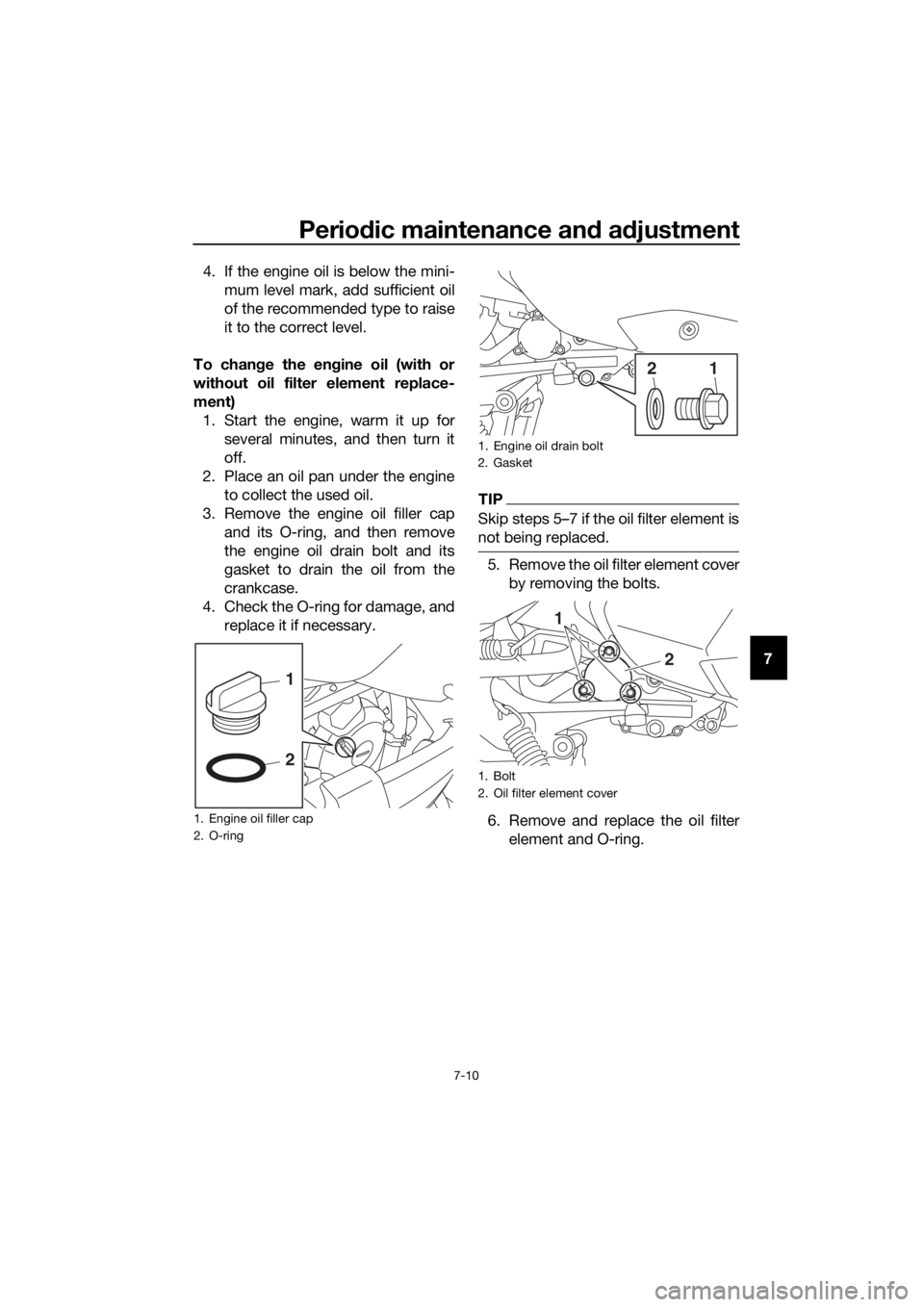
To change the engine oil (with or
without oil filter element replace-
ment)
1. Start the engine, warm it up for
several minutes, and then turn it
off.
2. Place an oil pan under the engine
to collect the used oil.
3. Remove the engine oil filler cap
and its O-ring, and then remove
the engine oil drain bolt and its
gasket to drain the oil from the
crankcase.
4. Check the O-ring for damage, and
replace it if necessary.
TIP
Skip steps 5…7 if the oil filter element is
not being replaced.
5. Remove the oil filter element cover
by removing the bolts.
6. Remove and replace the oil filter
element and O-ring.
1. Engine oil filler cap
2. O-ring
1
2
1. Engine oil drain bolt
2. Gasket
1. Bolt
2. Oil filter element cover
12
2 1
UBY3E0E0.book Page 10 Friday, September 15, 2017 3:59 PM