valve YAMAHA XMAX 300 2021 Owners Manual
[x] Cancel search | Manufacturer: YAMAHA, Model Year: 2021, Model line: XMAX 300, Model: YAMAHA XMAX 300 2021Pages: 114, PDF Size: 4.65 MB
Page 6 of 114

Table of contentsSafety information ............................ 1-1
Further safe-riding points ............... 1-5
Description ....................................... 2-1
Left view ......................................... 2-1
Right view ....................................... 2-2
Controls and instruments ............... 2-3
Smart key system ........................... 3-1
Smart key system ........................... 3-1
Operating range of the smart key system......................................... 3-2
Handling of the smart key and mechanical keys ......................... 3-3
Smart key ....................................... 3-5
Replacing the smart key battery..... 3-6
Main switch .................................... 3-8
Instrument an d control functions ... 4-1
Indicator lights and warning
lights............................................ 4-1
Speedometer .................................. 4-3
Tachometer .................................... 4-3
Multi-function display ..................... 4-4
Handlebar switches ...................... 4-12
Front brake lever .......................... 4-13
Rear brake lever ........................... 4-14
Anti-lock brake system (ABS)....... 4-14
Traction control system ................ 4-15
Fuel tank cap ................................ 4-17
Fuel ............................................... 4-18 Fuel tank overflow hose ................ 4-19
Catalytic converter ........................ 4-20
Storage compartments ................. 4-20
Windshield .................................... 4-22
Handlebar position ....................... 4-24
Adjusting the shock absorber
assemblies ................................. 4-25
Auxiliary DC jack .......................... 4-25
Sidestand ...................................... 4-26
Ignition circuit cut-off system ....... 4-27
For your safety – pre-operation
checks ............................................... 5-1
Operation an d important ri din g
points ................................................. 6-1
Engine break-in ............................... 6-1
Starting the engine .......................... 6-2
Starting off ...................................... 6-3
Acceleration and deceleration ........ 6-3
Braking ............................................ 6-3
Tips for reducing fuel consumption ................................ 6-4
Parking ............................................ 6-4
Perio dic maintenance an d
a d justment ........................................ 7-1
Tool kit ............................................ 7-2
Periodic maintenance charts .......... 7-3
Periodic maintenance chart for the emission control system .............. 7-3 General maintenance and
lubrication chart .......................... 7-4
Removing and installing the panel............................................ 7-8
Checking the spark plug................. 7-9
Canister ........................................ 7-10
Engine oil and oil filter element..... 7-10
Final transmission oil .................... 7-13
Coolant ......................................... 7-14
Air filter and V-belt case air filter elements .................................... 7-15
Checking the throttle grip free play ............................................ 7-19
Valve clearance............................. 7-20
Tires .............................................. 7-20
Cast wheels .................................. 7-22
Checking the front and rear brake
lever free play ............................ 7-22
Checking the front and rear brake pads .......................................... 7-23
Checking the brake fluid level ...... 7-23
Changing the brake fluid .............. 7-25
Checking the V-belt ...................... 7-25
Checking and lubricating the cables ........................................ 7-25
Checking and lubricating the
throttle grip and cable ............... 7-26
Lubricating the front and rear brake levers ............................... 7-26
Checking and lubricating the centerstand and sidestand........ 7-27UBBAE0E0.book Page 1 Thursday, September 24, 2020 3:19 PM
Page 46 of 114
Instrument and control functions
4-19
4
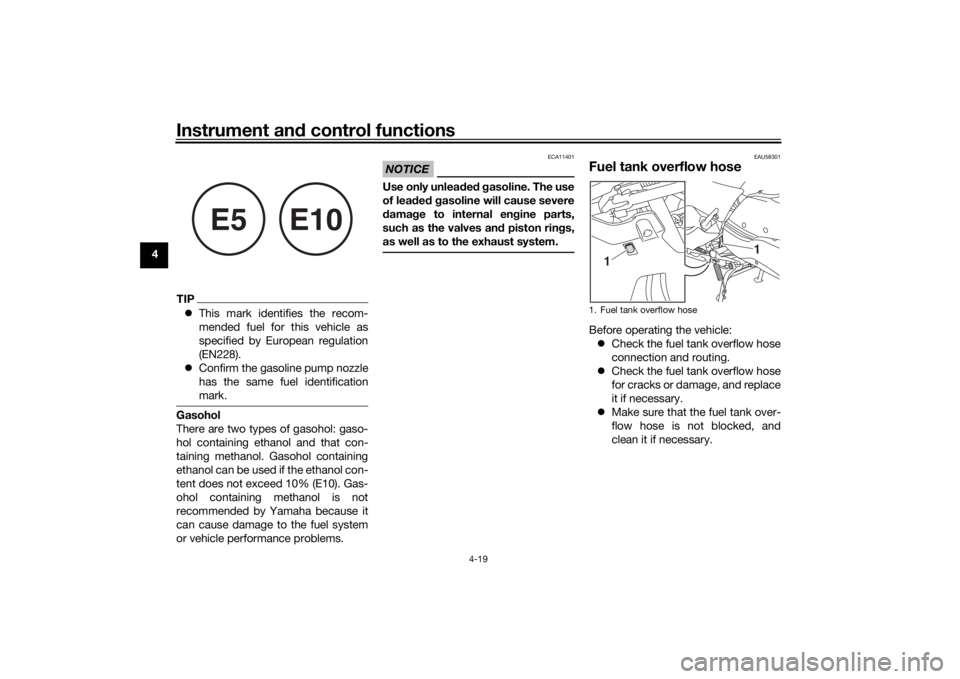
TIP This mark identifies the recom-
mended fuel for this vehicle as
specified by European regulation
(EN228).
Confirm the gasoline pump nozzle
has the same fuel identification
mark.Gasohol
There are two types of gasohol: gaso-
hol containing ethanol and that con-
taining methanol. Gasohol containing
ethanol can be used if the ethanol con-
tent does not exceed 10% (E10). Gas-
ohol containing methanol is not
recommended by Yamaha because it
can cause damage to the fuel system
or vehicle performance problems.
NOTICE
ECA11401
Use only unlea ded g asoline. The use
of lea ded g asoline will cause severe
d amag e to internal en gine parts,
such as the valves an d piston rin gs,
as well as to the exhaust system.
EAU58301
Fuel tank overflow hoseBefore operating the vehicle: Check the fuel tank overflow hose
connection and routing.
Check the fuel tank overflow hose
for cracks or damage, and replace
it if necessary.
Make sure that the fuel tank over-
flow hose is not blocked, and
clean it if necessary.
E5
E10
1. Fuel tank overflow hose
1
1
UBBAE0E0.book Page 19 Thursday, September 24, 2020 3:19 PM
Page 65 of 114
Periodic maintenance an d a djustment
7-3
7
EAU71033
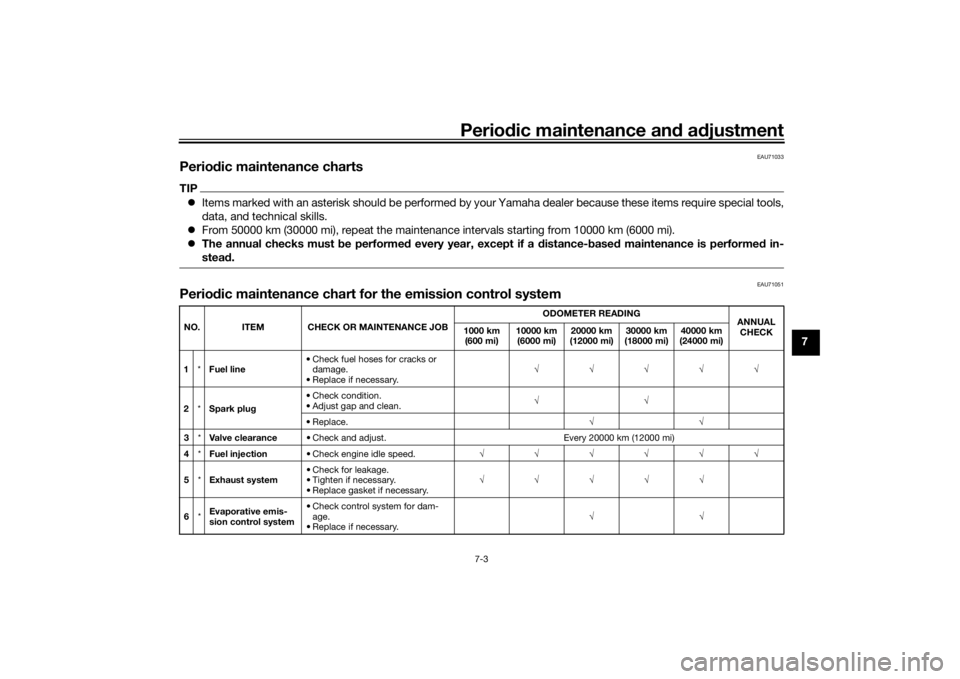
Perio dic maintenance chartsTIP Items marked with an asterisk should be performed by your Yamaha dealer because these items require special tools,
data, and technical skills.
From 50000 km (30000 mi), repeat the maintenance intervals starting from 10000 km (6000 mi).
The annual checks must be performe d every year, except if a distance- based maintenance is performe d in-
stea d.
EAU71051
Perio dic maintenance chart for the emission control systemNO. ITEM CHECK OR MAINTENANCE JOB ODOMETER READING
ANNUAL
CHECK
1000 km
(600 mi) 10000 km
(6000 mi) 20000 km
(12000 mi) 30000 km
(18000 mi) 40000 km
(24000 mi)
1 *Fuel line • Check fuel hoses for cracks or
damage.
• Replace if necessary. √√√√√
2 *Spark plu g • Check condition.
• Adjust gap and clean.
√√
•Replace. √√
3 *Valve clearance • Check and adjust. Every 20000 km (12000 mi)
4 *Fuel injection • Check engine idle speed. √√√√√√
5 *Exhaust system • Check for leakage.
• Tighten if necessary.
• Replace gasket if necessary. √√√√√
6 *Evaporative emis-
sion control system • Check control system for dam-
age.
• Replace if necessary. √√
UBBAE0E0.book Page 3 Thursday, September 24, 2020 3:19 PM
Page 82 of 114
Periodic maintenance an d a djustment
7-20
7
EAU21403
Valve clearanceThe valves are an important engine
component, and since valve clearance
changes with use, they must be
checked and adjusted at the intervals
specified in the periodic maintenance
chart. Unadjusted valves can result in
improper air-fuel mixture, engine
noise, and eventually engine damage.
To prevent this from occurring, have
your Yamaha dealer check and adjust
the valve clearance at regular intervals.TIPThis service must be performed when
the engine is cold.
EAU69761
TiresTires are the only contact between the
vehicle and the road. Safety in all con-
ditions of riding depends on a relatively
small area of road contact. Therefore, it
is essential to maintain the tires in good
condition at all times and replace them
at the appropriate time with the speci-
fied tires.
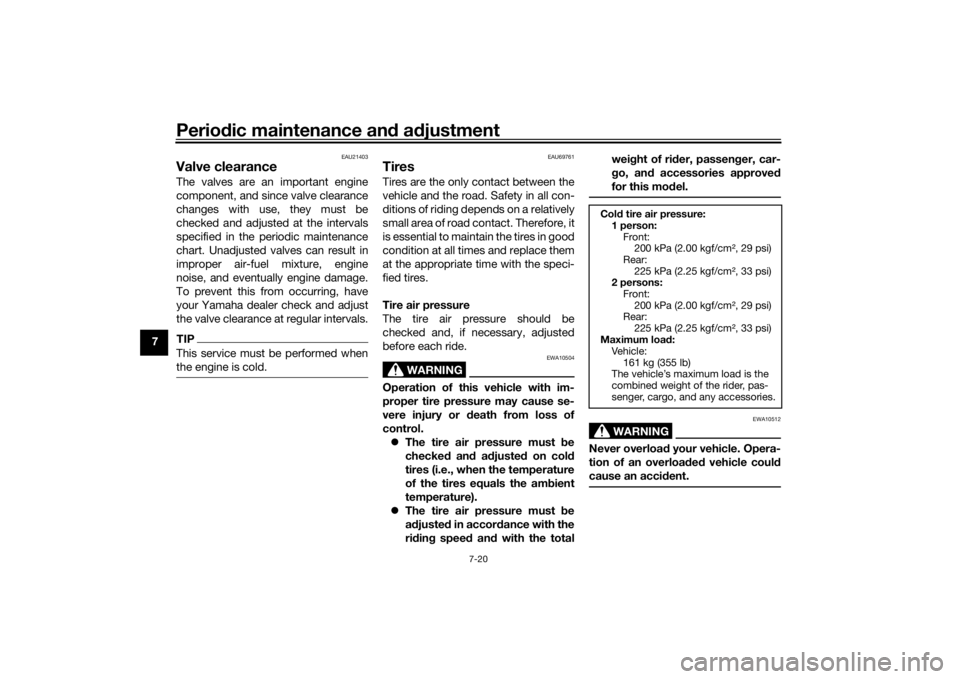
Tire air pressure
The tire air pressure should be
checked and, if necessary, adjusted
before each ride.
WARNING
EWA10504
Operation of this vehicle with im-
proper tire pressure may cause se-
vere injury or death from loss of
control. The tire air pressure must be
checked and a djuste d on col d
tires (i.e., when the temperature
of the tires equals the am bient
temperature).
The tire air pressure must be
a d juste d in accor dance with the
ri din g speed and with the total wei
ght of ri der, passen ger, car-
g o, an d accessories approve d
for this mo del.
WARNING
EWA10512
Never overloa d your vehicle. Opera-
tion of an overload ed vehicle coul d
cause an acci dent.Col d tire air pressure:
1 person: Front:200 kPa (2.00 kgf/cm², 29 psi)
Rear: 225 kPa (2.25 kgf/cm², 33 psi)
2 persons:
Front:200 kPa (2.00 kgf/cm², 29 psi)
Rear:
225 kPa (2.25 kgf/cm², 33 psi)
Maximum load :
Vehicle:
161 kg (355 lb)
The vehicle’s maximum load is the
combined weight of the rider, pas-
senger, cargo, and any accessories.
UBBAE0E0.book Page 20 Thursday, September 24, 2020 3:19 PM
Page 83 of 114
Periodic maintenance an d a djustment
7-21
7
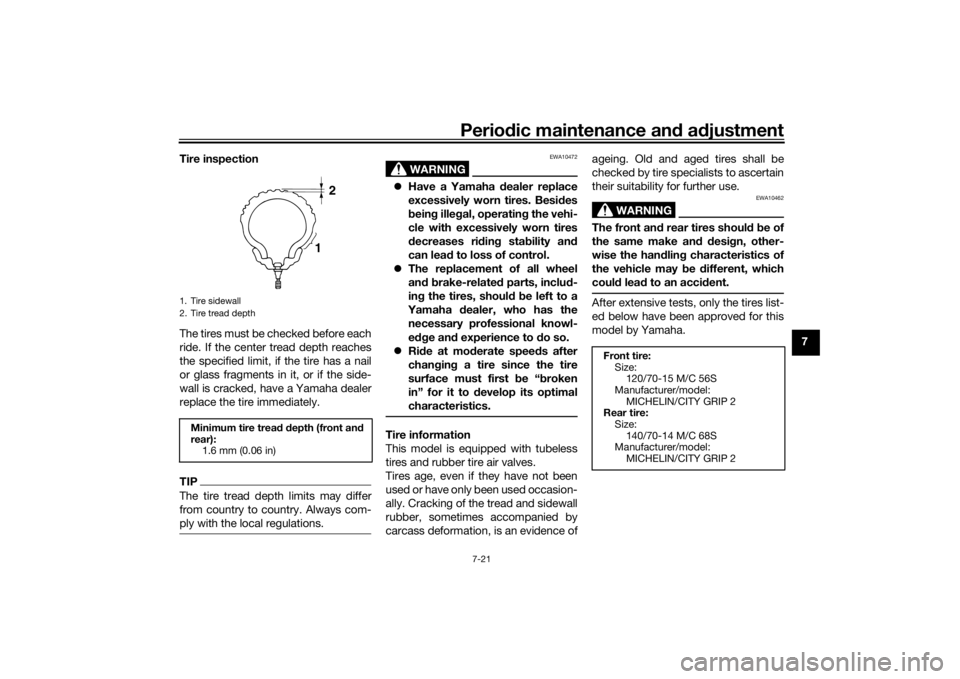
Tire inspection
The tires must be checked before each
ride. If the center tread depth reaches
the specified limit, if the tire has a nail
or glass fragments in it, or if the side-
wall is cracked, have a Yamaha dealer
replace the tire immediately.
TIPThe tire tread depth limits may differ
from country to country. Always com-
ply with the local regulations.
WARNING
EWA10472
Have a Yamaha d ealer replace
excessively worn tires. Besi des
b ein g ille gal, operatin g the vehi-
cle with excessively worn tires
d ecreases ri din g sta bility an d
can lea d to loss of control.
The replacement of all wheel
and b rake-relate d parts, inclu d-
in g the tires, shoul d b e left to a
Yamaha dealer, who has the
necessary professional knowl-
e dg e an d experience to do so.
Ride at mo derate spee ds after
chan gin g a tire since the tire
surface must first be “ broken
in” for it to d evelop its optimal
characteristics.Tire information
This model is equipped with tubeless
tires and rubber tire air valves.
Tires age, even if they have not been
used or have only been used occasion-
ally. Cracking of the tread and sidewall
rubber, sometimes accompanied by
carcass deformation, is an evidence of ageing. Old and aged tires shall be
checked by tire specialists to ascertain
their suitability for further use.
WARNING
EWA10462
The front an
d rear tires shoul d b e of
the same make an d d esi gn, other-
wise the han dlin g characteristics of
the vehicle may be different, which
coul d lea d to an acci dent.After extensive tests, only the tires list-
ed below have been approved for this
model by Yamaha.
1. Tire sidewall
2. Tire tread depthMinimum tire trea d d epth (front an d
rear): 1.6 mm (0.06 in)
1 2
Front tire:
Size: 120/70-15 M/C 56S
Manufacturer/model: MICHELIN/CITY GRIP 2
Rear tire:
Size: 140/70-14 M/C 68S
Manufacturer/model:
MICHELIN/CITY GRIP 2
UBBAE0E0.book Page 21 Thursday, September 24, 2020 3:19 PM
Page 86 of 114
Periodic maintenance an d a djustment
7-24
7 Rear
brake
WARNING
EWA16011
Improper maintenance can result in
loss of brakin g a bility. O bserve
these precautions: Insufficient brake flui d may al-
low air to enter the b rake sys-
tem, re ducin g brakin g
performance.
Clean the filler cap before re-
moving . Use only DOT 4 b rake
flui d from a seale d container.
Use only the specified b rake flu-
i d ; otherwise, the ru bber seals
may deteriorate, causin g leak-
a g e.
Refill with the same type of
brake flui d. A ddin g a brake flui d
other than DOT 4 may result in a
harmful chemical reaction.
Be careful that water or dust
d oes not enter the brake flui d
reservoir when refillin g. Water
will si gnificantly lower the boil-
in g point of the flui d an d may re-
sult in vapor lock, an d d ir
t may
clo g the ABS hy draulic unit
valves.
NOTICE
ECA17641
Brake flui d may damag e painted
surfaces or plastic parts. Always
clean up spille d flui d imme diately.As the brake pads wear, it is normal for
the brake fluid level to gradually go
down. A low brake fluid level may indi-
cate worn brake pads and/or brake
system leakage; therefore, be sure to
check the brake pads for wear and the
brake system for leakage. If the brake fluid level goes down suddenly, have a
Yamaha dealer check the cause before further riding.
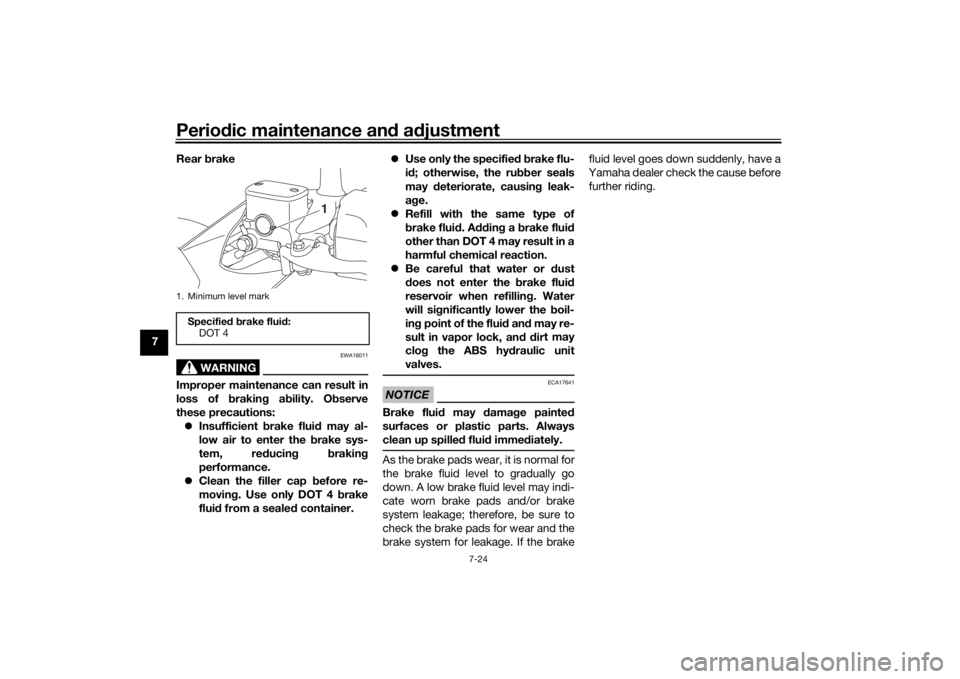
1. Minimum level markSpecifie d b rake flui d:
DOT 4
1
UBBAE0E0.book Page 24 Thursday, September 24, 2020 3:19 PM
Page 91 of 114
Periodic maintenance an d a djustment
7-29
7
EAU60691
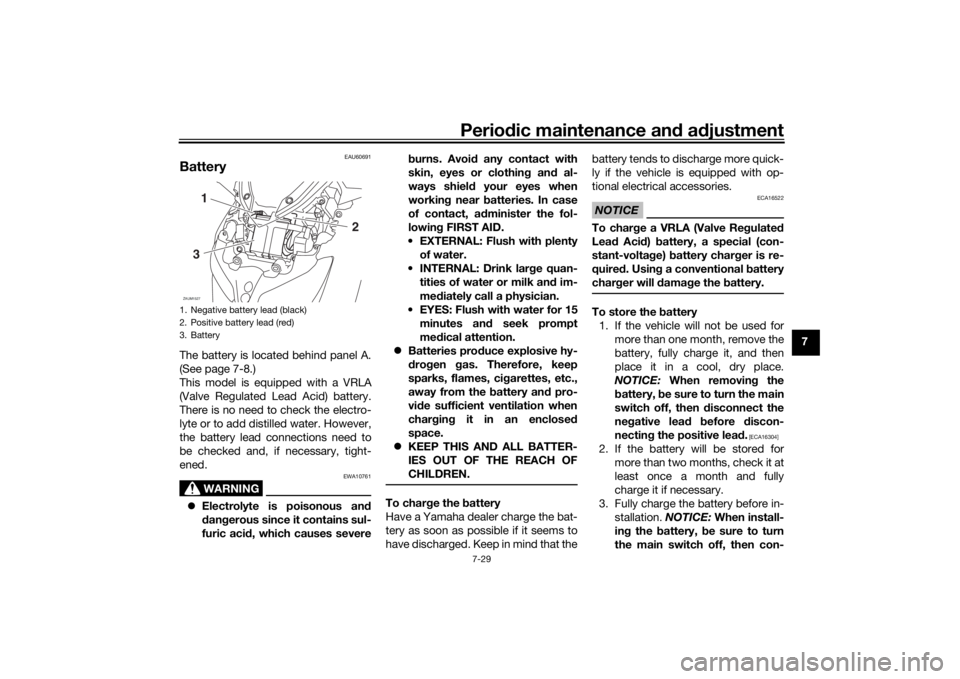
BatteryThe battery is located behind panel A.
(See page 7-8.)
This model is equipped with a VRLA
(Valve Regulated Lead Acid) battery.
There is no need to check the electro-
lyte or to add distilled water. However,
the battery lead connections need to
be checked and, if necessary, tight-
ened.
WARNING
EWA10761
Electrolyte is poisonous an d
d an gerous since it contains sul-
furic aci d, which causes severe b
urns. Avoi d any contact with
skin, eyes or clothin g an d al-
ways shiel d your eyes when
workin g near b atteries. In case
of contact, ad minister the fol-
lowin g FIRST AID.
EXTERNAL: Flush with plenty of water.
INTERNAL: Drink lar ge quan-
tities of water or milk an d im-
me diately call a physician.
EYES: Flush with water for 15 minutes an d seek prompt
me dical attention.
Batteries pro duce explosive hy-
d ro gen gas. Therefore, keep
sparks, flames, ci garettes, etc.,
away from the b attery and pro-
vi de sufficient ventilation when
char gin g it in an enclose d
space.
KEEP THIS AND ALL BATTER-
IES OUT OF THE REACH OF
CHILDREN.
To char ge the b attery
Have a Yamaha dealer charge the bat-
tery as soon as possible if it seems to
h a ve d is c h ar g e d . K e e p i n m i nd th a t th e battery tends to discharge more quick-
ly if the vehicle is equipped with op-
tional electrical accessories.
NOTICE
ECA16522
To char
ge a VRLA (Valve Re gulate d
Lea d Aci d) battery, a special (con-
stant-volta ge) battery char ger is re-
quire d. Usin g a conventional b attery
char ger will d amage the battery.To store the battery
1. If the vehicle will not be used for more than one month, remove the
battery, fully charge it, and then
place it in a cool, dry place.
NOTICE: When removin g the
b attery, be sure to turn the main
switch off, then d isconnect the
ne gative lead before discon-
nectin g the positive lea d.
[ECA16304]
2. If the battery will be stored for
more than two months, check it at
least once a month and fully
charge it if necessary.
3. Fully charge the battery before in- stallation. NOTICE: When install-
in g the b attery, be sure to turn
the main switch off, then con-
1. Negative battery lead (black)
2. Positive battery lead (red)
3. BatteryZAUM1527
13
2
UBBAE0E0.book Page 29 Thursday, September 24, 2020 3:19 PM
Page 105 of 114
Specifications
9-1
9
Dimensions:Overall length:2185 mm (86.0 in)
Overall width:
775 mm (30.5 in)
Overall height: 1415/1465 mm (55.7/57.7 in)
Seat height: 795 mm (31.3 in)
Wheelbase:
1540 mm (60.6 in)
Ground clearance: 135 mm (5.31 in)
Minimum turning radius: 2.6 m (8.53 ft)Wei ght:Curb weight:
179 kg (395 lb)Engine:Combustion cycle:
4-stroke
Cooling system: Liquid cooled
Valve train: SOHC
Number of cylinders:
Single cylinder
Displacement: 292 cm³
Bore × stroke:
70.0 × 75.9 mm (2.76 × 2.99 in)
Starting system:
Electric starter
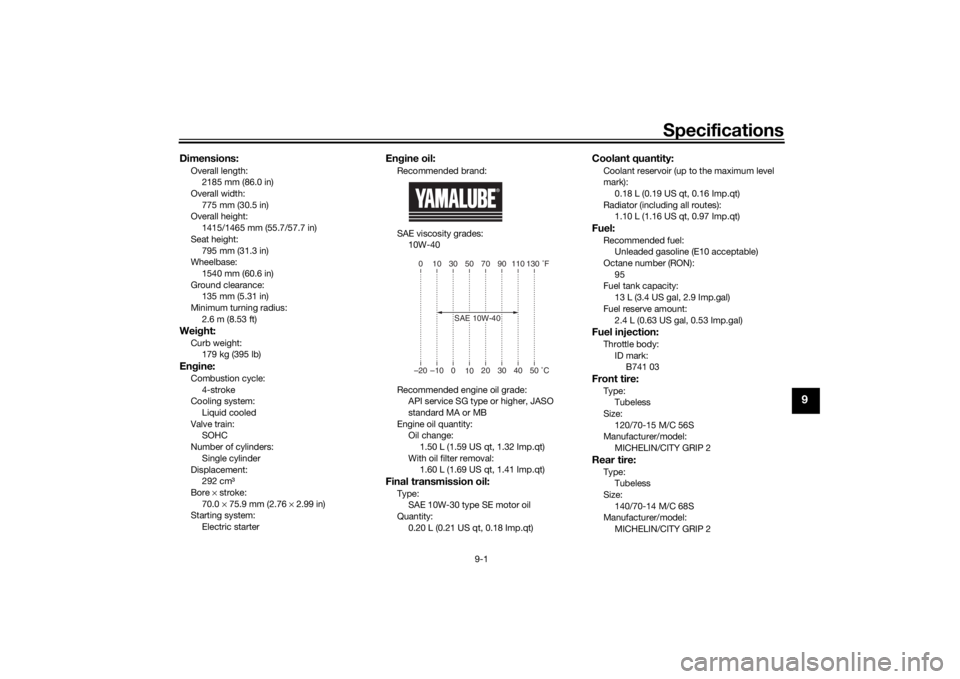
Engine oil:Recommended brand:
SAE viscosity grades:
10W-40
Recommended engine oil grade: API service SG type or higher, JASO
standard MA or MB
Engine oil quantity: Oil change:1.50 L (1.59 US qt, 1.32 Imp.qt)
With oil filter removal: 1.60 L (1.69 US qt, 1.41 Imp.qt)Final transmission oil:Type:SAE 10W-30 type SE motor oil
Quantity: 0.20 L (0.21 US qt, 0.18 Imp.qt)
Coolant quantity:Coolant reservoir (up to the maximum level
mark):0.18 L (0.19 US qt, 0.16 Imp.qt)
Radiator (including all routes): 1.10 L (1.16 US qt, 0.97 Imp.qt)Fuel:Recommended fuel:Unleaded gasoline (E10 acceptable)
Octane number (RON): 95
Fuel tank capacity:
13 L (3.4 US gal, 2.9 Imp.gal)
Fuel reserve amount: 2.4 L (0.63 US gal, 0.53 Imp.gal)Fuel injection:Throttle body:
ID mark:B741 03Front tire:Type: Tubeless
Size: 120/70-15 M/C 56S
Manufacturer/model:
MICHELIN/CITY GRIP 2Rear tire:Type:Tubeless
Size:
140/70-14 M/C 68S
Manufacturer/model: MICHELIN/CITY GRIP 2
–20 –10 0 1020 30 40 50 C
10 30 50 70 90 110
0 130 F
SAE 10W-40
UBBAE0E0.book Page 1 Thursday, September 24, 2020 3:19 PM
Page 111 of 114

Index
11-2
11
Throttle grip and cable, checking and
lubricating........................................... 7-26
Throttle grip free play, checking ........... 7-19
Tires ...................................................... 7-20
Tool kit .................................................... 7-2
Traction control system ........................ 4-15
Traction control system indicator light ... 4-2
TRIP/INFO switch ................................. 4-13
Troubleshooting.................................... 7-34
Troubleshooting chart .......................... 7-35
Turn signal indicator lights ..................... 4-1
Turn signal switch................................. 4-12VValve clearance .................................... 7-20
V-belt, checking.................................... 7-25
Vehicle identification number ............... 10-1WWheel bearings, checking .................... 7-28
Wheels .................................................. 7-22
Windshield ............................................ 4-22
UBBAE0E0.book Page 2 Thursday, September 24, 2020 3:19 PM