lock YAMAHA XMAX 400 2015 User Guide
[x] Cancel search | Manufacturer: YAMAHA, Model Year: 2015, Model line: XMAX 400, Model: YAMAHA XMAX 400 2015Pages: 92, PDF Size: 7.29 MB
Page 29 of 92
INSTRUMENT AND CONTROL FUNCTIONS
3-13
3 wheel hubs may be damaged, re-
sulting in improper performance of
the ABS system.
EAUM2991
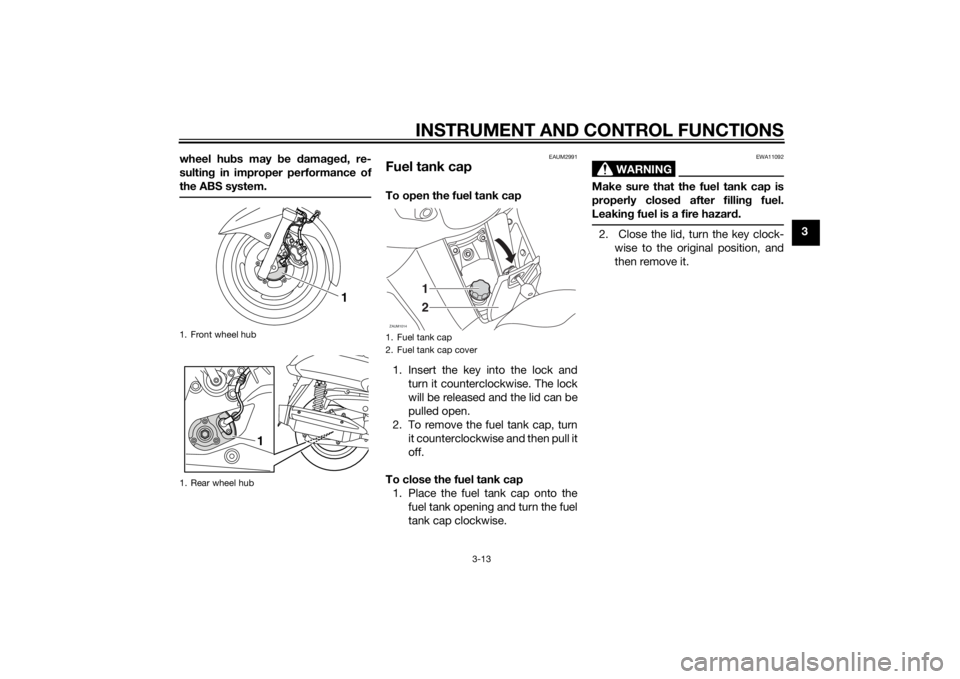
Fuel tank capTo open the fuel tank cap
1. Insert the key into the lock and
turn it counterclockwise. The lock
will be released and the lid can be
pulled open.
2. To remove the fuel tank cap, turn
it counterclockwise and then pull it
off.
To close the fuel tank cap
1. Place the fuel tank cap onto the
fuel tank opening and turn the fuel
tank cap clockwise.
WARNING
EWA11092
Make sure that the fuel tank cap is
properly closed after filling fuel.
Leaking fuel is a fire hazard.2. Close the lid, turn the key clock-
wise to the original position, and
then remove it.
1. Front wheel hub
1. Rear wheel hub
1
1
1. Fuel tank cap
2. Fuel tank cap coverZAUM1014
12
U1SDE1E0.book Page 13 Monday, September 23, 2013 3:55 PM
Page 32 of 92
INSTRUMENT AND CONTROL FUNCTIONS
3-16
3
EAU13933
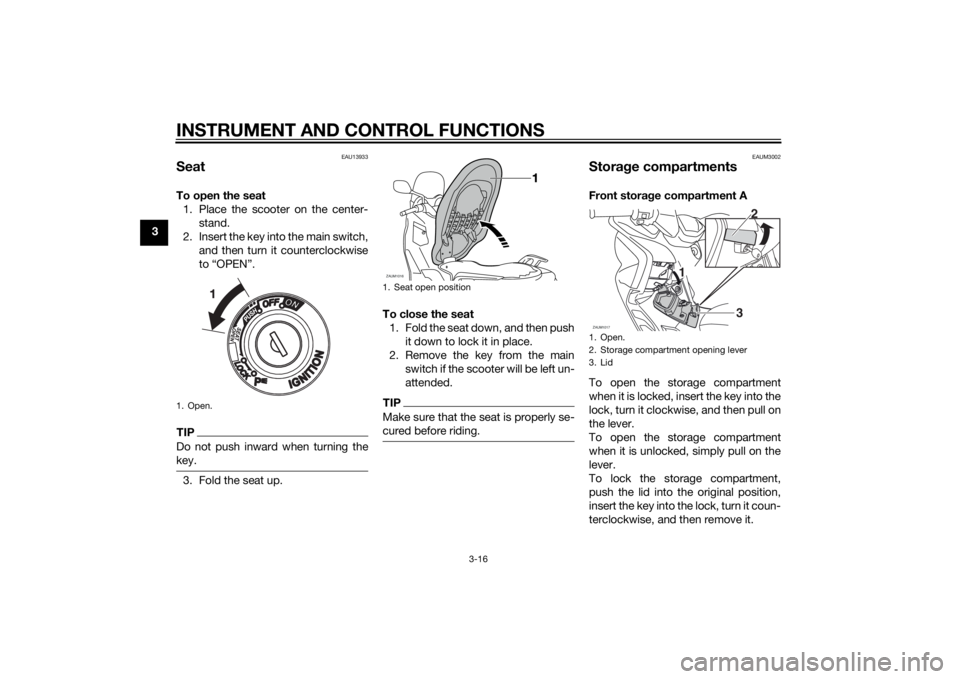
SeatTo open the seat
1. Place the scooter on the center-
stand.
2. Insert the key into the main switch,
and then turn it counterclockwise
to “OPEN”.TIPDo not push inward when turning the
key.3. Fold the seat up.To close the seat
1. Fold the seat down, and then push
it down to lock it in place.
2. Remove the key from the main
switch if the scooter will be left un-
attended.
TIPMake sure that the seat is properly se-
cured before riding.
EAUM3002
Storage compartmentsFront storage compartment A
To open the storage compartment
when it is locked, insert the key into the
lock, turn it clockwise, and then pull on
the lever.
To open the storage compartment
when it is unlocked, simply pull on the
lever.
To lock the storage compartment,
push the lid into the original position,
insert the key into the lock, turn it coun-
terclockwise, and then remove it.
1. Open.
1. Seat open positionZAUM1016
1. Open.
2. Storage compartment opening lever
3. LidZAUM1017
3
1 12
U1SDE1E0.book Page 16 Monday, September 23, 2013 3:55 PM
Page 65 of 92
PERIODIC MAINTENANCE AND ADJUSTMENT
6-22
6 Tire information
This model is equipped with tubeless
tires.
Tires age, even if they have not been
used or have only been used occasion-
ally. Cracking of the tread and sidewall
rubber, sometimes accompanied by
carcass deformation, is an evidence of
ageing. Old and aged tires shall be
checked by tire specialists to ascertain
their suitability for further use.
After extensive tests, only the tires list-
ed below have been approved for this
model by Yamaha Motor Co., Ltd.
WARNING
EWA10472
Have a Yamaha dealer replace
excessively worn tires. Besides
being illegal, operating the vehi-
cle with excessively worn tires
decreases riding stability and
can lead to loss of control.
The replacement of all wheel
and brake-related parts, includ-
ing the tires, should be left to a
Yamaha dealer, who has the
necessary professional knowl-
edge and experience to do so.
Ride at moderate speeds after
changing a tire since the tire
surface must first be “broken
in” for it to develop its optimal
characteristics.
EAU21995
Cast wheelsTo maximize the performance, durabil-
ity, and safe operation of your vehicle,
note the following points regarding the
specified wheels.
The wheel rims should be
checked for cracks, bends, warp-
age or other damage before each
ride. If any damage is found, have
a Yamaha dealer replace the
wheel. Do not attempt even the
smallest repair to the wheel. A de-
formed or cracked wheel must be
replaced.
The wheel should be balanced
whenever either the tire or wheel
has been changed or replaced. An
unbalanced wheel can result in
poor performance, adverse han-
dling characteristics, and a short-
ened tire life.
After repairing or replacing the
rear tire, tighten the valve stem nut
and locknut to the specified
torques.
Front tire:
Size:
120/70-15 M/C 56S
Manufacturer/model:
MICHELIN/CITY GRIP
SAVA/DIAMONDS MC28
Rear tire:
Size:
150/70-13 M/C 64S
Manufacturer/model:
MICHELIN/CITY GRIP
SAVA/DIAMONDS MC28
U1SDE1E0.book Page 22 Monday, September 23, 2013 3:55 PM
Page 66 of 92
PERIODIC MAINTENANCE AND ADJUSTMENT
6-23
6
EAU50861
Checking the front and rear
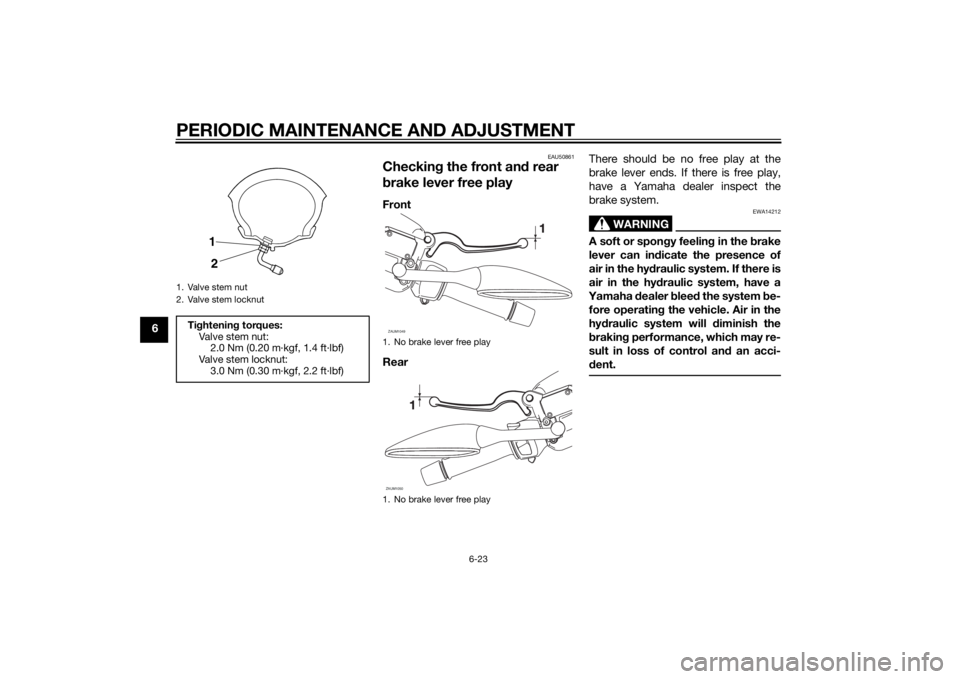
brake lever free playFront
RearThere should be no free play at the
brake lever ends. If there is free play,
have a Yamaha dealer inspect the
brake system.
WARNING
EWA14212
A soft or spongy feeling in the brake
lever can indicate the presence of
air in the hydraulic system. If there is
air in the hydraulic system, have a
Yamaha dealer bleed the system be-
fore operating the vehicle. Air in the
hydraulic system will diminish the
braking performance, which may re-
sult in loss of control and an acci-
dent.
1. Valve stem nut
2. Valve stem locknutTightening torques:
Valve stem nut:
2.0 Nm (0.20 m·kgf, 1.4 ft·lbf)
Valve stem locknut:
3.0 Nm (0.30 m·kgf, 2.2 ft·lbf)
1
2
1. No brake lever free play
1. No brake lever free playZAUM1049ZAUM1050
U1SDE1E0.book Page 23 Monday, September 23, 2013 3:55 PM
Page 68 of 92
PERIODIC MAINTENANCE AND ADJUSTMENT
6-25
6Rear brake
WARNING
EWA16011
Improper maintenance can result in
loss of braking ability. Observe
these precautions:
Insufficient brake fluid may al-
low air to enter the brake sys-
tem, reducing braking
performance.
Clean the filler cap before re-
moving. Use only DOT 4 brake
fluid from a sealed container.Use only the specified brake flu-
id; otherwise, the rubber seals
may deteriorate, causing leak-
age.
Refill with the same type of
brake fluid. Adding a brake fluid
other than DOT 4 may result in a
harmful chemical reaction.
Be careful that water or dust
does not enter the brake fluid
reservoir when refilling. Water
will significantly lower the boil-
ing point of the fluid and may re-
sult in vapor lock, an
d dirt may
clog the ABS hydraulic unit
valves.
NOTICE
ECA17641
Brake fluid may damage painted
surfaces or plastic parts. Always
clean up spilled fluid immediately.As the brake pads wear, it is normal for
the brake fluid level to gradually go
down. A low brake fluid level may indi-
cate worn brake pads and/or brake
system leakage; therefore, be sure to
check the brake pads for wear and the
brake system for leakage. If the brakefluid level goes down suddenly, have a
Yamaha dealer check the cause before
further riding.
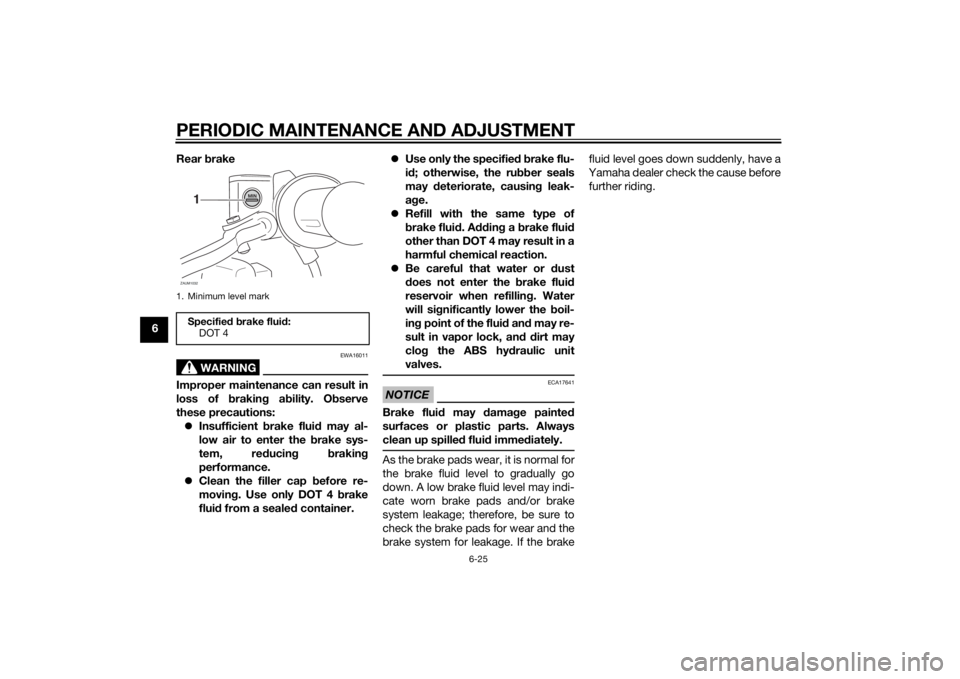
1. Minimum level markSpecified brake fluid:
DOT 4ZAUM1032
1
U1SDE1E0.book Page 25 Monday, September 23, 2013 3:55 PM
Page 76 of 92

PERIODIC MAINTENANCE AND ADJUSTMENT
6-33
6
EAU24182
Tail/brake lightThis model is equipped with an LED-
type tail/brake light.
If the tail/brake light does not come on,
have a Yamaha dealer check it.
EAU39881
Front turn signal lightIf a front turn signal light does not
come on, have a Yamaha dealer check
its electrical circuit or replace the bulb.
EAUM3062
Replacing a rear turn signal
light bulb1. Place the scooter on the center-
stand.
2. Open the seat. (See page 3-16.)
3. Remove the rear storage com-
partment by removing the bolts.
4. Remove the socket (together with
the turn signal light bulb) by turn-
ing it counterclockwise.
5. Remove the burnt-out bulb by
pushing it in and turning it coun-
terclockwise.1. Bolt
2. Storage compartmentZAUM1052
1
2
U1SDE1E0.book Page 33 Monday, September 23, 2013 3:55 PM
Page 77 of 92

PERIODIC MAINTENANCE AND ADJUSTMENT
6-34
6 6. Insert a new bulb into the socket,
push it in, and then turn it clock-
wise until it stops.
7. Install the socket (together with
the bulb) by turning it clockwise.8. Place the rear storage compart-
ment in the original position and
install the bolts.
9. Close the seat.
EAUM2203
Replacing the license plate
light bulb1. Remove the socket (together with
the bulb) by pulling it out.
2. Remove the burnt-out bulb by
pulling it out.
3. Insert a new bulb into the socket.
4. Install the socket (together with
the bulb) by pushing it in.
1. Turn signal light bulb socket
1. Turn signal light bulb
2. Turn signal light bulb socketZAUM1038
1
ZAUM1039
1
2
1. License plate light bulb socketZAUM1041
1
U1SDE1E0.book Page 34 Monday, September 23, 2013 3:55 PM
Page 80 of 92
PERIODIC MAINTENANCE AND ADJUSTMENT
6-37
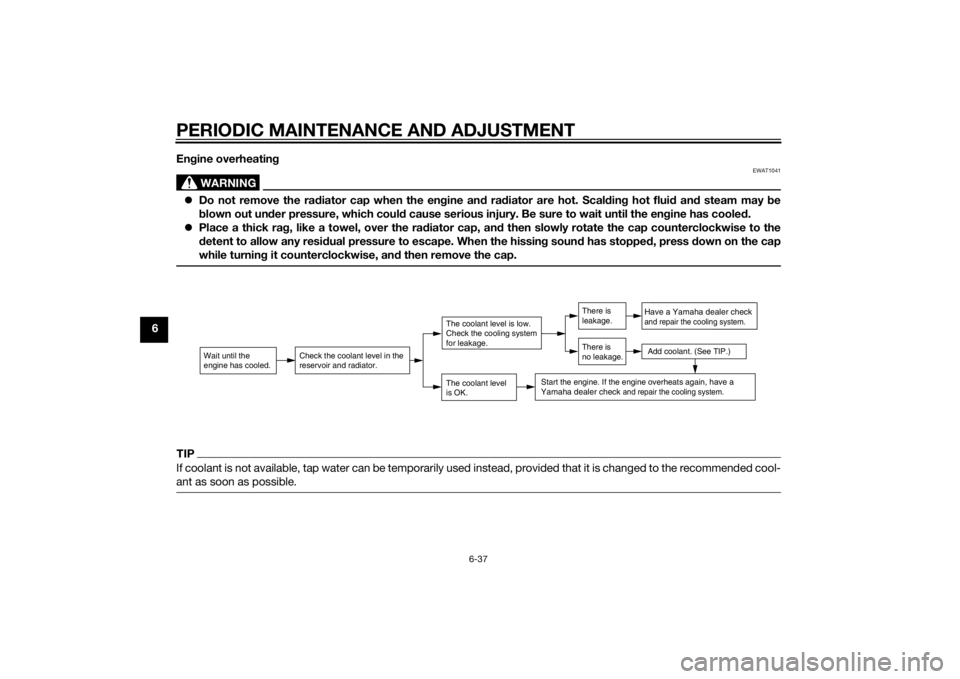
6Engine overheating
WARNING
EWAT1041
Do not remove the radiator cap when the engine and radiator are hot. Scalding hot fluid and steam may be
blown out under pressure, which could cause serious injury. Be sure to wait until the engine has cooled.
Place a thick rag, like a towel, over the radiator cap, and then slowly rotate the cap counterclockwise to the
detent to allow any residual pressure to escape. When the hissing sound has stopped, press down on the cap
while turning it counterclockwise, and then remove the cap.TIPIf coolant is not available, tap water can be temporarily used instead, provided that it is changed to the recommended cool-
ant as soon as possible.
Wait until the
engine has cooled.
Check the coolant level in the
reservoir and radiator.
The coolant level
is OK.The coolant level is low.
Check the cooling system
for leakage.
Have a Yamaha dealer checkand repair the cooling system.Add coolant. (See TIP.)
Start the engine. If the engine overheats again,
have a
Yamaha dealer check
and repair the cooling system.
There is
leakage.
There is
no leakage.
U1SDE1E0.book Page 37 Monday, September 23, 2013 3:55 PM
Page 89 of 92

10-1
10
INDEX
AABS (for ABS models) .......................... 3-12
ABS warning light (for ABS models) ....... 3-4
Acceleration and deceleration ................ 5-3
Air filter elements and check hoses
and V-belt case air filter element ....... 6-18
Anti-theft alarm (optional) ..................... 3-10
Auxiliary light ........................................ 6-35BBattery .................................................. 6-29
Brake fluid, changing............................ 6-26
Brake fluid level, checking.................... 6-24
Brake lever, front .................................. 3-11
Brake lever, rear ................................... 3-12
Brake levers, lubricating ....................... 6-27
Braking ................................................... 5-3CCables, checking and lubricating ......... 6-26
Care ........................................................ 7-1
Catalytic converters.............................. 3-15
Centerstand and sidestand, checking
and lubricating ................................... 6-27
Coolant ................................................. 6-16DDimmer switch...................................... 3-11EEngine break-in ...................................... 5-4
Engine oil and oil filter element............. 6-13
Engine trouble warning light ................... 3-4FFinal transmission oil ............................ 6-15
Front and rear brake lever free play,
checking ............................................. 6-23
Front and rear brake pads, checking ... 6-24Front fork, checking ............................. 6-28
Front turn signal light ........................... 6-33
Fuel ...................................................... 3-14
Fuel consumption, tips for reducing ...... 5-4
Fuel tank cap........................................ 3-13
Fuses, replacing ................................... 6-31
HHandlebar switches ............................. 3-10
Hazard switch ...................................... 3-11
Headlight bulb, replacing ..................... 6-32
High beam indicator light ....................... 3-4
Horn switch .......................................... 3-11IIdentification numbers ........................... 9-1
Ignition circuit cut-off system .............. 3-19
Immobilizer system ................................ 3-1
Immobilizer system indicator light ......... 3-4
Indicator lights and warning lights ......... 3-3LLicense plate light bulb, replacing ....... 6-34MMain switch/steering lock ...................... 3-2
Maintenance and lubrication, periodic... 6-4
Maintenance, emission control
system ................................................. 6-3
Matte color, caution ............................... 7-1
Model label............................................. 9-1
Multi-function display............................. 3-6PPanels, removing and installing ............. 6-8
Parking ................................................... 5-5
Part locations ......................................... 2-1
Pass switch .......................................... 3-11
SSafe-riding points ................................... 1-5
Safety information................................... 1-1
Seat....................................................... 3-16
Shock absorber assemblies,
adjusting ............................................. 3-18
Sidestand.............................................. 3-18
Spark plug, checking ............................ 6-11
Specifications ......................................... 8-1
Speedometer .......................................... 3-5
Starting off .............................................. 5-2
Starting the engine ................................. 5-1
Start switch ........................................... 3-11
Steering, checking ................................ 6-29
Storage ................................................... 7-4
Storage compartments ......................... 3-16TTachometer............................................. 3-6
Tail/brake light ...................................... 6-33
Throttle grip and cable, checking and
lubricating ........................................... 6-26
Throttle grip free play, checking ........... 6-20
Tires ...................................................... 6-21
Tool kit .................................................... 6-2
Troubleshooting .................................... 6-35
Troubleshooting charts ......................... 6-36
Turn signal indicator lights...................... 3-3
Turn signal light bulb (rear),
replacing ............................................. 6-33
Turn signal switch ................................. 3-11VValve clearance..................................... 6-20
Vehicle identification number ................. 9-1
U1SDE1E0.book Page 1 Monday, September 23, 2013 3:55 PM