warning YAMAHA XMAX 400 2015 Owner's Manual
[x] Cancel search | Manufacturer: YAMAHA, Model Year: 2015, Model line: XMAX 400, Model: YAMAHA XMAX 400 2015Pages: 92, PDF Size: 7.29 MB
Page 40 of 92
OPERATION AND IMPORTANT RIDING POINTS
5-2
5
NOTICE
ECA15025
If a warning light, indicator light or
indicator does not go off, see pages
3-3, 3-6, 3-8, 3-8 or 3-8 for the corre-
sponding warning light, indicator
light or indicator circuit check.2. Close the throttle completely.
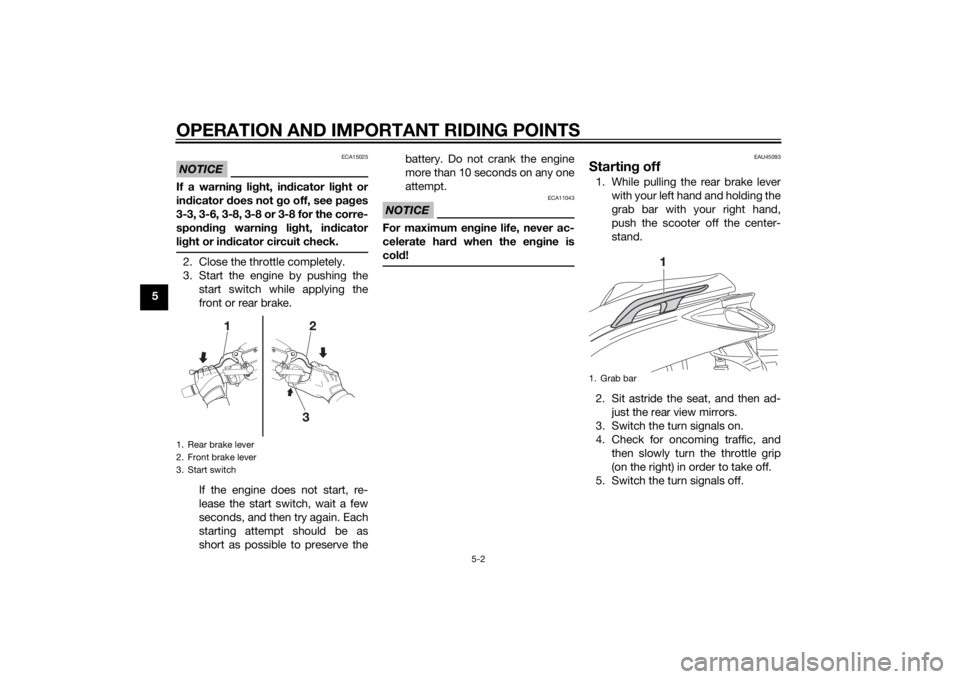
3. Start the engine by pushing the
start switch while applying the
front or rear brake.
If the engine does not start, re-
lease the start switch, wait a few
seconds, and then try again. Each
starting attempt should be as
short as possible to preserve thebattery. Do not crank the engine
more than 10 seconds on any one
attempt.
NOTICE
ECA11043
For maximum engine life, never ac-
celerate hard when the engine is
cold!
EAU45093
Starting off1. While pulling the rear brake lever
with your left hand and holding the
grab bar with your right hand,
push the scooter off the center-
stand.
2. Sit astride the seat, and then ad-
just the rear view mirrors.
3. Switch the turn signals on.
4. Check for oncoming traffic, and
then slowly turn the throttle grip
(on the right) in order to take off.
5. Switch the turn signals off.
1. Rear brake lever
2. Front brake lever
3. Start switch
1. Grab bar
U1SDE1E0.book Page 2 Monday, September 23, 2013 3:55 PM
Page 41 of 92
OPERATION AND IMPORTANT RIDING POINTS
5-3
5
EAU16782
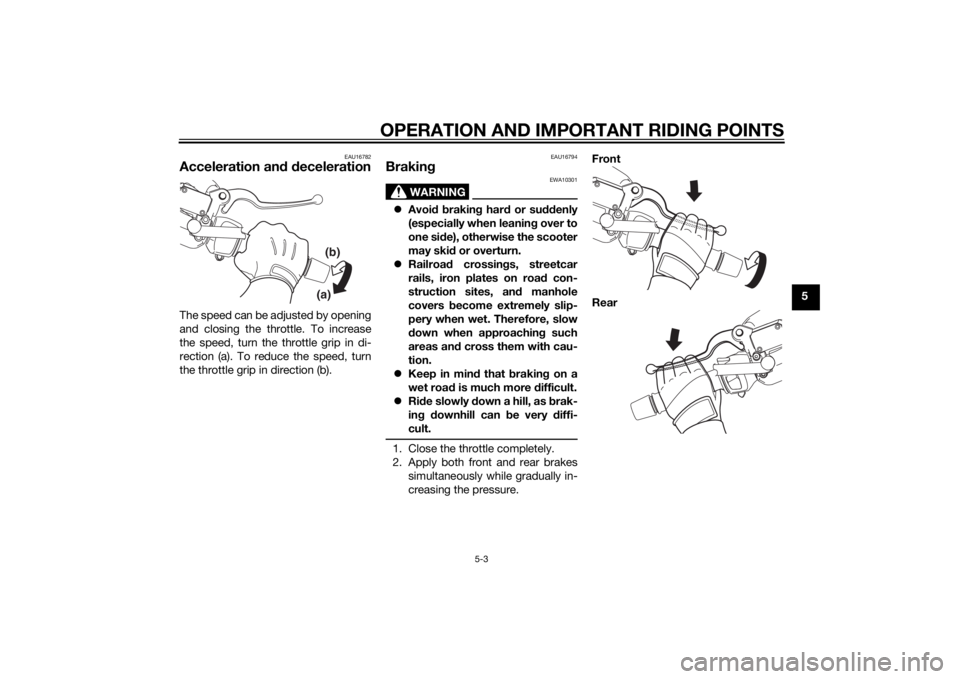
Acceleration and decelerationThe speed can be adjusted by opening
and closing the throttle. To increase
the speed, turn the throttle grip in di-
rection (a). To reduce the speed, turn
the throttle grip in direction (b).
EAU16794
Braking
WARNING
EWA10301
Avoid braking hard or suddenly
(especially when leaning over to
one side), otherwise the scooter
may skid or overturn.
Railroad crossings, streetcar
rails, iron plates on road con-
struction sites, and manhole
covers become extremely slip-
pery when wet. Therefore, slow
down when approaching such
areas and cross them with cau-
tion.
Keep in mind that braking on a
wet road is much more difficult.
Ride slowly down a hill, as brak-
ing downhill can be very diffi-
cult.1. Close the throttle completely.
2. Apply both front and rear brakes
simultaneously while gradually in-
creasing the pressure.Front
Rear
(a)(b)
U1SDE1E0.book Page 3 Monday, September 23, 2013 3:55 PM
Page 43 of 92
OPERATION AND IMPORTANT RIDING POINTS
5-5
5
EAU17214
ParkingWhen parking, stop the engine, and
then remove the key from the main
switch.
WARNING
EWA10312
Since the engine and exhaust
system can become very hot,
park in a place where pedestri-
ans or children are not likely to
touch them and be burned.
Do not park on a slope or on soft
ground, otherwise the vehicle
may overturn, increasing the
risk of a fuel leak and fire.
Do not park near grass or other
flammable materials which
might catch fire.
U1SDE1E0.book Page 5 Monday, September 23, 2013 3:55 PM
Page 44 of 92
PERIODIC MAINTENANCE AND ADJUSTMENT
6-1
6
EAUS1824
Periodic inspection, adjustment, and
lubrication will keep your vehicle in the
safest and most efficient condition
possible. Safety is an obligation of the
vehicle owner/operator. The most im-
portant points of vehicle inspection,
adjustment, and lubrication are ex-
plained on the following pages.
The intervals given in the periodic
maintenance charts should be simply
considered as a general guide under
normal riding conditions. However, de-
pending on the weather, terrain, geo-
graphical location, and individual use,
the maintenance intervals may need to
be shortened.
WARNING
EWA10322
Failure to properly maintain the vehi-
cle or performing maintenance ac-
tivities incorrectly may increase
your risk of injury or death during
service or while using the vehicle. If
you are not familiar with vehicle ser-
vice, have a Yamaha dealer perform
service.
WARNING
EWA15123
Turn off the engine when performing
maintenance unless otherwise
specified.
A running engine has moving
parts that can catch on body
parts or clothing and electrical
parts that can cause shocks or
fires.
Running the engine while ser-
vicing can lead to eye injury,
burns, fire, or carbon monoxide
poisoning – possibly leading to
death. See page 1-3 for more in-
formation about carbon monox-
ide.
WARNING
EWA10331
This scooter is designed for use on
paved roads only. If this scooter is
operated in abnormally dusty, mud-
dy or wet conditions, the air filter el-
ement should be cleaned or
replaced more frequently, otherwise
rapid engine wear may result. Con-
sult a Yamaha dealer for proper
maintenance intervals.
WARNING
EWA15461
Brake discs, calipers, drums, and
linings can become very hot during
use. To avoid possible burns, let
brake components cool before
touching them.
U1SDE1E0.book Page 1 Monday, September 23, 2013 3:55 PM
Page 59 of 92
PERIODIC MAINTENANCE AND ADJUSTMENT
6-16
6
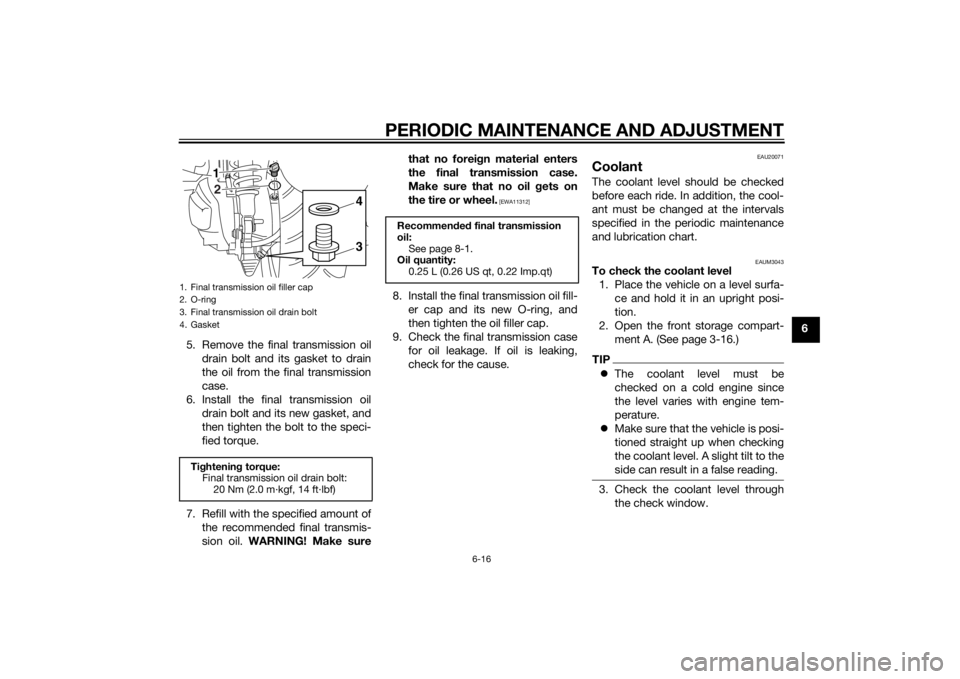
5. Remove the final transmission oil
drain bolt and its gasket to drain
the oil from the final transmission
case.
6. Install the final transmission oil
drain bolt and its new gasket, and
then tighten the bolt to the speci-
fied torque.
7. Refill with the specified amount of
the recommended final transmis-
sion oil. WARNING! Make surethat no foreign material enters
the final transmission case.
Make sure that no oil gets on
the tire or wheel.
[EWA11312]
8. Install the final transmission oil fill-
er cap and its new O-ring, and
then tighten the oil filler cap.
9. Check the final transmission case
for oil leakage. If oil is leaking,
check for the cause.
EAU20071
CoolantThe coolant level should be checked
before each ride. In addition, the cool-
ant must be changed at the intervals
specified in the periodic maintenance
and lubrication chart.
EAUM3043
To check the coolant level
1. Place the vehicle on a level surfa-
ce and hold it in an upright posi-
tion.
2. Open the front storage compart-
ment A. (See page 3-16.)TIPThe coolant level must be
checked on a cold engine since
the level varies with engine tem-
perature.
Make sure that the vehicle is posi-
tioned straight up when checking
the coolant level. A slight tilt to the
side can result in a false reading.3. Check the coolant level through
the check window.
1. Final transmission oil filler cap
2. O-ring
3. Final transmission oil drain bolt
4. GasketTightening torque:
Final transmission oil drain bolt:
20 Nm (2.0 m·kgf, 14 ft·lbf)
21
34
Recommended final transmission
oil:
See page 8-1.
Oil quantity:
0.25 L (0.26 US qt, 0.22 Imp.qt)
U1SDE1E0.book Page 16 Monday, September 23, 2013 3:55 PM
Page 60 of 92

PERIODIC MAINTENANCE AND ADJUSTMENT
6-17
6
TIPThe coolant should be between the mi-
nimum and maximum level marks.4. If the coolant is at or below the mi-
nimum level mark, remove panel
B. (See page 6-8.)
5. Open the reservoir cap, and then
add coolant to the maximum level
mark. WARNING! Remove only
the coolant reservoir cap. Never
attempt to remove the radiator
cap when the engine is hot.
[EWA15162]
NOTICE: If coolant is not
available, use distilled water or
soft tap water instead. Do not
use hard water or salt watersince it is harmful to the engine.
If water has been used instead
of coolant, replace it with cool-
ant as soon as possible, other-
wise the cooling system will not
be protected against frost and
corrosion. If water has been
added to the coolant, have a
Yamaha dealer check the anti-
freeze content of the coolant as
soon as possible, otherwise the
effectiveness of the coolant will
be reduced.
[ECA10473]
6. Close the reservoir cap, and then
install the panel.7. Close the front storage compart-
ment.
EAU33032
Changing the coolant
The coolant must be changed at the in-
tervals specified in the periodic main-
tenance and lubrication chart. Have a
Yamaha dealer change the coolant.
WARNING! Never attempt to remove
the radiator cap when the engine is
hot.
[EWA10382]
1. Maximum level mark
2. Minimum level markZAUM1029
2 1
Coolant LevelCoolant L
evelH
ighH
igh
LowLo
w
1. Coolant reservoir capCoolant reservoir capacity:
0.31 L (0.33 US qt, 0.27 Imp.qt)ZAUM10301
U1SDE1E0.book Page 17 Monday, September 23, 2013 3:55 PM
Page 64 of 92
PERIODIC MAINTENANCE AND ADJUSTMENT
6-21
6
EAU21877
TiresTires are the only contact between the
vehicle and the road. Safety in all con-
ditions of riding depends on a relatively
small area of road contact. Therefore, it
is essential to maintain the tires in good
condition at all times and replace them
at the appropriate time with the speci-
fied tires.
Tire air pressure
The tire air pressure should be
checked and, if necessary, adjusted
before each ride.
WARNING
EWA10504
Operation of this vehicle with im-
proper tire pressure may cause se-
vere injury or death from loss of
control.
The tire air pressure must be
checked and adjusted on cold
tires (i.e., when the temperature
of the tires equals the ambient
temperature).
The tire air pressure must be
adjusted in accordance with the
riding speed and with the totalweight of rider, passenger, car-
go, and accessories approved
for this model.
WARNING
EWA10512
Never overload your vehicle. Opera-
tion of an overloaded vehicle could
cause an accident.
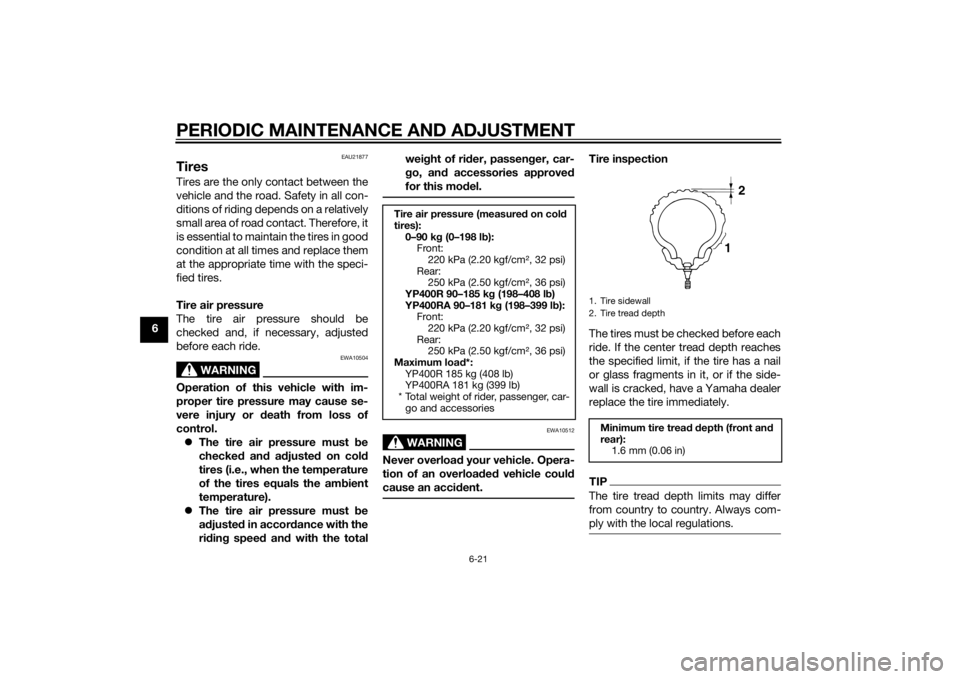
Tire inspection
The tires must be checked before each
ride. If the center tread depth reaches
the specified limit, if the tire has a nail
or glass fragments in it, or if the side-
wall is cracked, have a Yamaha dealer
replace the tire immediately.TIPThe tire tread depth limits may differ
from country to country. Always com-
ply with the local regulations.
Tire air pressure (measured on cold
tires):
0–90 kg (0–198 lb):
Front:
220 kPa (2.20 kgf/cm², 32 psi)
Rear:
250 kPa (2.50 kgf/cm², 36 psi)
YP400R 90–185 kg (198–408 lb)
YP400RA 90–181 kg (198–399 lb):
Front:
220 kPa (2.20 kgf/cm², 32 psi)
Rear:
250 kPa (2.50 kgf/cm², 36 psi)
Maximum load*:
YP400R 185 kg (408 lb)
YP400RA 181 kg (399 lb)
* Total weight of rider, passenger, car-
go and accessories
1. Tire sidewall
2. Tire tread depthMinimum tire tread depth (front and
rear):
1.6 mm (0.06 in)
12
U1SDE1E0.book Page 21 Monday, September 23, 2013 3:55 PM
Page 65 of 92
PERIODIC MAINTENANCE AND ADJUSTMENT
6-22
6 Tire information
This model is equipped with tubeless
tires.
Tires age, even if they have not been
used or have only been used occasion-
ally. Cracking of the tread and sidewall
rubber, sometimes accompanied by
carcass deformation, is an evidence of
ageing. Old and aged tires shall be
checked by tire specialists to ascertain
their suitability for further use.
After extensive tests, only the tires list-
ed below have been approved for this
model by Yamaha Motor Co., Ltd.
WARNING
EWA10472
Have a Yamaha dealer replace
excessively worn tires. Besides
being illegal, operating the vehi-
cle with excessively worn tires
decreases riding stability and
can lead to loss of control.
The replacement of all wheel
and brake-related parts, includ-
ing the tires, should be left to a
Yamaha dealer, who has the
necessary professional knowl-
edge and experience to do so.
Ride at moderate speeds after
changing a tire since the tire
surface must first be “broken
in” for it to develop its optimal
characteristics.
EAU21995
Cast wheelsTo maximize the performance, durabil-
ity, and safe operation of your vehicle,
note the following points regarding the
specified wheels.
The wheel rims should be
checked for cracks, bends, warp-
age or other damage before each
ride. If any damage is found, have
a Yamaha dealer replace the
wheel. Do not attempt even the
smallest repair to the wheel. A de-
formed or cracked wheel must be
replaced.
The wheel should be balanced
whenever either the tire or wheel
has been changed or replaced. An
unbalanced wheel can result in
poor performance, adverse han-
dling characteristics, and a short-
ened tire life.
After repairing or replacing the
rear tire, tighten the valve stem nut
and locknut to the specified
torques.
Front tire:
Size:
120/70-15 M/C 56S
Manufacturer/model:
MICHELIN/CITY GRIP
SAVA/DIAMONDS MC28
Rear tire:
Size:
150/70-13 M/C 64S
Manufacturer/model:
MICHELIN/CITY GRIP
SAVA/DIAMONDS MC28
U1SDE1E0.book Page 22 Monday, September 23, 2013 3:55 PM
Page 66 of 92
PERIODIC MAINTENANCE AND ADJUSTMENT
6-23
6
EAU50861
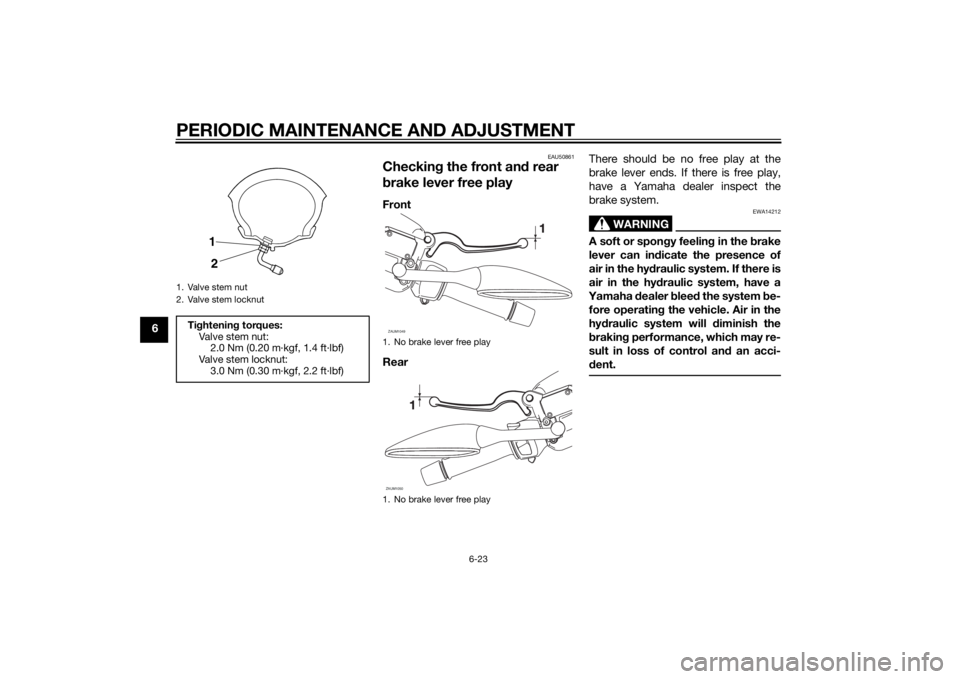
Checking the front and rear
brake lever free playFront
RearThere should be no free play at the
brake lever ends. If there is free play,
have a Yamaha dealer inspect the
brake system.
WARNING
EWA14212
A soft or spongy feeling in the brake
lever can indicate the presence of
air in the hydraulic system. If there is
air in the hydraulic system, have a
Yamaha dealer bleed the system be-
fore operating the vehicle. Air in the
hydraulic system will diminish the
braking performance, which may re-
sult in loss of control and an acci-
dent.
1. Valve stem nut
2. Valve stem locknutTightening torques:
Valve stem nut:
2.0 Nm (0.20 m·kgf, 1.4 ft·lbf)
Valve stem locknut:
3.0 Nm (0.30 m·kgf, 2.2 ft·lbf)
1
2
1. No brake lever free play
1. No brake lever free playZAUM1049ZAUM1050
U1SDE1E0.book Page 23 Monday, September 23, 2013 3:55 PM
Page 68 of 92
PERIODIC MAINTENANCE AND ADJUSTMENT
6-25
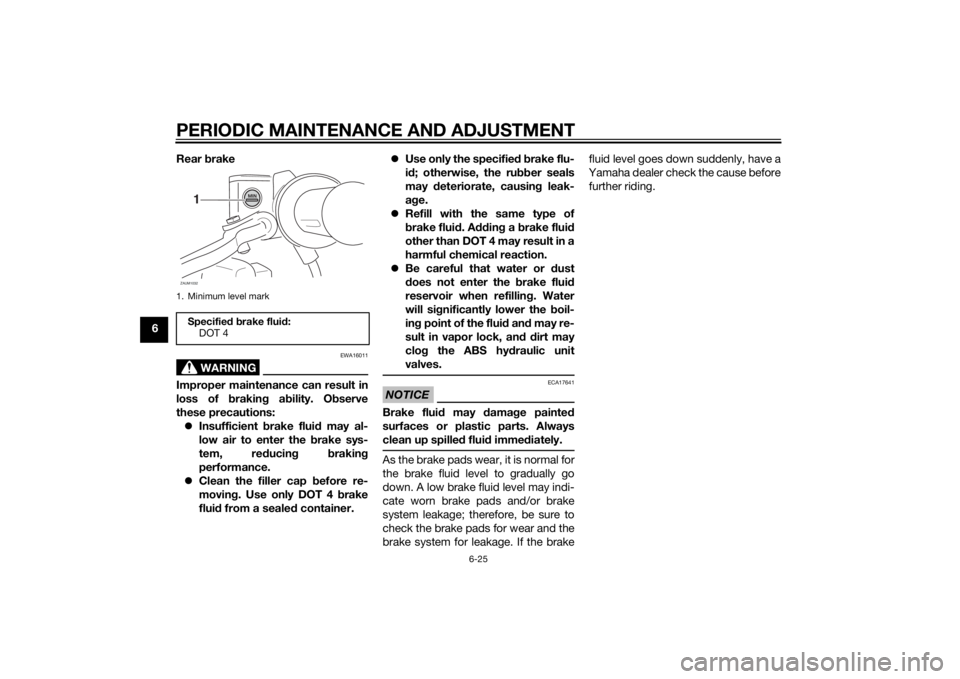
6Rear brake
WARNING
EWA16011
Improper maintenance can result in
loss of braking ability. Observe
these precautions:
Insufficient brake fluid may al-
low air to enter the brake sys-
tem, reducing braking
performance.
Clean the filler cap before re-
moving. Use only DOT 4 brake
fluid from a sealed container.Use only the specified brake flu-
id; otherwise, the rubber seals
may deteriorate, causing leak-
age.
Refill with the same type of
brake fluid. Adding a brake fluid
other than DOT 4 may result in a
harmful chemical reaction.
Be careful that water or dust
does not enter the brake fluid
reservoir when refilling. Water
will significantly lower the boil-
ing point of the fluid and may re-
sult in vapor lock, an
d dirt may
clog the ABS hydraulic unit
valves.
NOTICE
ECA17641
Brake fluid may damage painted
surfaces or plastic parts. Always
clean up spilled fluid immediately.As the brake pads wear, it is normal for
the brake fluid level to gradually go
down. A low brake fluid level may indi-
cate worn brake pads and/or brake
system leakage; therefore, be sure to
check the brake pads for wear and the
brake system for leakage. If the brakefluid level goes down suddenly, have a
Yamaha dealer check the cause before
further riding.
1. Minimum level markSpecified brake fluid:
DOT 4ZAUM1032
1
U1SDE1E0.book Page 25 Monday, September 23, 2013 3:55 PM