ABS YAMAHA XMAX 400 2018 User Guide
[x] Cancel search | Manufacturer: YAMAHA, Model Year: 2018, Model line: XMAX 400, Model: YAMAHA XMAX 400 2018Pages: 118, PDF Size: 9.03 MB
Page 69 of 118
Periodic maintenance and adjustment
7-5
7
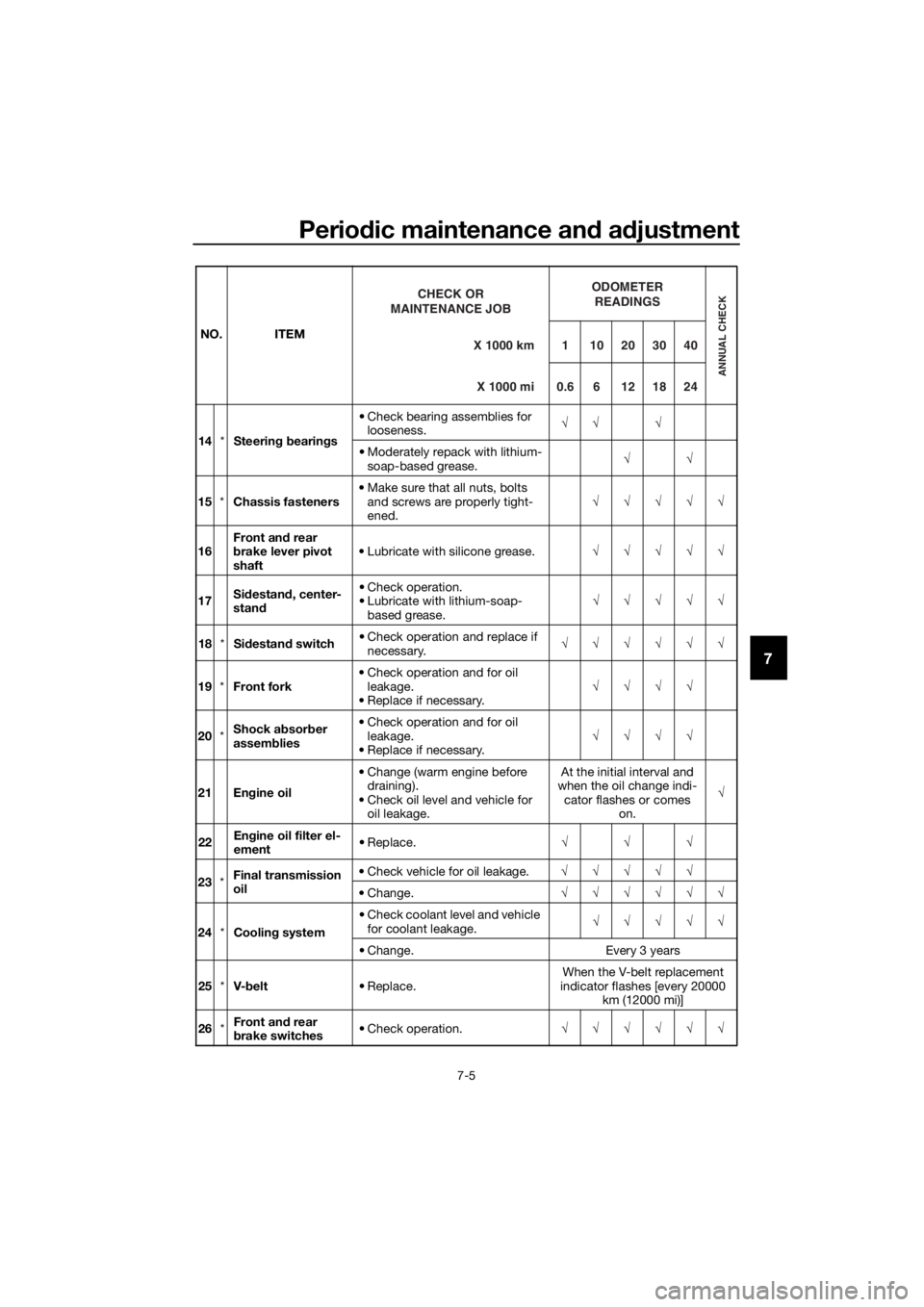
14*Steering bearings• Check bearing assemblies for
looseness.√√ √
• Moderately repack with lithium-
soap-based grease.√√
15*Chassis fasteners• Make sure that all nuts, bolts
and screws are properly tight-
ened.√√√√√
16Front and rear
brake lever pivot
shaft• Lubricate with silicone grease.√√√√√
17Sidestand, center-
stand• Check operation.
• Lubricate with lithium-soap-
based grease.√√√√√
18*Sidestand switch• Check operation and replace if
necessary.√√√√√√
19*Front fork• Check operation and for oil
leakage.
• Replace if necessary.√√√√
20*Shock absorber
assemblies• Check operation and for oil
leakage.
• Replace if necessary.√√√√
21 Engine oil• Change (warm engine before
draining).
• Check oil level and vehicle for
oil leakage.At the initial interval and
when the oil change indi-
cator flashes or comes
on.√
22Engine oil filter el-
ement• Replace.√√√
23*Final transmission
oil• Check vehicle for oil leakage.√√√√√
• Change.√√√√√√
24
*Cooling system• Check coolant level and vehicle
for coolant leakage.√√√√√
• Change. Every 3 years
25*V-belt• Replace.When the V-belt replacement
indicator flashes [every 20000
km (12000 mi)]
26*Front and rear
brake switches• Check operation.√√√√√√ NO. ITEM
X 1000 km CHECK OR
MAINTENANCE JOB
X 1000 mi
ODOMETER
READINGS
ANNUAL CHECK
110203040
0.66121824
UBL1E0E0.book Page 5 Thursday, May 11, 2017 8:51 AM
Page 88 of 118
Periodic maintenance and adjustment
7-24
7Clean the filler cap before re-
moving. Use only DOT 4 brake
fluid from a sealed container.
Use only the specified brake flu-
id; otherwise, the rubber seals
may deteriorate, causing leak-
age.
Refill with the same type of
brake fluid. Adding a brake fluid
other than DOT 4 may result in a
harmful chemical reaction.
Be careful that water or dust
does not enter the brake fluid
reservoir when refilling. Water
will significantly lower the boil-
ing point of the fluid and may re-
sult in vapor lock, and dirt may
clog the ABS hydraulic unit
valves.NOTICE
ECA17641
Brake fluid may damage painted
surfaces or plastic parts. Always
clean up spilled fluid immediately.
As the brake pads wear, it is normal for
the brake fluid level to gradually go
down. A low brake fluid level may indi-
cate worn brake pads and/or brake
system leakage; therefore, be sure to
check the brake pads for wear and the
brake system for leakage. If the brake
fluid level goes down suddenly, have a
Yamaha dealer check the cause before
further riding.
EAU22734
Changing the brake fluid
Have a Yamaha dealer change the
brake fluid every 2 years. In addition,
have the seals of the master cylinders
and brake calipers, as well as the brake
hoses replaced at the intervals listed
below or sooner if they are damaged or
leaking.
Brake seals: every 2 years
Brake hoses: every 4 years
UBL1E0E0.book Page 24 Thursday, May 11, 2017 8:51 AM
Page 95 of 118
Periodic maintenance and adjustment
7-31
7
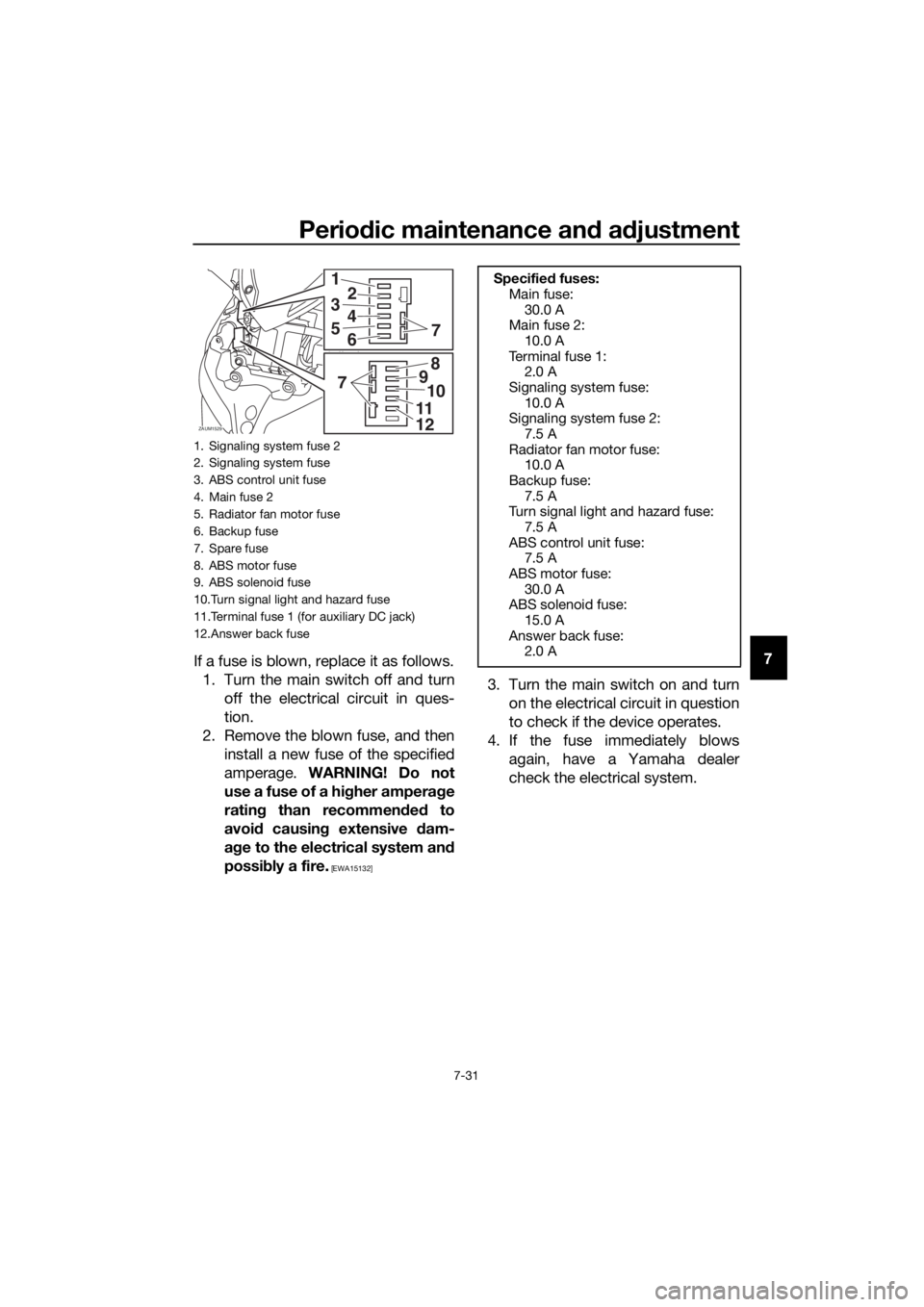
If a fuse is blown, replace it as follows.
1. Turn the main switch off and turn
off the electrical circuit in ques-
tion.
2. Remove the blown fuse, and then
install a new fuse of the specified
amperage. WARNING! Do not
use a fuse of a higher amperage
rating than recommended to
avoid causing extensive dam-
age to the electrical system and
possibly a fire.
[EWA15132]
3. Turn the main switch on and turn
on the electrical circuit in question
to check if the device operates.
4. If the fuse immediately blows
again, have a Yamaha dealer
check the electrical system.
1. Signaling system fuse 2
2. Signaling system fuse
3. ABS control unit fuse
4. Main fuse 2
5. Radiator fan motor fuse
6. Backup fuse
7. Spare fuse
8. ABS motor fuse
9. ABS solenoid fuse
10.Turn signal light and hazard fuse
11.Terminal fuse 1 (for auxiliary DC jack)
12.Answer back fuse
ZAUM1529
1234567
8910
11
12
7
Specified fuses:
Main fuse:
30.0 A
Main fuse 2:
10.0 A
Terminal fuse 1:
2.0 A
Signaling system fuse:
10.0 A
Signaling system fuse 2:
7.5 A
Radiator fan motor fuse:
10.0 A
Backup fuse:
7.5 A
Turn signal light and hazard fuse:
7.5 A
ABS control unit fuse:
7.5 A
ABS motor fuse:
30.0 A
ABS solenoid fuse:
15.0 A
Answer back fuse:
2.0 A
UBL1E0E0.book Page 31 Thursday, May 11, 2017 8:51 AM
Page 106 of 118
Scooter care and storage
8-3
8Cleaning the windshield
Avoid using any alkaline or strong acid
cleaner, gasoline, brake fluid, or any
other solvent. Clean the windshield
with a cloth or sponge dampened with
a neutral detergent, and after cleaning,
thoroughly wash it off with water. For
additional cleaning, use Yamaha Wind-
shield Cleaner or other quality cleaner.
Some cleaning compounds for plastics
may leave scratches on surfaces of the
windshield. Before using them, make a
test by polishing an area which does
not affect your visibility.
After cleaning
1. Dry the scooter with a chamois or
an absorbing cloth.
2. Use a chrome polish to shine
chrome, aluminum and stainless-
steel parts, including the exhaust
system. (Even the thermally in-
duced discoloring of stainless-
steel exhaust systems can be re-
moved through polishing.)
3. To prevent corrosion, it is recom-
mended to apply a corrosion pro-
tection spray on all metal,
including chrome- and nickel-plat-
ed, surfaces.
4. Use spray oil as a universal clean-
er to remove any remaining dirt.
5. Touch up minor paint damage
caused by stones, etc.
6. Wax all painted surfaces.
7. Let the scooter dry completely be-
fore storing or covering it.
WARNING
EWA10943
Contaminants on the brakes or tires
can cause loss of control.Make sure that there is no oil or
wax on the brakes or tires. If
necessary, clean the brake
discs and brake linings with a
regular brake disc cleaner or
acetone, and wash the tires with
warm water and a mild deter-
gent.
Before operating the scooter
test its braking performance
and cornering behavior.
NOTICE
ECAU0022
Apply spray oil and wax spar-
ingly and make sure to wipe off
any excess.
Never apply oil or wax to any
rubber parts, plastic parts or
headlight, taillight and meter
lenses, but treat them with a
suitable care product.
Avoid using abrasive polishing
compounds as they will wear
away the paint.
TIP
Consult a Yamaha dealer for ad-
vice on what products to use.
Washing, rainy weather or humid
climates can cause the headlight
lens to fog. Turning the headlight
on for a short period of time will
help remove the moisture from the
lens.
UBL1E0E0.book Page 3 Thursday, May 11, 2017 8:51 AM
Page 110 of 118

Specifications
9-2
9
Trail:
95 mm (3.7 in)
Front tire:
Type:
Tubeless
Size:
120/70-15 M/C 56S
Manufacturer/model:
MICHELIN/CITY GRIP
Rear tire:
Type:
Tubeless
Size:
150/70-13 M/C 64S
Manufacturer/model:
MICHELIN/CITY GRIP
Loading:
Maximum load:
184 kg (406 lb)
(Total weight of rider, passenger, cargo
and accessories)
Tire air pressure (measured on cold
tires):
1 person:
Front:
220 kPa (2.20 kgf/cm², 32 psi)
Rear:
250 kPa (2.50 kgf/cm², 36 psi)
2 persons:
Front:
220 kPa (2.20 kgf/cm², 32 psi)
Rear:
250 kPa (2.50 kgf/cm², 36 psi)
Front wheel:
Wheel type:
Cast wheel
Rim size:
15 x MT3.50
Rear wheel:
Wheel type:
Cast wheel
Rim size:
13 x MT4.00
Front brake:
Type:
Hydraulic dual disc brake
Specified brake fluid:
DOT 4
Rear brake:
Type:
Hydraulic single disc brake
Specified brake fluid:
DOT 4
Front suspension:
Type:
Telescopic fork
Spring:
Coil spring
Shock absorber:
Hydraulic damper
Wheel travel:
110 mm (4.3 in)
Rear suspension:
Type:
Unit swing
Spring:
Coil spring
Shock absorber:
Hydraulic damper
Wheel travel:
107 mm (4.2 in)
Electrical system:
System voltage:
12 V
Ignition system:
TCI
Charging system:
AC magneto
Battery:
Model:
GTZ8V
Voltage, capacity:
12 V, 7.0 Ah (10 HR)
Bulb wattage:
Headlight:
LED
Brake/tail light:
LED
Front turn signal light:
10.0 W × 2
Rear turn signal light:
10.0 W × 2
Auxiliary light:
LED
License plate light:
5.0 W × 1
Meter lighting:
LED
UBL1E0E0.book Page 2 Thursday, May 11, 2017 8:51 AM
Page 111 of 118

Specifications
9-3
9
High beam indicator light:
LED
Turn signal indicator light:
LED
Engine trouble warning light:
LED
ABS warning light:
LED
Smart key system indicator light:
LED
Traction control system indicator/warning
light:
LED
Fuse(s):
Main fuse:
30.0 A
Main fuse 2:
10.0 A
Terminal fuse 1:
2.0 A
Signaling system fuse:
10.0 A
Signaling system fuse 2:
7.5 A
Radiator fan motor fuse:
10.0 A
Turn signal light and hazard fuse:
7.5 A
ABS control unit fuse:
7.5 A
ABS motor fuse:
30.0 A
ABS solenoid fuse:
15.0 A
Answer back fuse:
2.0 A
Backup fuse:
7.5 A
UBL1E0E0.book Page 3 Thursday, May 11, 2017 8:51 AM
Page 113 of 118
Consumer information
10-2
10
EAUM3881
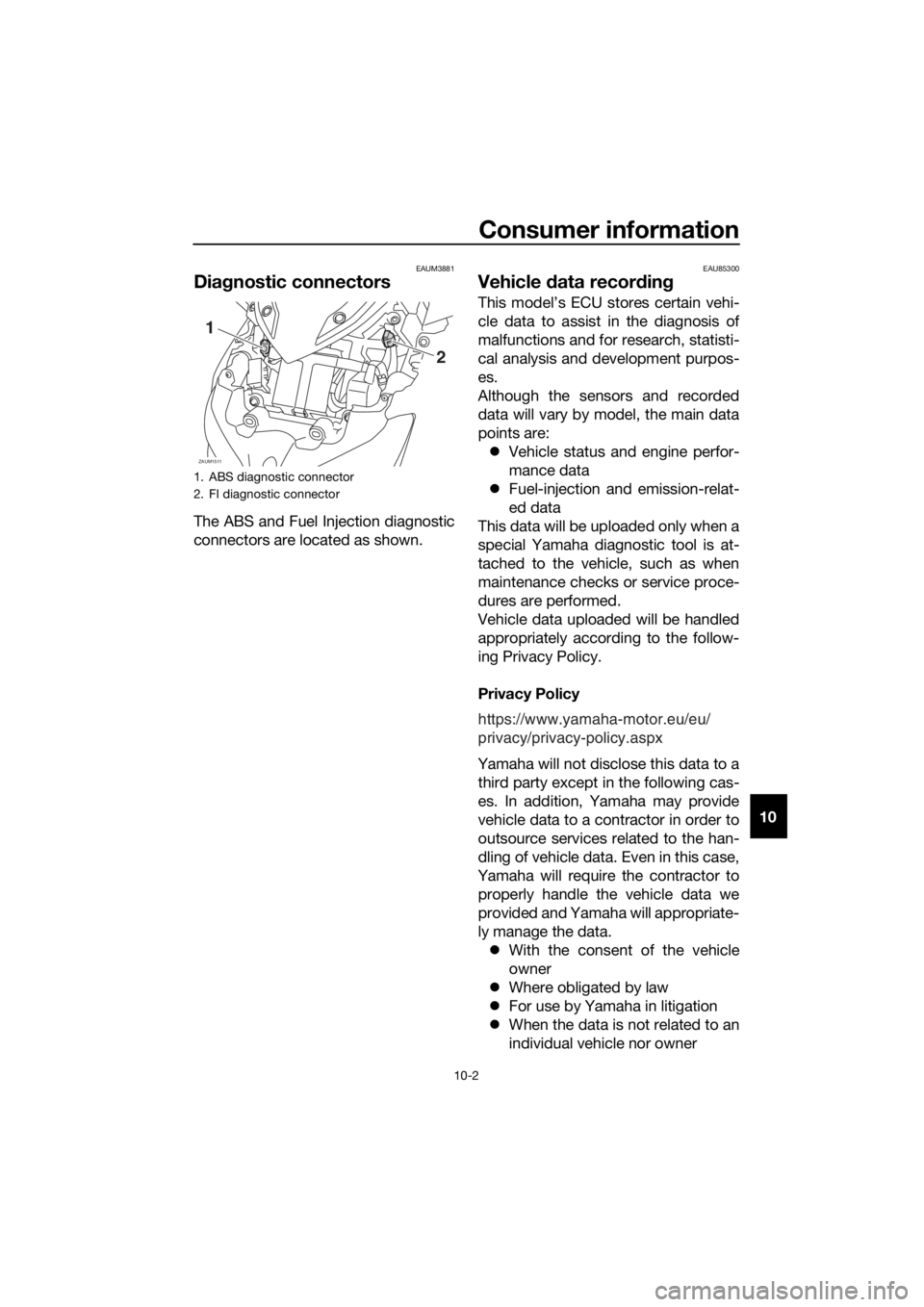
Diagnostic connectors
The ABS and Fuel Injection diagnostic
connectors are located as shown.
EAU85300
Vehicle data recording
This model’s ECU stores certain vehi-
cle data to assist in the diagnosis of
malfunctions and for research, statisti-
cal analysis and development purpos-
es.
Although the sensors and recorded
data will vary by model, the main data
points are: Vehicle status and engine perfor-
mance data
Fuel-injection and emission-relat-
ed data
This data will be uploaded only when a
special Yamaha diagnostic tool is at-
tached to the vehicle, such as when
maintenance checks or service proce-
dures are performed.
Vehicle data uploaded will be handled
appropriately according to the follow-
ing Privacy Policy.
Privacy Policy
Yamaha will not disclose this data to a third party except in the following cas-
es. In addition, Yamaha may provide
vehicle data to a contractor in order to
outsource services related to the han-
dling of vehicle data. Even in this case,
Yamaha will require the contractor to properly handle the vehicle data we
provided and Yamaha will appropriate-
ly manage the data. With the consent of the vehicle
owner
Where obligated by law
For use by Yamaha in litigation
When the data is not related to an
individual vehicle nor owner
1. ABS diagnostic connector
2. FI diagnostic connector
ZAUM1511
2
1
https://www.yamaha-motor.eu/eu/
privacy/privacy-policy.aspx
UBL1E1E0.book Page 2 Wednesday, May 23, 2018 11:04 AM
Page 114 of 118

11-1
11
Index
A
ABS ....................................................... 4-15
ABS warning light ................................... 4-1
Acceleration and deceleration ................ 6-3
Air filter elements and check hoses and
V-belt case air filter element ............... 7-15
Auxiliary DC jack ................................... 4-30
Auxiliary lights ....................................... 7-32
B
Battery .................................................. 7-29
Brake fluid, changing ............................ 7-24
Brake fluid level, checking .................... 7-23
Brake lever, front .................................. 4-13
Brake lever, rear.................................... 4-14
Brake levers, lubricating ....................... 7-26
Brake/tail light ....................................... 7-33
Braking.................................................... 6-4
C
Cables, checking and lubricating ......... 7-25
Canister................................................... 7-9
Care ........................................................ 8-1
Catalytic converters .............................. 4-21
Centerstand and sidestand, checking
and lubricating .................................... 7-27
Coolant ................................................. 7-13
D
Data recording, vehicle ......................... 10-2
Diagnostic connectors .......................... 10-2
Dimmer/Pass switch ............................. 4-12
E
Emergency mode.................................. 7-38
Engine break-in....................................... 6-5
Engine oil and oil filter element ............. 7-10
Engine serial number ............................ 10-1
Engine trouble warning light ................... 4-1
F
Final transmission oil ............................ 7-12
Front and rear brake lever free play,
checking ............................................. 7-21
Front and rear brake pads, checking.... 7-23
Front fork, checking .............................. 7-27
Front turn signal light ............................ 7-33
Fuel ....................................................... 4-19
Fuel consumption, tips for reducing ....... 6-5
Fuel tank cap ........................................ 4-18
Fuel tank overflow hose ........................ 4-20
Fuses, replacing.................................... 7-30
H
Handlebar position, adjusting ............... 4-26
Handlebar switches .............................. 4-12Hazard switch....................................... 4-12
Headlights ............................................ 7-32
High beam indicator light ....................... 4-1
Horn switch .......................................... 4-12
I
Identification numbers .......................... 10-1
Ignition circuit cut-off system............... 4-28
Indicator lights and warning lights ......... 4-1
K
Key, handling of smart and mechanical
keys ...................................................... 3-3
L
License plate light bulb, replacing........ 7-34
M
Main switch ............................................ 3-8
Maintenance and lubrication, periodic ... 7-4
Maintenance, emission control
system.................................................. 7-3
Matte color, caution ............................... 8-1
Model label ........................................... 10-1
Multi-function display ............................. 4-3
O
Operating range of the smart key
system.................................................. 3-2
P
Panels, removing and installing.............. 7-7
Parking ................................................... 6-6
Part locations ......................................... 2-1
R
Rear brake lock cable, adjusting .......... 7-22
Rear brake lock, checking .................... 7-22
Rear brake lock lever............................ 4-14
S
Safe-riding points ................................... 1-5
Safety information .................................. 1-1
Shock absorber assemblies,
adjusting............................................. 4-26
Sidestand ............................................. 4-27
Smart key ............................................... 3-5
Smart key battery, replacing .................. 3-6
Smart key system ................................... 3-1
Smart key system indicator light ............ 4-2
Smart key system, troubleshooting...... 7-35
Spark plug, checking ............................. 7-8
Specifications ......................................... 9-1
Speedometer .......................................... 4-2
Starting off.............................................. 6-3
Starting the engine ................................. 6-2
Steering, checking................................ 7-28
Stop/Run/Start switch .......................... 4-12
UBL1E0E0.book Page 1 Thursday, May 11, 2017 8:51 AM