lock YAMAHA XMAX 400 2018 User Guide
[x] Cancel search | Manufacturer: YAMAHA, Model Year: 2018, Model line: XMAX 400, Model: YAMAHA XMAX 400 2018Pages: 118, PDF Size: 9.03 MB
Page 40 of 118
Instrument and control functions
4-14
4
EAU12952
Rear brake lever
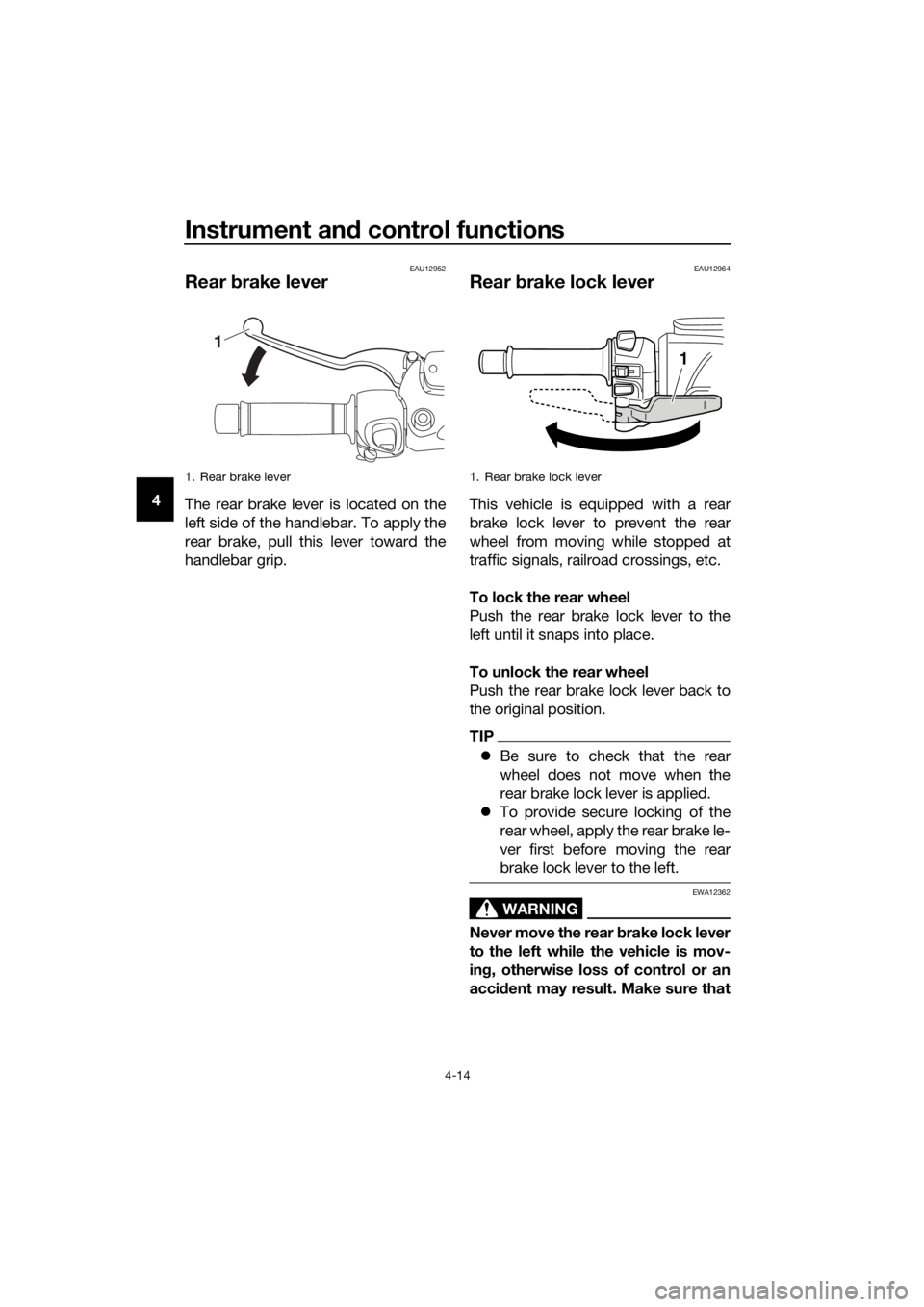
The rear brake lever is located on the
left side of the handlebar. To apply the
rear brake, pull this lever toward the
handlebar grip.
EAU12964
Rear brake lock lever
This vehicle is equipped with a rear
brake lock lever to prevent the rear
wheel from moving while stopped at
traffic signals, railroad crossings, etc.
To lock the rear wheel
Push the rear brake lock lever to the
left until it snaps into place.
To unlock the rear wheel
Push the rear brake lock lever back to
the original position.
TIP
Be sure to check that the rear
wheel does not move when the
rear brake lock lever is applied.
To provide secure locking of the
rear wheel, apply the rear brake le-
ver first before moving the rear
brake lock lever to the left.
WARNING
EWA12362
Never move the rear brake lock lever
to the left while the vehicle is mov-
ing, otherwise loss of control or an
accident may result. Make sure that
1. Rear brake lever
1
1. Rear brake lock lever
1
UBL1E0E0.book Page 14 Thursday, May 11, 2017 8:51 AM
Page 41 of 118
Instrument and control functions
4-15
4 the vehicle is stopped before mov-
ing the rear brake lock lever to the
left.
EAU78200
ABS
The Yamaha ABS (Anti-lock Brake
System) features a dual electronic con-
trol system, which acts on the front and
rear brakes independently.
Operate the brakes with ABS as you
would conventional brakes. If the ABS
is activated, a pulsating sensation may
be felt at the brake levers. In this situa-
tion, continue to apply the brakes and
let the ABS work; do not “pump” the
brakes as this will reduce braking ef-
fectiveness.
WARNING
EWA16051
Always keep a sufficient distance
from the vehicle ahead to match the
riding speed even with ABS.
The ABS performs best with
long braking distances.
On certain surfaces, such as
rough or gravel roads, the brak-
ing distance may be longer with
the ABS than without.
The ABS is monitored by an ECU,
which will revert the system to conven-
tional braking if a malfunction occurs.
TIP
The ABS performs a self-diagno-
sis test each time the vehicle first
starts off after the main switch is
turned to “ON” and the vehicle has
traveled at a speed of 10 km/h (6
mi/h) or higher. During this test, a
“clicking” noise can be heard from
the front of the vehicle, and if ei-
ther brake lever is even slightly ap-
plied, a vibration can be felt at the
lever, but these do not indicate a
malfunction.
UBL1E0E0.book Page 15 Thursday, May 11, 2017 8:51 AM
Page 44 of 118
Instrument and control functions
4-18
4
EAU78502
Fuel tank cap
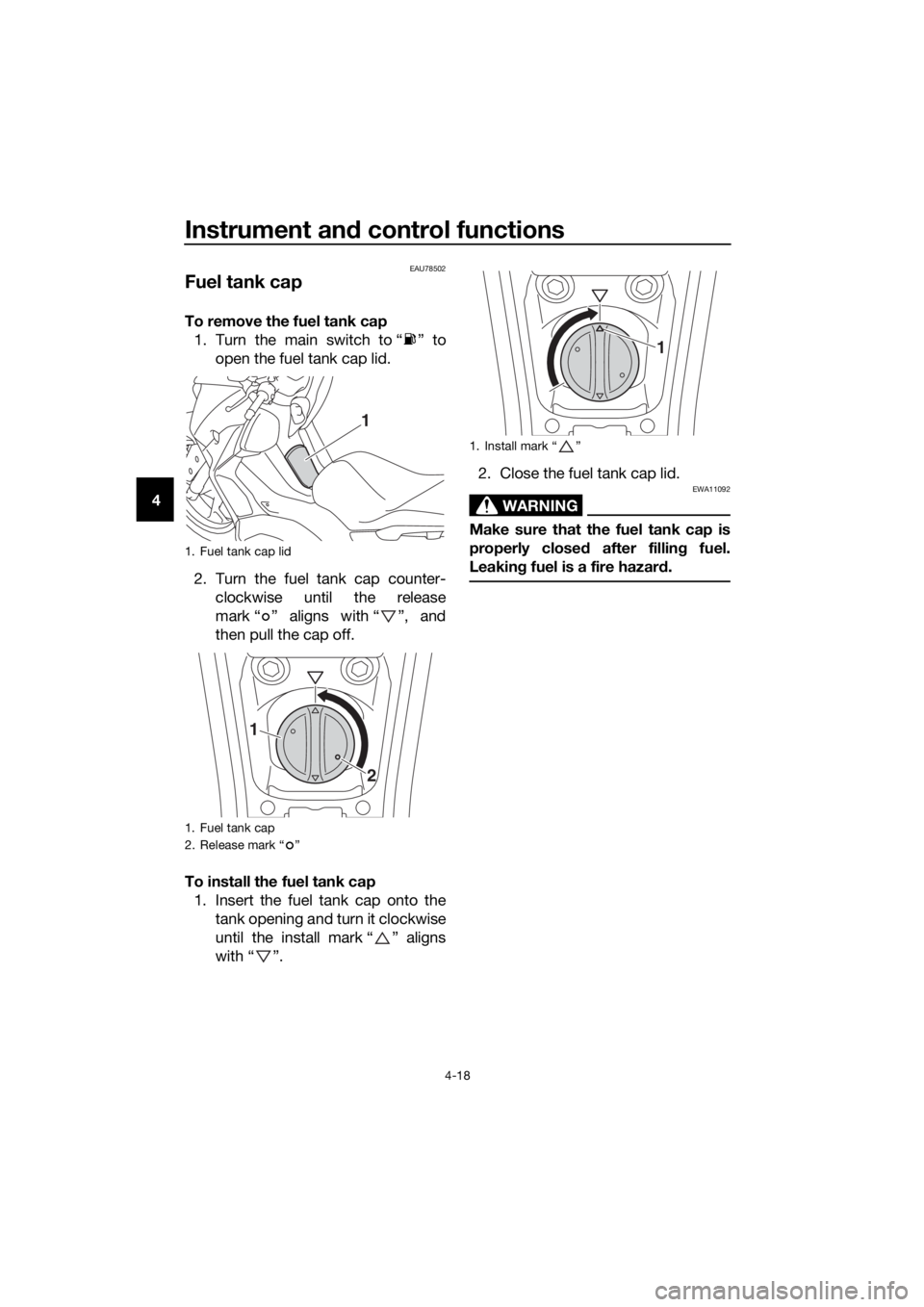
To remove the fuel tank cap
1. Turn the main switch to “ ” to
open the fuel tank cap lid.
2. Turn the fuel tank cap counter-
clockwise until the release
mark “ ” aligns with “ ”, and
then pull the cap off.
To install the fuel tank cap
1. Insert the fuel tank cap onto the
tank opening and turn it clockwise
until the install mark “ ” aligns
with “ ”.2. Close the fuel tank cap lid.
WARNING
EWA11092
Make sure that the fuel tank cap is
properly closed after filling fuel.
Leaking fuel is a fire hazard.
1. Fuel tank cap lid
1. Fuel tank cap
2. Release mark “ ”
1
1
2
1. Install mark Ž
1
UBL1E0E0.book Page 18 Thursday, May 11, 2017 8:51 AM
Page 46 of 118
Instrument and control functions
4-20
4
TIP
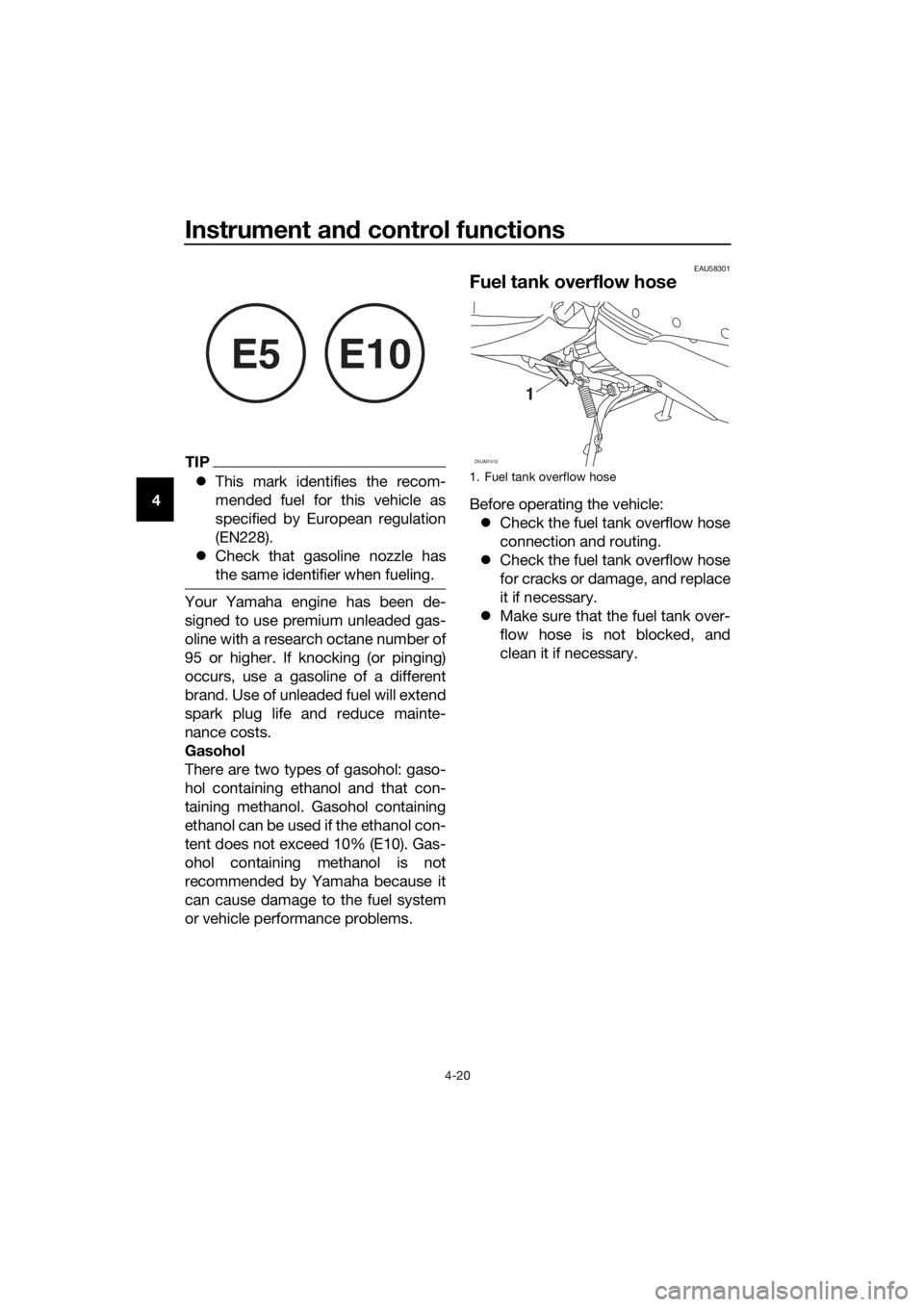
This mark identifies the recom-
mended fuel for this vehicle as
specified by European regulation
(EN228).
Check that gasoline nozzle has
the same identifier when fueling.
Your Yamaha engine has been de-
signed to use premium unleaded gas-
oline with a research octane number of
95 or higher. If knocking (or pinging)
occurs, use a gasoline of a different
brand. Use of unleaded fuel will extend
spark plug life and reduce mainte-
nance costs.
Gasohol
There are two types of gasohol: gaso-
hol containing ethanol and that con-
taining methanol. Gasohol containing
ethanol can be used if the ethanol con-
tent does not exceed 10% (E10). Gas-
ohol containing methanol is not
recommended by Yamaha because it
can cause damage to the fuel system
or vehicle performance problems.
EAU58301
Fuel tank overflow hose
Before operating the vehicle:
Check the fuel tank overflow hose
connection and routing.
Check the fuel tank overflow hose
for cracks or damage, and replace
it if necessary.
Make sure that the fuel tank over-
flow hose is not blocked, and
clean it if necessary.
E5E10
1. Fuel tank overflow hose
ZAUM1510
1
UBL1E1E0.book Page 20 Wednesday, May 23, 2018 11:03 AM
Page 48 of 118
Instrument and control functions
4-22
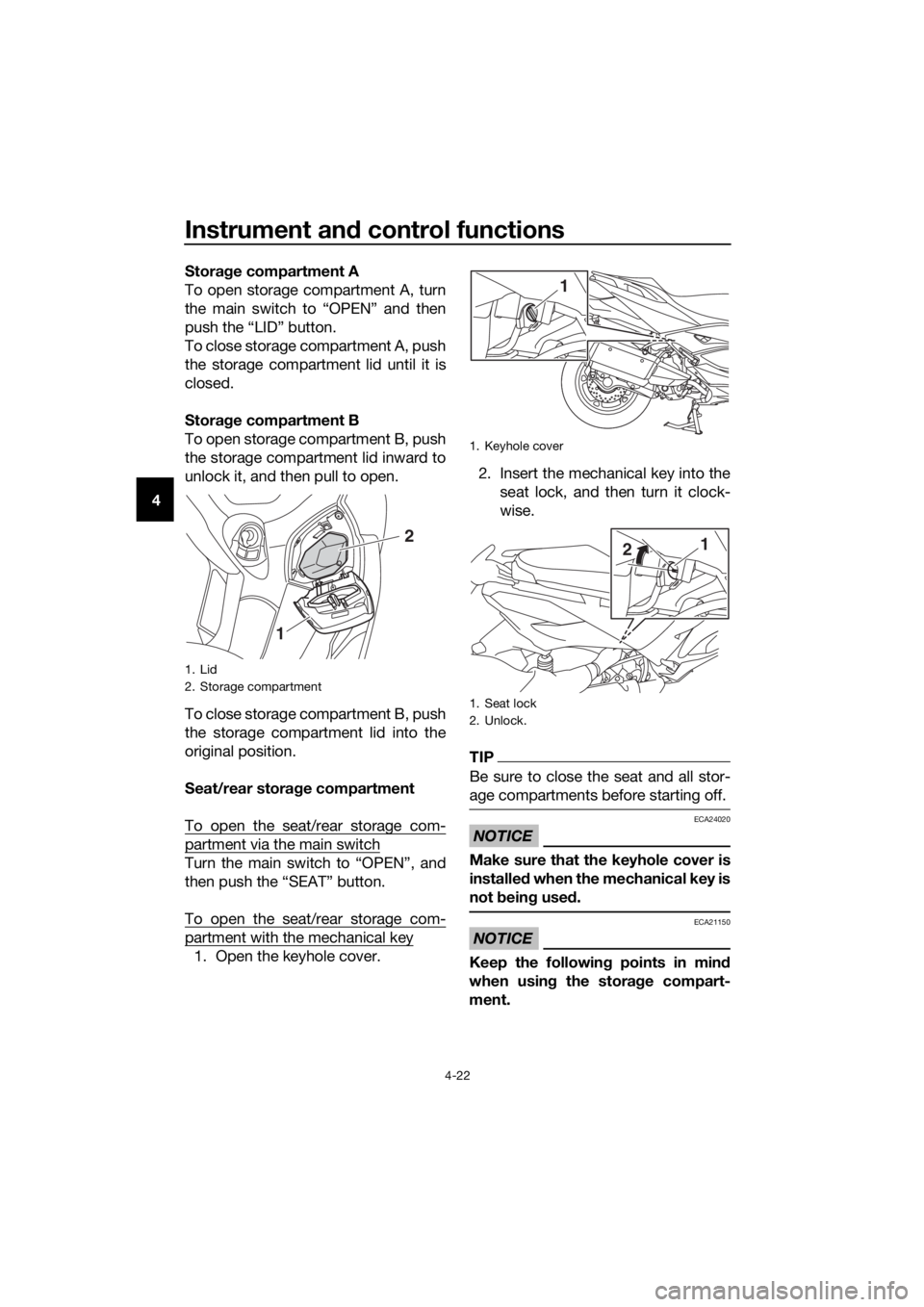
4Storage compartment A
To open storage compartment A, turn
the main switch to “OPEN” and then
push the “LID” button.
To close storage compartment A, push
the storage compartment lid until it is
closed.
Storage compartment B
To open storage compartment B, push
the storage compartment lid inward to
unlock it, and then pull to open.
To close storage compartment B, push
the storage compartment lid into the
original position.
Seat/rear storage compartment
To open the seat/rear storage com-
partment via the main switch
Turn the main switch to “OPEN”, and
then push the “SEAT” button.
To open the seat/rear storage com-
partment with the mechanical key
1. Open the keyhole cover.2. Insert the mechanical key into the
seat lock, and then turn it clock-
wise.
TIP
Be sure to close the seat and all stor-
age compartments before starting off.
NOTICE
ECA24020
Make sure that the keyhole cover is
installed when the mechanical key is
not being used.
NOTICE
ECA21150
Keep the following points in mind
when using the storage compart-
ment.
1. Lid
2. Storage compartment
12
1. Keyhole cover
1. Seat lock
2. Unlock.
1
1
2
UBL1E0E0.book Page 22 Thursday, May 11, 2017 8:51 AM
Page 68 of 118
Periodic maintenance and adjustment
7-4
7
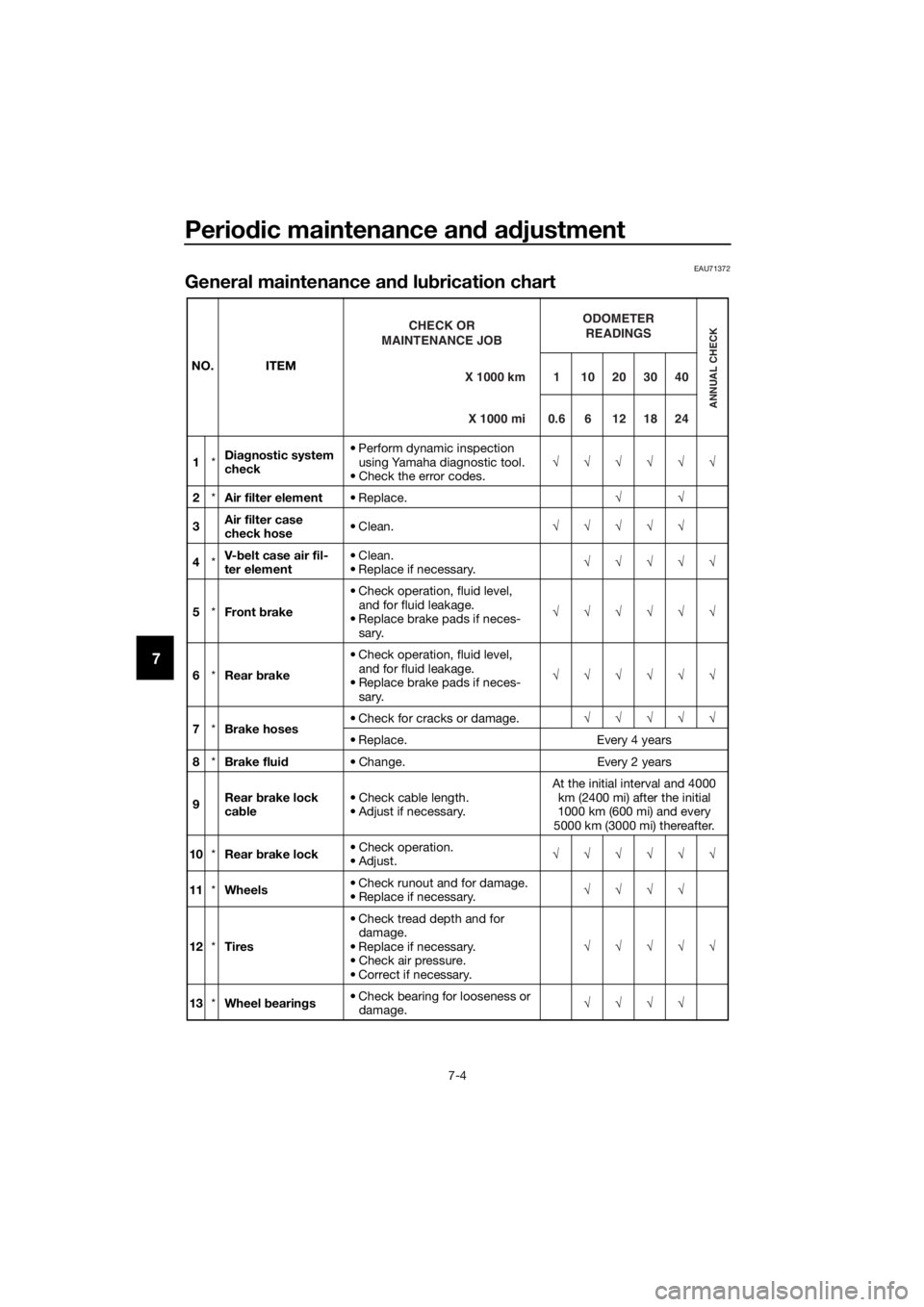
EAU71372
General maintenance and lubrication chart
NO. ITEM
1*Diagnostic system
check• Perform dynamic inspection
using Yamaha diagnostic tool.
• Check the error codes.√√√√√√
2*Air filter element• Replace.√√
3Air filter case
check hose• Clean.√√√√√
4*V-belt case air fil-
ter element• Clean.
• Replace if necessary.√√√√√
5*Front brake• Check operation, fluid level,
and for fluid leakage.
• Replace brake pads if neces-
sary.√√√√√√
6*Rear brake• Check operation, fluid level,
and for fluid leakage.
• Replace brake pads if neces-
sary.√√√√√√
7*Brake hoses• Check for cracks or damage.√√√√√
• Replace. Every 4 years
8*Brake fluid• Change. Every 2 years
9Rear brake lock
cable• Check cable length.
• Adjust if necessary.At the initial interval and 4000
km (2400 mi) after the initial
1000 km (600 mi) and every
5000 km (3000 mi) thereafter.
10*Rear brake lock• Check operation.
•Adjust.√√√√√√
11*Wheels• Check runout and for damage.
• Replace if necessary.√√√√
12*Tires• Check tread depth and for
damage.
• Replace if necessary.
• Check air pressure.
• Correct if necessary.√√√√√
13*Wheel bearing
s• Check bearing for looseness or
damage.√√√√
X 1000 km CHECK OR
MAINTENANCE JOB
X 1000 miODOMETER
READINGSANNUAL CHECK
1 10203040
0.6 6 12 18 24
UBL1E0E0.book Page 4 Thursday, May 11, 2017 8:51 AM
Page 73 of 118
Periodic maintenance and adjustment
7-9
7 Clean the surface of the spark plug
gasket and its mating surface, and
then wipe off any grime from the spark
plug threads.
TIP
If a torque wrench is not available
when installing a spark plug, a good
estimate of the correct torque is 1/4…
1/2 turn past finger tight. However, the
spark plug should be tightened to the
specified torque as soon as possible.
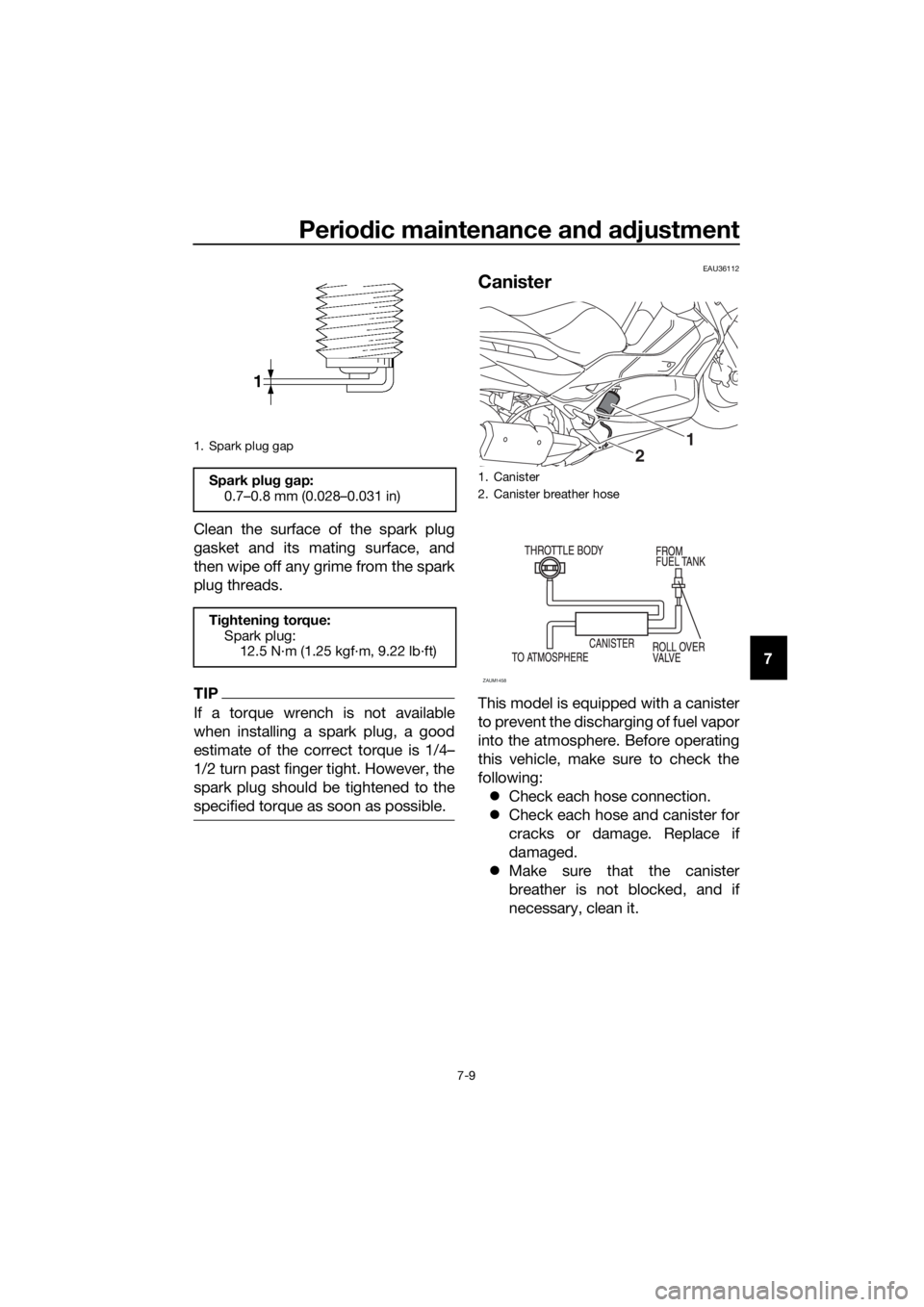
EAU36112
Canister
This model is equipped with a canister
to prevent the discharging of fuel vapor
into the atmosphere. Before operating
this vehicle, make sure to check the
following:
Check each hose connection.
Check each hose and canister for
cracks or damage. Replace if
damaged.
Make sure that the canister
breather is not blocked, and if
necessary, clean it.
1. Spark plug gap
Spark plug gap:
0.7–0.8 mm (0.028–0.031 in)
Tightening torque:
Spark plug:
12.5 N·m (1.25 kgf·m, 9.22 lb·ft)1. Canister
2. Canister breather hose
2
1
ZAUM1458
UBL1E0E0.book Page 9 Thursday, May 11, 2017 8:51 AM
Page 84 of 118
Periodic maintenance and adjustment
7-20
7
WARNING
EWA10462
The front and rear tires should be of
the same make and design, other-
wise the handling characteristics of
the vehicle may be different, which
could lead to an accident.
After extensive tests, only the tires list-
ed below have been approved for this
model by Yamaha.
EAU21995
Cast wheels
To maximize the performance, durabil-
ity, and safe operation of your vehicle,
note the following points regarding the
specified wheels.
The wheel rims should be
checked for cracks, bends, warp-
age or other damage before each
ride. If any damage is found, have
a Yamaha dealer replace the
wheel. Do not attempt even the
smallest repair to the wheel. A de-
formed or cracked wheel must be
replaced.
The wheel should be balanced
whenever either the tire or wheel
has been changed or replaced. An
unbalanced wheel can result in
poor performance, adverse han-
dling characteristics, and a short-
ened tire life.
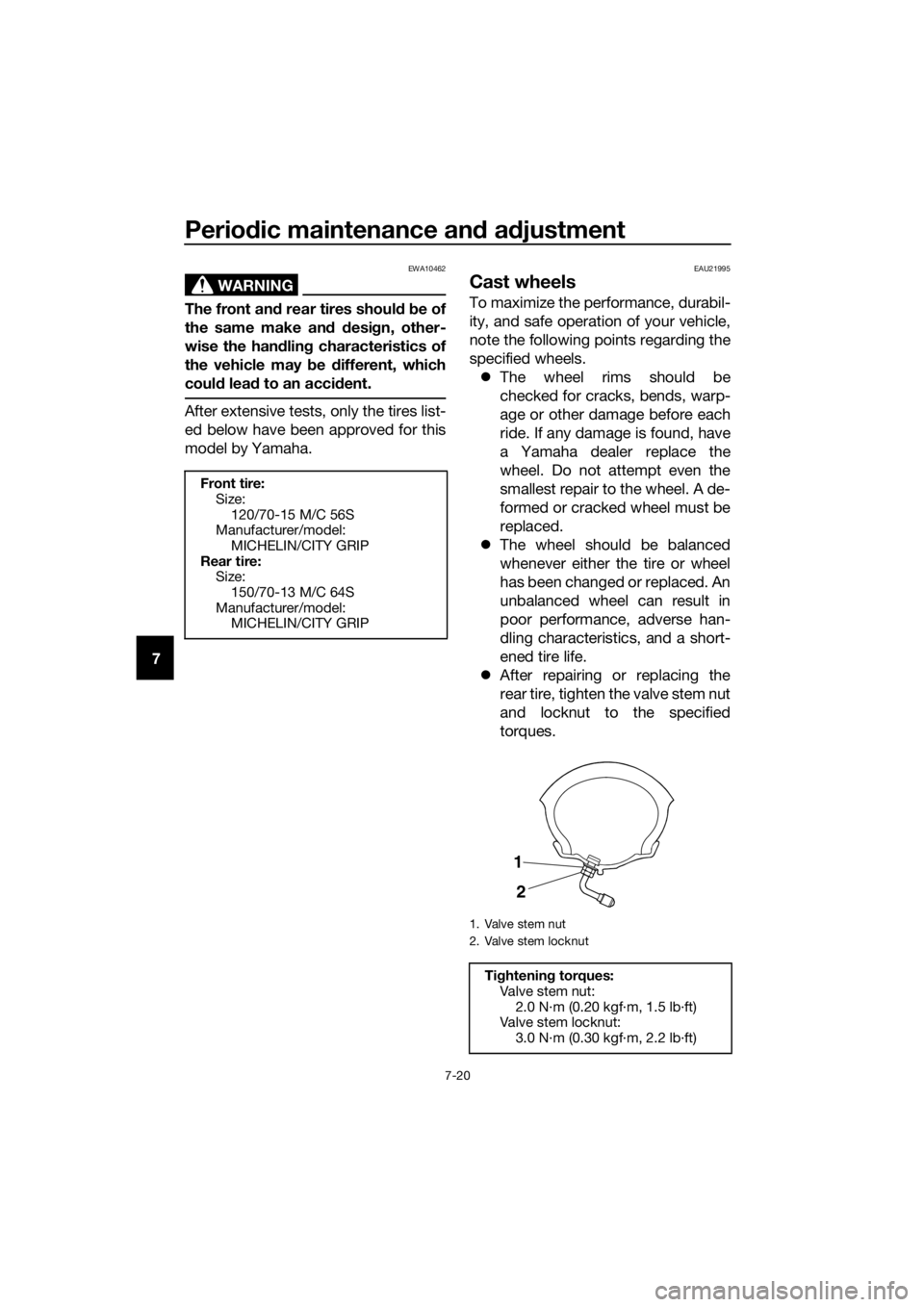
After repairing or replacing the
rear tire, tighten the valve stem nut
and locknut to the specified
torques.
Front tire:
Size:
120/70-15 M/C 56S
Manufacturer/model:
MICHELIN/CITY GRIP
Rear tire:
Size:
150/70-13 M/C 64S
Manufacturer/model:
MICHELIN/CITY GRIP
1. Valve stem nut
2. Valve stem locknut
Tightening torques:
Valve stem nut:
2.0 N·m (0.20 kgf·m, 1.5 lb·ft)
Valve stem locknut:
3.0 N·m (0.30 kgf·m, 2.2 lb·ft)
1
2
UBL1E0E0.book Page 20 Thursday, May 11, 2017 8:51 AM
Page 86 of 118
Periodic maintenance and adjustment
7-22
7
EAU53033
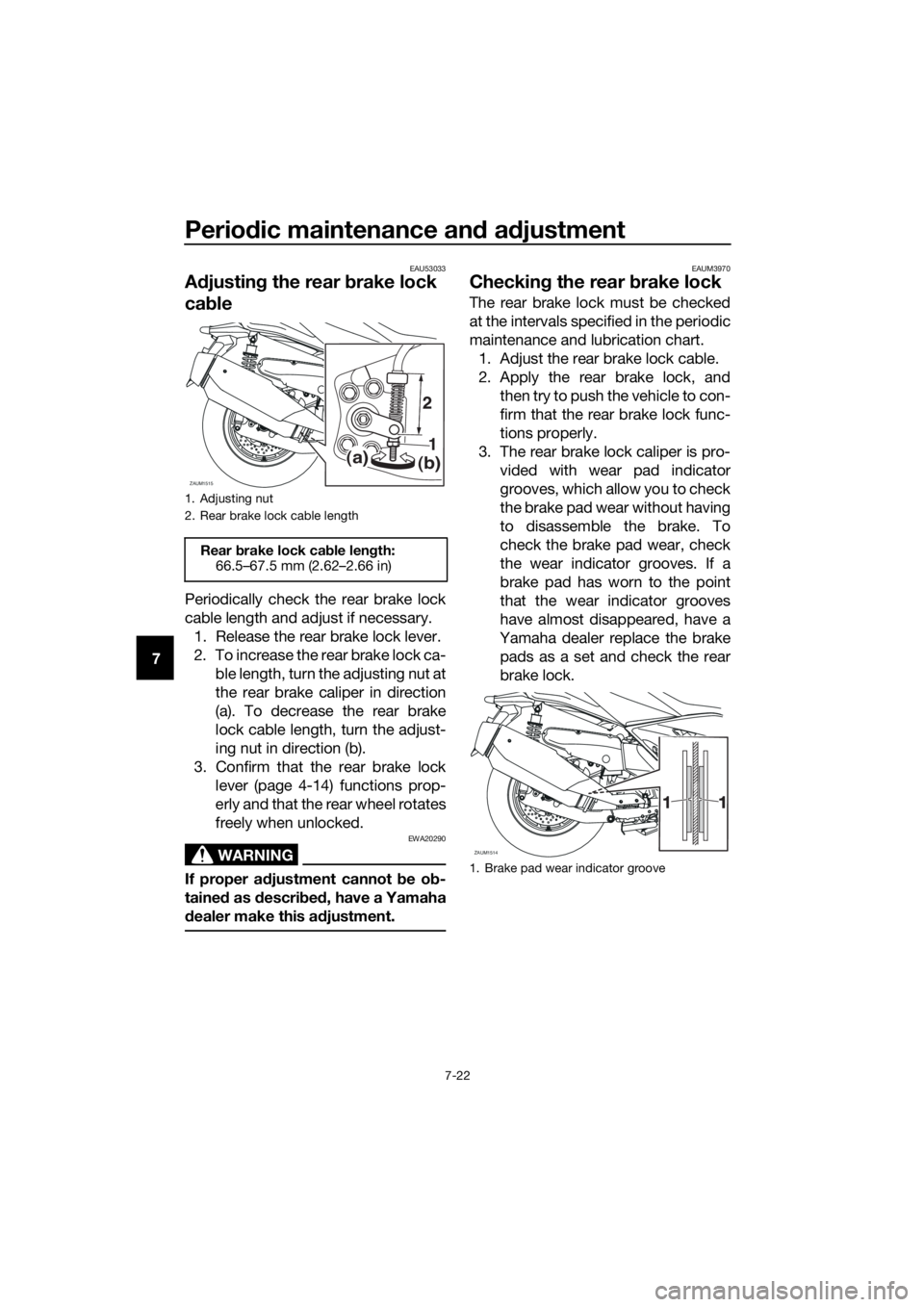
Adjusting the rear brake lock
cable
Periodically check the rear brake lock
cable length and adjust if necessary.
1. Release the rear brake lock lever.
2. To increase the rear brake lock ca-
ble length, turn the adjusting nut at
the rear brake caliper in direction
(a). To decrease the rear brake
lock cable length, turn the adjust-
ing nut in direction (b).
3. Confirm that the rear brake lock
lever (page 4-14) functions prop-
erly and that the rear wheel rotates
freely when unlocked.
WARNING
EWA20290
If proper adjustment cannot be ob-
tained as described, have a Yamaha
dealer make this adjustment.
EAUM3970
Checking the rear brake lock
The rear brake lock must be checked
at the intervals specified in the periodic
maintenance and lubrication chart.
1. Adjust the rear brake lock cable.
2. Apply the rear brake lock, and
then try to push the vehicle to con-
firm that the rear brake lock func-
tions properly.
3. The rear brake lock caliper is pro-
vided with wear pad indicator
grooves, which allow you to check
the brake pad wear without having
to disassemble the brake. To
check the brake pad wear, check
the wear indicator grooves. If a
brake pad has worn to the point
that the wear indicator grooves
have almost disappeared, have a
Yamaha dealer replace the brake
pads as a set and check the rear
brake lock.
1. Adjusting nut
2. Rear brake lock cable length
Rear brake lock cable length:
66.5–67.5 mm (2.62–2.66 in)
ZAUM1515
2
(b) (a)
1
2
(b) (a)
1. Brake pad wear indicator groove
ZAUM1514
UBL1E0E0.book Page 22 Thursday, May 11, 2017 8:51 AM
Page 88 of 118
Periodic maintenance and adjustment
7-24
7Clean the filler cap before re-
moving. Use only DOT 4 brake
fluid from a sealed container.
Use only the specified brake flu-
id; otherwise, the rubber seals
may deteriorate, causing leak-
age.
Refill with the same type of
brake fluid. Adding a brake fluid
other than DOT 4 may result in a
harmful chemical reaction.
Be careful that water or dust
does not enter the brake fluid
reservoir when refilling. Water
will significantly lower the boil-
ing point of the fluid and may re-
sult in vapor lock, and dirt may
clog the ABS hydraulic unit
valves.NOTICE
ECA17641
Brake fluid may damage painted
surfaces or plastic parts. Always
clean up spilled fluid immediately.
As the brake pads wear, it is normal for
the brake fluid level to gradually go
down. A low brake fluid level may indi-
cate worn brake pads and/or brake
system leakage; therefore, be sure to
check the brake pads for wear and the
brake system for leakage. If the brake
fluid level goes down suddenly, have a
Yamaha dealer check the cause before
further riding.
EAU22734
Changing the brake fluid
Have a Yamaha dealer change the
brake fluid every 2 years. In addition,
have the seals of the master cylinders
and brake calipers, as well as the brake
hoses replaced at the intervals listed
below or sooner if they are damaged or
leaking.
Brake seals: every 2 years
Brake hoses: every 4 years
UBL1E0E0.book Page 24 Thursday, May 11, 2017 8:51 AM