brake YAMAHA XMAX 400 2018 Owner's Manual
[x] Cancel search | Manufacturer: YAMAHA, Model Year: 2018, Model line: XMAX 400, Model: YAMAHA XMAX 400 2018Pages: 118, PDF Size: 9.03 MB
Page 70 of 118
Periodic maintenance and adjustment
7-6
7
EAU72770
TIP
Engine air filters and V-belt air filter
• This model’s engine air filters are equipped with disposable oil-coated pa-
per elements, which must not be cleaned with compressed air to avoid
damaging them.
• The engine air filter elements need to be replaced and the V-belt air filter
element needs to be serviced more frequently when riding in unusually wet
or dusty areas.
Hydraulic brake service
• Regularly check and, if necessary, correct the brake fluid level.
• Every two years replace the internal components of the brake master cyl-
inders and calipers, and change the brake fluid.
• Replace the brake hoses every four years and if cracked or damaged.
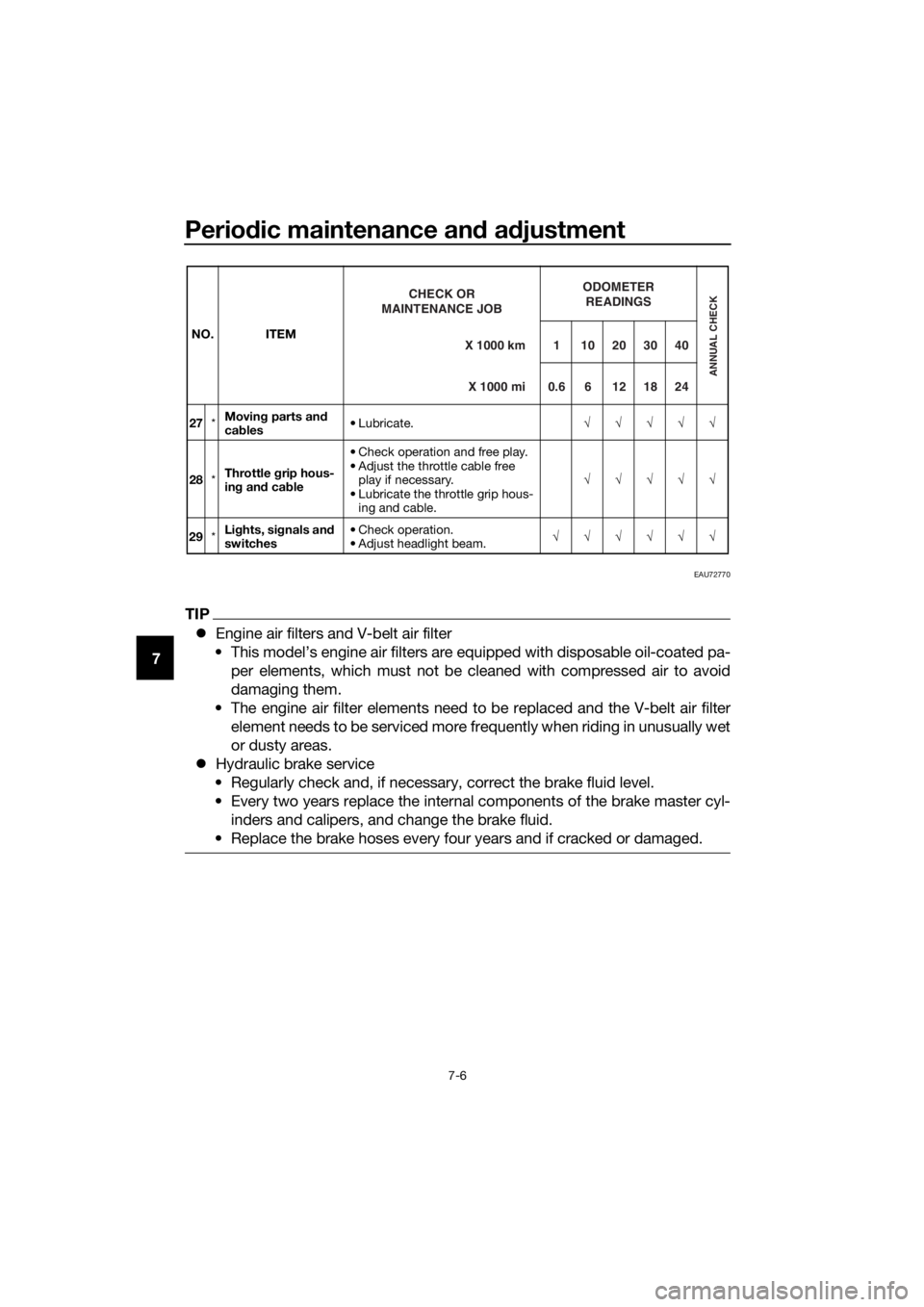
27*Moving parts and
cables• Lubricate.√√√√√
28*Throttle grip hous-
ing and cable• Check operation and free play.
• Adjust the throttle cable free
play if necessary.
• Lubricate the throttle grip hous-
ing and cable.√√√√√
29*Lights, signals and
switches• Check operation.
• Adjust headlight beam.√√√√√√ NO. ITEM
X 1000 km CHECK OR
MAINTENANCE JOB
X 1000 miODOMETER
READINGS
ANNUAL CHECK
110203040
0.6 6 12 18 24
UBL1E0E0.book Page 6 Thursday, May 11, 2017 8:51 AM
Page 83 of 118
Periodic maintenance and adjustment
7-19
7
WARNING
EWA10512
Never overload your vehicle. Opera-
tion of an overloaded vehicle could
cause an accident.
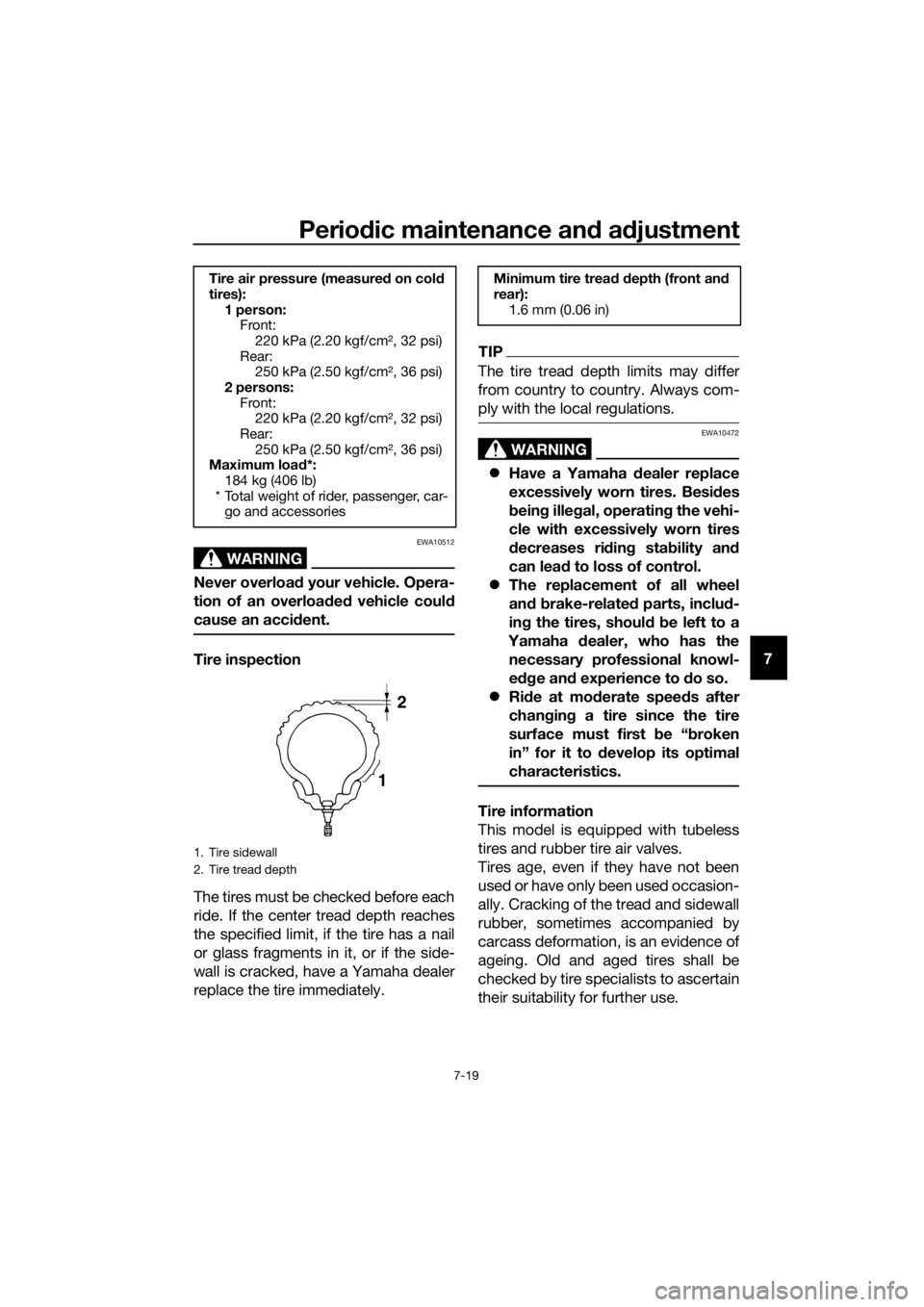
Tire inspection
The tires must be checked before each
ride. If the center tread depth reaches
the specified limit, if the tire has a nail
or glass fragments in it, or if the side-
wall is cracked, have a Yamaha dealer
replace the tire immediately.
TIP
The tire tread depth limits may differ
from country to country. Always com-
ply with the local regulations.
WARNING
EWA10472
Have a Yamaha dealer replace
excessively worn tires. Besides
being illegal, operating the vehi-
cle with excessively worn tires
decreases riding stability and
can lead to loss of control.
The replacement of all wheel
and brake-related parts, includ-
ing the tires, should be left to a
Yamaha dealer, who has the
necessary professional knowl-
edge and experience to do so.
Ride at moderate speeds after
changing a tire since the tire
surface must first be “broken
in” for it to develop its optimal
characteristics.
Tire information
This model is equipped with tubeless
tires and rubber tire air valves.
Tires age, even if they have not been
used or have only been used occasion-
ally. Cracking of the tread and sidewall
rubber, sometimes accompanied by
carcass deformation, is an evidence of
ageing. Old and aged tires shall be
checked by tire specialists to ascertain
their suitability for further use.
Tire air pressure (measured on cold
tires):
1 person:
Front:
220 kPa (2.20 kgf/cm², 32 psi)
Rear:
250 kPa (2.50 kgf/cm², 36 psi)
2 persons:
Front:
220 kPa (2.20 kgf/cm², 32 psi)
Rear:
250 kPa (2.50 kgf/cm², 36 psi)
Maximum load*:
184 kg (406 lb)
* Total weight of rider, passenger, car-
go and accessories
1. Tire sidewall
2. Tire tread depth
12
Minimum tire tread depth (front and
rear):
1.6 mm (0.06 in)
UBL1E0E0.book Page 19 Thursday, May 11, 2017 8:51 AM
Page 85 of 118
Periodic maintenance and adjustment
7-21
7
EAU50861
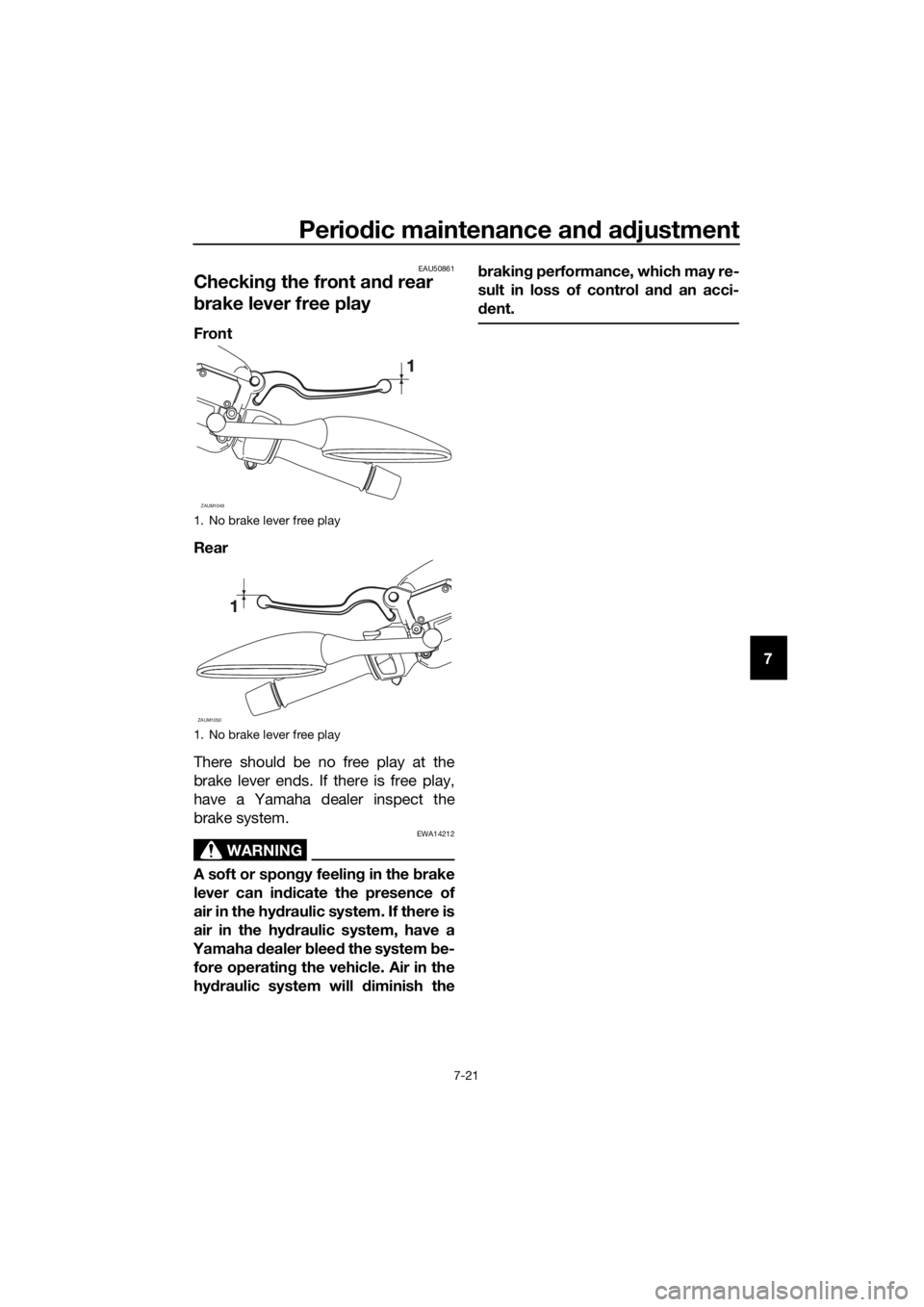
Checking the front and rear
brake lever free play
Front
Rear
There should be no free play at the
brake lever ends. If there is free play,
have a Yamaha dealer inspect the
brake system.
WARNING
EWA14212
A soft or spongy feeling in the brake
lever can indicate the presence of
air in the hydraulic system. If there is
air in the hydraulic system, have a
Yamaha dealer bleed the system be-
fore operating the vehicle. Air in the
hydraulic system will diminish thebraking performance, which may re-
sult in loss of control and an acci-
dent.
1. No brake lever free play
1. No brake lever free play
ZAUM1049
ZAUM1050
UBL1E0E0.book Page 21 Thursday, May 11, 2017 8:51 AM
Page 86 of 118
Periodic maintenance and adjustment
7-22
7
EAU53033
Adjusting the rear brake lock
cable
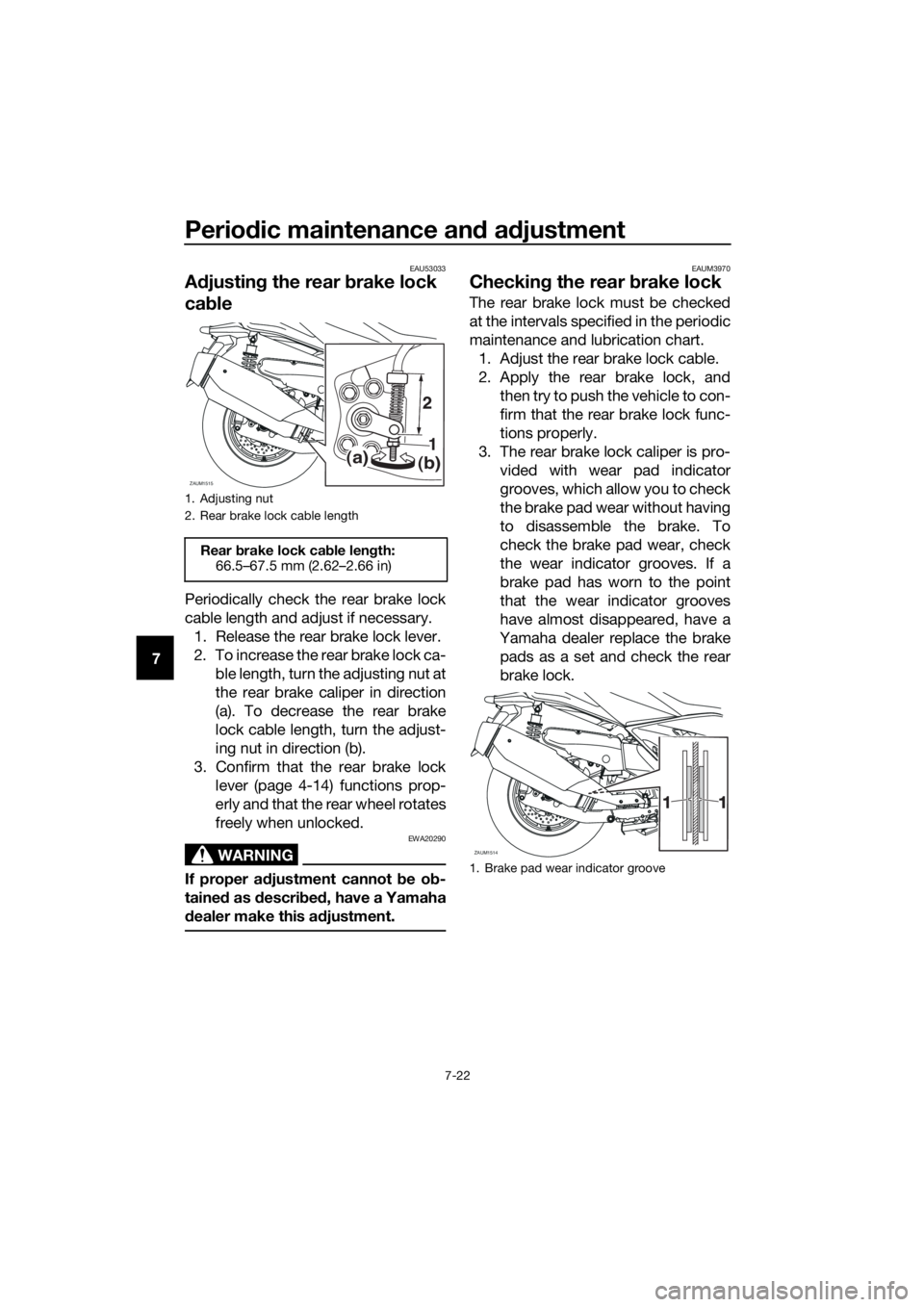
Periodically check the rear brake lock
cable length and adjust if necessary.
1. Release the rear brake lock lever.
2. To increase the rear brake lock ca-
ble length, turn the adjusting nut at
the rear brake caliper in direction
(a). To decrease the rear brake
lock cable length, turn the adjust-
ing nut in direction (b).
3. Confirm that the rear brake lock
lever (page 4-14) functions prop-
erly and that the rear wheel rotates
freely when unlocked.
WARNING
EWA20290
If proper adjustment cannot be ob-
tained as described, have a Yamaha
dealer make this adjustment.
EAUM3970
Checking the rear brake lock
The rear brake lock must be checked
at the intervals specified in the periodic
maintenance and lubrication chart.
1. Adjust the rear brake lock cable.
2. Apply the rear brake lock, and
then try to push the vehicle to con-
firm that the rear brake lock func-
tions properly.
3. The rear brake lock caliper is pro-
vided with wear pad indicator
grooves, which allow you to check
the brake pad wear without having
to disassemble the brake. To
check the brake pad wear, check
the wear indicator grooves. If a
brake pad has worn to the point
that the wear indicator grooves
have almost disappeared, have a
Yamaha dealer replace the brake
pads as a set and check the rear
brake lock.
1. Adjusting nut
2. Rear brake lock cable length
Rear brake lock cable length:
66.5–67.5 mm (2.62–2.66 in)
ZAUM1515
2
(b) (a)
1
2
(b) (a)
1. Brake pad wear indicator groove
ZAUM1514
UBL1E0E0.book Page 22 Thursday, May 11, 2017 8:51 AM
Page 87 of 118
Periodic maintenance and adjustment
7-23
7
EAU22393
Checking the front and rear
brake pads
The front and rear brake pads must be
checked for wear at the intervals spec-
ified in the periodic maintenance and
lubrication chart.
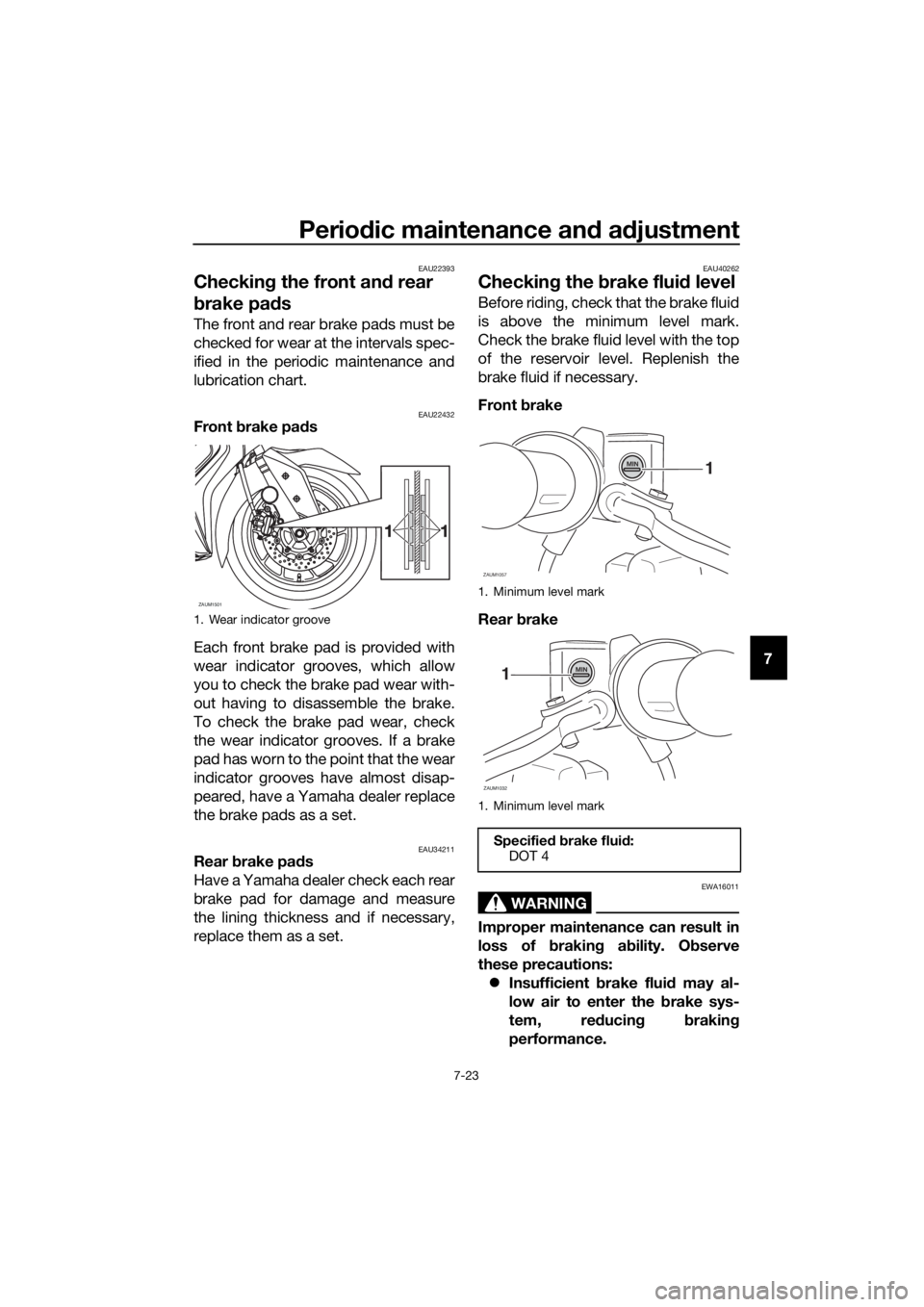
EAU22432Front brake pads
Each front brake pad is provided with
wear indicator grooves, which allow
you to check the brake pad wear with-
out having to disassemble the brake.
To check the brake pad wear, check
the wear indicator grooves. If a brake
pad has worn to the point that the wear
indicator grooves have almost disap-
peared, have a Yamaha dealer replace
the brake pads as a set.
EAU34211Rear brake pads
Have a Yamaha dealer check each rear
brake pad for damage and measure
the lining thickness and if necessary,
replace them as a set.
EAU40262
Checking the brake fluid level
Before riding, check that the brake fluid
is above the minimum level mark.
Check the brake fluid level with the top
of the reservoir level. Replenish the
brake fluid if necessary.
Front brake
Rear brake
WARNING
EWA16011
Improper maintenance can result in
loss of braking ability. Observe
these precautions:
Insufficient brake fluid may al-
low air to enter the brake sys-
tem, reducing braking
performance.
1. Wear indicator groove
ZAUM15011. Minimum level mark
1. Minimum level mark
Specified brake fluid:
DOT 4
1
ZAUM1057
ZAUM1032
1
UBL1E0E0.book Page 23 Thursday, May 11, 2017 8:51 AM
Page 88 of 118
Periodic maintenance and adjustment
7-24
7Clean the filler cap before re-
moving. Use only DOT 4 brake
fluid from a sealed container.
Use only the specified brake flu-
id; otherwise, the rubber seals
may deteriorate, causing leak-
age.
Refill with the same type of
brake fluid. Adding a brake fluid
other than DOT 4 may result in a
harmful chemical reaction.
Be careful that water or dust
does not enter the brake fluid
reservoir when refilling. Water
will significantly lower the boil-
ing point of the fluid and may re-
sult in vapor lock, and dirt may
clog the ABS hydraulic unit
valves.NOTICE
ECA17641
Brake fluid may damage painted
surfaces or plastic parts. Always
clean up spilled fluid immediately.
As the brake pads wear, it is normal for
the brake fluid level to gradually go
down. A low brake fluid level may indi-
cate worn brake pads and/or brake
system leakage; therefore, be sure to
check the brake pads for wear and the
brake system for leakage. If the brake
fluid level goes down suddenly, have a
Yamaha dealer check the cause before
further riding.
EAU22734
Changing the brake fluid
Have a Yamaha dealer change the
brake fluid every 2 years. In addition,
have the seals of the master cylinders
and brake calipers, as well as the brake
hoses replaced at the intervals listed
below or sooner if they are damaged or
leaking.
Brake seals: every 2 years
Brake hoses: every 4 years
UBL1E0E0.book Page 24 Thursday, May 11, 2017 8:51 AM
Page 90 of 118
Periodic maintenance and adjustment
7-26
7
EAU23115
Checking and lubricating the
throttle grip and cable
The operation of the throttle grip
should be checked before each ride. In
addition, the cable should be lubricat-
ed by a Yamaha dealer at the intervals
specified in the periodic maintenance
chart.
The throttle cable is equipped with a
rubber cover. Make sure that the cover
is securely installed. Even though the
cover is installed correctly, it does not
completely protect the cable from wa-
ter entry. Therefore, use care not to
pour water directly onto the cover or
cable when washing the vehicle. If the
cable or cover becomes dirty, wipe
clean with a moist cloth.
EAU23173
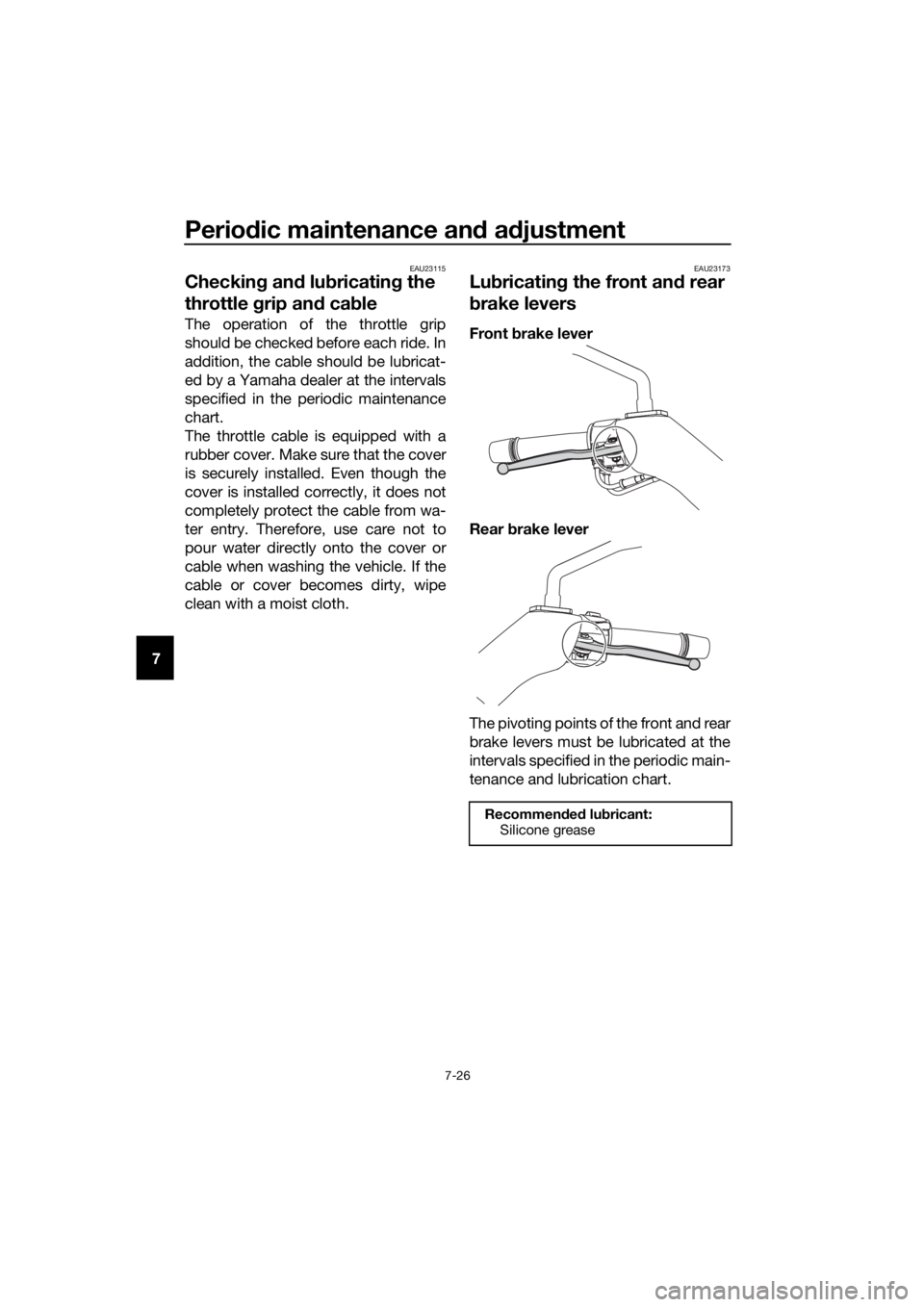
Lubricating the front and rear
brake levers
Front brake lever
Rear brake lever
The pivoting points of the front and rear
brake levers must be lubricated at the
intervals specified in the periodic main-
tenance and lubrication chart.
Recommended lubricant:
Silicone grease
UBL1E0E0.book Page 26 Thursday, May 11, 2017 8:51 AM
Page 91 of 118
Periodic maintenance and adjustment
7-27
7
EAU23215
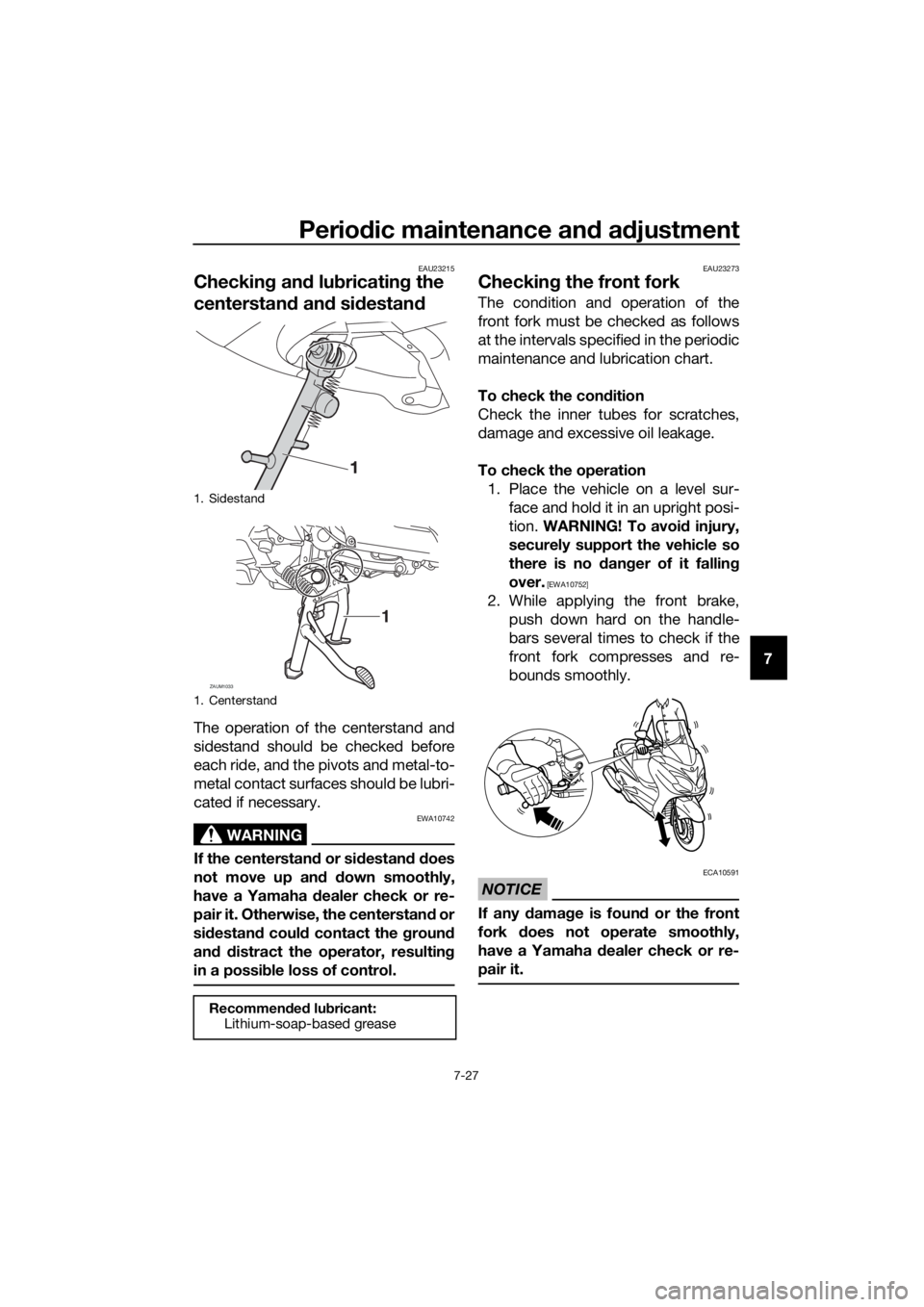
Checking and lubricating the
centerstand and sidestand
The operation of the centerstand and
sidestand should be checked before
each ride, and the pivots and metal-to-
metal contact surfaces should be lubri-
cated if necessary.
WARNING
EWA10742
If the centerstand or sidestand does
not move up and down smoothly,
have a Yamaha dealer check or re-
pair it. Otherwise, the centerstand or
sidestand could contact the ground
and distract the operator, resulting
in a possible loss of control.
EAU23273
Checking the front fork
The condition and operation of the
front fork must be checked as follows
at the intervals specified in the periodic
maintenance and lubrication chart.
To check the condition
Check the inner tubes for scratches,
damage and excessive oil leakage.
To check the operation
1. Place the vehicle on a level sur-
face and hold it in an upright posi-
tion. WARNING! To avoid injury,
securely support the vehicle so
there is no danger of it falling
over.
[EWA10752]
2. While applying the front brake,
push down hard on the handle-
bars several times to check if the
front fork compresses and re-
bounds smoothly.
NOTICE
ECA10591
If any damage is found or the front
fork does not operate smoothly,
have a Yamaha dealer check or re-
pair it.
1. Sidestand
1. Centerstand
Recommended lubricant:
Lithium-soap-based grease
ZAUM1033
1
UBL1E0E0.book Page 27 Thursday, May 11, 2017 8:51 AM
Page 97 of 118
Periodic maintenance and adjustment
7-33
7
EAU70540
Brake/tail light
This model is equipped with an LED-
type brake/tail light.
If the brake/tail light does not come on,
have a Yamaha dealer check it.
EAU39881
Front turn signal light
If a front turn signal light does not
come on, have a Yamaha dealer check
its electrical circuit or replace the bulb.
UBL1E0E0.book Page 33 Thursday, May 11, 2017 8:51 AM
Page 105 of 118
Scooter care and storage
8-2
8 structed. Also, thoroughly rinse
the area off with water, immedi-
ately dry it, and then apply a cor-
rosion protection spray.
Improper cleaning can damage
plastic parts (such as cowlings,
panels, windshields, headlight
lenses, meter lenses, etc.) and
the mufflers. Use only a soft,
clean cloth or sponge with wa-
ter to clean plastic. However, if
the plastic parts cannot be thor-
oughly cleaned with water, di-
luted mild detergent with water
may be used. Be sure to rinse
off any detergent residue using
plenty of water, as it is harmful
to plastic parts.
Do not use any harsh chemical
products on plastic parts. Be
sure to avoid using cloths or
sponges which have been in
contact with strong or abrasive
cleaning products, solvent or
thinner, fuel (gasoline), rust re-
movers or inhibitors, brake fluid,
antifreeze or electrolyte.
Do not use high-pressure wash-
ers or steam-jet cleaners since
they cause water seepage and
deterioration in the following ar-
eas: seals (of wheel and swing-
arm bearings, fork and brakes),
electric components (couplers,
connectors, instruments,
switches and lights), breather
hoses and vents.
For scooters equipped with a
windshield: Do not use strong
cleaners or hard sponges as
they will cause dulling or
scratching. Some cleaningcompounds for plastic may
leave scratches on the wind-
shield. Test the product on a
small hidden part of the wind-
shield to make sure that it does
not leave any marks. If the wind-
shield is scratched, use a quality
plastic polishing compound
af-
ter washing.
After normal use
Remove dirt with warm water, a mild
detergent, and a soft, clean sponge,
and then rinse thoroughly with clean
water. Use a toothbrush or bottlebrush
for hard-to-reach areas. Stubborn dirt
and insects will come off more easily if
the area is covered with a wet cloth for
a few minutes before cleaning.
After riding in the rain, near the sea, or
on salt-sprayed roads
Since sea salt or salt sprayed on roads
during winter are extremely corrosive
in combination with water, carry out
the following steps after each ride in
the rain, near the sea, or on salt-
sprayed roads.
TIP
Salt sprayed on roads in the winter
may remain well into spring.
1. Clean the scooter with cold water
and a mild detergent after the en-
gine has cooled down. NOTICE:
Do not use warm water since it
increases the corrosive action
of the salt.
[ECA10792]
2. Apply a corrosion protection spray
on all metal, including chrome-
and nickel-plated, surfaces to pre-
vent corrosion.
UBL1E0E0.book Page 2 Thursday, May 11, 2017 8:51 AM