brake YAMAHA XMAX 400 2020 User Guide
[x] Cancel search | Manufacturer: YAMAHA, Model Year: 2020, Model line: XMAX 400, Model: YAMAHA XMAX 400 2020Pages: 118, PDF Size: 9.04 MB
Page 54 of 118

Instrument and control functions
4-28
4
EAU78690
Ignition circuit cut-off system
The ignition circuit cut-off system
works with the sidestand switch and
brake light switches. It has the follow-
ing functions.
It prevents the engine from start-
ing when the sidestand is down.
It prevents the engine from start-
ing if the brakes are not applied.
It will stop the running engine if the
sidestand is moved down.
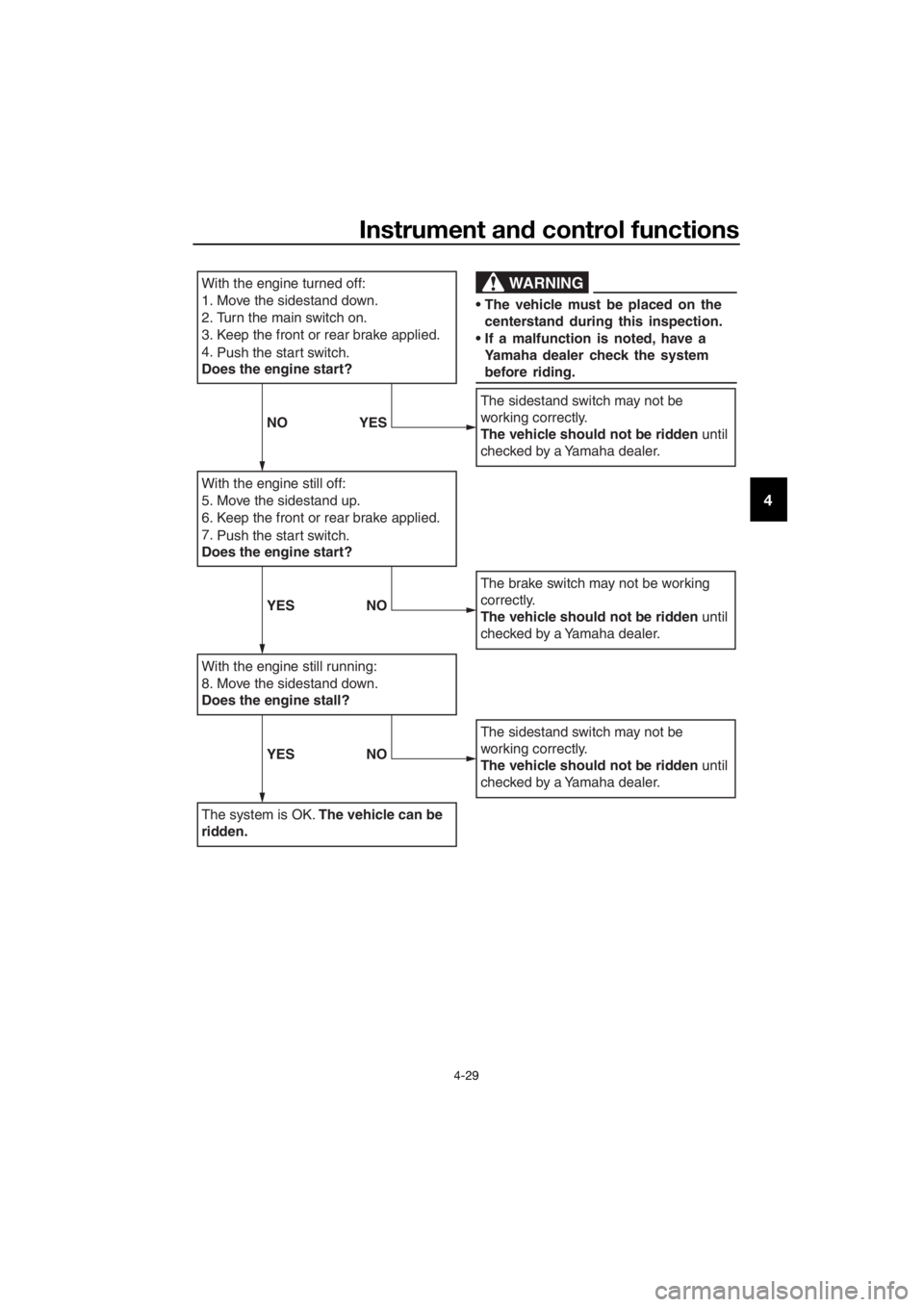
Periodically check the operation of the
ignition circuit cut-off system accord-
ing to the following procedure.
UBL1E0E0.book Page 28 Thursday, May 11, 2017 8:51 AM
Page 55 of 118
Instrument and control functions
4-29
4
With the engine turned off:
1. Move the sidestand down.
2. Turn the main switch on.
3. Keep the front or rear brake applied.
Push the start switch. 4.
Does the engine start?
With the engine still off:
5. Move the sidestand up.
6. Keep the front or rear brake applied.
Push the start switch. 7.
Does the engine start?
With the engine still running:
8. Move the sidestand down.
Does the engine stall?
The system is OK. The vehicle can be
ridden.
The sidestand switch may not be
working correctly.
The vehicle should not be ridden until
checked by a Yamaha dealer.
The brake switch may not be working
correctly.
The vehicle should not be ridden until
checked by a Yamaha dealer.
The sidestand switch may not be
working correctly.
The vehicle should not be ridden until
checked by a Yamaha dealer.
WARNING
The vehicle must be placed on the
centerstand during this inspection.
If a malfunction is noted, have a
Yamaha dealer check the system
before riding.
NO YES
YES NO
YES NO
UBL1E0E0.book Page 29 Thursday, May 11, 2017 8:51 AM
Page 57 of 118
For your safety – pre-operation checks
5-1
5
EAU63440
Inspect your vehicle each time you use it to make sure the vehicle is in safe oper-
ating condition. Always follow the inspection and maintenance procedures and
schedules described in the Owner’s Manual.
WARNING
EWA11152
Failure to inspect or maintain the vehicle properly increases the possibility
of an accident or equipment damage. Do not operate the vehicle if you find
any problem. If a problem cannot be corrected by the procedures provided
in this manual, have the vehicle inspected by a Yamaha dealer.
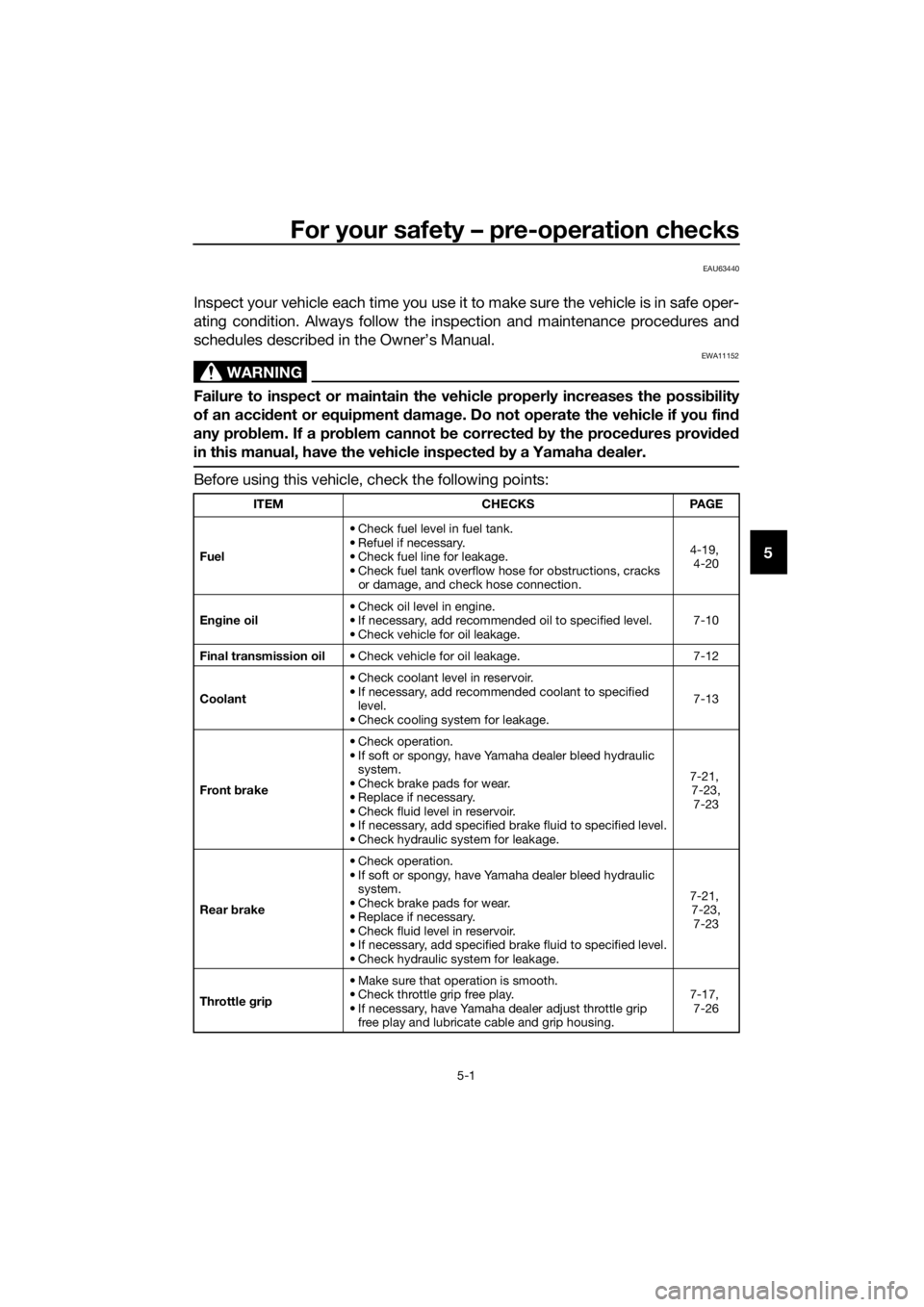
Before using this vehicle, check the following points:
ITEM CHECKS PAGE
Fuel• Check fuel level in fuel tank.
• Refuel if necessary.
• Check fuel line for leakage.
• Check fuel tank overflow hose for obstructions, cracks
or damage, and check hose connection.4-19,
4-20
Engine oil• Check oil level in engine.
• If necessary, add recommended oil to specified level.
• Check vehicle for oil leakage.7-10
Final transmission oil• Check vehicle for oil leakage. 7-12
Coolant• Check coolant level in reservoir.
• If necessary, add recommended coolant to specified
level.
• Check cooling system for leakage.7-13
Front brake• Check operation.
• If soft or spongy, have Yamaha dealer bleed hydraulic
system.
• Check brake pads for wear.
• Replace if necessary.
• Check fluid level in reservoir.
• If necessary, add specified brake fluid to specified level.
• Check hydraulic system for leakage.7-21,
7-23,
7-23
Rear brake• Check operation.
• If soft or spongy, have Yamaha dealer bleed hydraulic
system.
• Check brake pads for wear.
• Replace if necessary.
• Check fluid level in reservoir.
• If necessary, add specified brake fluid to specified level.
• Check hydraulic system for leakage.7-21,
7-23,
7-23
Throttle grip• Make sure that operation is smooth.
• Check throttle grip free play.
• If necessary, have Yamaha dealer adjust throttle grip
free play and lubricate cable and grip housing.7-17,
7-26
UBL1E0E0.book Page 1 Thursday, May 11, 2017 8:51 AM
Page 58 of 118

For your safety – pre-operation checks
5-2
5
Control cables• Make sure that operation is smooth.
• Lubricate if necessary.7-25
Wheels and tires•Check for damage.
• Check tire condition and tread depth.
• Check air pressure.
• Correct if necessary.7-18,
7-20
Brake levers• Make sure that operation is smooth.
• Lubricate lever pivoting points if necessary.7-26
Centerstand, side-
stand• Make sure that operation is smooth.
• Lubricate pivots if necessary.7-27
Chassis fasteners• Make sure that all nuts, bolts and screws are properly
tightened.
• Tighten if necessary.—
Instruments, lights,
signals and switches• Check operation.
• Correct if necessary.—
Sidestand switch • Check operation of ignition circuit cut-off system.
• If system is not working correctly, have Yamaha dealer
check vehicle.4-27 ITEM CHECKS PAGE
UBL1E0E0.book Page 2 Thursday, May 11, 2017 8:51 AM
Page 60 of 118
Operation and important riding points
6-2
6
EAU78231
Starting the engine
NOTICE
ECA10251
See page 6-5 for engine break-in in-
structions prior to operating the ve-
hicle for the first time.
In order for the ignition circuit cut-off
system to enable starting, the side-
stand must be up. (See page 4-28.)
1. Turn the main switch on and make
sure that the stop/run/start switch
is set to “ ”.
The following warning lights and
indicator lights should come on for
a few seconds, then go off.
Engine trouble warning light
Traction control system indi-
cator light
Smart key system indicator
light
TIP
The ABS warning light should come on
and stay on until the vehicle reaches a
traveling speed of 10 km/h (6 mi/h) or
higher.
NOTICE
ECA22510
If a warning or indicator light does
not work as described above, see
page 4-1 for the corresponding
warning and indicator light circuit
check.
2. Close the throttle.
3. While applying the front or rear
brake, push the “ ” side of the
stop/run/start switch. Release it
when the engine starts.
TIP
If the engine does not start, release the
start switch after 5 seconds. Before
pressing the start switch again, wait 10
seconds to allow battery voltage to re-
store.
NOTICE
ECA11043
For maximum engine life, never ac-
celerate hard when the engine is
cold!
UBL1E0E0.book Page 2 Thursday, May 11, 2017 8:51 AM
Page 61 of 118
Operation and important riding points
6-3
6
EAU45093
Starting off
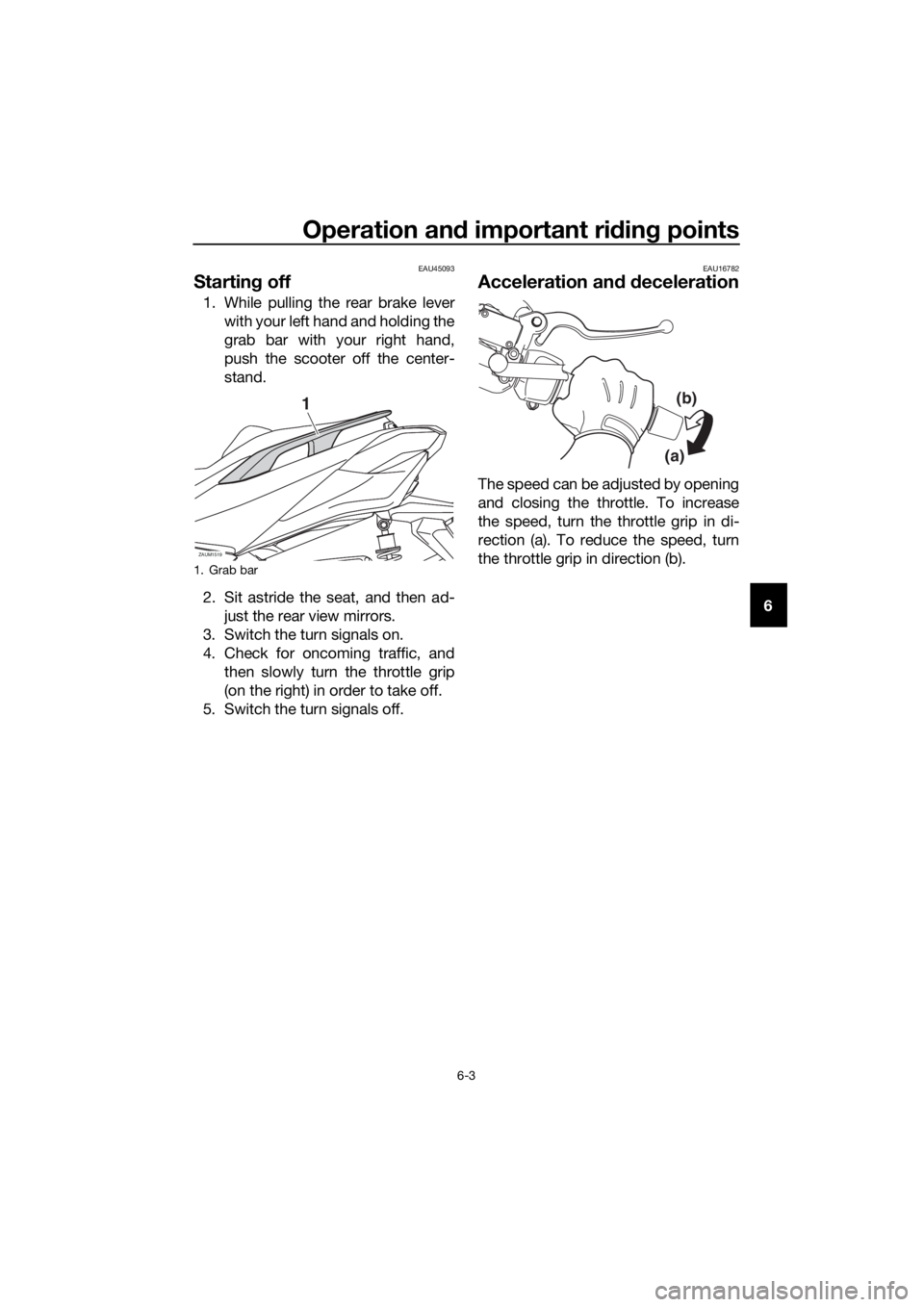
1. While pulling the rear brake lever
with your left hand and holding the
grab bar with your right hand,
push the scooter off the center-
stand.
2. Sit astride the seat, and then ad-
just the rear view mirrors.
3. Switch the turn signals on.
4. Check for oncoming traffic, and
then slowly turn the throttle grip
(on the right) in order to take off.
5. Switch the turn signals off.
EAU16782
Acceleration and deceleration
The speed can be adjusted by opening
and closing the throttle. To increase
the speed, turn the throttle grip in di-
rection (a). To reduce the speed, turn
the throttle grip in direction (b).
1. Grab bar
ZAUM1519
1
(a)(b)
UBL1E0E0.book Page 3 Thursday, May 11, 2017 8:51 AM
Page 62 of 118
Operation and important riding points
6-4
6
EAU16794
Braking
WARNING
EWA10301
Avoid braking hard or suddenly
(especially when leaning over to
one side), otherwise the scooter
may skid or overturn.
Railroad crossings, streetcar
rails, iron plates on road con-
struction sites, and manhole
covers become extremely slip-
pery when wet. Therefore, slow
down when approaching such
areas and cross them with cau-
tion.
Keep in mind that braking on a
wet road is much more difficult.
Ride slowly down a hill, as brak-
ing downhill can be very diffi-
cult.
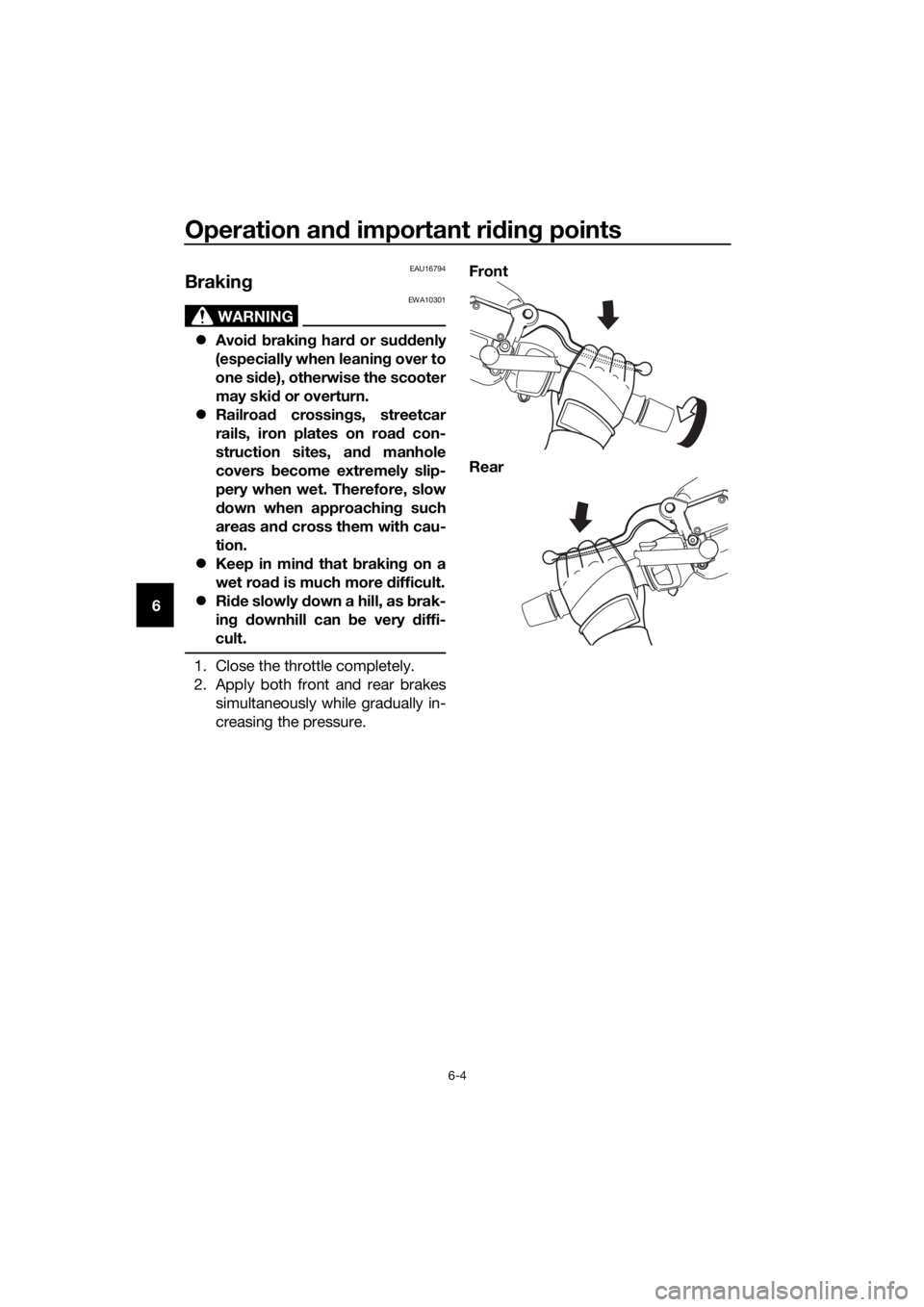
1. Close the throttle completely.
2. Apply both front and rear brakes
simultaneously while gradually in-
creasing the pressure.Front
Rear
UBL1E0E0.book Page 4 Thursday, May 11, 2017 8:51 AM
Page 65 of 118
Periodic maintenance and adjustment
7-1
7
EAUS1824
Periodic inspection, adjustment, and
lubrication will keep your vehicle in the
safest and most efficient condition
possible. Safety is an obligation of the
vehicle owner/operator. The most im-
portant points of vehicle inspection,
adjustment, and lubrication are ex-
plained on the following pages.
The intervals given in the periodic
maintenance charts should be simply
considered as a general guide under
normal riding conditions. However, de-
pending on the weather, terrain, geo-
graphical location, and individual use,
the maintenance intervals may need to
be shortened.
WARNING
EWA10322
Failure to properly maintain the vehi-
cle or performing maintenance ac-
tivities incorrectly may increase
your risk of injury or death during
service or while using the vehicle. If
you are not familiar with vehicle ser-
vice, have a Yamaha dealer perform
service.
WARNING
EWA15123
Turn off the engine when performing
maintenance unless otherwise
specified.
A running engine has moving
parts that can catch on body
parts or clothing and electrical
parts that can cause shocks or
fires.
Running the engine while ser-
vicing can lead to eye injury,
burns, fire, or carbon monoxide
poisoning – possibly leading todeath. See page 1-2 for more in-
formation about carbon monox-
ide.
WARNING
EWA10331
This scooter is designed for use on
paved roads only. If this scooter is
operated in abnormally dusty, mud-
dy or wet conditions, the air filter el-
ement should be cleaned or
replaced more frequently, otherwise
rapid engine wear may result. Con-
sult a Yamaha dealer for proper
maintenance intervals.
WARNING
EWA15461
Brake discs, calipers, drums, and
linings can become very hot during
use. To avoid possible burns, let
brake components cool before
touching them.
UBL1E0E0.book Page 1 Thursday, May 11, 2017 8:51 AM
Page 68 of 118

Periodic maintenance and adjustment
7-4
7
EAU71372
General maintenance and lubrication chart
NO. ITEM
1*Diagnostic system
check• Perform dynamic inspection
using Yamaha diagnostic tool.
• Check the error codes.√√√√√√
2*Air filter element• Replace.√√
3Air filter case
check hose• Clean.√√√√√
4*V-belt case air fil-
ter element• Clean.
• Replace if necessary.√√√√√
5*Front brake• Check operation, fluid level,
and for fluid leakage.
• Replace brake pads if neces-
sary.√√√√√√
6*Rear brake• Check operation, fluid level,
and for fluid leakage.
• Replace brake pads if neces-
sary.√√√√√√
7*Brake hoses• Check for cracks or damage.√√√√√
• Replace. Every 4 years
8*Brake fluid• Change. Every 2 years
9Rear brake lock
cable• Check cable length.
• Adjust if necessary.At the initial interval and 4000
km (2400 mi) after the initial
1000 km (600 mi) and every
5000 km (3000 mi) thereafter.
10*Rear brake lock• Check operation.
•Adjust.√√√√√√
11*Wheels• Check runout and for damage.
• Replace if necessary.√√√√
12*Tires• Check tread depth and for
damage.
• Replace if necessary.
• Check air pressure.
• Correct if necessary.√√√√√
13*Wheel bearing
s• Check bearing for looseness or
damage.√√√√
X 1000 km CHECK OR
MAINTENANCE JOB
X 1000 miODOMETER
READINGSANNUAL CHECK
1 10203040
0.6 6 12 18 24
UBL1E0E0.book Page 4 Thursday, May 11, 2017 8:51 AM
Page 69 of 118

Periodic maintenance and adjustment
7-5
7
14*Steering bearings• Check bearing assemblies for
looseness.√√ √
• Moderately repack with lithium-
soap-based grease.√√
15*Chassis fasteners• Make sure that all nuts, bolts
and screws are properly tight-
ened.√√√√√
16Front and rear
brake lever pivot
shaft• Lubricate with silicone grease.√√√√√
17Sidestand, center-
stand• Check operation.
• Lubricate with lithium-soap-
based grease.√√√√√
18*Sidestand switch• Check operation and replace if
necessary.√√√√√√
19*Front fork• Check operation and for oil
leakage.
• Replace if necessary.√√√√
20*Shock absorber
assemblies• Check operation and for oil
leakage.
• Replace if necessary.√√√√
21 Engine oil• Change (warm engine before
draining).
• Check oil level and vehicle for
oil leakage.At the initial interval and
when the oil change indi-
cator flashes or comes
on.√
22Engine oil filter el-
ement• Replace.√√√
23*Final transmission
oil• Check vehicle for oil leakage.√√√√√
• Change.√√√√√√
24
*Cooling system• Check coolant level and vehicle
for coolant leakage.√√√√√
• Change. Every 3 years
25*V-belt• Replace.When the V-belt replacement
indicator flashes [every 20000
km (12000 mi)]
26*Front and rear
brake switches• Check operation.√√√√√√ NO. ITEM
X 1000 km CHECK OR
MAINTENANCE JOB
X 1000 mi
ODOMETER
READINGS
ANNUAL CHECK
110203040
0.66121824
UBL1E0E0.book Page 5 Thursday, May 11, 2017 8:51 AM