VIN YAMAHA XMAX 400 2020 Owners Manual
[x] Cancel search | Manufacturer: YAMAHA, Model Year: 2020, Model line: XMAX 400, Model: YAMAHA XMAX 400 2020Pages: 118, PDF Size: 9.04 MB
Page 5 of 118

Table of contents
Safety information............................1-1
Further safe-riding points ................1-5
Description........................................2-1
Left view ..........................................2-1
Right view........................................2-2
Controls and instruments ................2-3
Smart key system ............................3-1
Smart key system............................3-1
Operating range of the smart key
system .........................................3-2
Handling of the smart key and
mechanical keys ..........................3-3
Smart key ........................................3-5
Replacing the smart key battery .....3-6
Main switch .....................................3-8
Instrument and control functions....4-1
Indicator lights and warning
lights ............................................4-1
Speedometer...................................4-2
Tachometer .....................................4-3
Multi-function display......................4-3
Handlebar switches.......................4-12
Front brake lever ...........................4-13
Rear brake lever ............................4-14
Rear brake lock lever ....................4-14
ABS ...............................................4-15
Traction control system.................4-16
Fuel tank cap.................................4-18
Fuel................................................4-19
Fuel tank overflow hose ................4-20
Catalytic converters .....................4-21
Storage compartments .................4-21
Windshield.....................................4-23
Handlebar position .......................4-26
Adjusting the shock absorber
assemblies .................................4-26
Sidestand ......................................4-27
Ignition circuit cut-off system........4-28
Auxiliary DC jack ..........................4-30For your safety – pre-operation
checks............................................... 5-1
Operation and important riding
points................................................. 6-1
Starting the engine.......................... 6-2
Starting off ...................................... 6-3
Acceleration and deceleration ........ 6-3
Braking............................................ 6-4
Tips for reducing fuel
consumption................................ 6-5
Engine break-in ............................... 6-5
Parking ............................................ 6-6
Periodic maintenance and
adjustment........................................ 7-1
Owner’s tool kit ............................... 7-2
Periodic maintenance chart for the
emission control system.............. 7-3
General maintenance and
lubrication chart........................... 7-4
Removing and installing panels ...... 7-7
Checking the spark plug ................. 7-8
Canister........................................... 7-9
Engine oil and oil filter element ..... 7-10
Final transmission oil .................... 7-12
Coolant ......................................... 7-13
Air filter elements and check
hoses and V-belt case air filter
element ...................................... 7-15
Checking the throttle grip free
play ............................................ 7-17
Valve clearance ............................. 7-18
Tires .............................................. 7-18
Cast wheels .................................. 7-20
Checking the front and rear brake
lever free play ............................ 7-21
Adjusting the rear brake lock
cable .......................................... 7-22
Checking the rear brake lock ........ 7-22
Checking the front and rear brake
pads........................................... 7-23
Checking the brake fluid level....... 7-23
Changing the brake fluid............... 7-24
Checking the V-belt ...................... 7-25
UBL1E0E0.book Page 1 Thursday, May 11, 2017 8:51 AM
Page 10 of 118

Safety information
1-4
1Genuine Yamaha Accessories
Choosing accessories for your vehicle
is an important decision. Genuine
Yamaha accessories, which are avail-
able only from a Yamaha dealer, have
been designed, tested, and approved
by Yamaha for use on your vehicle.
Many companies with no connection
to Yamaha manufacture parts and ac-
cessories or offer other modifications
for Yamaha vehicles. Yamaha is not in
a position to test the products that
these aftermarket companies produce.
Therefore, Yamaha can neither en-
dorse nor recommend the use of ac-
cessories not sold by Yamaha or
modifications not specifically recom-
mended by Yamaha, even if sold and
installed by a Yamaha dealer.
Aftermarket Parts, Accessories, and
Modifications
While you may find aftermarket prod-
ucts similar in design and quality to
genuine Yamaha accessories, recog-
nize that some aftermarket accesso-
ries or modifications are not suitable
because of potential safety hazards to
you or others. Installing aftermarket
products or having other modifications
performed to your vehicle that change
any of the vehicle’s design or operation
characteristics can put you and others
at greater risk of serious injury or
death. You are responsible for injuries
related to changes in the vehicle.
Keep the following guidelines in mind,
as well as those provided under “Load-
ing” when mounting accessories.
Never install accessories or carry
cargo that would impair the per-
formance of your scooter. Careful-ly inspect the accessory before
using it to make sure that it does
not in any way reduce ground
clearance or cornering clearance,
limit suspension travel, steering
travel or control operation, or ob-
scure lights or reflectors.
• Accessories fitted to the han-
dlebar or the front fork area can
create instability due to improp-
er weight distribution or aerody-
namic changes. If accessories
are added to the handlebar or
front fork area, they must be as
lightweight as possible and
should be kept to a minimum.
• Bulky or large accessories may
seriously affect the stability of
the scooter due to aerodynamic
effects. Wind may attempt to lift
the scooter, or the scooter may
become unstable in cross
winds. These accessories may
also cause instability when
passing or being passed by
large vehicles.
• Certain accessories can dis-
place the operator from his or
her normal riding position. This
improper position limits the
freedom of movement of the
operator and may limit control
ability, therefore, such accesso-
ries are not recommended.
Use caution when adding electri-
cal accessories. If electrical ac-
cessories exceed the capacity of
the scooter’s electrical system, an
electric failure could result, which
could cause a dangerous loss of
lights or engine power.
UBL1E0E0.book Page 4 Thursday, May 11, 2017 8:51 AM
Page 17 of 118

Smart key system
3-3
3 tem does not operate, see page
3-5 and confirm that the smart key
is turned on.
Placing the smart key in the front
or rear storage compartment may
block communication between
the smart key and the vehicle. If
the rear storage compartment is
locked with the smart key inside,
the smart key system may be dis-
abled. The smart key should al-
ways be carried with you.
When leaving the vehicle, make
sure you lock the steering and
take the smart key with you. It is
recommended that you turn the
smart key off.
WARNING
EWA17952
The smart key should be carried
with you. Do not store it on the
vehicle.
When the smart key is within
operating range, exercise due
care because other people not
carrying the smart key can start
the engine and operate the vehi-
cle.
EAU78623
Handling of the smart key and
mechanical keys
WARNING
EWA17952
The smart key should be carried
with you. Do not store it on the
vehicle.
When the smart key is within
operating range, exercise due
care because other people not
carrying the smart key can start
the engine and operate the vehi-
cle.
1. Smart key
2. Mechanical key
1. Identification number card
2. Smart key (inside)
3. Identification number
12
868588
868588
1
32
UBL1E0E0.book Page 3 Thursday, May 11, 2017 8:51 AM
Page 22 of 118
Smart key system
3-8
3
EAU76892
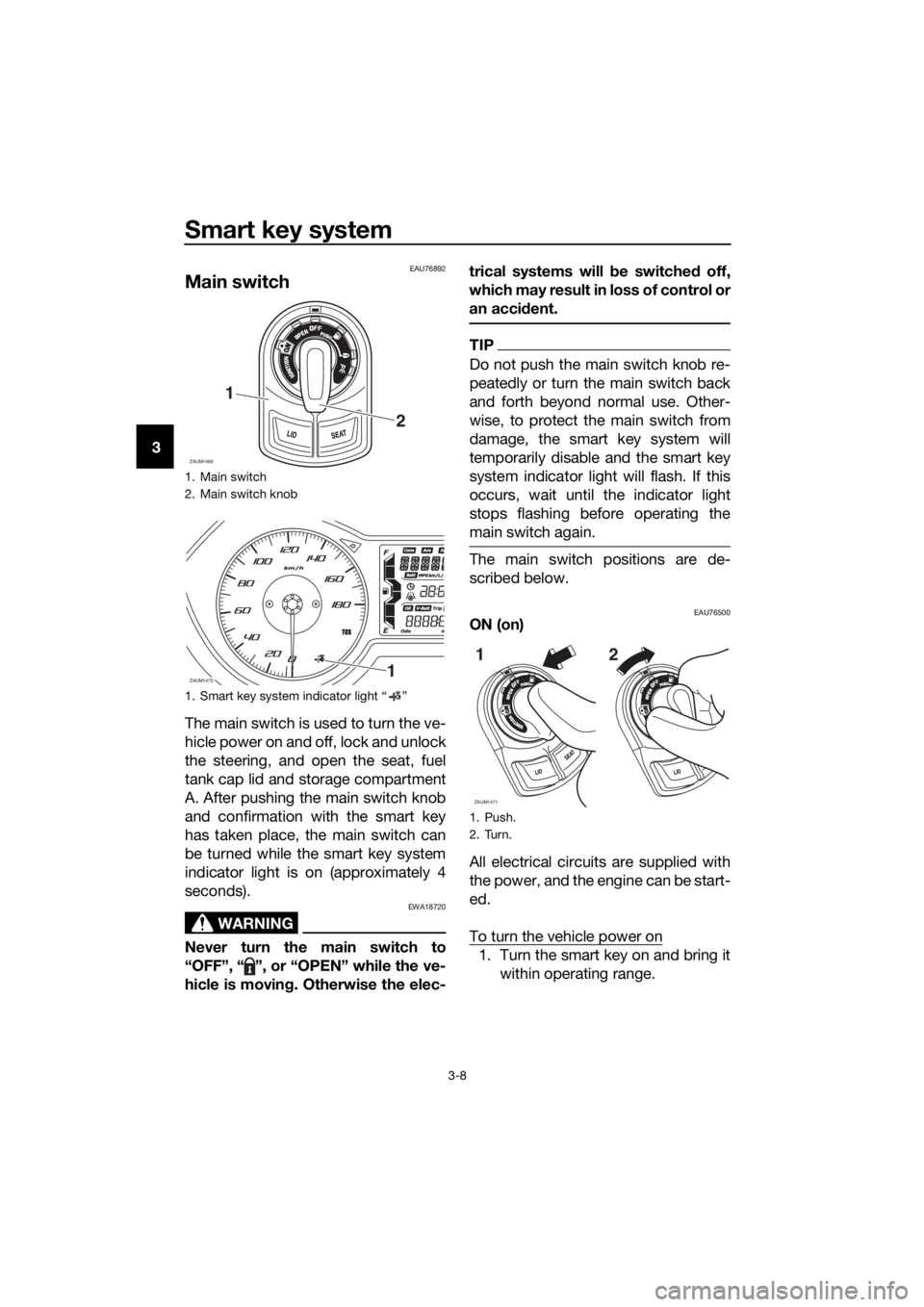
Main switch
The main switch is used to turn the ve-
hicle power on and off, lock and unlock
the steering, and open the seat, fuel
tank cap lid and storage compartment
A. After pushing the main switch knob
and confirmation with the smart key
has taken place, the main switch can
be turned while the smart key system
indicator light is on (approximately 4
seconds).
WARNING
EWA18720
Never turn the main switch to
“OFF”, “ ”, or “OPEN” while the ve-
hicle is moving. Otherwise the elec-trical systems will be switched off,
which may result in loss of control or
an accident.
TIP
Do not push the main switch knob re-
peatedly or turn the main switch back
and forth beyond normal use. Other-
wise, to protect the main switch from
damage, the smart key system will
temporarily disable and the smart key
system indicator light will flash. If this
occurs, wait until the indicator light
stops flashing before operating the
main switch again.
The main switch positions are de-
scribed below.
EAU76500ON (on)
All electrical circuits are supplied with
the power, and the engine can be start-
ed.
To turn the vehicle power on
1. Turn the smart key on and bring it
within operating range.
1. Main switch
2. Main switch knob
1. Smart key system indicator light “ ”
ZAUM1469
2
1
ZAUM14701
1. Push.
2. Turn.
ZAUM1471
1
2
UBL1E0E0.book Page 8 Thursday, May 11, 2017 8:51 AM
Page 40 of 118
Instrument and control functions
4-14
4
EAU12952
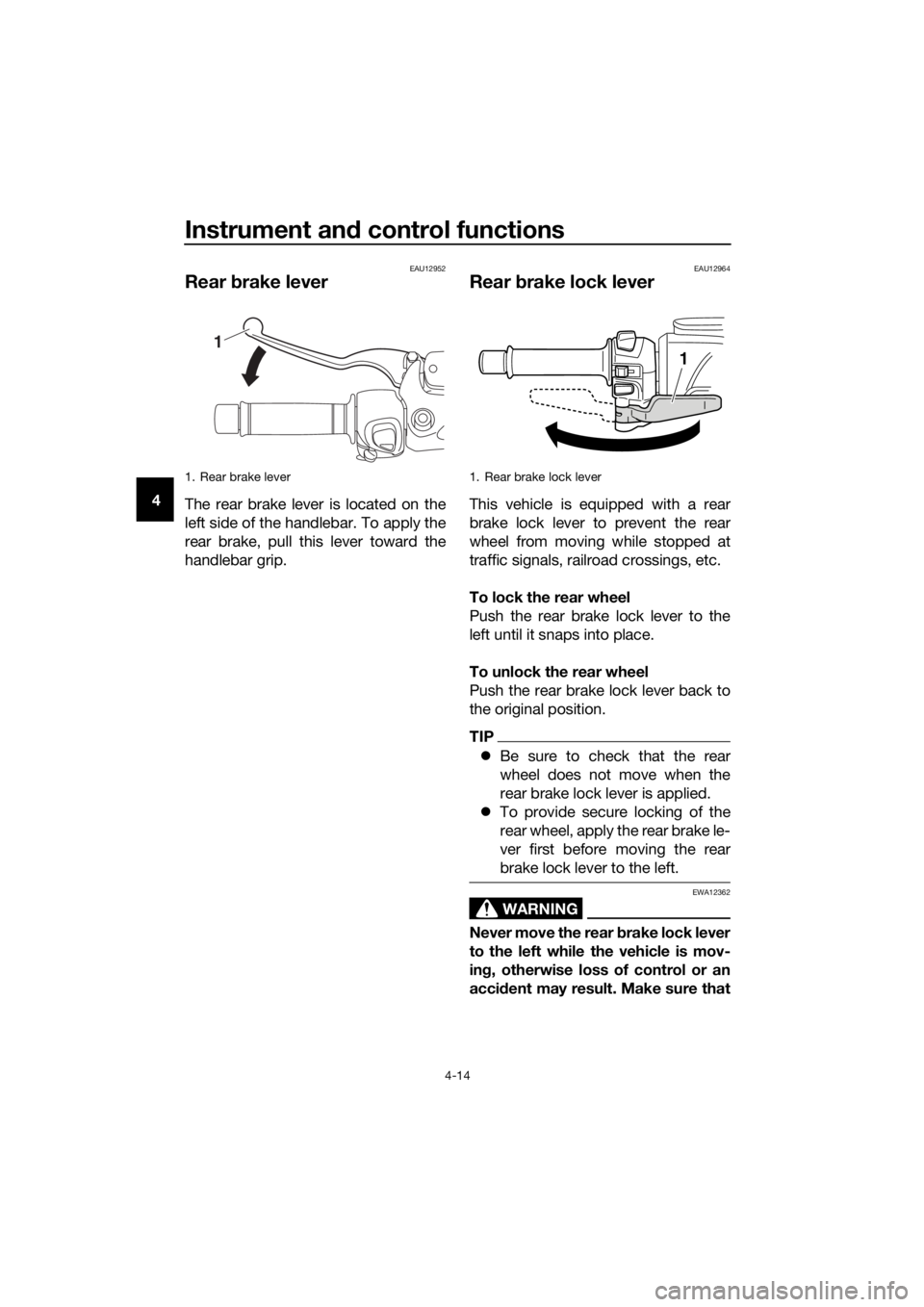
Rear brake lever
The rear brake lever is located on the
left side of the handlebar. To apply the
rear brake, pull this lever toward the
handlebar grip.
EAU12964
Rear brake lock lever
This vehicle is equipped with a rear
brake lock lever to prevent the rear
wheel from moving while stopped at
traffic signals, railroad crossings, etc.
To lock the rear wheel
Push the rear brake lock lever to the
left until it snaps into place.
To unlock the rear wheel
Push the rear brake lock lever back to
the original position.
TIP
Be sure to check that the rear
wheel does not move when the
rear brake lock lever is applied.
To provide secure locking of the
rear wheel, apply the rear brake le-
ver first before moving the rear
brake lock lever to the left.
WARNING
EWA12362
Never move the rear brake lock lever
to the left while the vehicle is mov-
ing, otherwise loss of control or an
accident may result. Make sure that
1. Rear brake lever
1
1. Rear brake lock lever
1
UBL1E0E0.book Page 14 Thursday, May 11, 2017 8:51 AM
Page 49 of 118
Instrument and control functions
4-23
4 Since the storage compartment
accumulates heat when ex-
posed to the sun and/or the en-
gine heat, do not store anything
susceptible to heat, consum-
ables or flammable items inside
it.
To avoid humidity from spread-
ing through the storage com-
partment, wrap wet articles in a
plastic bag before storing them
in the compartment.
Since the storage compartment
may get wet while the vehicle is
being washed, wrap any articles
stored in the compartment in a
plastic bag.
Do not keep anything valuable
or breakable in the storage
compartment.
WARNING
EWA18950
Do not exceed the load limit of 1
kg (2.2 lb) for storage compart-
ment A.
Do not exceed the load limit of
0.5 kg (1.1 lb) for storage com-
partment B.
Do not exceed the load limit of 5
kg (11 lb) for the rear storage
compartment.
Do not exceed the maximum
load of 184 kg (406 lb) for the ve-
hicle.
EAU78521
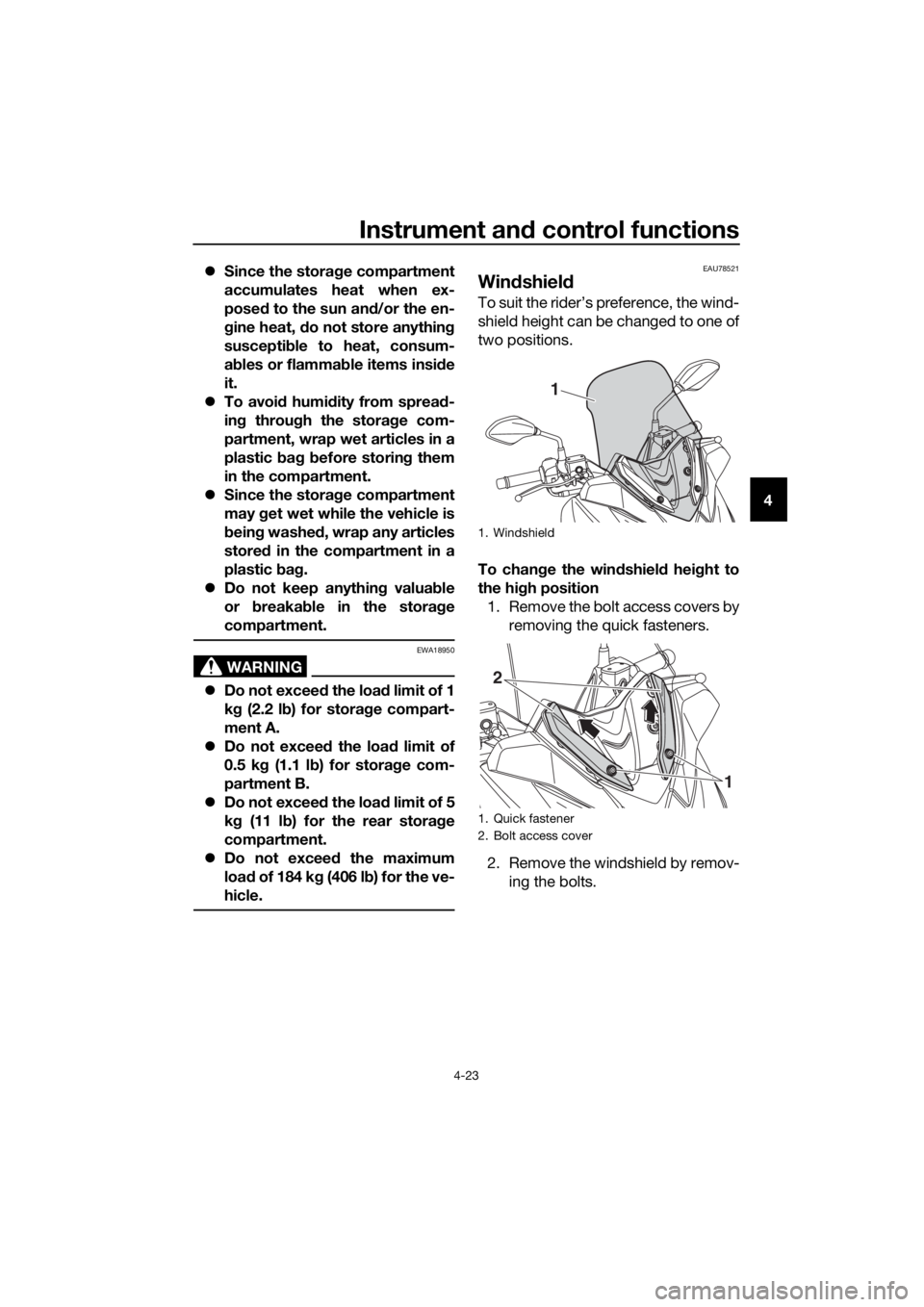
Windshield
To suit the rider’s preference, the wind-
shield height can be changed to one of
two positions.
To change the windshield height to
the high position
1. Remove the bolt access covers by
removing the quick fasteners.
2. Remove the windshield by remov-
ing the bolts.
1. Windshield
1. Quick fastener
2. Bolt access cover
1
2
1
UBL1E0E0.book Page 23 Thursday, May 11, 2017 8:51 AM
Page 50 of 118
Instrument and control functions
4-24
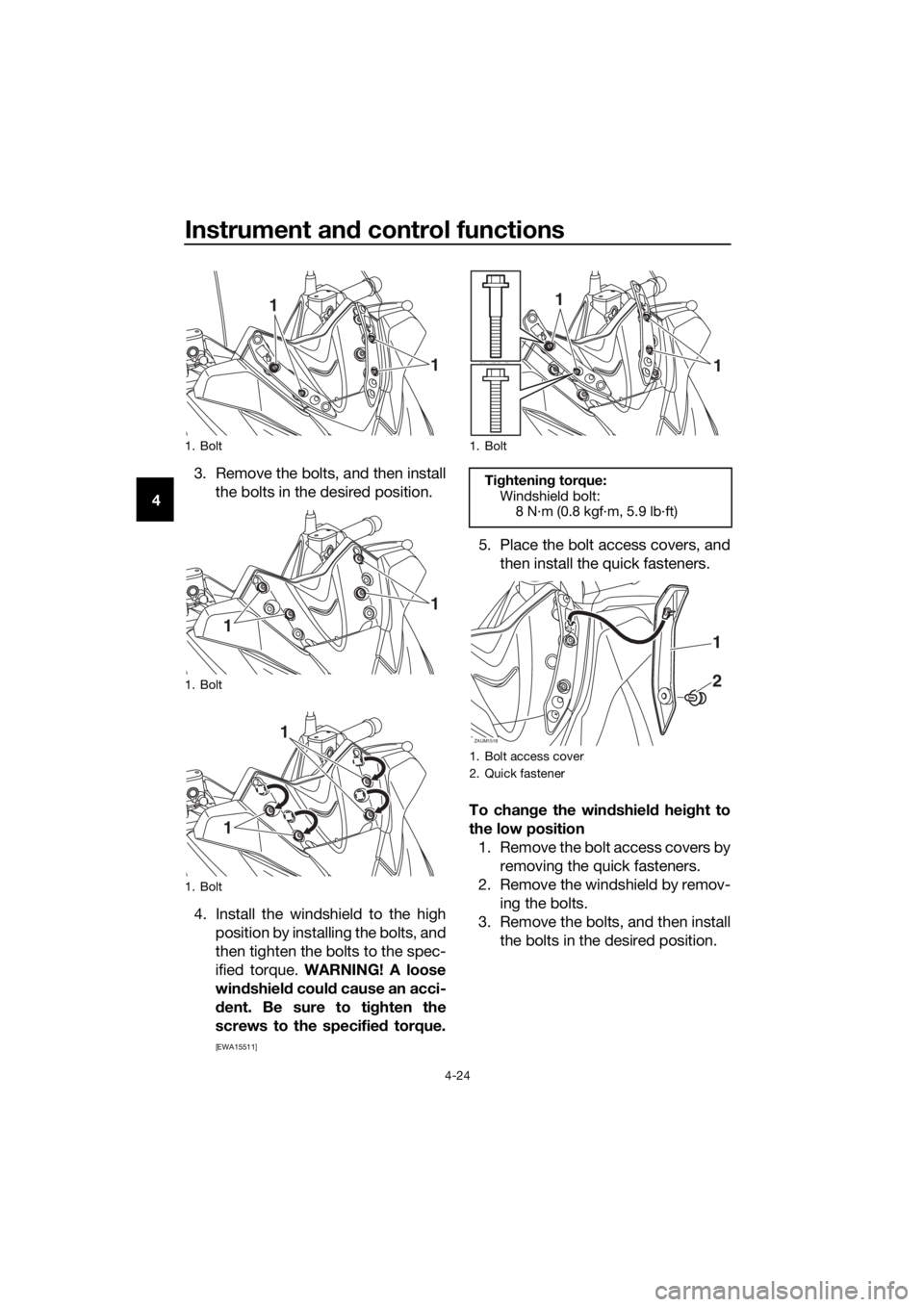
43. Remove the bolts, and then install
the bolts in the desired position.
4. Install the windshield to the high
position by installing the bolts, and
then tighten the bolts to the spec-
ified torque. WARNING! A loose
windshield could cause an acci-
dent. Be sure to tighten the
screws to the specified torque.
[EWA15511]
5. Place the bolt access covers, and
then install the quick fasteners.
To change the windshield height to
the low position
1. Remove the bolt access covers by
removing the quick fasteners.
2. Remove the windshield by remov-
ing the bolts.
3. Remove the bolts, and then install
the bolts in the desired position.
1. Bolt
1. Bolt
1. Bolt
1
1
1
1
1
1
1. Bolt
Tightening torque:
Windshield bolt:
8 N·m (0.8 kgf·m, 5.9 lb·ft)
1. Bolt access cover
2. Quick fastener
1
1
ZAUM1518
1
2
UBL1E0E0.book Page 24 Thursday, May 11, 2017 8:51 AM
Page 64 of 118
Operation and important riding points
6-6
6
EAUN1421
Parking
When parking, turn the vehicle power
off, and then turn the smart key off.
TIP
Even when the vehicle is parked in a lo-
cation partitioned by a fence or the
glass window of a shop, if the smart
key is within operating range, other
people will be able to start the engine
and operate the vehicle. Please turn
the smart key off when leaving the ve-
hicle. (See page 3-5.)
If the sidestand is lowered when the
engine is running, the engine will stop
and the beeper will sound for approxi-
mately 1 minute. To stop the beeper,
turn the vehicle power off or raise the
sidestand.
TIP
Before leaving the vehicle, be sure
to turn the main switch to “OFF”
or “ ”. Otherwise, the battery may
discharge.
The sidestand alarm beeper can
be set to not activate. Please con-
tact your Yamaha dealer.
WARNING
EWA10312
Since the engine and exhaust
system can become very hot,
park in a place where pedestri-
ans or children are not likely to
touch them and be burned.
Do not park on a slope or on soft
ground, otherwise the vehicle
may overturn, increasing the
risk of a fuel leak and fire.Do not park near grass or other
flammable materials which
might catch fire.
UBL1E0E0.book Page 6 Thursday, May 11, 2017 8:51 AM
Page 65 of 118
Periodic maintenance and adjustment
7-1
7
EAUS1824
Periodic inspection, adjustment, and
lubrication will keep your vehicle in the
safest and most efficient condition
possible. Safety is an obligation of the
vehicle owner/operator. The most im-
portant points of vehicle inspection,
adjustment, and lubrication are ex-
plained on the following pages.
The intervals given in the periodic
maintenance charts should be simply
considered as a general guide under
normal riding conditions. However, de-
pending on the weather, terrain, geo-
graphical location, and individual use,
the maintenance intervals may need to
be shortened.
WARNING
EWA10322
Failure to properly maintain the vehi-
cle or performing maintenance ac-
tivities incorrectly may increase
your risk of injury or death during
service or while using the vehicle. If
you are not familiar with vehicle ser-
vice, have a Yamaha dealer perform
service.
WARNING
EWA15123
Turn off the engine when performing
maintenance unless otherwise
specified.
A running engine has moving
parts that can catch on body
parts or clothing and electrical
parts that can cause shocks or
fires.
Running the engine while ser-
vicing can lead to eye injury,
burns, fire, or carbon monoxide
poisoning – possibly leading todeath. See page 1-2 for more in-
formation about carbon monox-
ide.
WARNING
EWA10331
This scooter is designed for use on
paved roads only. If this scooter is
operated in abnormally dusty, mud-
dy or wet conditions, the air filter el-
ement should be cleaned or
replaced more frequently, otherwise
rapid engine wear may result. Con-
sult a Yamaha dealer for proper
maintenance intervals.
WARNING
EWA15461
Brake discs, calipers, drums, and
linings can become very hot during
use. To avoid possible burns, let
brake components cool before
touching them.
UBL1E0E0.book Page 1 Thursday, May 11, 2017 8:51 AM
Page 70 of 118

Periodic maintenance and adjustment
7-6
7
EAU72770
TIP
Engine air filters and V-belt air filter
• This model’s engine air filters are equipped with disposable oil-coated pa-
per elements, which must not be cleaned with compressed air to avoid
damaging them.
• The engine air filter elements need to be replaced and the V-belt air filter
element needs to be serviced more frequently when riding in unusually wet
or dusty areas.
Hydraulic brake service
• Regularly check and, if necessary, correct the brake fluid level.
• Every two years replace the internal components of the brake master cyl-
inders and calipers, and change the brake fluid.
• Replace the brake hoses every four years and if cracked or damaged.
27*Moving parts and
cables• Lubricate.√√√√√
28*Throttle grip hous-
ing and cable• Check operation and free play.
• Adjust the throttle cable free
play if necessary.
• Lubricate the throttle grip hous-
ing and cable.√√√√√
29*Lights, signals and
switches• Check operation.
• Adjust headlight beam.√√√√√√ NO. ITEM
X 1000 km CHECK OR
MAINTENANCE JOB
X 1000 miODOMETER
READINGS
ANNUAL CHECK
110203040
0.6 6 12 18 24
UBL1E0E0.book Page 6 Thursday, May 11, 2017 8:51 AM