periodic YAMAHA XSR 700 2016 Owners Manual
[x] Cancel search | Manufacturer: YAMAHA, Model Year: 2016, Model line: XSR 700, Model: YAMAHA XSR 700 2016Pages: 100, PDF Size: 7.24 MB
Page 6 of 100

Table of contentsSafety information............................ 1-1
Description....................................... 2-1
Left view ......................................... 2-1
Right view ....................................... 2-2
Controls and instruments ............... 2-3
Instrument and control functions... 3-1
Immobilizer system......................... 3-1
Main switch/steering lock............... 3-2
Indicator lights and warning
lights............................................ 3-4
Multi-function meter unit ................ 3-6
Handlebar switches ...................... 3-12
Clutch lever .................................. 3-13
Shift pedal .................................... 3-14
Brake lever.................................... 3-14
Brake pedal .................................. 3-14
ABS .............................................. 3-15
Fuel tank cap ................................ 3-16
Fuel ............................................... 3-16
Fuel tank breather hose and
overflow hose ............................ 3-18
Catalytic converter ....................... 3-18
Seat .............................................. 3-19
Helmet holding cable.................... 3-19
Adjusting the shock absorber
assembly ................................... 3-21
Sidestand ..................................... 3-22
Ignition circuit cut-off system ....... 3-22
Auxiliary DC connector ................. 3-24For your safety – pre-operation
checks............................................... 4-1
Operation and important riding
points................................................. 5-1
Starting the engine .......................... 5-1
Shifting ............................................ 5-2
Tips for reducing fuel
consumption ................................ 5-4
Engine break-in ............................... 5-4
Parking ............................................ 5-5
Periodic maintenance and
adjustment........................................ 6-1
Owner’s tool kit ............................... 6-2
Periodic maintenance chart for the
emission control system .............. 6-3
General maintenance and
lubrication chart ........................... 6-4
Checking the spark plugs ............... 6-8
Canister ........................................... 6-9
Engine oil and oil filter cartridge...... 6-9
Coolant.......................................... 6-12
Replacing the air filter element
and cleaning the check hose..... 6-15
Checking the throttle grip free
play ............................................ 6-15
Valve clearance ............................. 6-16
Tires .............................................. 6-16
Cast wheels................................... 6-18Adjusting the clutch lever free
play ............................................ 6-19
Checking the brake lever free
play ............................................ 6-19
Brake light switches ..................... 6-20
Checking the front and rear brake
pads .......................................... 6-20
Checking the brake fluid level ...... 6-21
Changing the brake fluid .............. 6-22
Drive chain slack........................... 6-23
Cleaning and lubricating the drive
chain.......................................... 6-24
Checking and lubricating the
cables ........................................ 6-25
Checking and lubricating the
throttle grip and cable ............... 6-25
Checking and lubricating the
brake and shift pedals............... 6-26
Checking and lubricating the
brake and clutch levers ............. 6-26
Checking and lubricating the
sidestand................................... 6-27
Lubricating the rear suspension ... 6-27
Lubricating the swingarm
pivots......................................... 6-28
Checking the front fork ................. 6-28
Checking the steering................... 6-29
Checking the wheel bearings ....... 6-29
Battery .......................................... 6-29
Replacing the fuses ...................... 6-31
Replacing the headlight bulb ........ 6-33UB34E0E0.book Page 1 Friday, July 10, 2015 10:31 AM
Page 37 of 100
Instrument and control functions
3-22
3
EAU15306
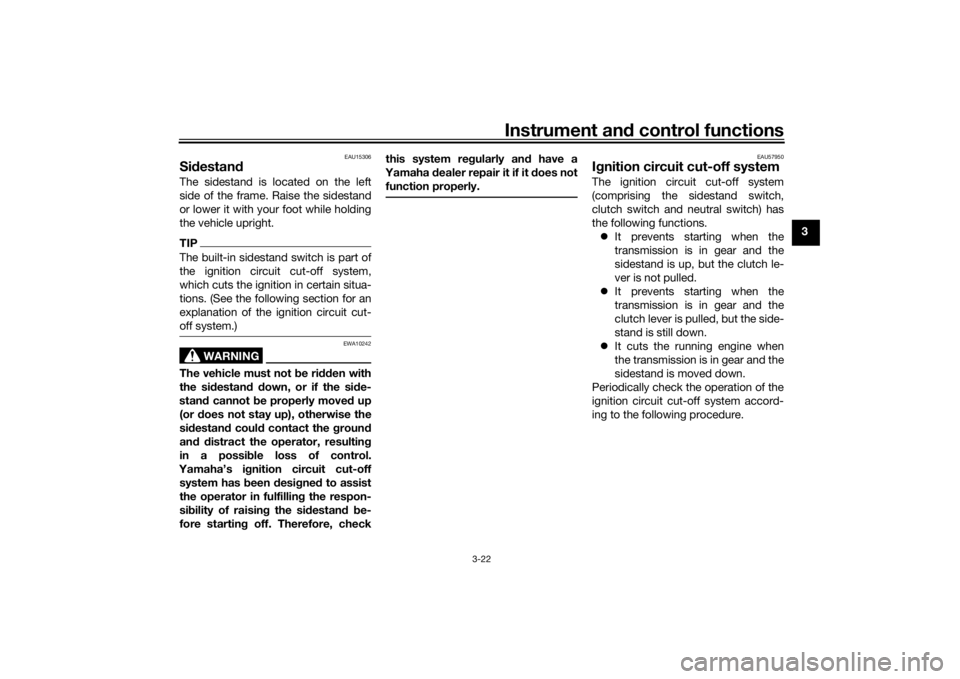
SidestandThe sidestand is located on the left
side of the frame. Raise the sidestand
or lower it with your foot while holding
the vehicle upright.TIPThe built-in sidestand switch is part of
the ignition circuit cut-off system,
which cuts the ignition in certain situa-
tions. (See the following section for an
explanation of the ignition circuit cut-
off system.)
WARNING
EWA10242
The vehicle must not be ridden with
the sidestand down, or if the side-
stand cannot be properly moved up
(or does not stay up), otherwise the
sidestand could contact the ground
and distract the operator, resulting
in a possible loss of control.
Yamaha’s ignition circuit cut-off
system has been designed to assist
the operator in fulfilling the respon-
sibility of raising the sidestand be-
fore starting off. Therefore, checkthis system regularly and have a
Yamaha dealer repair it if it does not
function properly.
EAU57950
Ignition circuit cut-off systemThe ignition circuit cut-off system
(comprising the sidestand switch,
clutch switch and neutral switch) has
the following functions.
It prevents starting when the
transmission is in gear and the
sidestand is up, but the clutch le-
ver is not pulled.
It prevents starting when the
transmission is in gear and the
clutch lever is pulled, but the side-
stand is still down.
It cuts the running engine when
the transmission is in gear and the
sidestand is moved down.
Periodically check the operation of the
ignition circuit cut-off system accord-
ing to the following procedure.
UB34E0E0.book Page 22 Friday, July 10, 2015 10:31 AM
Page 48 of 100
Periodic maintenance and adjustment
6-1
6
EAU17246
Periodic inspection, adjustment, and
lubrication will keep your vehicle in the
safest and most efficient condition
possible. Safety is an obligation of the
vehicle owner/operator. The most im-
portant points of vehicle inspection,
adjustment, and lubrication are ex-
plained on the following pages.
The intervals given in the periodic
maintenance charts should be simply
considered as a general guide under
normal riding conditions. However, de-
pending on the weather, terrain, geo-
graphical location, and individual use,
the maintenance intervals may need to
be shortened.
WARNING
EWA10322
Failure to properly maintain the vehi-
cle or performing maintenance ac-
tivities incorrectly may increase
your risk of injury or death during
service or while using the vehicle. If
you are not familiar with vehicle ser-
vice, have a Yamaha dealer perform
service.
WARNING
EWA15123
Turn off the engine when performing
maintenance unless otherwise
specified.
A running engine has moving
parts that can catch on body
parts or clothing and electrical
parts that can cause shocks or
fires.
Running the engine while ser-
vicing can lead to eye injury,
burns, fire, or carbon monoxide
poisoning – possibly leading to
death. See page 1-3 for more in-
formation about carbon monox-
ide.
WARNING
EWA15461
Brake discs, calipers, drums, and
linings can become very hot during
use. To avoid possible burns, let
brake components cool before
touching them.
EAU17303
Emission controls not only function to
ensure cleaner air, but are also vital to
proper engine operation and maximum
performance. In the following periodic
maintenance charts, the services relat-
ed to emissions control are grouped
separately. These services require
specialized data, knowledge, and
equipment. Maintenance, replace-
ment, or repair of the emission control
devices and systems may be per-
formed by any repair establishment or
individual that is certified (if applicable).
Yamaha dealers are trained and
equipped to perform these particular
services.
UB34E0E0.book Page 1 Friday, July 10, 2015 10:31 AM
Page 49 of 100
Periodic maintenance and adjustment
6-2
6
EAU17382
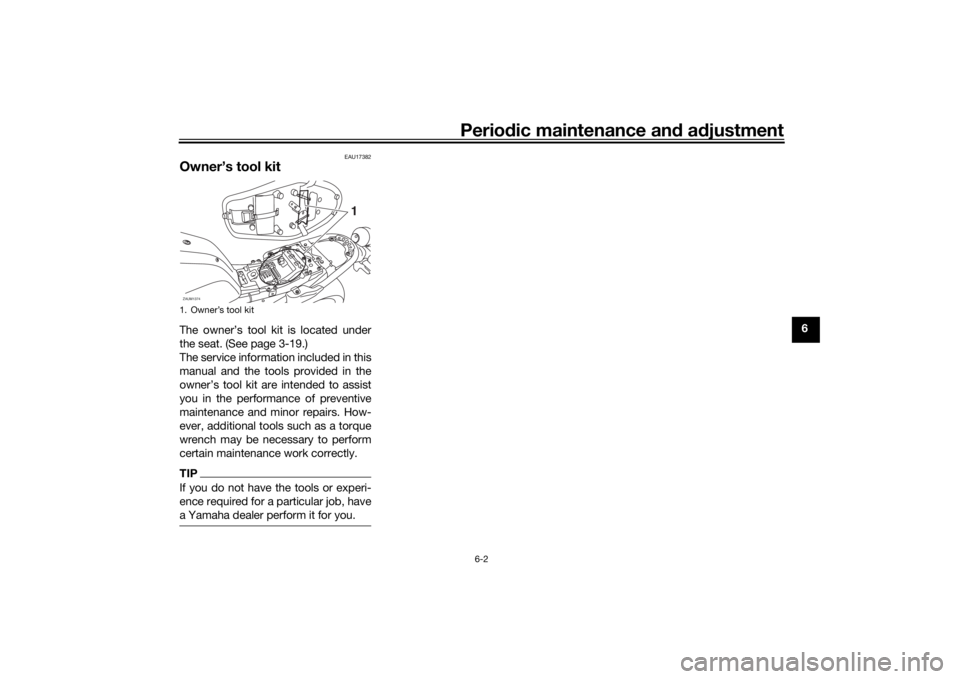
Owner’s tool kitThe owner’s tool kit is located under
the seat. (See page 3-19.)
The service information included in this
manual and the tools provided in the
owner’s tool kit are intended to assist
you in the performance of preventive
maintenance and minor repairs. How-
ever, additional tools such as a torque
wrench may be necessary to perform
certain maintenance work correctly.TIPIf you do not have the tools or experi-
ence required for a particular job, have
a Yamaha dealer perform it for you.1. ZAUM1374
1
UB34E0E0.book Page 2 Friday, July 10, 2015 10:31 AM
Page 50 of 100
Periodic maintenance and adjustment
6-3
6
EAU46862
TIPThe annual checks must be performed every year, except if a kilometer-based maintenance, or for the UK, a
mileage-based maintenance, is performed instead.
From 50000 km (30000 mi), repeat the maintenance intervals starting from 10000 km (6000 mi).
Items marked with an asterisk should be performed by a Yamaha dealer as they require special tools, data and tech-
nical skills.
EAU46911
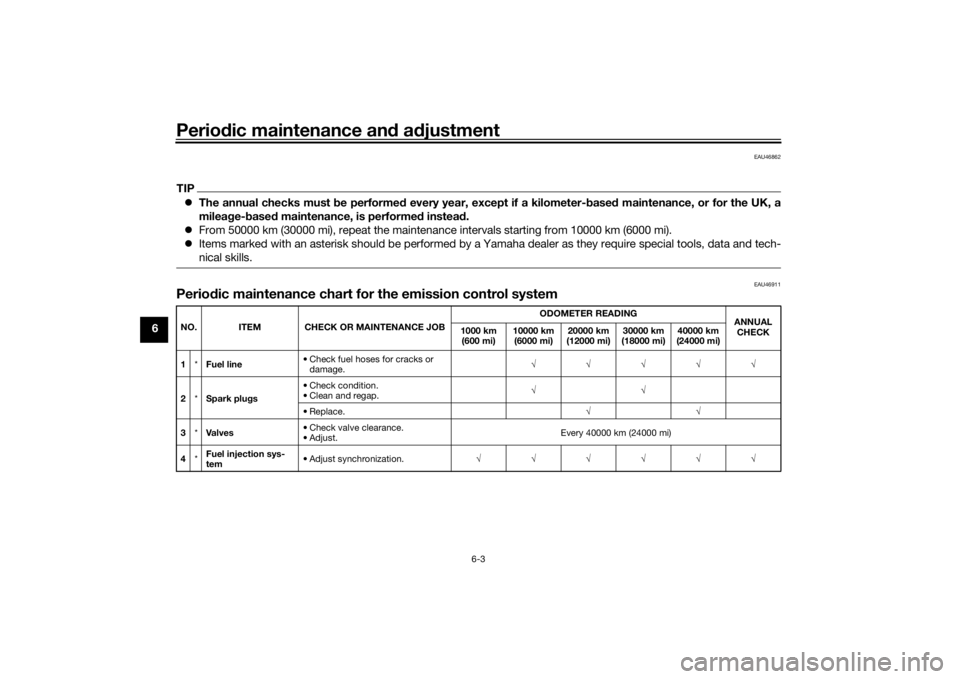
Periodic maintenance chart for the emission control systemNO. ITEM CHECK OR MAINTENANCE JOBODOMETER READING
ANNUAL
CHECK 1000 km
(600 mi)10000 km
(6000 mi)20000 km
(12000 mi)30000 km
(18000 mi)40000 km
(24000 mi)
1*Fuel line• Check fuel hoses for cracks or
damage.√√√√√
2*Spark plugs• Check condition.
• Clean and regap.√√
• Replace.√√
3*Va l ve s• Check valve clearance.
•Adjust.Every 40000 km (24000 mi)
4*Fuel injection sys-
tem• Adjust synchronization.√√√√√√
UB34E0E0.book Page 3 Friday, July 10, 2015 10:31 AM
Page 51 of 100

Periodic maintenance and adjustment
6-4
6
EAU1770M
General maintenance and lubrication chartNO. ITEM CHECK OR MAINTENANCE JOBODOMETER READING
ANNUAL
CHECK 1000 km
(600 mi)10000 km
(6000 mi)20000 km
(12000 mi)30000 km
(18000 mi)40000 km
(24000 mi)
1*Air filter element•Replace.√
2 Air filter check hose• Clean.√√√√√
3Clutch• Check operation.
•Adjust.√√√√√
4*Front brake• Check operation, fluid level and
vehicle for fluid leakage.√√√√√√
• Replace brake pads. Whenever worn to the limit
5*Rear brake• Check operation, fluid level and
vehicle for fluid leakage.√√√√√√
• Replace brake pads. Whenever worn to the limit
6*Brake hoses• Check for cracks or damage.
• Check for correct routing and
clamping.√√√√√
• Replace. Every 4 years
7*Brake fluid• Change. Every 2 years
8*Wheels• Check runout and for damage.√√√√
9*Tires• Check tread depth and for dam-
age.
• Replace if necessary.
• Check air pressure.
• Correct if necessary.√√√√√
10*Wheel bearings• Check bearings for looseness or
damage.√√√√
UB34E0E0.book Page 4 Friday, July 10, 2015 10:31 AM
Page 52 of 100

Periodic maintenance and adjustment
6-5
6
11*Swingarm• Check operation and for exces-
sive play.√√√√
• Lubricate with lithium-soap-
based grease.Every 50000 km (30000 mi)
12 Drive chain• Check chain slack, alignment and
condition.
• Adjust and lubricate chain with a
special O-ring chain lubricant
thoroughly. Every 800 km (500 mi) and after washing the motorcycle, riding in the rain or
riding in wet areas
13*Steering bearings• Check bearing play and steering
for roughness.√√√√√
• Lubricate with lithium-soap-
based grease.Every 20000 km (12000 mi)
14*Chassis fasteners• Make sure that all nuts, bolts and
screws are properly tightened.√√√√√
15Brake lever pivot
shaft• Lubricate with silicone grease.√√√√√
16Brake pedal pivot
shaft• Lubricate with lithium-soap-
based grease.√√√√√
17Clutch lever pivot
shaft• Lubricate with lithium-soap-
based grease.√√√√√
18Shift pedal pivot
shaft• Lubricate with lithium-soap-
based grease.√√√√√
19 Sidestand• Check operation.
• Lubricate with lithium-soap-
based grease.√√√√√
20*Sidestand switch• Check operation.√√√√√√ NO. ITEM CHECK OR MAINTENANCE JOBODOMETER READING
ANNUAL
CHECK 1000 km
(600 mi)10000 km
(6000 mi)20000 km
(12000 mi)30000 km
(18000 mi)40000 km
(24000 mi)UB34E0E0.book Page 5 Friday, July 10, 2015 10:31 AM
Page 53 of 100

Periodic maintenance and adjustment
6-6
6
21*Front fork• Check operation and for oil leak-
age.√√√√
22*Shock absorber as-
sembly• Check operation and shock ab-
sorber for oil leakage.√√√√
23*Rear suspension re-
lay arm and con-
necting arm
pivoting points• Check operation.√√√√
• Lubricate with lithium-soap-
based grease.√√
24 Engine oil• Change.
• Check oil level and vehicle for oil
leakage.√√√√√√
25Engine oil filter car-
tridge•Replace.√√√
26*Cooling system• Check coolant level and vehicle
for coolant leakage.√√√√√
• Change coolant. Every 3 years
27*Front and rear
brake switches• Check operation.√√√√√√
28Moving parts and
cables• Lubricate.√√√√√
29*Throttle grip• Check operation.
• Check throttle grip free play, and
adjust if necessary.
• Lubricate cable and grip housing.√√√√√
30*Lights, signals and
switches
• Check operation.
• Adjust headlight beam.√√√√√√ NO. ITEM CHECK OR MAINTENANCE JOBODOMETER READING
ANNUAL
CHECK 1000 km
(600 mi)10000 km
(6000 mi)20000 km
(12000 mi)30000 km
(18000 mi)40000 km
(24000 mi)
UB34E0E0.book Page 6 Friday, July 10, 2015 10:31 AM
Page 54 of 100
Periodic maintenance and adjustment
6-7
6
EAU18681
TIPAir filter
• This model’s air filter is equipped with a disposable oil-coated paper element, which must not be cleaned with com-
pressed air to avoid damaging it.
• The air filter element needs to be replaced more frequently when riding in unusually wet or dusty areas.
Hydraulic brake service
• Regularly check and, if necessary, correct the brake fluid level.
• Every two years replace the internal components of the brake master cylinders and calipers, and change the brake
fluid.
• Replace the brake hoses every four years and if cracked or damaged.
UB34E0E0.book Page 7 Friday, July 10, 2015 10:31 AM
Page 55 of 100
Periodic maintenance and adjustment
6-8
6
EAU19653
Checking the spark plugsThe spark plugs are important engine
components, which should be
checked periodically, preferably by a
Yamaha dealer. Since heat and depos-
its will cause any spark plug to slowly
erode, they should be removed and
checked in accordance with the peri-
odic maintenance and lubrication
chart. In addition, the condition of the
spark plugs can reveal the condition of
the engine.
The porcelain insulator around the
center electrode of each spark plug
should be a medium-to-light tan (the
ideal color when the vehicle is ridden
normally), and all spark plugs installed
in the engine should have the same
color. If any spark plug shows a dis-
tinctly different color, the engine could
be operating improperly. Do not at-
tempt to diagnose such problems
yourself. Instead, have a Yamaha deal-
er check the vehicle.
If a spark plug shows signs of elec-
trode erosion and excessive carbon or
other deposits, it should be replaced.Before installing a spark plug, the
spark plug gap should be measured
with a wire thickness gauge and, if
necessary, adjusted to specification.
Clean the surface of the spark plug
gasket and its mating surface, and
then wipe off any grime from the spark
plug threads.
TIPIf a torque wrench is not available
when installing a spark plug, a good
estimate of the correct torque is 1/4…
1/2 turn past finger tight. However, the
spark plug should be tightened to the
specified torque as soon as possible.NOTICE
ECA10841
Do not use any tools to remove or in-
stall the spark plug cap, otherwise
the ignition coil coupler may get
damaged. The spark plug cap may
be difficult to remove because the
rubber seal on the end of the cap fits
tightly. To remove the spark plug
cap, simply twist it back and forth
while pulling it out; to install it, twist
it back and forth while pushing it in.
Specified spark plug:
NGK/LMAR8A-9
1. Spark plug gap
Spark plug gap:
0.8–0.9 mm (0.031–0.035 in)
Tightening torque:
Spark plug:
13 Nm (1.3 m·kgf, 9.4 ft·lbf)
UB34E0E0.book Page 8 Friday, July 10, 2015 10:31 AM