transmission YAMAHA XSR 700 2017 User Guide
[x] Cancel search | Manufacturer: YAMAHA, Model Year: 2017, Model line: XSR 700, Model: YAMAHA XSR 700 2017Pages: 100, PDF Size: 7.24 MB
Page 45 of 100
Operation and important riding points
5-3
5
NOTICE
ECA10261
Even with the transmission in
the neutral position, do not
coast for long periods of time
with the engine off, and do not
tow the motorcycle for long dis-
tances. The transmission is
properly lubricated only when
the engine is running. Inade-
quate lubrication may damage
the transmission.
Always use the clutch while
changing gears to avoid dam-
aging the engine, transmission,
and drive train, which are not
designed to withstand the
shock of forced shifting.
EAU16682
To start out and accelerate
1. Pull the clutch lever to disengage
the clutch.
2. Shift the transmission into first
gear. The neutral indicator light
should go out.
3. Open the throttle gradually, and at
the same time, release the clutch
lever slowly.4. At the recommended shift points
shown in the following table, close
the throttle, and at the same time,
quickly pull the clutch lever in.
5. Shift the transmission into second
gear. (Make sure not to shift the
transmission into the neutral posi-
tion.)
6. Open the throttle part way and
gradually release the clutch lever.
7. Follow the same procedure when
shifting to the next higher gear.
TIPWhen shifting gears in normal operat-
ing conditions, use the recommended
shift points.
EAU58270
To decelerate
1. Release the throttle and apply
both the front and the rear brakes
smoothly to slow the motorcycle.
2. At the recommended shift points
shown in the following table, shift
to a lower gear.
3. When the motorcycle reaches 20
km/h (12 mi/h), the engine is about
to stall or runs roughly, pull theclutch lever in, use the brakes to
slow the motorcycle, and continue
to downshift as necessary.
4. Once the motorcycle has
stopped, the transmission can be
shifted into the neutral position.
The neutral indicator light should
come on and then the clutch lever
can be released.
WARNING
EWA17380
Improper braking can cause
loss of control or traction. Al-
ways use both brakes and apply
them smoothly.
Make sure that the motorcycle
and the engine have sufficiently
slowed before shifting to a low-
er gear. Engaging a lower gear
when the vehicle or engine
speed is too high could make
the rear wheel lose traction or
the engine to over-rev. This
could cause loss of control, an
accident and injury. It could also
cause engine or drive train dam-
age.
UB34E0E0.book Page 3 Friday, July 10, 2015 10:31 AM
Page 70 of 100
Periodic maintenance and adjustment
6-23
6
EAU22762
Drive chain slackThe drive chain slack should be
checked before each ride and adjusted
if necessary.
EAU60043
To check the drive chain slack
1. Place the motorcycle on the side-
stand.TIPWhen checking and adjusting the drive
chain slack, there should be no weight
on the motorcycle.2. Shift the transmission into the
neutral position.
3. Push down on the drive chain un-
der the end of the drive chain
guide with a force of 15 N (1.5 kgf,
3.0 lbf).
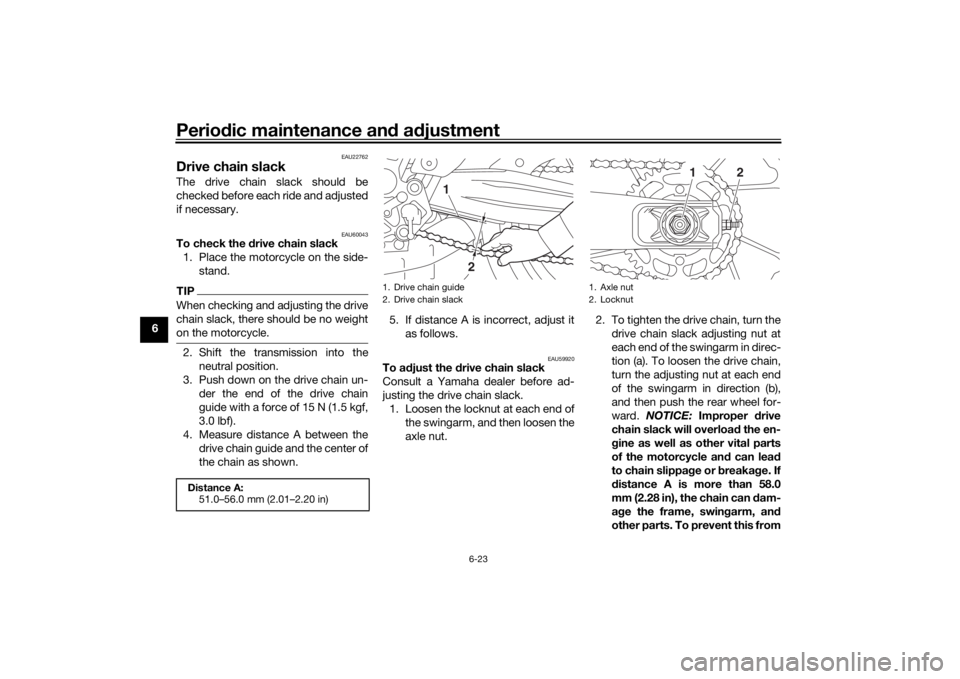
4. Measure distance A between the
drive chain guide and the center of
the chain as shown.5. If distance A is incorrect, adjust it
as follows.
EAU59920
To adjust the drive chain slack
Consult a Yamaha dealer before ad-
justing the drive chain slack.
1. Loosen the locknut at each end of
the swingarm, and then loosen the
axle nut.2. To tighten the drive chain, turn the
drive chain slack adjusting nut at
each end of the swingarm in direc-
tion (a). To loosen the drive chain,
turn the adjusting nut at each end
of the swingarm in direction (b),
and then push the rear wheel for-
ward. NOTICE: Improper drive
chain slack will overload the en-
gine as well as other vital parts
of the motorcycle and can lead
to chain slippage or breakage. If
distance A is more than 58.0
mm (2.28 in), the chain can dam-
age the frame, swingarm, and
other parts. To prevent this from
Distance A:
51.0–56.0 mm (2.01–2.20 in)
1. Drive chain guide
2. Drive chain slack
2
1
1. Axle nut
2. Locknut
2
1
UB34E0E0.book Page 23 Friday, July 10, 2015 10:31 AM
Page 92 of 100

Specifications
8-1
8
Dimensions:Overall length:
2075 mm (81.7 in)
Overall width:
820 mm (32.3 in)
Overall height:
1130 mm (44.5 in)
Seat height:
815 mm (32.1 in)
Wheelbase:
1405 mm (55.3 in)
Ground clearance:
140 mm (5.51 in)
Minimum turning radius:
2700 mm (106.3 in)Weight:Curb weight:
186 kg (410 lb)Engine:Engine type:
Liquid cooled 4-stroke, DOHC
Cylinder arrangement:
Inline 2-cylinder
Displacement:
689 cm³
Bore × stroke:
80.0 × 68.6 mm (3.15 × 2.70 in)
Compression ratio:
11.5 : 1
Starting system:
Electric starter
Lubrication system:
Wet sump
Engine oil:Recommended brand:
YAMALUBE
SAE viscosity grades:
10W-40
Recommended engine oil grade:
API service SG type or higher, JASO
standard MA
Engine oil quantity:
Without oil filter cartridge replacement:
2.30 L (2.43 US qt, 2.02 Imp.qt)
With oil filter cartridge replacement:
2.60 L (2.75 US qt, 2.29 Imp.qt)Coolant quantity:Coolant reservoir (up to the maximum level
mark):
0.25 L (0.26 US qt, 0.22 Imp.qt)
Radiator (including all routes):
1.60 L (1.69 US qt, 1.41 Imp.qt)Air filter:Air filter element:
Oil-coated paper elementFuel:Recommended fuel:
Premium unleaded gasoline (Gasohol (E10)
acceptable)
Fuel tank capacity:
14.0 L (3.70 US gal, 3.08 Imp.gal)
Fuel reserve amount:
2.7 L (0.71 US gal, 0.59 Imp.gal)Fuel injection:Throttle body:
ID mark:
1WS1 10
Spark plug(s):Manufacturer/model:
NGK/LMAR8A-9
Spark plug gap:
0.8–0.9 mm (0.031–0.035 in)Clutch:Clutch type:
Wet, multiple-discTransmission:Primary reduction ratio:
1.925 (77/40)
Final drive:
Chain
Secondary reduction ratio:
2.688 (43/16)
Transmission type:
Constant mesh 6-speed
Operation:
Left foot operation
Gear ratio:
1st:
2.846 (37/13)
2nd:
2.125 (34/16)
3rd:
1.632 (31/19)
4th:
1.300 (26/20)
5th:
1.091 (24/22)
6th:
0.964 (27/28)
UB34E0E0.book Page 1 Friday, July 10, 2015 10:31 AM