stop start YAMAHA XSR 900 2016 Owners Manual
[x] Cancel search | Manufacturer: YAMAHA, Model Year: 2016, Model line: XSR 900, Model: YAMAHA XSR 900 2016Pages: 106, PDF Size: 7.68 MB
Page 21 of 106
Instrument and control functions
3-6
1
234
5
6
7
8
9
10
11
12
EAUM3621
Immobilizer system indicator light
“”
When the key is turned to “OFF” and 30
seconds have passed, the indicator
light will flash steadily to indicate the im-
mobilizer system is enabled. After 24
hours have passed, the indicator light
will stop flashing, however the immobi-
lizer system is still enabled.
The electrical circuit of the indicator
light can be checked by turning the key
to “ON”. The indicator light should
come on for a few seconds, and then
go off.
If the indicator light does not come on
initially when the key is turned to “ON”,
if the indicator light remains on, or if the
indicator light flashes in a pattern (if a
problem is detected in the immobilizer
system, the immobili zer system indica-
tor light will flash in a pattern), have a
Yamaha dealer check the vehicle.TIPIf the immobilizer system indicator light
flashes in the pattern, slowly 5 times
then quickly 2 times, this could be
caused by transponder interference. If
this occurs, try the following.
1. Make sure there are no other im- mobilizer keys close to the main
switch. Other immobilizer system
keys may cause signal interfer-
ence and prevent the engine from
starting.
2. Use the code re-registering key to start the engine.
3. If the engine starts, turn it off, and try starting the engine with the
standard keys.
4. If one or both of the standard keys do not start the engine, take the
vehicle and all 3 keys to a Yamaha
dealer to have the standard keys
re-registered.
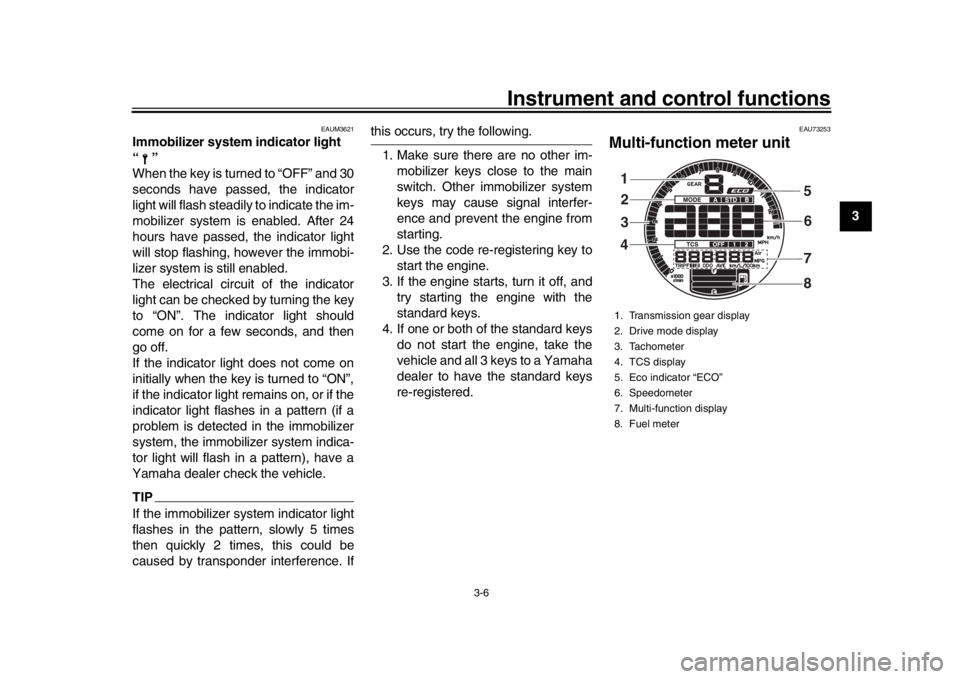
EAU73253
Multi-function meter unit1. Transmission gear display
2. Drive mode display
3. Tachometer
4. TCS display
5. Eco indicator “ECO”
6. Speedometer
7. Multi-function display
8. Fuel meter1
32
4 5
6
8
7
B90-9-E0_1.book 6 ページ 2015年12月15日 火曜日 午後8時5分
Page 23 of 106
Instrument and control functions
3-8
1
234
5
6
7
8
9
10
11
12
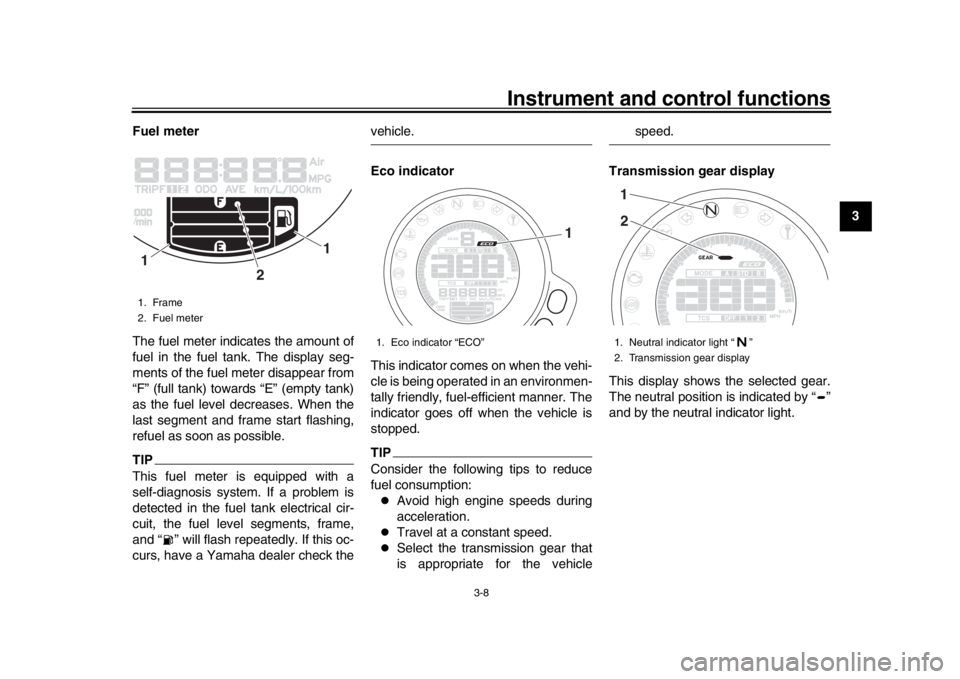
Fuel meter
The fuel meter indicates the amount of
fuel in the fuel tank. The display seg-
ments of the fuel meter disappear from
“F” (full tank) towards “E” (empty tank)
as the fuel level decreases. When the
last segment and frame start flashing,
refuel as soon as possible.
TIPThis fuel meter is equipped with a
self-diagnosis system. If a problem is
detected in the fuel tank electrical cir-
cuit, the fuel level segments, frame,
and “ ” will flash repeatedly. If this oc-
curs, have a Yamaha dealer check the
vehicle.
Eco indicator
This indicator comes on when the vehi-
cle is being operated in an environmen-
tally friendly, fuel-efficient manner. The
indicator goes off when the vehicle is
stopped.TIPConsider the following tips to reduce
fuel consumption:
Avoid high engine speeds during
acceleration.
Travel at a constant speed.
Select the transmission gear that
is appropriate for the vehicle
speed.
Transmission gear display
This display shows the selected gear.
The neutral position is indicated by “ ”
and by the neutral indicator light.
1. Frame
2. Fuel meter
1
1
2
1. Eco indicator “ECO”
1
1. Neutral indicator light “ ”
2. Transmission gear display12
B90-9-E0_1.book 8 ページ 2015年12月15日 火曜日 午後8時5分
Page 27 of 106
Instrument and control functions
3-12
1
234
5
6
7
8
9
10
11
12
ments.
If the message “HI” flashes, stop the
vehicle, then stop the engine and let it
cool. (See page 6-39.)
TIP
When the coolant temperature is
below 40
C, “Lo” will be displayed.
The coolant temperature varies
with changes in the weather andengine load.
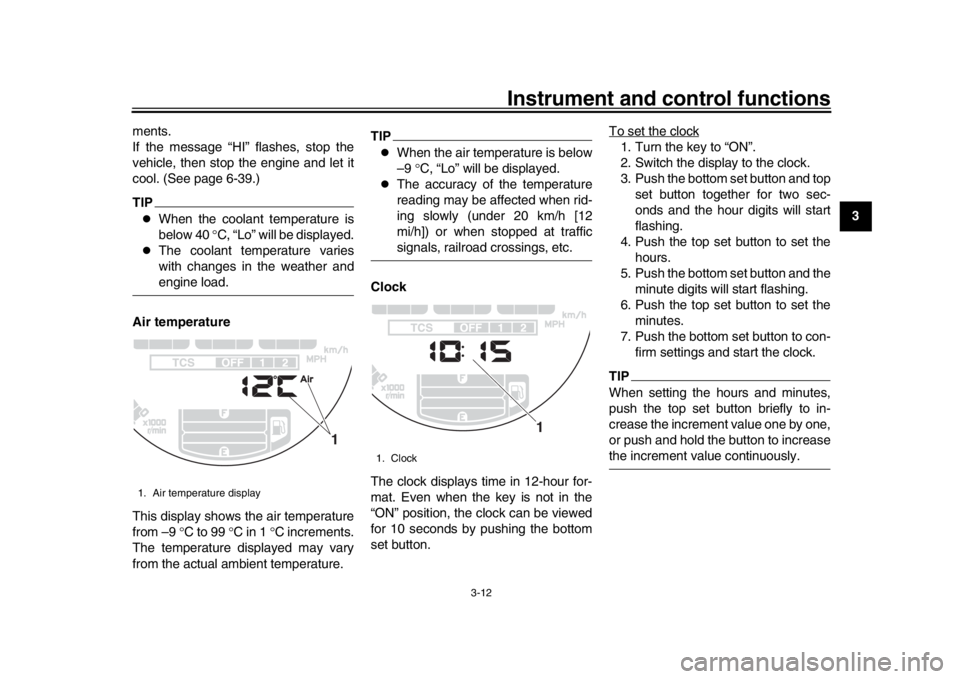
Air temperature
This display shows the air temperature
from –9 C to 99 C in 1 C increments.
The temperature displayed may vary
from the actual ambient temperature.
TIP
When the air temperature is below
–9 C, “Lo” will be displayed.
The accuracy of the temperature
reading may be affected when rid-
ing slowly (under 20 km/h [12
mi/h]) or when stopped at trafficsignals, railroad crossings, etc.
Clock
The clock displays time in 12-hour for-
mat. Even when the key is not in the
“ON” position, the clock can be viewed
for 10 seconds by pushing the bottom
set button. To set the clock
1. Turn the key to “ON”.
2. Switch the display to the clock.
3. Push the bottom set button and top
set button together for two sec-
onds and the hour digits will start
flashing.
4. Push the top set button to set the hours.
5. Push the bottom set button and the minute digits will start flashing.
6. Push the top set button to set the minutes.
7. Push the bottom set button to con- firm settings and start the clock.TIPWhen setting the hours and minutes,
push the top set button briefly to in-
crease the increment value one by one,
or push and hold the button to increasethe increment value continuously.
1. Air temperature display
1
1. Clock
1
B90-9-E0_1.book 12 ページ 2015年12月15日 火曜日 午後8時5分
Page 29 of 106
Instrument and control functions
3-14
1
234
5
6
7
8
9
10
11
12
This mode allows the rider to enjoy
smooth and sporty drivability from the
low-speed range to the high-speed
range.
Mode “A”
Mode “A” offers a sportier engine re-
sponse in the low- to mid-speed range
compared to mode “STD”.
Mode “B”
Mode “B” offers response that is some-
what less sharp compared to mode
“STD” for riding situations that require
especially sensitive throttle operation.
EAU1234K
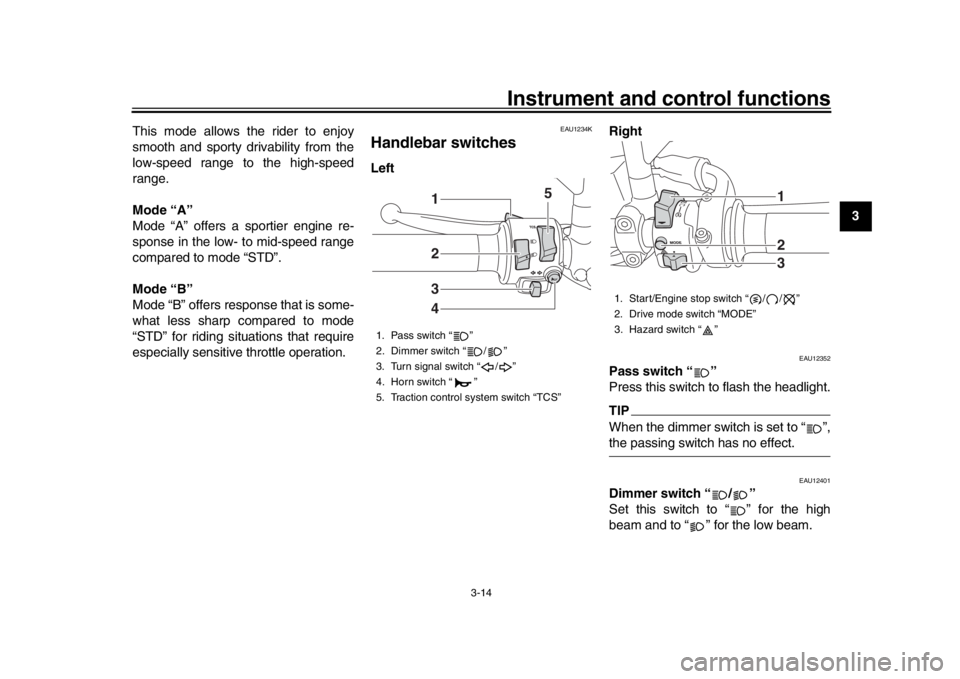
Handlebar switchesLeft
Right
EAU12352
Pass switch “ ”
Press this switch to flash the headlight.TIPWhen the dimmer switch is set to “ ”,the passing switch has no effect.
EAU12401
Dimmer switch “ / ”
Set this switch to “ ” for the high
beam and to “ ” for the low beam.
1. Pass switch “ ”
2. Dimmer switch “ / ”
3. Turn signal switch “ / ”
4. Horn switch “ ”
5. Traction control system switch “TCS”
2341
5
1. Start/Engine stop switch “ / / ”
2. Drive mode switch “MODE”
3. Hazard switch “ ”
123
B90-9-E0_1.book 14 ページ 2015年12月15日 火曜日 午後8時5分
Page 30 of 106
Instrument and control functions
3-15
1
23
4
5
6
7
8
9
10
11
12
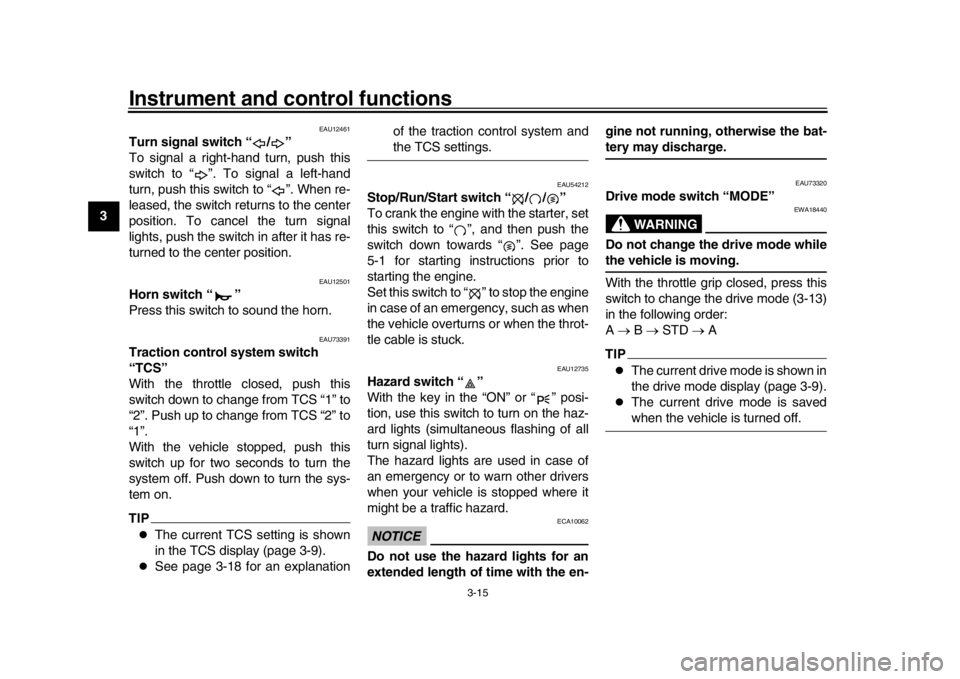
EAU12461
Turn signal switch “ / ”
To signal a right-hand turn, push this
switch to “ ”. To signal a left-hand
turn, push this switch to “ ”. When re-
leased, the switch returns to the center
position. To cancel the turn signal
lights, push the switch in after it has re-
turned to the center position.
EAU12501
Horn switch “ ”
Press this switch to sound the horn.
EAU73391
Traction control system switch
“TCS”
With the throttle closed, push this
switch down to change from TCS “1” to
“2”. Push up to change from TCS “2” to
“1”.
With the vehicle stopped, push this
switch up for two seconds to turn the
system off. Push down to turn the sys-
tem on.TIP
The current TCS setting is shown
in the TCS display (page 3-9).
See page 3-18 for an explanation of the traction control system and
the TCS settings.
EAU54212
Stop/Run/Start switch “ / / ”
To crank the engine with the starter, set
this switch to “ ”, and then push the
switch down towards “ ”. See page
5-1 for starting instructions prior to
starting the engine.
Set this switch to “ ” to stop the engine
in case of an emergency, such as when
the vehicle overturns or when the throt-
tle cable is stuck.
EAU12735
Hazard switch “ ”
With the key in the “ON” or “ ” posi-
tion, use this switch to turn on the haz-
ard lights (simultaneous flashing of all
turn signal lights).
The hazard lights are used in case of
an emergency or to warn other drivers
when your vehicle is stopped where it
might be a traffic hazard.NOTICE
ECA10062
Do not use the hazard lights for an
extended length of time with the en- gine not running, otherwise the bat-
tery may discharge.
EAU73320
Drive mode switch “MODE”
WARNING
EWA18440
Do not change the drive mode whilethe vehicle is moving.
With the throttle grip closed, press this
switch to change the drive mode (3-13)
in the following order:
A
B STD ATIP
The current drive mode is shown in
the drive mode display (page 3-9).
The current drive mode is savedwhen the vehicle is turned off.
B90-9-E0_1.book 15 ページ 2015年12月15日 火曜日 午後8時5分
Page 44 of 106
Instrument and control functions
3-29
1
23
4
5
6
7
8
9
10
11
12
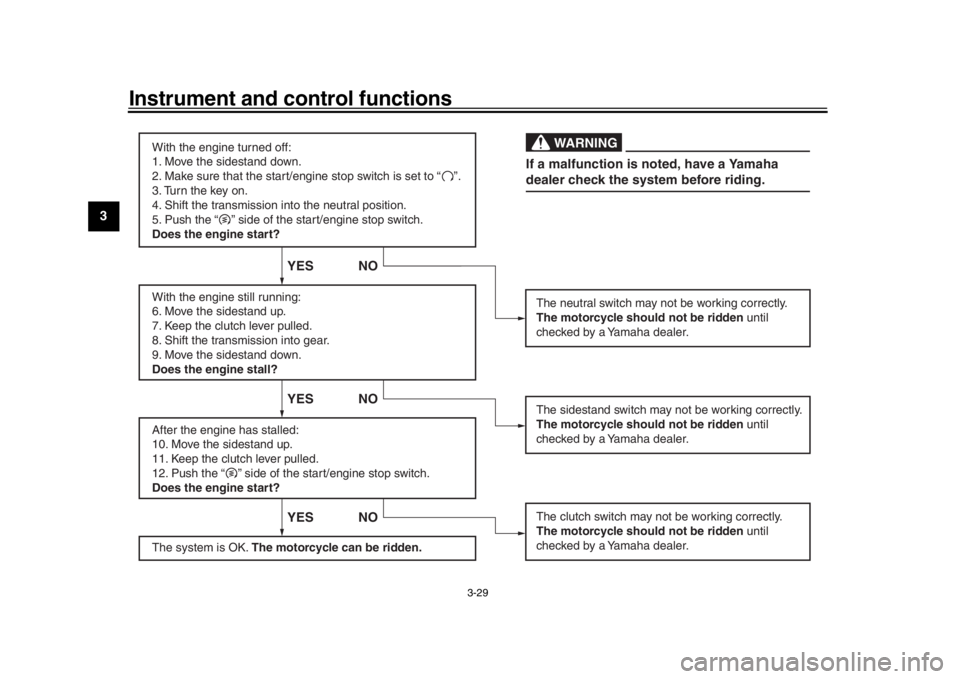
With the engine turned off:
1. Move the sidestand down.
2. Make sure that the start/engine stop switch is set to “ ”.
3. Turn the key on.
4. Shift the transmission into the neutral position.
5. Push the “ ” side of the start/engine stop switch.
Does the engine start?
With the engine still running:
6. Move the sidestand up.
7. Keep the clutch lever pulled.
8. Shift the transmission into gear.
9. Move the sidestand down.
Does the engine stall?
After the engine has stalled:
10. Move the sidestand up.
11. Keep the clutch lever pulled.
12. Push the “ ” side of the start/engine stop switch.
Does the engine start?
The system is OK. The motorcycle can be ridden.
YES NO YES NO YES NO
The neutral switch may not be working correctly.
The motorcycle should not be ridden until
checked by a Yamaha dealer.
The clutch switch may not be working correctly.
The motorcycle should not be ridden until
checked by a Yamaha dealer.The sidestand switch may not be working correctly.
The motorcycle should not be ridden until
checked by a Yamaha dealer.If a malfunction is noted, have a Yamaha
dealer check the system before riding.
WARNING
B90-9-E0_1.book 29 ページ 2015年12月15日 火曜日 午後8時5分
Page 49 of 106
5-1
1
2
3
456
7
8
9
10
11
12
Operation and important riding points
EAU15952
Read the Owner’s Manual carefully to
become familiar with all controls. If
there is a control or function you do not
understand, ask your Yamaha dealer.
WARNING
EWA10272
Failure to familiarize yourself with
the controls can lead to loss of con-
trol, which could cause an accidentor injury.
EAUM3631
TIPThis model is equipped with:
a lean angle sensor to stop the en-
gine in case of a turnover. In this
case, the engine trouble warning
light will come on, but this is not a
malfunction. Turn the key to “OFF”
and then to “ON” to turn off the
warning light. Failing to do so will
prevent the engine from starting
even though the engine will crank
when pushing the start switch.
an engine auto-stop system. The
engine stops automatically if left
idling for 20 minutes. If the engine
stops, simply push the start switchto restart the engine.
EAU73430
Starting the engineIn order for the ignition circuit cut-off
system to enable starting, one of the
following conditions must be met:
The transmission is in the neutral
position.
The transmission is in gear with
the clutch lever pulled and the sid-
estand up.
See page 3-28 for more informa-
tion.
1. Turn the key to “ON” and make sure that the start/engine stop
switch is set to “ ”.
The following warning lights and
indicator light should come on for a
few seconds, then go off.
Oil level warning light
Coolant temperature warning
light
Engine trouble warning light
Immobilizer system indicator
light
NOTICE
ECA17671
If the above warning lights or indica-
tor light do not come on initially
when the key is turned to “ON”, or if
B90-9-E0_1.book 1 ページ 2015年12月15日 火曜日 午後8時5分
Page 50 of 106
Operation and important riding points
5-2
1
2
3
45
6
7
8
9
10
11
12 a warning or indicator light remains
on, see page 3-4 for the correspond-
ing warning and indicator light cir-
cuit check.
The ABS warning light should
come on when the key is turned to
“ON”, and then go off after travel-
ing at a speed of 10 km/h (6 mi/h)
or higher.NOTICE
ECA17682
If the ABS warning light does not
come on and then go off as ex-
plained above, see page 3-4 for thewarning light circuit check.2. Shift the transmission into the neu- tral position. The neutral indicator
light should come on. If not, ask a
Yamaha dealer to check the elec-
trical circuit.
3. Start the engine by sliding the switch toward “ ”.
If the engine fails to start, release
the start/engine stop switch, wait a
few seconds, and then try again.
Each starting attempt should be as
short as possible to preserve the
battery. Do not crank the engine more than 10 seconds on any one
attempt.
NOTICE
ECA11043
For maximum engine life, never ac-
celerate hard when the engine iscold!
EAU16673
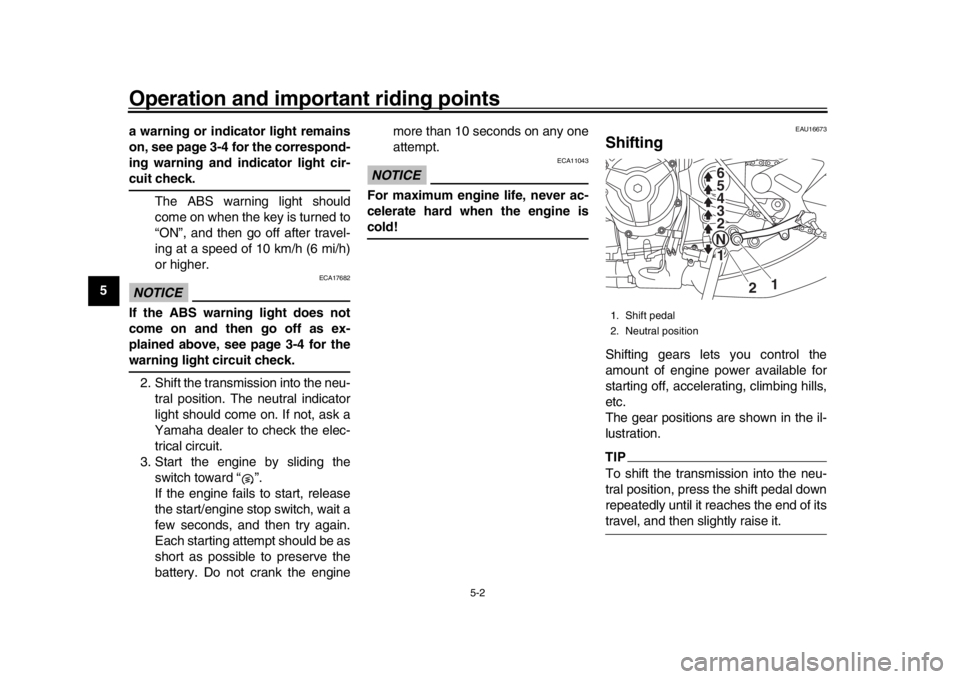
ShiftingShifting gears lets you control the
amount of engine power available for
starting off, accelerating, climbing hills,
etc.
The gear positions are shown in the il-
lustration.TIPTo shift the transmission into the neu-
tral position, press the shift pedal down
repeatedly until it reaches the end of itstravel, and then slightly raise it.1. Shift pedal
2. Neutral position
1
N
2 3 4
5 6
1
2
B90-9-E0_1.book 2 ページ 2015年12月15日 火曜日 午後8時5分
Page 51 of 106
Operation and important riding points
5-3
1
2
3
456
7
8
9
10
11
12
NOTICE
ECA10261
Even with the transmission in
the neutral position, do not
coast for long periods of time
with the engine off, and do not
tow the motorcycle for long dis-
tances. The transmission is
properly lubricated only when
the engine is running. Inade-
quate lubrication may damage
the transmission.
Always use the clutch while
changing gears to avoid damag-
ing the engine, transmission,
and drive train, which are not
designed to withstand theshock of forced shifting.
EAU16682
To start out and accelerate 1. Pull the clutch lever to disengage the clutch.
2. Shift the transmission into first gear. The neutral indicator light
should go out.
3. Open the throttle gradually, and at the same time, release the clutch
lever slowly. 4. At the recommended shift points
shown in the following table, close
the throttle, and at the same time,
quickly pull the clutch lever in.
5. Shift the transmission into second gear. (Make sure not to shift the
transmission into the neutral posi-
tion.)
6. Open the throttle part way and gradually release the clutch lever.
7. Follow the same procedure when shifting to the next higher gear.
TIPWhen shifting gears in normal operat-
ing conditions, use the recommendedshift points.
EAU58270
To decelerate1. Release the throttle and apply both the front and the rear brakes
smoothly to slow the motorcycle.
2. At the recommended shift points shown in the following table, shift
to a lower gear.
3. When the motorcycle reaches 25 km/h (16 mph), the engine is about
to stall or runs roughly, pull the clutch lever in, use the brakes to
slow the motorcycle, and continue
to downshift as necessary.
4. Once the motorcycle has stopped, the transmission can be shifted
into the neutral position. The neu-
tral indicator light should come on
and then the clutch lever can be
released.
WARNING
EWA17380
Improper braking can cause
loss of control or traction. Al-
ways use both brakes and apply
them smoothly.
Make sure that the motorcycle
and the engine have sufficiently
slowed before shifting to a low-
er gear. Engaging a lower gear
when the vehicle or engine
speed is too high could make
the rear wheel lose traction or
the engine to over-rev. This
could cause loss of control, an
accident and injury. It could also
cause engine or drive train dam-age.
B90-9-E0_1.book 3 ページ 2015年12月15日 火曜日 午後8時5分
Page 89 of 106
Periodic maintenance and adjustment6-36
1
2
3
4
567
8
9
10
11
12
3. Insert a new bulb into the socket,
push it in, and then turn it clock-
wise until it stops.
4. Install the lens by installing the screw. NOTICE: Do not over-
tighten the screw, otherwise the
lens may break.
[ECA11192] EAU24331
License plate lightIf the license plate light does not come
on, have a Yamaha dealer check the
electrical circuit or replace the bulb.
EAU67131
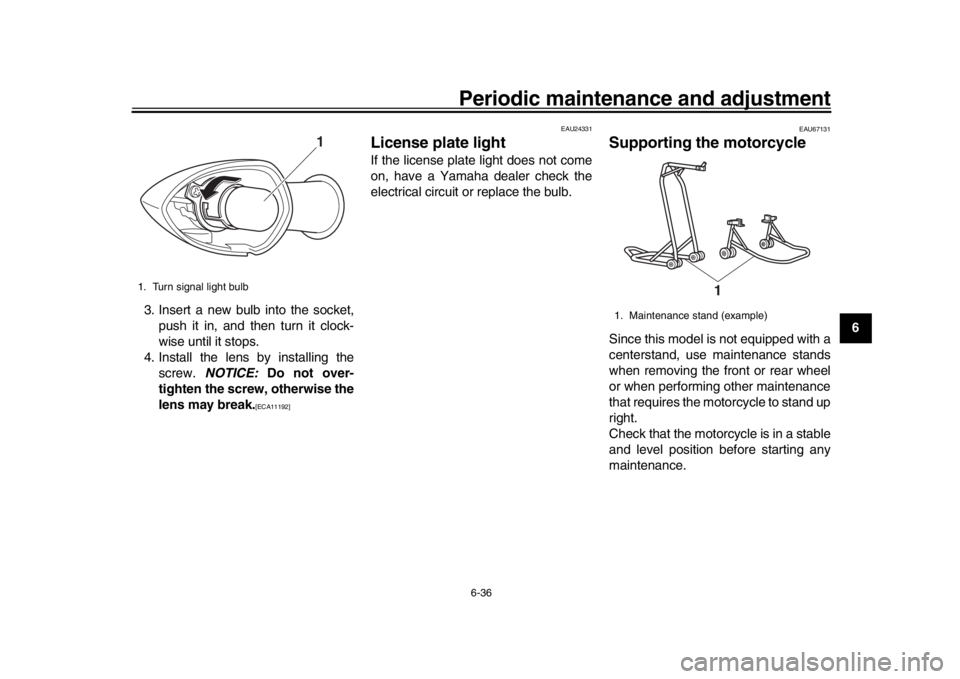
Supporting the motorcycleSince this model is not equipped with a
centerstand, use maintenance stands
when removing the front or rear wheel
or when performing other maintenance
that requires the motorcycle to stand up
right.
Check that the motorcycle is in a stable
and level position before starting any
maintenance.
1. Turn signal light bulb
1
1. Maintenance stand (example)
1
B90-9-E0_1.book 36 ページ 2015年12月15日 火曜日 午後8時5分