warning YAMAHA XSR 900 2020 Owner's Manual
[x] Cancel search | Manufacturer: YAMAHA, Model Year: 2020, Model line: XSR 900, Model: YAMAHA XSR 900 2020Pages: 102, PDF Size: 7.74 MB
Page 47 of 102
5-1
1
2
3
456
7
8
9
10
11
12
Operation and important riding points
EAU15952
Read the Owner’s Manual carefully to
become familiar with all controls. If
there is a control or function you do not
understand, ask your Yamaha dealer.
WARNING
EWA10272
Failure to familiarize yourself with
the controls can lead to loss of con-
trol, which could cause an accidentor injury.
EAU16842
Engine break-inThere is never a more important period
in the life of your engine than the period
between 0 and 1600 km (1000 mi). For
this reason, you should read the follow-
ing material carefully.
Since the engine is brand new, do not
put an excessive load on it for the first
1600 km (1000 mi). The various parts in
the engine wear and polish themselves
to the correct operating clearances.
During this period, prolonged full-throt-
tle operation or any condition that might
result in engine overheating must be
avoided.
EAU17094
0–1000 km (0–600 mi)
Avoid prolonged operation above 5600
r/min. NOTICE: After 1000 km (600
mi) of operation, the engine oil must
be changed and the oil filter car-
tridge or element replaced.
[ECA10303]
1000–1600 km (600–1000 mi)
Avoid prolonged operation above 6800 r/min.
1600 km (1000 mi) and beyond
The vehicle can now be operated nor-
mally.
NOTICE
ECA10311
Keep the engine speed out of
the tachometer red zone.
If any engine trouble should oc-
cur during the engine break-in
period, immediately have a
Yamaha dealer check the vehi-cle.
BAE-28199-E1.book 1 ページ 2019年8月23日 金曜日 午後3時56分
Page 48 of 102
Operation and important riding points
5-2
1
2
3
45
6
7
8
9
10
11
12
EAU86590
Starting the engineThe ignition circuit cut-off system will
enable starting when:
the transmission is in the neutral
position or
the transmission is in gear, the sid-
estand is up, and the clutch lever is
pulled.
To start the engine
1. Turn the main switch on and set the engine stop switch to the run
position.
2. Confirm the indicator and warning light(s) come on for a few seconds,
and the go off. (See page 3-3.)TIP
Do not start the engine if the en-
gine trouble warning light or the oil
level warning light remains on.
The ABS warning light should
come on and stay on until the vehi-
cle reaches a speed of 10 km/h (6mi/h).
NOTICE
ECA24110
If a warning or indicator light does not work as described above, have a
Yamaha dealer check the vehicle.
3. Shift the transmission into the neu- tral position.
4. Start the engine by pushing the start switch.
5. Release the start switch when the engine starts, or after 5 seconds.
Wait 10 seconds before pressing
the switch again to allow battery
voltage to restore.NOTICE
ECA11043
For maximum engine life, never ac-
celerate hard when the engine iscold!
EAUM3632
TIPThis model is equipped with:
a lean angle sensor. This sensor
stops the engine in case of a vehi-
cle turnover. If this happens, the
engine trouble warning light will
come on, but this is not a malfunc-
tion. Turn the vehicle power off
and then back on again to cancel
the warning light. Failing to do so
will prevent the engine from start-
ing even though the engine will
crank when pushing the start
switch.
an engine auto-stop system. The
engine stops automatically if left
idling for 20 minutes. If the engine
stops, simply push the start switchto restart the engine.
BAE-28199-E1.book 2 ページ 2019年8月23日 金曜日 午後3時56分
Page 50 of 102
Operation and important riding points
5-4
1
2
3
45
6
7
8
9
10
11
12
EAU17214
ParkingWhen parking, stop the engine, and
then remove the key from the main
switch.
WARNING
EWA10312
Since the engine and exhaust
system can become very hot,
park in a place where pedestri-
ans or children are not likely to
touch them and be burned.
Do not park on a slope or on soft
ground, otherwise the vehicle
may overturn, increasing the
risk of a fuel leak and fire.
Do not park near grass or other
flammable materials whichmight catch fire.
BAE-28199-E1.book 4 ページ 2019年8月23日 金曜日 午後3時56分
Page 51 of 102
6-1
1
2
3
4
567
8
9
10
11
12
Periodic maintenance and adjustment
EAU17246
Periodic inspection, adjustment, and lu-
brication will keep your vehicle in the
safest and most efficient condition pos-
sible. Safety is an obligation of the vehi-
cle owner/operator. The most important
points of vehicle inspection, adjust-
ment, and lubrication are explained on
the following pages.
The intervals given in the periodic
maintenance charts should be simply
considered as a general guide under
normal riding conditions. However, de-
pending on the weather, terrain, geo-
graphical location, and individual use,
the maintenance intervals may need to
be shortened.
WARNING
EWA10322
Failure to properly maintain the ve-
hicle or performing maintenance ac-
tivities incorrectly may increase
your risk of injury or death during
service or while using the vehicle. If
you are not familiar with vehicle ser-
vice, have a Yamaha dealer performservice.
WARNING
EWA15123
Turn off the engine when performing
maintenance unless otherwise
specified.
A running engine has moving
parts that can catch on body
parts or clothing and electrical
parts that can cause shocks or
fires.
Running the engine while ser-
vicing can lead to eye injury,
burns, fire, or carbon monoxide
poisoning – possibly leading to
death. See page 1-2 for more in-
formation about carbon monox-ide.WARNING
EWA15461
Brake discs, calipers, drums, and
linings can become very hot during
use. To avoid possible burns, let
brake components cool beforetouching them.
EAU17303
Emission controls not only function to
ensure cleaner air, but are also vital to
proper engine operation and maximum
performance. In the following periodic
maintenance charts, the services relat-
ed to emissions control are grouped
separately. These services require
specialized data, knowledge, and
equipment. Maintenance, replacement,
or repair of the emission control devic-
es and systems may be performed by
any repair establishment or individual
that is certified (if applicable). Yamaha
dealers are trained and equipped to
perform these particular services.
BAE-28199-E1.book 1 ページ 2019年8月23日 金曜日 午後3時56分
Page 63 of 102
Periodic maintenance and adjustment6-13
1
2
3
4
567
8
9
10
11
12
EAU85450
Why YamalubeYAMALUBE oil is a Genuine YAMAHA
Part born of the engineers’ passion and
belief that engine oil is an important liq-
uid engine component. We form teams
of specialists in the fields of mechanical
engineering, chemistry, electronics and
track testing, and have them develop
the engine together with the oil it will
use. Yamalube oils take full advantage
of the base oil’s qualities and blend in
the ideal balance of additives to make
sure the final oil clears our performance
standards. Thus, Yamalube mineral,
semisynthetic and synthetic oils have
their own distinct characters and value.
Yamaha’s experience gained over
many years of research and develop-
ment into oil since the 1960’s helps
make Yamalube the best choice for
your Yamaha engine.
EAUS1203
CoolantThe coolant level should be checked
regularly. In addition, the coolant must
be changed at the intervals specified in
the periodic maintenance chart.TIPIf genuine Yamaha coolant is not avail-
able, use an ethylene glycol antifreeze
containing corrosion inhibitors for alu-
minum engines and mix with distilledwater at a 1:1 ratio.
EAU20097
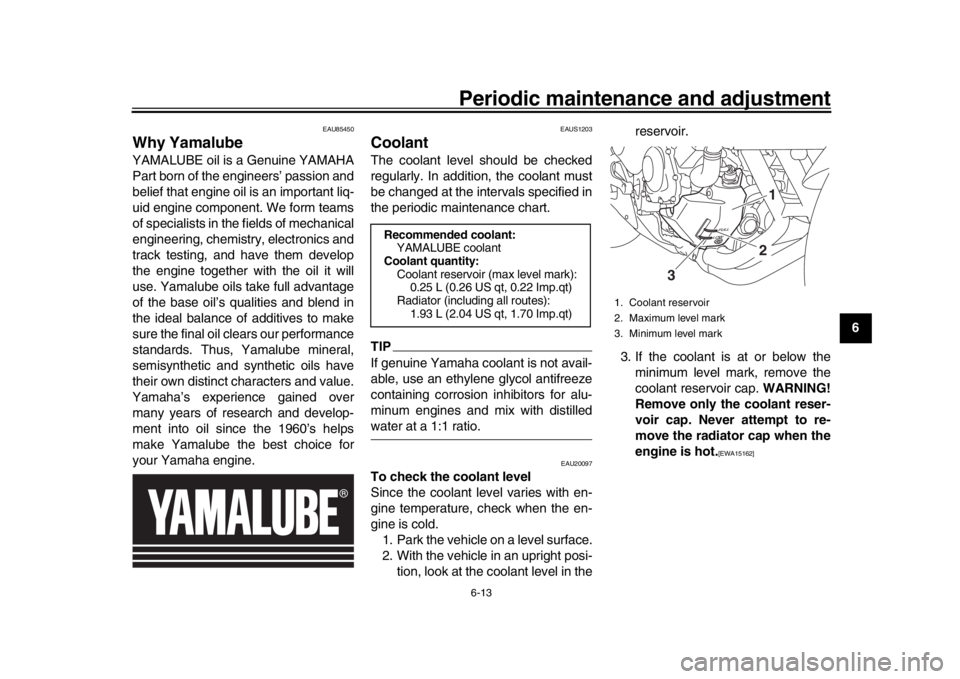
To check the coolant level
Since the coolant level varies with en-
gine temperature, check when the en-
gine is cold. 1. Park the vehicle on a level surface.
2. With the vehicle in an upright posi- tion, look at the coolant level in the reservoir.
3. If the coolant is at or below the minimum level mark, remove the
coolant reservoir cap. WARNING!
Remove only the coolant reser-
voir cap. Never attempt to re-
move the radiator cap when the
engine is hot.
[EWA15162]
Recommended coolant: YAMALUBE coolant
Coolant quantity: Coolant reservoir (max level mark):0.25 L (0.26 US qt, 0.22 Imp.qt)
Radiator (including all routes): 1.93 L (2.04 US qt, 1.70 Imp.qt)
1. Coolant reservoir
2. Maximum level mark
3. Minimum level mark
21
3
BAE-28199-E1.book 13 ページ 2019年8月23日 金曜日 午後3時56分
Page 64 of 102
Periodic maintenance and adjustment
6-14
1
2
3
4
56
7
8
9
10
11
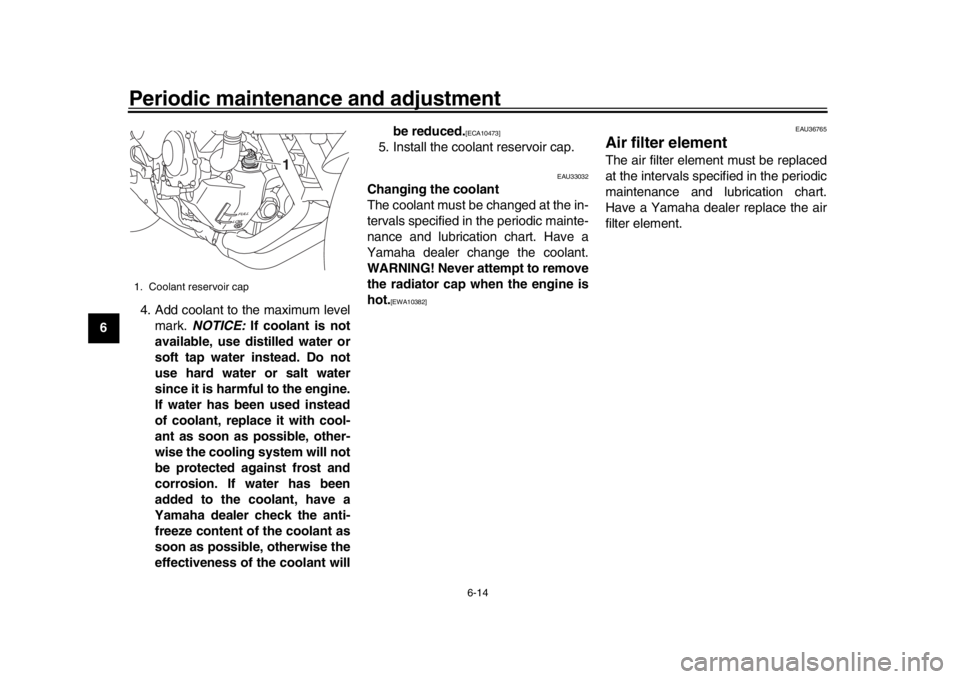
12 4. Add coolant to the maximum level
mark. NOTICE: If coolant is not
available, use distilled water or
soft tap water instead. Do not
use hard water or salt water
since it is harmful to the engine.
If water has been used instead
of coolant, replace it with cool-
ant as soon as possible, other-
wise the cooling system will not
be protected against frost and
corrosion. If water has been
added to the coolant, have a
Yamaha dealer check the anti-
freeze content of the coolant as
soon as possible, otherwise the
effectiveness of the coolant will be reduced.
[ECA10473]
5. Install the coolant reservoir cap.
EAU33032
Changing the coolant
The coolant must be changed at the in-
tervals specified in the periodic mainte-
nance and lubrication chart. Have a
Yamaha dealer change the coolant.
WARNING! Never attempt to remove
the radiator cap when the engine is
hot.
[EWA10382]
EAU36765
Air filter elementThe air filter element must be replaced
at the intervals specified in the periodic
maintenance and lubrication chart.
Have a Yamaha dealer replace the air
filter element.
1. Coolant reservoir cap
1
BAE-28199-E1.book 14 ページ 2019年8月23日 金曜日 午後3時56分
Page 66 of 102
Periodic maintenance and adjustment
6-16
1
2
3
4
56
7
8
9
10
11
12
EAU64412
TiresTires are the only contact between the
vehicle and the road. Safety in all con-
ditions of riding depends on a relatively
small area of road contact. Therefore, it
is essential to maintain the tires in good
condition at all times and replace them
at the appropriate time with the speci-
fied tires.
Tire air pressure
The tire air pressure should be checked
and, if necessary, adjusted before each
ride.
WARNING
EWA10504
Operation of this vehicle with im-
proper tire pressure may cause se-
vere injury or death from loss of
control.
The tire air pressure must be
checked and adjusted on cold
tires (i.e., when the temperature
of the tires equals the ambient
temperature).
The tire air pressure must be ad-
justed in accordance with the
riding speed and with the total weight of rider, passenger, car-
go, and accessories approved
for this model.WARNING
EWA10512
Never overload your vehicle. Opera-
tion of an overloaded vehicle couldcause an accident.
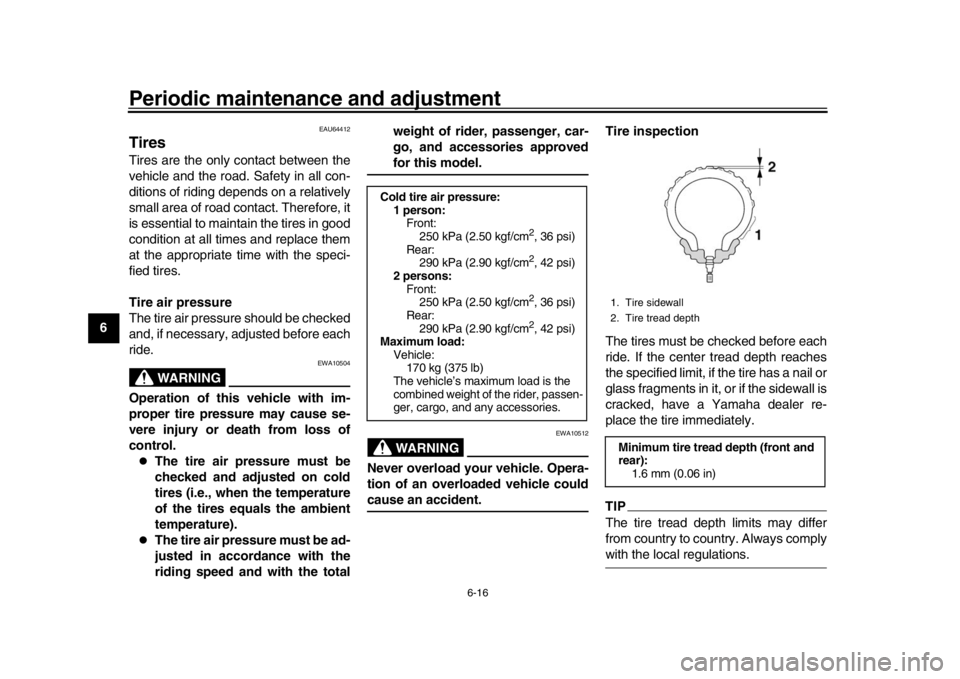
Tire inspection
The tires must be checked before each
ride. If the center tread depth reaches
the specified limit, if the tire has a nail or
glass fragments in it, or if the sidewall is
cracked, have a Yamaha dealer re-
place the tire immediately.
TIPThe tire tread depth limits may differ
from country to country. Always complywith the local regulations.
Cold tire air pressure:
1 person:
Front: 250 kPa (2.50 kgf/cm
2, 36 psi)
Rear:
290 kPa (2.90 kgf/cm2, 42 psi)
2 persons: Front:
250 kPa (2.50 kgf/cm2, 36 psi)
Rear: 290 kPa (2.90 kgf/cm2, 42 psi)
Maximum load: Vehicle:170 kg (375 lb)
The vehicle’s maximum load is the
combined weight of the rider, passen-
ger, cargo, and any accessories.
1. Tire sidewall
2. Tire tread depthMinimum tire tread depth (front and
rear): 1.6 mm (0.06 in)
BAE-28199-E1.book 16 ページ 2019年8月23日 金曜日 午後3時56分
Page 67 of 102
Periodic maintenance and adjustment6-17
1
2
3
4
567
8
9
10
11
12
WARNING
EWA10472
Have a Yamaha dealer replace
excessively worn tires. Besides
being illegal, operating the vehi-
cle with excessively worn tires
decreases riding stability and
can lead to loss of control.
The replacement of all wheel
and brake-related parts, includ-
ing the tires, should be left to a
Yamaha dealer, who has the
necessary professional knowl-
edge and experience to do so.
Ride at moderate speeds after
changing a tire since the tire
surface must first be “broken
in” for it to develop its optimalcharacteristics. Tire information
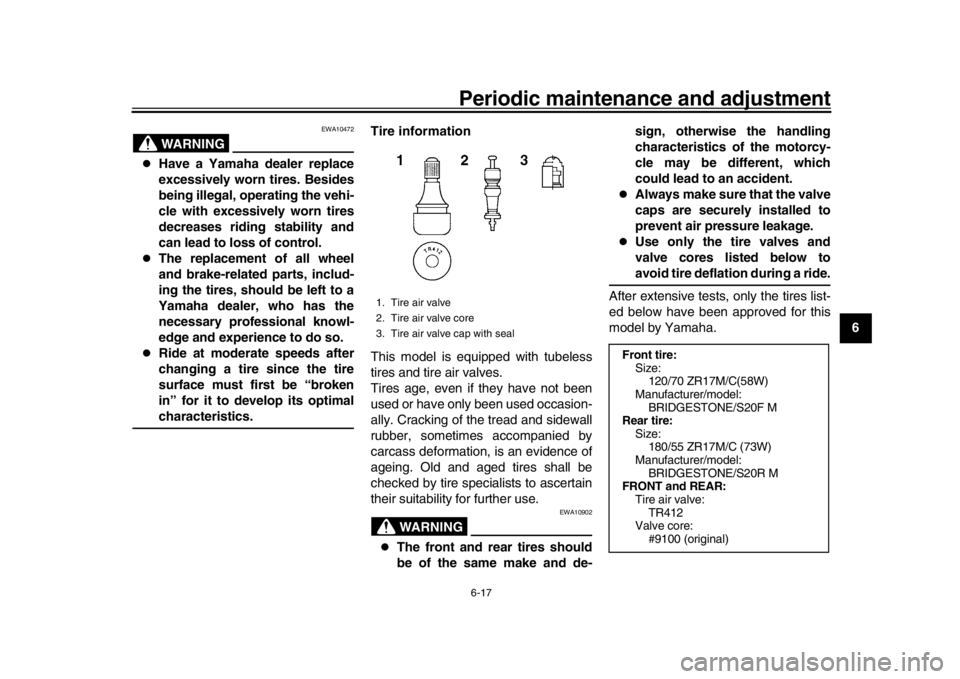
This model is equipped with tubeless
tires and tire air valves.
Tires age, even if they have not been
used or have only been used occasion-
ally. Cracking of the tread and sidewall
rubber, sometimes accompanied by
carcass deformation, is an evidence of
ageing. Old and aged tires shall be
checked by tire specialists to ascertain
their suitability for further use.
WARNING
EWA10902
The front and rear tires should
be of the same make and de- sign, otherwise the handling
characteristics of the motorcy-
cle may be different, which
could lead to an accident.
Always make sure that the valve
caps are securely installed to
prevent air pressure leakage.
Use only the tire valves and
valve cores listed below toavoid tire deflation during a ride.
After extensive tests, only the tires list-
ed below have been approved for this
model by Yamaha.
1. Tire air valve
2. Tire air valve core
3. Tire air valve cap with seal
Front tire: Size:
120/70 ZR17M/C(58W)
Manufacturer/model: BRIDGESTONE/S20F M
Rear tire: Size:180/55 ZR17M/C (73W)
Manufacturer/model: BRIDGESTONE/S20R M
FRONT and REAR:
Tire air valve:TR412
Valve core:
#9100 (original)
BAE-28199-E1.book 17 ページ 2019年8月23日 金曜日 午後3時56分
Page 68 of 102
Periodic maintenance and adjustment
6-18
1
2
3
4
56
7
8
9
10
11
12
WARNING
EWA10601
This motorcycle is fitted with su-
per-high-speed tires. Note the fol-
lowing points in order to make the
most efficient use of these tires.
Use only the specified replace-
ment tires. Other tires may run
the danger of bursting at super
high speeds.
Brand-new tires can have a rela-
tively poor grip on certain road
surfaces until they have been
“broken in”. Therefore, it is ad-
visable before doing any
high-speed riding to ride con-
servatively for approximately
100 km (60 mi) after installing a
new tire.
The tires must be warmed up
before a high-speed run.
Always adjust the tire air pres-
sure according to the operatingconditions.
EAU21963
Cast wheelsTo maximize the performance, durabil-
ity, and safe operation of your vehicle,
note the following points regarding the
specified wheels.
The wheel rims should be checked
for cracks, bends, warpage or oth-
er damage before each ride. If any
damage is found, have a Yamaha
dealer replace the wheel. Do not
attempt even the smallest repair to
the wheel. A deformed or cracked
wheel must be replaced.
The wheel should be balanced
whenever either the tire or wheel
has been changed or replaced. An
unbalanced wheel can result in
poor performance, adverse han-
dling characteristics, and a short-
ened tire life.
EAU22083
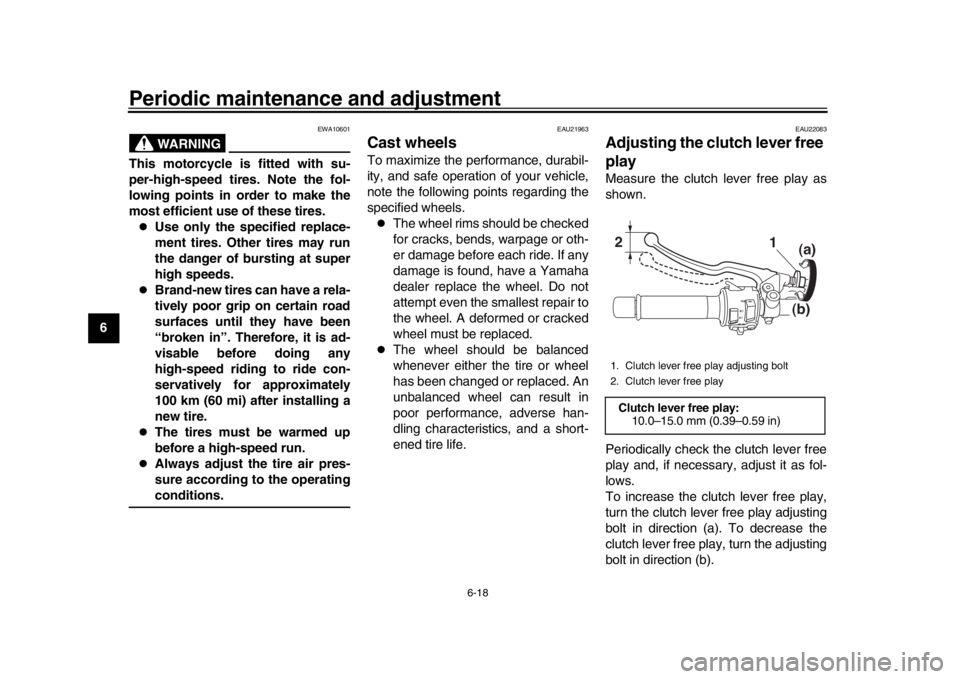
Adjusting the clutch lever free
playMeasure the clutch lever free play as
shown.
Periodically check the clutch lever free
play and, if necessary, adjust it as fol-
lows.
To increase the clutch lever free play,
turn the clutch lever free play adjusting
bolt in direction (a). To decrease the
clutch lever free play, turn the adjusting
bolt in direction (b).1. Clutch lever free play adjusting bolt
2. Clutch lever free playClutch lever free play: 10.0–15.0 mm (0.39–0.59 in)2
1
(b)(a)
BAE-28199-E1.book 18 ページ 2019年8月23日 金曜日 午後3時56分
Page 69 of 102
Periodic maintenance and adjustment6-19
1
2
3
4
567
8
9
10
11
12
TIPIf the specified free play cannot be ob-
tained as described above or if the
clutch does not operate correctly, have
a Yamaha dealer check the internalclutch mechanism.
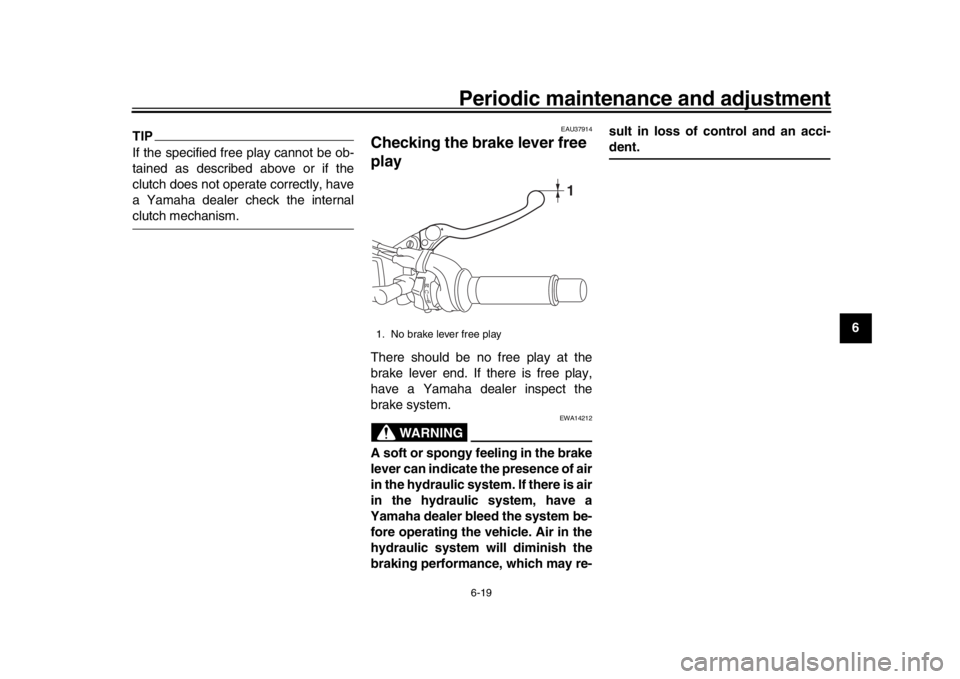
EAU37914
Checking the brak e lever free
playThere should be no free play at the
brake lever end. If there is free play,
have a Yamaha dealer inspect the
brake system.
WARNING
EWA14212
A soft or spongy feeling in the brake
lever can indicate the presence of air
in the hydraulic system. If there is air
in the hydraulic system, have a
Yamaha dealer bleed the system be-
fore operating the vehicle. Air in the
hydraulic system will diminish the
braking performance, which may re- sult in loss of control and an acci-
dent.
1. No brake lever free play
1
BAE-28199-E1.book 19 ページ 2019年8月23日 金曜日 午後3時56分