brake light YAMAHA XSR 900 2020 Owners Manual
[x] Cancel search | Manufacturer: YAMAHA, Model Year: 2020, Model line: XSR 900, Model: YAMAHA XSR 900 2020Pages: 102, PDF Size: 7.74 MB
Page 6 of 102

Table of contentsSafety information........................... 1-1
Description ....................................... 2-1
Left view ......................................... 2-1
Right view ....................................... 2-2
Controls and instruments................ 2-3
Instrument and co ntrol functions... 3-1
Immobilizer system ..... .................... 3-1
Main switch/steering lock................ 3-2
Indicator lights and warning
lights ............................................ 3-3
Multi-function meter unit ................. 3-5
D-mode (drive mode).................... 3-12
Handlebar switches ...................... 3-12
Clutch lever................................... 3-14
Shift pedal..... ............................ .... 3-14
Brake lever ................................... 3-15
Brake pedal .................................. 3-15
ABS .............................................. 3-15
Traction control syst em ................ 3-16
Fuel tank cap ................................ 3-18
Fuel............................................... 3-18
Fuel tank overflow hose................ 3-20
Catalytic converter ........................ 3-21
Seat .............................................. 3-21
Storage compartment ................... 3-22
Adjusting the front fork.................. 3-22
Adjusting the shock absorber assembly ................................... 3-24
Luggage strap holders . ................. 3-25Auxiliary DC connector................. 3-26
Sidestand ..................................... 3-26
Ignition circuit cut-
off system ........ 3-27
For your safety – pre-operation
checks .............................................. 4-1
Operation and important riding
points ................................................ 5-1
Engine break-in .............................. 5-1
Starting the engine ......................... 5-2
Shifting ........................................... 5-3
Tips for reducing fuel consumption ............................... 5-3
Parking ........................................... 5-4
Periodic maintenance and
adjustment ....................................... 6-1
Tool kit............................................ 6-2
Periodic maintenance charts .......... 6-3
Periodic maintenance chart for the emission control system ............. 6-3
General maintenance and
lubrication chart .......................... 6-5
Checking the spark plugs ............... 6-9
Canister ........................................ 6-10
Engine oil ..................................... 6-10
Why Yamalube ............................. 6-13
Coolant ......................................... 6-13
Air filter element ........................... 6-14 Checking the engine idling
speed............ ............................ 6-15
Checking the throttle grip free play ........................................... 6-15
Valve clearance ........................... 6-15
Tires ............................................. 6-16
Cast wheels ................................. 6-18
Adjusting the clutch lever free
play ........................................... 6-18
Checking the brake lever free play ........................................... 6-19
Brake light switches ..................... 6-20
Checking the front and rear brake pads................................ 6-20
Checking the brake fluid level ...... 6-21
Changing the brake fluid .............. 6-22
Drive chain slack.......................... 6-22
Cleaning and lubricating the drive chain ................................ 6-24
Checking and lubricating the
cables ....................................... 6-25
Checking and lubricating the throttle grip and cable ............... 6-25
Checking and lubricating the brake and shift pedals .............. 6-25
Checking and lubricating the brake and clutch levers ............ 6-26
Checking and lubricating the
sidestand .................................. 6-27
Lubricating the swingarm pivots ........................................ 6-27BAE-28199-E1.book 1 ページ 2019年8月23日 金曜日 午後3時56分
Page 7 of 102

Table of contents
Checking the front fork ................. 6-27
Checking the steering ................... 6-28
Checking the wheel bearings ....... 6-28
Battery .......................................... 6-29
Replacing the fuses ...................... 6-30
Replacing the headlight bulb ........ 6-33
Replacing the auxiliary light bulb .......................................... 6-34
Brake/tail light ............................... 6-35
Replacing a turn signal light bulb ........................................... 6-35
License plate light......................... 6-36
Supporting the motor cycle............ 6-36
Troubleshooting............................ 6-36
Troubleshooting chart ................... 6-38
Motorcycle care and storage .......... 7-1
Matte color caution ......................... 7-1
Care................................................ 7-1
Storage ........................................... 7-3
Specifications .................................. 8-1
Consumer information .................... 9-1
Identification numbers .................... 9-1
Diagnostic connector ... ................... 9-2
Vehicle data recording.................... 9-2
Index ............................................... 10-1
BAE-28199-E1.book 2 ページ 2019年8月23日 金曜日 午後3時56分
Page 14 of 102
Description
2-2
12
3
4
5
6
7
8
9
10
11
12
EAU10421
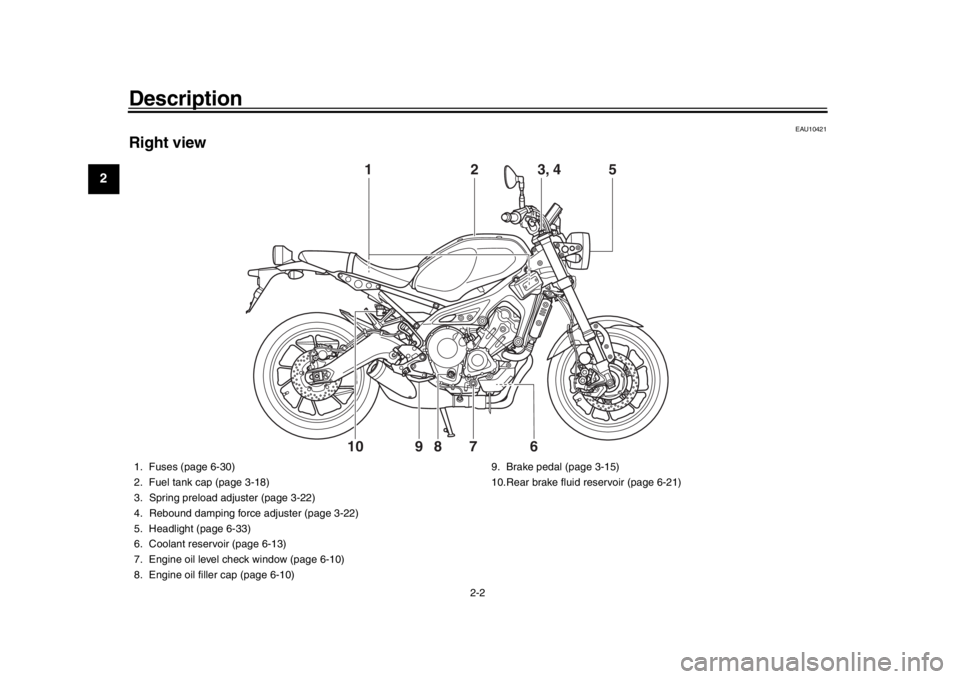
Right view
2
5
8
7
9
6
10
1
3, 4
1. Fuses (page 6-30)
2. Fuel tank cap (page 3-18)
3. Spring preload adjuster (page 3-22)
4. Rebound damping force adjuster (page 3-22)
5. Headlight (page 6-33)
6. Coolant reservoir (page 6-13)
7. Engine oil level check window (page 6-10)
8. Engine oil filler cap (page 6-10) 9. Brake pedal (page 3-15)
10.Rear brake fluid reservoir (page 6-21)
BAE-28199-E1.book 2 ページ 2019年8月23日 金曜日 午後3時56分
Page 19 of 102
Instrument and control functions
3-4
1
234
5
6
7
8
9
10
11
12
TIPWhen the vehicle is turned on, the light
will come on for a few seconds and
then go off. If the light does not come
on, or if the light remains on after con-
firming that the oil level is correct (see
page 6-10), have a Yamaha dealercheck the vehicle.
EAU11449
Coolant temperature warning light
“”
This warning light comes on when the
engine is overheating. If this occurs,
stop the engine immediately and allow
the engine to cool. (See page 6-39.)
For vehicles with a radiator fan, the ra-
diator fan(s) automatically switch on or
off according to the coolant tempera-
ture.TIPWhen the vehicle is turned on, the light
will come on for a few seconds, and
then go off. If the light does not come
on, or if the light remains on, have aYamaha dealer check the vehicle.
NOTICE
ECA10022
Do not continue to operate the en-gine if it is overheating.
EAU73172
Engine trouble warning light “ ”
This warning light comes on if a prob-
lem is detected in the engine or other
vehicle control system . If this occurs,
have a Yamaha dealer check the
on-board diagnostic system.TIPWhen the vehicle is turned on, the light
will come on for a few seconds and
then go off. If the light does not come
on, or if the light remains on, have aYamaha dealer check the vehicle.
EAU69895
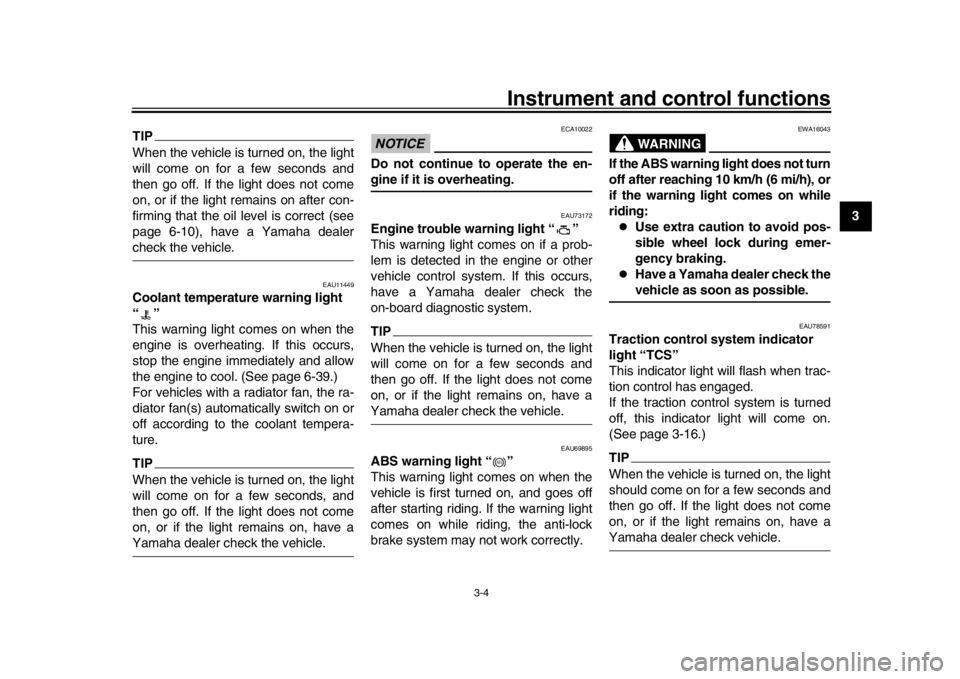
ABS warning light “ ”
This warning light comes on when the
vehicle is first turned on, and goes off
after starting riding. If the warning light
comes on while riding, the anti-lock
brake system may not work correctly.
WARNING
EWA16043
If the ABS warning light does not turn
off after reaching 10 km/h (6 mi/h), or
if the warning light comes on while
riding:
Use extra caution to avoid pos-
sible wheel lock during emer-
gency braking.
Have a Yamaha dealer check thevehicle as soon as possible.
EAU78591
Traction control system indicator
light “TCS”
This indicator light will flash when trac-
tion control has engaged.
If the traction control system is turned
off, this indicator light will come on.
(See page 3-16.)TIPWhen the vehicle is turned on, the light
should come on for a few seconds and
then go off. If the light does not come
on, or if the light remains on, have aYamaha dealer check vehicle.
ABS
BAE-28199-E1.book 4 ページ 2019年8月23日 金曜日 午後3時56分
Page 31 of 102
Instrument and control functions
3-16
1
234
5
6
7
8
9
10
11
12
TIP
The ABS performs a self-diagno-
sis test each time the vehicle first
starts off after the key is turned to
“ON” and the vehicle has traveled
at a speed of 10 km/h (6 mi/h) or
higher. During this test, a “clicking”
noise can be heard from the hy-
draulic control unit, and if the brake
lever or brake pedal is even slight-
ly applied, a vibration can be felt at
the lever and pedal, but these do
not indicate a malfunction.
This ABS has a test mode which
allows the owner to experience the
pulsation at the brake lever or
brake pedal when the ABS is oper-
ating. However, special tools are
required, so please consult yourYamaha dealer.
NOTICE
ECA20100
Be careful not to damage the wheel
sensor or wheel sensor rotor; other-
wise, improper performance of theABS will result.
EAU74351
Traction control systemThe traction control system (TCS)
helps maintain traction when accelerat-
ing on slippery surfaces, such as un-
paved or wet roads. If sensors detect
that the rear wheel is starting to slip (un-
controlled spinning), the traction control
system assists by regulating engine
power as needed until traction is re-
stored.
WARNING
EWA15433
The traction control system is not a
substitute for riding appropriately
for the conditions. Traction control
cannot prevent loss of traction due
to excessive speed when entering
turns, when accelerating hard at a
sharp lean angle, or while braking,
and cannot prevent front wheel slip-
ping. As with any vehicle, approach
surfaces that may be slippery with
caution and avoid especially slip-pery surfaces.
The “ ” indicator light flashes when
traction control has engaged. You may
notice slight changes in engine and ex-
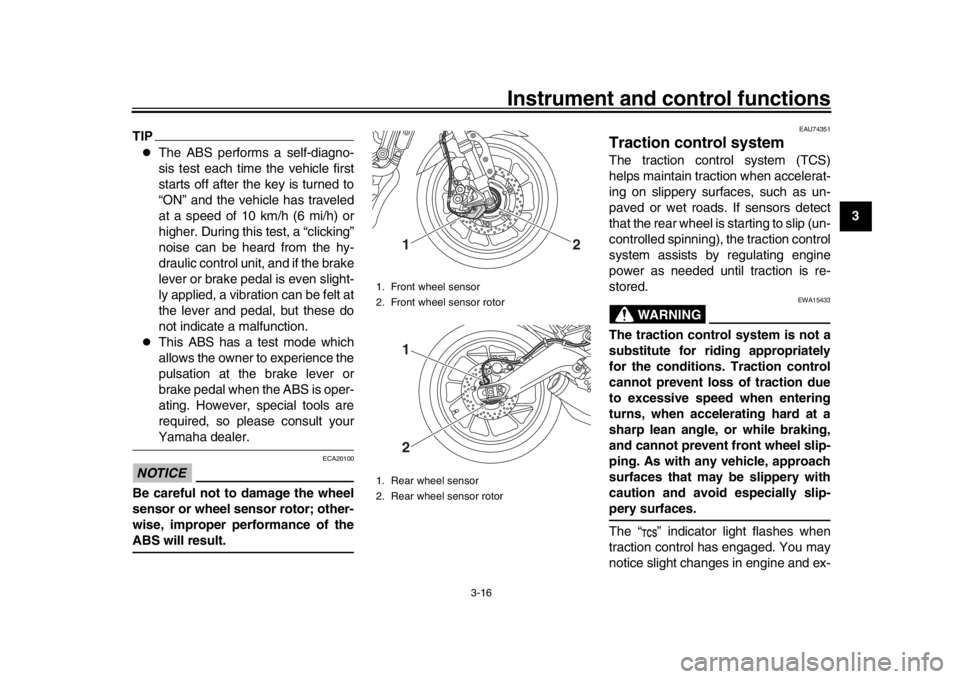
1. Front wheel sensor
2. Front wheel sensor rotor
1. Rear wheel sensor
2. Rear wheel sensor rotor
1
2
12
BAE-28199-E1.book 16 ページ 2019年8月23日 金曜日 午後3時56分
Page 57 of 102

Periodic maintenance and adjustment
6-7
1
2
3
4
567
8
9
10
11
12
23 *Rear suspension
relay arm and
connecting arm
pivoting points Check operation.
24 Engine oil Change (warm engine before
draining).
Check oil level and vehicle for oil leakage.
25 Engine oil filter
cartridge Replace.
26 *Cooling system Check coolant level and vehicle
for coolant leakage.
Change. Every 3 years
27 *Front and rear brake
switches Check operation.
28 *Moving parts and
cables Lubricate.
29 *Throttle grip
housing and cable Check operation and free play.
Adjust the throttle cable free play
if necessary.
Lubricate the throttle grip housing and cable.
30 *Lights, signals and
switches Check operation.
Adjust headlight beam.
NO. ITEM CHECK OR MAINTENANCE JOB
ODOMETER READING
ANNUAL
CHECK
1000 km
(600 mi) 10000 km
(6000 mi) 20000 km
(12000 mi) 30000 km
(18000 mi) 40000 km
(24000 mi)
BAE-28199-E1.book 7 ページ 2019年8月23日 金曜日 午後3時56分
Page 70 of 102
Periodic maintenance and adjustment
6-20
1
2
3
4
56
7
8
9
10
11
12
EAU36505
Brake light switchesThe brake light should come on just be-
fore braking takes effect. The brake
light is activated by switches connected
to the brake lever and brake pedal.
Since the brake light switches are com-
ponents of the anti-lock brake system,
they should only be serviced by a
Yamaha dealer.
EAU22393
Checking the front and rear
brake padsThe front and rear brake pads must be
checked for wear at the intervals spec-
ified in the periodic maintenance and
lubrication chart.
EAU36891
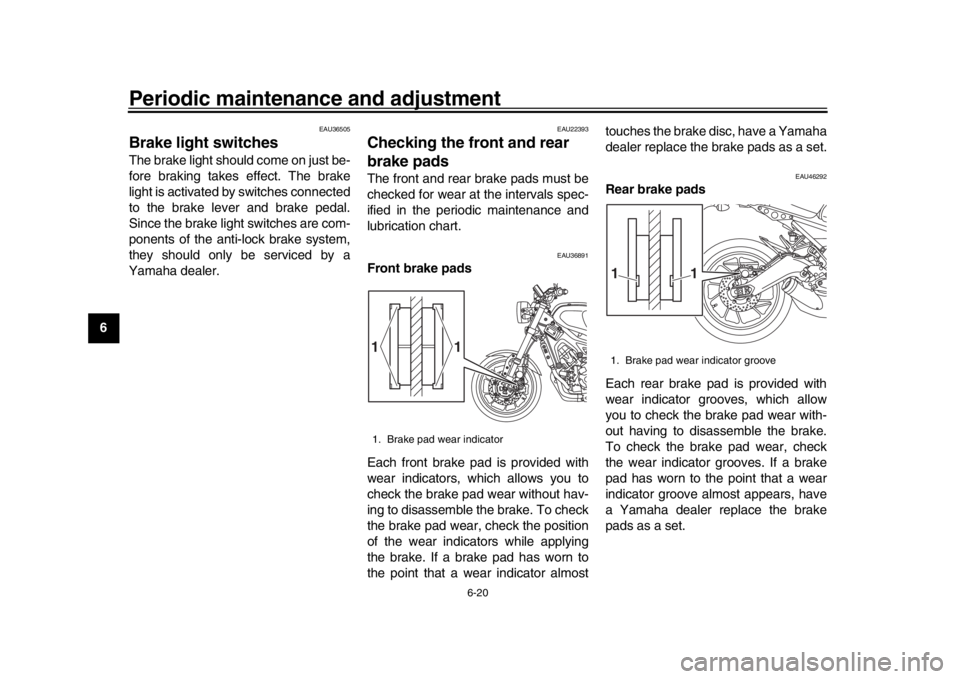
Front brake pads
Each front brake pad is provided with
wear indicators, which allows you to
check the brake pad wear without hav-
ing to disassemble the brake. To check
the brake pad wear, check the position
of the wear indicators while applying
the brake. If a brake pad has worn to
the point that a wear indicator almost touches the brake disc, have a Yamaha
dealer replace the brake pads as a set.
EAU46292
Rear brake pads
Each rear brake pad is provided with
wear indicator grooves, which allow
you to check the brake pad wear with-
out having to disassemble the brake.
To check the brake pad wear, check
the wear indicator grooves. If a brake
pad has worn to the point that a wear
indicator groove almost appears, have
a Yamaha dealer replace the brake
pads as a set.
1. Brake pad wear indicator
1
1
1. Brake pad wear indicator groove
1
1
BAE-28199-E1.book 20 ページ 2019年8月23日 金曜日 午後3時56分
Page 85 of 102
Periodic maintenance and adjustment6-35
1
2
3
4
567
8
9
10
11
12
EAU70540
Brake/tail lightThis model is equipped with an
LED-type brake/tail light.
If the brake/tail light does not come on,
have a Yamaha dealer check it.
EAU24205
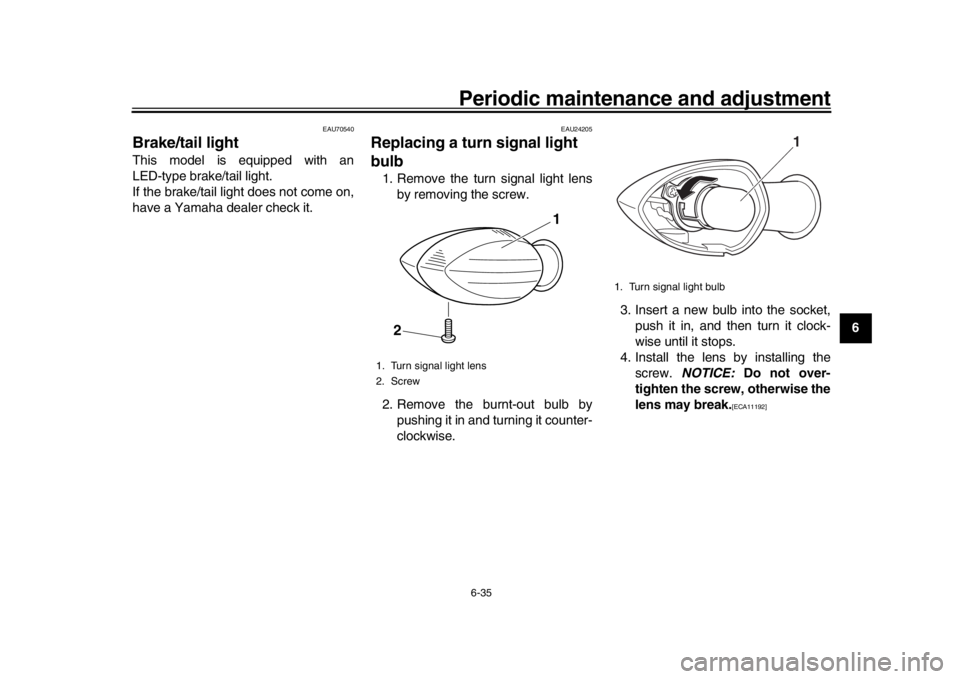
Replacing a turn signal light
bulb1. Remove the turn signal light lens by removing the screw.
2. Remove the burnt-out bulb by pushing it in and turning it counter-
clockwise. 3. Insert a new bulb into the socket,
push it in, and then turn it clock-
wise until it stops.
4. Install the lens by installing the screw. NOTICE: Do not over-
tighten the screw, otherwise the
lens may break.
[ECA11192]
1. Turn signal light lens
2. Screw
1
2
1. Turn signal light bulb
1
BAE-28199-E1.book 35 ページ 2019年8月23日 金曜日 午後3時56分
Page 91 of 102
Motorcycle care and storage
7-2
1
2
3
4
5
678
9
10
11
12
gasoline, rust removers, brake
fluid, or antifreeze, etc.
Before washing 1. Park the vehicle out of direct sun- light and allow it to cool. This will
help avoid water spots.
2. Make sure all caps, covers, electri- cal couplers and connectors are
tightly installed.
3. Cover the muffler end with a plas- tic bag and a strong rubber band.
4. Pre-soak stubborn stains like in- sects or bird droppings with a wet
towel for a few minutes.
5. Remove road grime and oil stains with a quality degreasing agent
and a plastic-bristle brush or
sponge. NOTICE: Do not use de-
greasing agent on areas requir-
ing lubrication such as seals,
gaskets, and wheel axles. Fol-
low product instructions.
[ECA26290]
Washing 1. Rinse off any degreaser and spray down the vehicle with a garden
hose. Use only enough pressure to do the job. Avoid spraying water
directly into the muffler, instrument
panel, air inlet, or other inner areas
such as underseat storage com-
partments.
2. Wash the vehicle with a quality au- tomotive-type detergent mixed
with cool water and a soft, clean
towel or sponge. Use an old tooth-
brush or plastic-bristle brush for
hard-to-reach places. NOTICE:
Use cold water if the vehicle has
been exposed to salt. Warm wa-
ter will increase salt’s corrosive
properties.
[ECA26301]
3. For windshield-equipped vehicles: Clean the windshield with a soft
towel or sponge dampened with
water and a pH neutral detergent.
If necessary, use a high-quality
windshield cleaner or polish for
motorcycles. NOTICE: Never use
any strong chemicals to clean
the windshield. Additionally,
some cleaning compounds for
plastic may scratch the wind-
shield, so be sure to test all
cleaning products before gener-
al application.
[ECA26310]
4. Rinse off thoroughly with clean wa- ter. Be sure to remove all deter-
gent residues, as they can be
harmful to plastic parts.
After washing 1. Dry the vehicle with a chamois or absorbent towel, preferably micro-
fiber terrycloth.
2. For drive chain-equipped models: Dry and then lubricate the drive
chain to prevent rust.
3. Use a chrome polish to shine chrome, aluminum, and stainless
steel parts. Often the thermally in-
duced discoloring of stainless steel
exhaust systems can be removed
through polishing.
4. Apply a corrosion protection spray on all metal parts including chrome
or nickel-plated surfaces.
WARNING! Do not apply
silicone or oil spray to seats,
hand grips, rubber foot pegs or
tire treads. Otherwise these
parts will become slippery,
which could cause loss of con-
trol. Thoroughly clean the sur-
faces of these parts before
BAE-28199-E1.book 2 ページ 2019年8月23日 金曜日 午後3時56分
Page 92 of 102
![YAMAHA XSR 900 2020 Owners Manual Motorcycle care and storage
7-3
1
2
3
4
5
67
8
9
10
11
12 operating the vehicle.
[EWA20650]
5. Treat rubber, vinyl, and unpainted
plastic parts with a suitable care
product.
6. Touch up minor paint da](/img/51/53064/w960_53064-91.png "YAMAHA XSR 900 2020 Owners Manual Motorcycle care and storage
7-3
1
2
3
4
5
67
8
9
10
11
12 operating the vehicle.
[EWA20650]
5. Treat rubber, vinyl, and unpainted
plastic parts with a suitable care
product.
6. Touch up minor paint da")
Motorcycle care and storage
7-3
1
2
3
4
5
67
8
9
10
11
12 operating the vehicle.
[EWA20650]
5. Treat rubber, vinyl, and unpainted
plastic parts with a suitable care
product.
6. Touch up minor paint damage caused by stones, etc.
7. Wax all painted surfaces using a non-abrasive wax or use a detail
spray for motorcycles.
8. When finished cleaning, start the engine and let it idle for several
minutes to help dry any remaining
moisture.
9. If the headlight lens has fogged up, start the engine and turn on the
headlight to help remove the mois-
ture.
10. Let the vehicle dry completely be- fore storing or covering it.NOTICE
ECA26320
Do not apply wax to rubber or
unpainted plastic parts.
Do not use abrasive polishing
compounds as they will wear
away the paint.
Apply sprays and wax sparing-ly. Wipe off excess afterwards.
WARNING
EWA20660
Contaminants left on the brakes or
tires can cause loss of control.
Make sure there is no lubricant
or wax on the brakes or tires.
If necessary, wash the tires with
warm water and a mild deter-
gent.
If necessary, clean the brake
discs and pads with brake
cleaner or acetone.
Before riding at higher speeds,
test the vehicle’s braking perfor-mance and cornering behavior.
EAU83472
StorageAlways store the vehicle in a cool, dry
place. If necessary, protect it against
dust with a porous cover. Be sure the
engine and the exhaust system are
cool before covering the vehicle. If the
vehicle often sits for weeks at a time
between uses, the use of a quality fuel
stabilizer is recommended after each
fill-up.NOTICE
ECA21170
Storing the vehicle in a poorly
ventilated room or covering it
with a tarp, while it is still wet,
will allow water and humidity to
seep in and cause rust.
To prevent corrosion, avoid
damp cellars, stables (because
of the presence of ammonia)
and areas where strong chemi-cals are stored.
Long term storage
Before storing the vehicle long term (60
days or more): 1. Make all necessary repairs and
BAE-28199-E1.book 3 ページ 2019年8月23日 金曜日 午後3時56分