lock YAMAHA XT1200Z 2013 User Guide
[x] Cancel search | Manufacturer: YAMAHA, Model Year: 2013, Model line: XT1200Z, Model: YAMAHA XT1200Z 2013Pages: 108, PDF Size: 2.86 MB
Page 26 of 108
INSTRUMENT AND CONTROL FUNCTIONS
3-11
33. Push the left button; the minute
digits start flashing.
4. Push the right button to set the minutes.
5. Push the left button; the clock starts after the button is released.
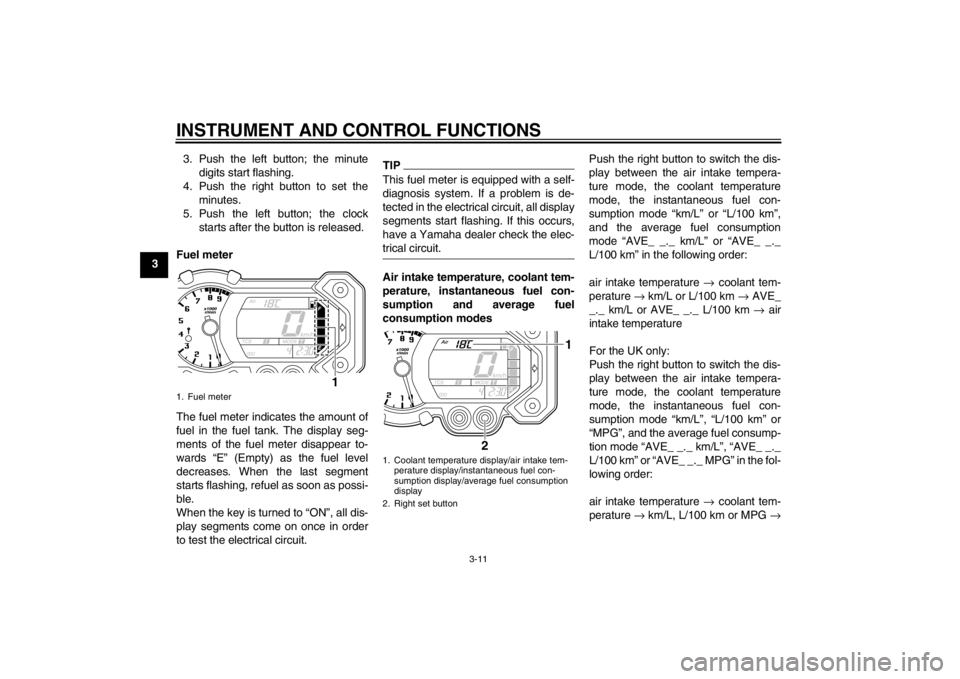
Fuel meter
The fuel meter indicates the amount of
fuel in the fuel tank. The display seg-
ments of the fuel meter disappear to-
wards “E” (Empty) as the fuel level
decreases. When the last segment
starts flashing, refuel as soon as possi-
ble.
When the key is turned to “ON”, all dis-
play segments come on once in order
to test the electrical circuit.
TIPThis fuel meter is equipped with a self-
diagnosis system. If a problem is de-
tected in the electrical circuit, all display
segments start flashing. If this occurs,
have a Yamaha dealer check the elec-
trical circuit.Air intake temperature, coolant tem-
perature, instantaneous fuel con-
sumption and average fuel
consumption modes Push the right button to switch the dis-
play between the air intake tempera-
ture mode, the coolant temperature
mode, the instantaneous fuel con-
sumption mode “km/L” or “L/100 km”,
and the average fuel consumption
mode “AVE_ _._ km/L” or “AVE_ _._
L/100 km” in the following order:
air intake temperature
→ coolant tem-
perature → km/L or L/100 km → AVE_
_._ km/L or AVE_ _._ L/100 km → air
intake temperature
For the UK only:
Push the right button to switch the dis-
play between the air intake tempera-
ture mode, the coolant temperature
mode, the instantaneous fuel con-
sumption mode “km/L”, “L/100 km” or
“MPG”, and the average fuel consump-
tion mode “AVE_ _._ km/L”, “AVE_ _._
L/100 km” or “AVE_ _._ MPG” in the fol-
lowing order:
air intake temperature → coolant tem-
perature → km/L, L/100 km or MPG →
1. Fuel meter
1
1. Coolant temperature display/air intake tem-
perature display/instantaneous fuel con-
sumption display/average fuel consumption
display
2. Right set button
2
1
U23PE3E0.book Page 11 Monday, July 30, 2012 8:44 AM
Page 35 of 108
INSTRUMENT AND CONTROL FUNCTIONS
3-20
3
EAU49481
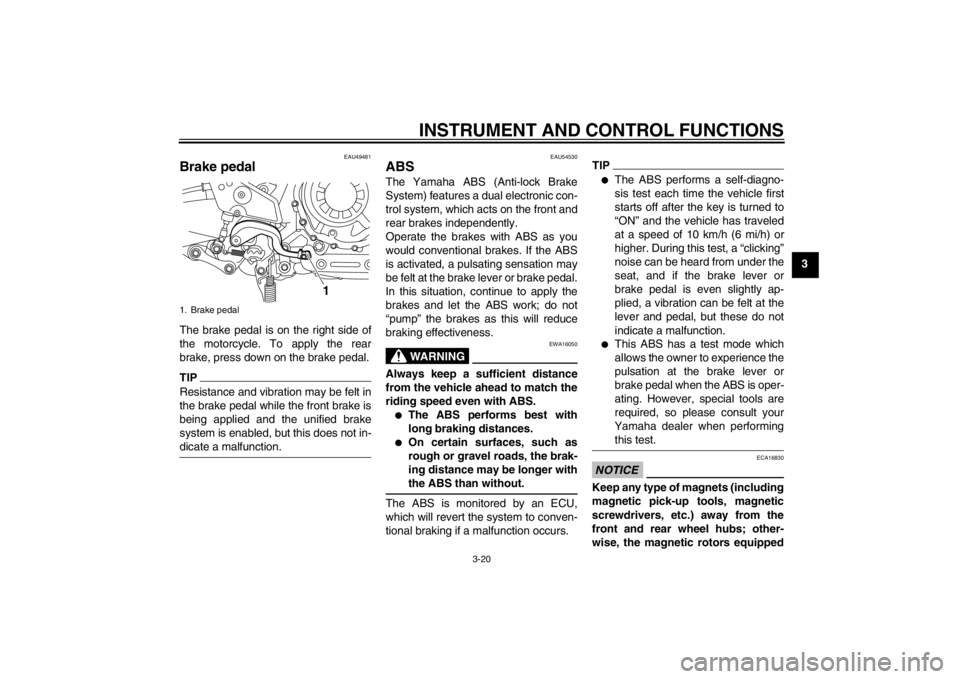
Brake pedal The brake pedal is on the right side of
the motorcycle. To apply the rear
brake, press down on the brake pedal.TIPResistance and vibration may be felt in
the brake pedal while the front brake is
being applied and the unified brake
system is enabled, but this does not in-
dicate a malfunction.
EAU54530
ABS The Yamaha ABS (Anti-lock Brake
System) features a dual electronic con-
trol system, which acts on the front and
rear brakes independently.
Operate the brakes with ABS as you
would conventional brakes. If the ABS
is activated, a pulsating sensation may
be felt at the brake lever or brake pedal.
In this situation, continue to apply the
brakes and let the ABS work; do not
“pump” the brakes as this will reduce
braking effectiveness.
WARNING
EWA16050
Always keep a sufficient distance
from the vehicle ahead to match the
riding speed even with ABS.●
The ABS performs best with
long braking distances.
●
On certain surfaces, such as
rough or gravel roads, the brak-
ing distance may be longer with
the ABS than without.
The ABS is monitored by an ECU,
which will revert the system to conven-
tional braking if a malfunction occurs.
TIP●
The ABS performs a self-diagno-
sis test each time the vehicle first
starts off after the key is turned to
“ON” and the vehicle has traveled
at a speed of 10 km/h (6 mi/h) or
higher. During this test, a “clicking”
noise can be heard from under the
seat, and if the brake lever or
brake pedal is even slightly ap-
plied, a vibration can be felt at the
lever and pedal, but these do not
indicate a malfunction.
●
This ABS has a test mode which
allows the owner to experience the
pulsation at the brake lever or
brake pedal when the ABS is oper-
ating. However, special tools are
required, so please consult your
Yamaha dealer when performing this test.
NOTICE
ECA16830
Keep any type of magnets (including
magnetic pick-up tools, magnetic
screwdrivers, etc.) away from the
front and rear wheel hubs; other-
wise, the magnetic rotors equipped
1. Brake pedal
1
U23PE3E0.book Page 20 Monday, July 30, 2012 8:44 AM
Page 38 of 108
INSTRUMENT AND CONTROL FUNCTIONS
3-23
3
EAU13074
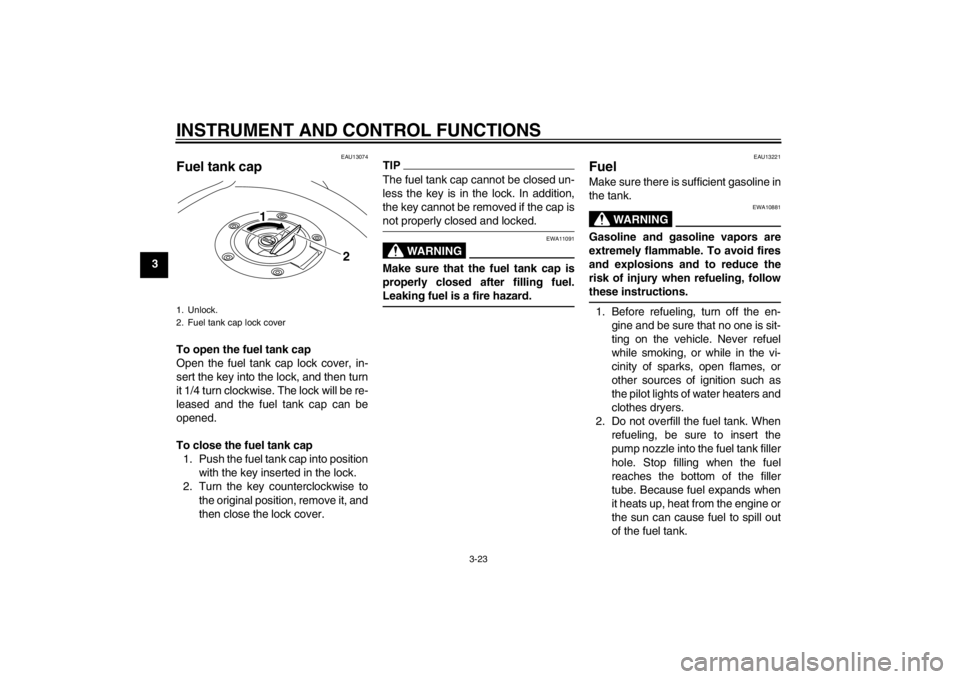
Fuel tank cap To open the fuel tank cap
Open the fuel tank cap lock cover, in-
sert the key into the lock, and then turn
it 1/4 turn clockwise. The lock will be re-
leased and the fuel tank cap can be
opened.
To close the fuel tank cap1. Push the fuel tank cap into position with the key inserted in the lock.
2. Turn the key counterclockwise to the original position, remove it, and
then close the lock cover.
TIPThe fuel tank cap cannot be closed un-
less the key is in the lock. In addition,
the key cannot be removed if the cap is
not properly closed and locked.
WARNING
EWA11091
Make sure that the fuel tank cap is
properly closed after filling fuel.
Leaking fuel is a fire hazard.
EAU13221
Fuel Make sure there is sufficient gasoline in
the tank.
WARNING
EWA10881
Gasoline and gasoline vapors are
extremely flammable. To avoid fires
and explosions and to reduce the
risk of injury when refueling, follow
these instructions.1. Before refueling, turn off the en-gine and be sure that no one is sit-
ting on the vehicle. Never refuel
while smoking, or while in the vi-
cinity of sparks, open flames, or
other sources of ignition such as
the pilot lights of water heaters and
clothes dryers.
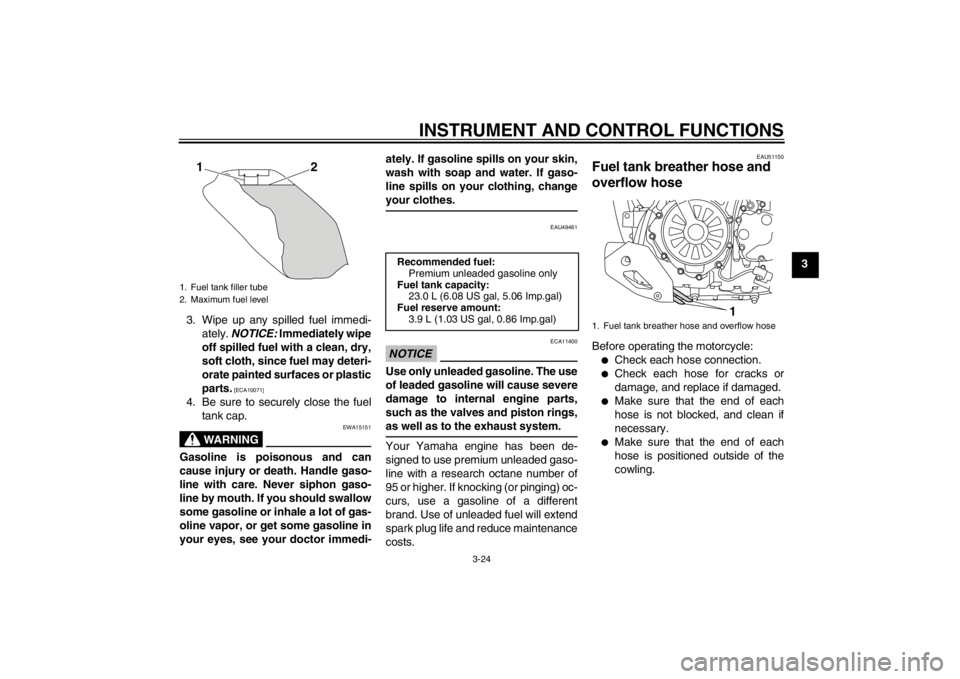
2. Do not overfill the fuel tank. When refueling, be sure to insert the
pump nozzle into the fuel tank filler
hole. Stop filling when the fuel
reaches the bottom of the filler
tube. Because fuel expands when
it heats up, heat from the engine or
the sun can cause fuel to spill out
of the fuel tank.
1. Unlock.
2. Fuel tank cap lock cover
2
1
U23PE3E0.book Page 23 Monday, July 30, 2012 8:44 AM
Page 39 of 108
INSTRUMENT AND CONTROL FUNCTIONS
3-24
3
3. Wipe up any spilled fuel immedi- ately. NOTICE: Immediately wipe
off spilled fuel with a clean, dry,
soft cloth, since fuel may deteri-
orate painted surfaces or plastic
parts.
[ECA10071]
4. Be sure to securely close the fuel tank cap.
WARNING
EWA15151
Gasoline is poisonous and can
cause injury or death. Handle gaso-
line with care. Never siphon gaso-
line by mouth. If you should swallow
some gasoline or inhale a lot of gas-
oline vapor, or get some gasoline in
your eyes, see your doctor immedi- ately. If gasoline spills on your skin,
wash with soap and water. If gaso-
line spills on your clothing, change
your clothes.
EAU49461
NOTICE
ECA11400
Use only unleaded gasoline. The use
of leaded gasoline will cause severe
damage to internal engine parts,
such as the valves and piston rings,
as well as to the exhaust system.Your Yamaha engine has been de-
signed to use premium unleaded gaso-
line with a research octane number of
95 or higher. If knocking (or pinging) oc-
curs, use a gasoline of a different
brand. Use of unleaded fuel will extend
spark plug life and reduce maintenance
costs.
EAU51150
Fuel tank breather hose and
overflow hose Before operating the motorcycle:●
Check each hose connection.
●
Check each hose for cracks or
damage, and replace if damaged.
●
Make sure that the end of each
hose is not blocked, and clean if
necessary.
●
Make sure that the end of each
hose is positioned outside of the
cowling.
1. Fuel tank filler tube
2. Maximum fuel level
2
1
Recommended fuel:
Premium unleaded gasoline only
Fuel tank capacity: 23.0 L (6.08 US gal, 5.06 Imp.gal)
Fuel reserve amount: 3.9 L (1.03 US gal, 0.86 Imp.gal)
1. Fuel tank breather hose and overflow hose
1
U23PE3E0.book Page 24 Monday, July 30, 2012 8:44 AM
Page 40 of 108
INSTRUMENT AND CONTROL FUNCTIONS
3-25
3
EAU13433
Catalytic converter This model is equipped with a catalytic
converter in the exhaust system.
WARNING
EWA10862
The exhaust system is hot after op-
eration. To prevent a fire hazard or
burns:●
Do not park the vehicle near
possible fire hazards such as
grass or other materials that
easily burn.
●
Park the vehicle in a place
where pedestrians or children
are not likely to touch the hot
exhaust system.
●
Make sure that the exhaust sys-
tem has cooled down before do-
ing any maintenance work.
●
Do not allow the engine to idle
more than a few minutes. Long
idling can cause a build-up of
heat.
NOTICE
ECA10701
Use only unleaded gasoline. The use
of leaded gasoline will cause unre-
pairable damage to the catalytic
converter.
EAU49443
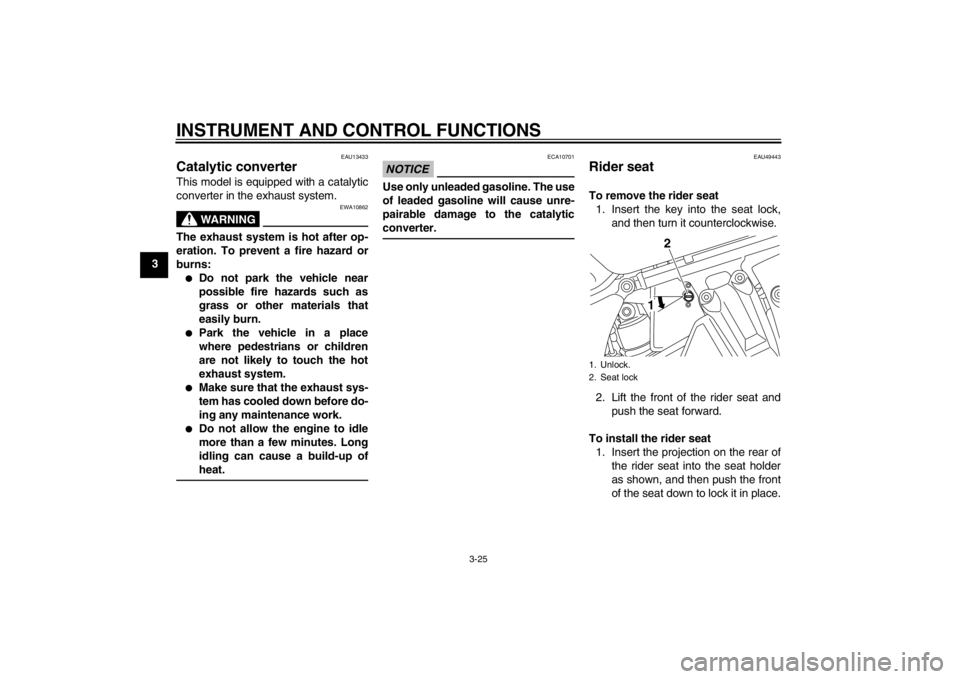
Rider seat To remove the rider seat1. Insert the key into the seat lock, and then turn it counterclockwise.
2. Lift the front of the rider seat and push the seat forward.
To install the rider seat 1. Insert the projection on the rear of the rider seat into the seat holder
as shown, and then push the front
of the seat down to lock it in place.1. Unlock.
2. Seat lock
2
1
U23PE3E0.book Page 25 Monday, July 30, 2012 8:44 AM
Page 79 of 108
PERIODIC MAINTENANCE AND ADJUSTMENT
6-23
6
Rear brake
WARNING
EWA16010
Improper maintenance can result in
loss of braking ability. Observe
these precautions:●
Insufficient brake fluid may al-
low air to enter the brake sys-
tem, reducing braking
performance.
●
Clean the filler cap before re-
moving. Use only DOT 4 brake
fluid from a sealed container.
●
Use only the specified brake flu-
id; otherwise, the rubber seals
may deteriorate, causing leak-
age.
●
Refill with the same type of
brake fluid. Adding a brake fluid
other than DOT 4 may result in a
harmful chemical reaction.
●
Be careful that water or dust
does not enter the brake fluid
reservoir when refilling. Water
will significantly lower the boil-
ing point of the fluid and may re-
sult in vapor lock, and dirt may
clog the ABS hydraulic unit
valves.
NOTICE
ECA17640
Brake fluid may damage painted sur-
faces or plastic parts. Always clean
up spilled fluid immediately.As the brake pads wear, it is normal for
the brake fluid level to gradually go
down. A low brake fluid level may indi-
cate worn brake pads and/or brake sys-
tem leakage; therefore, be sure to
check the brake pads for wear and the
brake system for leakage. If the brake fluid level goes down suddenly, have a
Yamaha dealer check the cause before
further riding.
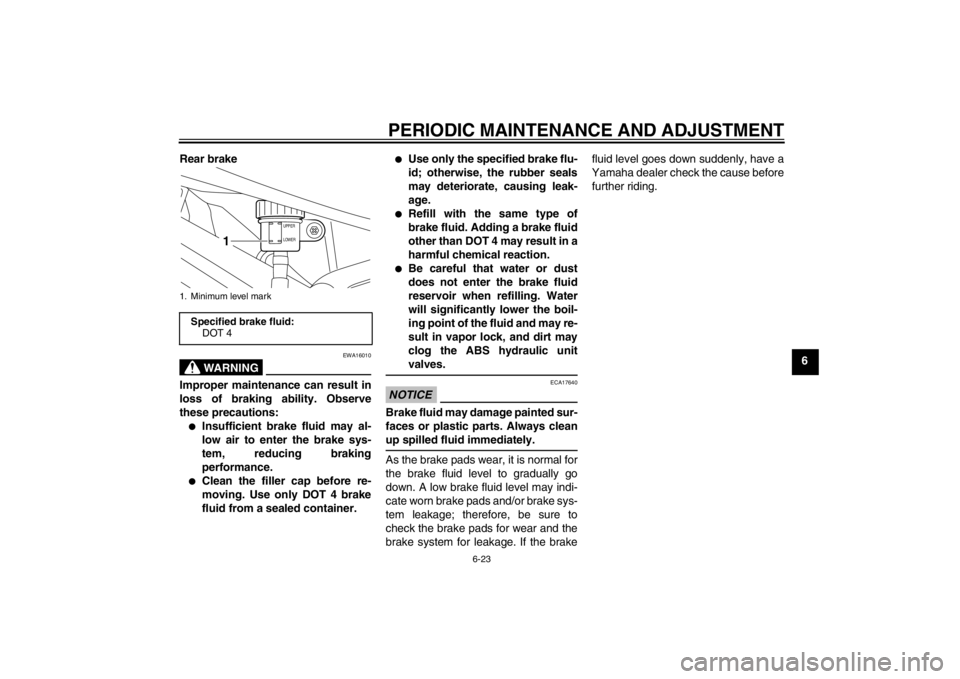
1. Minimum level markSpecified brake fluid:
DOT 4
UPPER
LOWER
1
U23PE3E0.book Page 23 Monday, July 30, 2012 8:44 AM
Page 86 of 108
PERIODIC MAINTENANCE AND ADJUSTMENT
6-30
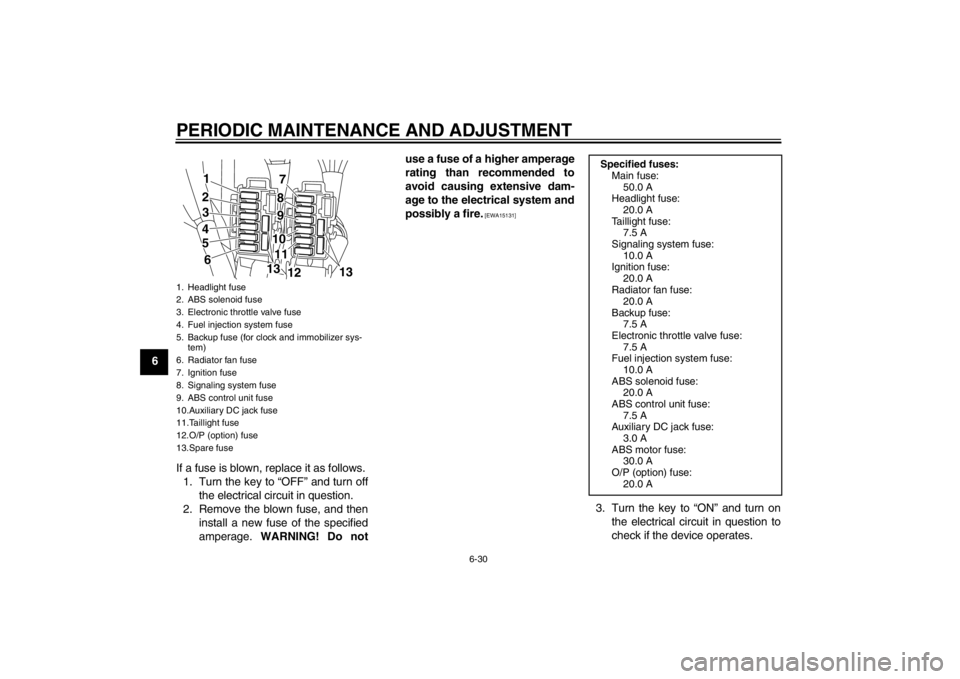
6If a fuse is blown, replace it as follows.1. Turn the key to “OFF” and turn off the electrical circuit in question.
2. Remove the blown fuse, and then install a new fuse of the specified
amperage. WARNING! Do not use a fuse of a higher amperage
rating than recommended to
avoid causing extensive dam-
age to the electrical system and
possibly a fire.
[EWA15131]
3. Turn the key to “ON” and turn on
the electrical circuit in question to
check if the device operates.
1. Headlight fuse
2. ABS solenoid fuse
3. Electronic throttle valve fuse
4. Fuel injection system fuse
5. Backup fuse (for clock and immobilizer sys-tem)
6. Radiator fan fuse
7. Ignition fuse
8. Signaling system fuse
9. ABS control unit fuse
10.Auxiliary DC jack fuse
11.Taillight fuse
12.O/P (option) fuse
13.Spare fuse
78912
13
13
1110
124563
Specified fuses: Main fuse:
50.0 A
Headlight fuse:
20.0 A
Taillight fuse: 7.5 A
Signaling system fuse: 10.0 A
Ignition fuse:
20.0 A
Radiator fan fuse: 20.0 A
Backup fuse: 7.5 A
Electronic throttle valve fuse:
7.5 A
Fuel injection system fuse: 10.0 A
ABS solenoid fuse: 20.0 A
ABS control unit fuse:
7.5 A
Auxiliary DC jack fuse: 3.0 A
ABS motor fuse: 30.0 A
O/P (option) fuse:
20.0 A
U23PE3E0.book Page 30 Monday, July 30, 2012 8:44 AM
Page 87 of 108
PERIODIC MAINTENANCE AND ADJUSTMENT
6-31
6
4. If the fuse immediately blows
again, have a Yamaha dealer
check the electrical system.
EAU39013
Replacing a he adlight bulb This model is equipped with halogen
bulb headlights. If a headlight bulb
burns out, replace it as follows.NOTICE
ECA10650
Take care not to damage the follow-
ing parts:●
Headlight bulb
Do not touch the glass part of
the headlight bulb to keep it free
from oil, otherwise the transpar-
ency of the glass, the luminosity
of the bulb, and the bulb life will
be adversely affected. Thor-
oughly clean off any dirt and fin-
gerprints on the headlight bulb
using a cloth moistened with al-
cohol or thinner.
●
Headlight lens
Do not affix any type of tinted
film or stickers to the headlight
lens.
Do not use a headlight bulb of a
wattage higher than specified.
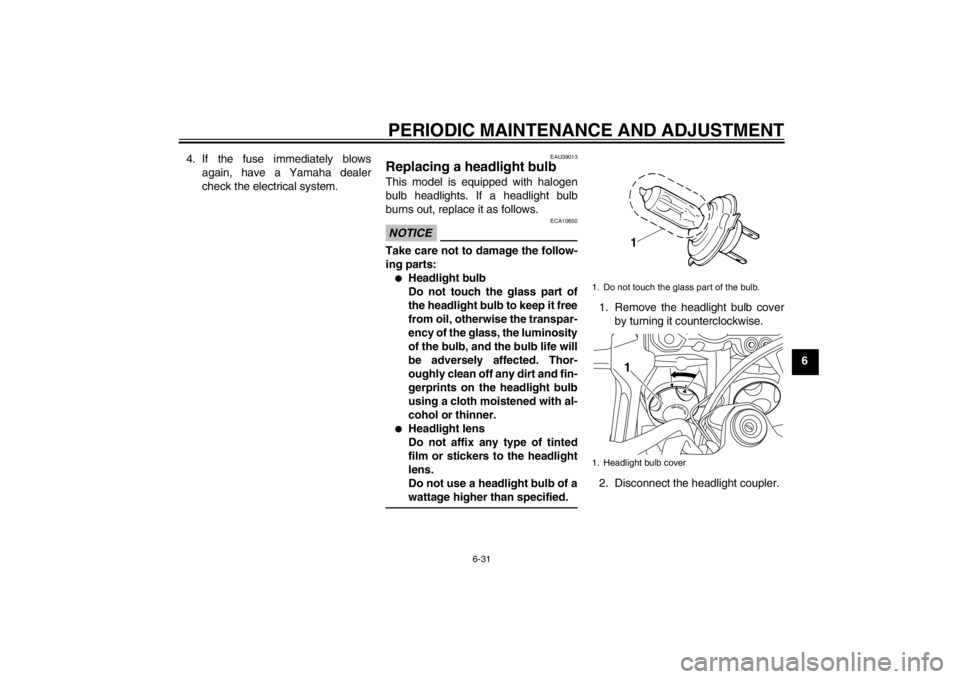
1. Remove the headlight bulb cover
by turning it counterclockwise.
2. Disconnect the headlight coupler.1. Do not touch the glass part of the bulb.
1. Headlight bulb cover
1
U23PE3E0.book Page 31 Monday, July 30, 2012 8:44 AM
Page 88 of 108
PERIODIC MAINTENANCE AND ADJUSTMENT
6-32
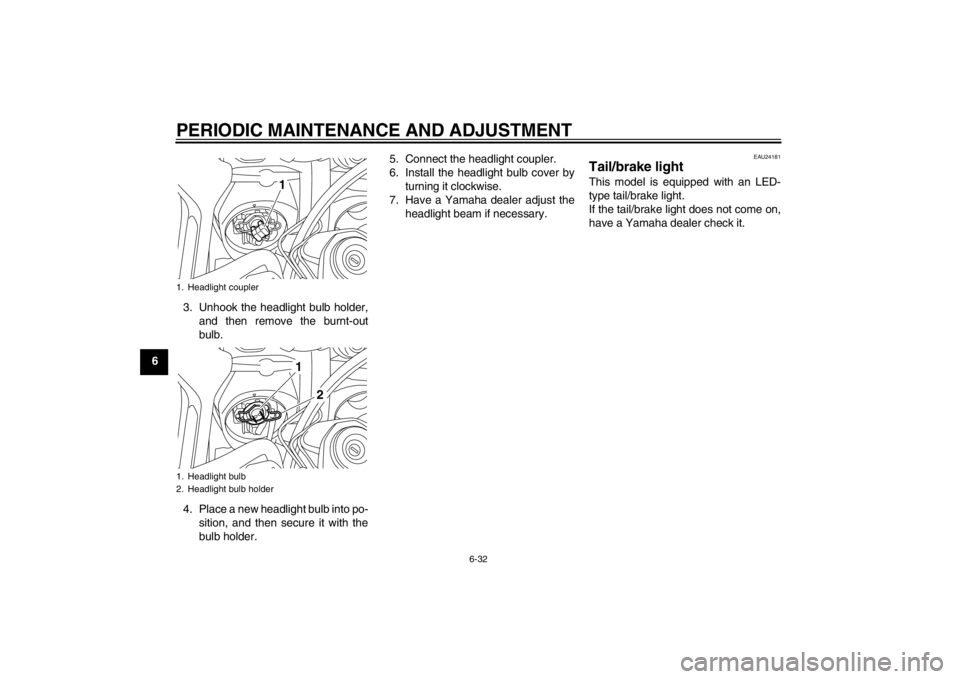
63. Unhook the headlight bulb holder,
and then remove the burnt-out
bulb.
4. Place a new headlight bulb into po- sition, and then secure it with the
bulb holder. 5. Connect the headlight coupler.
6. Install the headlight bulb cover by
turning it clockwise.
7. Have a Yamaha dealer adjust the headlight beam if necessary.
EAU24181
Tail/brake light This model is equipped with an LED-
type tail/brake light.
If the tail/brake light does not come on,
have a Yamaha dealer check it.
1. Headlight coupler
1. Headlight bulb
2. Headlight bulb holder
1
1
2
U23PE3E0.book Page 32 Monday, July 30, 2012 8:44 AM
Page 89 of 108
PERIODIC MAINTENANCE AND ADJUSTMENT
6-33
6
EAU24204
Replacing a turn signal light
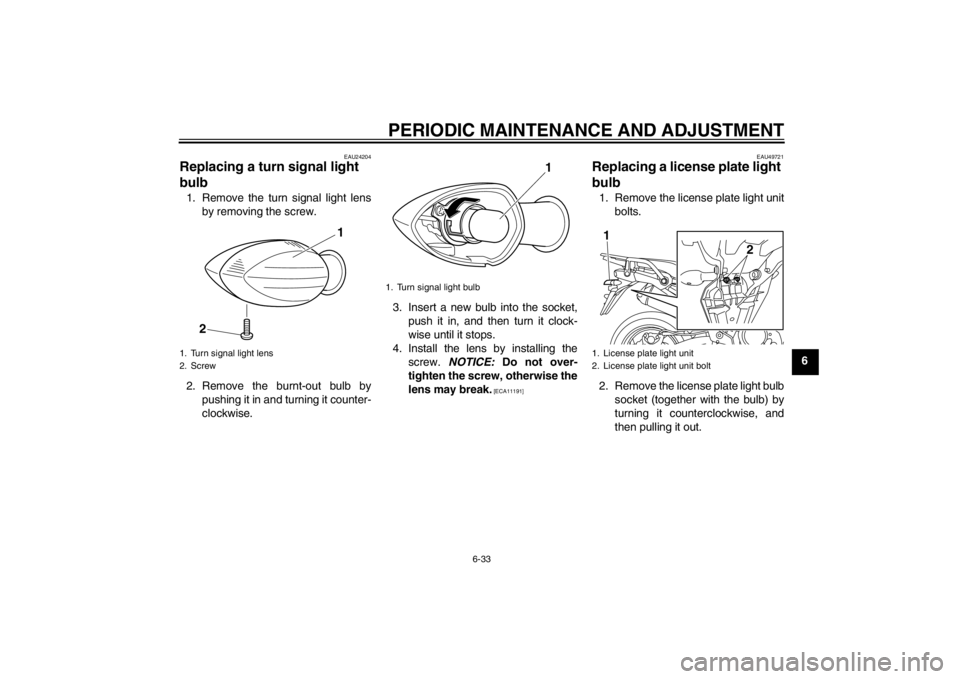
bulb 1. Remove the turn signal light lensby removing the screw.
2. Remove the burnt-out bulb by pushing it in and turning it counter-
clockwise. 3. Insert a new bulb into the socket,
push it in, and then turn it clock-
wise until it stops.
4. Install the lens by installing the screw. NOTICE: Do not over-
tighten the screw, otherwise the
lens may break.
[ECA11191] EAU49721
Replacing a license plate light
bulb 1. Remove the license plate light unit
bolts.
2. Remove the license plate light bulb socket (together with the bulb) by
turning it counterclockwise, and
then pulling it out.
1. Turn signal light lens
2. Screw
1
2
1. Turn signal light bulb
1
1. License plate light unit
2. License plate light unit bolt
2
1
U23PE3E0.book Page 33 Monday, July 30, 2012 8:44 AM