warning light YAMAHA XT1200Z 2013 User Guide
[x] Cancel search | Manufacturer: YAMAHA, Model Year: 2013, Model line: XT1200Z, Model: YAMAHA XT1200Z 2013Pages: 108, PDF Size: 2.86 MB
Page 35 of 108
INSTRUMENT AND CONTROL FUNCTIONS
3-20
3
EAU49481
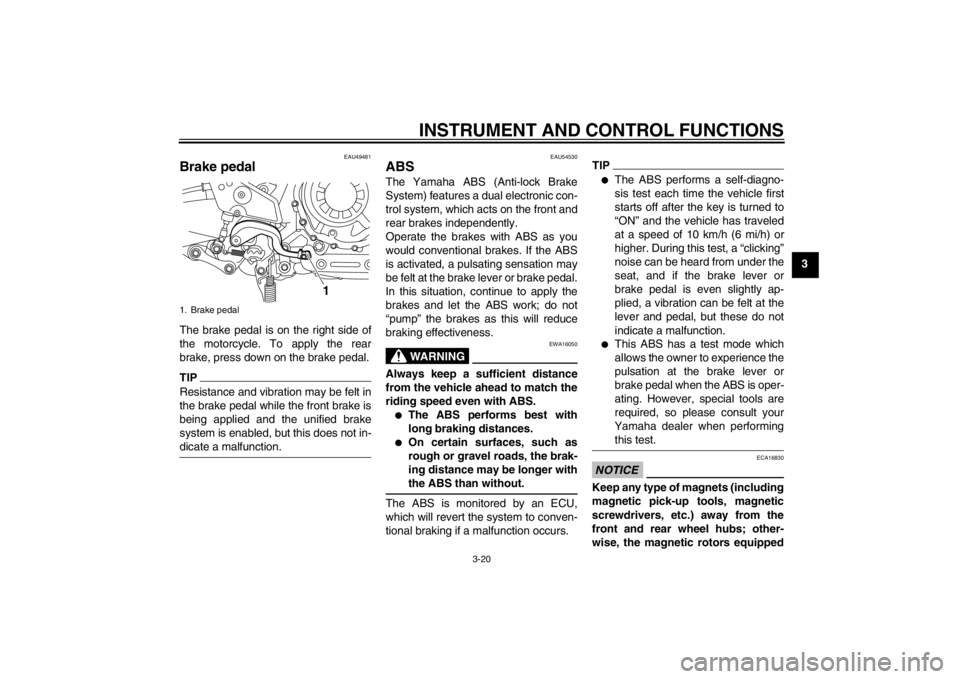
Brake pedal The brake pedal is on the right side of
the motorcycle. To apply the rear
brake, press down on the brake pedal.TIPResistance and vibration may be felt in
the brake pedal while the front brake is
being applied and the unified brake
system is enabled, but this does not in-
dicate a malfunction.
EAU54530
ABS The Yamaha ABS (Anti-lock Brake
System) features a dual electronic con-
trol system, which acts on the front and
rear brakes independently.
Operate the brakes with ABS as you
would conventional brakes. If the ABS
is activated, a pulsating sensation may
be felt at the brake lever or brake pedal.
In this situation, continue to apply the
brakes and let the ABS work; do not
“pump” the brakes as this will reduce
braking effectiveness.
WARNING
EWA16050
Always keep a sufficient distance
from the vehicle ahead to match the
riding speed even with ABS.●
The ABS performs best with
long braking distances.
●
On certain surfaces, such as
rough or gravel roads, the brak-
ing distance may be longer with
the ABS than without.
The ABS is monitored by an ECU,
which will revert the system to conven-
tional braking if a malfunction occurs.
TIP●
The ABS performs a self-diagno-
sis test each time the vehicle first
starts off after the key is turned to
“ON” and the vehicle has traveled
at a speed of 10 km/h (6 mi/h) or
higher. During this test, a “clicking”
noise can be heard from under the
seat, and if the brake lever or
brake pedal is even slightly ap-
plied, a vibration can be felt at the
lever and pedal, but these do not
indicate a malfunction.
●
This ABS has a test mode which
allows the owner to experience the
pulsation at the brake lever or
brake pedal when the ABS is oper-
ating. However, special tools are
required, so please consult your
Yamaha dealer when performing this test.
NOTICE
ECA16830
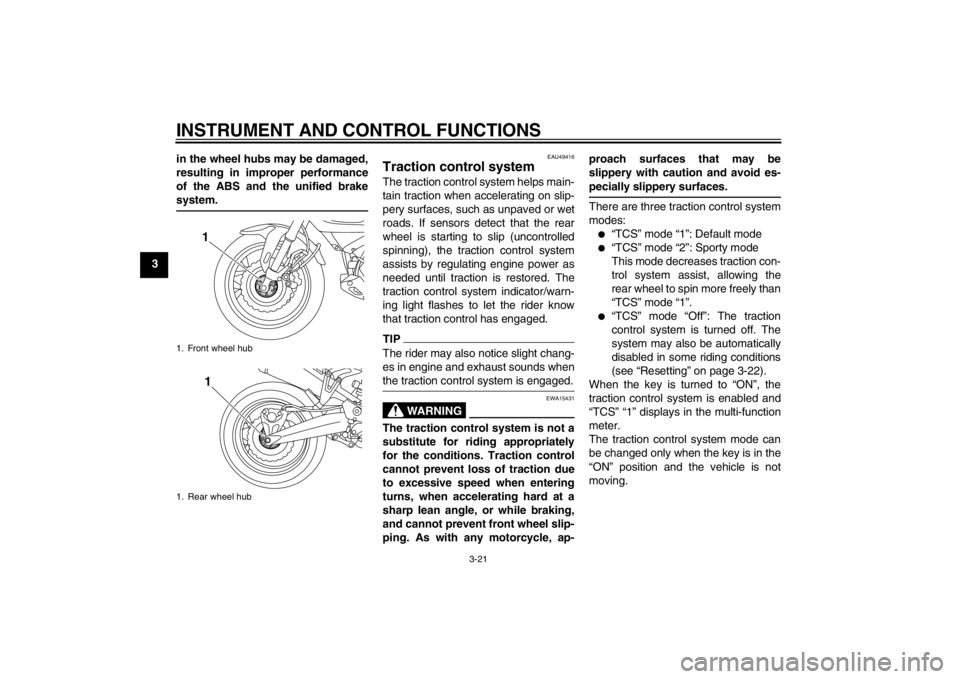
Keep any type of magnets (including
magnetic pick-up tools, magnetic
screwdrivers, etc.) away from the
front and rear wheel hubs; other-
wise, the magnetic rotors equipped
1. Brake pedal
1
U23PE3E0.book Page 20 Monday, July 30, 2012 8:44 AM
Page 36 of 108
INSTRUMENT AND CONTROL FUNCTIONS
3-21
3in the wheel hubs may be damaged,
resulting in improper performance
of the ABS and the unified brake
system.
EAU49416
Traction control system The traction control system helps main-
tain traction when accelerating on slip-
pery surfaces, such as unpaved or wet
roads. If sensors detect that the rear
wheel is starting to slip (uncontrolled
spinning), the traction control system
assists by regulating engine power as
needed until traction is restored. The
traction control system indicator/warn-
ing light flashes to let the rider know
that traction control has engaged.TIPThe rider may also notice slight chang-
es in engine and exhaust sounds when
the traction control system is engaged.
WARNING
EWA15431
The traction control system is not a
substitute for riding appropriately
for the conditions. Traction control
cannot prevent loss of traction due
to excessive speed when entering
turns, when accelerating hard at a
sharp lean angle, or while braking,
and cannot prevent front wheel slip-
ping. As with any motorcycle, ap- proach surfaces that may be
slippery with caution and avoid es-
pecially slippery surfaces.
There are three traction control system
modes:●
“TCS” mode “1”: Default mode
●
“TCS” mode “2”: Sporty mode
This mode decreases traction con-
trol system assist, allowing the
rear wheel to spin more freely than
“TCS” mode “1”.
●
“TCS” mode “Off”: The traction
control system is turned off. The
system may also be automatically
disabled in some riding conditions
(see “Resetting” on page 3-22).
When the key is turned to “ON”, the
traction control system is enabled and
“TCS” “1” displays in the multi-function
meter.
The traction control system mode can
be changed only when the key is in the
“ON” position and the vehicle is not
moving.
1. Front wheel hub
1. Rear wheel hub
11
U23PE3E0.book Page 21 Monday, July 30, 2012 8:44 AM
Page 37 of 108
INSTRUMENT AND CONTROL FUNCTIONS
3-22
3
TIPUse “TCS” mode “Off” to help free the
rear wheel if the motorcycle gets stuck
in mud, sand, or other soft surfaces.NOTICE
ECA16800
Use only the specified tires. (See
page 6-18.) Using different sized
tires will prevent the traction control
system from controlling tire rotation
accurately.Setting the traction control system
WARNING
EWA15440
Be sure to stop the vehicle before
making any setting changes to the
traction control system. Changing
settings while riding can distract the
operator and increase the risk of an
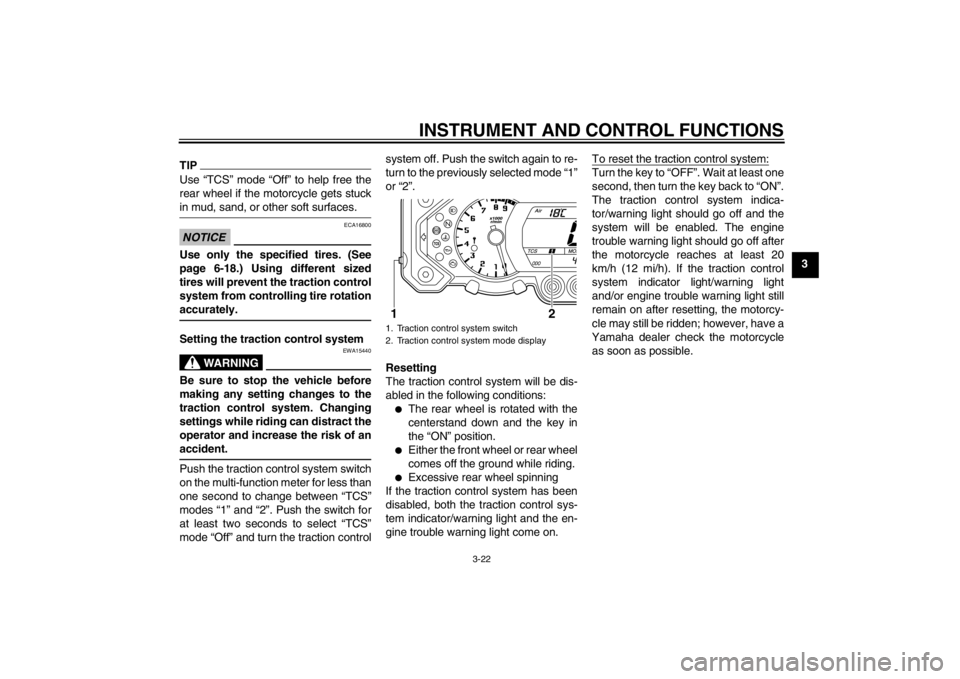
accident.Push the traction control system switch
on the multi-function meter for less than
one second to change between “TCS”
modes “1” and “2”. Push the switch for
at least two seconds to select “TCS”
mode “Off” and turn the traction controlsystem off. Push the switch again to re-
turn to the previously selected mode “1”
or “2”.
Resetting
The traction control system will be dis-
abled in the following conditions:
●
The rear wheel is rotated with the
centerstand down and the key in
the “ON” position.
●
Either the front wheel or rear wheel
comes off the ground while riding.
●
Excessive rear wheel spinning
If the traction control system has been
disabled, both the traction control sys-
tem indicator/warning light and the en-
gine trouble warning light come on. To reset the traction control system:
Turn the key to “OFF”. Wait at least one
second, then turn the key back to “ON”.
The traction control system indica-
tor/warning light should go off and the
system will be enabled. The engine
trouble warning light should go off after
the motorcycle reaches at least 20
km/h (12 mi/h). If the traction control
system indicator light/warning light
and/or engine trouble warning light still
remain on after resetting, the motorcy-
cle may still be ridden; however, have a
Yamaha dealer check the motorcycle
as soon as possible.
1. Traction control system switch
2. Traction control system mode display
2
1
U23PE3E0.book Page 22 Monday, July 30, 2012 8:44 AM
Page 38 of 108
INSTRUMENT AND CONTROL FUNCTIONS
3-23
3
EAU13074
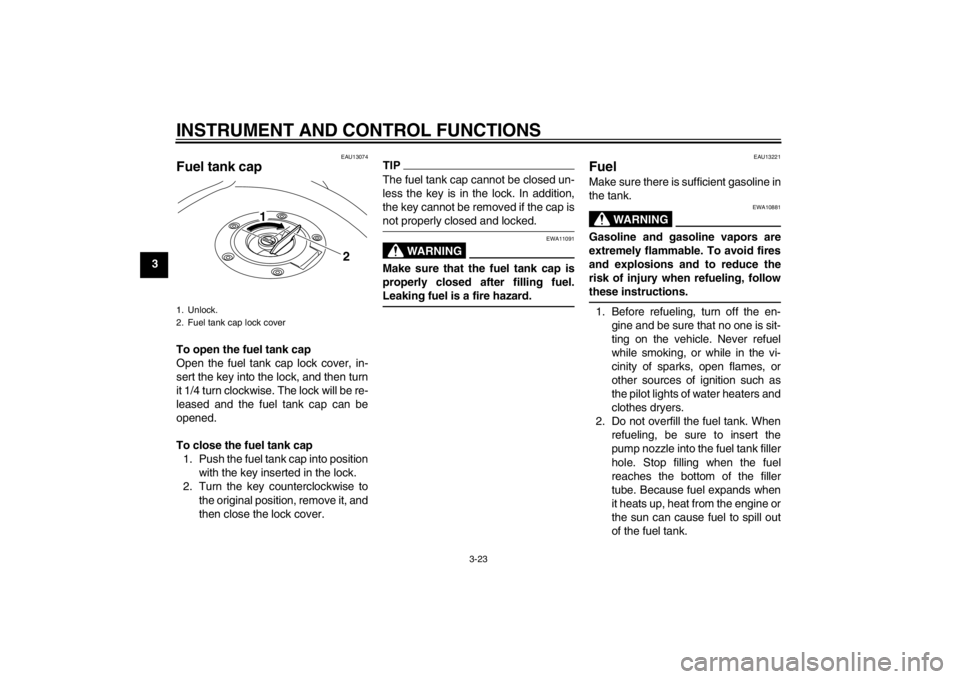
Fuel tank cap To open the fuel tank cap
Open the fuel tank cap lock cover, in-
sert the key into the lock, and then turn
it 1/4 turn clockwise. The lock will be re-
leased and the fuel tank cap can be
opened.
To close the fuel tank cap1. Push the fuel tank cap into position with the key inserted in the lock.
2. Turn the key counterclockwise to the original position, remove it, and
then close the lock cover.
TIPThe fuel tank cap cannot be closed un-
less the key is in the lock. In addition,
the key cannot be removed if the cap is
not properly closed and locked.
WARNING
EWA11091
Make sure that the fuel tank cap is
properly closed after filling fuel.
Leaking fuel is a fire hazard.
EAU13221
Fuel Make sure there is sufficient gasoline in
the tank.
WARNING
EWA10881
Gasoline and gasoline vapors are
extremely flammable. To avoid fires
and explosions and to reduce the
risk of injury when refueling, follow
these instructions.1. Before refueling, turn off the en-gine and be sure that no one is sit-
ting on the vehicle. Never refuel
while smoking, or while in the vi-
cinity of sparks, open flames, or
other sources of ignition such as
the pilot lights of water heaters and
clothes dryers.
2. Do not overfill the fuel tank. When refueling, be sure to insert the
pump nozzle into the fuel tank filler
hole. Stop filling when the fuel
reaches the bottom of the filler
tube. Because fuel expands when
it heats up, heat from the engine or
the sun can cause fuel to spill out
of the fuel tank.
1. Unlock.
2. Fuel tank cap lock cover
2
1
U23PE3E0.book Page 23 Monday, July 30, 2012 8:44 AM
Page 53 of 108
OPERATION AND IMPORTANT RIDING POINTS
5-1
5
EAU15951
Read the Owner’s Manual carefully to
become familiar with all controls. If
there is a control or function you do not
understand, ask your Yamaha dealer.
WARNING
EWA10271
Failure to familiarize yourself with
the controls can lead to loss of con-
trol, which could cause an accident
or injury.
EAU48710
TIPThis model is equipped with:●
a lean angle sensor to stop the en-
gine in case of a turnover. In this
case, the multi-function display in-
dicates error code 30, but this is
not a malfunction. Turn the key to
“OFF” and then to “ON” to clear the
error code. Failing to do so will pre-
vent the engine from starting even
though the engine will crank when
pushing the start switch.
●
an engine auto-stop system. The
engine stops automatically if left
idling for 20 minutes. If the engine
stops, simply push the start switch
to restart the engine.
EAU54520
Starting the engine In order for the ignition circuit cut-off
system to enable starting, one of the
following conditions must be met:●
The transmission is in the neutral
position.
●
The transmission is in gear with
the clutch lever pulled and the
sidestand up.
See page 3-33 for more informa-
tion.
1. Turn the key to “ON” and make sure that the engine stop switch is
set to “ ”.
The following warning lights and
indicator lights should come on for
a few seconds, then go off.●
Oil level warning light
●
Engine trouble warning light
●
Coolant temperature warning
light
●
Traction control system indi-
cator/warning light
●
Immobilizer system indicator
light
U23PE3E0.book Page 1 Monday, July 30, 2012 8:44 AM
Page 54 of 108
OPERATION AND IMPORTANT RIDING POINTS
5-2
5
NOTICE
ECA17670
If the above warning lights or indica-
tor light do not come on initially
when the key is turned to “ON”, or if
a warning or indicator light remains
on, see page 3-4 for the correspond-
ing warning and indicator light cir-
cuit check.
The ABS warning light should
come on when the main switch is
turned to “ON” and then go off after
traveling at a speed of 10 km/h (6
mi/h) or higher.
NOTICE
ECA17680
If the ABS warning light does not
come on and then go off as ex-
plained above, see page 3-4 for the
indicator light circuit check.2. Shift the transmission into the neu-tral position. The neutral indicator
light should come on. If not, ask a
Yamaha dealer to check the elec-
trical circuit.
3. Start the engine by pushing the start switch. If the engine fails to start, release
the start switch, wait a few sec-
onds, and then try again. Each
starting attempt should be as short
as possible to preserve the bat-
tery. Do not crank the engine more
than 10 seconds on any one at-
tempt.
NOTICE
ECA11042
For maximum engine life, never ac-
celerate hard when the engine is
cold!
EAU16671
Shifting Shifting gears lets you control the
amount of engine power available for
starting off, accelerating, climbing hills,
etc.
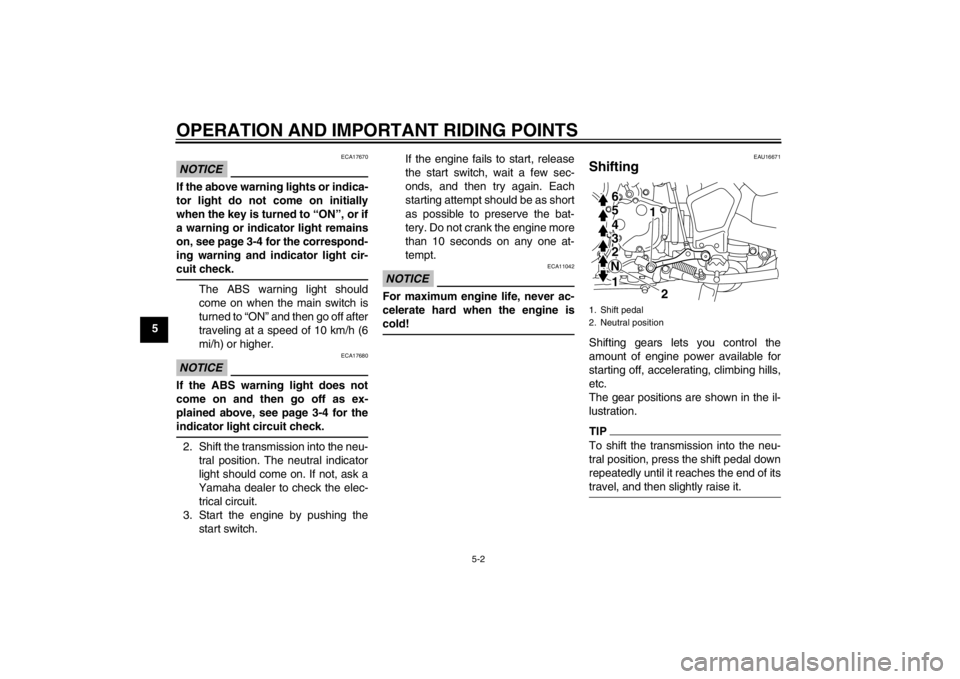
The gear positions are shown in the il-
lustration.TIPTo shift the transmission into the neu-
tral position, press the shift pedal down
repeatedly until it reaches the end of its
travel, and then slightly raise it.1. Shift pedal
2. Neutral position
1
2
654321N
U23PE3E0.book Page 2 Monday, July 30, 2012 8:44 AM
Page 69 of 108
PERIODIC MAINTENANCE AND ADJUSTMENT
6-13
6
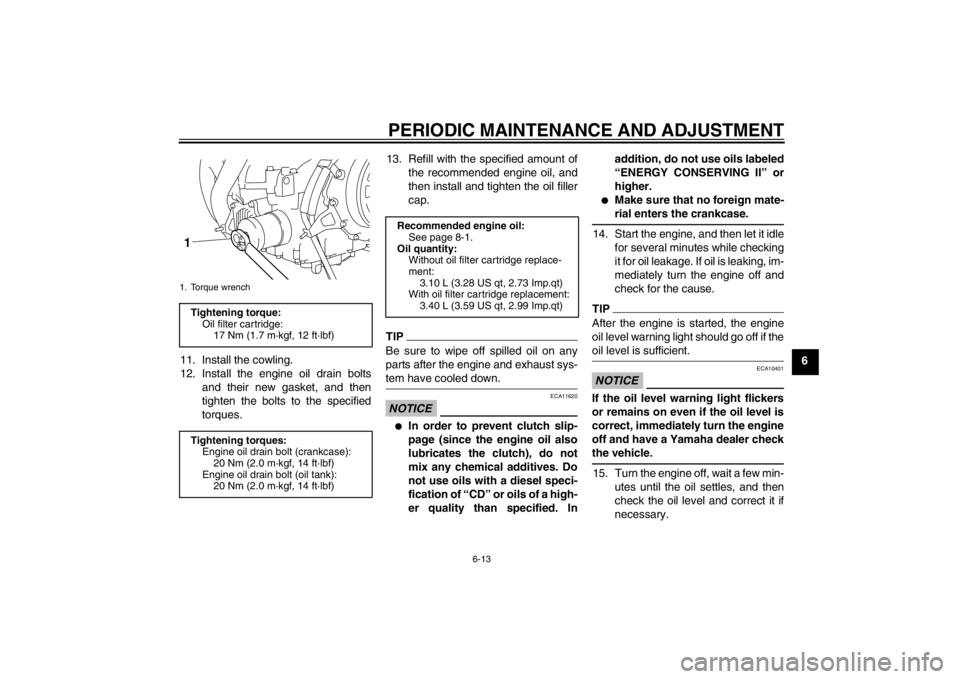
11. Install the cowling.
12. Install the engine oil drain bolts
and their new gasket, and then
tighten the bolts to the specified
torques. 13. Refill with the specified amount of
the recommended engine oil, and
then install and tighten the oil filler
cap.
TIPBe sure to wipe off spilled oil on any
parts after the engine and exhaust sys-
tem have cooled down.NOTICE
ECA11620
●
In order to prevent clutch slip-
page (since the engine oil also
lubricates the clutch), do not
mix any chemical additives. Do
not use oils with a diesel speci-
fication of “CD” or oils of a high-
er quality than specified. In addition, do not use oils labeled
“ENERGY CONSERVING II” or
higher.
●
Make sure that no foreign mate-
rial enters the crankcase.
14. Start the engine, and then let it idle
for several minutes while checking
it for oil leakage. If oil is leaking, im-
mediately turn the engine off and
check for the cause.TIPAfter the engine is started, the engine
oil level warning light should go off if the
oil level is sufficient.NOTICE
ECA10401
If the oil level warning light flickers
or remains on even if the oil level is
correct, immediately turn the engine
off and have a Yamaha dealer check
the vehicle.15. Turn the engine off, wait a few min-utes until the oil settles, and then
check the oil level and correct it if
necessary.
1. Torque wrenchTightening torque:Oil filter cartridge:17 Nm (1.7 m·kgf, 12 ft·lbf)
Tightening torques: Engine oil drain bolt (crankcase):
20 Nm (2.0 m·kgf, 14 ft·lbf)
Engine oil drain bolt (oil tank): 20 Nm (2.0 m·kgf, 14 ft·lbf)1
Recommended engine oil:
See page 8-1.
Oil quantity: Without oil filter cartridge replace-
ment:3.10 L (3.28 US qt, 2.73 Imp.qt)
With oil filter cartridge replacement:
3.40 L (3.59 US qt, 2.99 Imp.qt)
U23PE3E0.book Page 13 Monday, July 30, 2012 8:44 AM
Page 70 of 108
PERIODIC MAINTENANCE AND ADJUSTMENT
6-14
6
EAU20016
Final gear oil The final gear case must be checked
for oil leakage before each ride. If any
leakage is found, have a Yamaha deal-
er check and repair the vehicle. In addi-
tion, the final gear oil level must be
checked and the oil changed as follows
at the intervals specified in the periodic
maintenance and lubrication chart.
WARNING
EWA10370
●
Make sure that no foreign mate-
rial enters the final gear case.
●
Make sure that no oil gets on the
tire or wheel.
To check the final gear oil level1. Place the vehicle on the center- stand.TIPMake sure that the vehicle is positioned
straight up when checking the oil level.
A slight tilt to the side can result in a
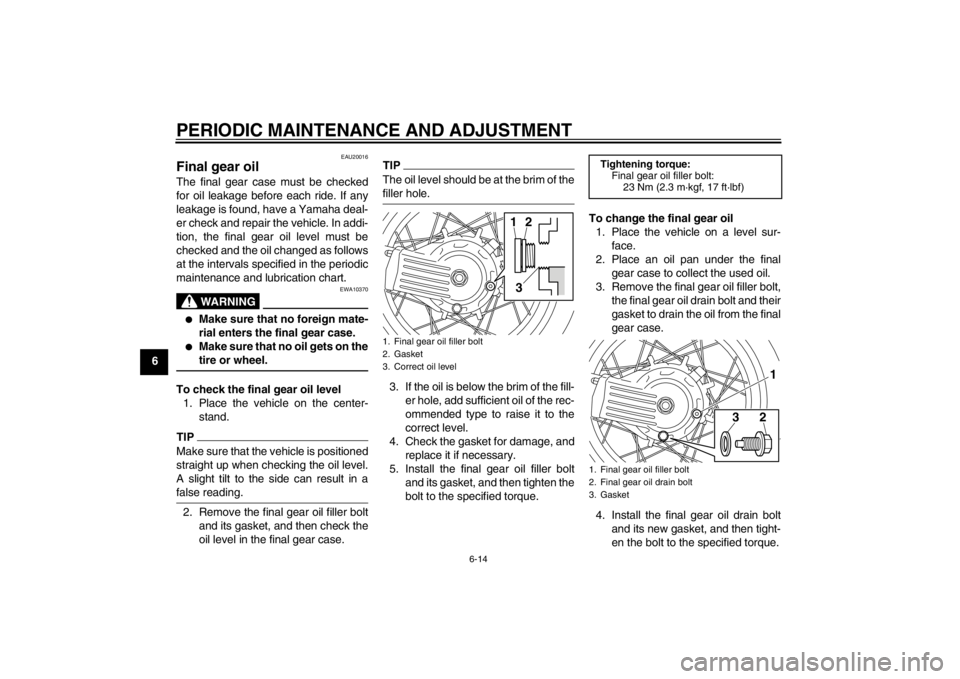
false reading.2. Remove the final gear oil filler boltand its gasket, and then check the
oil level in the final gear case.
TIPThe oil level should be at the brim of the
filler hole.3. If the oil is below the brim of the fill-er hole, add sufficient oil of the rec-
ommended type to raise it to the
correct level.
4. Check the gasket for damage, and replace it if necessary.
5. Install the final gear oil filler bolt and its gasket, and then tighten the
bolt to the specified torque. To change the final gear oil
1. Place the vehicle on a level sur- face.
2. Place an oil pan under the final gear case to collect the used oil.
3. Remove the final gear oil filler bolt, the final gear oil drain bolt and their
gasket to drain the oil from the final
gear case.
4. Install the final gear oil drain bolt and its new gasket, and then tight-
en the bolt to the specified torque.1. Final gear oil filler bolt
2. Gasket
3. Correct oil level
1
2
3
Tightening torque: Final gear oil filler bolt:
23 Nm (2.3 m·kgf, 17 ft·lbf)1. Final gear oil filler bolt
2. Final gear oil drain bolt
3. Gasket
2
3
1
U23PE3E0.book Page 14 Monday, July 30, 2012 8:44 AM
Page 77 of 108
PERIODIC MAINTENANCE AND ADJUSTMENT
6-21
6
EAU37913
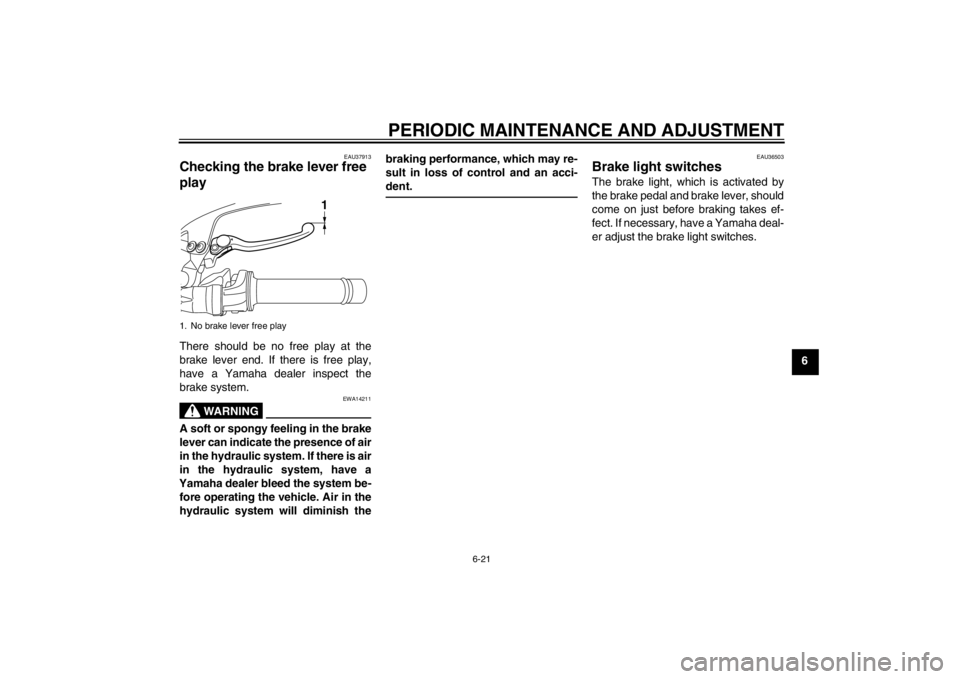
Checking the brake lever free
play There should be no free play at the
brake lever end. If there is free play,
have a Yamaha dealer inspect the
brake system.
WARNING
EWA14211
A soft or spongy feeling in the brake
lever can indicate the presence of air
in the hydraulic system. If there is air
in the hydraulic system, have a
Yamaha dealer bleed the system be- fore operating the vehicle. Air in the
hydraulic system will diminish the braking performance, which may re-
sult in loss of control and an acci-
dent.
EAU36503
Brake light switches The brake light, which is activated by
the brake pedal and brake lever, should
come on just before braking takes ef-
fect. If necessary, have a Yamaha deal-
er adjust the brake light switches.
1. No brake lever free play
1
U23PE3E0.book Page 21 Monday, July 30, 2012 8:44 AM
Page 86 of 108
PERIODIC MAINTENANCE AND ADJUSTMENT
6-30
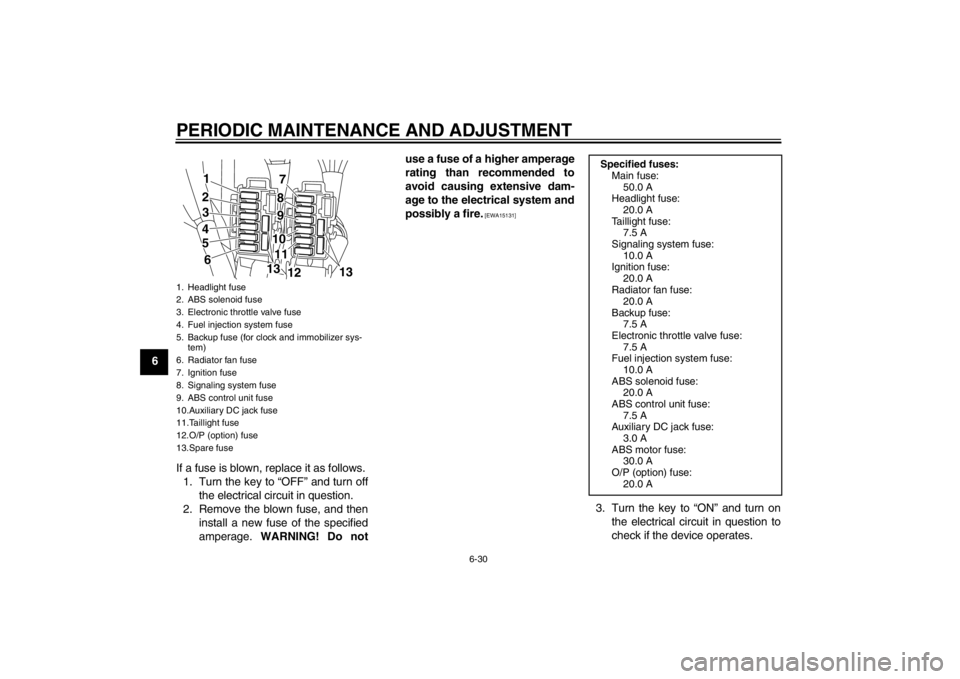
6If a fuse is blown, replace it as follows.1. Turn the key to “OFF” and turn off the electrical circuit in question.
2. Remove the blown fuse, and then install a new fuse of the specified
amperage. WARNING! Do not use a fuse of a higher amperage
rating than recommended to
avoid causing extensive dam-
age to the electrical system and
possibly a fire.
[EWA15131]
3. Turn the key to “ON” and turn on
the electrical circuit in question to
check if the device operates.
1. Headlight fuse
2. ABS solenoid fuse
3. Electronic throttle valve fuse
4. Fuel injection system fuse
5. Backup fuse (for clock and immobilizer sys-tem)
6. Radiator fan fuse
7. Ignition fuse
8. Signaling system fuse
9. ABS control unit fuse
10.Auxiliary DC jack fuse
11.Taillight fuse
12.O/P (option) fuse
13.Spare fuse
78912
13
13
1110
124563
Specified fuses: Main fuse:
50.0 A
Headlight fuse:
20.0 A
Taillight fuse: 7.5 A
Signaling system fuse: 10.0 A
Ignition fuse:
20.0 A
Radiator fan fuse: 20.0 A
Backup fuse: 7.5 A
Electronic throttle valve fuse:
7.5 A
Fuel injection system fuse: 10.0 A
ABS solenoid fuse: 20.0 A
ABS control unit fuse:
7.5 A
Auxiliary DC jack fuse: 3.0 A
ABS motor fuse: 30.0 A
O/P (option) fuse:
20.0 A
U23PE3E0.book Page 30 Monday, July 30, 2012 8:44 AM