ECU YAMAHA XT1200Z 2013 Owners Manual
[x] Cancel search | Manufacturer: YAMAHA, Model Year: 2013, Model line: XT1200Z, Model: YAMAHA XT1200Z 2013Pages: 108, PDF Size: 2.86 MB
Page 10 of 108

SAFETY INFORMATION
1-3
1Carbon Monoxide is a colorless, odor-
less, tasteless gas which may be
present even if you do not see or smell
any engine exhaust. Deadly levels of
carbon monoxide can collect rapidly
and you can quickly be overcome and
unable to save yourself. Also, deadly
levels of carbon monoxide can linger
for hours or days in enclosed or poorly
ventilated areas. If you experience any
symptoms of carbon monoxide poison-
ing, leave the area immediately, get
fresh air, and SEEK MEDICAL TREAT-
MENT.
●
Do not run engine indoors. Even if
you try to ventilate engine exhaust
with fans or open windows and
doors, carbon monoxide can rap-
idly reach dangerous levels.
●
Do not run engine in poorly venti-
lated or partially enclosed areas
such as barns, garages, or car-
ports.
●
Do not run engine outdoors where
engine exhaust can be drawn into
a building through openings such
as windows and doors. Loading
Adding accessories or cargo to your
motorcycle can adversely affect stabili-
ty and handling if the weight distribution
of the motorcycle is changed. To avoid
the possibility of an accident, use ex-
treme caution when adding cargo or
accessories to your motorcycle. Use
extra care when riding a motorcycle
that has added cargo or accessories.
Here, along with the information about
accessories below, are some general
guidelines to follow if loading cargo to
your motorcycle:
The total weight of the operator, pas-
senger, accessories and cargo must
not exceed the maximum load limit.
Operation of an overloaded vehicle
could cause an accident.
When loading within this weight limit,
keep the following in mind:
●
Cargo and accessory weight
should be kept as low and close to
the motorcycle as possible. Se-
curely pack your heaviest items as close to the center of the vehicle as
possible and make sure to distrib-
ute the weight as evenly as possi-
ble on both sides of the motorcycle
to minimize imbalance or instabili-
ty.
●
Shifting weights can create a sud-
den imbalance. Make sure that ac-
cessories and cargo are securely
attached to the motorcycle before
riding. Check accessory mounts
and cargo restraints frequently.
Properly adjust the suspension for your load (suspension-ad-
justable models only), and
check the condition and pres-
sure of your tires.
Never attach any large or heavy items to the handlebar, front
fork, or front fender. These
items, including such cargo as
sleeping bags, duffel bags, or
tents, can create unstable han-
dling or a slow steering re-
sponse.
●
This vehicle is not designed to
pull a trailer or to be attached to
a sidecar.
Maximum load: 209 kg (461 lb)
U23PE3E0.book Page 3 Monday, July 30, 2012 8:44 AM
Page 12 of 108

SAFETY INFORMATION
1-5
1Aftermarket Tires and Rims
The tires and rims that came with your
motorcycle were designed to match the
performance capabilities and to provide
the best combination of handling, brak-
ing, and comfort. Other tires, rims, siz-
es, and combinations may not be
appropriate. Refer to page 6-18 for tire
specifications and more information on
replacing your tires.
Transporting the Motorcycle
Be sure to observe following instruc-
tions before transporting the motorcy-
cle in another vehicle.
●
Remove all loose items from the
motorcycle.
●
Check that the fuel cock (if
equipped) is in the “OFF” position
and that there are no fuel leaks.
●
Point the front wheel straight
ahead on the trailer or in the truck
bed, and choke it in a rail to pre-
vent movement.
●
Shift the transmission in gear (for
models with a manual transmis-
sion).
●
Secure the motorcycle with tie-
downs or suitable straps that are
attached to solid parts of the mo-
torcycle, such as the frame or up-
per front fork triple clamp (and not,
for example, to rubber-mounted
handlebars or turn signals, or parts
that could break). Choose the lo-
cation for the straps carefully so
the straps will not rub against
painted surfaces during transport.
●
The suspension should be com-
pressed somewhat by the tie-
downs, if possible, so that the mo-
torcycle will not bounce excessive-
ly during transport.
U23PE3E0.book Page 5 Monday, July 30, 2012 8:44 AM
Page 16 of 108
INSTRUMENT AND CONTROL FUNCTIONS
3-1
3
EAU10977
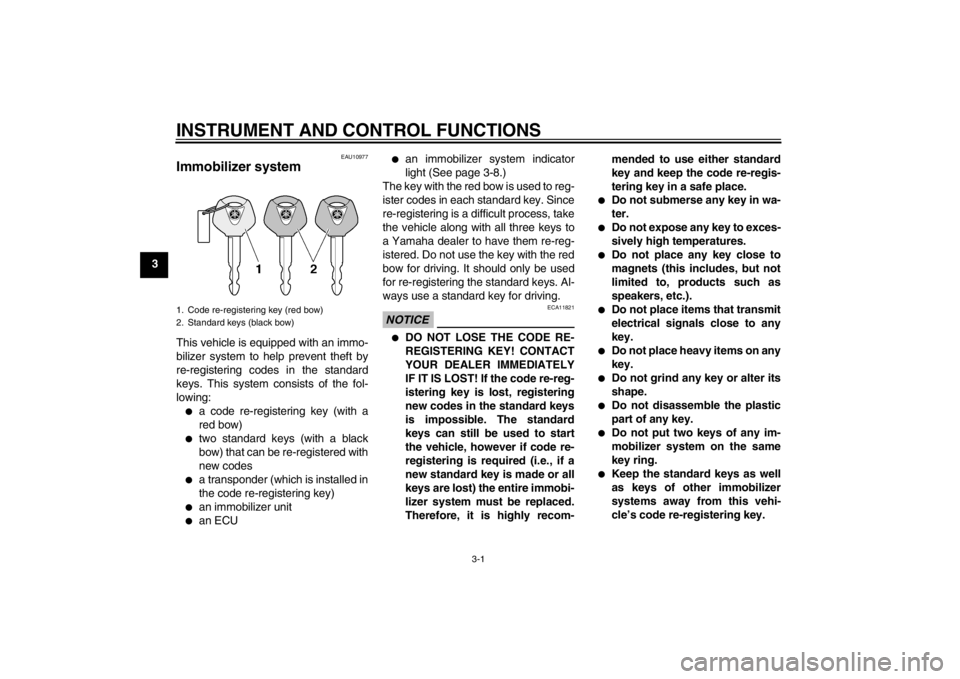
Immobilizer system This vehicle is equipped with an immo-
bilizer system to help prevent theft by
re-registering codes in the standard
keys. This system consists of the fol-
lowing:●
a code re-registering key (with a
red bow)
●
two standard keys (with a black
bow) that can be re-registered with
new codes
●
a transponder (which is installed in
the code re-registering key)
●
an immobilizer unit
●
an ECU
●
an immobilizer system indicator
light (See page 3-8.)
The key with the red bow is used to reg-
ister codes in each standard key. Since
re-registering is a difficult process, take
the vehicle along with all three keys to
a Yamaha dealer to have them re-reg-
istered. Do not use the key with the red
bow for driving. It should only be used
for re-registering the standard keys. Al-
ways use a standard key for driving.
NOTICE
ECA11821
●
DO NOT LOSE THE CODE RE-
REGISTERING KEY! CONTACT
YOUR DEALER IMMEDIATELY
IF IT IS LOST! If the code re-reg-
istering key is lost, registering
new codes in the standard keys
is impossible. The standard
keys can still be used to start
the vehicle, however if code re-
registering is required (i.e., if a
new standard key is made or all
keys are lost) the entire immobi-
lizer system must be replaced.
Therefore, it is highly recom- mended to use either standard
key and keep the code re-regis-
tering key in a safe place.
●
Do not submerse any key in wa-
ter.
●
Do not expose any key to exces-
sively high temperatures.
●
Do not place any key close to
magnets (this includes, but not
limited to, products such as
speakers, etc.).
●
Do not place items that transmit
electrical signals close to any
key.
●
Do not place heavy items on any
key.
●
Do not grind any key or alter its
shape.
●
Do not disassemble the plastic
part of any key.
●
Do not put two keys of any im-
mobilizer system on the same
key ring.
●
Keep the standard keys as well
as keys of other immobilizer
systems away from this vehi-
cle’s code re-registering key.
1. Code re-registering key (red bow)
2. Standard keys (black bow)U23PE3E0.book Page 1 Monday, July 30, 2012 8:44 AM
Page 34 of 108
INSTRUMENT AND CONTROL FUNCTIONS
3-19
3
EAU49517
Brake lever The brake lever is located on the right
side of the handlebar. To apply the front
brake, pull the lever toward the throttle
grip.
This model is equipped with a unified
brake system.
When pulling the brake lever, the front
brake and a portion of the rear brake
are applied. For full braking perfor-
mance, apply both the brake lever and
the brake pedal simultaneously.
The unified brake system is monitored
by an ECU, which disables unified
braking and resumes conventional
braking if a malfunction occurs.TIP●
Resistance and vibration may be
felt in the brake pedal while the
front brake is being applied and
the unified brake system is en-
abled, but this does not indicate a
malfunction.
●
The unified brake system does not
function until the vehicle starts
moving.
●
After coming to a stop while apply-
ing the brake lever, the unified
brake system is still enabled. As
further squeezing of the brake le-
ver will not increase the braking
power of the rear brake, apply the
rear brake should further braking
power be necessary (such as
when parking on a slope).
The unified brake system disables
after the brake lever is released.
The brake system then reverts to
the conventional type.
When the vehicle starts moving,
the unified brake system is re-en-
abled.
●
The unified brake system does not
function when the brake pedal is
applied alone or before the brake
lever is applied.
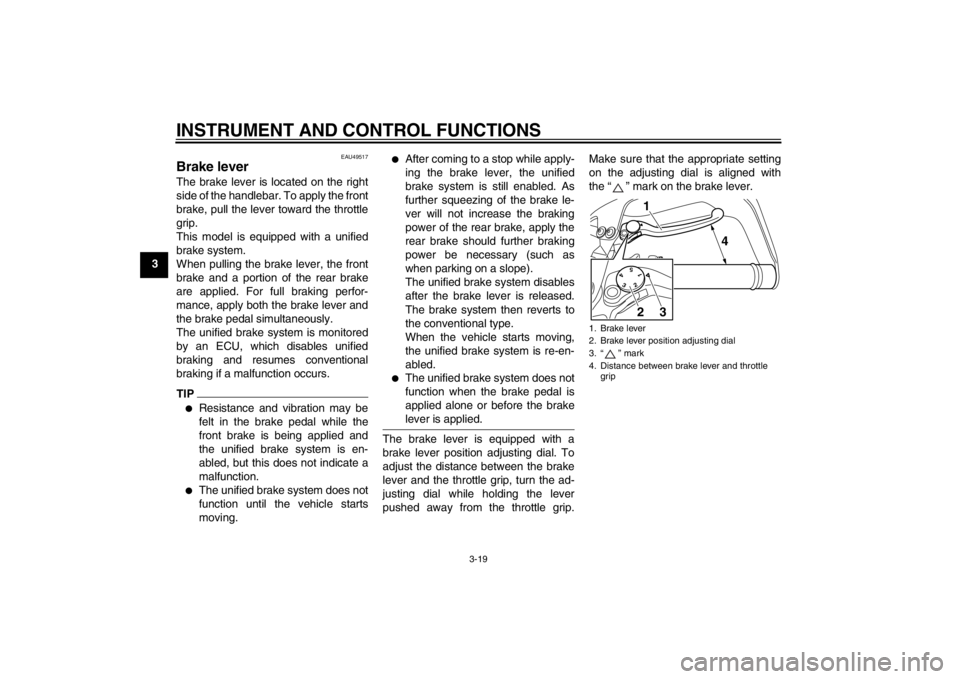
The brake lever is equipped with a
brake lever position adjusting dial. To
adjust the distance between the brake
lever and the throttle grip, turn the ad-
justing dial while holding the lever
pushed away from the throttle grip.Make sure that the appropriate setting
on the adjusting dial is aligned with
the “ ” mark on the brake lever.
1. Brake lever
2. Brake lever position adjusting dial
3. “ ” mark
4. Distance between brake lever and throttle
grip
5
43
211
4
3
2
U23PE3E0.book Page 19 Monday, July 30, 2012 8:44 AM
Page 35 of 108
INSTRUMENT AND CONTROL FUNCTIONS
3-20
3
EAU49481
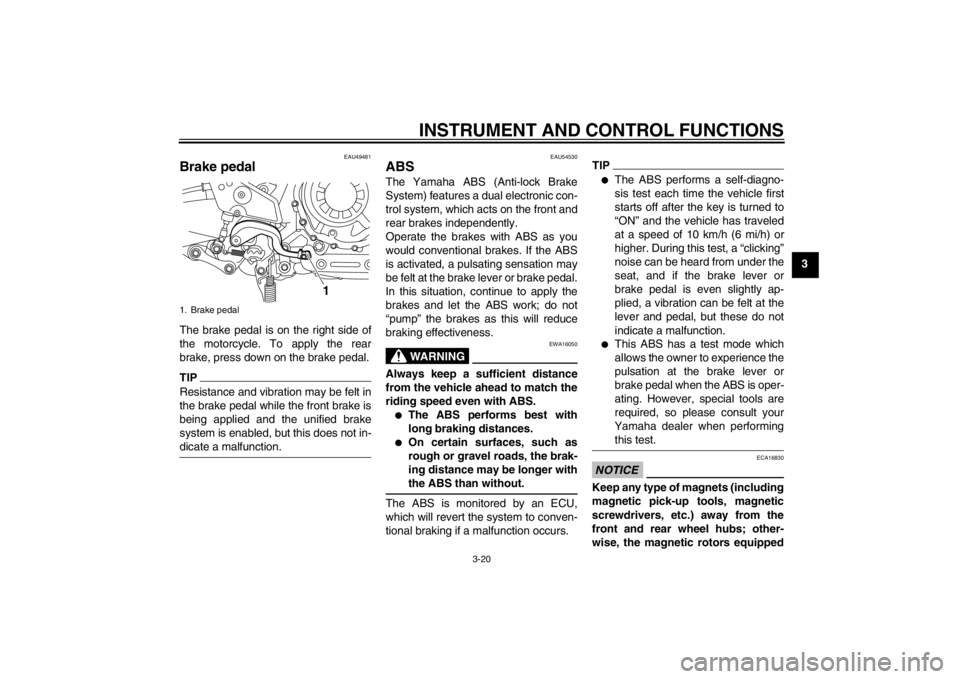
Brake pedal The brake pedal is on the right side of
the motorcycle. To apply the rear
brake, press down on the brake pedal.TIPResistance and vibration may be felt in
the brake pedal while the front brake is
being applied and the unified brake
system is enabled, but this does not in-
dicate a malfunction.
EAU54530
ABS The Yamaha ABS (Anti-lock Brake
System) features a dual electronic con-
trol system, which acts on the front and
rear brakes independently.
Operate the brakes with ABS as you
would conventional brakes. If the ABS
is activated, a pulsating sensation may
be felt at the brake lever or brake pedal.
In this situation, continue to apply the
brakes and let the ABS work; do not
“pump” the brakes as this will reduce
braking effectiveness.
WARNING
EWA16050
Always keep a sufficient distance
from the vehicle ahead to match the
riding speed even with ABS.●
The ABS performs best with
long braking distances.
●
On certain surfaces, such as
rough or gravel roads, the brak-
ing distance may be longer with
the ABS than without.
The ABS is monitored by an ECU,
which will revert the system to conven-
tional braking if a malfunction occurs.
TIP●
The ABS performs a self-diagno-
sis test each time the vehicle first
starts off after the key is turned to
“ON” and the vehicle has traveled
at a speed of 10 km/h (6 mi/h) or
higher. During this test, a “clicking”
noise can be heard from under the
seat, and if the brake lever or
brake pedal is even slightly ap-
plied, a vibration can be felt at the
lever and pedal, but these do not
indicate a malfunction.
●
This ABS has a test mode which
allows the owner to experience the
pulsation at the brake lever or
brake pedal when the ABS is oper-
ating. However, special tools are
required, so please consult your
Yamaha dealer when performing this test.
NOTICE
ECA16830
Keep any type of magnets (including
magnetic pick-up tools, magnetic
screwdrivers, etc.) away from the
front and rear wheel hubs; other-
wise, the magnetic rotors equipped
1. Brake pedal
1
U23PE3E0.book Page 20 Monday, July 30, 2012 8:44 AM
Page 39 of 108
INSTRUMENT AND CONTROL FUNCTIONS
3-24
3
3. Wipe up any spilled fuel immedi- ately. NOTICE: Immediately wipe
off spilled fuel with a clean, dry,
soft cloth, since fuel may deteri-
orate painted surfaces or plastic
parts.
[ECA10071]
4. Be sure to securely close the fuel tank cap.
WARNING
EWA15151
Gasoline is poisonous and can
cause injury or death. Handle gaso-
line with care. Never siphon gaso-
line by mouth. If you should swallow
some gasoline or inhale a lot of gas-
oline vapor, or get some gasoline in
your eyes, see your doctor immedi- ately. If gasoline spills on your skin,
wash with soap and water. If gaso-
line spills on your clothing, change
your clothes.
EAU49461
NOTICE
ECA11400
Use only unleaded gasoline. The use
of leaded gasoline will cause severe
damage to internal engine parts,
such as the valves and piston rings,
as well as to the exhaust system.Your Yamaha engine has been de-
signed to use premium unleaded gaso-
line with a research octane number of
95 or higher. If knocking (or pinging) oc-
curs, use a gasoline of a different
brand. Use of unleaded fuel will extend
spark plug life and reduce maintenance
costs.
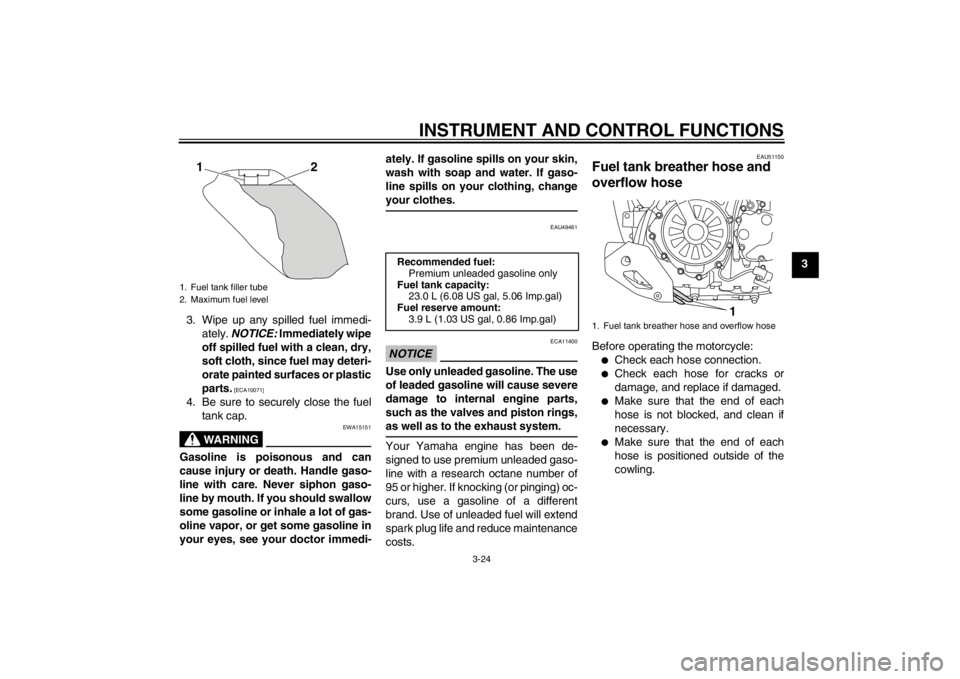
EAU51150
Fuel tank breather hose and
overflow hose Before operating the motorcycle:●
Check each hose connection.
●
Check each hose for cracks or
damage, and replace if damaged.
●
Make sure that the end of each
hose is not blocked, and clean if
necessary.
●
Make sure that the end of each
hose is positioned outside of the
cowling.
1. Fuel tank filler tube
2. Maximum fuel level
2
1
Recommended fuel:
Premium unleaded gasoline only
Fuel tank capacity: 23.0 L (6.08 US gal, 5.06 Imp.gal)
Fuel reserve amount: 3.9 L (1.03 US gal, 0.86 Imp.gal)
1. Fuel tank breather hose and overflow hose
1
U23PE3E0.book Page 24 Monday, July 30, 2012 8:44 AM
Page 41 of 108
INSTRUMENT AND CONTROL FUNCTIONS
3-26
3
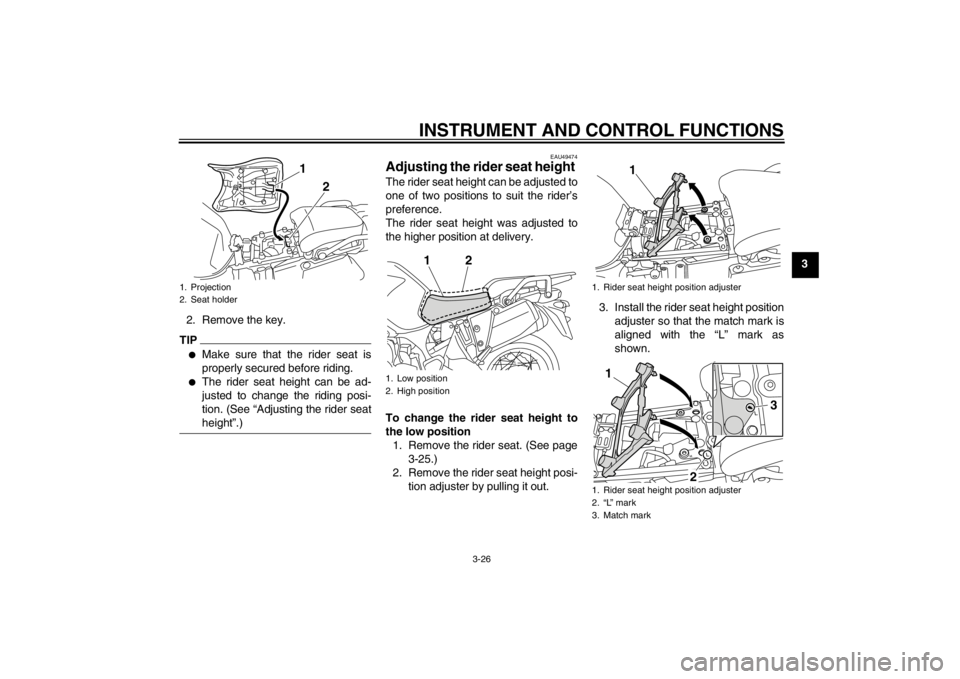
2. Remove the key.
TIP●
Make sure that the rider seat is
properly secured before riding.
●
The rider seat height can be ad-
justed to change the riding posi-
tion. (See “Adjusting the rider seat
height”.)
EAU49474
Adjusting the rider seat height The rider seat height can be adjusted to
one of two positions to suit the rider’s
preference.
The rider seat height was adjusted to
the higher position at delivery.
To change the rider seat height to
the low position 1. Remove the rider seat. (See page 3-25.)
2. Remove the rider seat height posi- tion adjuster by pulling it out. 3. Install the rider seat height position
adjuster so that the match mark is
aligned with the “L” mark as
shown.
1. Projection
2. Seat holder
1
2
1. Low position
2. High position
1
2
1. Rider seat height position adjuster
1. Rider seat height position adjuster
2. “L” mark
3. Match mark
1
3
2
1
U23PE3E0.book Page 26 Monday, July 30, 2012 8:44 AM
Page 42 of 108
INSTRUMENT AND CONTROL FUNCTIONS
3-27
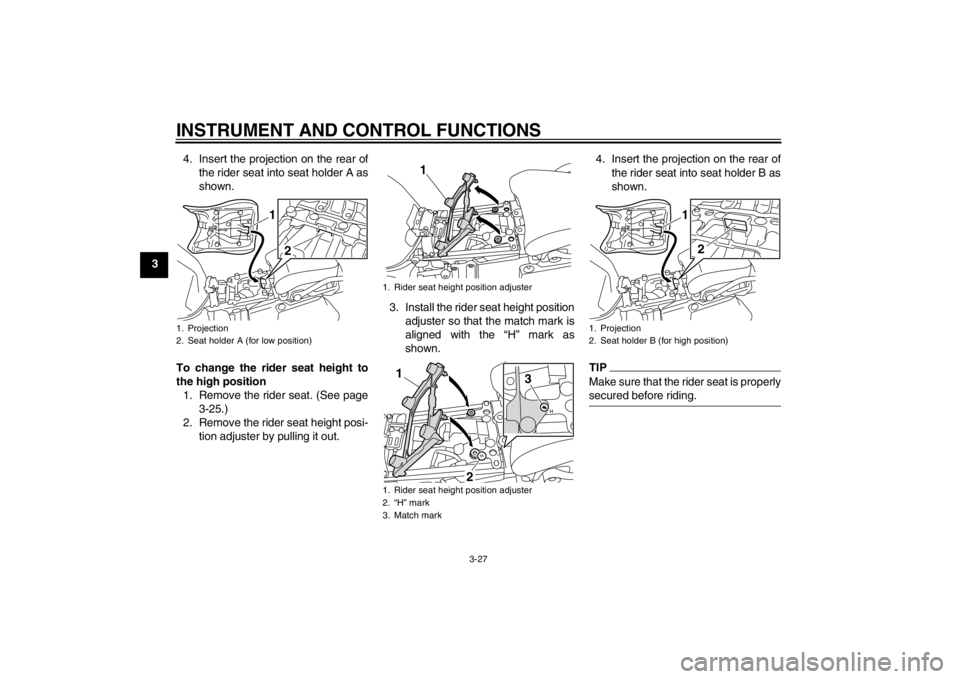
34. Insert the projection on the rear of
the rider seat into seat holder A as
shown.
To change the rider seat height to
the high position 1. Remove the rider seat. (See page 3-25.)
2. Remove the rider seat height posi- tion adjuster by pulling it out. 3. Install the rider seat height position
adjuster so that the match mark is
aligned with the “H” mark as
shown. 4. Insert the projection on the rear of
the rider seat into seat holder B as
shown.
TIPMake sure that the rider seat is properly
secured before riding.
1. Projection
2. Seat holder A (for low position)
1
2
1. Rider seat height position adjuster
1. Rider seat height position adjuster
2. “H” mark
3. Match mark
1
2 3
1
1. Projection
2. Seat holder B (for high position)
1
2
U23PE3E0.book Page 27 Monday, July 30, 2012 8:44 AM
Page 75 of 108
PERIODIC MAINTENANCE AND ADJUSTMENT
6-19
6
WARNING
EWA10471
●
Have a Yamaha dealer replace
excessively worn tires. Besides
being illegal, operating the vehi-
cle with excessively worn tires
decreases riding stability and
can lead to loss of control.
●
The replacement of all wheel
and brake-related parts, includ-
ing the tires, should be left to a
Yamaha dealer, who has the necessary professional knowl-
edge and experience to do so.
●
Ride at moderate speeds after
changing a tire since the tire
surface must first be “broken
in” for it to develop its optimal
characteristics.
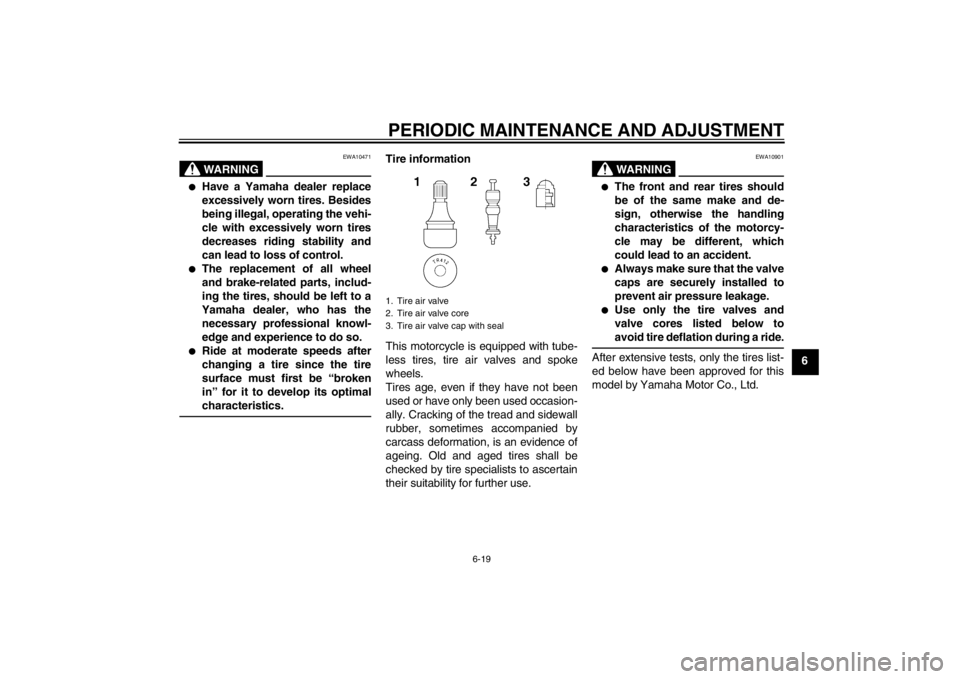
Tire information
This motorcycle is equipped with tube-
less tires, tire air valves and spoke
wheels.
Tires age, even if they have not been
used or have only been used occasion-
ally. Cracking of the tread and sidewall
rubber, sometimes accompanied by
carcass deformation, is an evidence of
ageing. Old and aged tires shall be
checked by tire specialists to ascertain
their suitability for further use.
WARNING
EWA10901
●
The front and rear tires should
be of the same make and de-
sign, otherwise the handling
characteristics of the motorcy-
cle may be different, which
could lead to an accident.
●
Always make sure that the valve
caps are securely installed to
prevent air pressure leakage.
●
Use only the tire valves and
valve cores listed below to
avoid tire deflation during a ride.
After extensive tests, only the tires list-
ed below have been approved for this
model by Yamaha Motor Co., Ltd.
1. Tire air valve
2. Tire air valve core
3. Tire air valve cap with seal
U23PE3E0.book Page 19 Monday, July 30, 2012 8:44 AM
Page 80 of 108
PERIODIC MAINTENANCE AND ADJUSTMENT
6-24
6
EAU22752
Changing the brake and
clutch fluids Have a Yamaha dealer change the
brake and clutch fluids at the intervals
specified in the periodic maintenance
and lubrication chart or in the TIP after
the periodic maintenance and lubrica-
tion chart. In addition, have the oil seals
of the brake and clutch master cylin-
ders and calipers as well as the brake
and clutch hoses replaced at the inter-
vals listed below or whenever they are
damaged or leaking.●
Oil seals: Replace every two
years.
●
Brake and clutch hoses: Replace
every four years.
EAU23114
Checking and lubricating the
throttle grip and cable The operation of the throttle grip should
be checked before each ride. In addi-
tion, the cable should be lubricated by a
Yamaha dealer at the intervals speci- fied in the periodic maintenance chart.
The throttle cable is equipped with a
rubber cover. Make sure that the cover
is securely installed. Even though the
cover is installed correctly, it does not
completely protect the cable from water
entry. Therefore, use care not to pour
water directly onto the cover or cable
when washing the vehicle. If the cable
or cover becomes dirty, wipe clean with
a moist cloth.
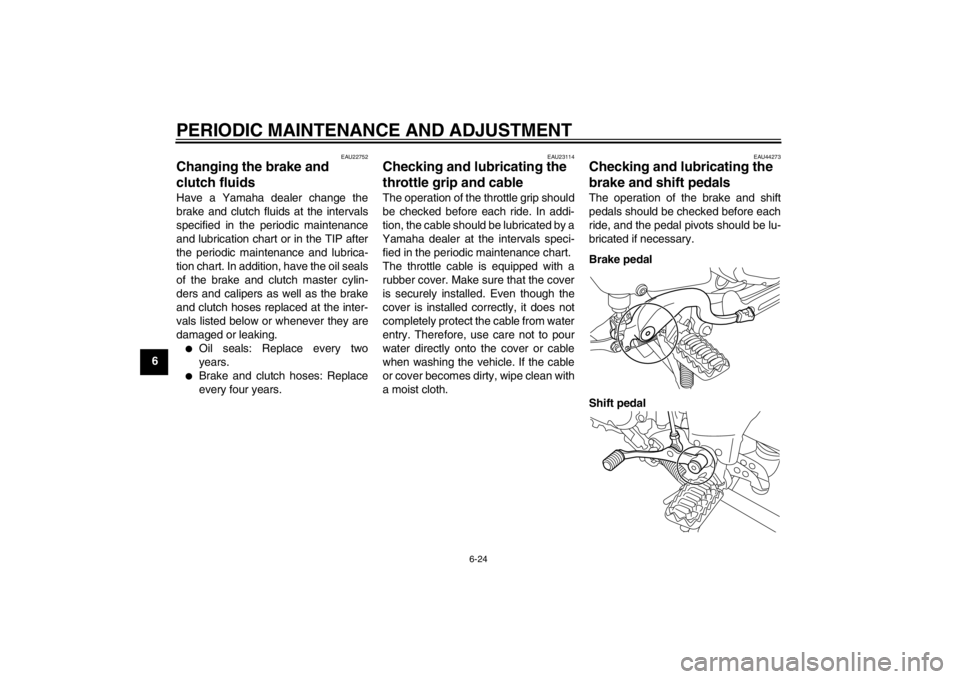
EAU44273
Checking and lubricating the
brake and sh ift pedals The operation of the brake and shift
pedals should be checked before each
ride, and the pedal pivots should be lu-
bricated if necessary.
Brake pedal
Shift pedal
U23PE3E0.book Page 24 Monday, July 30, 2012 8:44 AM