fuel consumption YAMAHA XT1200Z 2013 Owners Manual
[x] Cancel search | Manufacturer: YAMAHA, Model Year: 2013, Model line: XT1200Z, Model: YAMAHA XT1200Z 2013Pages: 108, PDF Size: 2.86 MB
Page 6 of 108

TABLE OF CONTENTSSAFETY INFORMATION ..................1-1
DESCRIPTION ..................................2-1
Left view ..........................................2-1
Right view ........................................2-2
Controls and instruments.................2-3
INSTRUMENT AND CONTROL
FUNCTIONS .......................................3-1
Immobilizer system .........................3-1
Main switch/steering lock ................3-2
Indicator lights and warning lights ............................................3-4
Multi-function meter unit .................3-8
D-mode (drive mode) ....................3-15
Handlebar switches ......................3-16
Clutch lever ...................................3-18
Shift pedal .....................................3-18
Brake lever ...................................3-19
Brake pedal ..................................3-20
ABS ..............................................3-20
Traction control system ................3-21
Fuel tank cap ................................3-23
Fuel ...............................................3-23
Fuel tank breather hose and overflow hose ............................3-24
Catalytic converter ........................3-25
Rider seat .....................................3-25
Adjusting the rider seat height ......3-26
Windshield ....................................3-28
Adjusting the front fork ..................3-28 Adjusting the shock absorber
assembly ................................... 3-30
Carriers ........................................ 3-31
Luggage strap holders ................. 3-32
Sidestand ..................................... 3-32
Ignition circuit cut-off system ........ 3-33
Auxiliary DC jack .......................... 3-35
FOR YOUR SAFETY –
PRE-OPERATION CHECKS ............. 4-1
OPERATION AND IMPORTANT
RIDING POINTS ................................. 5-1
Starting the engine ......................... 5-1
Shifting ........................................... 5-2
Tips for reducing fuel consumption ............................... 5-3
Engine break-in .............................. 5-3
Parking ........................................... 5-4
PERIODIC MAINTENANCE AND
ADJUSTMENT ................................... 6-1
Owner’s tool kit ............................... 6-2
Periodic maintenance chart for the
emission control system ............. 6-3
General maintenance and
lubrication chart .......................... 6-4
Removing and installing cowlings ...................................... 6-8
Checking the spark plugs ............. 6-10
Engine oil and oil filter cartridge ... 6-11 Final gear oil ................................ 6-14
Coolant ........................................ 6-15
Air filter element ........................... 6-16
Checking the engine idling
speed ........................................ 6-17
Checking the throttle grip free play ........................................... 6-17
Valve clearance ........................... 6-17
Tires ............................................. 6-18
Spoke wheels .............................. 6-20
Clutch lever .................................. 6-20
Checking the brake lever free
play ........................................... 6-21
Brake light switches ..................... 6-21
Checking the front and rear brake
pads .......................................... 6-22
Checking the brake fluid level ...... 6-22
Changing the brake and clutch
fluids ......................................... 6-24
Checking and lubricating the
throttle grip and cable ............... 6-24
Checking and lubricating the brake and shift pedals .............. 6-24
Checking and lubricating the brake and clutch levers ............ 6-25
Checking and lubricating the
centerstand and sidestand ....... 6-26
Lubricating the swingarm pivots ........................................ 6-26
Checking the front fork ................. 6-27
Checking the steering .................. 6-27U23PE3E0.book Page 1 Monday, July 30, 2012 8:44 AM
Page 23 of 108
INSTRUMENT AND CONTROL FUNCTIONS
3-8
3
Try to reset the traction control system
and the lights by following the proce-
dures under “Resetting” on page 3-22.
EAU38624
Immobilizer system indicator light
The electrical circuit of the indicator
light can be checked by turning the key
to “ON”. The indicator light should
come on for a few seconds, and then
go off. If the indicator light does not come on
initially when the key is turned to “ON”,
or if the indicator light remains on, have
a Yamaha dealer check the electrical
circuit.
When the key is turned to “OFF” and 30
seconds have passed, the indicator
light will start flashing indicating the im-
mobilizer system is enabled. After 24
hours have passed, the indicator light
will stop flashing, however the immobi-
lizer system is still enabled.
The self-diagnosis device also detects
problems in the immobilizer system cir-
cuits. (See page 3-14 for an explana-
tion of the self-diagnosis device.)
EAU49606
Multi-function meter unit
WARNING
EWA12422
Be sure to stop the vehicle before
making any setting changes to the
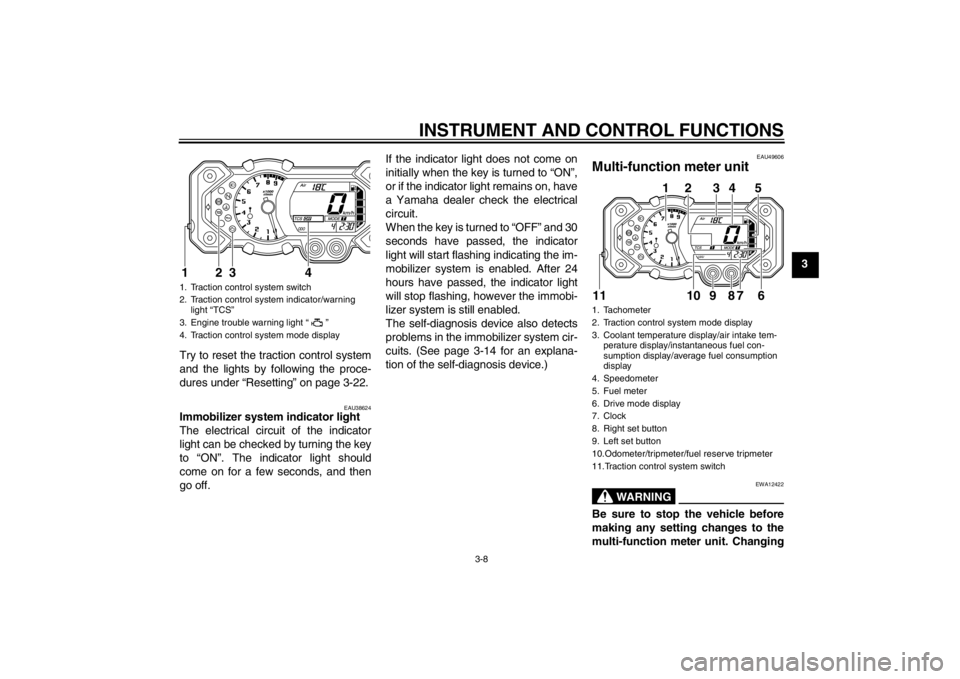
multi-function meter unit. Changing
1. Traction control system switch
2. Traction control system indicator/warning
light “TCS”
3. Engine trouble warning light “ ”
4. Traction control system mode display
4
3
2
1
1. Tachometer
2. Traction control system mode display
3. Coolant temperature display/air intake tem- perature display/instantaneous fuel con-
sumption display/average fuel consumption
display
4. Speedometer
5. Fuel meter
6. Drive mode display
7. Clock
8. Right set button
9. Left set button
10.Odometer/tripmeter/fuel reserve tripmeter
11.Traction control system switch
1
2
3
5
6
78
9
10
4
11
U23PE3E0.book Page 8 Monday, July 30, 2012 8:44 AM
Page 24 of 108
INSTRUMENT AND CONTROL FUNCTIONS
3-9
3settings while riding can distract the
operator and increase the risk of an
accident.
The multi-function meter unit is
equipped with the following:●
a speedometer
●
a tachometer
●
an odometer
●
two tripmeters (which show the
distance traveled since they were
last set to zero)
●
a fuel reserve tripmeter (which
shows the distance traveled since
the last segment of the fuel meter
started flashing)
●
a clock
●
a fuel meter
●
an air intake temperature display
●
a coolant temperature display
●
a fuel consumption display (instan-
taneous and average consumption
functions)
●
a drive mode display (which shows
the selected drive mode)
●
a traction control system mode dis-
play (which shows the selected
traction control system mode)
●
a self-diagnosis device
●
an LCD and tachometer bright-
ness control mode
The left and right set buttons, located
under the display, allow you to control
or change the settings in the multi-func-
tion meter unit.
TIP●
To use the left and right buttons,
the key must be turned to “ON”,
except for the brightness mode.
●
For the U.K. only: To switch the
speedometer and odometer/trip-
meter/fuel consumption displays
between kilometers and miles,
press the left button for at least two
seconds.
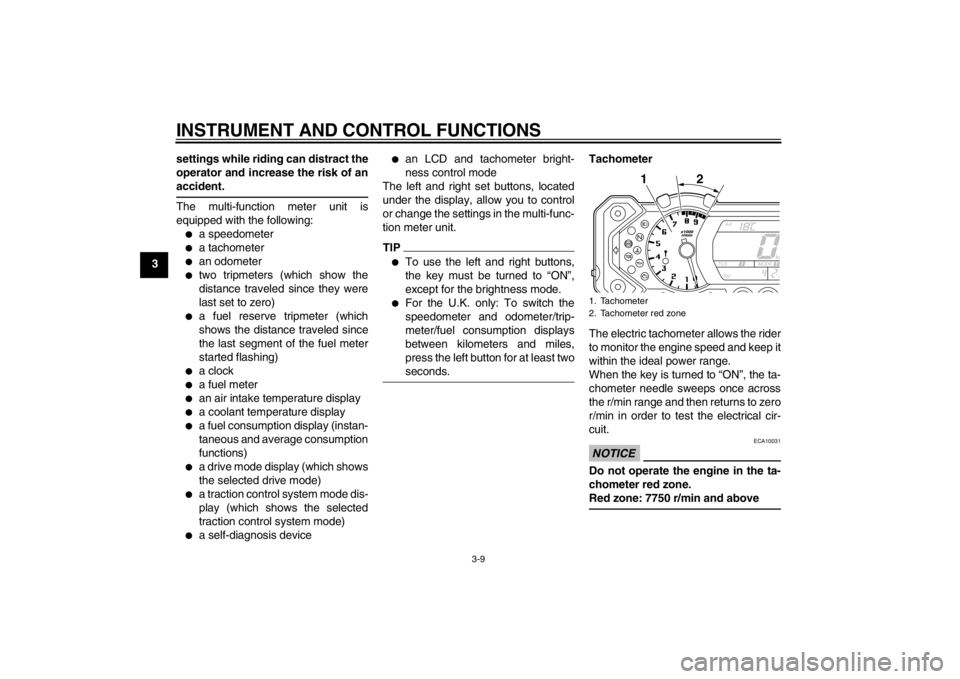
Tachometer
The electric tachometer allows the rider
to monitor the engine speed and keep it
within the ideal power range.
When the key is turned to “ON”, the ta-
chometer needle sweeps once across
the r/min range and then returns to zero
r/min in order to test the electrical cir-
cuit.NOTICE
ECA10031
Do not operate the engine in the ta-
chometer red zone.
Red zone: 7750 r/min and above1. Tachometer
2. Tachometer red zone
12
U23PE3E0.book Page 9 Monday, July 30, 2012 8:44 AM
Page 26 of 108
INSTRUMENT AND CONTROL FUNCTIONS
3-11
33. Push the left button; the minute
digits start flashing.
4. Push the right button to set the minutes.
5. Push the left button; the clock starts after the button is released.
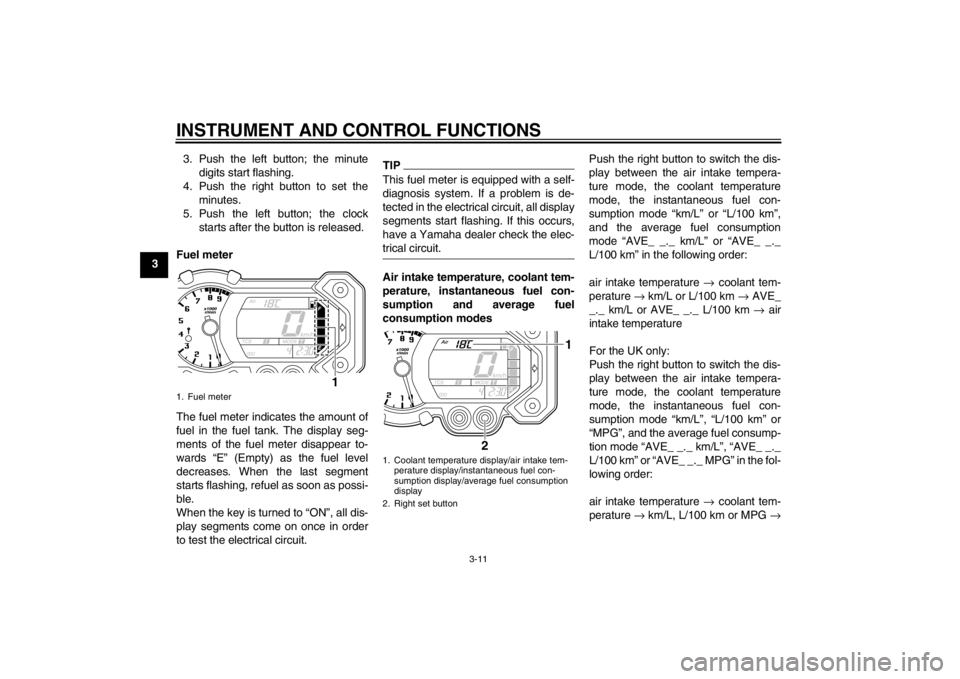
Fuel meter
The fuel meter indicates the amount of
fuel in the fuel tank. The display seg-
ments of the fuel meter disappear to-
wards “E” (Empty) as the fuel level
decreases. When the last segment
starts flashing, refuel as soon as possi-
ble.
When the key is turned to “ON”, all dis-
play segments come on once in order
to test the electrical circuit.
TIPThis fuel meter is equipped with a self-
diagnosis system. If a problem is de-
tected in the electrical circuit, all display
segments start flashing. If this occurs,
have a Yamaha dealer check the elec-
trical circuit.Air intake temperature, coolant tem-
perature, instantaneous fuel con-
sumption and average fuel
consumption modes Push the right button to switch the dis-
play between the air intake tempera-
ture mode, the coolant temperature
mode, the instantaneous fuel con-
sumption mode “km/L” or “L/100 km”,
and the average fuel consumption
mode “AVE_ _._ km/L” or “AVE_ _._
L/100 km” in the following order:
air intake temperature
→ coolant tem-
perature → km/L or L/100 km → AVE_
_._ km/L or AVE_ _._ L/100 km → air
intake temperature
For the UK only:
Push the right button to switch the dis-
play between the air intake tempera-
ture mode, the coolant temperature
mode, the instantaneous fuel con-
sumption mode “km/L”, “L/100 km” or
“MPG”, and the average fuel consump-
tion mode “AVE_ _._ km/L”, “AVE_ _._
L/100 km” or “AVE_ _._ MPG” in the fol-
lowing order:
air intake temperature → coolant tem-
perature → km/L, L/100 km or MPG →
1. Fuel meter
1
1. Coolant temperature display/air intake tem-
perature display/instantaneous fuel con-
sumption display/average fuel consumption
display
2. Right set button
2
1
U23PE3E0.book Page 11 Monday, July 30, 2012 8:44 AM
Page 27 of 108
INSTRUMENT AND CONTROL FUNCTIONS
3-12
3
AVE_ _._ km/L, AVE_ _._ L/100 km or
AVE_ _._ MPG
→ air intake tempera-
ture
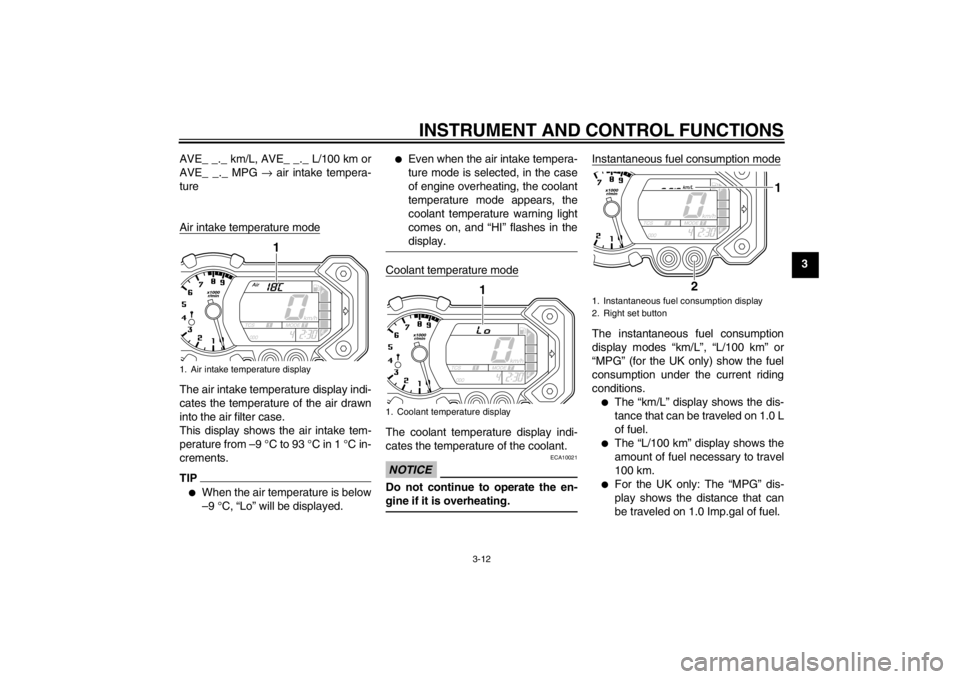
Air intake temperature mode
The air intake temperature display indi-
cates the temperature of the air drawn
into the air filter case.
This display shows the air intake tem-
perature from –9 °C to 93 °C in 1 °C in-
crements. TIP●
When the air temperature is below
–9 °C, “Lo” will be displayed.
●
Even when the air intake tempera-
ture mode is selected, in the case
of engine overheating, the coolant
temperature mode appears, the
coolant temperature warning light
comes on, and “HI” flashes in the
display.
Coolant temperature modeThe coolant temperature display indi-
cates the temperature of the coolant.NOTICE
ECA10021
Do not continue to operate the en-
gine if it is overheating.
Instantaneous fuel consumption modeThe instantaneous fuel consumption
display modes “km/L”, “L/100 km” or
“MPG” (for the UK only) show the fuel
consumption under the current riding
conditions.●
The “km/L” display shows the dis-
tance that can be traveled on 1.0 L
of fuel.
●
The “L/100 km” display shows the
amount of fuel necessary to travel
100 km.
●
For the UK only: The “MPG” dis-
play shows the distance that can
be traveled on 1.0 Imp.gal of fuel.
1. Air intake temperature display
1
1. Coolant temperature display
1
1. Instantaneous fuel consumption display
2. Right set button
2
1
U23PE3E0.book Page 12 Thursday, March 6, 2014 10:46 AM
Page 28 of 108
INSTRUMENT AND CONTROL FUNCTIONS
3-13
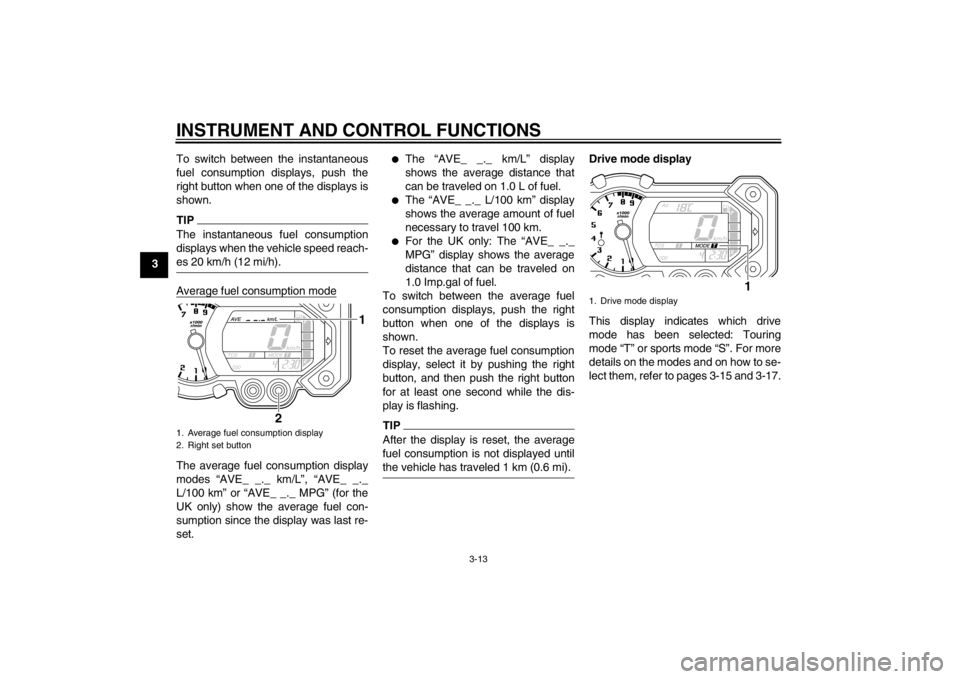
3To switch between the instantaneous
fuel consumption displays, push the
right button when one of the displays is
shown.
TIPThe instantaneous fuel consumption
displays when the vehicle speed reach-
es 20 km/h (12 mi/h).Average fuel consumption modeThe average fuel consumption display
modes “AVE_ _._ km/L”, “AVE_ _._
L/100 km” or “AVE_ _._ MPG” (for the
UK only) show the average fuel con-
sumption since the display was last re-
set.
●
The “AVE_ _._ km/L” display
shows the average distance that
can be traveled on 1.0 L of fuel.
●
The “AVE_ _._ L/100 km” display
shows the average amount of fuel
necessary to travel 100 km.
●
For the UK only: The “AVE_ _._
MPG” display shows the average
distance that can be traveled on
1.0 Imp.gal of fuel.
To switch between the average fuel
consumption displays, push the right
button when one of the displays is
shown.
To reset the average fuel consumption
display, select it by pushing the right
button, and then push the right button
for at least one second while the dis-
play is flashing.
TIPAfter the display is reset, the average
fuel consumption is not displayed until
the vehicle has traveled 1 km (0.6 mi).
Drive mode display
This display indicates which drive
mode has been selected: Touring
mode “T” or sports mode “S”. For more
details on the modes and on how to se-
lect them, refer to pages 3-15 and 3-17.
1. Average fuel consumption display
2. Right set button
2
1
1. Drive mode display
1
U23PE3E0.book Page 13 Monday, July 30, 2012 8:44 AM
Page 55 of 108
OPERATION AND IMPORTANT RIDING POINTS
5-3
5
NOTICE
ECA10260
●
Even with the transmission in
the neutral position, do not
coast for long periods of time
with the engine off, and do not
tow the motorcycle for long dis-
tances. The transmission is
properly lubricated only when
the engine is running. Inade-
quate lubrication may damage
the transmission.
●
Always use the clutch while
changing gears to avoid damag-
ing the engine, transmission,
and drive train, which are not
designed to withstand the
shock of forced shifting.
EAU16810
Tips for reducing fuel con-
sumption Fuel consumption depends largely on
your riding style. Consider the following
tips to reduce fuel consumption:●
Shift up swiftly, and avoid high en-
gine speeds during acceleration.
●
Do not rev the engine while shifting
down, and avoid high engine
speeds with no load on the engine.
●
Turn the engine off instead of let-
ting it idle for an extended length of
time (e.g., in traffic jams, at traffic
lights or at railroad crossings).
EAU16841
Engine break-in There is never a more important period
in the life of your engine than the period
between 0 and 1600 km (1000 mi). For
this reason, you should read the follow-
ing material carefully.
Since the engine is brand new, do not
put an excessive load on it for the first
1600 km (1000 mi). The various parts in
the engine wear and polish themselves
to the correct operating clearances.
During this period, prolonged full-throt-
tle operation or any condition that might
result in engine overheating must be
avoided.
EAU17123
0–1000 km (0–600 mi)
Avoid prolonged operation above 3900
r/min. NOTICE: After 1000 km (600
mi) of operation, the engine oil and
final gear oil must be changed, and
the oil filter cartridge or element re-
placed.
[ECA10332]
U23PE3E0.book Page 3 Monday, July 30, 2012 8:44 AM
Page 104 of 108

INDEXAABS ....................................................... 3-20
ABS warning light.................................... 3-7
Air filter element .................................... 6-16
Auxiliary DC jack ................................... 3-35
Auxiliary light bulb, replacing ................ 6-34BBattery................................................... 6-28
Brake and clutch fluids, changing ......... 6-24
Brake and clutch levers, checking and lubricating ........................................... 6-25
Brake and shift pedals, checking and
lubricating ........................................... 6-24
Brake fluid level, checking .................... 6-22
Brake lever ............................................ 3-19
Brake lever free play, checking ............. 6-21
Brake light switches .............................. 6-21
Brake pedal ........................................... 3-20CCare ........................................................ 7-1
Carriers ................................................. 3-31
Catalytic converter ................................ 3-25
Centerstand and sidestand, checking
and lubricating .................................... 6-26
Clutch lever .................................. 3-18, 6-20
Coolant.................................................. 6-15
Coolant temperature warning light .......... 3-4
Cowlings, removing and installing........... 6-8DDimmer switch ...................................... 3-16
D-mode (drive mode) ............................ 3-15EEngine break-in ....................................... 5-3
Engine idling speed, checking .............. 6-17 Engine oil and oil filter cartridge ........... 6-11
Engine stop switch................................ 3-17
Engine trouble warning light ................... 3-7
FFinal gear oil ......................................... 6-14
Front and rear brake pads, checking .... 6-22
Front fork, adjusting .............................. 3-28
Front fork, checking .............................. 6-27
Fuel....................................................... 3-23
Fuel consumption, tips for reducing........ 5-3
Fuel tank breather hose and overflow
hose ................................................... 3-24
Fuel tank cap ........................................ 3-23
Fuses, replacing ................................... 6-29HHandlebar switches .............................. 3-16
Hazard switch ....................................... 3-17
Headlight bulb, replacing ...................... 6-31
High beam indicator light ........................ 3-4
Horn switch ........................................... 3-17IIdentification numbers ............................ 9-1
Ignition circuit cut-off system ................ 3-33
Immobilizer system ................................. 3-1
Immobilizer system indicator light........... 3-8
Indicator lights and warning lights .......... 3-4LLicense plate light bulb, replacing ........ 6-33
Luggage strap holders .......................... 3-32MMain switch/steering lock........................ 3-2
Maintenance and lubrication, periodic .... 6-4
Maintenance, emission control
system .................................................. 6-3 Matte color, caution ................................. 7-1
Model label .............................................. 9-1
Multi-function meter unit .......................... 3-8
NNeutral indicator light .............................. 3-4OOil level warning light .............................. 3-4PParking .................................................... 5-4
Part locations .......................................... 2-1
Pass switch ........................................... 3-16RRider seat .............................................. 3-25
Rider seat height, adjusting................... 3-26SSafety information ................................... 1-1
Shifting .................................................... 5-2
Shift pedal ............................................. 3-18
Shock absorber assembly, adjusting .... 3-30
Sidestand .............................................. 3-32
Spark plugs, checking ........................... 6-10
Specifications .......................................... 8-1
Starting the engine .................................. 5-1
Start switch............................................ 3-17
Steering, checking................................. 6-27
Storage.................................................... 7-4
Swingarm pivots, lubricating ................. 6-26TTail/brake light ....................................... 6-32
Throttle grip and cable, checking and
lubricating ........................................... 6-24
Throttle grip free play, checking ............ 6-17
Tires ...................................................... 6-18
Tool kit..................................................... 6-2
U23PE3E0.book Page 1 Monday, July 30, 2012 8:44 AM