stop start YAMAHA XT1200ZE 2019 User Guide
[x] Cancel search | Manufacturer: YAMAHA, Model Year: 2019, Model line: XT1200ZE, Model: YAMAHA XT1200ZE 2019Pages: 122, PDF Size: 3.88 MB
Page 58 of 122
Instrument and control functions
3-44
3
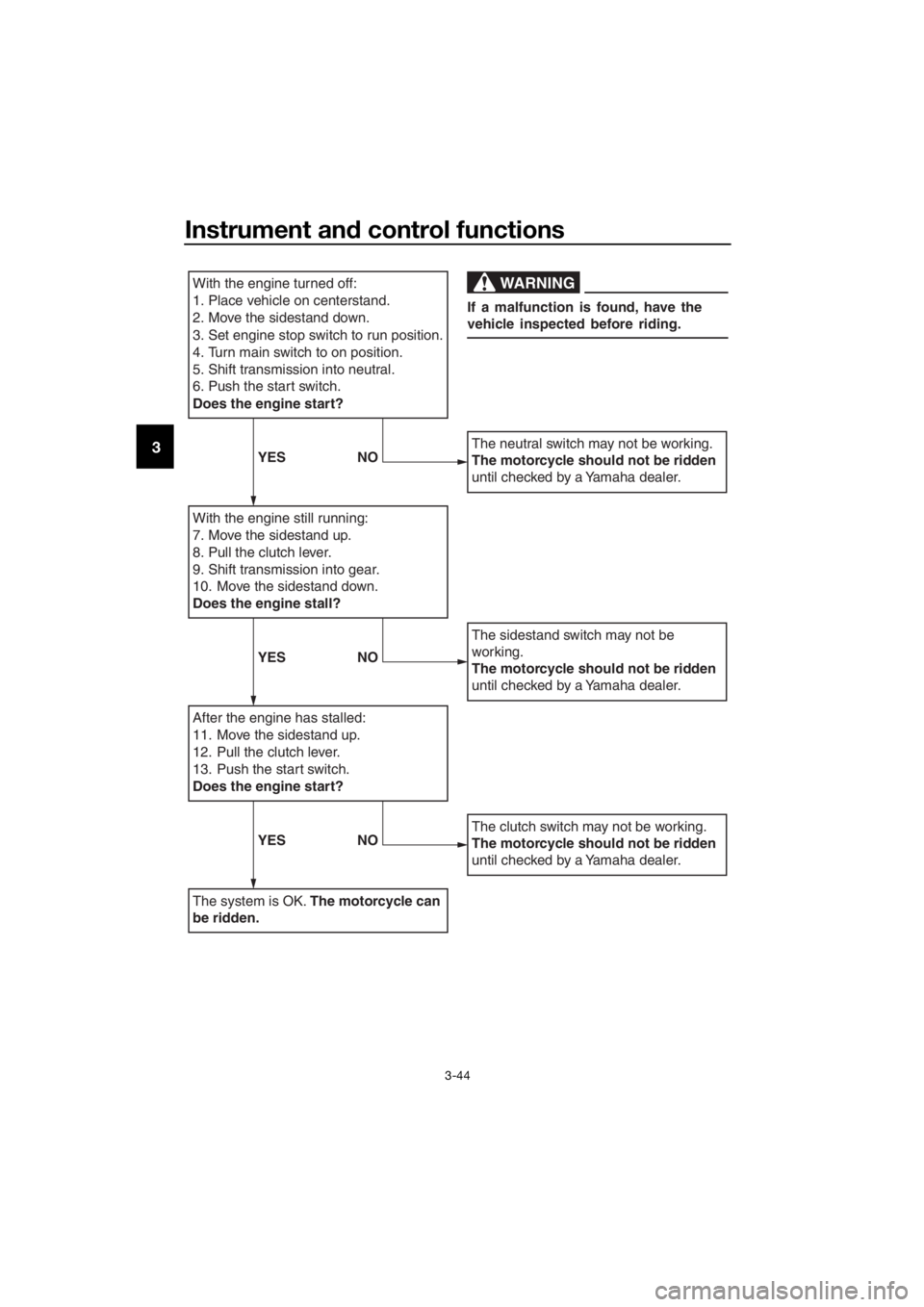
With the engine turned off:
1. Place vehicle on centerstand.
2. Move the sidestand down.
3. Set engine stop switch to run position.
4. Turn main switch to on position.
5. Shift transmission into neutral.
6. Push the start switch.
Does the engine start?
With the engine still running:
7. Move the sidestand up.
8. Pull the clutch lever.
9. Shift transmission into gear.
10. Move the sidestand down.
Does the engine stall?
After the engine has stalled:
11. Move the sidestand up.
12. Pull the clutch lever.
13. Push the start switch.
Does the engine start?
The system is OK. The motorcycle can
be ridden.
The neutral switch may not be working.
The motorcycle should not be ridden
until checked by a Yamaha dealer.
The sidestand switch may not be
working.
The motorcycle should not be ridden
until checked by a Yamaha dealer.
The clutch switch may not be working.
The motorcycle should not be ridden
until checked by a Yamaha dealer.
WARNING
If a malfunction is found, have the
vehicle inspected before riding.
YES NO
YESNO
YESNO
UBP9E1E0.book Page 44 Friday, September 7, 2018 10:01 AM
Page 61 of 122

Operation and important ri din g points
5-1
5
EAU15952
Read the Owner’s Manual carefully to
become familiar with all controls. If
there is a control or function you do not
understand, ask your Yamaha dealer.
WARNING
EWA10272
Failure to familiarize yourself with
the controls can lead to loss of con-
trol, which coul d cause an acci dent
or injury.
EAU73451
TIP
This model is equipped with: a lean angle sensor to stop the en-
gine in case of turnover. Turn the
main switch off once before at-
tempting to restart the engine.
Failing to do so will prevent the en-
gine from starting, even though
the engine will crank when the
start switch is pushed.
an engine auto-stop system. The
engine stops automatically if left
idling for 20 minutes. In this case,
simply push the start switch to re-
start the engine.
UBP9E1E0.book Page 1 Friday, September 7, 2018 10:01 AM
Page 62 of 122
Operation and important rid ing points
5-2
5
EAU58242
Startin g the en gine
In order for the ignition circuit cut-off
system to enable starting, one of the
following conditions must be met:
The transmission is in the neutral
position.
The transmission is in gear with
the clutch lever pulled and the
sidestand up.
See page 3-43 for more informa-
tion.
1. Turn the key to “ON” and make sure that the start/engine stop
switch is set to “ ”.
The following warning lights and
indicator lights should come on for
a few seconds, then go off. Oil level warning light
Engine trouble warning light
Traction control system indi-
cator light
Cruise control indicator lights
Suspension sy stem warning
light
Immobilizer system indicator
light
NOTICE
ECA11834
If a warnin g or in dicator li ght does
not come on initially when the key is
turne d to “ON”, or if a warnin g or in-
d icator li ght remains on, see pag e
3-3 for the correspon din g warnin g
an d in dicator li ght circuit check.
The ABS warning light should
come on when the key is turned to
“ON”, and then go off after travel-
ing at a speed of 10 km/h (6 mi/h)
or higher.
NOTICE
ECA17682
If the ABS warnin g li ght does not
come on an d then g o off as ex-
plained above, see pag e 3-3 for the
warnin g lig ht circuit check.
2. Shift the transmission into the
neutral position. The neutral indi-
cator light should come on. If not,
ask a Yamaha dealer to check the
electrical circuit.
3. Start the engine by pushing the “ ” side of the start/engine
stop switch.
If the engine fails to start, release
the start/engine stop switch, wait
a few seconds, and then try again.
Each starting attempt should be
as short as possible to preserve
the battery. Do not crank the en-
gine more than 10 seconds on any
one attempt.
NOTICE
ECA11043
For maximum en gine life, never ac-
celerate har d when the en gine is
col d!
UBP9E1E0.book Page 2 Friday, September 7, 2018 10:01 AM
Page 63 of 122
Operation and important ri din g points
5-3
5
EAU16674
Shiftin g
Shifting gears lets you control the
amount of engine power available for
starting off, accelerating, climbing hills,
etc.
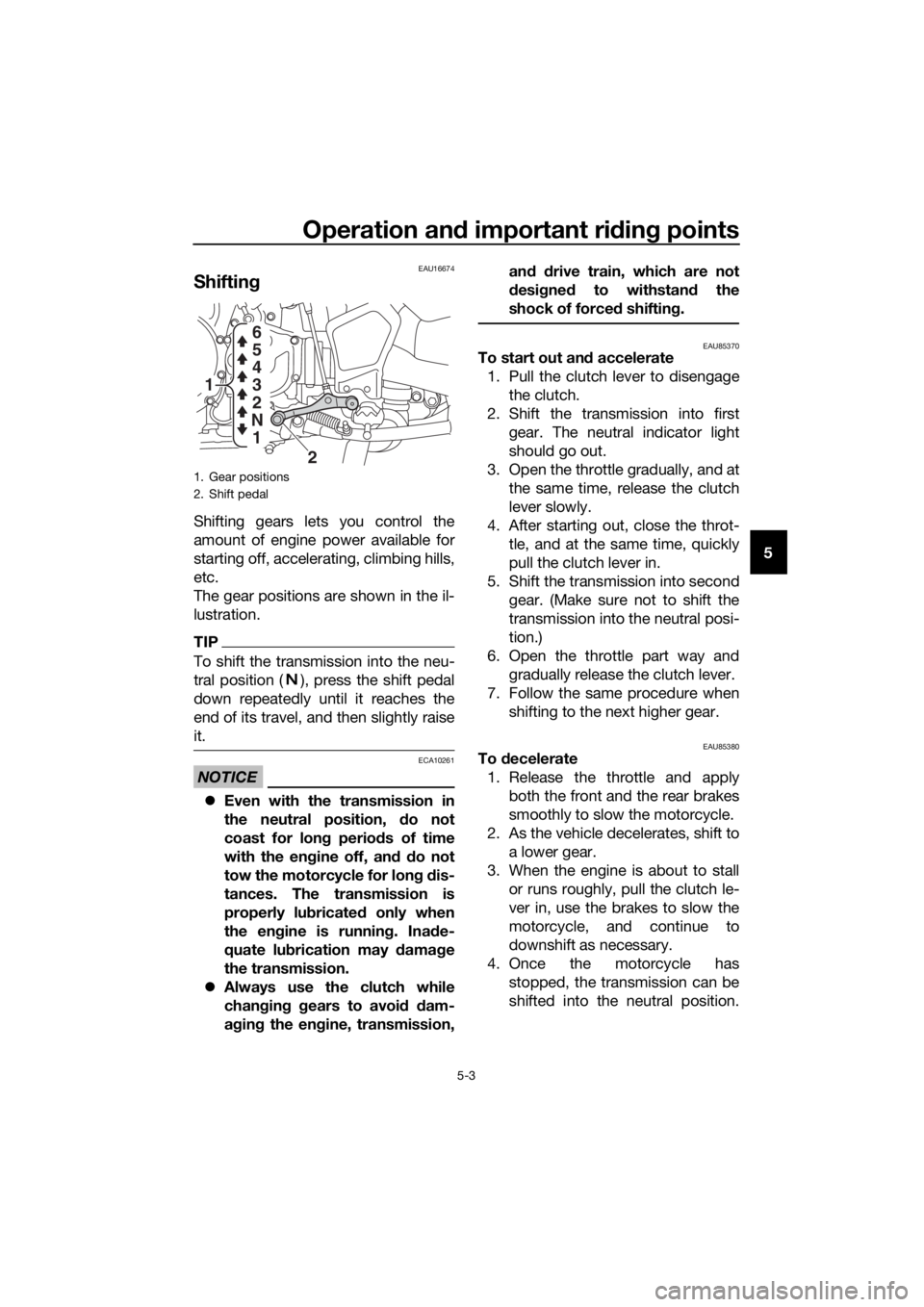
The gear positions are shown in the il-
lustration.
TIP
To shift the transmission into the neu-
tral position ( ), press the shift pedal
down repeatedly until it reaches the
end of its travel, and then slightly raise
it.
NOTICE
ECA10261
Even with the transmission in
the neutral position, d o not
coast for lon g period s of time
with the en gine off, an d d o not
tow the motorcycle for lon g d is-
tances. The transmission is
properly lu bricated only when
the en gine is runnin g. Ina de-
quate lu brication may damag e
the transmission.
Always use the clutch while
chan gin g g ears to avoi d d am-
a g in g the en gine, transmission, an
d d rive train, which are not
d esi gne d to withstan d the
shock of force d shiftin g.
EAU85370To start out an d accelerate
1. Pull the clutch lever to disengage the clutch.
2. Shift the transmission into first gear. The neutral indicator light
should go out.
3. Open the throttle gradually, and at the same time, release the clutch
lever slowly.
4. After starting out, close the throt- tle, and at the same time, quickly
pull the clutch lever in.
5. Shift the transmission into second gear. (Make sure not to shift the
transmission into the neutral posi-
tion.)
6. Open the throttle part way and gradually release the clutch lever.
7. Follow the same procedure when shifting to the next higher gear.
EAU85380To decelerate
1. Release the throttle and apply both the front and the rear brakes
smoothly to slow the motorcycle.
2. As the vehicle decelerates, shift to a lower gear.
3. When the engine is about to stall or runs roughly, pull the clutch le-
ver in, use the brakes to slow the
motorcycle, and continue to
downshift as necessary.
4. Once the motorcycle has stopped, the transmission can be
shifted into the neutral position.
1. Gear positions
2. Shift pedal
2
1
1
N 2 3 4
5
6
UBP9E1E0.book Page 3 Friday, September 7, 2018 10:01 AM
Page 77 of 122
Periodic maintenance an d a djustment
6-11
6
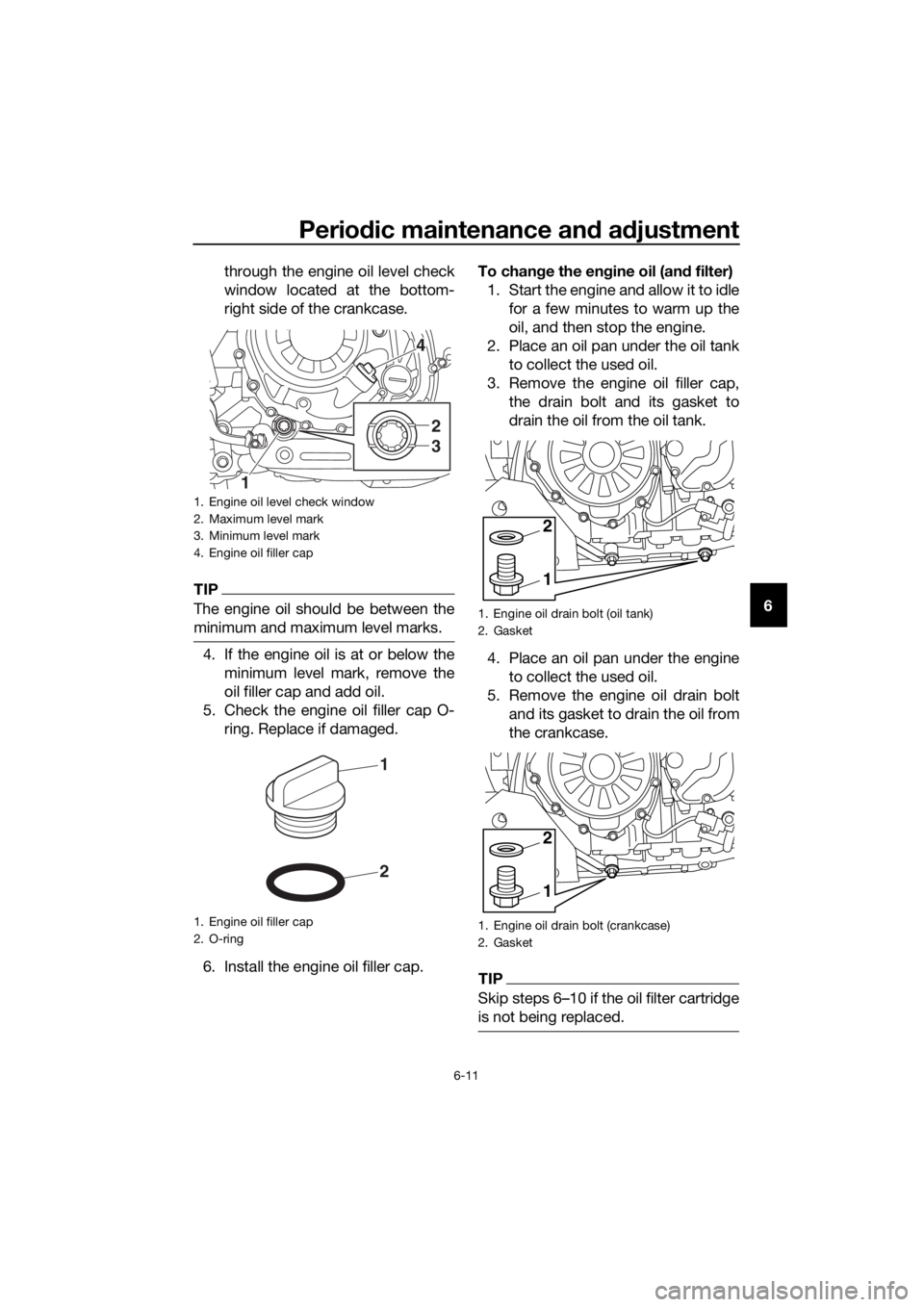
through the engine oil level check
window located at the bottom-
right side of the crankcase.
TIP
The engine oil should be between the
minimum and maximum level marks.
4. If the engine oil is at or below the
minimum level mark, remove the
oil filler cap and add oil.
5. Check the engine oil filler cap O- ring. Replace if damaged.
6. Install the engine oil filler cap. To chan
ge the en gine oil (an d filter)
1. Start the engine and allow it to idle for a few minutes to warm up the
oil, and then stop the engine.
2. Place an oil pan under the oil tank to collect the used oil.
3. Remove the engine oil filler cap, the drain bolt and its gasket to
drain the oil from the oil tank.
4. Place an oil pan under the engine to collect the used oil.
5. Remove the engine oil drain bolt and its gasket to drain the oil from
the crankcase.
TIP
Skip steps 6–10 if the oil filter cartridge
is not being replaced.
1. Engine oil level check window
2. Maximum level mark
3. Minimum level mark
4. Engine oil filler cap
1. Engine oil filler cap
2. O-ring
4
2
3
1
2
1
1. Engine oil drain bolt (oil tank)
2. Gasket
1. Engine oil drain bolt (crankcase)
2. Gasket
1
2
1
2
UBP9E1E0.book Page 11 Friday, September 7, 2018 10:01 AM
Page 107 of 122
Periodic maintenance an d a djustment
6-41
6
En
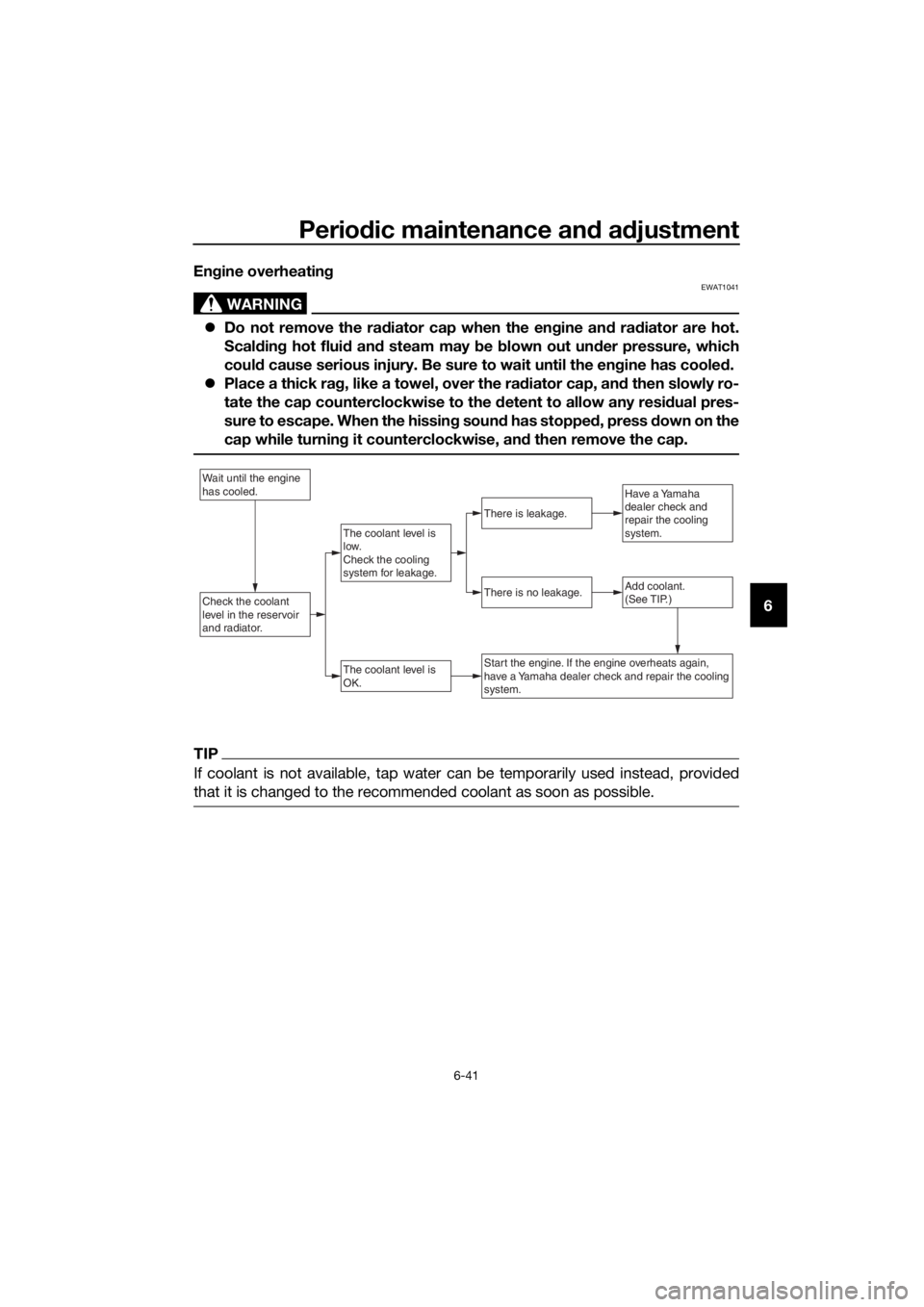
gine overheatin g
WARNING
EWAT1041
Do not remove the rad iator cap when the engine an d ra diator are hot.
Scal din g hot flui d an d steam may b e blown out un der pressure, which
coul d cause serious injury. Be sure to wait until the en gine has coole d.
Place a thick ra g, like a towel, over the rad iator cap, and then slowly ro-
tate the cap counterclockwise to the d etent to allow any residual pres-
sure to escape. When the hissin g soun d has stoppe d, press d own on the
cap while turnin g it counterclockwise, an d then remove the cap.
TIP
If coolant is not available, tap water can be temporarily used instead, provided
that it is changed to the recommended coolant as soon as possible.
W ait until the engine
has cooled.
Check the coolant
le vel in the reser voir
and radiator.Add coolant.
(See TIP.)
The coolant le vel is
OK.
There is no leakage.
There is leakage.
The coolant le vel is
lo w.
Check the cooling
system for leakage.
Ha ve a Yamaha
dealer check and
repair the cooling
system.
Start the engine. If the engine o verheats again,
ha ve a Yamaha dealer check and repair the cooling
system.
UBP9E1E0.book Page 41 Friday, September 7, 2018 10:01 AM
Page 118 of 122

10-1
10
Index
A
ABS ....................................................... 3-26
ABS warning light ................................... 3-4
Air filter element .................................... 6-17
Auxiliary DC jack ................................... 3-41
Auxiliary light bulb, replacing ................ 6-35
B
Battery .................................................. 6-30
Brake and clutch fluids, changing ........ 6-26
Brake and clutch levers, checking
and lubricating .................................... 6-27
Brake and shift pedals, checking and
lubricating ........................................... 6-27
Brake fluid level, checking .................... 6-25
Brake lever ............................................ 3-24
Brake lever free play, checking............. 6-23
Brake light switches.............................. 6-23
Brake pedal........................................... 3-25
C
Canister................................................. 6-10
Care ........................................................ 7-1
Carriers ................................................. 3-40
Catalytic converter ................................ 3-31
Centerstand and sidestand, checking and lubricating .................................... 6-28
Clutch lever ................................. 3-23, 6-22
Coolant ................................................. 6-16
Cowlings, removing and installing .......... 6-7
Cruise control indicator lights ................. 3-4
Cruise control switches ........................ 3-23
Cruise control system ............................. 3-6
D
Data recording, vehicle ........................... 9-3
Diagnostic connector.............................. 9-2
Dimmer/Pass switch ............................. 3-22
D-mode (drive mode) ............................ 3-21
E
Engine break-in....................................... 5-5
Engine idling speed, checking .............. 6-18
Engine oil .............................................. 6-10
Engine serial number .............................. 9-1
Engine trouble warning light ................... 3-4
F
Final gear oil.......................................... 6-14
Front and rear brake pads, checking.... 6-24
Front fork, checking .............................. 6-29
Fuel ....................................................... 3-29
Fuel consumption, tips for reducing ....... 5-4
Fuel tank cap ........................................ 3-29
Fuel tank overflow hose ........................ 3-31 Fuses, replacing ................................... 6-32
H
Handlebar switches .............................. 3-22
Hazard switch....................................... 3-22
Headlight bulb, replacing ..................... 6-33
High beam indicator light ....................... 3-3
Horn switch .......................................... 3-22
I
Identification numbers ............................ 9-1
Ignition circuit cut-off system............... 3-43
Immobilizer system ................................ 3-1
Immobilizer system indicator light.......... 3-5
Indicator lights and warning lights ......... 3-3
L
License plate light bulb, replacing........ 6-38
Luggage strap holders ......................... 3-41
M
Main switch/steering lock....................... 3-2
Maintenance and lubrication, periodic ... 6-4
Maintenance, emission control
system.................................................. 6-3
Matte color, caution ............................... 7-1
Menu switch ......................................... 3-23
Model label ............................................. 9-1
Multi-function meter unit ........................ 3-9
N
Neutral indicator light ............................. 3-3
O
Oil level warning light ............................. 3-4
P
Parking ................................................... 5-6
Part locations ......................................... 2-1
R
Rider seat ............................................. 3-32
Rider seat height, adjusting.................. 3-33
S
Safety information .................................. 1-1
Select switch ........................................ 3-23
Shifting ................................................... 5-3
Shift pedal ............................................ 3-24
Sidestand ............................................. 3-42
Spark plugs, checking ............................ 6-9
Specifications ......................................... 8-1
Starting the engine ................................. 5-2
Steering, checking................................ 6-29
Stop/Run/Start switch .......................... 3-22
Storage ................................................... 7-4
Suspension, adjusting the front and rear ..................................................... 3-35
Suspension system warning light........... 3-5
UBP9E1E0.book Page 1 Friday, September 7, 2018 10:01 AM