wheel YAMAHA XT1200ZE 2019 User Guide
[x] Cancel search | Manufacturer: YAMAHA, Model Year: 2019, Model line: XT1200ZE, Model: YAMAHA XT1200ZE 2019Pages: 122, PDF Size: 3.88 MB
Page 60 of 122

For your safety – pre-operation checks
4-2
4
Throttle grip • Make sure that operation is smooth.
• Check throttle grip free play.
• If necessary, have Yamaha dealer adjust throttle grip
free play and lubricate cable and grip housing. 6-18,
6-26
Wheels an d tires •Check for damage.
• Check tire condition and tread depth.
• Check air pressure.
• Correct if necessary. 6-19,
6-22
Brake an d shift pe dals • Make sure that operation is smooth.
• Lubricate pedal pivoting points if necessary.
6-27
Brake an d clutch le-
vers • Make sure that operation is smooth.
• Lubricate lever pivoting points if necessary.
6-27
Centerstan d, si de-
stan d • Make sure that operation is smooth.
• Lubricate pivots if necessary.
6-28
Chassis fasteners • Make sure that all nuts, bolts and screws are properly
tightened.
• Tighten if necessary. —
Instruments, li ghts,
si gnals an d switches • Check operation.
• Correct if necessary.
—
Si destan d switch • Check operation of ignition circuit cut-off system.
• If system is not working correctly, have Yamaha dealer
check vehicle. 3-42
ITEM CHECKS PAGE
UBP9E1E0.book Page 2 Friday, September 7, 2018 10:01 AM
Page 64 of 122

Operation and important rid ing points
5-4
5 The neutral indicator light should
come on and then the clutch lever
can be released.
WARNING
EWA17380
Improper brakin g can cause
loss of control or traction. Al-
ways use b oth brakes an d apply
them smoothly.
Make sure that the motorcycle
and the en gine have sufficiently
slowe d b efore shiftin g to a low-
er gear. En gag in g a lower gear
when the vehicle or en gine
speed is too hi gh coul d make
the rear wheel lose traction or
the en gine to over-rev. This
coul d cause loss of control, an
acci dent an d injury. It coul d also
cause en gine or drive train dam-
a g e.
EAU16811
Tips for re ducin g fuel con-
sumption
Fuel consumption depends largely on
your riding style. Consider the follow-
ing tips to reduce fuel consumption:
Shift up swiftly, and avoid high en-
gine speeds during acceleration.
Do not rev the engine while shift-
ing down, and avoid high engine
speeds with no load on the en-
gine.
Turn the engine off instead of let-
ting it idle for an extended length
of time (e.g., in traffic jams, at traf-
fic lights or at railroad crossings).
UBP9E1E0.book Page 4 Friday, September 7, 2018 10:01 AM
Page 70 of 122

Periodic maintenance an d a djustment
6-4
6
EAU71372
General maintenance an d lu brication chart
NO. ITEM
1 *Dia
gnostic system
check • Perform dynamic inspection
using Yamaha diagnostic tool.
• Check the error codes. √√√√√√
2 *Air filter element • Replace. Every 40000 km (24000 mi)
3 *Clutch • Check operation, fluid level and
vehicle for fluid leakage. √√√√√
4 *Front brake • Check operation, fluid level,
and for fluid leakage.
• Replace brake pads if neces- sary. √√√√√√
5 *Rear brake • Check operation, fluid level,
and for fluid leakage.
• Replace brake pads if neces- sary. √√√√√√
6 *Brake hoses • Check for cracks or damage.
√√√√√
• Replace. Every 4 years
7 *Brake flui d • Change. Every 2 years
8 *Wheels • Check runout and for damage.
• Tighten all spokes. At the initial interval and every
5000 km (3000 mi) thereafter
9 *Tires • Check tread depth and for
damage.
• Replace if necessary.
• Check air pressure.
• Correct if necessary. √√√√√
10 *Wheel bearin gs • Check bearing for looseness or
damage. √√√√
11 *Swin
garm pivot
b earin gs • Check operation and for exces-
sive play. √√√√
• Lubricate with lithium-soap- based grease. Every 50000 km (30000 mi)
12 *Steerin g b earin gs • Check bearing assemblies for
looseness. √√√√√
•
Moderately repack with lithium-
soap-based grease. Every 50000 km (30000 mi)
X 1000 km
CHECK OR
MAINTENANCE JOB
X 1000 mi ODOMETER
READINGSANNUAL CHECK
1 10203040
0.6 6 12 18 24
UBP9E1E0.book Page 4 Friday, September 7, 2018 10:01 AM
Page 80 of 122
Periodic maintenance an d a djustment
6-14
6
EAU20017
Final g ear oil
The final gear case must be checked
for oil leakage before each ride. If any
leakage is found, have a Yamaha deal-
er check and repair the vehicle. In ad-
dition, the final gear oil level must be
checked and the oil changed as fol-
lows at the intervals specified in the
periodic maintenance and lubrication
chart.
WARNING
EWA10371
Make sure that no forei gn mate-
rial enters the final g ear case.
Make sure that no oil gets on
the tire or wheel.
To check the final gear oil level
1. Place the vehicle on the center- stand.
TIP
Make sure that the vehicle is posi-
tioned straight up when checking the
oil level. A slight tilt to the side can re-
sult in a false reading.
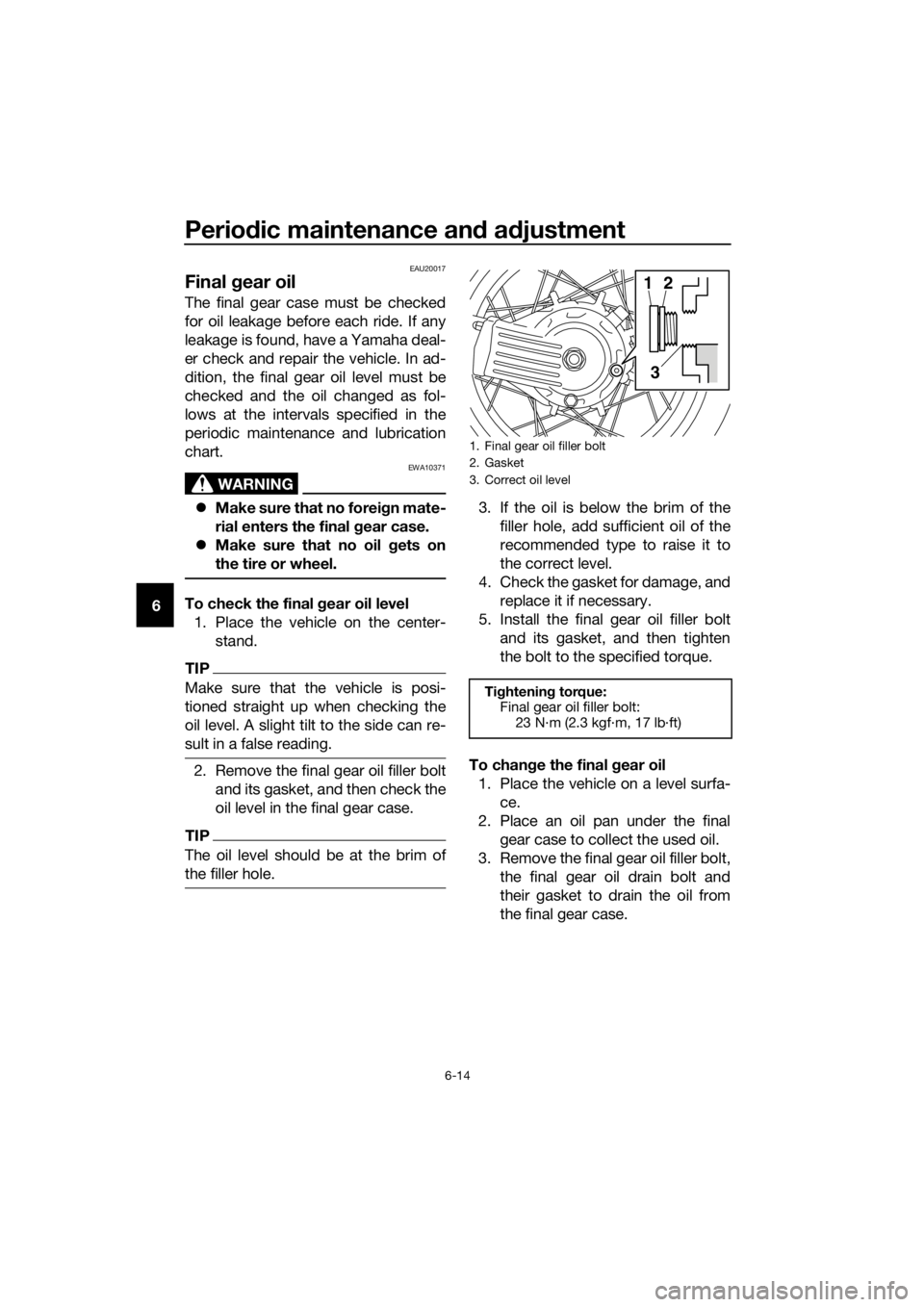
2. Remove the final gear oil filler boltand its gasket, and then check the
oil level in the final gear case.
TIP
The oil level should be at the brim of
the filler hole.
3. If the oil is below the brim of thefiller hole, add sufficient oil of the
recommended type to raise it to
the correct level.
4. Check the gasket for damage, and replace it if necessary.
5. Install the final gear oil filler bolt and its gasket, and then tighten
the bolt to the specified torque.
To chan ge the final gear oil
1. Place the vehicle on a level surfa- ce.
2. Place an oil pan under the final gear case to collect the used oil.
3. Remove the final gear oil filler bolt, the final gear oil drain bolt and
their gasket to drain the oil from
the final gear case.
1. Final gear oil filler bolt
2. Gasket
3. Correct oil level
Tightening torque:
Final gear oil filler bolt:
23 N·m (2.3 kgf·m, 17 lb·ft)
12
3
UBP9E1E0.book Page 14 Friday, September 7, 2018 10:01 AM
Page 86 of 122
Periodic maintenance an d a djustment
6-20
6
WARNING
EWA10512
Never overloa d your vehicle. Opera-
tion of an overloa ded vehicle coul d
cause an acci dent.
Tire inspection
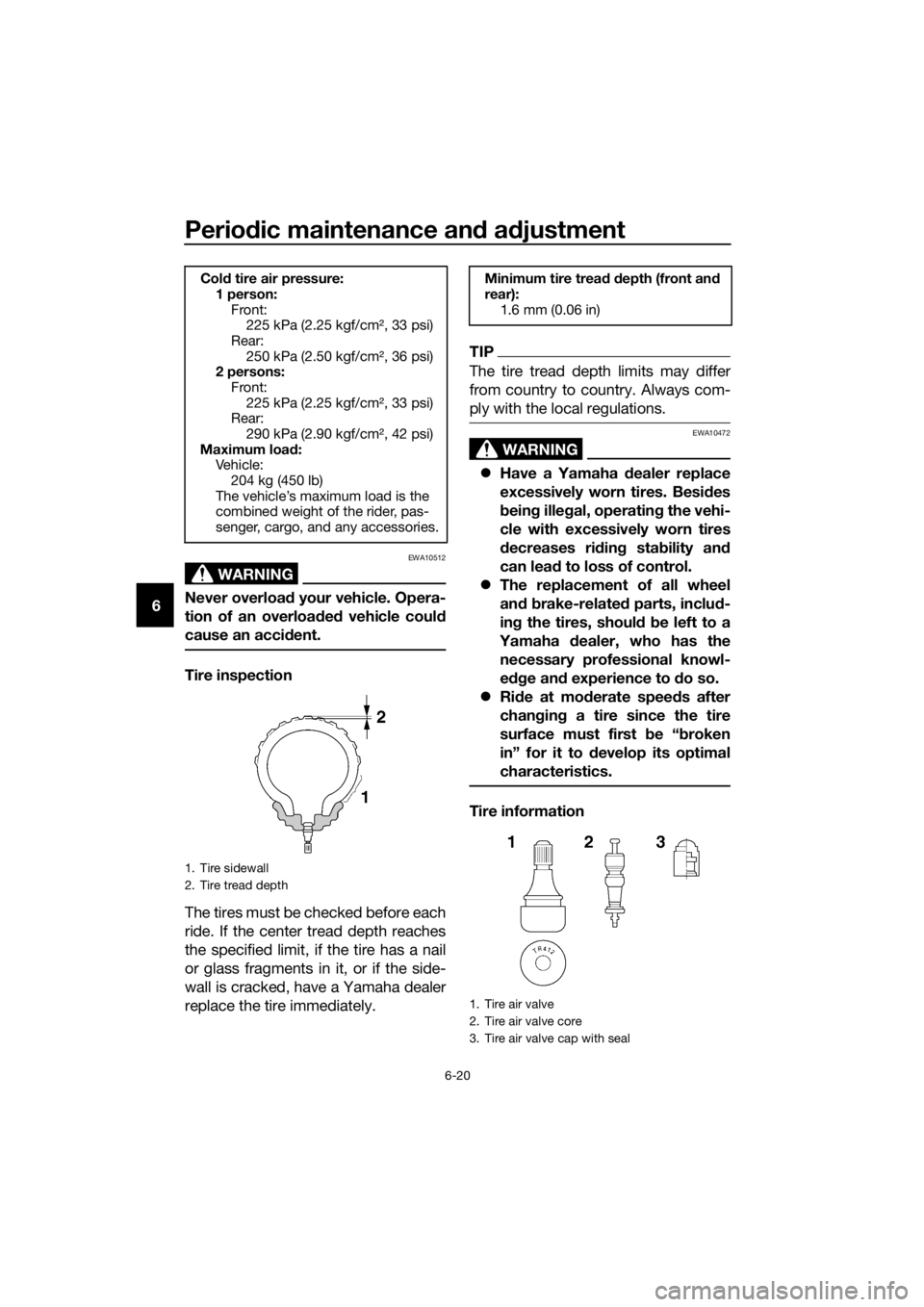
The tires must be checked before each
ride. If the center tread depth reaches
the specified limit, if the tire has a nail
or glass fragments in it, or if the side-
wall is cracked, have a Yamaha dealer
replace the tire immediately.
TIP
The tire tread depth limits may differ
from country to country. Always com-
ply with the local regulations.
WARNING
EWA10472
Have a Yamaha dealer replace
excessively worn tires. Besi des
b ein g ille gal, operatin g the vehi-
cle with excessively worn tires
d ecreases ri din g sta bility an d
can lead to loss of control.
The replacement of all wheel
and b rake-relate d parts, inclu d-
in g the tires, shoul d b e left to a
Yamaha dealer, who has the
necessary professional knowl-
e dge an d experience to do so.
Ride at mo derate spee ds after
chan gin g a tire since the tire
surface must first b e “broken
in” for it to develop its optimal
characteristics.
Tire information
Col d tire air pressure:
1 person: Front: 225 kPa (2.25 kgf/cm², 33 psi)
Rear: 250 kPa (2.50 kgf/cm², 36 psi)
2 persons:
Front: 225 kPa (2.25 kgf/cm², 33 psi)
Rear:
290 kPa (2.90 kgf/cm², 42 psi)
Maximum load :
Vehicle:
204 kg (450 lb)
The vehicle’s maximum load is the
combined weight of the rider, pas-
senger, cargo, and any accessories.
1. Tire sidewall
2. Tire tread depth
Minimum tire trea d d epth (front an d
rear): 1.6 mm (0.06 in)
1. Tire air valve
2. Tire air valve core
3. Tire air valve cap with seal
UBP9E1E0.book Page 20 Friday, September 7, 2018 10:01 AM
Page 88 of 122

Periodic maintenance an d a djustment
6-22
6
EAU49713
Spoke wheels
To maximize the performance, durabil-
ity, and safe operation of your vehicle,
note the following points.
Check each wheel for cracks, de-
formation and other damage. If
any damage is found, have the
wheel inspected by your Yamaha
dealer. Do not attempt to repair or
straighten a bent or damaged
wheel.
Check the spokes for looseness. If
any loose spokes are found, have
the wheel adjusted by your
Yamaha dealer. Improperly tight- ened spokes can cause wheel
misalignment.
Have the wheel balanced whenev-
er the tire or tube has been re-
placed. An unbalanced wheel can
result in adverse handling charac-
teristics and shortened tire life.
EAU42851
Clutch lever
Since this model is equipped with a hy-
draulic clutch, adjusting the clutch le-
ver free play is not needed. However, it
is necessary to check the hydraulic
system for leakage before each ride. If
the clutch lever free play does become
excessive, and shifting becomes rough
or clutch slippage occurs, causing
poor acceleration, there may be air in
the clutch system. If there is air in the
hydraulic system, have a Yamaha deal-
er bleed the system before operating
the motorcycle.
UBP9E1E0.book Page 22 Friday, September 7, 2018 10:01 AM
Page 96 of 122
Periodic maintenance an d a djustment
6-30
6
EAU23292
Checkin g the wheel bearin gs
The front and rear wheel bearings must
be checked at the intervals specified in
the periodic maintenance and lubrica-
tion chart. If there is play in the wheel
hub or if the wheel does not turn
smoothly, have a Yamaha dealer
check the wheel bearings.
EAU34227
Battery
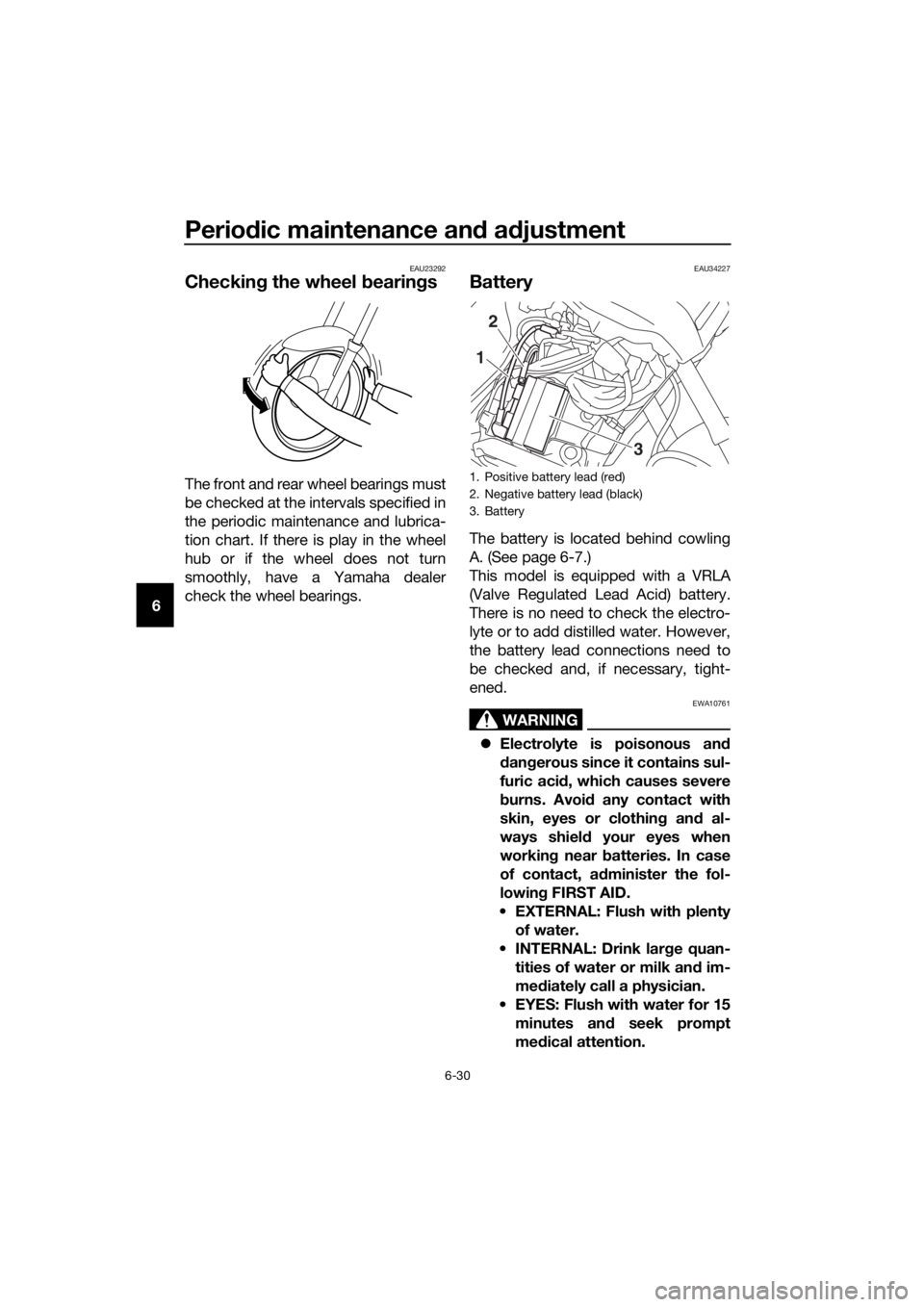
The battery is located behind cowling
A. (See page 6-7.)
This model is equipped with a VRLA
(Valve Regulated Lead Acid) battery.
There is no need to check the electro-
lyte or to add distilled water. However,
the battery lead connections need to
be checked and, if necessary, tight-
ened.
WARNING
EWA10761
Electrolyte is poisonous an d
d an gerous since it contains sul-
furic aci d, which causes severe
b urns. Avoi d any contact with
skin, eyes or clothin g an d al-
ways shiel d your eyes when
workin g near b atteries. In case
of contact, ad minister the fol-
lowin g FIRST AID.
EXTERNAL: Flush with plenty of water.
INTERNAL: Drink lar ge quan-
tities of water or milk an d im-
me diately call a physician.
EYES: Flush with water for 15 minutes an d seek prompt
me dical attention.
1. Positive battery lead (red)
2. Negative battery lead (black)
3. Battery
1 2
3
UBP9E1E0.book Page 30 Friday, September 7, 2018 10:01 AM
Page 108 of 122
Motorcycle care and stora ge
7-1
7
EAU37834
Matte color caution
NOTICE
ECA15193
Some mo dels are equipped with
matte colore d finishe d parts. Be
sure to consult a Yamaha dealer for
a d vice on what pro ducts to use be-
fore cleanin g the vehicle. Usin g a
b rush, harsh chemical prod ucts or
cleanin g compoun ds when cleanin g
these parts will scratch or damag e
their surface. Wax also shoul d not
b e applied to any matte colored fin-
ishe d parts.
EAU83443
Care
Frequent, thorough cleaning of the ve-
hicle will not only enhance its appear-
ance but also will improve its general
performance and extend the useful life
of many components. Washing, clean-
ing, and polishing will also give you a
chance to inspect the condition of the
vehicle more frequently. Be sure to
wash the vehicle after riding in the rain
or near the sea, because salt is corro-
sive to metals.
TIP
The roads of heavy snowfall areas
may be sprayed with salt as a de-
icing method. This salt can stay on
the roads well into spring, so be
sure to wash the underside and
chassis parts after riding in such
areas.
Genuine Yamaha care and main-
tenance products are sold under
the YAMALUBE brand in many
markets worldwide.
See your Yamaha dealer for addi-
tional cleaning tips.
NOTICE
ECA26280
Improper cleanin g can cause cos-
metic an d mechanical dama ge. Do
not use: high-pressure washers or
steam-jet cleaners. Excessive
water pressure may cause wa-
ter seepag e and d eterioration of
wheel bearin gs, brakes, trans-
mission seals an d electrical de-
vices. Avoi d hi gh-pressure
d eter gent applications such as
those availa ble in coin-operate d
car washers.
UBP9E1E0.book Page 1 Friday, September 7, 2018 10:01 AM
Page 109 of 122

Motorcycle care and stora ge
7-2
7
harsh chemicals, inclu din g
stron g aci dic wheel cleaners,
especially on spoke or ma gne-
sium wheels.
harsh chemicals, ab rasive
cleanin g compoun ds, or wax on
matte-finished parts. Brushes
can scratch an d damag e the
matte-finish, use soft spon ge or
towel only.
towels, spon ges, or brushes
contaminate d with a brasive
cleanin g prod ucts or stron g
chemicals such as, solvents,
g asoline, rust removers, brake
flui d, or antifreeze, etc.
Before washin g
1. Park the vehicle out of direct sun- light and allow it to cool. This will
help avoid water spots.
2. Make sure all caps, covers, elec- trical couplers and connectors are
tightly installed.
3. Cover the muffler end with a plas- tic bag and a strong rubber band.
4. Pre-soak stubborn stains like in- sects or bird droppings with a wet
towel for a few minutes.
5. Remove road grime and oil stains with a quality degreasing agent
and a plastic-bristle brush or
sponge. NOTICE: Do not use
d eg reasin g a gent on areas re-
quirin g lu brication such as
seals, gaskets, an d wheel axles.
Follow prod uct instructions.
[ECA26290]
Washing
1. Rinse off any degreaser and spray down the vehicle with a garden
hose. Use only enough pressure
to do the job. Avoid spraying wa-
ter directly into the muffler, instru-
ment panel, air inlet, or other inner
areas such as underseat storage
compartments.
2. Wash the vehicle with a quality au- tomotive-type detergent mixed
with cool water and a soft, clean
towel or sponge. Use an old tooth-
brush or plastic-bristle brush for
hard-to-reach places. NOTICE:
Use col d water if the vehicle has
b een exposed to salt. Warm wa-
ter will increase salt’s corrosive
properties.
[ECA26301]
3. For windshield-equipped vehicles: Clean the windshield with a soft
towel or sponge dampened with
water and a pH neutral detergent.
If necessary, use a high-quality
windshield cleaner or polish for
motorcycles. NOTICE: Never use
any stron g chemicals to clean
the win dshiel d. A dditionally,
some cleanin g compoun ds for
plastic may scratch the win d-
shiel d, so b e sure to test all
cleanin g prod ucts before gen-
eral application.
[ECA26310]
4. Rinse off thoroughly with clean water. Be sure to remove all deter-
gent residues, as they can be
harmful to plastic parts.
After washin g
1. Dry the vehicle with a chamois or absorbent towel, preferably mi-
crofiber terrycloth.
UBP9E1E0.book Page 2 Friday, September 7, 2018 10:01 AM
Page 112 of 122

Motorcycle care and stora ge
7-5
7 8. Check and correct the tire air
pressure, and then lift the vehicle
so that all wheels are off the
ground. Otherwise, turn the
wheels a little once a month in or-
der to prevent the tires from be-
coming degraded in one spot.
9. Cover the muffler outlet with a plastic bag to prevent moisture
from entering it.
10. Remove the battery and fully char- ge it, or attach a maintenance
charger to keep the battery opti-
mally charged. NOTICE: Confirm
that the b attery and its char ger
are compati ble. Do not char ge a
VRLA battery with a convention-
al char ger.
[ECA26330]
TIP
If the battery will be removed,
charge it once a month and store
it in a temperate location between
0-30 °C (32-90 °F).
See page 6-30 for more informa-
tion on charging and storing the
battery.
UBP9E1E0.book Page 5 Friday, September 7, 2018 10:01 AM