light YAMAHA XT500E 2000 User Guide
[x] Cancel search | Manufacturer: YAMAHA, Model Year: 2000, Model line: XT500E, Model: YAMAHA XT500E 2000Pages: 96, PDF Size: 4.23 MB
Page 45 of 96

6-5
PERIODIC MAINTENANCE AND MINOR REPAIR
1
2
3
4
56
7
8
9
EAU03884
NOTE:
8The air filter needs more frequent service if you are riding in unusually wet or dusty areas.
8Hydraulic brake service
9Regularly check and, if necessary, correct the brake fluid level.
9Every two years replace the internal components of the brake master cylinders and calipers, and change the
brake fluid.
9Replace the brake hoses every four years and if cracked or damaged.20
*Rear suspension relay
arm and connecting arm
pivoting points¥Check operation.ÖÖÖÖ
¥Lubricate with molybdenum disulfide grease.ÖÖ
21*Carburetor¥Check starter (choke) operation.
¥Adjust engine idling speed.ÖÖÖÖÖÖ
22Engine oil¥Change.ÖÖÖÖÖÖ
23Engine oil filter element¥Replace.ÖÖÖ
24*Front and rear brake
switches¥Check operation.ÖÖÖÖÖÖ
25Moving parts and cables¥Lubricate.ÖÖÖÖÖ
26*Lights, signals and
switches¥Check operation.
¥Adjust headlight beam.ÖÖÖÖÖÖ NO.ITEMCHECK OR MAINTENANCE JOBODOMETER READING (´ 1,000 km)
ANNUAL
CHECK
110203040
4PT-9-E6 (ENG) 6 12/27/00 1:29 PM Page 6
Page 49 of 96
Inspection
The spark plug is an important
engine component and is easy to
inspect. The condition of the spark
plug can indicate the condition of the
engine.
The ideal color on the white insulator
around the center electrode is a
medium-to-light tan color for a motor-
cycle that is being ridden normally.
Do not attempt to diagnose such
problems yourself. Instead, take the
motorcycle to a Yamaha dealer. You
should periodically remove and
inspect the spark plug because heat
and deposits will cause any spark
plug to slowly break down and erode.
If electrode erosion becomes exces-
sive, or if carbon and other deposits
are excessive, you should replace
the spark plug with the specified plug.Installation
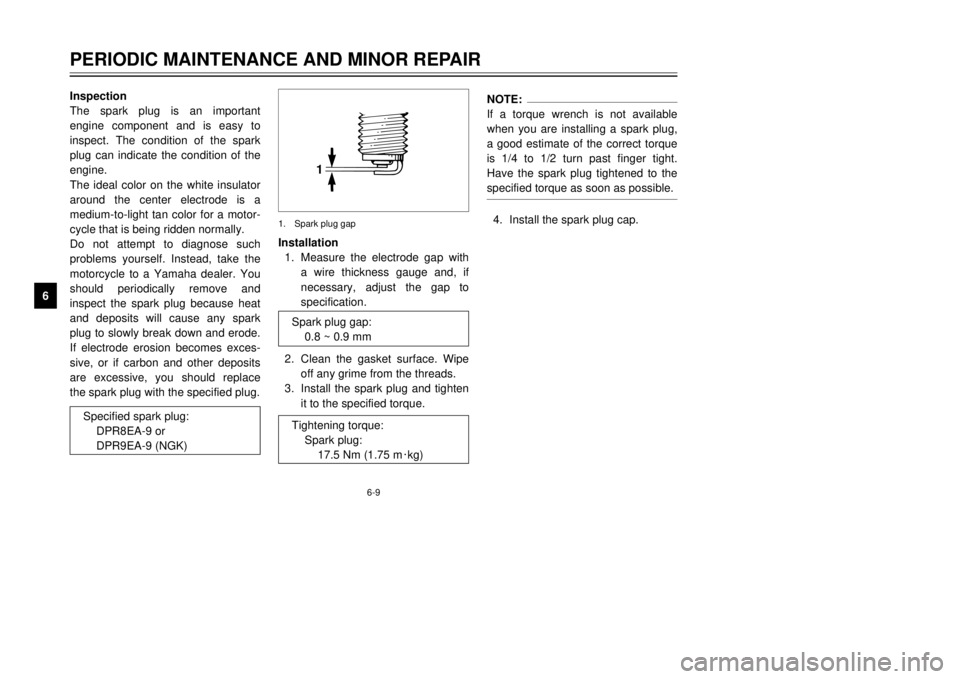
1.Measure the electrode gap with
a wire thickness gauge and, if
necessary, adjust the gap to
specification.
2.Clean the gasket surface. Wipe
off any grime from the threads.
3.Install the spark plug and tighten
it to the specified torque.
NOTE:
If a torque wrench is not available
when you are installing a spark plug,
a good estimate of the correct torque
is 1/4 to 1/2 turn past finger tight.
Have the spark plug tightened to the
specified torque as soon as possible.4.Install the spark plug cap.
6-9
PERIODIC MAINTENANCE AND MINOR REPAIR
1
2
3
4
56
7
8
9
Specified spark plug:
DPR8EA-9 or
DPR9EA-9 (NGK)
Spark plug gap:
0.8 ~ 0.9 mmTightening torque:
Spark plug:
17.5 Nm (1.75 m0kg)
1
1.Spark plug gap
4PT-9-E6 (ENG) 6 12/27/00 1:29 PM Page 10
Page 53 of 96
EAU00629
Carburetor adjustmentThe carburetor is a vital part of the
engine and requires very sophisticat-
ed adjustment. Most adjustments
should be left to a Yamaha dealer
who has the professional knowledge
and experience to do so. However,
the following may be serviced by the
owner as part of routine mainte-
nance.
EC000094
cCThe carburetor was set at the
Yamaha factory after many tests. If
the settings are changed, poor
engine performance and damage
may result.
6-13
PERIODIC MAINTENANCE AND MINOR REPAIR
1
2
3
4
56
7
8
9
5.Install the air filter with the arrow
mark on the top pointing inward.
6.Install the air filter case cover
and the panel.
EC000082
cC8
8
Make sure the air filter is prop-
erly seated in the air filter
case.
8 8
The engine should never be
run without the air filter
installed. Excessive piston
and/or cylinder wear may
result.
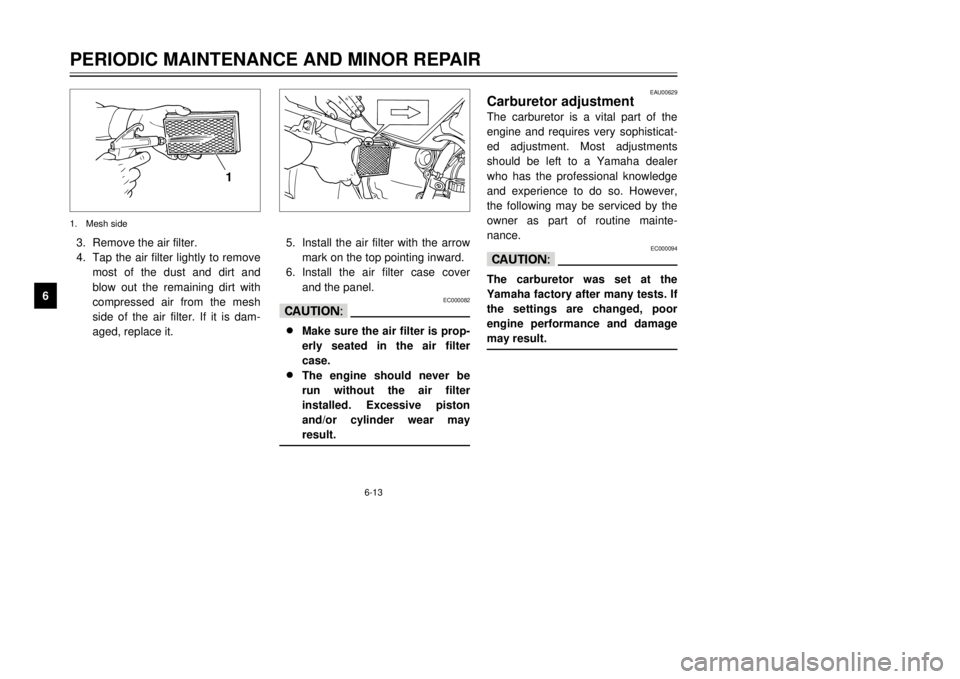
1
3.Remove the air filter.
4.Tap the air filter lightly to remove
most of the dust and dirt and
blow out the remaining dirt with
compressed air from the mesh
side of the air filter. If it is dam-
aged, replace it.1.Mesh side
4PT-9-E6 (ENG) 6 12/27/00 1:29 PM Page 14
Page 60 of 96
6-20
PERIODIC MAINTENANCE AND MINOR REPAIR
1
2
3
4
56
7
8
9
EAU00713
Brake light switch
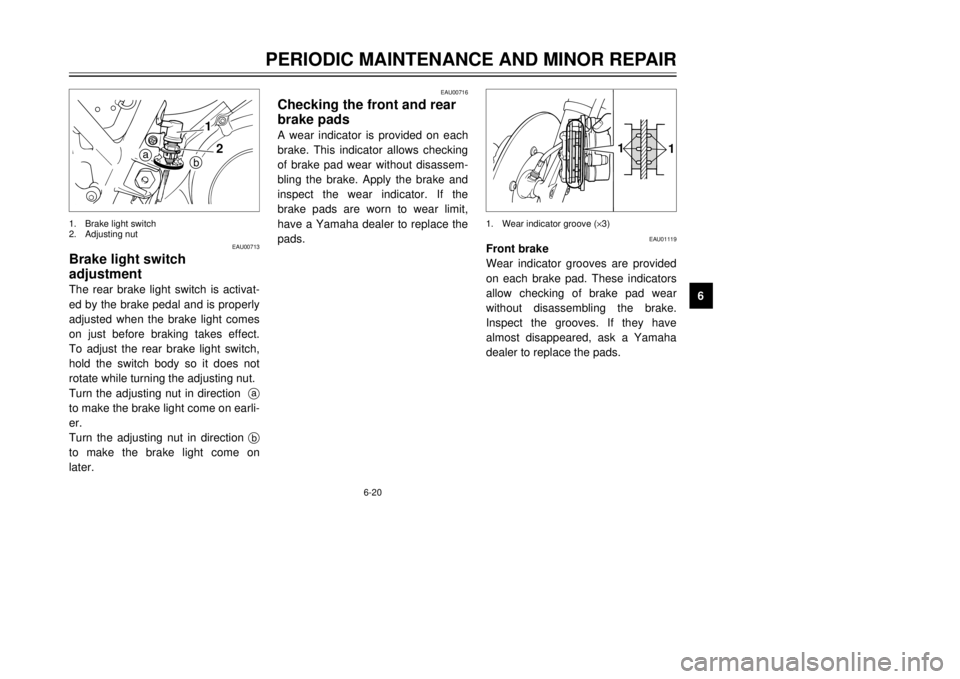
adjustmentThe rear brake light switch is activat-
ed by the brake pedal and is properly
adjusted when the brake light comes
on just before braking takes effect.
To adjust the rear brake light switch,
hold the switch body so it does not
rotate while turning the adjusting nut.
Turn the adjusting nut in direction a
to make the brake light come on earli-
er.
Turn the adjusting nut in direction b
to make the brake light come on
later.
21
a
b
1.Brake light switch
2.Adjusting nut
EAU00716
Checking the front and rear
brake padsA wear indicator is provided on each
brake. This indicator allows checking
of brake pad wear without disassem-
bling the brake. Apply the brake and
inspect the wear indicator. If the
brake pads are worn to wear limit,
have a Yamaha dealer to replace the
pads.
EAU01119
Front brake
Wear indicator grooves are provided
on each brake pad. These indicators
allow checking of brake pad wear
without disassembling the brake.
Inspect the grooves. If they have
almost disappeared, ask a Yamaha
dealer to replace the pads.
1
1
1.Wear indicator groove (´3)
4PT-9-E6 (ENG) 6 12/27/00 1:29 PM Page 21
Page 69 of 96

EC000103
cCDo not use fuses of higher amper-
age rating than those recommend-
ed. Substitution of a fuse of
improper rating can cause exten-
sive electrical system damage and
possibly a fire.
EAU01146
Headlight bulb replacementThis motorcycle is equipped with a
quartz bulb headlight. If the headlight
bulb burns out, replace it as follows:
1.Remove cowling A. (See page
6-7 for cowling removal and
installation procedures.)
2.Remove the headlight unit.
6-29
PERIODIC MAINTENANCE AND MINOR REPAIR
1
2
3
4
56
7
8
9Specified fuse:
20 A
1
1.Bolt (´3)
1
2
EAU01307
Fuse replacementThe fuse is located behind panel A.
(See page 6-7 for panel removal and
installation procedures.)
If the fuse is blown, turn off the main
switch and the switch of the circuit in
question. Install a new fuse of proper
amperage. Turn on the switches and
see if the electrical device operates.
If the fuse immediately blows again,
consult a Yamaha dealer.1.Main fuse
2.Spare fuse
4PT-9-E6 (ENG) 6 12/27/00 1:29 PM Page 30
Page 71 of 96
6-31
PERIODIC MAINTENANCE AND MINOR REPAIR
1
2
3
4
56
7
8
9
EAU01095
Turn signal light bulb
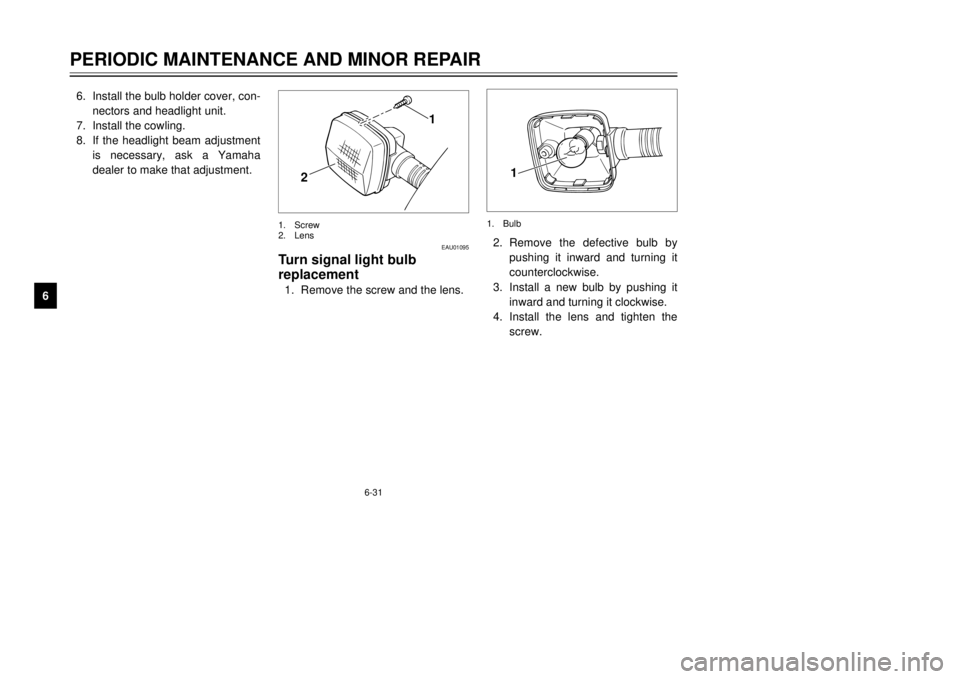
replacement1.Remove the screw and the lens.2.Remove the defective bulb by
pushing it inward and turning it
counterclockwise.
3.Install a new bulb by pushing it
inward and turning it clockwise.
4.Install the lens and tighten the
screw.
1
2
1.Screw
2.Lens
1
1.Bulb
6.Install the bulb holder cover, con-
nectors and headlight unit.
7.Install the cowling.
8.If the headlight beam adjustment
is necessary, ask a Yamaha
dealer to make that adjustment.
4PT-9-E6 (ENG) 6 12/27/00 1:29 PM Page 32
Page 72 of 96

6-32
PERIODIC MAINTENANCE AND MINOR REPAIR
1
2
3
4
56
7
8
9
EAU01579
Supporting the motorcycleSince the Yamaha XT500E/XT600E
has no centerstand, follow these pre-
cautions when removing the front and
rear wheel or performing other main-
tenance requiring the motorcycle to
stand upright. Check that the motor-
cycle is in a stable and level position
before starting any maintenance. A
strong wooden box can be placed
under the engine for added stability.
Front wheel service
To stabilize the rear of the motorcy-
cle, either use a motorcycle stand or
place a motorcycle jack under the
frame in front of the rear wheel to
prevent it from moving from side to
side. Then use a motorcycle stand to
elevate the front wheel off of the
ground.
EAU01623
Taillight bulb replacement1.Remove the screws and the
lens.
21
1.Screw (´2)
2.Lens
2.Remove the defective bulb by
pushing it inward and turning it
counterclockwise.
3.Install a new bulb by pushing it
inward and turning it clockwise.
4.Install the lens and tighten the
screws.
EC000108
cCDo not over-tighten the screws as
the lens may break.
1
1.Bulb
4PT-9-E6 (ENG) 6 12/27/00 1:29 PM Page 33
Page 80 of 96

7-2
8 8
Improper cleaning can damage
windshields, cowlings, panels
and other plastic parts. Use
only a soft, clean cloth or
sponge with mild detergent
and water to clean plastic.
8 8
Do not use any harsh chemical
products on plastic parts. Be
sure to avoid using cloths or
sponges which have been in
contact with strong or abra-
sive cleaning products, sol-
vent or thinner, fuel (gasoline),
rust removers or inhibitors,
brake fluid, antifreeze or elec-
trolyte.8 8
Do not use high-pressure
washers or steam-jet cleaners
since they cause water seep-
age and deterioration in the
following areas: seals (of
wheel bearings, swingarm
bearings, forks and brakes),
electric components (cou-
plers, connectors, instru-
ments, switches and lights),
breather hoses and vents.
8 8
For motorcycles equipped
with a windshield: Do not use
strong cleaners or hard
sponges as they will cause
dulling or scratching. Some
cleaning compounds for plas-
tic may leave scratches on the
windshield. Test the product
on a small hidden part of the
windshield to make sure they
do not leave any marks. If the
windshield is scratched, use a
quality plastic polishing com-
pound after washing.
After riding in the rain, near the seaor on salt-sprayed roads.Since sea salt or salt sprayed on the
roads in the winter are extremely cor-
rosive in combination with water,
carry out the following steps after
each ride in the rain, near the sea or
on salt-sprayed roads. (Salt sprayed
in the winter may remain on the roads
well into spring.)
1.Clean your motorcycle with cold
water and soap after the engine
has cooled down.
ECA00012
cCDo not use warm water since it
increases the corrosive action of
the salt.2.Be sure to apply a corrosion pro-
tection spray on all (even
chrome- and nickel-plated) metal
surfaces to prevent corrosion.
MOTORCYCLE CARE AND STORAGE
1
2
3
4
5
67
8
9
4PT-9-E6 (ENG) 7~9 12/27/00 1:30 PM Page 3
Page 88 of 96

SPECIFICATIONS
1
2
3
4
5
6
78
9
8-4 Electrical
Ignition systemT.C.I. (Digital)
Charging system
TypeA.C. magneto
Standard output14 V, 13.5A@5,000 rpm
Battery
TypeYTX9-BS
Voltage, capacity12 V, 8 AH
Headlight bulb typeHalogen bulb
Bulb voltage, wattage ´quantity
Headlight12 V, 60/55W ´1
Tail / brake light12 V, 5/21W ´1
Auxiliary light12 V, 4W ´1
12 V, 3.4W ´1 (GB only)
Front flasher light12 V, 21W ´2
Rear flasher light12 V, 21W ´2
Meter light12 V, 3.4W ´1
Neutral indicator light12 V, 3.4W ´1
High beam indicator light12 V, 3.4W ´1
Turn indicator light12 V, 3.4W ´1
Fuse
Main20A
4PT-9-E6 (ENG) 7~9 12/27/00 1:30 PM Page 11
Page 93 of 96
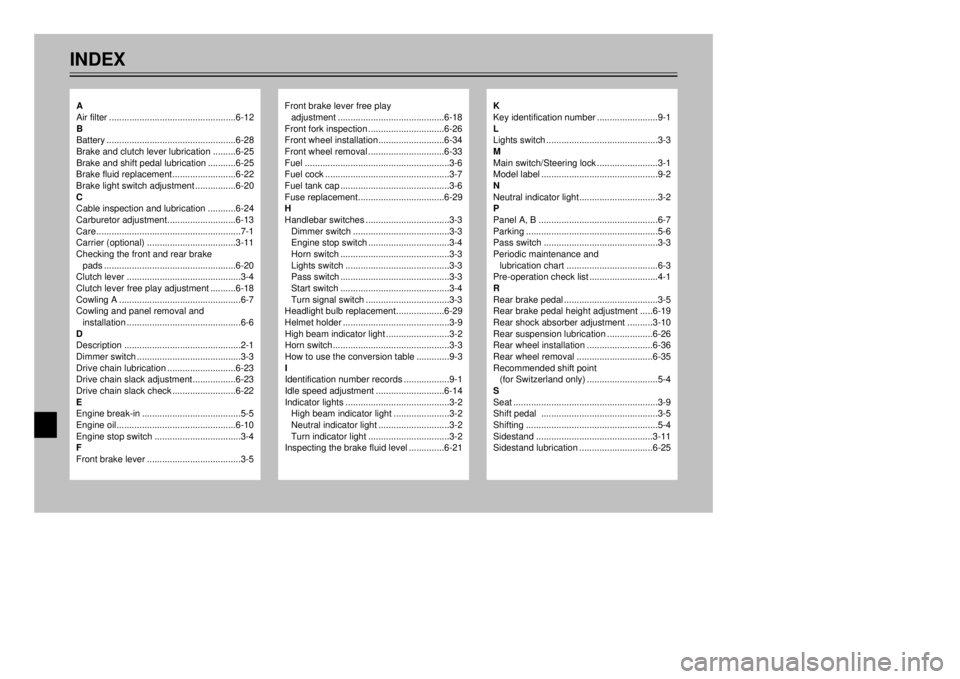
INDEX
Front brake lever free play
adjustment..........................................6-18
Front fork inspection..............................6-26
Front wheel installation..........................6-34
Front wheel removal..............................6-33
Fuel.........................................................3-6
Fuel cock.................................................3-7
Fuel tank cap...........................................3-6
Fuse replacement..................................6-29
H
Handlebar switches.................................3-3
Dimmer switch......................................3-3
Engine stop switch................................3-4
Horn switch...........................................3-3
Lights switch.........................................3-3
Pass switch...........................................3-3
Start switch...........................................3-4
Turn signal switch.................................3-3
Headlight bulb replacement...................6-29
Helmet holder..........................................3-9
High beam indicator light.........................3-2
Horn switch..............................................3-3
How to use the conversion table.............9-3
I
Identification number records..................9-1
Idle speed adjustment...........................6-14
Indicator lights.........................................3-2
High beam indicator light......................3-2
Neutral indicator light............................3-2
Turn indicator light................................3-2
Inspecting the brake fluid level..............6-21
K
Key identification number........................9-1
L
Lights switch............................................3-3
M
Main switch/Steering lock........................3-1
Model label..............................................9-2
N
Neutral indicator light...............................3-2
P
Panel A, B...............................................6-7
Parking....................................................5-6
Pass switch.............................................3-3
Periodic maintenance and
lubrication chart....................................6-3
Pre-operation check list...........................4-1
R
Rear brake pedal.....................................3-5
Rear brake pedal height adjustment.....6-19
Rear shock absorber adjustment..........3-10
Rear suspension lubrication..................6-26
Rear wheel installation..........................6-36
Rear wheel removal..............................6-35
Recommended shift point
(for Switzerland only)............................5-4
S
Seat.........................................................3-9
Shift pedal ..............................................3-5
Shifting....................................................5-4
Sidestand..............................................3-11
Sidestand lubrication.............................6-25
A
Air filter..................................................6-12
B
Battery...................................................6-28
Brake and clutch lever lubrication.........6-25
Brake and shift pedal lubrication...........6-25
Brake fluid replacement.........................6-22
Brake light switch adjustment................6-20
C
Cable inspection and lubrication...........6-24
Carburetor adjustment...........................6-13
Care.........................................................7-1
Carrier (optional)...................................3-11
Checking the front and rear brake
pads....................................................6-20
Clutch lever.............................................3-4
Clutch lever free play adjustment..........6-18
Cowling A................................................6-7
Cowling and panel removal and
installation.............................................6-6
D
Description..............................................2-1
Dimmer switch.........................................3-3
Drive chain lubrication...........................6-23
Drive chain slack adjustment.................6-23
Drive chain slack check.........................6-22
E
Engine break-in.......................................5-5
Engine oil...............................................6-10
Engine stop switch..................................3-4
F
Front brake lever.....................................3-5
4PT-9-E6 (ENG) 7~9 12/27/00 1:30 PM Page 16