key YAMAHA XT660Z 2015 User Guide
[x] Cancel search | Manufacturer: YAMAHA, Model Year: 2015, Model line: XT660Z, Model: YAMAHA XT660Z 2015Pages: 98, PDF Size: 8.44 MB
Page 29 of 98
INSTRUMENT AND CONTROL FUNCTIONS
3-12
3
EAU51802
ABS (for ABS models)The Yamaha ABS (Anti-lock Brake
System) features a dual electronic con-
trol system, which acts on the front and
rear brakes independently.
Operate the brakes with ABS as you
would conventional brakes. If the ABS
is activated, a pulsating sensation may
be felt at the brake lever or brake ped-
al. In this situation, continue to apply
the brakes and let the ABS work; do
not “pump” the brakes as this will re-
duce braking effectiveness.
WARNING
EWA16051
Always keep a sufficient distance
from the vehicle ahead to match the
riding speed even with ABS.
The ABS performs best with
long braking distances.
On certain surfaces, such as
rough or gravel roads, the brak-
ing distance may be longer with
the ABS than without.The ABS is monitored by an ECU,
which will revert the system to conven-
tional braking if a malfunction occurs.
TIPThe ABS performs a self-diagno-
sis test each time the vehicle first
starts off after the key is turned to
“ON” and the vehicle has traveled
at a speed of 10 km/h (6 mi/h) or
higher. During this test, a “click-
ing” noise can be heard from un-
der the seat, and if the brake lever
or brake pedal is even slightly ap-
plied, a vibration can be felt at the
lever and pedal, but these do not
indicate a malfunction.
This ABS has a test mode which
allows the owner to experience
the pulsation at the brake lever or
brake pedal when the ABS is op-
erating. However, special tools are
required, so please consult your
Yamaha dealer.NOTICE
ECA16121
Keep any type of magnets (including
magnetic pick-up tools, magnetic
screwdrivers, etc.) away from the
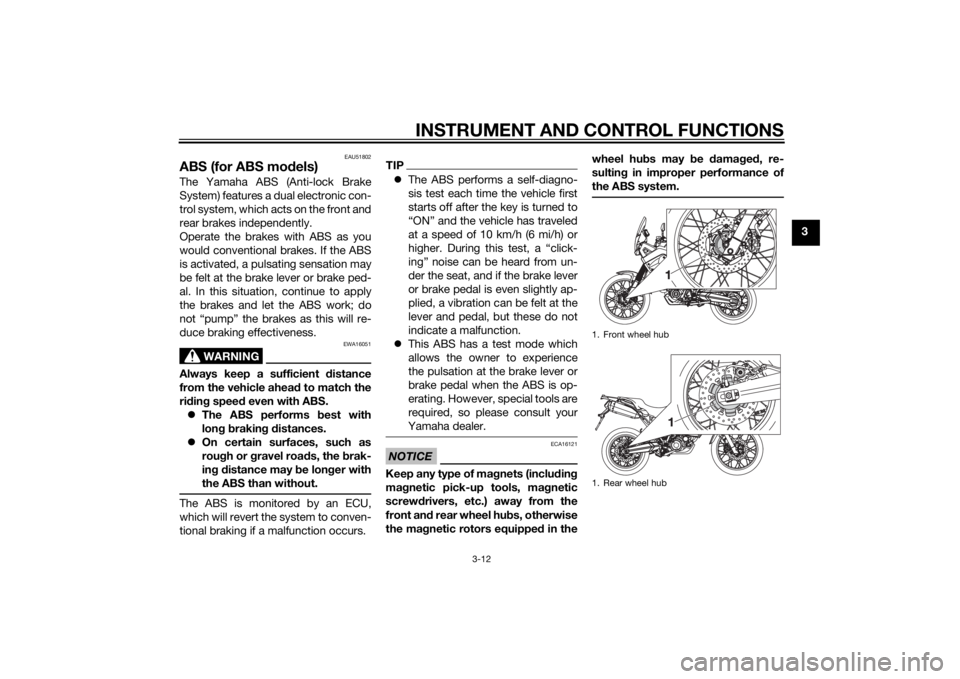
front and rear wheel hubs, otherwise
the magnetic rotors equipped in thewheel hubs may be damaged, re-
sulting in improper performance of
the ABS system.
1. Front wheel hub
1. Rear wheel hub
U2BDE1E0.book Page 12 Tuesday, December 16, 2014 5:38 PM
Page 30 of 98
INSTRUMENT AND CONTROL FUNCTIONS
3-13
3
EAU13075
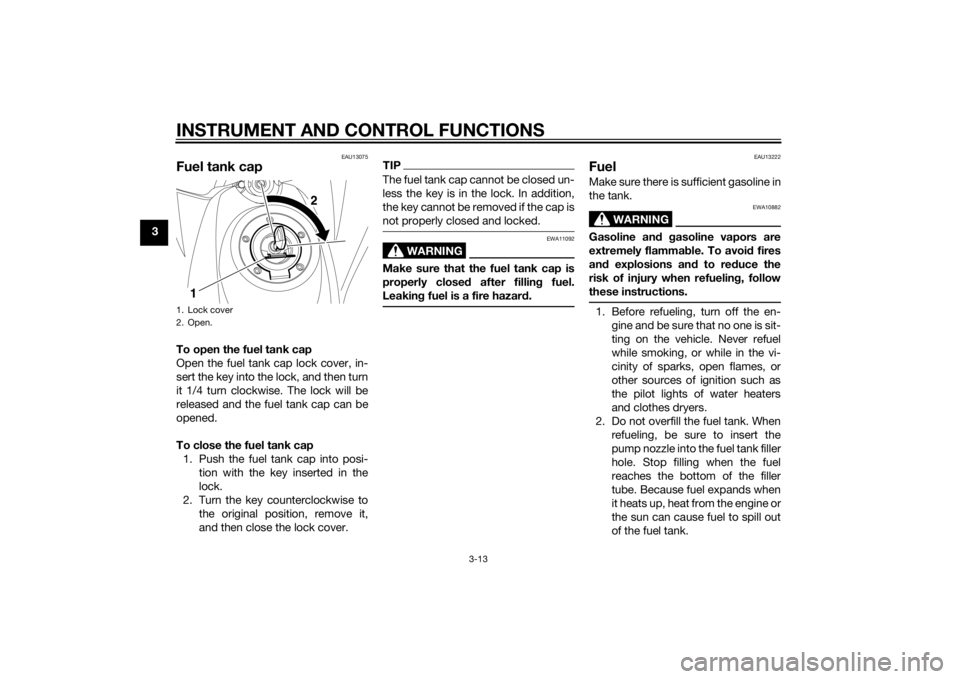
Fuel tank capTo open the fuel tank cap
Open the fuel tank cap lock cover, in-
sert the key into the lock, and then turn
it 1/4 turn clockwise. The lock will be
released and the fuel tank cap can be
opened.
To close the fuel tank cap
1. Push the fuel tank cap into posi-
tion with the key inserted in the
lock.
2. Turn the key counterclockwise to
the original position, remove it,
and then close the lock cover.
TIPThe fuel tank cap cannot be closed un-
less the key is in the lock. In addition,
the key cannot be removed if the cap is
not properly closed and locked.
WARNING
EWA11092
Make sure that the fuel tank cap is
properly closed after filling fuel.
Leaking fuel is a fire hazard.
EAU13222
FuelMake sure there is sufficient gasoline in
the tank.
WARNING
EWA10882
Gasoline and gasoline vapors are
extremely flammable. To avoid fires
and explosions and to reduce the
risk of injury when refueling, follow
these instructions.1. Before refueling, turn off the en-
gine and be sure that no one is sit-
ting on the vehicle. Never refuel
while smoking, or while in the vi-
cinity of sparks, open flames, or
other sources of ignition such as
the pilot lights of water heaters
and clothes dryers.
2. Do not overfill the fuel tank. When
refueling, be sure to insert the
pump nozzle into the fuel tank filler
hole. Stop filling when the fuel
reaches the bottom of the filler
tube. Because fuel expands when
it heats up, heat from the engine or
the sun can cause fuel to spill out
of the fuel tank.
1. Lock cover
2. Open.U2BDE1E0.book Page 13 Tuesday, December 16, 2014 5:38 PM
Page 33 of 98
INSTRUMENT AND CONTROL FUNCTIONS
3-16
3
EAU13862
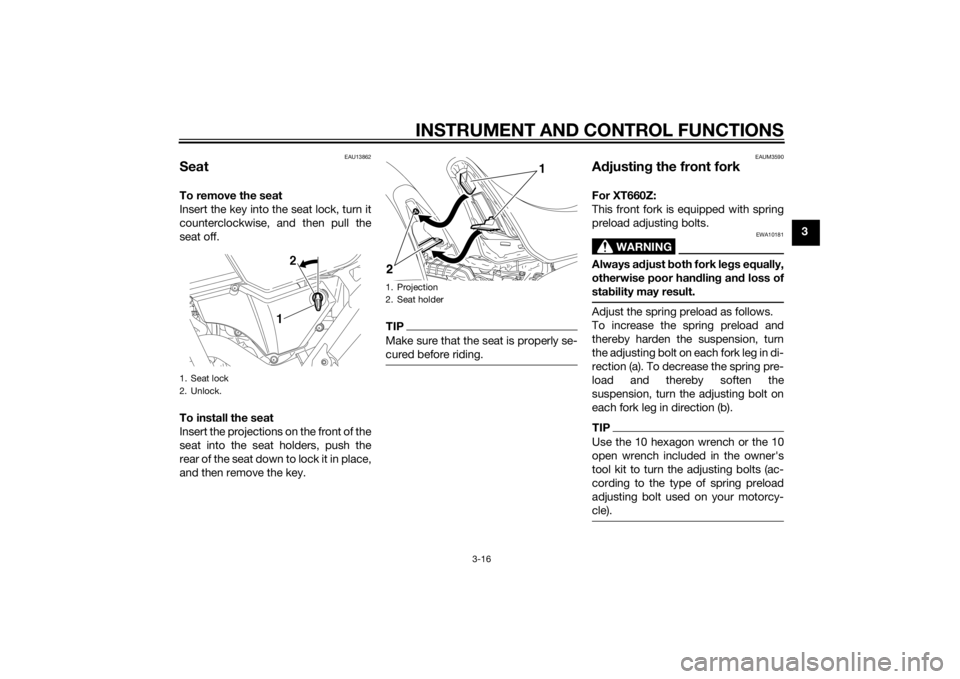
SeatTo remove the seat
Insert the key into the seat lock, turn it
counterclockwise, and then pull the
seat off.
To install the seat
Insert the projections on the front of the
seat into the seat holders, push the
rear of the seat down to lock it in place,
and then remove the key.
TIPMake sure that the seat is properly se-
cured before riding.
EAUM3590
Adjusting the front forkFor XT660Z:
This front fork is equipped with spring
preload adjusting bolts.
WARNING
EWA10181
Always adjust both fork legs equally,
otherwise poor handling and loss of
stability may result.Adjust the spring preload as follows.
To increase the spring preload and
thereby harden the suspension, turn
the adjusting bolt on each fork leg in di-
rection (a). To decrease the spring pre-
load and thereby soften the
suspension, turn the adjusting bolt on
each fork leg in direction (b).TIPUse the 10 hexagon wrench or the 10
open wrench included in the owner's
tool kit to turn the adjusting bolts (ac-
cording to the type of spring preload
adjusting bolt used on your motorcy-
cle).
1. Seat lock
2. Unlock.
1. Projection
2. Seat holder
U2BDE1E0.book Page 16 Tuesday, December 16, 2014 5:38 PM
Page 37 of 98
INSTRUMENT AND CONTROL FUNCTIONS
3-20
3
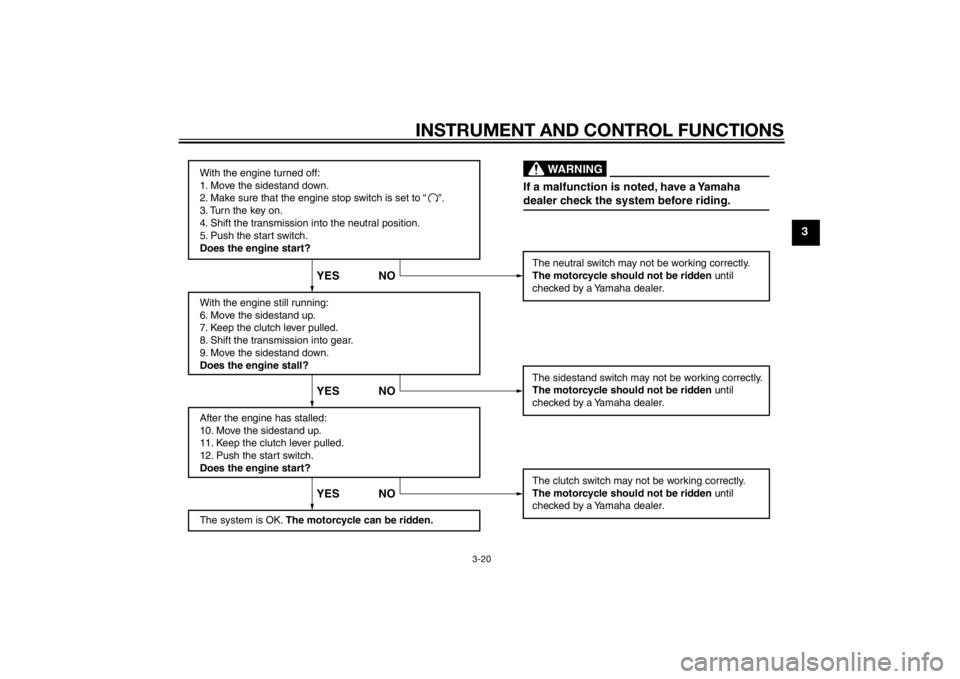
With the engine turned off:
1. Move the sidestand down.
2. Make sure that the engine stop switch is set to “
3. Turn the key on.
4. Shift the transmission into the neutral position.
5. Push the start switch.
Does the engine start?
With the engine still running:
6. Move the sidestand up.
7. Keep the clutch lever pulled.
8. Shift the transmission into gear.
9. Move the sidestand down.
Does the engine stall?
After the engine has stalled:
10. Move the sidestand up.
11. Keep the clutch lever pulled.
12. Push the start switch.
Does the engine start?
The system is OK. The motorcycle can be ridden.The neutral switch may not be working correctly.
The motorcycle should not be ridden until
checked by a Yamaha dealer.
The sidestand switch may not be working correctly.
The motorcycle should not be ridden until
checked by a Yamaha dealer.
The clutch switch may not be working correctly.
The motorcycle should not be ridden until
checked by a Yamaha dealer.
YES NO YES NO YES NO
If a malfunction is noted, have a Yamaha
dealer check the system before riding.
WARNING
”.
U2BDE1E0.book Page 20 Tuesday, December 16, 2014 5:38 PM
Page 41 of 98
OPERATION AND IMPORTANT RIDING POINTS
5-1
5
EAU15952
Read the Owner’s Manual carefully to
become familiar with all controls. If
there is a control or function you do not
understand, ask your Yamaha dealer.
WARNING
EWA10272
Failure to familiarize yourself with
the controls can lead to loss of con-
trol, which could cause an accident
or injury.
EAU48021
TIPThis model is equipped with a lean an-
gle sensor to stop the engine in case of
a turnover. In this case, the multi-func-
tion display indicates error code 30,
but this is not a malfunction. Turn the
the error code. Failing to do so will pre-
vent the engine from starting even
though the engine will crank when
pushing the start switch.
EAUS1952
Starting the engineIn order for the ignition circuit cut-off
system to enable starting, one of the
following conditions must be met:
The transmission is in the neutral
position.
The transmission is in gear with
the clutch lever pulled and the
sidestand up.
WARNING
EWA10291
Before starting the engine,
check the function of the igni-
tion circuit cut-off system ac-
cording to the procedure
described on page 3-19.
Never ride with the sidestand
down.1. Turn the key to “ON” and make
sure that the engine stop switch is
set to “ ”.NOTICE
ECAS0041
The following warning lights and in-
dicator lights should come on for a
few seconds, then go off.
Neutral indicator light
Turn signal indicator light
U2BDE1E0.book Page 1 Tuesday, December 16, 2014 5:38 PM
Page 44 of 98
OPERATION AND IMPORTANT RIDING POINTS
5-4
51600 km (1000 mi) and beyond
The vehicle can now be operated nor-
mally.
NOTICE
ECA10311
Keep the engine speed out of
the tachometer red zone.
If any engine trouble should oc-
cur during the engine break-in
period, immediately have a
Yamaha dealer check the vehi-
cle.
EAU17214
ParkingWhen parking, stop the engine, and
then remove the key from the main
switch.
WARNING
EWA10312
Since the engine and exhaust
system can become very hot,
park in a place where pedestri-
ans or children are not likely to
touch them and be burned.
Do not park on a slope or on soft
ground, otherwise the vehicle
may overturn, increasing the
risk of a fuel leak and fire.
Do not park near grass or other
flammable materials which
might catch fire.
U2BDE1E0.book Page 4 Tuesday, December 16, 2014 5:38 PM
Page 74 of 98
PERIODIC MAINTENANCE AND ADJUSTMENT
6-30
6working near batteries. In case
of contact, administer the fol-
lowing FIRST AID.
EXTERNAL: Flush with plenty
of water.
INTERNAL: Drink large quan-
tities of water or milk and im-
mediately call a physician.
EYES: Flush with water for 15
minutes and seek prompt
medical attention.
Batteries produce explosive hy-
drogen gas. Therefore, keep
sparks, flames, cigarettes, etc.,
away from the battery and pro-
vide sufficient ventilation when
charging it in an enclosed
space.
KEEP THIS AND ALL BATTER-
IES OUT OF THE REACH OF
CHILDREN.
NOTICE
ECA10621
Never attempt to remove the battery
cell seals, as this would permanently
damage the battery.
To charge the battery:
Have a Yamaha dealer charge the bat-
tery as soon as possible if it seems to
have discharged. Keep in mind that the
battery tends to discharge more quick-
ly if the vehicle is equipped with op-
tional electrical accessories.NOTICE
ECA16522
To charge a VRLA (Valve Regulated
Lead Acid) battery, a special (con-
stant-voltage) battery charger is re-
quired. Using a conventional battery
charger will damage the battery.To store the battery:
1. If the vehicle will not be used for
more than one month, remove the
battery, fully charge it, and then
place it in a cool, dry place.
NOTICE: When removing the
battery, be sure the key is
turned to “OFF”, then discon-
nect the negative lead before
disconnecting the positive lead.
[ECA16303]
2. If the battery will be stored for
more than two months, check it at
least once a month and fully
charge it if necessary.
3. Fully charge the battery before in-
stallation. NOTICE: When install-
ing the battery, be sure the key
is turned to “OFF”, then connect
the positive lead before con-
necting the negative lead.
[ECA16841]
4. After installation, make sure that
the battery leads are properly con-
nected to the battery terminals.NOTICE
ECA16531
Always keep the battery charged.
Storing a discharged battery can
cause permanent battery damage.
U2BDE1E0.book Page 30 Tuesday, December 16, 2014 5:38 PM
Page 75 of 98
PERIODIC MAINTENANCE AND ADJUSTMENT
6-31
6
EAUS1934
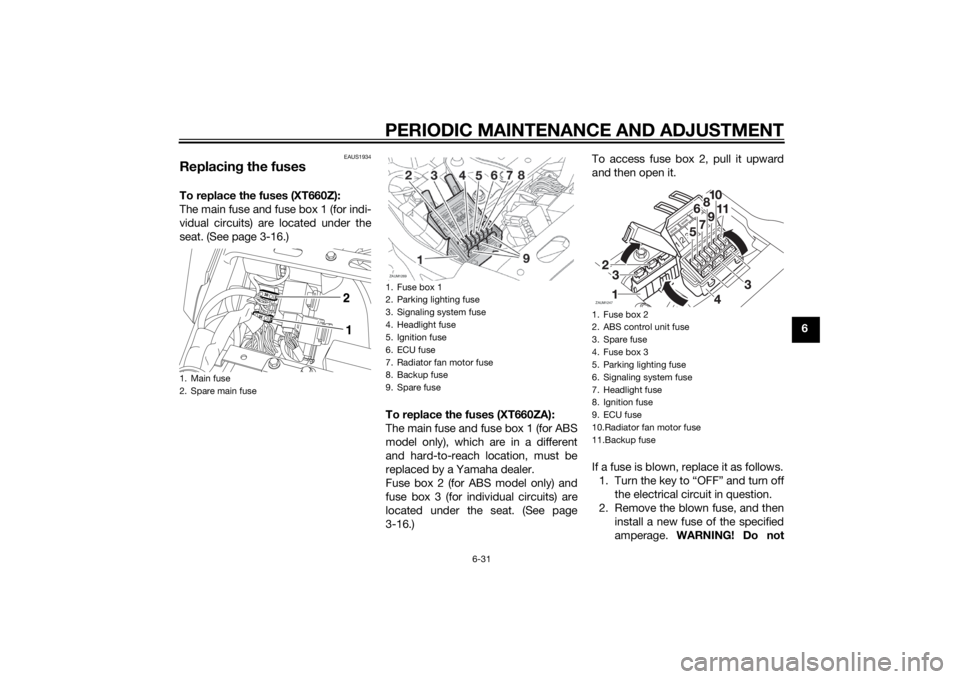
Replacing the fusesTo replace the fuses (XT660Z):
The main fuse and fuse box 1 (for indi-
vidual circuits) are located under the
seat. (See page 3-16.)
To replace the fuses (XT660ZA):
The main fuse and fuse box 1 (for ABS
model only), which are in a different
and hard-to-reach location, must be
replaced by a Yamaha dealer.
Fuse box 2 (for ABS model only) and
fuse box 3 (for individual circuits) are
located under the seat. (See page
3-16.)To access fuse box 2, pull it upward
and then open it.
If a fuse is blown, replace it as follows.
1. Turn the key to “OFF” and turn off
the electrical circuit in question.
2. Remove the blown fuse, and then
install a new fuse of the specified
amperage. WARNING! Do not1. Main fuse
2. Spare main fuse
1. Fuse box 1
2. Parking lighting fuse
3. Signaling system fuse
4. Headlight fuse
5. Ignition fuse
6. ECU fuse
7. Radiator fan motor fuse
8. Backup fuse
9. Spare fuseZAUM1269
1. Fuse box 2
2. ABS control unit fuse
3. Spare fuse
4. Fuse box 3
5. Parking lighting fuse
6. Signaling system fuse
7. Headlight fuse
8. Ignition fuse
9. ECU fuse
10.Radiator fan motor fuse
11.Backup fuse
2
34567
1SPA RE
SPA RE SPA RE
ZAUM1247
U2BDE1E0.book Page 31 Tuesday, December 16, 2014 5:38 PM
Page 76 of 98
![YAMAHA XT660Z 2015 User Guide PERIODIC MAINTENANCE AND ADJUSTMENT
6-32
6use a fuse of a higher amperage
rating than recommended to
avoid causing extensive dam-
age to the electrical system and
possibly a fire.
[EWA15132]
3. Turn](/img/51/53212/w960_53212-75.png "YAMAHA XT660Z 2015 User Guide PERIODIC MAINTENANCE AND ADJUSTMENT
6-32
6use a fuse of a higher amperage
rating than recommended to
avoid causing extensive dam-
age to the electrical system and
possibly a fire.
[EWA15132]
3. Turn")
PERIODIC MAINTENANCE AND ADJUSTMENT
6-32
6use a fuse of a higher amperage
rating than recommended to
avoid causing extensive dam-
age to the electrical system and
possibly a fire.
[EWA15132]
3. Turn the key to “ON” and turn on
the electrical circuit in question to
check if the device operates.4. If the fuse immediately blows
again, have a Yamaha dealer
check the electrical system.
EAUB1583
Replacing a headlight bulbThis model is equipped with halogen
bulb headlights. If a headlight bulb
burns out, replace it as follows.NOTICE
ECA10651
Take care not to damage the follow-
ing parts:
Headlight bulb
Do not touch the glass part of
the headlight bulb to keep it free
from oil, otherwise the transpar-
ency of the glass, the luminosity
of the bulb, and the bulb life will
be adversely affected. Thor-
oughly clean off any dirt and fin-
gerprints on the headlight bulb
using a cloth moistened with al-
cohol or thinner.
Headlight lens
Do not affix any type of tinted
film or stickers to the headlight
lens.
Do not use a headlight bulb of a
wattage higher than specified.
Specified fuses:
Main fuse:
30.0 A
Parking lighting fuse:
10.0 A
Signaling system fuse:
10.0 A
Headlight fuse:
20.0 A
Ignition fuse:
10.0 A
Fuel injection system fuse:
10.0 A
Radiator fan motor fuse:
7.5 A
Backup fuse:
10.0 A
ABS motor fuse:
XT660ZA 30.0 A
ABS solenoid fuse:
XT660ZA 20.0 A
ABS control unit fuse:
XT660ZA 5.0 A
U2BDE1E0.book Page 32 Tuesday, December 16, 2014 5:38 PM