battery YAMAHA XT660Z 2015 Owners Manual
[x] Cancel search | Manufacturer: YAMAHA, Model Year: 2015, Model line: XT660Z, Model: YAMAHA XT660Z 2015Pages: 98, PDF Size: 8.44 MB
Page 6 of 98

TABLE OF CONTENTSSAFETY INFORMATION.................. 1-1
DESCRIPTION.................................. 2-1
Left view ......................................... 2-1
Right view ....................................... 2-3
Controls and instruments ............... 2-5
INSTRUMENT AND CONTROL
FUNCTIONS...................................... 3-1
Immobilizer system......................... 3-1
Main switch/steering lock............... 3-2
Indicator lights and warning
lights............................................ 3-4
Multi-function display ..................... 3-6
Handlebar switches ........................ 3-9
Clutch lever .................................. 3-10
Shift pedal .................................... 3-11
Brake lever.................................... 3-11
Brake pedal .................................. 3-11
ABS (for ABS models) .................. 3-12
Fuel tank cap ................................ 3-13
Fuel ............................................... 3-13
Fuel tank breather/overflow
hose .......................................... 3-15
Catalytic converter ....................... 3-15
Seat .............................................. 3-16
Adjusting the front fork ................. 3-16
Adjusting the shock absorber
assembly ................................... 3-18
Sidestand ..................................... 3-19
Ignition circuit cut-off system ....... 3-19FOR YOUR SAFETY –
PRE-OPERATION CHECKS............. 4-1
OPERATION AND IMPORTANT
RIDING POINTS................................ 5-1
Starting the engine .......................... 5-1
Shifting ............................................ 5-2
Tips for reducing fuel
consumption ................................ 5-3
Engine break-in ............................... 5-3
Parking ............................................ 5-4
PERIODIC MAINTENANCE AND
ADJUSTMENT................................... 6-1
Owner’s tool kit ............................... 6-2
Periodic maintenance chart for the
emission control system .............. 6-3
General maintenance and
lubrication chart ........................... 6-4
Removing and installing panels ...... 6-8
Checking the spark plug ................. 6-9
Engine oil and oil filter element ..... 6-10
Coolant.......................................... 6-13
Replacing the air filter element
and cleaning the check hose..... 6-14
Adjusting the engine idling
speed ......................................... 6-16
Checking the throttle grip free
play ............................................ 6-16
Valve clearance ............................. 6-17
Tires .............................................. 6-17Spoke wheels ............................... 6-19
Adjusting the clutch lever free
play ............................................ 6-20
Checking the front and rear brake
pads .......................................... 6-21
Checking the brake fluid level ...... 6-21
Changing the brake fluid .............. 6-23
Drive chain slack........................... 6-23
Cleaning and lubricating the drive
chain.......................................... 6-24
Checking and lubricating the
cables ........................................ 6-25
Checking and lubricating the
throttle grip and cable ............... 6-25
Checking and lubricating the
brake and clutch levers ............. 6-26
Checking and lubricating the
brake pedal ............................... 6-26
Checking and lubricating the
sidestand................................... 6-27
Lubricating the rear suspension ... 6-27
Lubricating the swingarm
pivots......................................... 6-27
Checking the front fork ................. 6-28
Checking the steering................... 6-28
Checking the wheel bearings ....... 6-29
Battery .......................................... 6-29
Replacing the fuses ...................... 6-31
Replacing a headlight bulb ........... 6-32
Replacing an auxiliary light bulb ... 6-34
Tail/brake light .............................. 6-34U2BDE1E0.book Page 1 Tuesday, December 16, 2014 5:38 PM
Page 15 of 98
DESCRIPTION
2-3
2
EAU32231
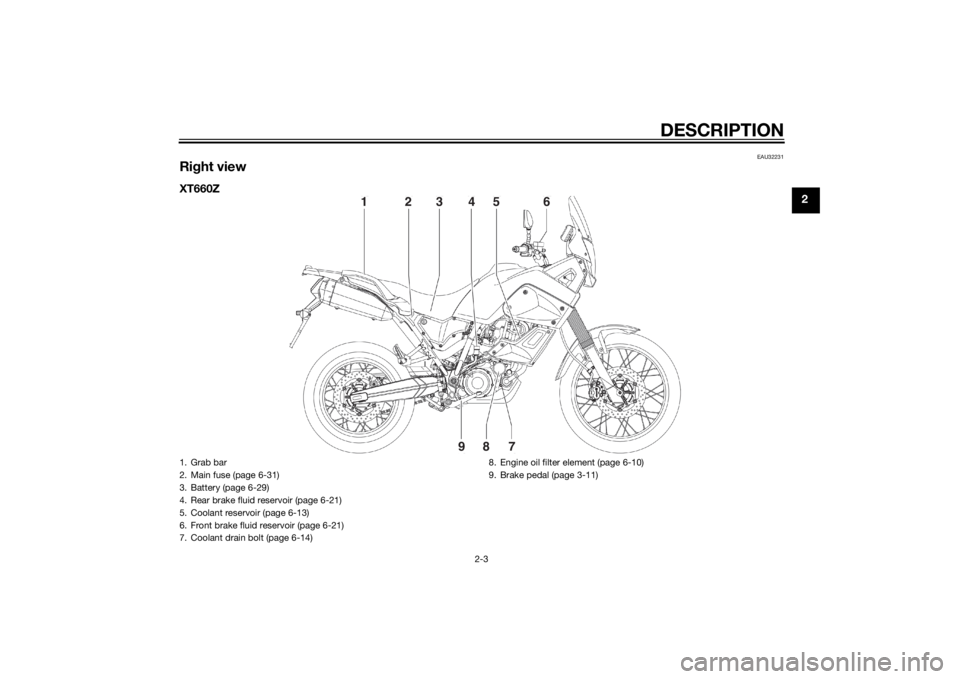
Right viewXT660Z
1
2
3
4
5
6
7
8
9
1. Grab bar
2. Main fuse (page 6-31)
3. Battery (page 6-29)
4. Rear brake fluid reservoir (page 6-21)
5. Coolant reservoir (page 6-13)
6. Front brake fluid reservoir (page 6-21)
7. Coolant drain bolt (page 6-14)8. Engine oil filter element (page 6-10)
9. Brake pedal (page 3-11)
U2BDE1E0.book Page 3 Tuesday, December 16, 2014 5:38 PM
Page 16 of 98
DESCRIPTION
2-4
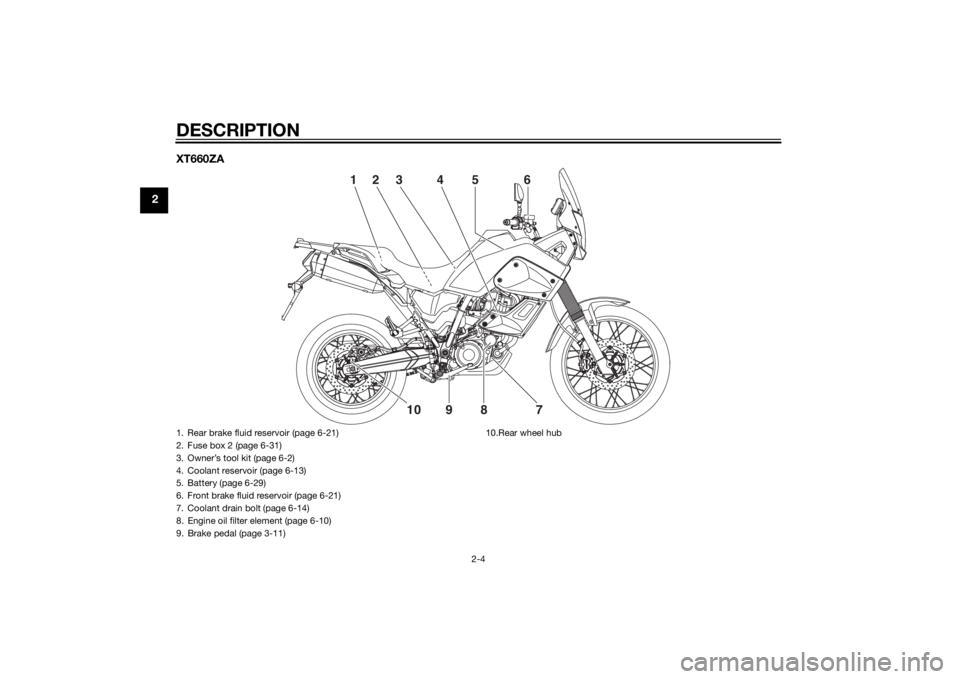
2XT660ZA
12 3 4 5 6
7 8 9 10
1. Rear brake fluid reservoir (page 6-21)
2. Fuse box 2 (page 6-31)
3. Owner’s tool kit (page 6-2)
4. Coolant reservoir (page 6-13)
5. Battery (page 6-29)
6. Front brake fluid reservoir (page 6-21)
7. Coolant drain bolt (page 6-14)
8. Engine oil filter element (page 6-10)
9. Brake pedal (page 3-11)10.Rear wheel hubU2BDE1E0.book Page 4 Tuesday, December 16, 2014 5:38 PM
Page 20 of 98
INSTRUMENT AND CONTROL FUNCTIONS
3-3
3
EAU10693
LOCK
The steering is locked, and all electrical
systems are off. The key can be re-
moved.
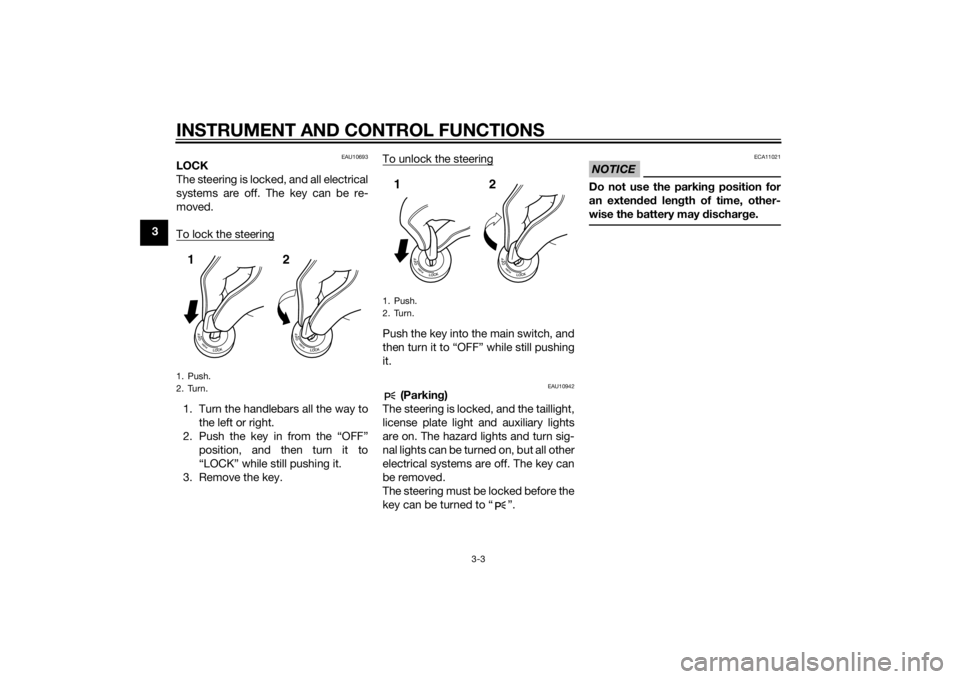
To lock the steering1. Turn the handlebars all the way to
the left or right.
2. Push the key in from the “OFF”
position, and then turn it to
“LOCK” while still pushing it.
3. Remove the key.To unlock the steering
Push the key into the main switch, and
then turn it to “OFF” while still pushing
it.
EAU10942
(Parking)
The steering is locked, and the taillight,
license plate light and auxiliary lights
are on. The hazard lights and turn sig-
nal lights can be turned on, but all other
electrical systems are off. The key can
be removed.
The steering must be locked before the
key can be turned to “ ”.
NOTICE
ECA11021
Do not use the parking position for
an extended length of time, other-
wise the battery may discharge.
1. Push.
2. Turn.12
1. Push.
2. Turn.12
U2BDE1E0.book Page 3 Tuesday, December 16, 2014 5:38 PM
Page 42 of 98
OPERATION AND IMPORTANT RIDING POINTS
5-2
5High beam indicator light
Engine trouble warning light
Coolant temperature warning
light
Immobilizer system indicator
light
ABS warning light (for ABS
model)
If a warning or indicator light does
not go off, see page 3-4 for the cor-
responding warning and indicator
light circuit check.
2. Shift the transmission into the
neutral position.TIPWhen the transmission is in the neutral
position, the neutral indicator light
should be on, otherwise have a
Yamaha dealer check the electrical cir-
cuit.3. Start the engine by pushing the
start switch.TIPIf the engine fails to start, release the
start switch, wait a few seconds, and
then try again. Each starting attempt
should be as short as possible to pre-serve the battery. Do not crank the en-
gine more than 10 seconds on any one
attempt.
TIPThe engine is warm when it quickly re-
sponds to the throttle.NOTICE
ECA11043
For maximum engine life, never ac-
celerate hard when the engine is
cold!
EAU16673
ShiftingShifting gears lets you control the
amount of engine power available for
starting off, accelerating, climbing hills,
etc.
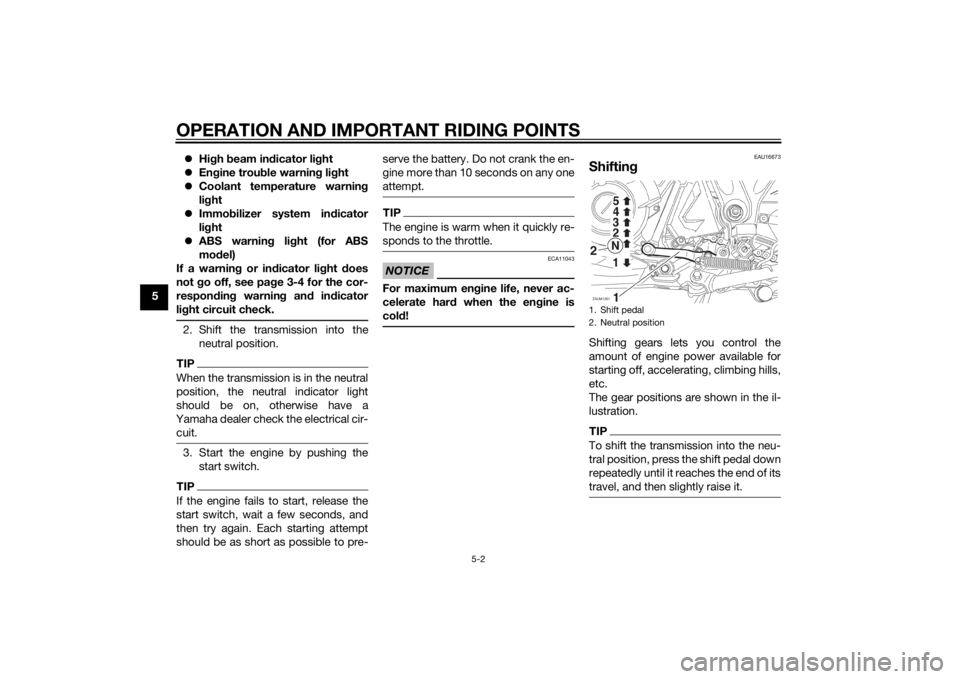
The gear positions are shown in the il-
lustration.TIPTo shift the transmission into the neu-
tral position, press the shift pedal down
repeatedly until it reaches the end of its
travel, and then slightly raise it.1. Shift pedal
2. Neutral positionZAUM12612
U2BDE1E0.book Page 2 Tuesday, December 16, 2014 5:38 PM
Page 73 of 98
PERIODIC MAINTENANCE AND ADJUSTMENT
6-29
6
EAU23292
Checking the wheel bearingsThe front and rear wheel bearings must
be checked at the intervals specified in
the periodic maintenance and lubrica-
tion chart. If there is play in the wheel
hub or if the wheel does not turn
smoothly, have a Yamaha dealer
check the wheel bearings.
EAUS1913
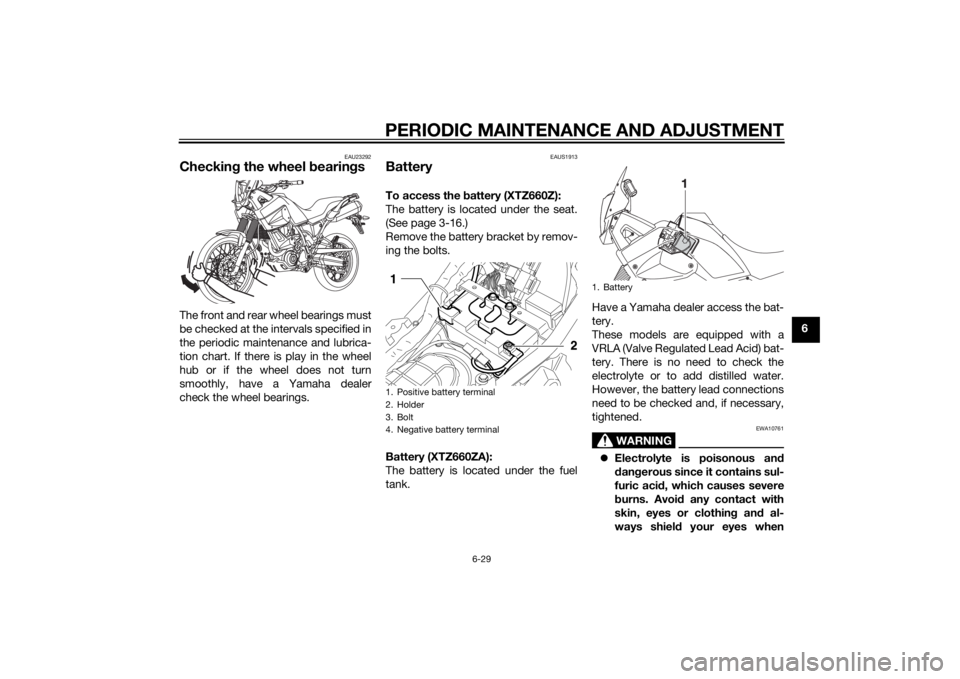
BatteryTo access the battery (XTZ660Z):
The battery is located under the seat.
(See page 3-16.)
Remove the battery bracket by remov-
ing the bolts.
Battery (XTZ660ZA):
The battery is located under the fuel
tank.Have a Yamaha dealer access the bat-
tery.
These models are equipped with a
VRLA (Valve Regulated Lead Acid) bat-
tery. There is no need to check the
electrolyte or to add distilled water.
However, the battery lead connections
need to be checked and, if necessary,
tightened.
WARNING
EWA10761
Electrolyte is poisonous and
dangerous since it contains sul-
furic acid, which causes severe
burns. Avoid any contact with
skin, eyes or clothing and al-
ways shield your eyes when
1. Positive battery terminal
2. Holder
3. Bolt
4. Negative battery terminal
1. Battery
U2BDE1E0.book Page 29 Tuesday, December 16, 2014 5:38 PM
Page 74 of 98
PERIODIC MAINTENANCE AND ADJUSTMENT
6-30
6working near batteries. In case
of contact, administer the fol-
lowing FIRST AID.
EXTERNAL: Flush with plenty
of water.
INTERNAL: Drink large quan-
tities of water or milk and im-
mediately call a physician.
EYES: Flush with water for 15
minutes and seek prompt
medical attention.
Batteries produce explosive hy-
drogen gas. Therefore, keep
sparks, flames, cigarettes, etc.,
away from the battery and pro-
vide sufficient ventilation when
charging it in an enclosed
space.
KEEP THIS AND ALL BATTER-
IES OUT OF THE REACH OF
CHILDREN.
NOTICE
ECA10621
Never attempt to remove the battery
cell seals, as this would permanently
damage the battery.
To charge the battery:
Have a Yamaha dealer charge the bat-
tery as soon as possible if it seems to
have discharged. Keep in mind that the
battery tends to discharge more quick-
ly if the vehicle is equipped with op-
tional electrical accessories.NOTICE
ECA16522
To charge a VRLA (Valve Regulated
Lead Acid) battery, a special (con-
stant-voltage) battery charger is re-
quired. Using a conventional battery
charger will damage the battery.To store the battery:
1. If the vehicle will not be used for
more than one month, remove the
battery, fully charge it, and then
place it in a cool, dry place.
NOTICE: When removing the
battery, be sure the key is
turned to “OFF”, then discon-
nect the negative lead before
disconnecting the positive lead.
[ECA16303]
2. If the battery will be stored for
more than two months, check it at
least once a month and fully
charge it if necessary.
3. Fully charge the battery before in-
stallation. NOTICE: When install-
ing the battery, be sure the key
is turned to “OFF”, then connect
the positive lead before con-
necting the negative lead.
[ECA16841]
4. After installation, make sure that
the battery leads are properly con-
nected to the battery terminals.NOTICE
ECA16531
Always keep the battery charged.
Storing a discharged battery can
cause permanent battery damage.
U2BDE1E0.book Page 30 Tuesday, December 16, 2014 5:38 PM
Page 84 of 98
PERIODIC MAINTENANCE AND ADJUSTMENT
6-40
6
EAU42706
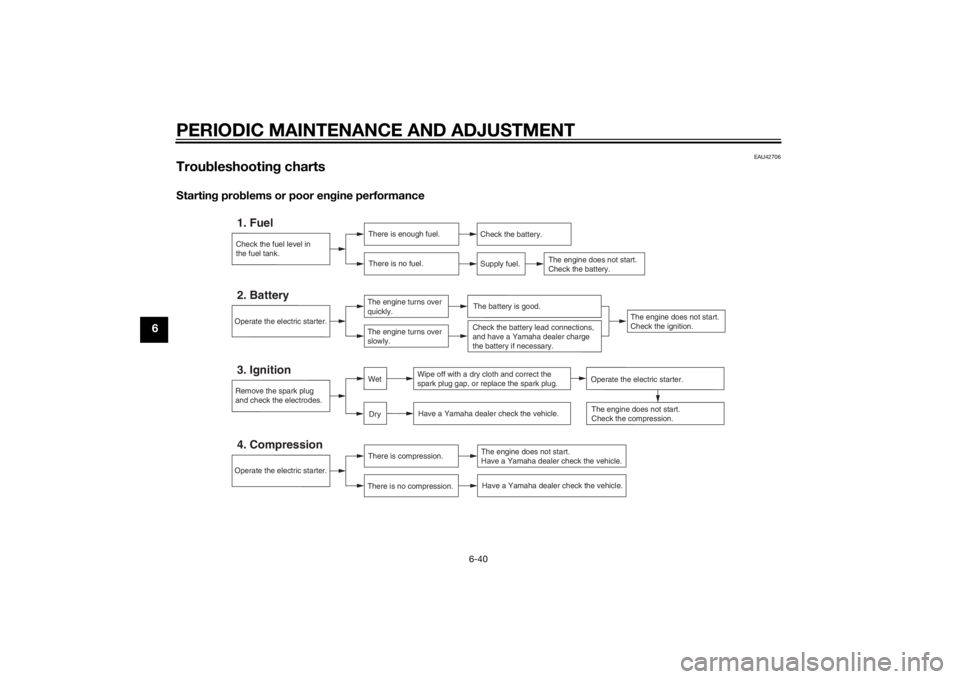
Troubleshooting chartsStarting problems or poor engine performance
Check the fuel level in
the fuel tank.1. Fuel
There is enough fuel.
There is no fuel.
Check the battery.
Supply fuel.
The engine does not start.
Check the battery.
Operate the electric starter.4. Compression
There is compression.
There is no compression.
The engine does not start.
Have a Yamaha dealer check the vehicle.Have a Yamaha dealer check the vehicle.
Remove the spark plug
and check the electrodes.3. Ignition
Wipe off with a dry cloth and correct the
spark plug gap, or replace the spark plug.
Have a Yamaha dealer check the vehicle.
The engine does not start.
Check the compression.
Operate the electric starter.2. Battery
The engine turns over
quickly.
The engine turns over
slowly.
The battery is good.
DryWet
Operate the electric starter.
Check the battery lead connections,
and have a Yamaha dealer charge
the battery if necessary.
The engine does not start.
Check the ignition.
U2BDE1E0.book Page 40 Tuesday, December 16, 2014 5:38 PM
Page 89 of 98

MOTORCYCLE CARE AND STORAGE7-4
7 2. Fill up the fuel tank and add fuel
stabilizer (if available) to prevent
the fuel tank from rusting and the
fuel from deteriorating.
3. Perform the following steps to
protect the cylinder, piston rings,
etc. from corrosion.
a. Remove the spark plug cap
and spark plug.
b. Pour a teaspoonful of engine
oil into the spark plug bore.
c. Install the spark plug cap onto
the spark plug, and then place
the spark plug on the cylinder
head so that the electrodes are
grounded. (This will limit spark-
ing during the next step.)
d. Turn the engine over several
times with the starter. (This will
coat the cylinder wall with oil.)
e. Remove the spark plug cap
from the spark plug, and then
install the spark plug and the
spark plug cap. WARNING! To
prevent damage or injury
from sparking, make sure to
ground the spark plug elec-
trodes while turning the en-
gine over.
[EWA10952]
4. Lubricate all control cables and
the pivoting points of all levers and
pedals as well as of the side-
stand/centerstand.
5. Check and, if necessary, correct
the tire air pressure, and then lift
the motorcycle so that both of its
wheels are off the ground. Alterna-
tively, turn the wheels a little every
month in order to prevent the tires
from becoming degraded in one
spot.
6. Cover the muffler outlets with
plastic bags to prevent moisture
from entering them.
7. Remove the battery and fully
charge it. Store it in a cool, dry
place and charge it once a month.
Do not store the battery in an ex-
cessively cold or warm place [less
than 0 °C (30 °F) or more than 30
°C (90 °F)]. For more information
on storing the battery, see page
6-29.TIPMake any necessary repairs before
storing the motorcycle.
U2BDE1E0.book Page 4 Tuesday, December 16, 2014 5:38 PM
Page 92 of 98

SPECIFICATIONS
8-3
8
Rear brake:Type:
Single disc brake
Operation:
Right foot operation
Specified brake fluid:
DOT 4Front suspension:Type:
Telescopic fork
Spring/shock absorber type:
Coil spring/oil damper
Wheel travel:
XT660Z 210 mm (8.3 in)
XT660ZA 160 mm (6.3 in)Rear suspension:Type:
Swingarm (link suspension)
Spring/shock absorber type:
Coil spring/gas-oil damper
Wheel travel:
XT660Z 200 mm (7.9 in)
XT660ZA 145 mm (5.7 in)Electrical system:Ignition system:
TCI
Charging system:
AC magnetoBattery:Model:
XT660Z GT9B-4
XT660ZA YTZ10SVoltage, capacity:
XT660Z 12 V, 8.0 Ah
XT660ZA 12 V, 8.6 Ah
Headlight:Bulb type:
Halogen bulbBulb voltage, wattage × quantity:Headlight:
12 V, 55.0 W × 2
Tail/brake light:
LED
Front turn signal light:
12 V, 10.0 W × 2
Rear turn signal light:
12 V, 10.0 W × 2
Auxiliary light:
12 V, 3.0 W × 2
License plate light:
12 V, 5.0 W × 1
Meter lighting:
LED
Neutral indicator light:
LED
High beam indicator light:
LED
Turn signal indicator light:
LED
Coolant temperature warning light:
LED
Engine trouble warning light:
LED
ABS warning light:
XT660ZA LEDImmobilizer system indicator light:
LED
Fuses:Main fuse:
30.0 A
Headlight fuse:
20.0 A
Signaling system fuse:
10.0 A
Ignition fuse:
10.0 A
Parking lighting fuse:
10.0 A
Radiator fan motor fuse:
7.5 A
Fuel injection system fuse:
10.0 A
ABS control unit fuse:
XT660ZA 5.0 A
ABS motor fuse:
XT660ZA 30.0 A
ABS solenoid fuse:
XT660ZA 20.0 A
Backup fuse:
10.0 A
U2BDE1E0.book Page 3 Tuesday, December 16, 2014 5:38 PM