lock YAMAHA XV1600A 2001 User Guide
[x] Cancel search | Manufacturer: YAMAHA, Model Year: 2001, Model line: XV1600A, Model: YAMAHA XV1600A 2001Pages: 104, PDF Size: 20.37 MB
Page 29 of 104
INSTRUMENT AND CONTROL FUNCTIONS
3-14
3
EAU01694*
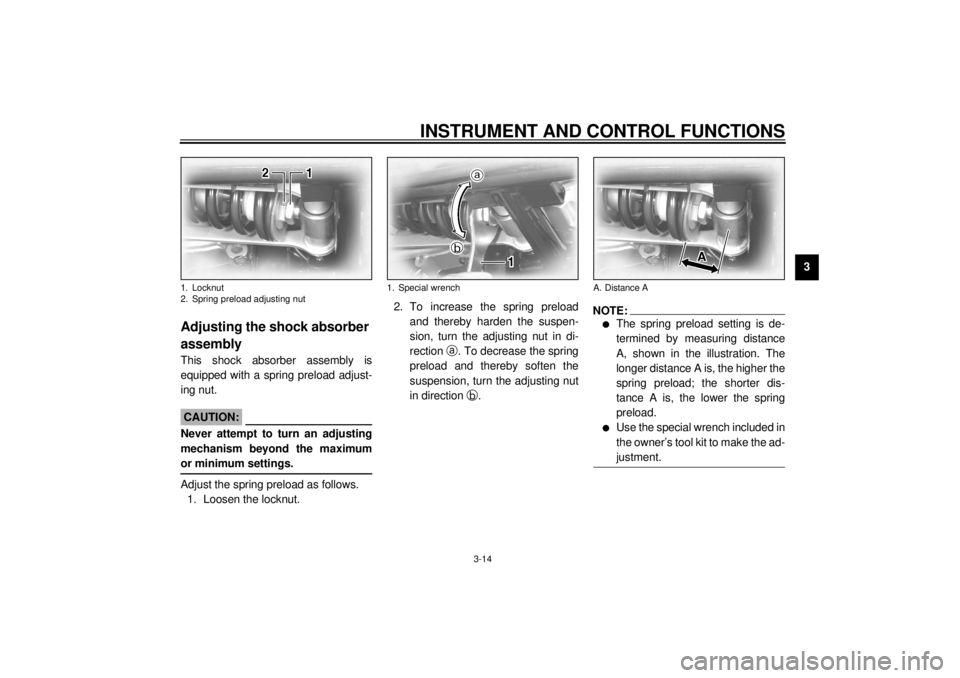
Adjusting the shock absorber
assembly This shock absorber assembly is
equipped with a spring preload adjust-
ing nut.
EC000015
CAUTION:@ Never attempt to turn an adjusting
mechanism beyond the maximum
or minimum settings. @Adjust the spring preload as follows.
1. Loosen the locknut.2. To increase the spring preload
and thereby harden the suspen-
sion, turn the adjusting nut in di-
rection
a. To decrease the spring
preload and thereby soften the
suspension, turn the adjusting nut
in direction
b.
NOTE:@ l
The spring preload setting is de-
termined by measuring distance
A, shown in the illustration. The
longer distance A is, the higher the
spring preload; the shorter dis-
tance A is, the lower the spring
preload.
l
Use the special wrench included in
the owner’s tool kit to make the ad-
justment.
@
1. Locknut
2. Spring preload adjusting nut
1. Special wrench
A. Distance A
E_5JA.book Page 14 Wednesday, September 13, 2000 6:06 PM
Page 30 of 104
INSTRUMENT AND CONTROL FUNCTIONS
3-15
33. Tighten the locknut to the speci-
fied torque.
EC000018
CAUTION:@ Always tighten the locknut against
the adjusting nut, and then tighten
the locknut to the specified torque. @
EAU00315
WARNING
@ This shock absorber contains high-
ly pressurized nitrogen gas. For
proper handling, read and under-
stand the following information be-
fore handling the shock absorber.
The manufacturer cannot be held re-
sponsible for property damage or
personal injury that may result from
improper handling.l
Do not tamper with or attempt to
open the gas cylinder.
l
Do not subject the shock ab-
sorber to an open flame or other
high heat sources, otherwise it
may explode due to excessive
gas pressure.
l
Do not deform or damage the
gas cylinder in any way, as this
will result in poor damping per-
formance.
l
Always have a Yamaha dealer
service the shock absorber.
@
EAU00330
Sidestand The sidestand is located on the left side
of the frame. Raise the sidestand or
lower it with your foot while holding the
motorcycle upright.NOTE:@ The built-in sidestand switch is part of
the ignition circuit cut-off system, which
cuts the ignition in certain situations.
(See further down for an explanation of
the ignition circuit cut-off system.) @
Spring preload:
Minimum (soft)/standard:
Distance A = 42.5 mm
Maximum (hard):
Distance A = 51.5 mm
Tightening torque:
Locknut:
35 Nm (3.5 m·kg)
E_5JA.book Page 15 Wednesday, September 13, 2000 6:06 PM
Page 66 of 104
PERIODIC MAINTENANCE AND MINOR REPAIR
6-21
6
EAU00694
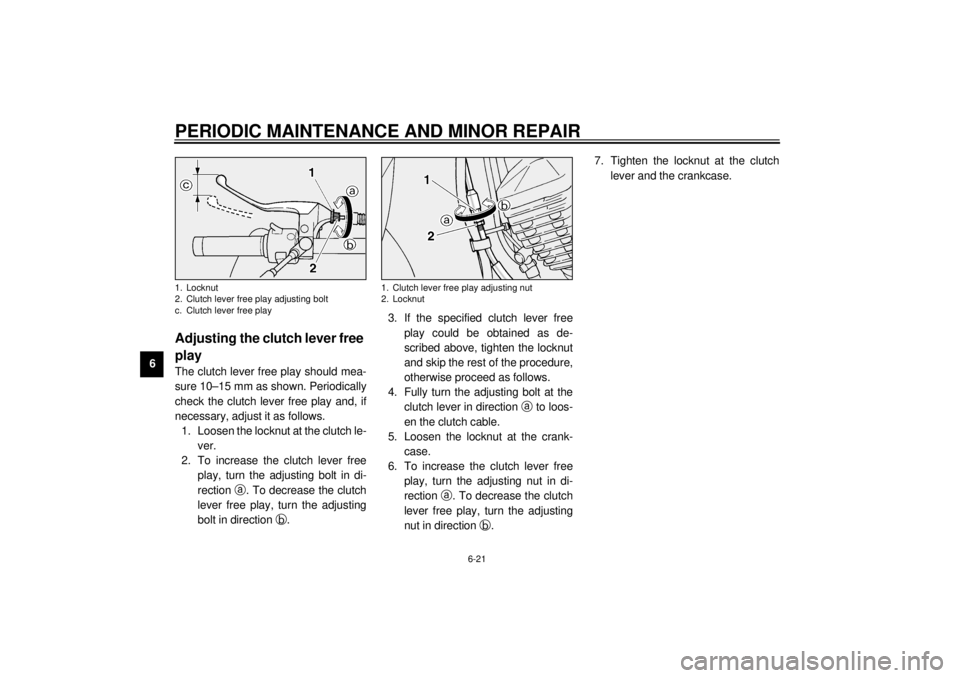
Adjusting the clutch lever free
play The clutch lever free play should mea-
sure 10–15 mm as shown. Periodically
check the clutch lever free play and, if
necessary, adjust it as follows.
1. Loosen the locknut at the clutch le-
ver.
2. To increase the clutch lever free
play, turn the adjusting bolt in di-
rection
a. To decrease the clutch
lever free play, turn the adjusting
bolt in direction
b.3. If the specified clutch lever free
play could be obtained as de-
scribed above, tighten the locknut
and skip the rest of the procedure,
otherwise proceed as follows.
4. Fully turn the adjusting bolt at the
clutch lever in direction
a to loos-
en the clutch cable.
5. Loosen the locknut at the crank-
case.
6. To increase the clutch lever free
play, turn the adjusting nut in di-
rection
a. To decrease the clutch
lever free play, turn the adjusting
nut in direction
b.7. Tighten the locknut at the clutch
lever and the crankcase.1. Locknut
2. Clutch lever free play adjusting bolt
c. Clutch lever free play
1. Clutch lever free play adjusting nut
2. Locknut
E_5JA.book Page 21 Wednesday, September 13, 2000 6:06 PM
Page 67 of 104
PERIODIC MAINTENANCE AND MINOR REPAIR
6-22
6
EAU00696
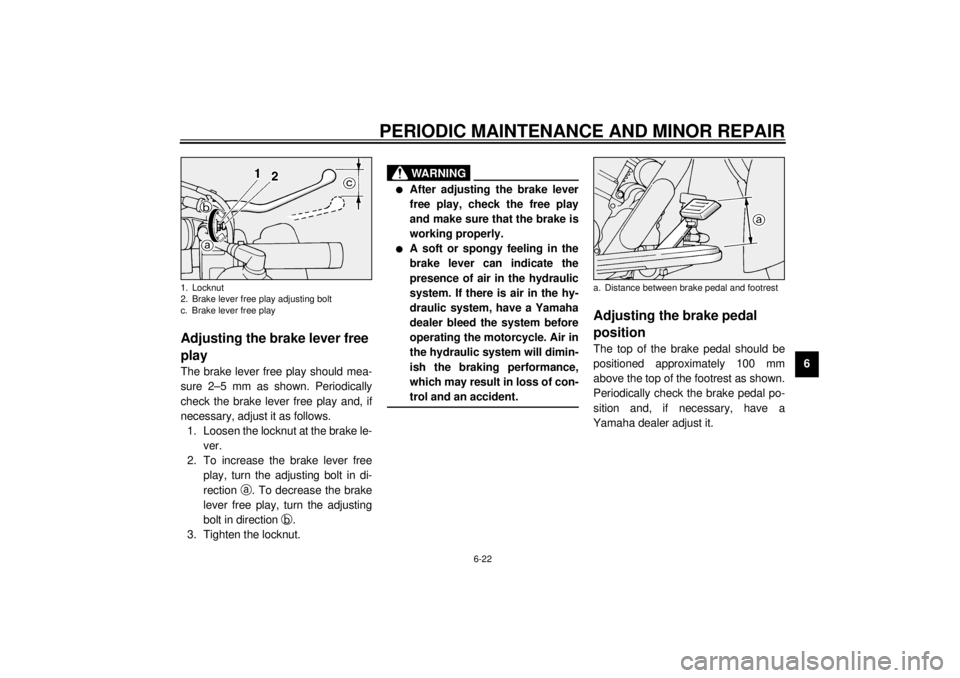
Adjusting the brake lever free
play The brake lever free play should mea-
sure 2–5 mm as shown. Periodically
check the brake lever free play and, if
necessary, adjust it as follows.
1. Loosen the locknut at the brake le-
ver.
2. To increase the brake lever free
play, turn the adjusting bolt in di-
rection
a. To decrease the brake
lever free play, turn the adjusting
bolt in direction
b.
3. Tighten the locknut.
EW000099
WARNING
@ l
After adjusting the brake lever
free play, check the free play
and make sure that the brake is
working properly.
l
A soft or spongy feeling in the
brake lever can indicate the
presence of air in the hydraulic
system. If there is air in the hy-
draulic system, have a Yamaha
dealer bleed the system before
operating the motorcycle. Air in
the hydraulic system will dimin-
ish the braking performance,
which may result in loss of con-
trol and an accident.
@
EAU01746
Adjusting the brake pedal
position The top of the brake pedal should be
positioned approximately 100 mm
above the top of the footrest as shown.
Periodically check the brake pedal po-
sition and, if necessary, have a
Yamaha dealer adjust it.
1. Locknut
2. Brake lever free play adjusting bolt
c. Brake lever free play
a. Distance between brake pedal and footrest
E_5JA.book Page 22 Wednesday, September 13, 2000 6:06 PM
Page 70 of 104
PERIODIC MAINTENANCE AND MINOR REPAIR
6-25
6
EAU03196
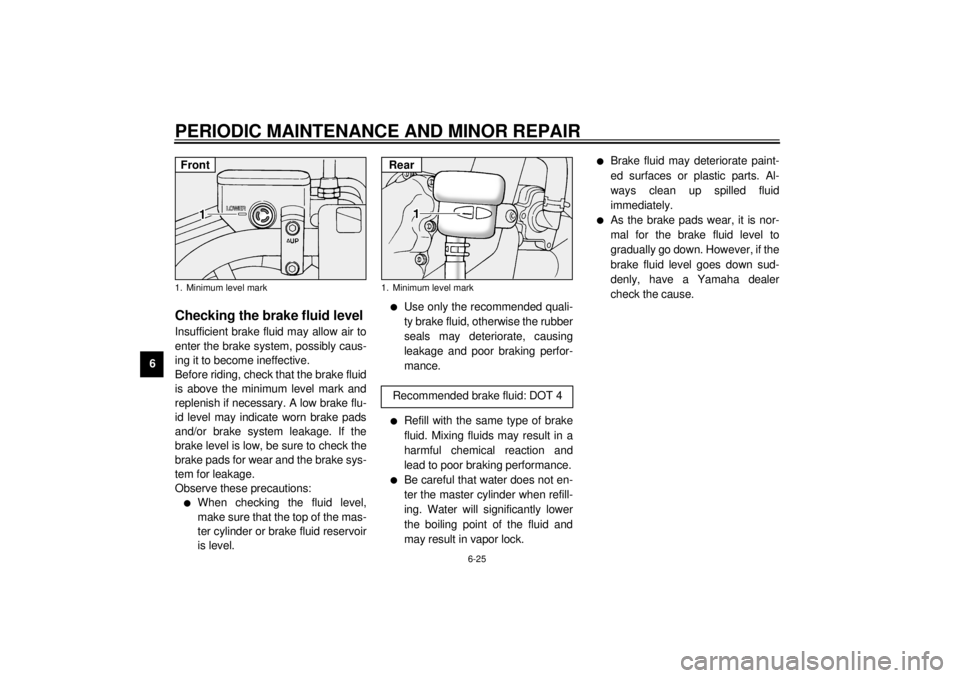
Checking the brake fluid level Insufficient brake fluid may allow air to
enter the brake system, possibly caus-
ing it to become ineffective.
Before riding, check that the brake fluid
is above the minimum level mark and
replenish if necessary. A low brake flu-
id level may indicate worn brake pads
and/or brake system leakage. If the
brake level is low, be sure to check the
brake pads for wear and the brake sys-
tem for leakage.
Observe these precautions:l
When checking the fluid level,
make sure that the top of the mas-
ter cylinder or brake fluid reservoir
is level.
l
Use only the recommended quali-
ty brake fluid, otherwise the rubber
seals may deteriorate, causing
leakage and poor braking perfor-
mance.
l
Refill with the same type of brake
fluid. Mixing fluids may result in a
harmful chemical reaction and
lead to poor braking performance.
l
Be careful that water does not en-
ter the master cylinder when refill-
ing. Water will significantly lower
the boiling point of the fluid and
may result in vapor lock.
l
Brake fluid may deteriorate paint-
ed surfaces or plastic parts. Al-
ways clean up spilled fluid
immediately.
l
As the brake pads wear, it is nor-
mal for the brake fluid level to
gradually go down. However, if the
brake fluid level goes down sud-
denly, have a Yamaha dealer
check the cause.
1. Minimum level markFront
1. Minimum level mark
Recommended brake fluid: DOT 4Rear
E_5JA.book Page 25 Wednesday, September 13, 2000 6:06 PM
Page 72 of 104
PERIODIC MAINTENANCE AND MINOR REPAIR
6-27
65. If the drive belt slack is incorrect,
adjust it as follows.
EAU01748
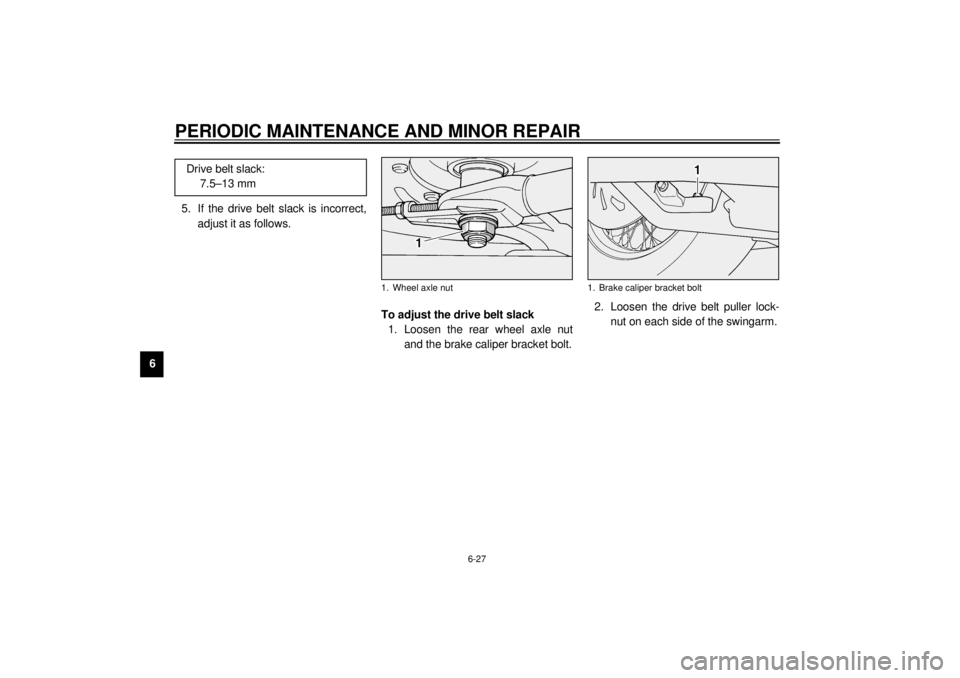
To adjust the drive belt slack
1. Loosen the rear wheel axle nut
and the brake caliper bracket bolt.2. Loosen the drive belt puller lock-
nut on each side of the swingarm. Drive belt slack:
7.5–13 mm1. Wheel axle nut
1. Brake caliper bracket bolt
E_5JA.book Page 27 Wednesday, September 13, 2000 6:06 PM
Page 73 of 104
PERIODIC MAINTENANCE AND MINOR REPAIR
6-28
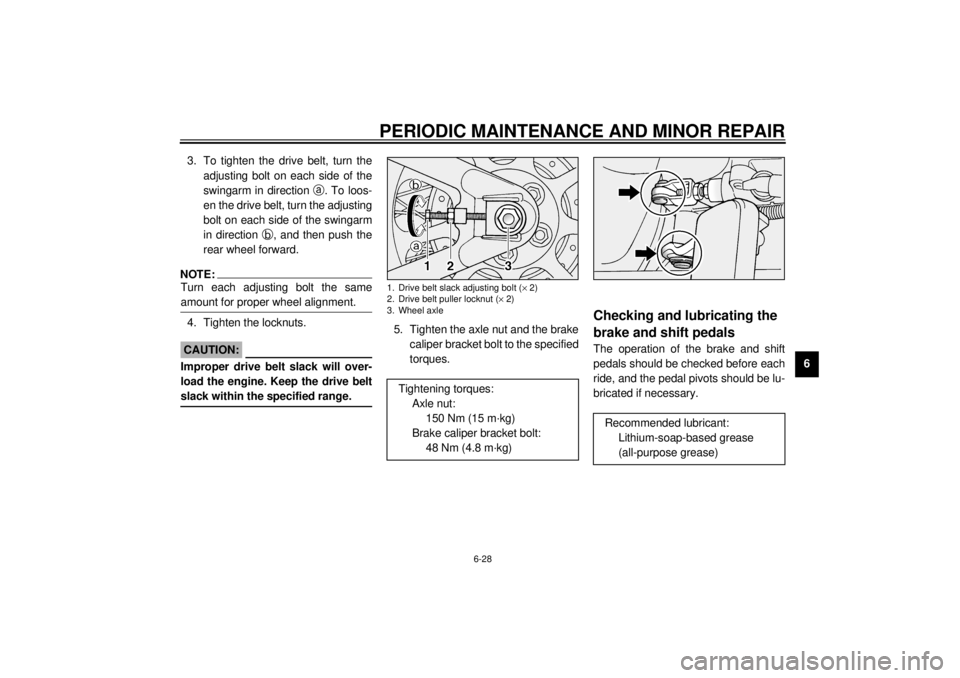
6 3. To tighten the drive belt, turn the
adjusting bolt on each side of the
swingarm in direction
a. To loos-
en the drive belt, turn the adjusting
bolt on each side of the swingarm
in direction
b, and then push the
rear wheel forward.
NOTE:@ Turn each adjusting bolt the same
amount for proper wheel alignment. @4. Tighten the locknuts.
ECA00025
CAUTION:@ Improper drive belt slack will over-
load the engine. Keep the drive belt
slack within the specified range. @
5. Tighten the axle nut and the brake
caliper bracket bolt to the specified
torques.
EAU03370
Checking and lubricating the
brake and shift pedals The operation of the brake and shift
pedals should be checked before each
ride, and the pedal pivots should be lu-
bricated if necessary.
1. Drive belt slack adjusting bolt (´ 2)
2. Drive belt puller locknut (´ 2)
3. Wheel axleTightening torques:
Axle nut:
150 Nm (15 m·kg)
Brake caliper bracket bolt:
48 Nm (4.8 m·kg)
Recommended lubricant:
Lithium-soap-based grease
(all-purpose grease)
E_5JA.book Page 28 Wednesday, September 13, 2000 6:06 PM
Page 82 of 104
PERIODIC MAINTENANCE AND MINOR REPAIR
6-37
6
EAU00855
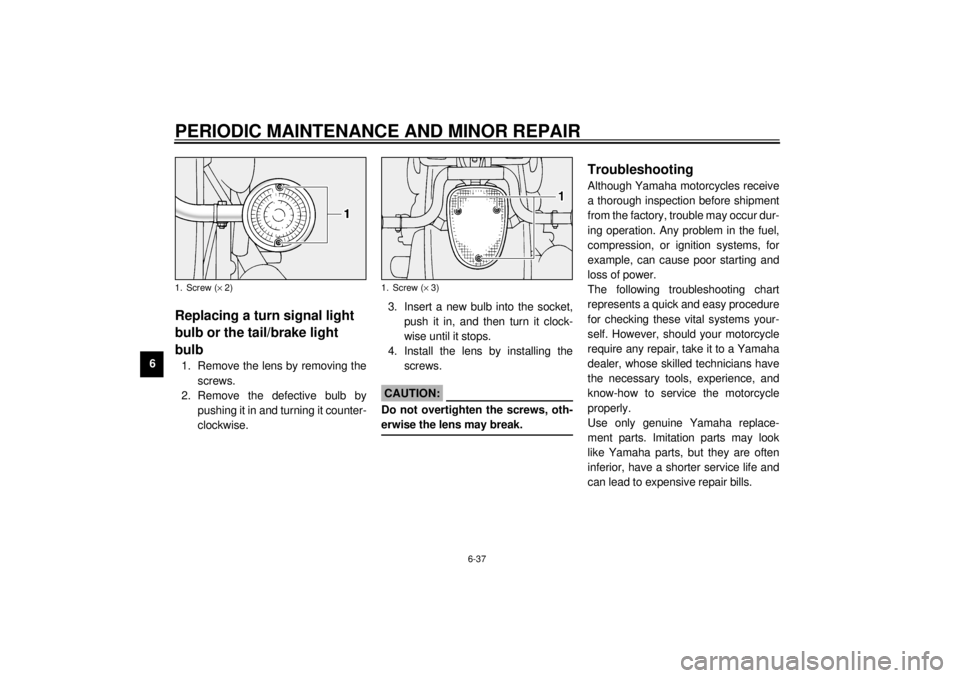
Replacing a turn signal light
bulb or the tail/brake light
bulb 1. Remove the lens by removing the
screws.
2. Remove the defective bulb by
pushing it in and turning it counter-
clockwise.3. Insert a new bulb into the socket,
push it in, and then turn it clock-
wise until it stops.
4. Install the lens by installing the
screws.
EC000108
CAUTION:@ Do not overtighten the screws, oth-
erwise the lens may break. @
EAU01008
Troubleshooting Although Yamaha motorcycles receive
a thorough inspection before shipment
from the factory, trouble may occur dur-
ing operation. Any problem in the fuel,
compression, or ignition systems, for
example, can cause poor starting and
loss of power.
The following troubleshooting chart
represents a quick and easy procedure
for checking these vital systems your-
self. However, should your motorcycle
require any repair, take it to a Yamaha
dealer, whose skilled technicians have
the necessary tools, experience, and
know-how to service the motorcycle
properly.
Use only genuine Yamaha replace-
ment parts. Imitation parts may look
like Yamaha parts, but they are often
inferior, have a shorter service life and
can lead to expensive repair bills.
1. Screw (´ 2)
1. Screw (´ 3)
E_5JA.book Page 37 Wednesday, September 13, 2000 6:06 PM
Page 100 of 104
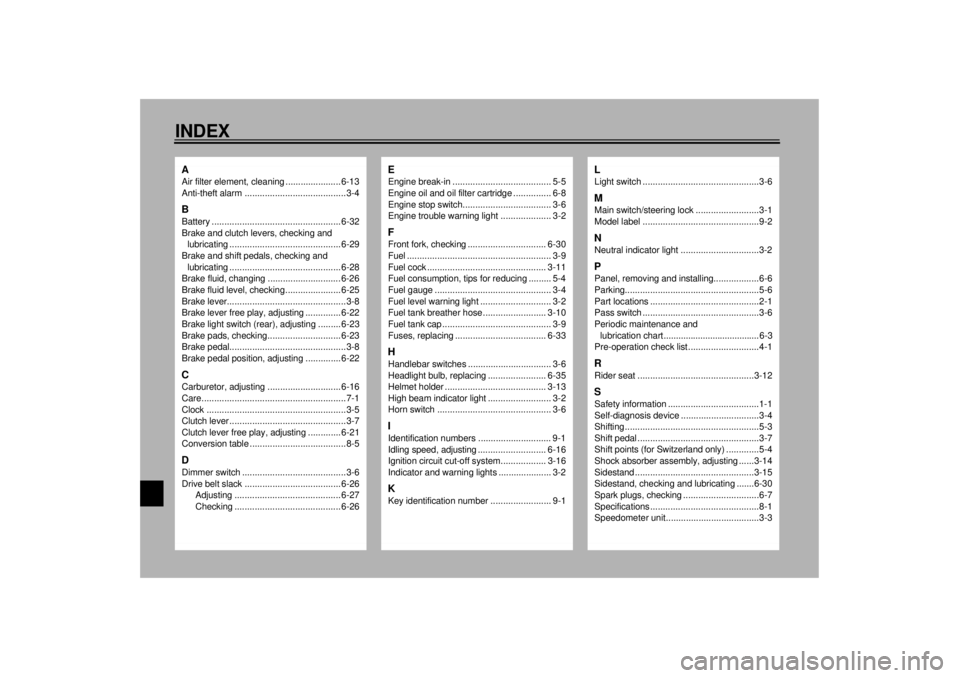
10-INDEXAAir filter element, cleaning ...................... 6-13
Anti-theft alarm ........................................3-4BBattery ................................................... 6-32
Brake and clutch levers, checking and
lubricating ............................................ 6-29
Brake and shift pedals, checking and
lubricating ............................................ 6-28
Brake fluid, changing ............................. 6-26
Brake fluid level, checking...................... 6-25
Brake lever...............................................3-8
Brake lever free play, adjusting .............. 6-22
Brake light switch (rear), adjusting ......... 6-23
Brake pads, checking............................. 6-23
Brake pedal..............................................3-8
Brake pedal position, adjusting .............. 6-22CCarburetor, adjusting ............................. 6-16
Care.........................................................7-1
Clock .......................................................3-5
Clutch lever ..............................................3-7
Clutch lever free play, adjusting ............. 6-21
Conversion table ......................................8-5DDimmer switch .........................................3-6
Drive belt slack ...................................... 6-26
Adjusting .......................................... 6-27
Checking .......................................... 6-26
EEngine break-in ....................................... 5-5
Engine oil and oil filter cartridge ............... 6-8
Engine stop switch................................... 3-6
Engine trouble warning light .................... 3-2FFront fork, checking ............................... 6-30
Fuel ......................................................... 3-9
Fuel cock ............................................... 3-11
Fuel consumption, tips for reducing ......... 5-4
Fuel gauge .............................................. 3-4
Fuel level warning light ............................ 3-2
Fuel tank breather hose ......................... 3-10
Fuel tank cap ........................................... 3-9
Fuses, replacing .................................... 6-33HHandlebar switches ................................. 3-6
Headlight bulb, replacing ....................... 6-35
Helmet holder ........................................ 3-13
High beam indicator light ......................... 3-2
Horn switch ............................................. 3-6IIdentification numbers ............................. 9-1
Idling speed, adjusting ........................... 6-16
Ignition circuit cut-off system.................. 3-16
Indicator and warning lights ..................... 3-2KKey identification number ........................ 9-1
LLight switch ..............................................3-6MMain switch/steering lock .........................3-1
Model label ..............................................9-2NNeutral indicator light ...............................3-2PPanel, removing and installing..................6-6
Parking.....................................................5-6
Part locations ...........................................2-1
Pass switch ..............................................3-6
Periodic maintenance and
lubrication chart ....................................... 6-3
Pre-operation check list ............................4-1RRider seat ..............................................3-12SSafety information ....................................1-1
Self-diagnosis device ...............................3-4
Shifting .....................................................5-3
Shift pedal ................................................3-7
Shift points (for Switzerland only) .............5-4
Shock absorber assembly, adjusting ......3-14
Sidestand ...............................................3-15
Sidestand, checking and lubricating .......6-30
Spark plugs, checking ..............................6-7
Specifications ...........................................8-1
Speedometer unit.....................................3-3
E_5JA.book Page 1 Wednesday, September 13, 2000 6:06 PM
Page 101 of 104
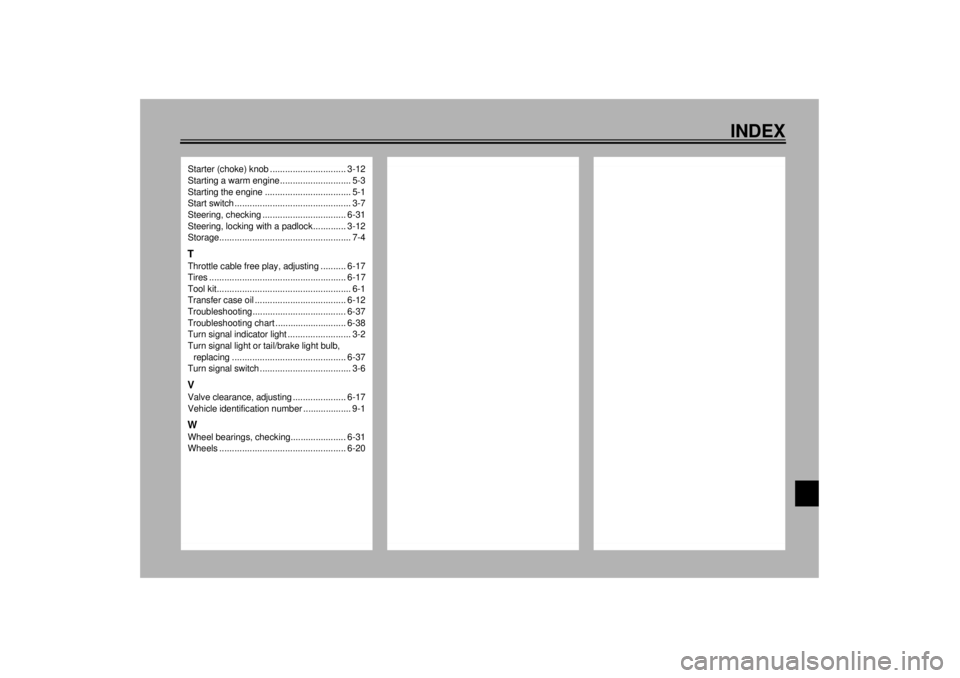
INDEX
Starter (choke) knob .............................. 3-12
Starting a warm engine ............................ 5-3
Starting the engine .................................. 5-1
Start switch .............................................. 3-7
Steering, checking ................................. 6-31
Steering, locking with a padlock............. 3-12
Storage.................................................... 7-4TThrottle cable free play, adjusting .......... 6-17
Tires ...................................................... 6-17
Tool kit..................................................... 6-1
Transfer case oil .................................... 6-12
Troubleshooting..................................... 6-37
Troubleshooting chart ............................ 6-38
Turn signal indicator light ......................... 3-2
Turn signal light or tail/brake light bulb,
replacing ............................................. 6-37
Turn signal switch .................................... 3-6VValve clearance, adjusting ..................... 6-17
Vehicle identification number ................... 9-1WWheel bearings, checking...................... 6-31
Wheels .................................................. 6-20
E_5JA.book Page 2 Wednesday, September 13, 2000 6:06 PM