key YAMAHA XV1900A 2012 User Guide
[x] Cancel search | Manufacturer: YAMAHA, Model Year: 2012, Model line: XV1900A, Model: YAMAHA XV1900A 2012Pages: 88, PDF Size: 1.91 MB
Page 26 of 88
INSTRUMENT AND CONTROL FUNCTIONS
3-11
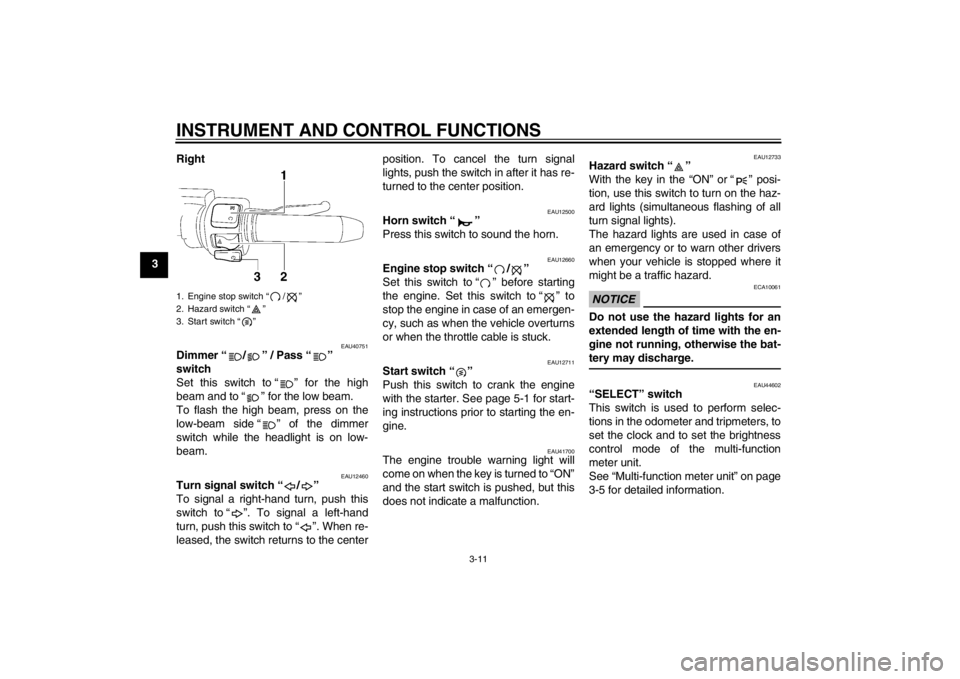
3Right
EAU40751
Dimmer “ / ” / Pass “ ”
switch
Set this switch to “ ” for the high
beam and to “ ” for the low beam.
To flash the high beam, press on the
low-beam side “ ” of the dimmer
switch while the headlight is on low-
beam.
EAU12460
Turn signal switch “ / ”
To signal a right-hand turn, push this
switch to “ ”. To signal a left-hand
turn, push this switch to “ ”. When re-
leased, the switch returns to the center position. To cancel the turn signal
lights, push the switch in after it has re-
turned to the center position.
EAU12500
Horn switch “ ”
Press this switch to sound the horn.
EAU12660
Engine stop switch “ / ”
Set this switch to “ ” before starting
the engine. Set this switch to “ ” to
stop the engine in case of an emergen-
cy, such as when the vehicle overturns
or when the throttle cable is stuck.
EAU12711
Start switch “ ”
Push this switch to crank the engine
with the starter. See page 5-1 for start-
ing instructions prior to starting the en-
gine.
EAU41700
The engine trouble warning light will
come on when the key is turned to “ON”
and the start switch is pushed, but this
does not indicate a malfunction.
EAU12733
Hazard switch “ ”
With the key in the “ON” or “ ” posi-
tion, use this switch to turn on the haz-
ard lights (simultaneous flashing of all
turn signal lights).
The hazard lights are used in case of
an emergency or to warn other drivers
when your vehicle is stopped where it
might be a traffic hazard.NOTICE
ECA10061
Do not use the hazard lights for an
extended length of time with the en-
gine not running, otherwise the bat-
tery may discharge.
EAU44602
“SELECT” switch
This switch is used to perform selec-
tions in the odometer and tripmeters, to
set the clock and to set the brightness
control mode of the multi-function
meter unit.
See “Multi-function meter unit” on page
3-5 for detailed information.
1. Engine stop switch “ / ”
2. Hazard switch “ ”
3. Start switch “ ”U1CRE1E0.book Page 11 Monday, October 3, 2011 8:45 AM
Page 28 of 88
INSTRUMENT AND CONTROL FUNCTIONS
3-13
3
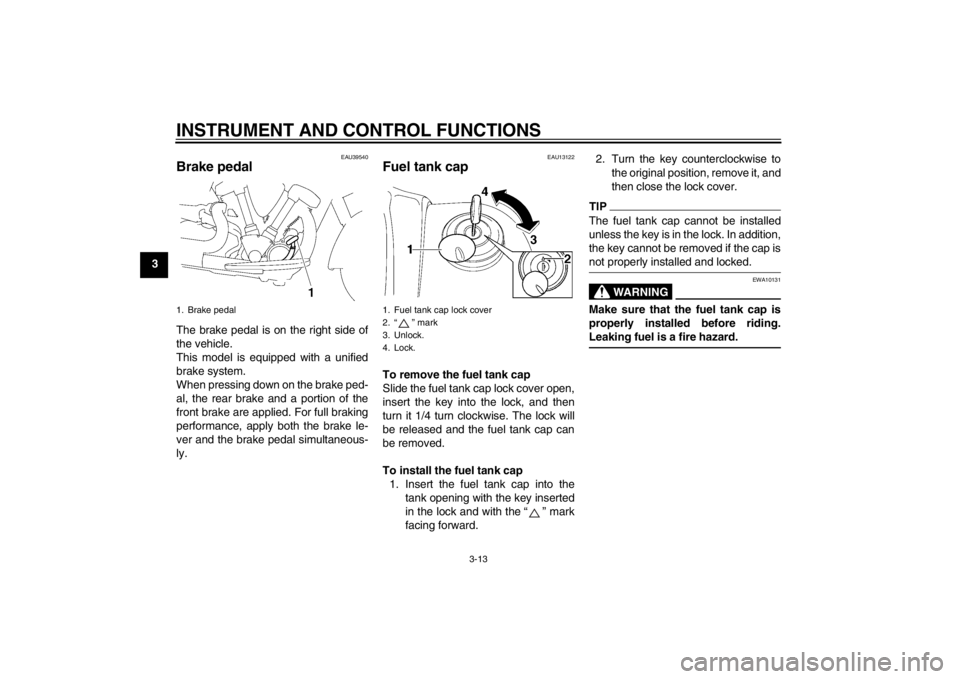
EAU39540
Brake pedal The brake pedal is on the right side of
the vehicle.
This model is equipped with a unified
brake system.
When pressing down on the brake ped-
al, the rear brake and a portion of the
front brake are applied. For full braking
performance, apply both the brake le-
ver and the brake pedal simultaneous-
ly.
EAU13122
Fuel tank cap To remove the fuel tank cap
Slide the fuel tank cap lock cover open,
insert the key into the lock, and then
turn it 1/4 turn clockwise. The lock will
be released and the fuel tank cap can
be removed.
To install the fuel tank cap1. Insert the fuel tank cap into the tank opening with the key inserted
in the lock and with the “ ” mark
facing forward. 2. Turn the key counterclockwise to
the original position, remove it, and
then close the lock cover.
TIPThe fuel tank cap cannot be installed
unless the key is in the lock. In addition,
the key cannot be removed if the cap is
not properly installed and locked.
WARNING
EWA10131
Make sure that the fuel tank cap is
properly installed before riding.
Leaking fuel is a fire hazard.
1. Brake pedal
1. Fuel tank cap lock cover
2. “ ” mark
3. Unlock.
4. Lock.
U1CRE1E0.book Page 13 Monday, October 3, 2011 8:45 AM
Page 31 of 88
INSTRUMENT AND CONTROL FUNCTIONS
3-16
3
NOTICE
ECA10701
Use only unleaded gasoline. The use
of leaded gasoline will cause unre-
pairable damage to the catalytic
converter.
EAU34042
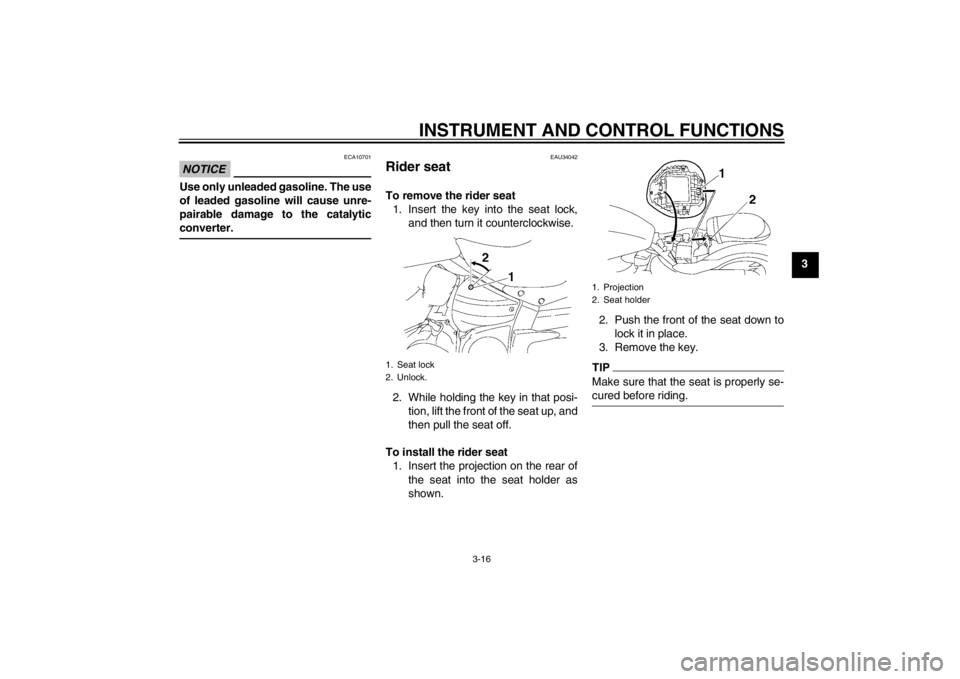
Rider seat To remove the rider seat1. Insert the key into the seat lock, and then turn it counterclockwise.
2. While holding the key in that posi- tion, lift the front of the seat up, and
then pull the seat off.
To install the rider seat 1. Insert the projection on the rear of the seat into the seat holder as
shown. 2. Push the front of the seat down to
lock it in place.
3. Remove the key.
TIPMake sure that the seat is properly se-
cured before riding.
1. Seat lock
2. Unlock.
1. Projection
2. Seat holder
U1CRE1E0.book Page 16 Monday, October 3, 2011 8:45 AM
Page 36 of 88
INSTRUMENT AND CONTROL FUNCTIONS
3-21
3
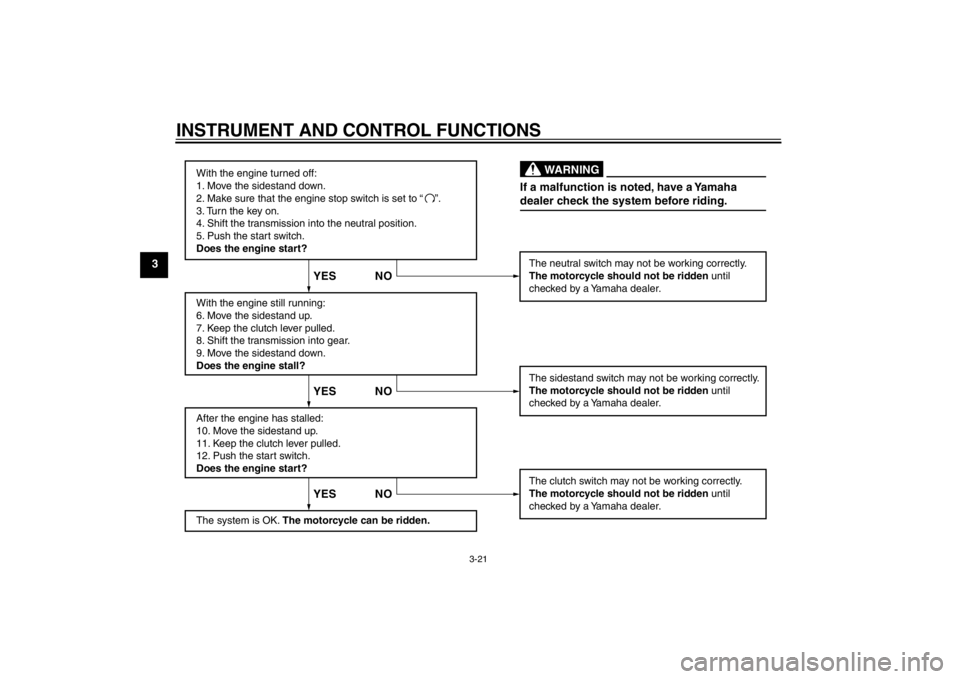
With the engine turned off:
1. Move the sidestand down.
2. Make sure that the engine stop switch is set to “
3. Turn the key on.
4. Shift the transmission into the neutral position.
5. Push the start switch.
Does the engine start?
With the engine still running:
6. Move the sidestand up.
7. Keep the clutch lever pulled.
8. Shift the transmission into gear.
9. Move the sidestand down.
Does the engine stall?
After the engine has stalled:
10. Move the sidestand up.
11. Keep the clutch lever pulled.
12. Push the start switch.
Does the engine start?
The system is OK. The motorcycle can be ridden.The neutral switch may not be working correctly.
The motorcycle should not be ridden until
checked by a Yamaha dealer.
The sidestand switch may not be working correctly.
The motorcycle should not be ridden until
checked by a Yamaha dealer.
The clutch switch may not be working correctly.
The motorcycle should not be ridden until
checked by a Yamaha dealer.
YES NO YES NO YES NO
If a malfunction is noted, have a Yamaha
dealer check the system before riding.
WARNING
”.
U1CRE1E0.book Page 21 Monday, October 3, 2011 8:45 AM
Page 37 of 88
INSTRUMENT AND CONTROL FUNCTIONS
3-22
3
EAU38354
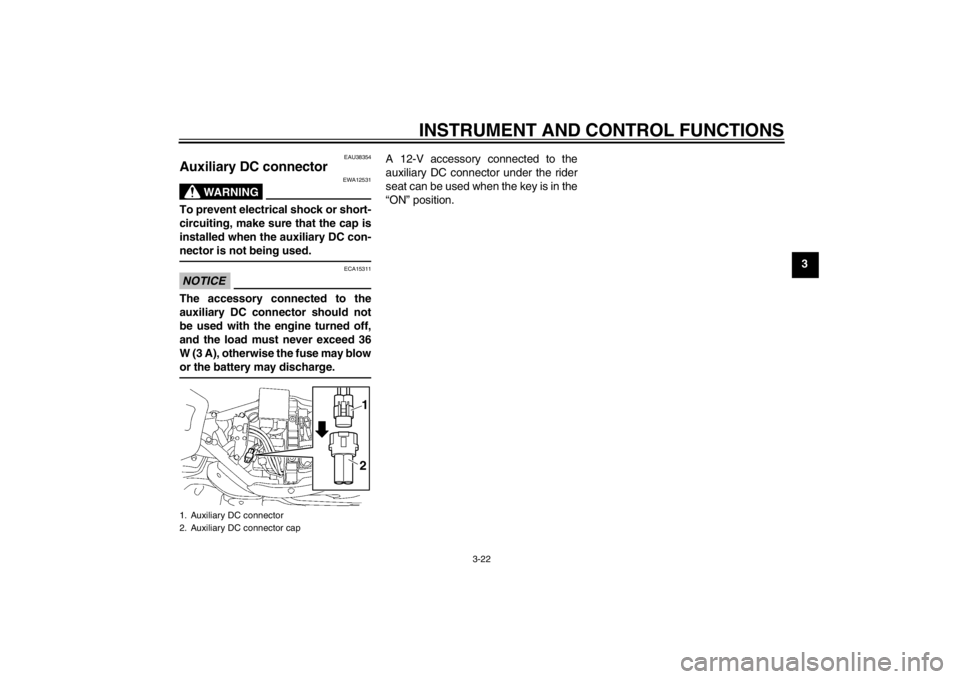
Auxiliary DC connector
WARNING
EWA12531
To prevent electrical shock or short-
circuiting, make sure that the cap is
installed when the auxiliary DC con-
nector is not being used.NOTICE
ECA15311
The accessory connected to the
auxiliary DC connector should not
be used with the engine turned off,
and the load must never exceed 36
W (3 A), otherwise the fuse may blow
or the battery may discharge.
A 12-V accessory connected to the
auxiliary DC connector under the rider
seat can be used when the key is in the
“ON” position.
1. Auxiliary DC connector
2. Auxiliary DC connector cap
21
U1CRE1E0.book Page 22 Monday, October 3, 2011 8:45 AM
Page 41 of 88
OPERATION AND IMPORTANT RIDING POINTS
5-1
5
EAU15951
Read the Owner’s Manual carefully to
become familiar with all controls. If
there is a control or function you do not
understand, ask your Yamaha dealer.
WARNING
EWA10271
Failure to familiarize yourself with
the controls can lead to loss of con-
trol, which could cause an accident
or injury.
EAU47150
TIPThis model is equipped with:●
a lean angle sensor to stop the en-
gine in case of a turnover. In this
case, the multi-function meter unit
indicates error code 30, but this is
not a malfunction. Turn the key to
“OFF” and then to “ON” to clear the
error code. Failing to do so will pre-
vent the engine from starting even
though the engine will crank when
pushing the start switch.
●
an engine auto-stop system. The
engine stops automatically if left
idling for 20 minutes. In this case,
the multi-function meter unit indi-
cates error code 70, but this is not
a malfunction. Push the start
switch to clear the error code and
to restart the engine.
EAU36745
Starting the engine In order for the ignition circuit cut-off
system to enable starting, one of the
following conditions must be met:●
The transmission is in the neutral
position.
●
The transmission is in gear with
the clutch lever pulled and the
sidestand up.
See page 3-20 for more informa-
tion.
1. Turn the key to “ON” and make sure that the engine stop switch is
set to “ ”.
The following warning lights and
indicator light should come on for a
few seconds, then go off.●
Fuel level warning light
●
Engine trouble warning light
●
Immobilizer system indicator
light
NOTICE
ECA11833
If a warning or indicator light does
not come on initially when the key is
turned to “ON”, or if a warning or in-
U1CRE1E0.book Page 1 Mond ay, October 3, 2011 8:45 AM
Page 44 of 88
OPERATION AND IMPORTANT RIDING POINTS
5-4
5
EAU17213
Parking When parking, stop the engine, and
then remove the key from the main
switch.
WARNING
EWA10311
●
Since the engine and exhaust
system can become very hot,
park in a place where pedestri-
ans or children are not likely to
touch them and be burned.
●
Do not park on a slope or on soft
ground, otherwise the vehicle
may overturn, increasing the
risk of a fuel leak and fire.
●
Do not park near grass or other
flammable materials which
might catch fire.
U1CRE1E0.book Page 4 Monday, October 3, 2011 8:45 AM
Page 69 of 88
PERIODIC MAINTENANCE AND ADJUSTMENT
6-25
6
battery tends to discharge more quickly
if the vehicle is equipped with optional
electrical accessories.
NOTICE
ECA16521
To charge a VRLA (Valve Regulated
Lead Acid) battery, a special (con-
stant-voltage) battery charger is re-
quired. Using a conventional battery
charger will damage the battery.To store the battery
1. If the vehicle will not be used for more than one month, remove the
battery, fully charge it, and then
place it in a cool, dry place.
NOTICE: When removing the battery, be sure the key is
turned to “OFF”, then discon-
nect the negative lead before
disconnecting the positive lead.
[ECA16302]
2. If the battery will be stored for more than two months, check it at least
once a month and fully charge it if
necessary.
3. Fully charge the battery before in- stallation. NOTICE: When install-
ing the battery, be sure the key is turned to “OFF”, then con-
nect the positive lead before
connecting the negative lead.
[ECA16840]
4. After installation, make sure that
the battery leads are properly con-
nected to the battery terminals.NOTICE
ECA16530
Always keep the battery charged.
Storing a discharged battery can
cause permanent battery damage.
EAU38373
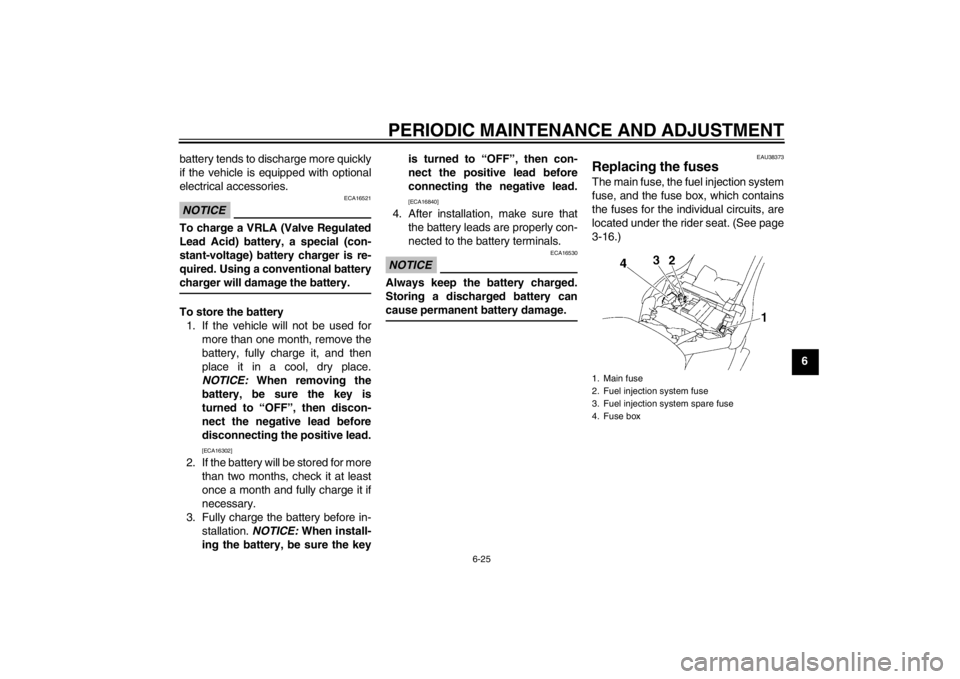
Replacing the fuses The main fuse, the fuel injection system
fuse, and the fuse box, which contains
the fuses for the individual circuits, are
located under the rider seat. (See page
3-16.)1. Main fuse
2. Fuel injection system fuse
3. Fuel injection system spare fuse
4. Fuse box
U1CRE1E0.book Page 25 Monday, October 3, 2011 8:45 AM
Page 70 of 88
PERIODIC MAINTENANCE AND ADJUSTMENT
6-26
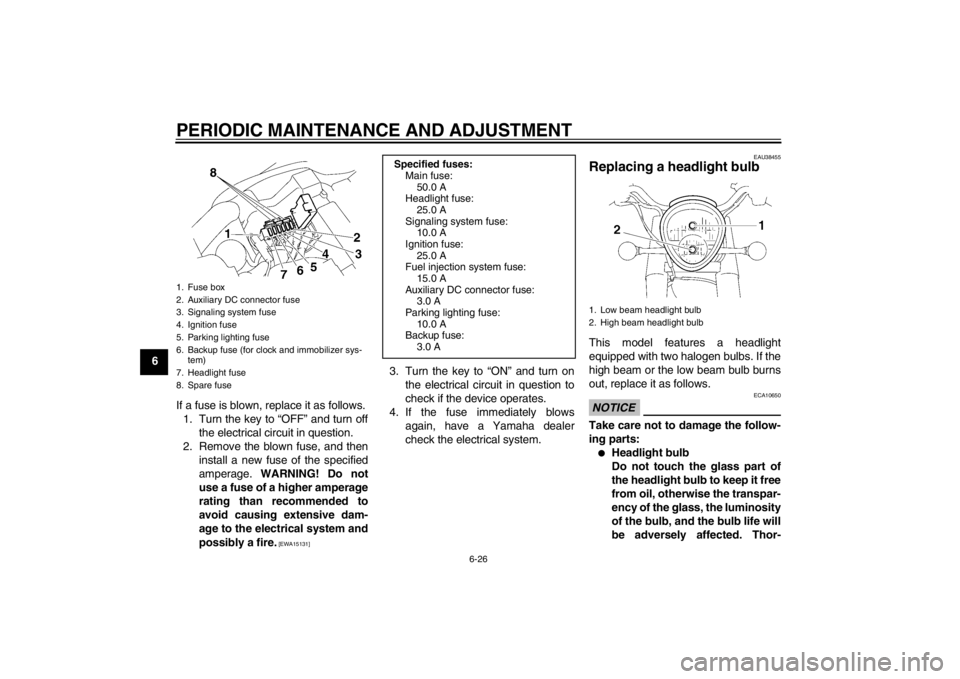
6If a fuse is blown, replace it as follows.1. Turn the key to “OFF” and turn off the electrical circuit in question.
2. Remove the blown fuse, and then install a new fuse of the specified
amperage. WARNING! Do not
use a fuse of a higher amperage
rating than recommended to
avoid causing extensive dam-
age to the electrical system and
possibly a fire.
[EWA15131]
3. Turn the key to “ON” and turn on the electrical circuit in question to
check if the device operates.
4. If the fuse immediately blows again, have a Yamaha dealer
check the electrical system.
EAU38455
Replacing a headlight bulb This model features a headlight
equipped with two halogen bulbs. If the
high beam or the low beam bulb burns
out, replace it as follows.NOTICE
ECA10650
Take care not to damage the follow-
ing parts:●
Headlight bulb
Do not touch the glass part of
the headlight bulb to keep it free
from oil, otherwise the transpar-
ency of the glass, the luminosity
of the bulb, and the bulb life will
be adversely affected. Thor-
1. Fuse box
2. Auxiliary DC connector fuse
3. Signaling system fuse
4. Ignition fuse
5. Parking lighting fuse
6. Backup fuse (for clock and immobilizer sys-tem)
7. Headlight fuse
8. Spare fuse
Specified fuses: Main fuse:50.0 A
Headlight fuse:
25.0 A
Signaling system fuse: 10.0 A
Ignition fuse: 25.0 A
Fuel injection system fuse:
15.0 A
Auxiliary DC connector fuse: 3.0 A
Parking lighting fuse: 10.0 A
Backup fuse:
3.0 A
1. Low beam headlight bulb
2. High beam headlight bulb
U1CRE1E0.book Page 26 Monday, October 3, 2011 8:45 AM