fuel YAMAHA XV535 2000 User Guide
[x] Cancel search | Manufacturer: YAMAHA, Model Year: 2000, Model line: XV535, Model: YAMAHA XV535 2000Pages: 87, PDF Size: 17.84 MB
Page 48 of 87
R
6-10
PERIODIC MAINTENANCE AND MINOR REPAIR
/Net/layout8/layout_G2/work/Imai_work/OM-PS/AA9149_XV535-E6/English/E-6.frame
NOTE:
ÒGL-4Ó is a quality and additive rating.
Hypoid gear oils rated ÒGL-5Ó or ÒGL-6Ó
may also be used.
5. Install and tighten the filler bolt to
the specified torque.
6. After replacing the final gear oil, be
sure to check for oil leakage. Final gear case capacity:
0.19 L
Recommended oil:
SAE 80 API GL-4 Hypoid gear oil
If desired, an SAE 80W90 hypoid
gear oil may be used for all
conditions.
Tightening torque:
Oil filler bolt:
23 Nm (2.3 mákg)
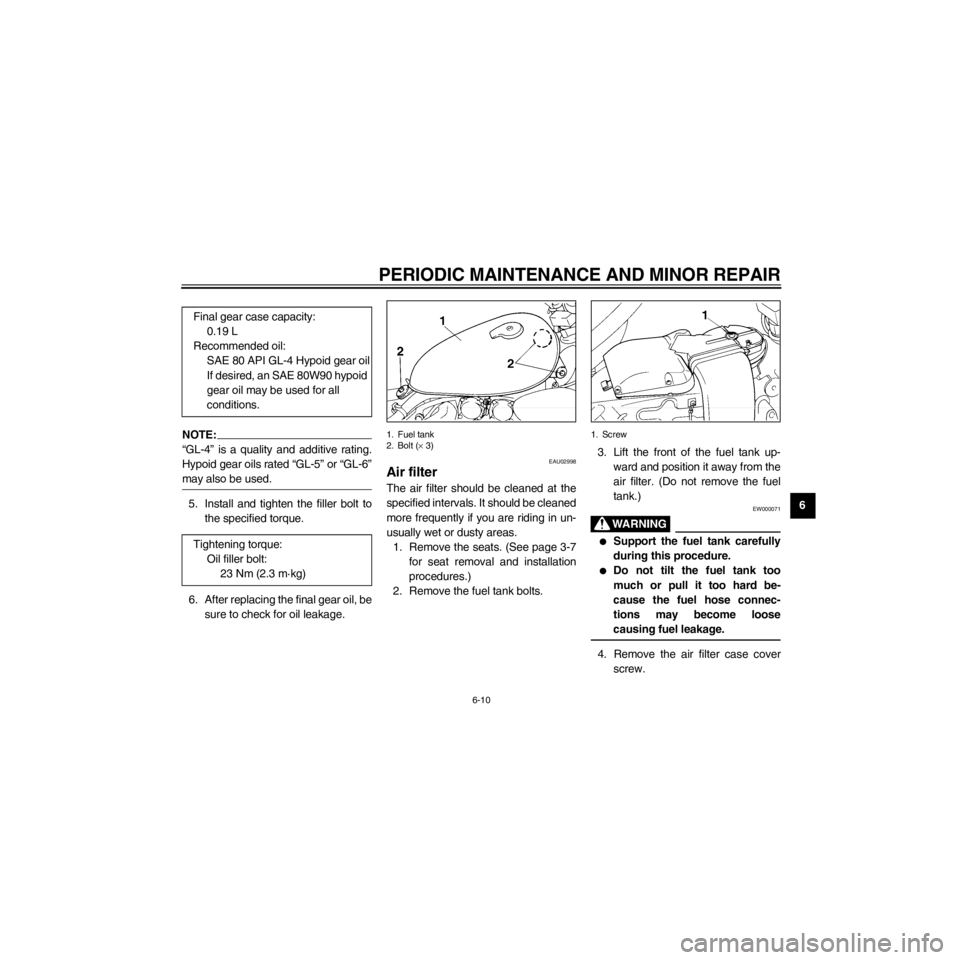
1. Fuel tank
2. Bolt (´ 3)
EAU02998
Air filter
The air filter should be cleaned at the
specified intervals. It should be cleaned
more frequently if you are riding in un-
usually wet or dusty areas.
1. Remove the seats. (See page 3-7
for seat removal and installation
procedures.)
2. Remove the fuel tank bolts.
1. Screw
3. Lift the front of the fuel tank up-
ward and position it away from the
air filter. (Do not remove the fuel
tank.)
EW000071
lSupport the fuel tank carefully
during this procedure.
lDo not tilt the fuel tank too
much or pull it too hard be-
cause the fuel hose connec-
tions may become loose
causing fuel leakage.
4. Remove the air filter case cover
screw.
Page 50 of 87
R
6-12
PERIODIC MAINTENANCE AND MINOR REPAIR
/Net/layout8/layout_G2/work/Imai_work/OM-PS/AA9149_XV535-E6/English/E-6.frame
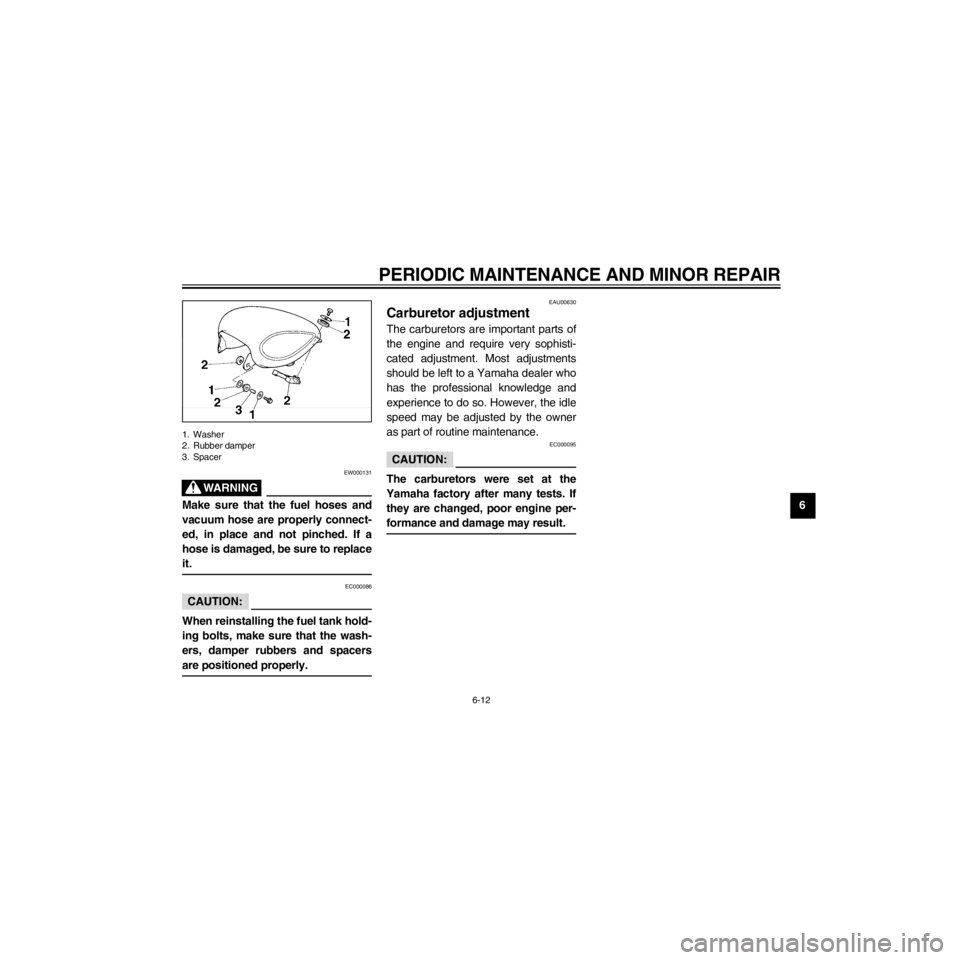
1. Washer
2. Rubber damper
3. Spacer
EW000131
Make sure that the fuel hoses and
vacuum hose are properly connect-
ed, in place and not pinched. If a
hose is damaged, be sure to replace
it.
EC000086
CAUTION:
When reinstalling the fuel tank hold-
ing bolts, make sure that the wash-
ers, damper rubbers and spacers
are positioned properly.
EAU00630
Carburetor adjustment
The carburetors are important parts of
the engine and require very sophisti-
cated adjustment. Most adjustments
should be left to a Yamaha dealer who
has the professional knowledge and
experience to do so. However, the idle
speed may be adjusted by the owner
as part of routine maintenance.
EC000095
CAUTION:
The carburetors were set at the
Yamaha factory after many tests. If
they are changed, poor engine per-
formance and damage may result.
Page 52 of 87
R
6-14
PERIODIC MAINTENANCE AND MINOR REPAIR
/Net/layout8/layout_G2/work/Imai_work/OM-PS/AA9149_XV535-E6/English/E-6.frame
EAU00637
Valve clearance adjustment
The correct valve clearance changes
with use, resulting in improper fuel/air
supply or engine noise. To prevent this,
the valve clearance must be adjusted
regularly. This adjustment however,
should be left to a professional
Yamaha service technician.
EAU00647
Tires
To ensure maximum performance,
long service, and safe operation, note
the following:
Tire air pressure
Always check and adjust the tire pres-
sure before operating the motorcycle.
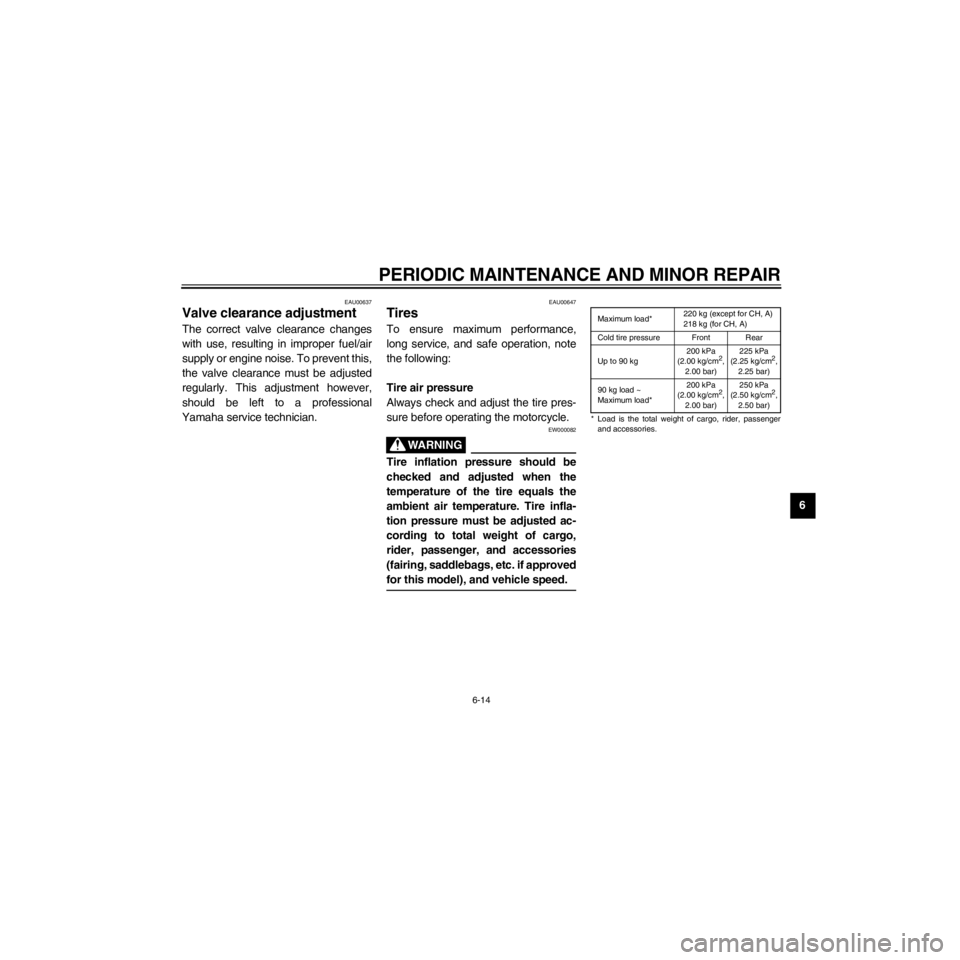
EW000082
Tire inflation pressure should be
checked and adjusted when the
temperature of the tire equals the
ambient air temperature. Tire infla-
tion pressure must be adjusted ac-
cording to total weight of cargo,
rider, passenger, and accessories
(fairing, saddlebags, etc. if approved
for this model), and vehicle speed.
Maximum load*220 kg (except for CH, A)
218 kg (for CH, A)
Cold tire pressure Front Rear
Up to 90 kg200 kPa
(2.00 kg/cm
2,
2.00 bar)225 kPa
(2.25 kg/cm2,
2.25 bar)
90 kg load ~
Maximum load*200 kPa
(2.00 kg/cm
2,
2.00 bar)250 kPa
(2.50 kg/cm2,
2.50 bar)
* Load is the total weight of cargo, rider, passenger
and accessories.
Page 67 of 87
L
6-29
PERIODIC MAINTENANCE AND MINOR REPAIR
/Net/layout8/layout_G2/work/Imai_work/OM-PS/AA9149_XV535-E6/English/E-6.frame
1
1
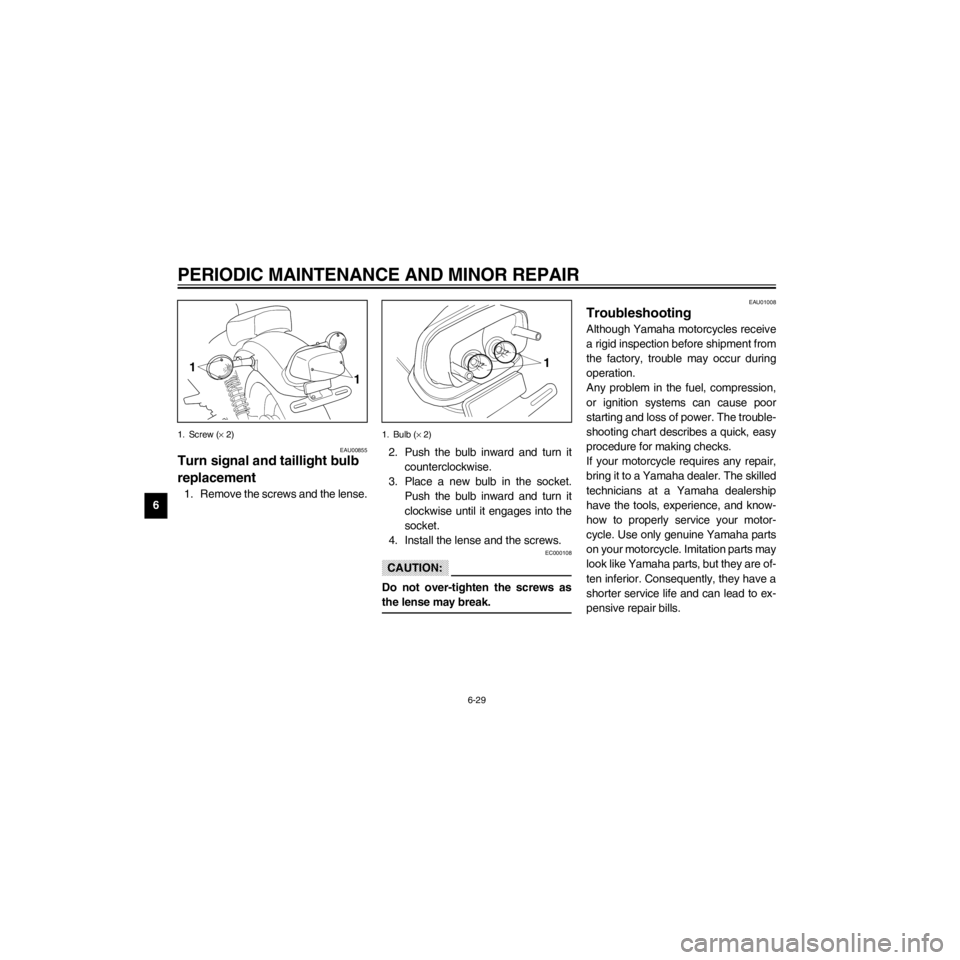
1. Screw (´ 2)
EAU00855
Turn signal and taillight bulb
replacement
1. Remove the screws and the lense.
1
1. Bulb (´ 2)
2. Push the bulb inward and turn it
counterclockwise.
3. Place a new bulb in the socket.
Push the bulb inward and turn it
clockwise until it engages into the
socket.
4. Install the lense and the screws.
EC000108
CAUTION:
Do not over-tighten the screws as
the lense may break.
EAU01008
Troubleshooting
Although Yamaha motorcycles receive
a rigid inspection before shipment from
the factory, trouble may occur during
operation.
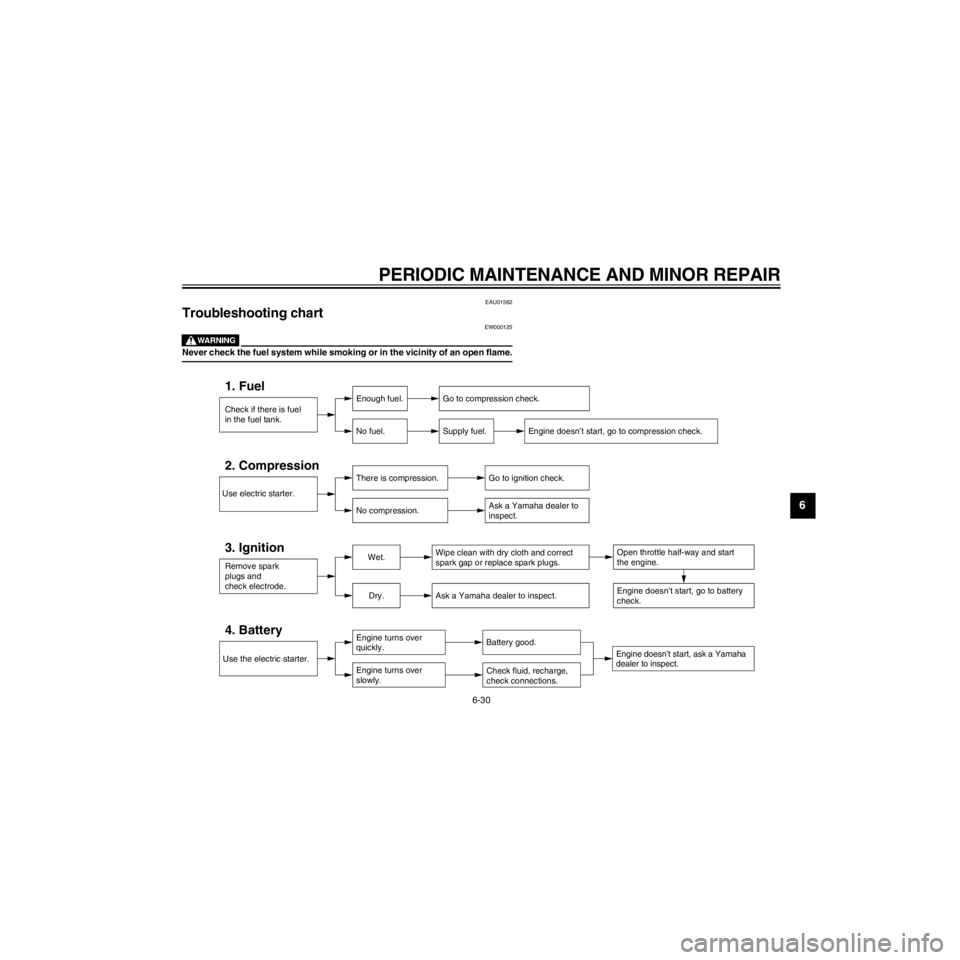
Any problem in the fuel, compression,
or ignition systems can cause poor
starting and loss of power. The trouble-
shooting chart describes a quick, easy
procedure for making checks.
If your motorcycle requires any repair,
bring it to a Yamaha dealer. The skilled
technicians at a Yamaha dealership
have the tools, experience, and know-
how to properly service your motor-
cycle. Use only genuine Yamaha parts
on your motorcycle. Imitation parts may
look like Yamaha parts, but they are of-
ten inferior. Consequently, they have a
shorter service life and can lead to ex-
pensive repair bills.
Page 68 of 87
R
6-30
PERIODIC MAINTENANCE AND MINOR REPAIR
/Net/layout8/layout_G2/work/Imai_work/OM-PS/AA9149_XV535-E6/English/E-6.frame
EAU01562
Troubleshooting chart
EW000125
Never check the fuel system while smoking or in the vicinity of an open flame.
Check if there is fuel
in the fuel tank.
1. FuelEnough fuel.
No fuel.Go to compression check.
Supply fuel.
Use electric starter.
2. CompressionThere is compression.
No compression.Go to ignition check.
Ask a Yamaha dealer to
inspect.
Remove spark
plugs and
check electrode.
3. IgnitionWet.
Dry.Wipe clean with dry cloth and correct
spark gap or replace spark plugs.
Ask a Yamaha dealer to inspect.
Engine doesnÕt start, go to battery
check.
Open throttle half-way and start
the engine.
Use the electric starter.
4. BatteryEngine turns over
quickly.
Engine turns over
slowly.Battery good.
Check fluid, recharge,
check connections.
Engine doesnÕt start, ask a Yamaha
dealer to inspect.
Engine doesnÕt start, go to compression check.
Page 72 of 87
R
7-2
MOTORCYCLE CARE AND STORAGE
/Net/layout8/layout_G2/work/Imai_work/OM-PS/AA9149_XV535-E6/English/E-7.frame
ECA00010
CAUTION:
lAvoid using strong acidic wheel
cleaners, especially on spoked
wheels. If you do use such
products for hard-to-remove
dirt, do not leave it on any long-
er than instructed, then thor-
oughly rinse it off with water,
immediately dry the area and
apply a corrosion protection
spray.
lImproper cleaning can damage
windshields, cowlings, panels
and other plastic parts. Use
only a soft, clean cloth or
sponge with mild detergent and
water to clean plastic.
lDo not use any harsh chemical
products on plastic parts. Be
sure to avoid using cloths or
sponges which have been in
contact with strong or abrasive
cleaning products, solvent or
thinner, fuel (gasoline), rust re-
movers or inhibitors, brake flu-
id, antifreeze or electrolyte.
lDo not use high-pressure wash-
ers or steam-jet cleaners since
they cause water seepage and
deterioration in the following ar-
eas: seals (of wheel bearings,
swingarm bearings, forks and
brakes), electric components
(couplers, connectors, instru-
ments, switches and lights),
breather hoses and vents.
lFor motorcycles equipped with
a windshield: Do not use strong
cleaners or hard sponges as
they will cause dulling or
scratching. Some cleaning
compounds for plastic may
leave scratches on the wind-
shield. Test the product on a
small hidden part of the wind-
shield to make sure they do not
leave any marks. If the wind-
shield is scratched, use a quali-
ty plastic polishing compound
after washing.
After riding in the rain, near the sea or
on salt-sprayed roads
Since sea salt or salt sprayed on the
roads in the winter are extremely corro-
sive in combination with water, carry
out the following steps after each ride
in the rain, near the sea or on salt-
sprayed roads. (Salt sprayed in the
winter may remain on the roads well
into spring.)
Page 74 of 87
R
7-4
MOTORCYCLE CARE AND STORAGE
/Net/layout8/layout_G2/work/Imai_work/OM-PS/AA9149_XV535-E6/English/E-7.frame
ECA00013
CAUTION:
lApply spray oil and wax spar-
ingly and wipe off any excess.
lNever apply oil or wax on rub-
ber and plastic parts, but treat
them with a suitable care prod-
uct.
lAvoid using abrasive polishing
compounds as they wear away
the paint.
NOTE:
Consult a Yamaha dealer for advice on
what products to use.
Storage
Short-term
Always store your motorcycle in a cool,
dry place and, if necessary, protect it
against dust with a porous cover.
ECA00014
CAUTION:
lStoring the motorcycle in a
poorly ventilated room or cov-
ering it with a tarp while it is still
wet will allow water and humidi-
ty to seep in and cause rust.
lTo prevent corrosion, avoid
damp cellars, stables (because
of the presence of ammonia)
and areas where strong chemi-
cals are stored.Long-term
Before storing your motorcycle for sev-
eral months:
1. Follow all the instructions in the
ÒCareÓ section of this chapter.
2. Drain the carburetor float cham-
bers by loosening the drain bolts;
this will prevent fuel deposits from
building up. Pour the drained fuel
into the fuel tank.
3. Only for motorcycles equipped
with a fuel cock which has an
ÒOFFÓ position: Turn the fuel cock
to ÒOFFÓ.
4. Fill up the fuel tank and add fuel
stabilizer (if available) to prevent
the fuel tank from rusting and the
fuel from deteriorating.
5. Perform the following steps to pro-
tect the cylinders, piston rings, etc.
from corrosion.
Page 77 of 87
L
8-1
SPECIFICATIONS
/Net/layout8/layout_G2/work/Imai_work/OM-PS/AA9149_XV535-E6/English/E-8.frame
Specifications
Model XV535
Dimensions
Overall length 2,225 mm
(except for CH, S, SF, N)
2,250 mm (for CH, S, SF, N)
Overall width 780 mm
Overall height 1,120 mm
Seat hight 720 mm
Wheelbase 1,520 mm
Ground clearance 160 mm
Minimum turning radius 2,900 mm
Basic weight (with oil and full
fuel tank)
195 kg (except for CH, A)
197 kg (for CH, A)
Engine
Engine type Air-cooled 4-stroke, SOHC
Cylinder arrangement V type 2-cylinder
Displacement 535 cm
3
Bore´ Stroke 76.0 ´ 59.0 mm
Compression ratio 9:1
Starting system Electric starter
Lubrication system Wet sump
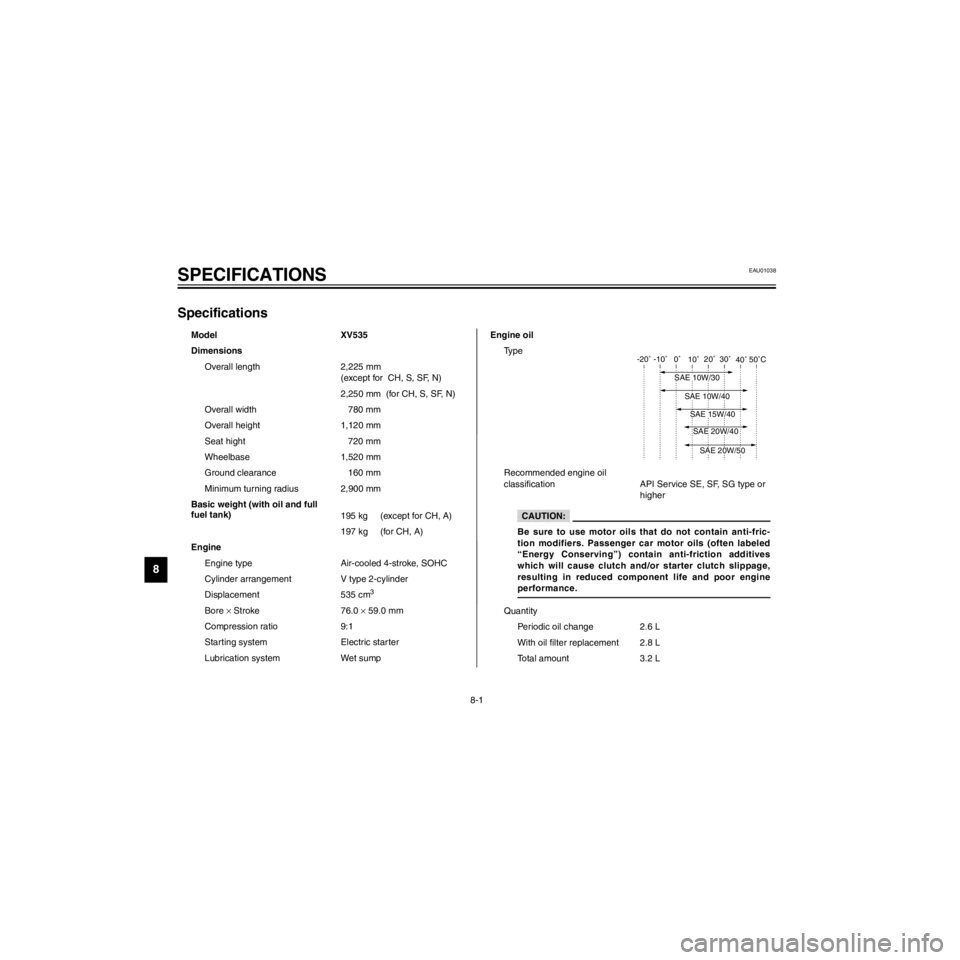
Engine oil
Ty p e
Recommended engine oil
classiÞcation API Service SE, SF, SG type or
higher
Quantity
Periodic oil change 2.6 L
With oil Þlter replacement 2.8 L
Total amount 3.2 L
-20û -10û 0û
10û20û 30û
40û50ûC
SAE 10W/30
SAE 15W/40
SAE 20W/40
SAE 20W/50
SAE 10W/40
CAUTION:
Be sure to use motor oils that do not contain anti-fric-
tion modifiers. Passenger car motor oils (often labeled
ÒEnergy ConservingÓ) contain anti-friction additives
which will cause clutch and/or starter clutch slippage,
resulting in reduced component life and poor engine
performance.
EAU01038
Page 78 of 87
R
8-2
SPECIFICATIONS
/Net/layout8/layout_G2/work/Imai_work/OM-PS/AA9149_XV535-E6/English/E-8.frame
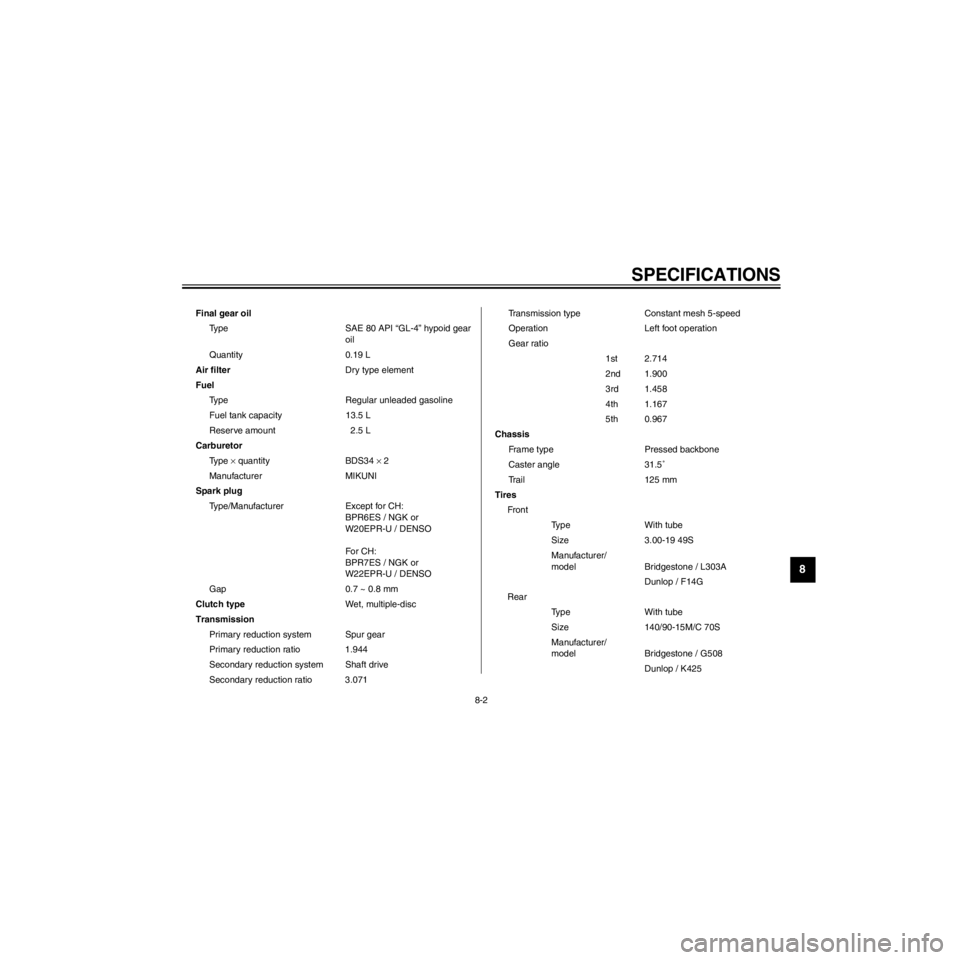
Final gear oil
Type SAE 80 API ÒGL-4Ó hypoid gear
oil
Quantity 0.19 L
Air filterDry type element
Fuel
Ty p eRegular unleaded gasoline
Fuel tank capacity 13.5 L
Reserve amount 2.5 L
Carburetor
Type ´ quantity BDS34 ´ 2
Manufacturer MIKUNI
Spark plug
Type/Manufacturer Except for CH:
BPR6ES / NGK or
W20EPR-U / DENSO
For CH:
BPR7ES / NGK or
W22EPR-U / DENSO
Gap 0.7 ~ 0.8 mm
Clutch typeWet, multiple-disc
Transmission
Primary reduction system Spur gear
Primary reduction ratio 1.944
Secondary reduction system Shaft drive
Secondary reduction ratio 3.071
Transmission type Constant mesh 5-speed
Operation Left foot operation
Gear ratio
1st 2.714
2nd 1.900
3rd 1.458
4th 1.167
5th 0.967
Chassis
Frame type Pressed backbone
Caster angle 31.5û
Tr a i l 1 2 5 m m
Tires
Front
Type With tube
Size 3.00-19 49S
Manufacturer/
model Bridgestone / L303A
Dunlop / F14G
Rear
Type With tube
Size 140/90-15M/C 70S
Manufacturer/
model Bridgestone / G508
Dunlop / K425
Page 85 of 87
L
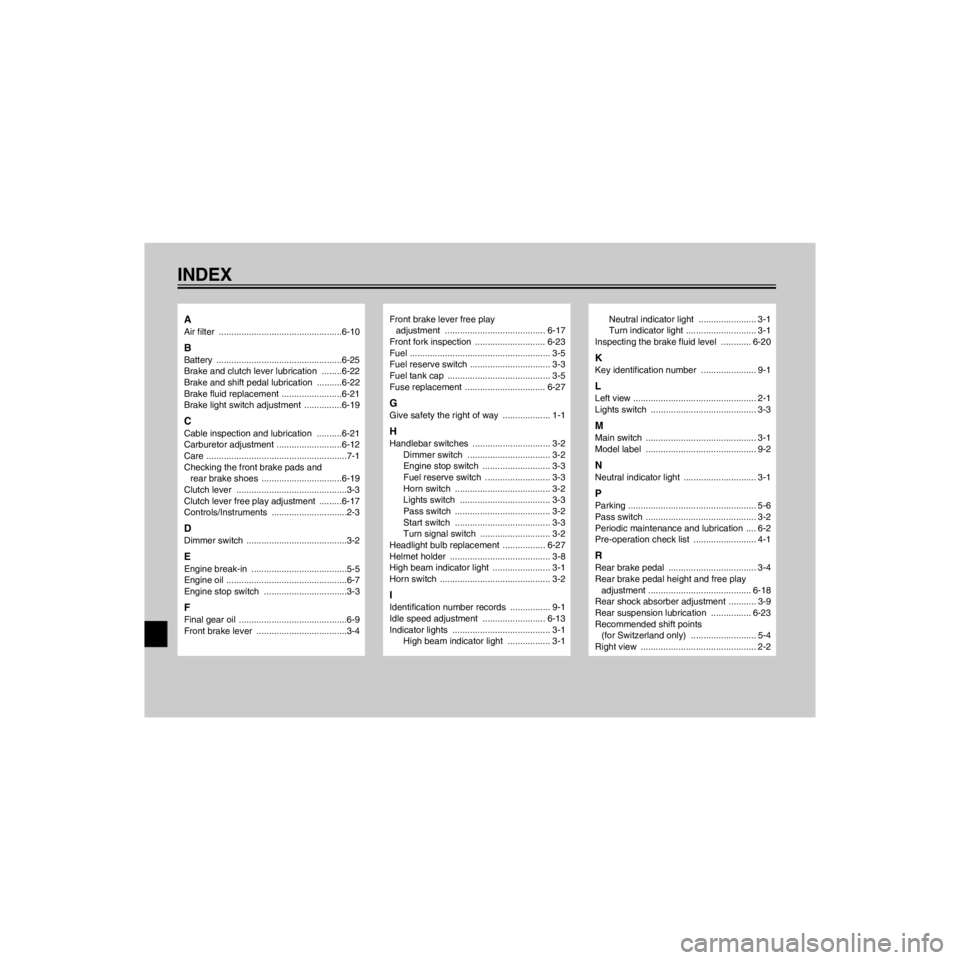
INDEX
/Net/layout8/layout_G2/work/Imai_work/OM-PS/AA9149_XV535-E6/English/XV535IX.-
A
Air filter .................................................6-10
B
Battery ..................................................6-25
Brake and clutch lever lubrication ........6-22
Brake and shift pedal lubrication ..........6-22
Brake fluid replacement ........................6-21
Brake light switch adjustment ...............6-19
C
Cable inspection and lubrication ..........6-21
Carburetor adjustment ..........................6-12
Care ........................................................7-1
Checking the front brake pads and
rear brake shoes ................................6-19
Clutch lever ............................................3-3
Clutch lever free play adjustment .........6-17
Controls/Instruments ..............................2-3
D
Dimmer switch ........................................3-2
E
Engine break-in ......................................5-5
Engine oil ................................................6-7
Engine stop switch .................................3-3
F
Final gear oil ...........................................6-9
Front brake lever ....................................3-4
Front brake lever free play
adjustment ........................................ 6-17
Front fork inspection ............................ 6-23
Fuel ........................................................ 3-5
Fuel reserve switch ................................ 3-3
Fuel tank cap ......................................... 3-5
Fuse replacement ................................ 6-27
G
Give safety the right of way ................... 1-1
H
Handlebar switches ............................... 3-2
Dimmer switch ................................. 3-2
Engine stop switch ........................... 3-3
Fuel reserve switch .......................... 3-3
Horn switch ...................................... 3-2
Lights switch .................................... 3-3
Pass switch ...................................... 3-2
Start switch ...................................... 3-3
Turn signal switch ............................ 3-2
Headlight bulb replacement ................. 6-27
Helmet holder ........................................ 3-8
High beam indicator light ....................... 3-1
Horn switch ............................................ 3-2
I
Identification number records ................ 9-1
Idle speed adjustment ......................... 6-13
Indicator lights ....................................... 3-1
High beam indicator light ................. 3-1
Neutral indicator light ....................... 3-1
Turn indicator light ............................ 3-1
Inspecting the brake fluid level ............ 6-20
K
Key identification number ...................... 9-1
L
Left view ................................................. 2-1
Lights switch .......................................... 3-3
M
Main switch ............................................ 3-1
Model label ............................................ 9-2
N
Neutral indicator light ............................. 3-1
P
Parking ................................................... 5-6
Pass switch ............................................ 3-2
Periodic maintenance and lubrication .... 6-2
Pre-operation check list ......................... 4-1
R
Rear brake pedal ................................... 3-4
Rear brake pedal height and free play
adjustment ......................................... 6-18
Rear shock absorber adjustment ........... 3-9
Rear suspension lubrication ................ 6-23
Recommended shift points
(for Switzerland only) .......................... 5-4
Right view .............................................. 2-2