transmission YAMAHA XV535 2000 Owners Manual
[x] Cancel search | Manufacturer: YAMAHA, Model Year: 2000, Model line: XV535, Model: YAMAHA XV535 2000Pages: 87, PDF Size: 17.84 MB
Page 15 of 87
L
3-1
INSTRUMENT AND CONTROL FUNCTIONS
/Net/layout8/layout_G2/work/Imai_work/OM-PS/AA9149_XV535-E6/English/E-3.frame
EAU00027
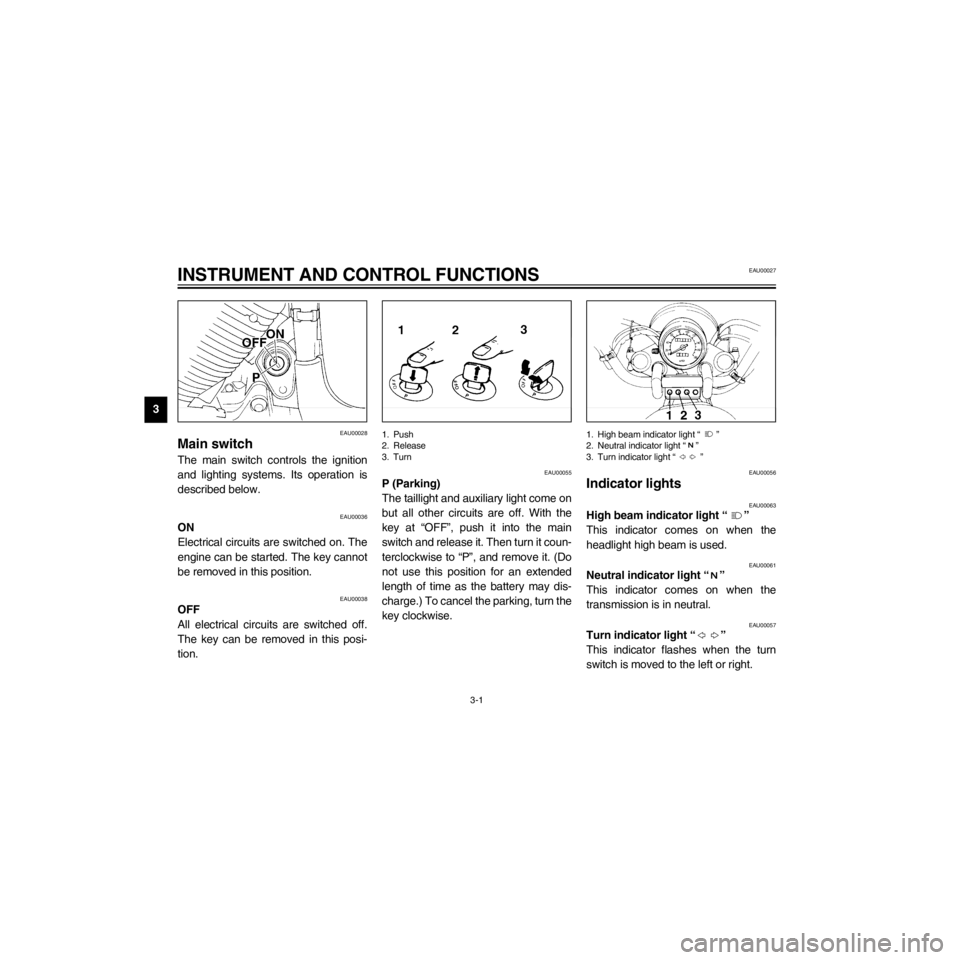
EAU00028
Main switch
The main switch controls the ignition
and lighting systems. Its operation is
described below.
EAU00036
ON
Electrical circuits are switched on. The
engine can be started. The key cannot
be removed in this position.
EAU00038
OFF
All electrical circuits are switched off.
The key can be removed in this posi-
tion.
1. Push
2. Release
3. Turn
EAU00055
P (Parking)
The taillight and auxiliary light come on
but all other circuits are off. With the
key at ÒOFFÓ, push it into the main
switch and release it. Then turn it coun-
terclockwise to ÒPÓ, and remove it. (Do
not use this position for an extended
length of time as the battery may dis-
charge.) To cancel the parking, turn the
key clockwise.
1. High beam indicator light Ò Ó
2. Neutral indicator light Ò Ó
3. Turn indicator light Ò Ó
EAU00056
Indicator lights
EAU00063
High beam indicator light Ò Ó
This indicator comes on when the
headlight high beam is used.
EAU00061
Neutral indicator light Ò Ó
This indicator comes on when the
transmission is in neutral.
EAU00057
Turn indicator light Ò Ó
This indicator flashes when the turn
switch is moved to the left or right.
Page 18 of 87
R
3-4
INSTRUMENT AND CONTROL FUNCTIONS
/Net/layout8/layout_G2/work/Imai_work/OM-PS/AA9149_XV535-E6/English/E-3.frame
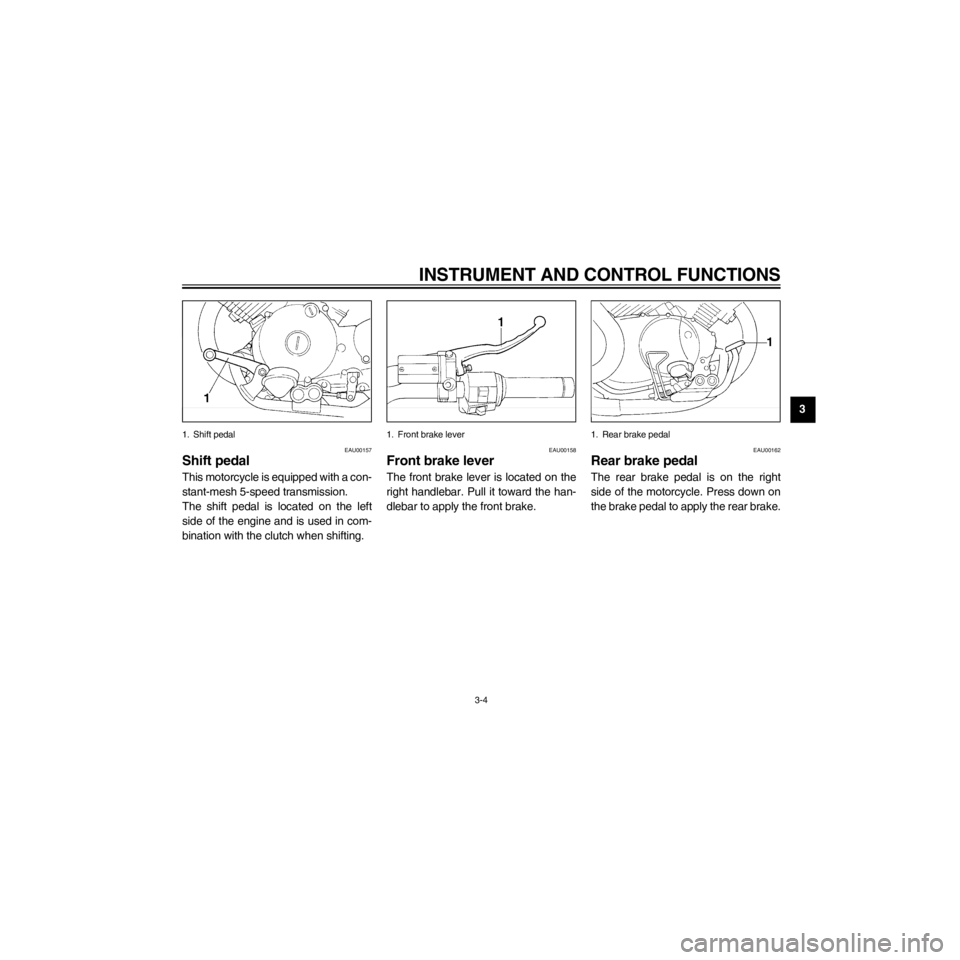
1. Shift pedal
EAU00157
Shift pedal
This motorcycle is equipped with a con-
stant-mesh 5-speed transmission.
The shift pedal is located on the left
side of the engine and is used in com-
bination with the clutch when shifting.
1. Front brake lever
EAU00158
Front brake lever
The front brake lever is located on the
right handlebar. Pull it toward the han-
dlebar to apply the front brake.
1. Rear brake pedal
EAU00162
Rear brake pedal
The rear brake pedal is on the right
side of the motorcycle. Press down on
the brake pedal to apply the rear brake.
Page 24 of 87
R
3-10
INSTRUMENT AND CONTROL FUNCTIONS
/Net/layout8/layout_G2/work/Imai_work/OM-PS/AA9149_XV535-E6/English/E-3.frame
EAU00331
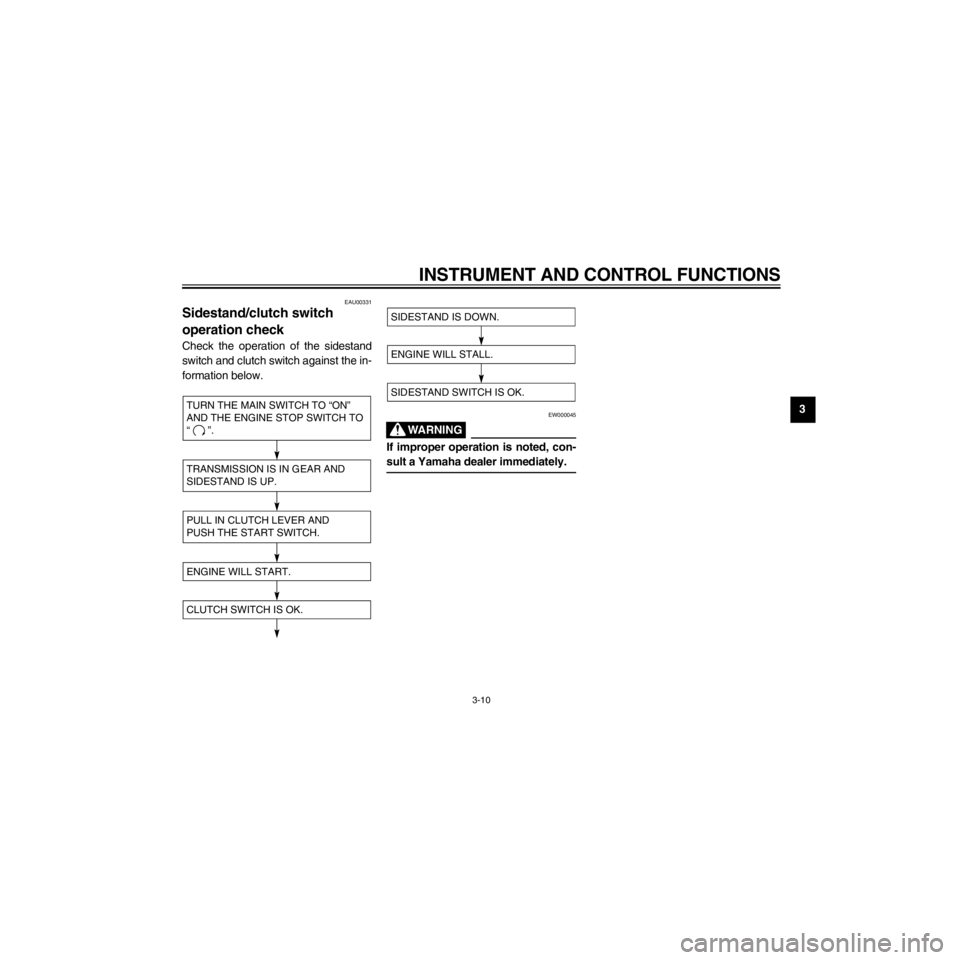
Sidestand/clutch switch
operation check
Check the operation of the sidestand
switch and clutch switch against the in-
formation below.
TURN THE MAIN SWITCH TO ÒONÓ
AND THE ENGINE STOP SWITCH TO
ÒÓ.
TRANSMISSION IS IN GEAR AND
SIDESTAND IS UP.
PULL IN CLUTCH LEVER AND
PUSH THE START SWITCH.
ENGINE WILL START.
CLUTCH SWITCH IS OK.
EW000045
If improper operation is noted, con-
sult a Yamaha dealer immediately.
SIDESTAND IS DOWN.
ENGINE WILL STALL.
SIDESTAND SWITCH IS OK.
Page 31 of 87

L
5-1
OPERATION AND IMPORTANT RIDING POINTS
/Net/layout8/layout_G2/work/Imai_work/OM-PS/AA9149_XV535-E6/English/E-5.frame
EAU00373
lBefore riding this motorcycle,
become thoroughly familiar
with all operating controls and
their functions. Consult a
Yamaha dealer regarding any
control or function that you do
not thoroughly understand.
lNever start your engine or let it
run for any length of time in a
closed area. The exhaust fumes
are poisonous and can cause
loss of consciousness and
death within a short time. Al-
ways operate your motorcycle
in an area with adequate ventila-
tion.
lBefore starting out, always be
sure the sidestand is up. Failure
to retract the sidestand com-
pletely can result in a serious
accident when you try to turn a
corner.
EAU02997
Starting the engine
NOTE:
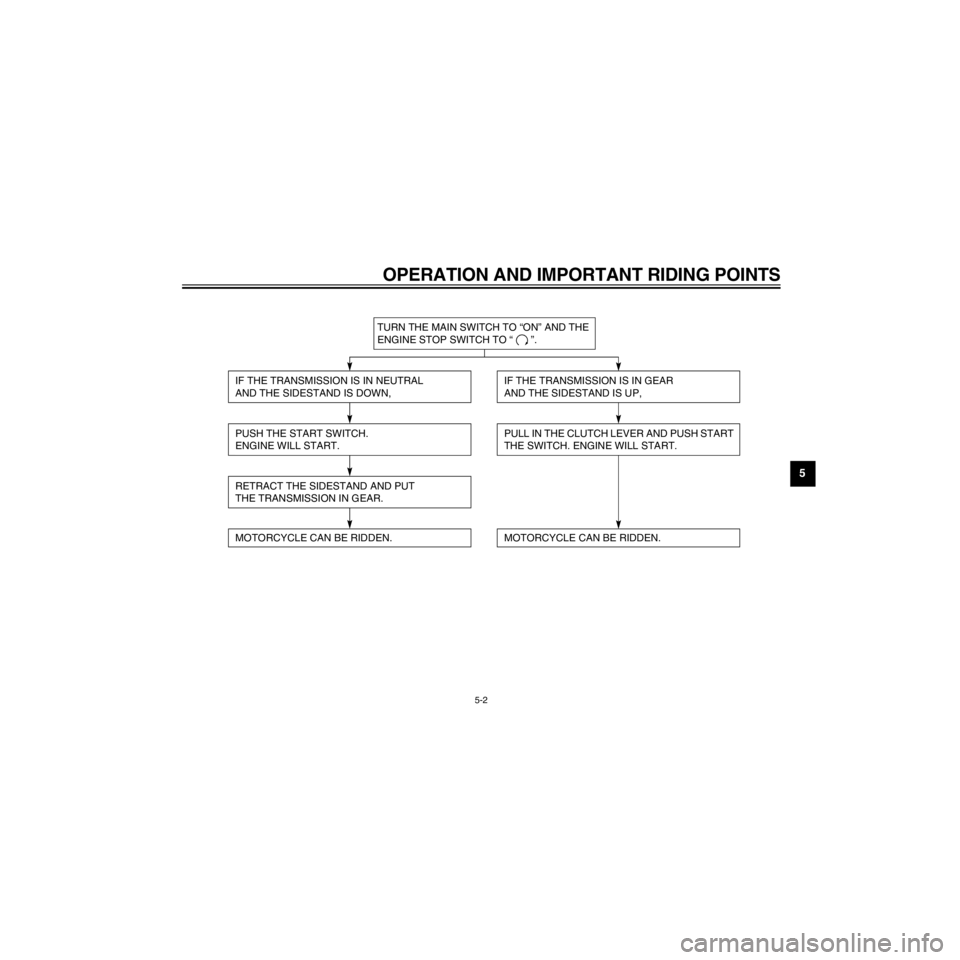
This motorcycle is equipped with an ig-
nition circuit cut-off system. The engine
can be started only under one of the
following conditions:
lThe transmission is in neutral.
lThe sidestand is up, the transmis-
sion is in gear and the clutch is dis-
engaged.
The motorcycle must not be ridden
when the sidestand is down.
EW000054
Before going through the following
steps, check the function of the
sidestand switch and clutch switch.
(Refer to page 3-10.)
EAU00372
Page 32 of 87
R
5-2
OPERATION AND IMPORTANT RIDING POINTS
/Net/layout8/layout_G2/work/Imai_work/OM-PS/AA9149_XV535-E6/English/E-5.frame
TURN THE MAIN SWITCH TO ÒONÓ AND THE
ENGINE STOP SWITCH TO Ò Ó.
IF THE TRANSMISSION IS IN NEUTRAL
AND THE SIDESTAND IS DOWN,
PUSH THE START SWITCH.
ENGINE WILL START.
RETRACT THE SIDESTAND AND PUT
THE TRANSMISSION IN GEAR.
IF THE TRANSMISSION IS IN GEAR
AND THE SIDESTAND IS UP,
PULL IN THE CLUTCH LEVER AND PUSH START
THE SWITCH. ENGINE WILL START.
MOTORCYCLE CAN BE RIDDEN.MOTORCYCLE CAN BE RIDDEN.
Page 33 of 87
L
5-3
OPERATION AND IMPORTANT RIDING POINTS
/Net/layout8/layout_G2/work/Imai_work/OM-PS/AA9149_XV535-E6/English/E-5.frame
1. Turn the main switch to ÒONÓ and
the engine stop switch to Ò Ó.
2. Shift the transmission into neutral.
NOTE:
When the transmission is in neutral, the
neutral indicator light should be on. If
the light does not come on, ask a
Yamaha dealer to inspect it.
3. Turn on the starter (choke) and
completely close the throttle grip.
4. Start the engine by pushing the
start switch.
NOTE:
If the engine fails to start, release the
start switch, wait a few seconds, then
try again. Each attempt should be as
short as possible to preserve the bat-
tery. Do not crank the engine more
than 10 seconds on any one attempt.
5. After starting the engine, move the
starter (choke) to the halfway posi-
tion.
NOTE:
For maximum engine life, never accel-
erate hard with a cold engine!
6. After the engine is warm, turn off
the starter (choke) completely.
NOTE:
The engine is warm when it responds
normally to the throttle with the starter
(choke) turned off.
EAU01258
Starting a warm engine
The starter (choke) is not required
when the engine is warm.
EC000046
CAUTION:
See the ÒEngine break-inÓ section
prior to operating the motorcycle for
the first time.
Page 34 of 87
R
5-4
OPERATION AND IMPORTANT RIDING POINTS
/Net/layout8/layout_G2/work/Imai_work/OM-PS/AA9149_XV535-E6/English/E-5.frame
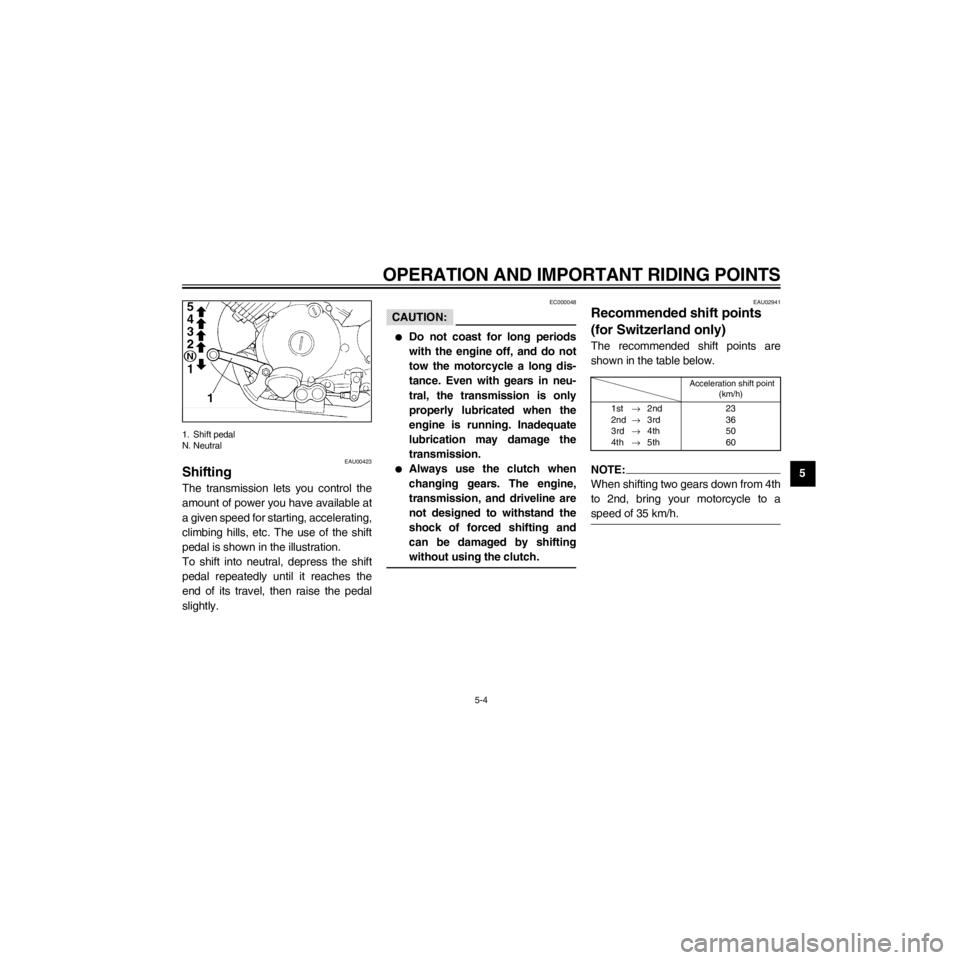
1. Shift pedal
N. Neutral
EAU00423
Shifting
The transmission lets you control the
amount of power you have available at
a given speed for starting, accelerating,
climbing hills, etc. The use of the shift
pedal is shown in the illustration.
To shift into neutral, depress the shift
pedal repeatedly until it reaches the
end of its travel, then raise the pedal
slightly.
EC000048
CAUTION:
lDo not coast for long periods
with the engine off, and do not
tow the motorcycle a long dis-
tance. Even with gears in neu-
tral, the transmission is only
properly lubricated when the
engine is running. Inadequate
lubrication may damage the
transmission.
lAlways use the clutch when
changing gears. The engine,
transmission, and driveline are
not designed to withstand the
shock of forced shifting and
can be damaged by shifting
without using the clutch.
EAU02941
Recommended shift points
(for Switzerland only)
The recommended shift points are
shown in the table below.
NOTE:
When shifting two gears down from 4th
to 2nd, bring your motorcycle to a
speed of 35 km/h.
Acceleration shift point
(km/h)
1st®2nd
2nd®3rd
3rd®4th
4th®5th23
36
50
60
Page 78 of 87
R
8-2
SPECIFICATIONS
/Net/layout8/layout_G2/work/Imai_work/OM-PS/AA9149_XV535-E6/English/E-8.frame
Final gear oil
Type SAE 80 API ÒGL-4Ó hypoid gear
oil
Quantity 0.19 L
Air filterDry type element
Fuel
Ty p eRegular unleaded gasoline
Fuel tank capacity 13.5 L
Reserve amount 2.5 L
Carburetor
Type ´ quantity BDS34 ´ 2
Manufacturer MIKUNI
Spark plug
Type/Manufacturer Except for CH:
BPR6ES / NGK or
W20EPR-U / DENSO
For CH:
BPR7ES / NGK or
W22EPR-U / DENSO
Gap 0.7 ~ 0.8 mm
Clutch typeWet, multiple-disc
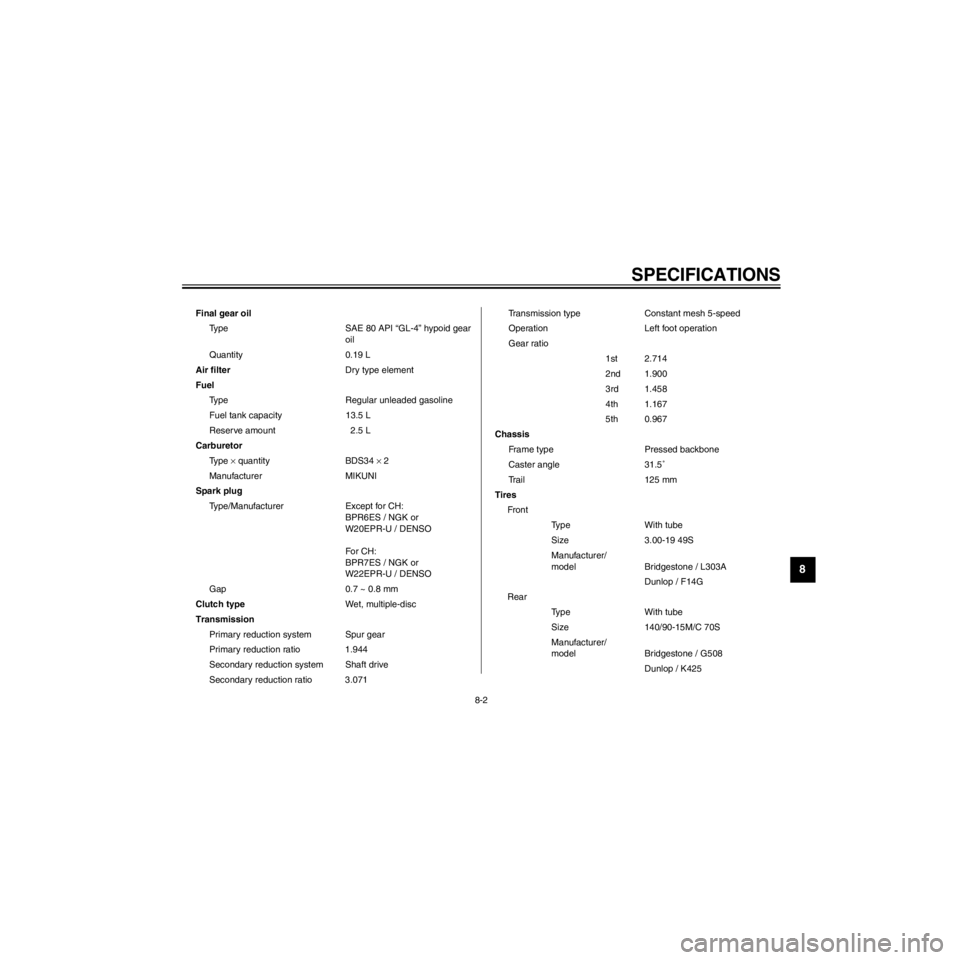
Transmission
Primary reduction system Spur gear
Primary reduction ratio 1.944
Secondary reduction system Shaft drive
Secondary reduction ratio 3.071
Transmission type Constant mesh 5-speed
Operation Left foot operation
Gear ratio
1st 2.714
2nd 1.900
3rd 1.458
4th 1.167
5th 0.967
Chassis
Frame type Pressed backbone
Caster angle 31.5û
Tr a i l 1 2 5 m m
Tires
Front
Type With tube
Size 3.00-19 49S
Manufacturer/
model Bridgestone / L303A
Dunlop / F14G
Rear
Type With tube
Size 140/90-15M/C 70S
Manufacturer/
model Bridgestone / G508
Dunlop / K425