air condition YAMAHA XV535 2001 Owners Manual
[x] Cancel search | Manufacturer: YAMAHA, Model Year: 2001, Model line: XV535, Model: YAMAHA XV535 2001Pages: 96, PDF Size: 10.38 MB
Page 28 of 96
4-1
4
EAU01114
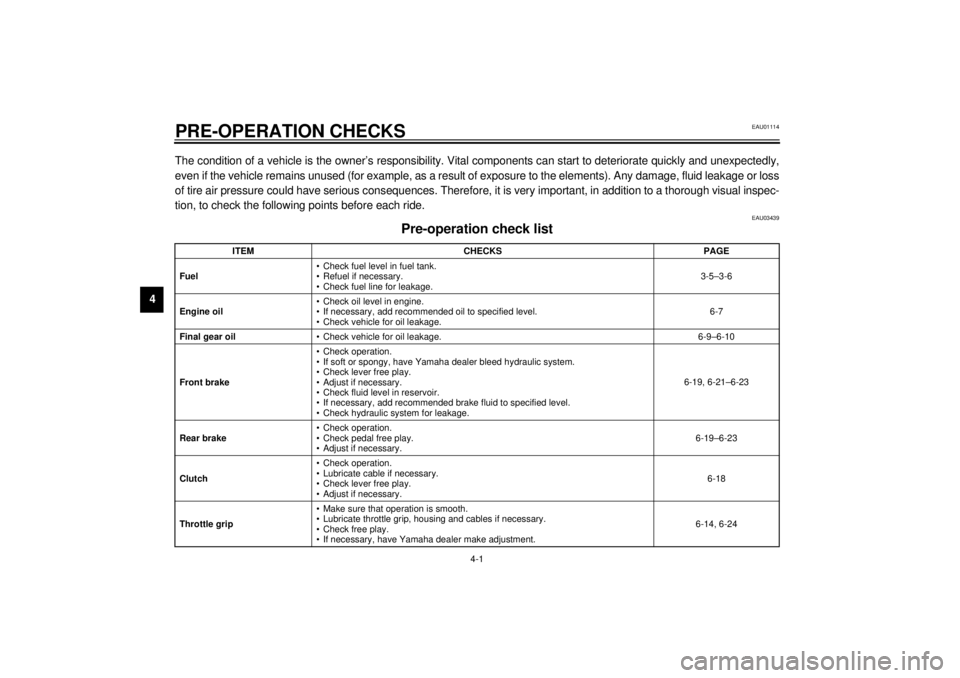
4-PRE-OPERATION CHECKSThe condition of a vehicle is the owner’s responsibility. Vital components can start to deteriorate quickly and unexpectedly,
even if the vehicle remains unused (for example, as a result of exposure to the elements). Any damage, fluid leakage or loss
of tire air pressure could have serious consequences. Therefore, it is very important, in addition to a thorough visual inspec-
tion, to check the following points before each ride.
EAU03439
Pre-operation check list
CO-01E
ITEM CHECKS PAGE
Fuel• Check fuel level in fuel tank.
• Refuel if necessary.
• Check fuel line for leakage.3-5–3-6
Engine oil• Check oil level in engine.
• If necessary, add recommended oil to specified level.
• Check vehicle for oil leakage.6-7
Final gear oil• Check vehicle for oil leakage. 6-9–6-10
Front brake• Check operation.
• If soft or spongy, have Yamaha dealer bleed hydraulic system.
• Check lever free play.
• Adjust if necessary.
• Check fluid level in reservoir.
• If necessary, add recommended brake fluid to specified level.
• Check hydraulic system for leakage.6-19, 6-21–6-23
Rear brake• Check operation.
• Check pedal free play.
• Adjust if necessary.6-19–6-23
Clutch• Check operation.
• Lubricate cable if necessary.
• Check lever free play.
• Adjust if necessary.6-18
Throttle grip• Make sure that operation is smooth.
• Lubricate throttle grip, housing and cables if necessary.
• Check free play.
• If necessary, have Yamaha dealer make adjustment.6-14, 6-24
E_3bt.book Page 1 Thursday, September 7, 2000 10:01 AM
Page 29 of 96
PRE-OPERATION CHECKS
4-2
4
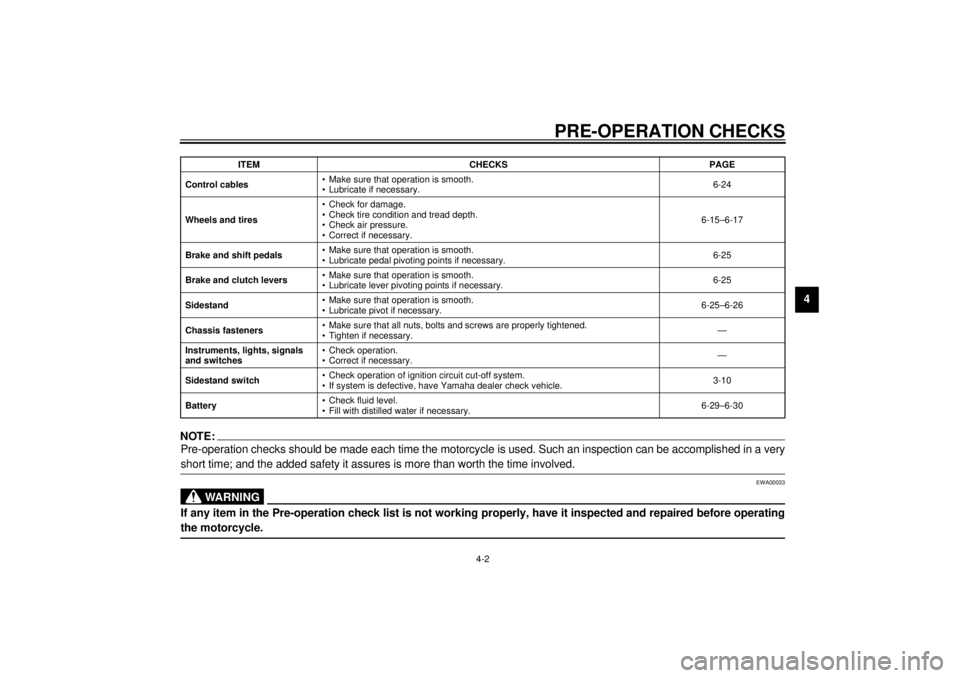
NOTE:@ Pre-operation checks should be made each time the motorcycle is used. Such an inspection can be accomplished in a very
short time; and the added safety it assures is more than worth the time involved. @
EWA00033
WARNING
@ If any item in the Pre-operation check list is not working properly, have it inspected and repaired before operating
the motorcycle. @Control cables• Make sure that operation is smooth.
• Lubricate if necessary.6-24
Wheels and tires• Check for damage.
• Check tire condition and tread depth.
• Check air pressure.
• Correct if necessary.6-15–6-17
Brake and shift pedals• Make sure that operation is smooth.
• Lubricate pedal pivoting points if necessary.6-25
Brake and clutch levers• Make sure that operation is smooth.
• Lubricate lever pivoting points if necessary.6-25
Sidestand• Make sure that operation is smooth.
• Lubricate pivot if necessary.6-25–6-26
Chassis fasteners• Make sure that all nuts, bolts and screws are properly tightened.
• Tighten if necessary.—
Instruments, lights, signals
and switches• Check operation.
• Correct if necessary.—
Sidestand switch• Check operation of ignition circuit cut-off system.
• If system is defective, have Yamaha dealer check vehicle.3-10
Battery• Check fluid level.
• Fill with distilled water if necessary.6-29–6-30 ITEM CHECKS PAGE
E_3bt.book Page 2 Thursday, September 7, 2000 10:01 AM
Page 38 of 96
6-1
6
EAU00462
6-PERIODIC MAINTENANCE AND MINOR REPAIR
EAU00464
Safety is an obligation of the owner.
Periodic inspection, adjustment and lu-
brication will keep your vehicle in the
safest and most efficient condition pos-
sible. The most important points of in-
spection, adjustment, and lubrication
are explained on the following pages.
The intervals given in the periodic
maintenance and lubrication chart
should be simply considered as a gen-
eral guide under normal riding condi-
tions. However, DEPENDING ON THE
WEATHER, TERRAIN, GEOGRAPHI-
CAL LOCATION, AND INDIVIDUAL
USE, THE MAINTENANCE INTER-
VALS MAY NEED TO BE SHORT-
ENED.
EW000060
WARNING
@ If you are not familiar with motor-
cycle maintenance work, have a
Yamaha dealer do it for you. @
EAU03713
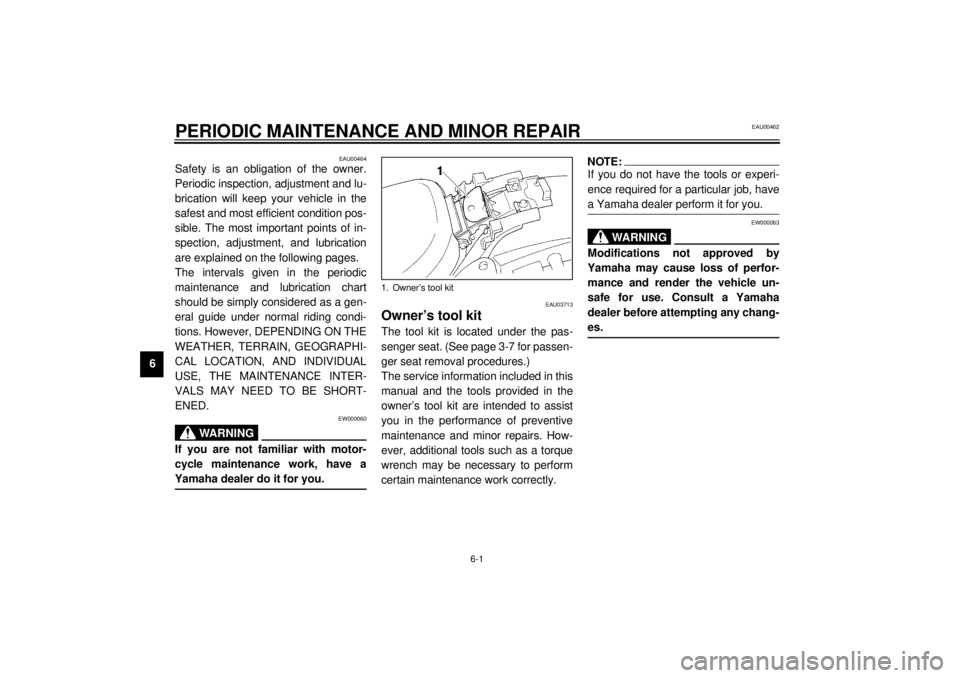
Owner’s tool kit The tool kit is located under the pas-
senger seat. (See page 3-7 for passen-
ger seat removal procedures.)
The service information included in this
manual and the tools provided in the
owner’s tool kit are intended to assist
you in the performance of preventive
maintenance and minor repairs. How-
ever, additional tools such as a torque
wrench may be necessary to perform
certain maintenance work correctly.
NOTE:_ If you do not have the tools or experi-
ence required for a particular job, have
a Yamaha dealer perform it for you. _
EW000063
WARNING
_ Modifications not approved by
Yamaha may cause loss of perfor-
mance and render the vehicle un-
safe for use. Consult a Yamaha
dealer before attempting any chang-
es. _
1. Owner’s tool kit
E_3bt.book Page 1 Thursday, September 7, 2000 10:01 AM
Page 39 of 96
PERIODIC MAINTENANCE AND MINOR REPAIR
6-2
6
EAU03685
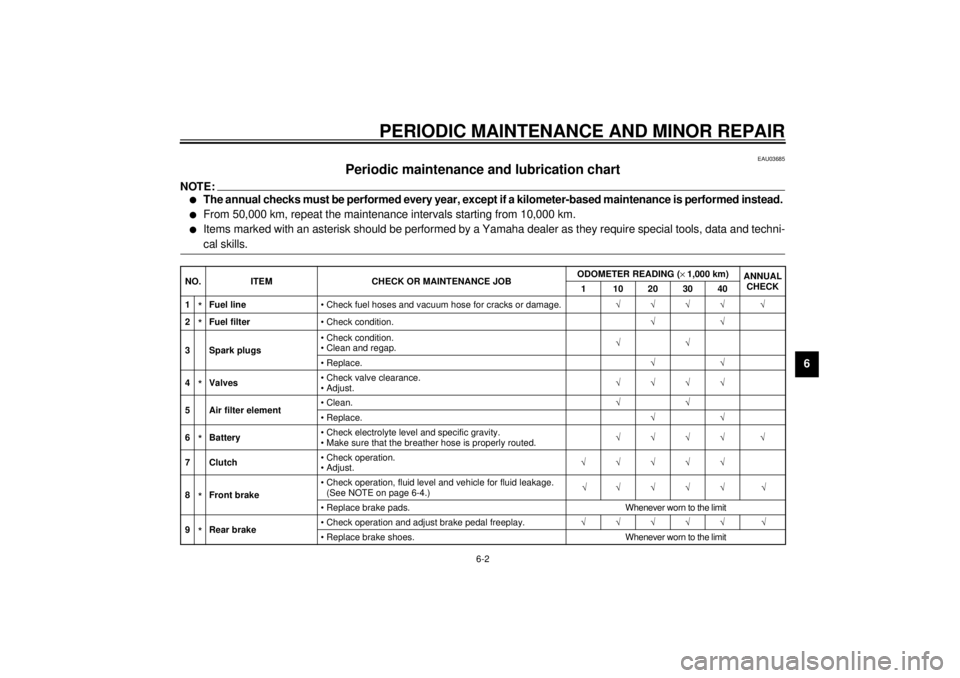
Periodic maintenance and lubrication chart
NOTE:_ l
The annual checks must be performed every year, except if a kilometer-based maintenance is performed instead.
l
From 50,000 km, repeat the maintenance intervals starting from 10,000 km.
l
Items marked with an asterisk should be performed by a Yamaha dealer as they require special tools, data and techni-
cal skills.
_CP-03ENO. ITEM CHECK OR MAINTENANCE JOBODOMETER READING (´1,000 km)
ANNUAL
CHECK
1 10203040
1
*Fuel line• Check fuel hoses and vacuum hose for cracks or damage.ÖÖÖÖ Ö
2*Fuel filter• Check condition.ÖÖ
3 Spark plugs• Check condition.
• Clean and regap.ÖÖ
• Replace.ÖÖ
4*Valves• Check valve clearance.
•Adjust.ÖÖÖÖ
5 Air filter element•Clean.ÖÖ
• Replace.ÖÖ
6*Battery• Check electrolyte level and specific gravity.
• Make sure that the breather hose is properly routed.ÖÖÖÖ Ö
7Clutch• Check operation.
•Adjust.ÖÖÖÖÖ
8*Front brake• Check operation, fluid level and vehicle for fluid leakage.
(See NOTE on page 6-4.)ÖÖÖÖÖ Ö
• Replace brake pads. Whenever worn to the limit
9*Rear brake• Check operation and adjust brake pedal freeplay.ÖÖÖÖÖ Ö
• Replace brake shoes. Whenever worn to the limit
E_3bt.book Page 2 Thursday, September 7, 2000 10:01 AM
Page 42 of 96
PERIODIC MAINTENANCE AND MINOR REPAIR
6-5
6
EAU01486
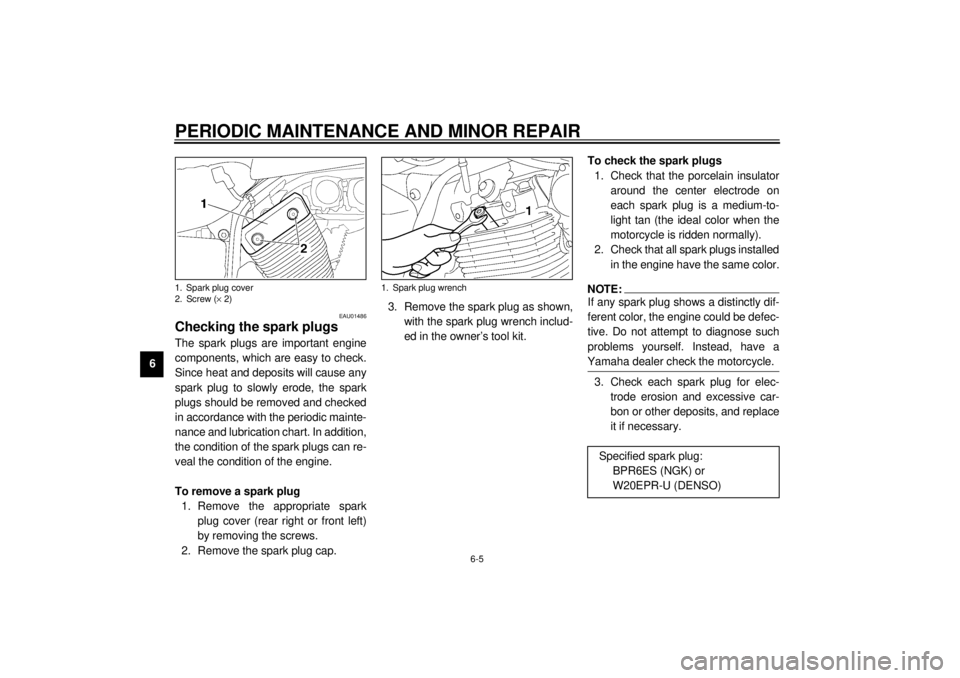
Checking the spark plugs The spark plugs are important engine
components, which are easy to check.
Since heat and deposits will cause any
spark plug to slowly erode, the spark
plugs should be removed and checked
in accordance with the periodic mainte-
nance and lubrication chart. In addition,
the condition of the spark plugs can re-
veal the condition of the engine.
To remove a spark plug
1. Remove the appropriate spark
plug cover (rear right or front left)
by removing the screws.
2. Remove the spark plug cap.3. Remove the spark plug as shown,
with the spark plug wrench includ-
ed in the owner’s tool kit.To check the spark plugs
1. Check that the porcelain insulator
around the center electrode on
each spark plug is a medium-to-
light tan (the ideal color when the
motorcycle is ridden normally).
2. Check that all spark plugs installed
in the engine have the same color.
NOTE:@ If any spark plug shows a distinctly dif-
ferent color, the engine could be defec-
tive. Do not attempt to diagnose such
problems yourself. Instead, have a
Yamaha dealer check the motorcycle. @3. Check each spark plug for elec-
trode erosion and excessive car-
bon or other deposits, and replace
it if necessary.
1. Spark plug cover
2. Screw (´ 2)
1. Spark plug wrench
Specified spark plug:
BPR6ES (NGK) or
W20EPR-U (DENSO)
E_3bt.book Page 5 Thursday, September 7, 2000 10:01 AM
Page 53 of 96
PERIODIC MAINTENANCE AND MINOR REPAIR
6-16
6
l
Adjust the suspension and tire
air pressure with regard to the
load.
l
Check the tire condition and air
pressure before each ride.
@
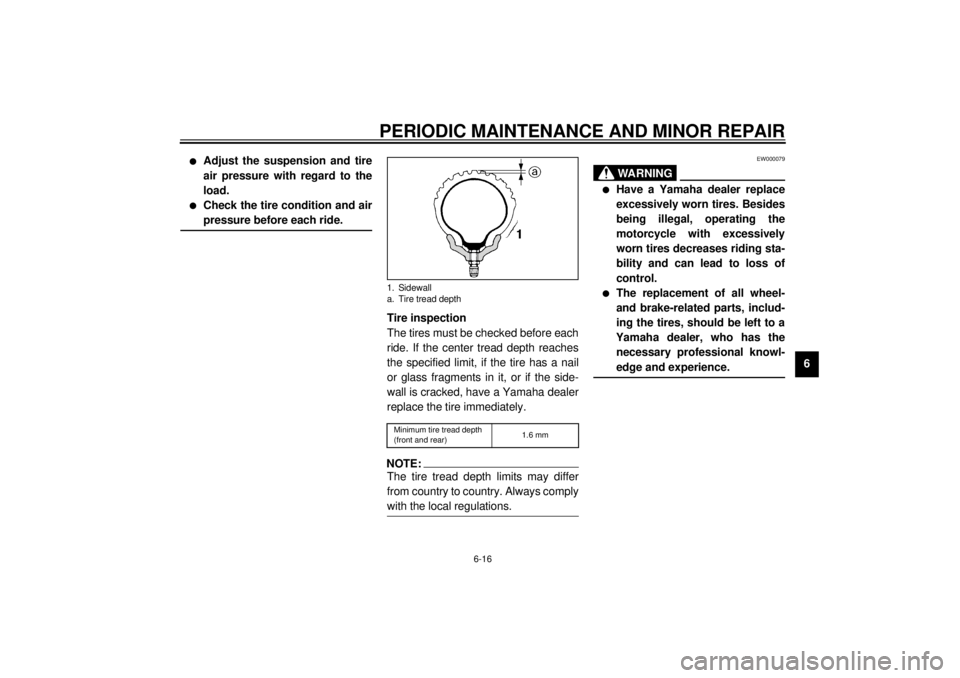
Tire inspection
The tires must be checked before each
ride. If the center tread depth reaches
the specified limit, if the tire has a nail
or glass fragments in it, or if the side-
wall is cracked, have a Yamaha dealer
replace the tire immediately.CE-08ENOTE:@ The tire tread depth limits may differ
from country to country. Always comply
with the local regulations. @
EW000079
WARNING
@ l
Have a Yamaha dealer replace
excessively worn tires. Besides
being illegal, operating the
motorcycle with excessively
worn tires decreases riding sta-
bility and can lead to loss of
control.
l
The replacement of all wheel-
and brake-related parts, includ-
ing the tires, should be left to a
Yamaha dealer, who has the
necessary professional knowl-
edge and experience.
@
1. Sidewall
a. Tire tread depthMinimum tire tread depth
(front and rear)1.6 mm
E_3bt.book Page 16 Thursday, September 7, 2000 10:01 AM
Page 60 of 96
PERIODIC MAINTENANCE AND MINOR REPAIR
6-23
6
l
Brake fluid may deteriorate paint-
ed surfaces or plastic parts. Al-
ways clean up spilled fluid
immediately.
l
As the brake pads wear, it is nor-
mal for the brake fluid level to
gradually go down. However, if the
brake fluid level goes down sud-
denly, have a Yamaha dealer
check the cause.
EAU03238
Changing the brake fluidHave a Yamaha dealer change the
brake fluid at the intervals specified in
the periodic maintenance and lubrica-
tion chart. In addition, have the oil seals
of the brake master cylinder and caliper
as well as the brake hose replaced at
the intervals listed below or whenever it
is damaged or leaking.l
Oil seals: Replace every two
years.
l
Brake hose: Replace every four
years.
EAU02962
Checking and lubricating the
cablesThe operation of all control cables and
the condition of the cables should be
checked before each ride, and the ca-
bles and cable ends should be lubricat-
ed if necessary. If a cable is damaged
or does not move smoothly, have a
Yamaha dealer check or replace it.
EW000112
WARNING
@ Damage to the outer sheath may in-
terfere with proper cable operation
and will cause the inner cable to
rust. Replace a damaged cable as
soon as possible to prevent unsafe
conditions. @
Recommended lubricant:
Engine oil
E_3bt.book Page 23 Thursday, September 7, 2000 10:01 AM
Page 61 of 96
PERIODIC MAINTENANCE AND MINOR REPAIR
6-24
6
EAU03209
Checking and lubricating the
throttle grip and cableThe operation of the throttle grip and
the condition of the throttle cable
should be checked before each ride,
and the cable should be lubricated or
replaced if necessary.NOTE:@ Since the throttle grip must be removed
to access the throttle cable end, the
throttle grip and the cable should al-
ways be lubricated at the same time. @1. Remove the throttle grip by remov-
ing the screws.
2. Disconnect the throttle cable, hold
it up, and then apply several drops
of oil to the cable end, allowing it to
trickle into the sheath.
3. Connect the throttle cable, and
then grease the inside of the throt-
tle grip housing.
4. Grease the metal-to-metal contact
surface of the throttle grip, and
then install the grip by installing
the screws.Recommended lubricant:
Throttle cable:
Engine oil
Throttle grip housing and grip:
Lithium-soap-based grease
(all-purpose grease)
E_3bt.book Page 24 Thursday, September 7, 2000 10:01 AM
Page 64 of 96
PERIODIC MAINTENANCE AND MINOR REPAIR
6-27
6
EAU02939
Checking the front forkThe condition and operation of the front
fork must be checked as follows at the
intervals specified in the periodic main-
tenance and lubrication chart.
To check the condition
EW000115
WARNING
@ Securely support the motorcycle so
that there is no danger of it falling
over. @Check the inner tubes for scratches,
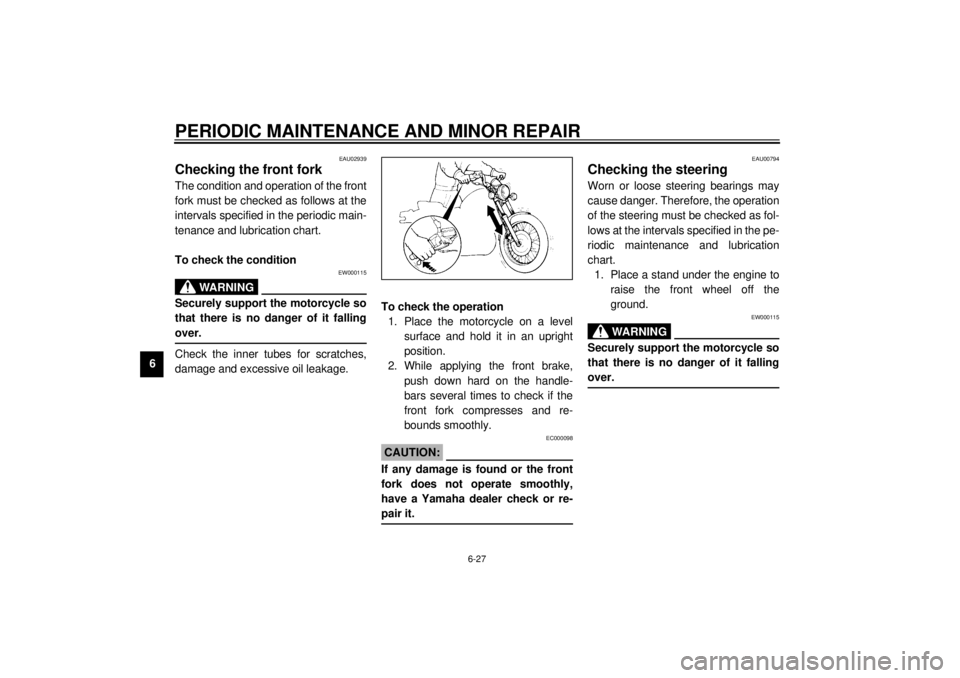
damage and excessive oil leakage.To check the operation
1. Place the motorcycle on a level
surface and hold it in an upright
position.
2. While applying the front brake,
push down hard on the handle-
bars several times to check if the
front fork compresses and re-
bounds smoothly.
EC000098
CAUTION:@ If any damage is found or the front
fork does not operate smoothly,
have a Yamaha dealer check or re-
pair it. @
EAU00794
Checking the steeringWorn or loose steering bearings may
cause danger. Therefore, the operation
of the steering must be checked as fol-
lows at the intervals specified in the pe-
riodic maintenance and lubrication
chart.
1. Place a stand under the engine to
raise the front wheel off the
ground.
EW000115
WARNING
@ Securely support the motorcycle so
that there is no danger of it falling
over. @
E_3bt.book Page 27 Thursday, September 7, 2000 10:01 AM
Page 67 of 96
PERIODIC MAINTENANCE AND MINOR REPAIR
6-30
6 away from the battery and pro-
vide sufficient ventilation when
charging it in an enclosed
space.
l
KEEP THIS AND ALL BATTER-
IES OUT OF THE REACH OF
CHILDREN.
@
EC000100
CAUTION:@ Use only distilled water, as tap water
contains minerals that are harmful
to the battery. @4. Check and, if necessary, tighten
the battery lead connections and
correct the breather hose routing.
To store the battery
1. If the motorcycle will not be used
for more than one month, remove
the battery, fully charge it, and
then place it in a cool, dry place.2. If the battery will be stored for
more than two months, check the
specific gravity of the electrolyte at
least once a month and fully
charge the battery whenever
necessary.
3. Fully charge the battery before
installation.
4. After installation, make sure that
the battery leads are properly con-
nected to the battery terminals and
that the breather hose is properly
routed, in good condition, and not
obstructed.
EC000099
CAUTION:@ If the breather hose is positioned in
such a way that the frame is ex-
posed to electrolyte or gas expelled
from the battery, the frame could
suffer structural and external
damages. @
E_3bt.book Page 30 Thursday, September 7, 2000 10:01 AM