fuel YAMAHA XV535 2001 Owners Manual
[x] Cancel search | Manufacturer: YAMAHA, Model Year: 2001, Model line: XV535, Model: YAMAHA XV535 2001Pages: 96, PDF Size: 10.38 MB
Page 13 of 96
DESCRIPTION
2-2
2
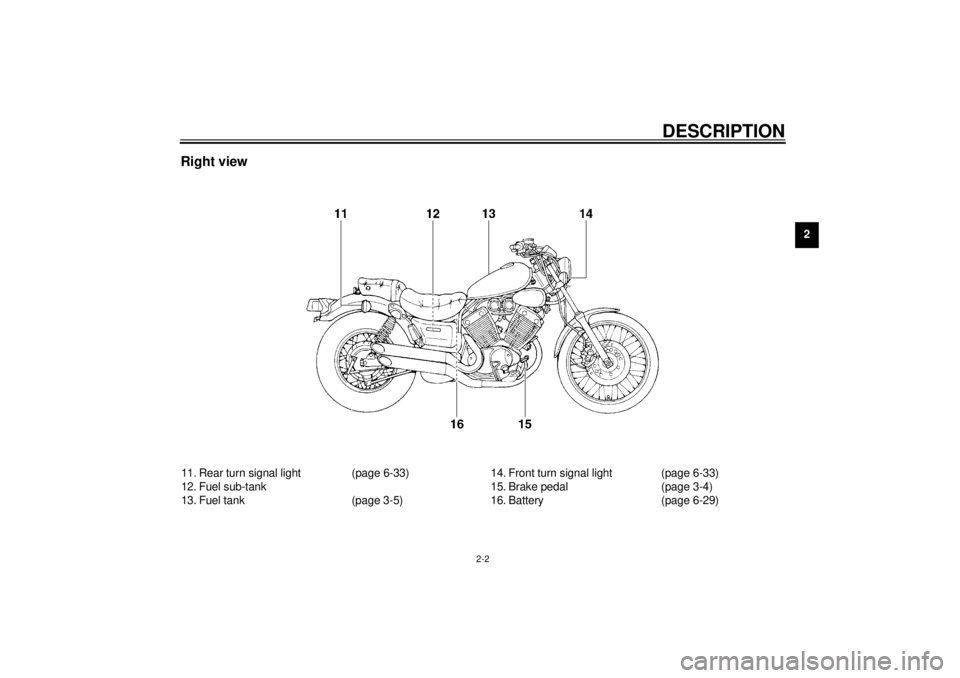
Right view11. Rear turn signal light (page 6-33)
12. Fuel sub-tank
13. Fuel tank (page 3-5)14. Front turn signal light (page 6-33)
15. Brake pedal (page 3-4)
16. Battery (page 6-29)
E_3bt.book Page 2 Thursday, September 7, 2000 10:01 AM
Page 15 of 96
INSTRUMENT AND CONTROL FUNCTIONS
3
Main switch ........................................................................................ 3-1
Indicator lights .................................................................................... 3-1
Speedometer unit .............................................................................. 3-2
Handlebar switches ............................................................................ 3-2
Clutch lever ........................................................................................ 3-3
Shift pedal .......................................................................................... 3-4
Brake lever ......................................................................................... 3-4
Brake pedal ........................................................................................ 3-4
Fuel tank cap ..................................................................................... 3-5
Fuel .................................................................................................... 3-5
Starter (choke) lever ........................................................................... 3-6
Steering lock ..................................................................................... 3-7
Seats ................................................................................................. 3-7
Helmet holder ..................................................................................... 3-9
Adjusting the shock absorber assemblies ......................................... 3-9
Sidestand ......................................................................................... 3-10
Ignition circuit cut-off system ............................................................ 3-10
E_3bt.book Page 1 Thursday, September 7, 2000 10:01 AM
Page 17 of 96
INSTRUMENT AND CONTROL FUNCTIONS
3-2
3
EAU00095
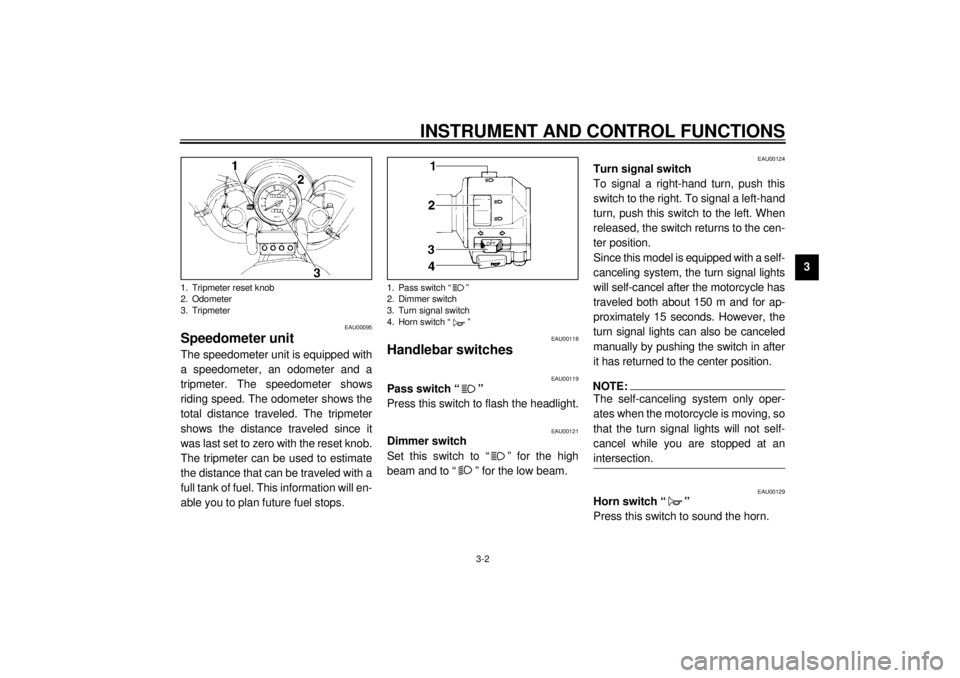
Speedometer unit The speedometer unit is equipped with
a speedometer, an odometer and a
tripmeter. The speedometer shows
riding speed. The odometer shows the
total distance traveled. The tripmeter
shows the distance traveled since it
was last set to zero with the reset knob.
The tripmeter can be used to estimate
the distance that can be traveled with a
full tank of fuel. This information will en-
able you to plan future fuel stops.
EAU00118
Handlebar switches
EAU00119
Pass switch “ ”
Press this switch to flash the headlight.
EAU00121
Dimmer switch
Set this switch to “ ” for the high
beam and to “ ” for the low beam.
EAU00124
Turn signal switch
To signal a right-hand turn, push this
switch to the right. To signal a left-hand
turn, push this switch to the left. When
released, the switch returns to the cen-
ter position.
Since this model is equipped with a self-
canceling system, the turn signal lights
will self-cancel after the motorcycle has
traveled both about 150 m and for ap-
proximately 15 seconds. However, the
turn signal lights can also be canceled
manually by pushing the switch in after
it has returned to the center position.NOTE:@ The self-canceling system only oper-
ates when the motorcycle is moving, so
that the turn signal lights will not self-
cancel while you are stopped at an
intersection.@
EAU00129
Horn switch “ ”
Press this switch to sound the horn.
1. Tripmeter reset knob
2. Odometer
3. Tripmeter
1. Pass switch “ ”
2. Dimmer switch
3. Turn signal switch
4. Horn switch “ ”
E_3bt.book Page 2 Thursday, September 7, 2000 10:01 AM
Page 18 of 96
INSTRUMENT AND CONTROL FUNCTIONS
3-3
3
EAU00138
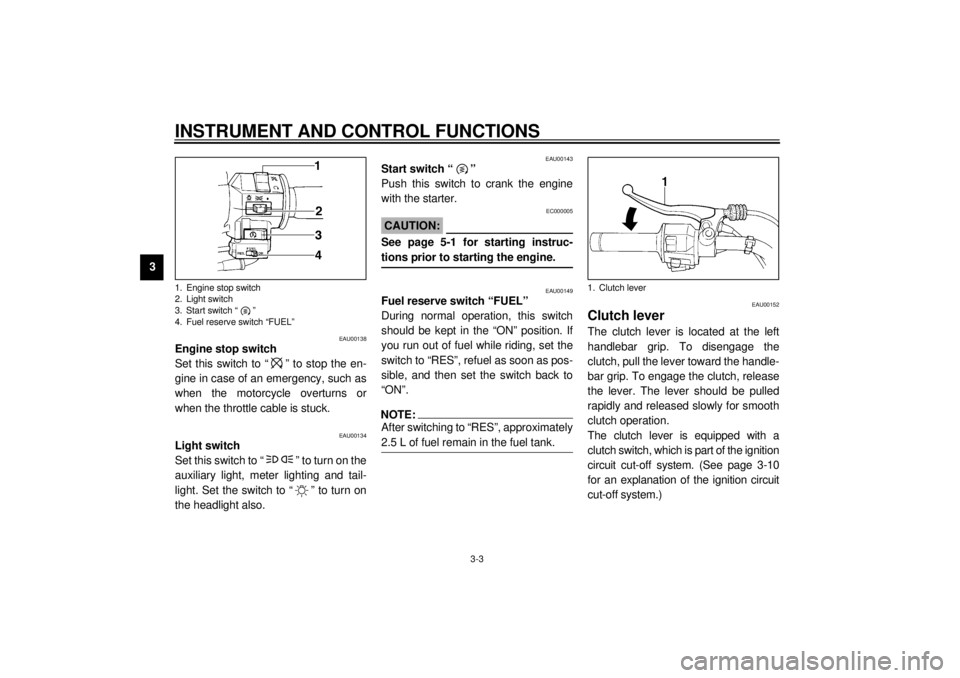
Engine stop switch
Set this switch to “ ” to stop the en-
gine in case of an emergency, such as
when the motorcycle overturns or
when the throttle cable is stuck.
EAU00134
Light switch
Set this switch to “ ” to turn on the
auxiliary light, meter lighting and tail-
light. Set the switch to “ ” to turn on
the headlight also.
EAU00143
Start switch “ ”
Push this switch to crank the engine
with the starter.
EC000005
CAUTION:@ See page 5-1 for starting instruc-
tions prior to starting the engine. @
EAU00149
Fuel reserve switch “FUEL”
During normal operation, this switch
should be kept in the “ON” position. If
you run out of fuel while riding, set the
switch to “RES”, refuel as soon as pos-
sible, and then set the switch back to
“ON”.NOTE:@ After switching to “RES”, approximately
2.5 L of fuel remain in the fuel tank. @
EAU00152
Clutch leverThe clutch lever is located at the left
handlebar grip. To disengage the
clutch, pull the lever toward the handle-
bar grip. To engage the clutch, release
the lever. The lever should be pulled
rapidly and released slowly for smooth
clutch operation.
The clutch lever is equipped with a
clutch switch, which is part of the ignition
circuit cut-off system. (See page 3-10
for an explanation of the ignition circuit
cut-off system.)
1. Engine stop switch
2. Light switch
3. Start switch “ ”
4. Fuel reserve switch “FUEL”
1. Clutch lever
E_3bt.book Page 3 Thursday, September 7, 2000 10:01 AM
Page 20 of 96
INSTRUMENT AND CONTROL FUNCTIONS
3-5
3
EAU03712
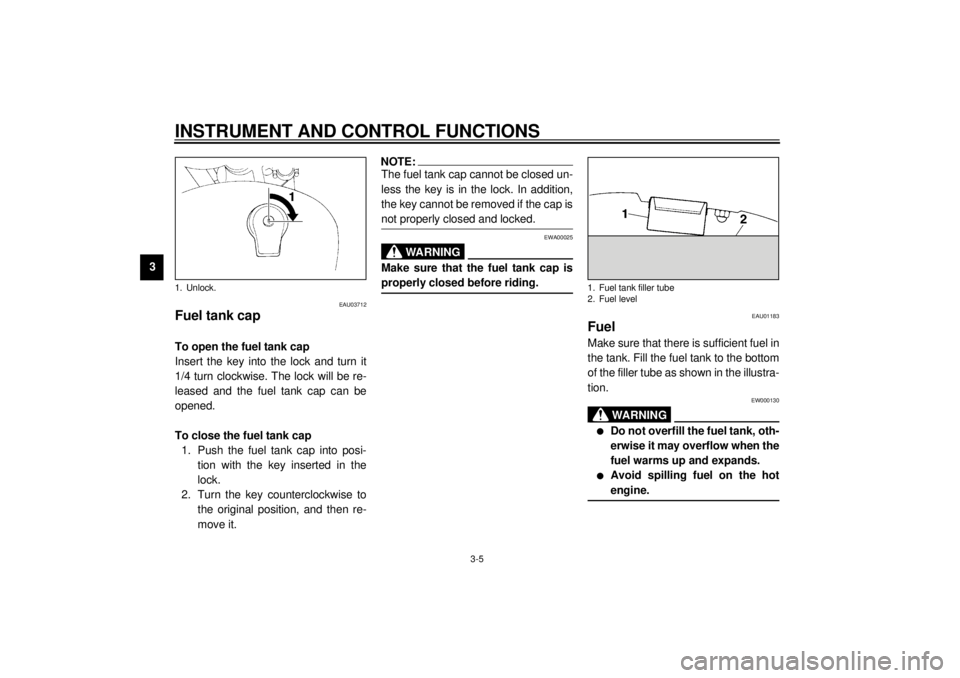
Fuel tank cap To open the fuel tank cap
Insert the key into the lock and turn it
1/4 turn clockwise. The lock will be re-
leased and the fuel tank cap can be
opened.
To close the fuel tank cap
1. Push the fuel tank cap into posi-
tion with the key inserted in the
lock.
2. Turn the key counterclockwise to
the original position, and then re-
move it.
NOTE:_ The fuel tank cap cannot be closed un-
less the key is in the lock. In addition,
the key cannot be removed if the cap is
not properly closed and locked. _
EWA00025
WARNING
_ Make sure that the fuel tank cap is
properly closed before riding. _
EAU01183
FuelMake sure that there is sufficient fuel in
the tank. Fill the fuel tank to the bottom
of the filler tube as shown in the illustra-
tion.
EW000130
WARNING
@ l
Do not overfill the fuel tank, oth-
erwise it may overflow when the
fuel warms up and expands.
l
Avoid spilling fuel on the hot
engine.
@
1. Unlock.
1. Fuel tank filler tube
2. Fuel level
E_3bt.book Page 5 Thursday, September 7, 2000 10:01 AM
Page 21 of 96
INSTRUMENT AND CONTROL FUNCTIONS
3-6
3
EAU00185
CAUTION:@ Immediately wipe off spilled fuel
with a clean, dry, soft cloth, since
fuel may deteriorate painted surfac-
es or plastic parts. @
EAU00191
NOTE:@ If knocking (or pinging) occurs, use
gasoline of a different brand or with a
higher octane grade. @
EAU02976
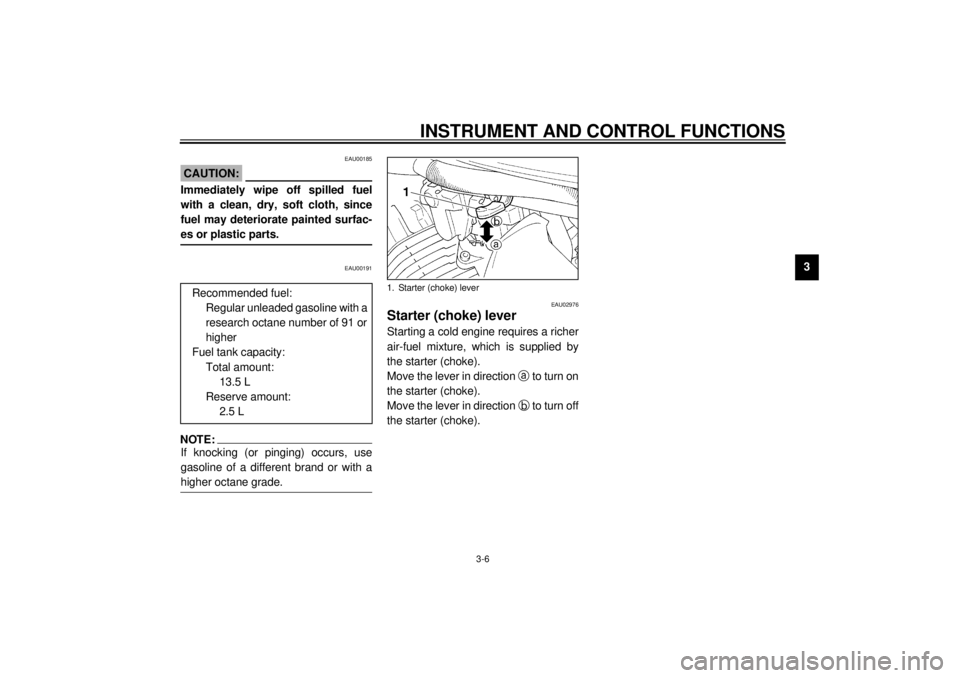
Starter (choke) leverStarting a cold engine requires a richer
air-fuel mixture, which is supplied by
the starter (choke).
Move the lever in direction
a to turn on
the starter (choke).
Move the lever in direction
b to turn off
the starter (choke). Recommended fuel:
Regular unleaded gasoline with a
research octane number of 91 or
higher
Fuel tank capacity:
Total amount:
13.5 L
Reserve amount:
2.5 L1. Starter (choke) lever
E_3bt.book Page 6 Thursday, September 7, 2000 10:01 AM
Page 28 of 96
4-1
4
EAU01114
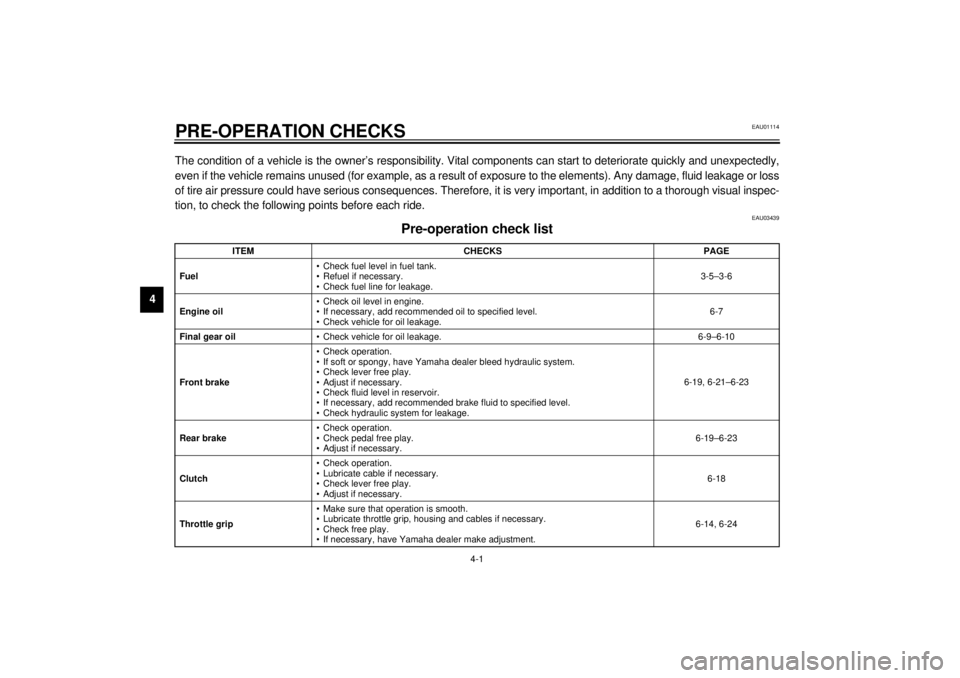
4-PRE-OPERATION CHECKSThe condition of a vehicle is the owner’s responsibility. Vital components can start to deteriorate quickly and unexpectedly,
even if the vehicle remains unused (for example, as a result of exposure to the elements). Any damage, fluid leakage or loss
of tire air pressure could have serious consequences. Therefore, it is very important, in addition to a thorough visual inspec-
tion, to check the following points before each ride.
EAU03439
Pre-operation check list
CO-01E
ITEM CHECKS PAGE
Fuel• Check fuel level in fuel tank.
• Refuel if necessary.
• Check fuel line for leakage.3-5–3-6
Engine oil• Check oil level in engine.
• If necessary, add recommended oil to specified level.
• Check vehicle for oil leakage.6-7
Final gear oil• Check vehicle for oil leakage. 6-9–6-10
Front brake• Check operation.
• If soft or spongy, have Yamaha dealer bleed hydraulic system.
• Check lever free play.
• Adjust if necessary.
• Check fluid level in reservoir.
• If necessary, add recommended brake fluid to specified level.
• Check hydraulic system for leakage.6-19, 6-21–6-23
Rear brake• Check operation.
• Check pedal free play.
• Adjust if necessary.6-19–6-23
Clutch• Check operation.
• Lubricate cable if necessary.
• Check lever free play.
• Adjust if necessary.6-18
Throttle grip• Make sure that operation is smooth.
• Lubricate throttle grip, housing and cables if necessary.
• Check free play.
• If necessary, have Yamaha dealer make adjustment.6-14, 6-24
E_3bt.book Page 1 Thursday, September 7, 2000 10:01 AM
Page 31 of 96
OPERATION AND IMPORTANT RIDING POINTS
5
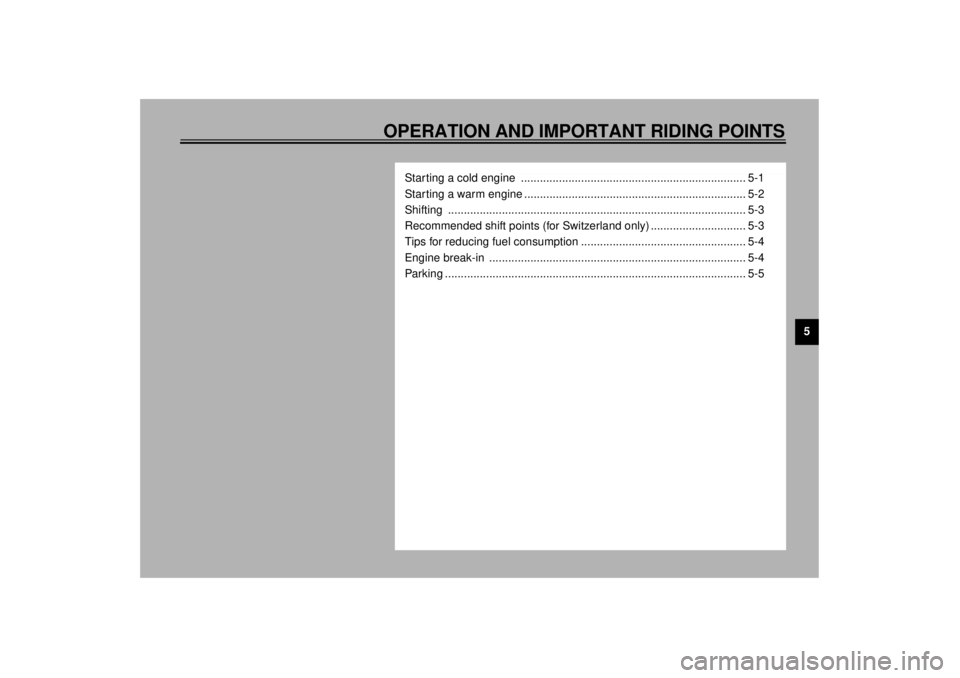
Starting a cold engine ....................................................................... 5-1
Starting a warm engine ...................................................................... 5-2
Shifting .............................................................................................. 5-3
Recommended shift points (for Switzerland only) .............................. 5-3
Tips for reducing fuel consumption .................................................... 5-4
Engine break-in ................................................................................. 5-4
Parking ............................................................................................... 5-5
E_3bt.book Page 1 Thursday, September 7, 2000 10:01 AM
Page 35 of 96
OPERATION AND IMPORTANT RIDING POINTS
5-4
5
EAU00424
Tips for reducing fuel
consumptionFuel consumption depends largely on
your riding style. Consider the following
tips to reduce fuel consumption:l
Thoroughly warm up the engine.
l
Turn the starter (choke) off as
soon as possible.
l
Shift up swiftly, and avoid high en-
gine speeds during acceleration.
l
Do not rev the engine while shift-
ing down, and avoid high engine
speeds with no load on the engine.
l
Turn the engine off instead of let-
ting it idle for an extended length
of time (e.g., in traffic jams, at traf-
fic lights or at railroad crossings).
EAU00436
Engine break-in There is never a more important period
in the life of your engine than the period
between 0 and 1,000 km. For this rea-
son, you should read the following ma-
terial carefully.
Since the engine is brand new, do not
put an excessive load on it for the first
1,000 km. The various parts in the en-
gine wear and polish themselves to the
correct operating clearances. During
this period, prolonged full-throttle oper-
ation or any condition that might result
in engine overheating must be avoided.
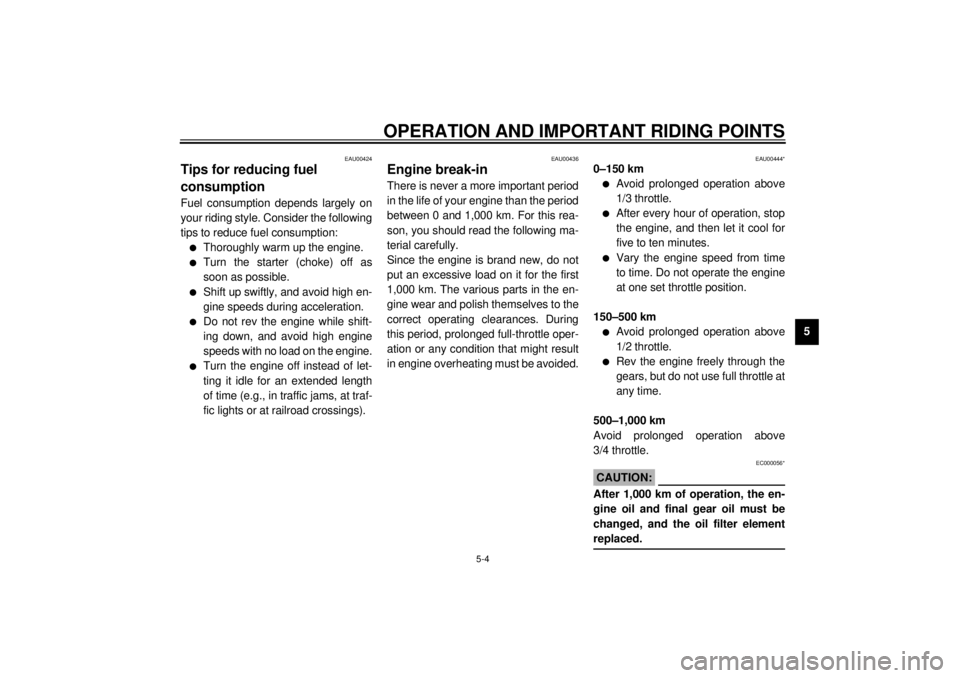
EAU00444*
0–150 kml
Avoid prolonged operation above
1/3 throttle.
l
After every hour of operation, stop
the engine, and then let it cool for
five to ten minutes.
l
Vary the engine speed from time
to time. Do not operate the engine
at one set throttle position.
150–500 km
l
Avoid prolonged operation above
1/2 throttle.
l
Rev the engine freely through the
gears, but do not use full throttle at
any time.
500–1,000 km
Avoid prolonged operation above
3/4 throttle.
EC000056*
CAUTION:@ After 1,000 km of operation, the en-
gine oil and final gear oil must be
changed, and the oil filter element
replaced. @
E_3bt.book Page 4 Thursday, September 7, 2000 10:01 AM
Page 39 of 96
PERIODIC MAINTENANCE AND MINOR REPAIR
6-2
6
EAU03685
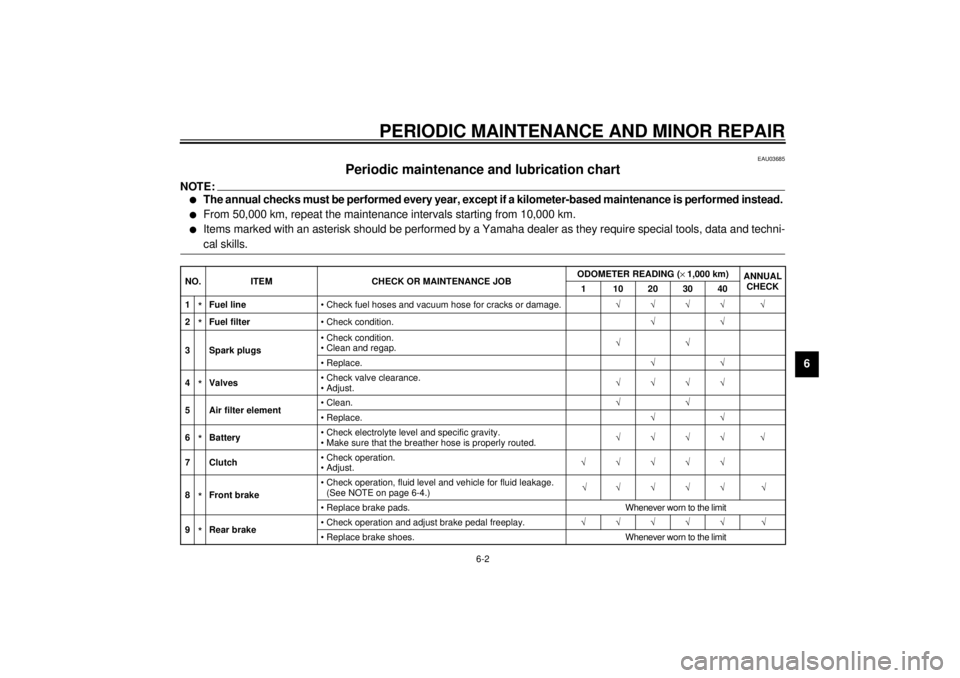
Periodic maintenance and lubrication chart
NOTE:_ l
The annual checks must be performed every year, except if a kilometer-based maintenance is performed instead.
l
From 50,000 km, repeat the maintenance intervals starting from 10,000 km.
l
Items marked with an asterisk should be performed by a Yamaha dealer as they require special tools, data and techni-
cal skills.
_CP-03ENO. ITEM CHECK OR MAINTENANCE JOBODOMETER READING (´1,000 km)
ANNUAL
CHECK
1 10203040
1
*Fuel line• Check fuel hoses and vacuum hose for cracks or damage.ÖÖÖÖ Ö
2*Fuel filter• Check condition.ÖÖ
3 Spark plugs• Check condition.
• Clean and regap.ÖÖ
• Replace.ÖÖ
4*Valves• Check valve clearance.
•Adjust.ÖÖÖÖ
5 Air filter element•Clean.ÖÖ
• Replace.ÖÖ
6*Battery• Check electrolyte level and specific gravity.
• Make sure that the breather hose is properly routed.ÖÖÖÖ Ö
7Clutch• Check operation.
•Adjust.ÖÖÖÖÖ
8*Front brake• Check operation, fluid level and vehicle for fluid leakage.
(See NOTE on page 6-4.)ÖÖÖÖÖ Ö
• Replace brake pads. Whenever worn to the limit
9*Rear brake• Check operation and adjust brake pedal freeplay.ÖÖÖÖÖ Ö
• Replace brake shoes. Whenever worn to the limit
E_3bt.book Page 2 Thursday, September 7, 2000 10:01 AM