ECO mode YAMAHA XV950 2014 Owners Manual
[x] Cancel search | Manufacturer: YAMAHA, Model Year: 2014, Model line: XV950, Model: YAMAHA XV950 2014Pages: 88, PDF Size: 2.37 MB
Page 12 of 88

SAFETY INFORMATION
1-5
1operator and may limit control
ability, therefore, such accesso-
ries are not recommended.
Use caution when adding electri-
cal accessories. If electrical ac-
cessories exceed the capacity of
the motorcycle’s electrical sys-
tem, an electric failure could re-
sult, which could cause a
dangerous loss of lights or engine
power.
Aftermarket Tires an d Rims
The tires and rims that came with your
motorcycle were designed to match
the performance capabilities and to
provide the best combination of han-
dling, braking, and comfort. Other
tires, rims, sizes, and combinations
may not be appropriate. Refer to page
6-14 for tire specifications and more in-
formation on replacing your tires.
Transportin g the Motorcycle
Be sure to observe following instruc-
tions before transporting the motorcy-
cle in another vehicle. Remove all loose items from the
motorcycle.
Check that the fuel cock (if
equipped) is in the “OFF” position
and that there are no fuel leaks.
Point the front wheel straight
ahead on the trailer or in the truck
bed, and choke it in a rail to pre-
vent movement.
Shift the transmission in gear (for
models with a manual transmis-
sion).
Secure the motorcycle with tie-
downs or suitable straps that are
attached to solid parts of the mo-
torcycle, such as the frame or up-
per front fork triple clamp (and not,
for example, to rubber-mounted
handlebars or turn signals, or
parts that could break). Choose
the location for the straps carefully
so the straps will not rub against
painted surfaces during transport.
The suspension should be com-
pressed somewhat by the tie-
downs, if possible, so that the mo-
torcycle will not bounce exces-
sively during transport.
U2DEE0E0.book Page 5 Friday, June 14, 2013 1:29 PM
Page 18 of 88
INSTRUMENT AND CONTROL FUNCTIONS
3-3
3
WARNING
EWA10073
Never turn the key to “OFF” while
the vehicle is moving, otherwise the
electrical systems will be switched
off, which may result in loss of con-
trol or an acci dent.
EAU57660
(Parkin g)
The hazard lights and turn signal lights
can be turned on, but all other electri-
cal systems are off. The key can be re-
moved.
EAU49394
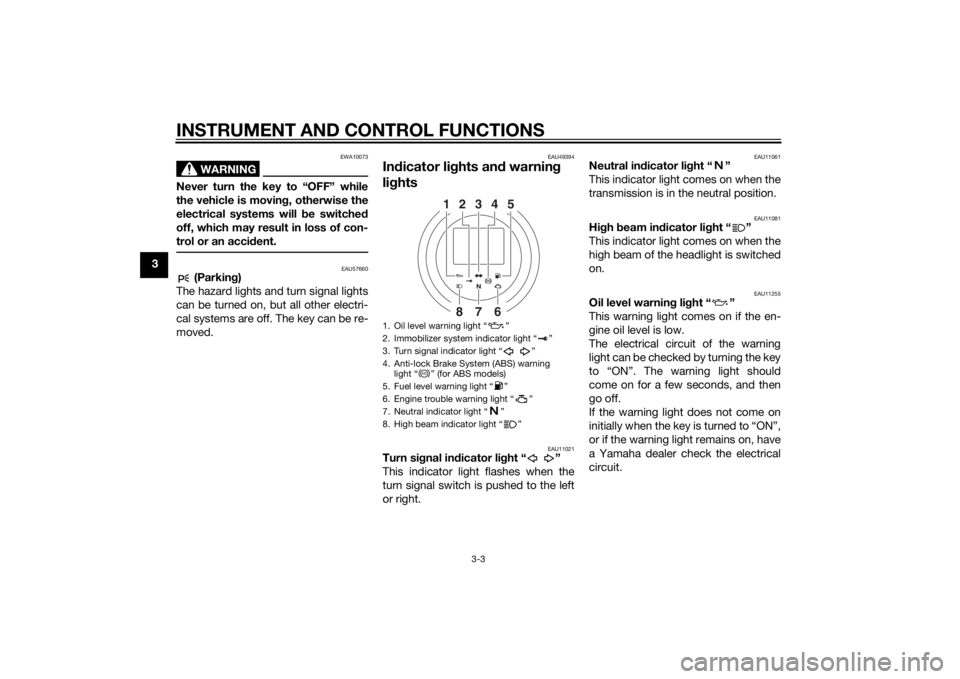
In dicator li ghts an d warnin g
li g hts
EAU11021
Turn si gnal in dicator li ght “ ”
This indicator light flashes when the
turn signal switch is pushed to the left
or right.
EAU11061
Neutral in dicator li ght “ ”
This indicator light comes on when the
transmission is in the neutral position.
EAU11081
Hi gh beam in dicator li ght “ ”
This indicator light comes on when the
high beam of the headlight is switched
on.
EAU11255
Oil level warnin g li ght “ ”
This warning light comes on if the en-
gine oil level is low.
The electrical circuit of the warning
light can be checked by turning the key
to “ON”. The warning light should
come on for a few seconds, and then
go off.
If the warning light does not come on
initially when the key is turned to “ON”,
or if the warning light remains on, have
a Yamaha dealer check the electrical
circuit.
1. Oil level warning light “ ”
2. Immobilizer system indicator light “ ”
3. Turn signal indicator light “ ”
4. Anti-lock Brake System (ABS) warning light “ ” (for ABS models)
5. Fuel level warning light “ ”
6. Engine trouble warning light “ ”
7. Neutral indicator light “ ”
8. High beam indicator light “ ”
1
35 42
8
7
6
ABS
U2DEE0E0.book Page 3 Friday, June 14, 2013 1:29 PM
Page 19 of 88
INSTRUMENT AND CONTROL FUNCTIONS
3-4
3
TIPEven if the oil level is sufficient, the
warning light may flicker when rid-
ing on a slope or during sudden
acceleration or deceleration, but
this is not a malfunction.
This model is also equipped with a
self-diagnosis device for the oil
level detection circuit. If a problem
is detected in the oil level detec-
tion circuit, the following cycle will
be repeated until the malfunction
is corrected: The oil level warning
light will flash ten times, then go
off for 2.5 seconds. If this occurs,
have a Yamaha dealer check the
vehicle.
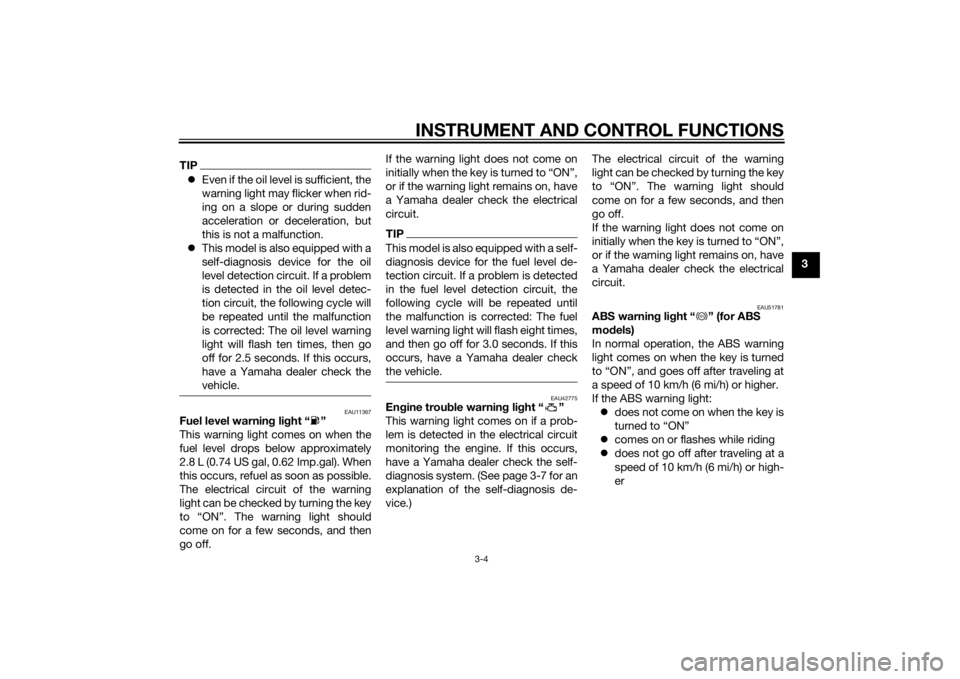
EAU11367
Fuel level warning light “ ”
This warning light comes on when the
fuel level drops below approximately
2.8 L (0.74 US gal, 0.62 Imp.gal). When
this occurs, refuel as soon as possible.
The electrical circuit of the warning
light can be checked by turning the key
to “ON”. The warning light should
come on for a few seconds, and then
go off. If the warning light does not come on
initially when the key is turned to “ON”,
or if the warning light remains on, have
a Yamaha dealer check the electrical
circuit.
TIPThis model is also equipped with a self-
diagnosis device for the fuel level de-
tection circuit. If a problem is detected
in the fuel level detection circuit, the
following cycle will be repeated until
the malfunction is corrected: The fuel
level warning light will flash eight times,
and then go off for 3.0 seconds. If this
occurs, have a Yamaha dealer check
the vehicle.
EAU42775
Engine trouble warning light “ ”
This warning light comes on if a prob-
lem is detected in the electrical circuit
monitoring the engine. If this occurs,
have a Yamaha dealer check the self-
diagnosis system. (See page 3-7 for an
explanation of the self-diagnosis de-
vice.)
The electrical circuit of the warning
light can be checked by turning the key
to “ON”. The warning light should
come on for a few seconds, and then
go off.
If the warning light does not come on
initially when the key is turned to “ON”,
or if the warning light remains on, have
a Yamaha dealer check the electrical
circuit.
EAU51781
ABS warning light “ ” (for ABS
models)
In normal operation, the ABS warning
light comes on when the key is turned
to “ON”, and goes off after traveling at
a speed of 10 km/h (6 mi/h) or higher.
If the ABS warning light:
does not come on when the key is
turned to “ON”
comes on or flashes while riding
does not go off after traveling at a
speed of 10 km/h (6 mi/h) or high-
er
ABS
U2DEE0E0.book Page 4 Friday, June 14, 2013 1:38 PM
Page 21 of 88
INSTRUMENT AND CONTROL FUNCTIONS
3-6
3
two tripmeters (which show the
distance traveled since they were
last set to zero)
a fuel reserve tripmeter (which
shows the distance traveled on
the fuel reserve)
a clock
a self-diagnosis device
TIPBe sure to turn the key to “ON” be-
fore using the “SELECT” and “RE-
SET” switches.
For the U.K. only: To switch the
speedometer and odometer/trip-
meter displays between kilome-
ters and miles, push the
“SELECT” switch for at least three
seconds.
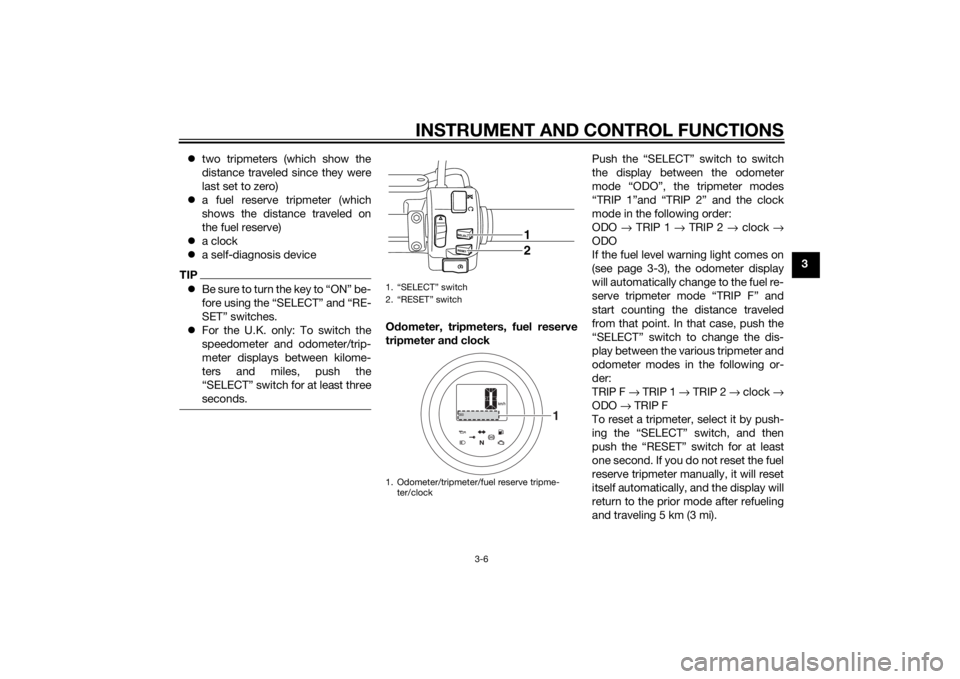
Odometer, tripmeters, fuel reserve
tripmeter an d clock Push the “SELECT” switch to switch
the display between the odometer
mode “ODO”, the tripmeter modes
“TRIP 1”and “TRIP 2” and the clock
mode in the following order:
ODO
→ TRIP 1 → TRIP 2 → clock →
ODO
If the fuel level warning light comes on
(see page 3-3), the odometer display
will automatically change to the fuel re-
serve tripmeter mode “TRIP F” and
start counting the distance traveled
from that point. In that case, push the
“SELECT” switch to change the dis-
play between the various tripmeter and
odometer modes in the following or-
der:
TRIP F → TRIP 1 → TRIP 2 → clock →
ODO → TRIP F
To reset a tripmeter, select it by push-
ing the “SELECT” switch, and then
push the “RESET” switch for at least
one second. If you do not reset the fuel
reserve tripmeter manually, it will reset
itself automatically, and the display will
return to the prior mode after refueling
and traveling 5 km (3 mi).1. “SELECT” switch
2. “RESET” switch
1. Odometer/tripmeter/fuel reserve tripme- ter/clock
1
2
1
U2DEE0E0.book Page 6 Friday, June 14, 2013 1:29 PM
Page 22 of 88
INSTRUMENT AND CONTROL FUNCTIONS
3-7
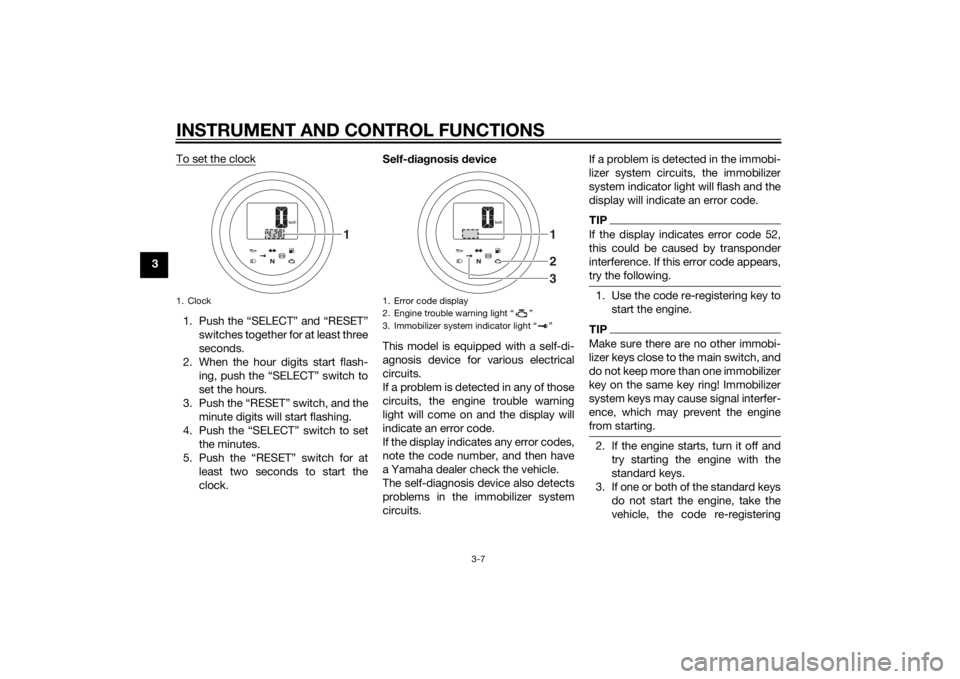
3To set the clock
1. Push the “SELECT” and “RESET”
switches together for at least three
seconds.
2. When the hour digits start flash- ing, push the “SELECT” switch to
set the hours.
3. Push the “RESET” switch, and the minute digits will start flashing.
4. Push the “SELECT” switch to set the minutes.
5. Push the “RESET” switch for at least two seconds to start the
clock. Self-
dia gnosis device
This model is equipped with a self-di-
agnosis device for various electrical
circuits.
If a problem is detected in any of those
circuits, the engine trouble warning
light will come on and the display will
indicate an error code.
If the display indicates any error codes,
note the code number, and then have
a Yamaha dealer check the vehicle.
The self-diagnosis device also detects
problems in the immobilizer system
circuits. If a problem is detected in the immobi-
lizer system circuits, the immobilizer
system indicator light will flash and the
display will indicate an error code.
TIPIf the display indicates error code 52,
this could be caused by transponder
interference. If this error code appears,
try the following.1. Use the code re-registering key to
start the engine.TIPMake sure there are no other immobi-
lizer keys close to the main switch, and
do not keep more than one immobilizer
key on the same key ring! Immobilizer
system keys may cause signal interfer-
ence, which may prevent the engine
from starting.2. If the engine starts, turn it off andtry starting the engine with the
standard keys.
3. If one or both of the standard keys do not start the engine, take the
vehicle, the code re-registering
1. Clock
1
1. Error code display
2. Engine trouble warning light “ ”
3. Immobilizer system indicator light “ ”
123
U2DEE0E0.book Page 7 Friday, June 14, 2013 1:29 PM
Page 29 of 88
INSTRUMENT AND CONTROL FUNCTIONS
3-14
3
brand or premium unleaded fuel. Use
of unleaded fuel will extend spark plug
life and reduce maintenance costs.
Gasohol
There are two types of gasohol: gaso-
hol containing ethanol and that con-
taining methanol. Gasohol containing
ethanol can be used if the ethanol con-
tent does not exceed 10% (E10). Gas-
ohol containing methanol is not
recommended by Yamaha because it
can cause damage to the fuel system
or vehicle performance problems.
EAUB1302
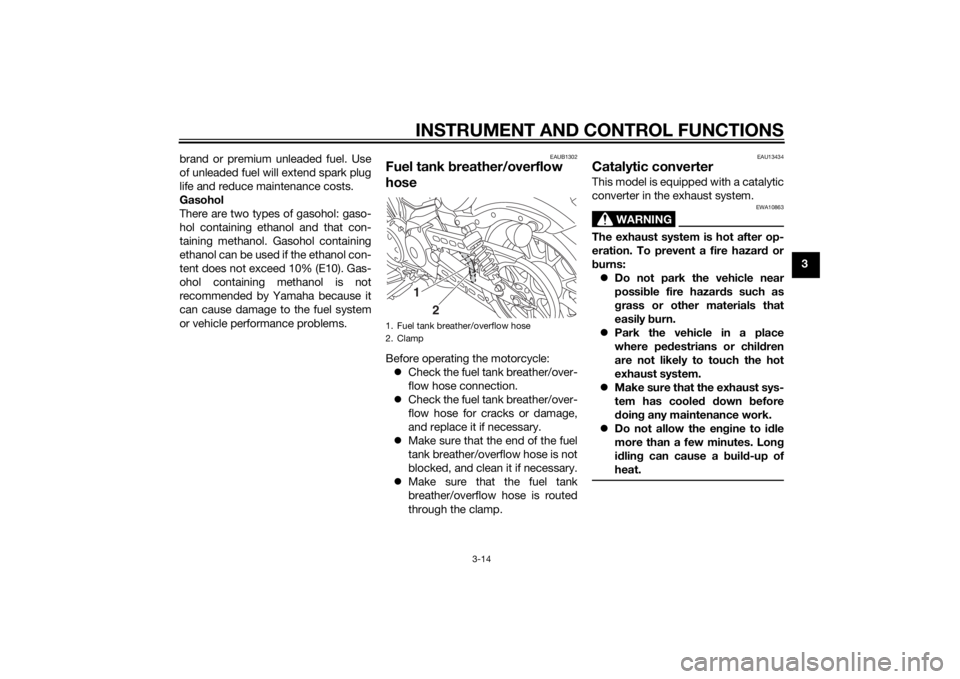
Fuel tank
breather/overflow
hoseBefore operating the motorcycle:
Check the fuel tank breather/over-
flow hose connection.
Check the fuel tank breather/over-
flow hose for cracks or damage,
and replace it if necessary.
Make sure that the end of the fuel
tank breather/overflow hose is not
blocked, and clean it if necessary.
Make sure that the fuel tank
breather/overflow hose is routed
through the clamp.
EAU13434
Catalytic converterThis model is equipped with a catalytic
converter in the exhaust system.
WARNING
EWA10863
The exhaust system is hot after op-
eration. To prevent a fire hazar d or
b urns:
Do not park the vehicle near
possi ble fire hazar ds such as
g rass or other materials that
easily burn.
Park the vehicle in a place
where pe destrians or chil dren
are not likely to touch the hot
exhaust system.
Make sure that the exhaust sys-
tem has coole d down before
d oin g any maintenance work.
Do not allow the en gine to i dle
more than a few minutes. Lon g
i d lin g can cause a b uild-up of
heat.
1. Fuel tank brea ther/overflow hose
2. Clamp
1
2
U2DEE0E0.book Page 14 Friday, June 14, 2013 1:29 PM
Page 38 of 88
OPERATION AND IMPORTANT RIDING POINTS
5-1
5
EAU15952
Read the Owner’s Manual carefully to
become familiar with all controls. If
there is a control or function you do not
understand, ask your Yamaha dealer.
WARNING
EWA10272
Failure to familiarize yourself with
the controls can lead to loss of con-
trol, which coul d cause an acci dent
or injury.
EAU48711
TIPThis model is equipped with: a lean angle sensor to stop the en-
gine in case of a turnover. In this
case, the multi-function display in-
dicates error code 30, but this is
not a malfunction. Turn the key to
“OFF” and then to “ON” to clear
the error code. Failing to do so will
prevent the engine from starting
even though the engine will crank
when pushing the start switch.
an engine auto-stop system. The
engine stops automatically if left
idling for 20 minutes. If the engine
stops, simply push the start
switch to restart the engine.
EAU57780
Startin g the en gineIn order for the ignition circuit cut-off
system to enable starting, one of the
following conditions must be met:
The transmission is in the neutral
position.
The transmission is in gear with
the clutch lever pulled and the
sidestand up.
See page 3-18 for more informa-
tion.
1. Turn the key to “ON” and make sure that the engine stop switch is
set to “ ”.
The following warning lights and
indicator light should come on for
a few seconds, then go off. Oil level warning light
Fuel level warning light
Engine trouble warning light
Immobilizer system indicator
lightNOTICE
ECA17671
If the a bove warnin g li ghts or in dica-
tor li ght do not come on initially
when the key is turne d to “ON”, or if
a warnin g or in dicator li ght remains
U2DEE0E0.book Page 1 Friday, June 14, 2013 1:29 PM
Page 39 of 88
OPERATION AND IMPORTANT RIDING POINTS
5-2
5
on, see pa
ge 3-3 for the correspond -
in g warnin g an d in dicator li ght cir-
cuit check.
For ABS models:The ABS warning light should
come on when the main switch is
turned to “ON” and then go off af-
ter traveling at a speed of 10 km/h
(6 mi/h) or higher.
NOTICE
ECA17682
If the ABS warnin g li ght does not
come on an d then go off as ex-
plaine d a bove, see pa ge 3-3 for the
warnin g li ght circuit check.2. Shift the transmission into the
neutral position. The neutral indi-
cator light should come on. If not,
ask a Yamaha dealer to check the
electrical circuit.
3. Start the engine by pushing the start switch.
If the engine fails to start, release
the start switch, wait a few sec-
onds, and then try again. Each
starting attempt should be as
short as possible to preserve the battery. Do not crank the engine
more than 10 seconds on any one
attempt.
NOTICE
ECA11043
For maximum en
gine life, never ac-
celerate har d when the en gine is
col d!
EAU16672
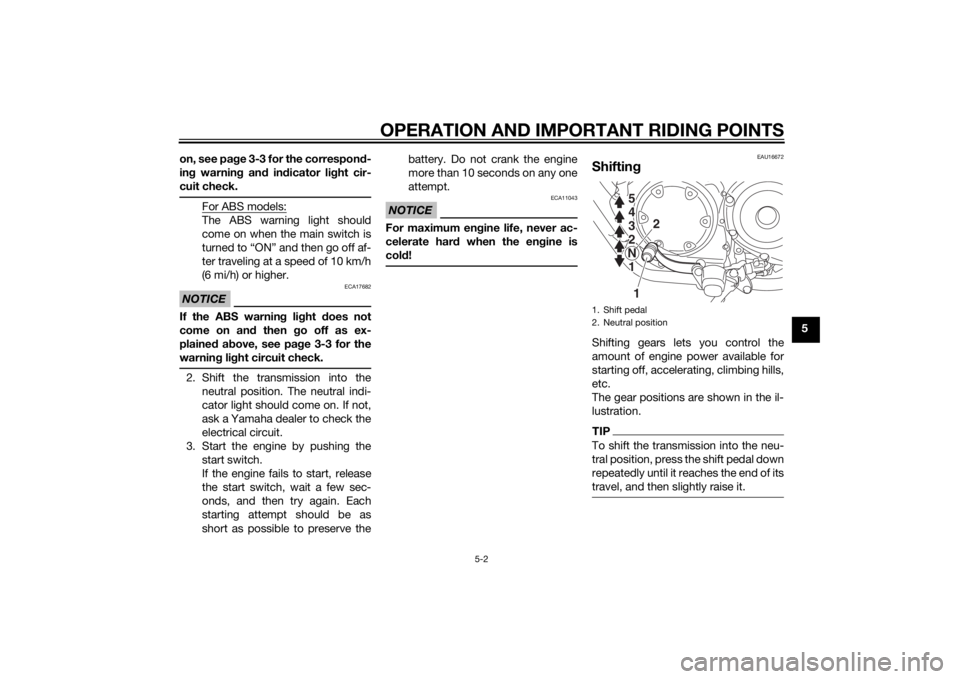
Shiftin gShifting gears lets you control the
amount of engine power available for
starting off, accelerating, climbing hills,
etc.
The gear positions are shown in the il-
lustration.TIPTo shift the transmission into the neu-
tral position, press the shift pedal down
repeatedly until it reaches the end of its
travel, and then slightly raise it.1. Shift pedal
2. Neutral position
1
2
5
4
3
2
N 1 5
4
3
2
N 1
U2DEE0E0.book Page 2 Friday, June 14, 2013 1:29 PM
Page 80 of 88
SPECIFICATIONS
8-1
8
Dimensions:Overall length:2290 mm (90.2 in)
Overall width:
830 mm (32.7 in)
Overall height: 1120 mm (44.1 in)
Seat height: 690 mm (27.2 in)
Wheelbase:
1570 mm (61.8 in)
Ground clearance: 130 mm (5.12 in)
Minimum turning radius: 3290 mm (129.5 in)Wei ght:Curb weight:
For non-ABS models 247 kg (545 lb)
For ABS models 251 kg (553 lb)Engine:Engine type:
Air cooled 4-stroke, SOHC
Cylinder arrangement:
V-type 2-cylinder
Displacement: 942 cm³
Bore × stroke:
85.0 × 83.0 mm (3.35 × 3.27 in)
Compression ratio:
9.00 : 1
Starting system: Electric starter
Lubrication system: Wet sump
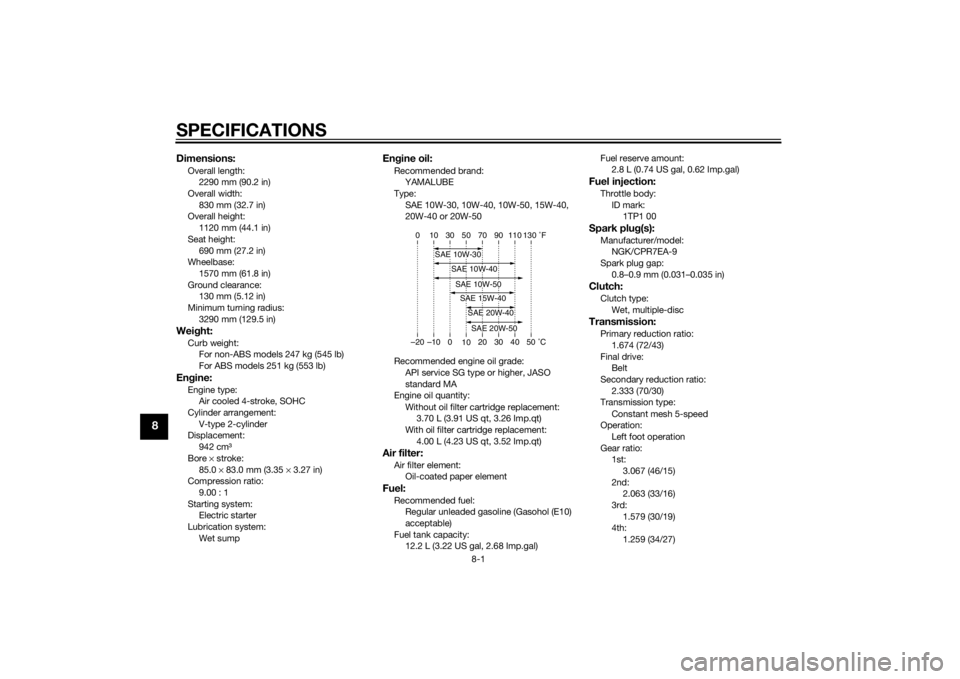
Engine oil:Recommended brand:
YAMALUBE
Type:
SAE 10W-30, 10W-40, 10W-50, 15W-40,
20W-40 or 20W-50
Recommended engine oil grade: API service SG type or higher, JASO
standard MA
Engine oil quantity:
Without oil filter cartridge replacement: 3.70 L (3.91 US qt, 3.26 Imp.qt)
With oil filter cartridge replacement:
4.00 L (4.23 US qt, 3.52 Imp.qt)Air filter:Air filter element:Oil-coated paper elementFuel:Recommended fuel:Regular unleaded gasoline (Gasohol (E10)
acceptable)
Fuel tank capacity: 12.2 L (3.22 US gal, 2.68 Imp.gal) Fuel reserve amount:
2.8 L (0.74 US gal, 0.62 Imp.gal)
Fuel injection:Throttle body:
ID mark: 1TP1 00Spark plu g(s):Manufacturer/model:
NGK/CPR7EA-9
Spark plug gap: 0.8–0.9 mm (0.031–0.035 in)Clutch:Clutch type:Wet, multiple-discTransmission:Primary reduction ratio:
1.674 (72/43)
Final drive: Belt
Secondary reduction ratio: 2.333 (70/30)
Transmission type:
Constant mesh 5-speed
Operation: Left foot operation
Gear ratio: 1st: 3.067 (46/15)
2nd: 2.063 (33/16)
3rd:
1.579 (30/19)
4th: 1.259 (34/27)
–20 –10 0 1020 30 40 50 C
10 30 50 70 90 110
0 130 F
SAE 10W-30
SAE 15W-40SAE 20W-40SAE 20W-50
SAE 10W-40SAE 10W-50
U2DEE0E0.book Page 1 Friday, June 14, 2013 1:29 PM
Page 83 of 88
CONSUMER INFORMATION
9-1
9
EAU48613
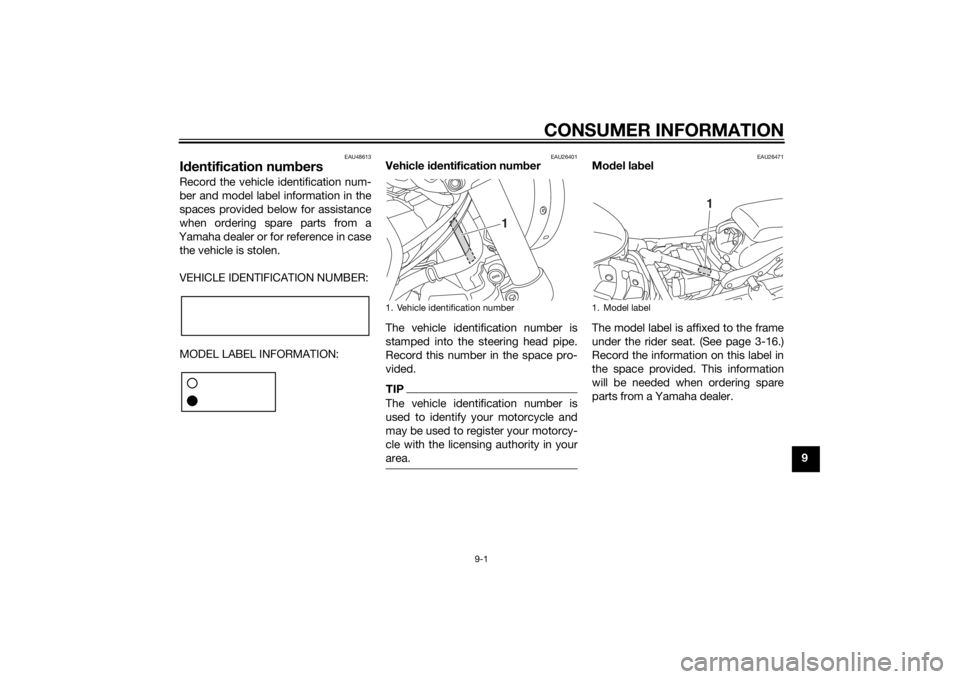
Id entification num bersRecord the vehicle identification num-
ber and model label information in the
spaces provided below for assistance
when ordering spare parts from a
Yamaha dealer or for reference in case the vehicle is stolen.
VEHICLE IDENTIFICATION NUMBER:
MODEL LABEL INFORMATION:
EAU26401
Vehicle i dentification num ber
The vehicle identification number is
stamped into the steering head pipe.
Record this number in the space pro-
vided.TIPThe vehicle identification number is
used to identify your motorcycle and
may be used to register your motorcy-
cle with the licensing authority in your
area.
EAU26471
Mo del la bel
The model label is affixed to the frame
under the rider seat. (See page 3-16.)
Record the information on this label in
the space provided. This information
will be needed when ordering spare
parts from a Yamaha dealer.
1. Vehicle identification number
1
1. Model label
1
U2DEE0E0.book Page 1 Friday, June 14, 2013 1:29 PM