wheel YAMAHA XVS1100 2000 User Guide
[x] Cancel search | Manufacturer: YAMAHA, Model Year: 2000, Model line: XVS1100, Model: YAMAHA XVS1100 2000Pages: 96, PDF Size: 13.11 MB
Page 79 of 96

MOTORCYCLE CARE AND STORAGE
7-2
7
ECA00010
CAUTION:@ l
Avoid using strong acidic wheel
cleaners, especially on spoked
wheels. If you do use such
products for hard-to-remove
dirt, do not leave it on any long-
er than instructed, then thor-
oughly rinse it off with water,
immediately dry the area and
apply a corrosion protection
spray.
l
Improper cleaning can damage
windshields, cowlings, panels
and other plastic parts. Use
only a soft, clean cloth or
sponge with mild detergent and
water to clean plastic.
l
Do not use any harsh chemical
products on plastic parts. Be
sure to avoid using cloths or
sponges which have been in
contact with strong or abrasive
cleaning products, solvent or
thinner, fuel (gasoline), rust re-
movers or inhibitors, brake flu-
id, antifreeze or electrolyte.
l
Do not use high-pressure wash-
ers or steam-jet cleaners since
they cause water seepage and
deterioration in the following ar-
eas: seals (of wheel bearings,
swingarm bearings, forks and
brakes), electric components
(couplers, connectors, instru-
ments, switches and lights),
breather hoses and vents.
l
For motorcycles equipped with
a windshield: Do not use strong
cleaners or hard sponges as
they will cause dulling or
scratching. Some cleaning
compounds for plastic may
leave scratches on the wind-
shield. Test the product on a
small hidden part of the wind-
shield to make sure they do not
leave any marks. If the wind-
shield is scratched, use a quali-
ty plastic polishing compound
after washing.
@After riding in the rain, near the sea oron salt-sprayed roadsSince sea salt or salt sprayed on the
roads in the winter are extremely corro-
sive in combination with water, carry
out the following steps after each ride
in the rain, near the sea or on salt-
sprayed roads. (Salt sprayed in the
winter may remain on the roads well
into spring.)
E_5el_Cleaning.fm Page 2 Monday, May 1, 2000 9:46 AM
Page 82 of 96

MOTORCYCLE CARE AND STORAGE
7-5
77. Check and, if necessary, correct
the tire air pressure, then raise the
motorcycle so that both of its
wheels are off the ground. Alterna-
tively, turn the wheels a little every
month in order to prevent the tires
from becoming degraded in one
spot.
8. Cover up the muffler outlets with
plastic bags to prevent moisture
from entering.
9. Remove the battery and fully
charge it. Store it in a cool, dry
place and recharge it once a
month. Do not store the battery in
an excessively cold or warm place
(less than 0°C or more than 30°C).
For more information, see “Battery
storage” in the chapter “PERIOD-
IC MAINTENANCE AND MINOR
REPAIRS”.
NOTE:@ Make any necessary repairs before
storing the motorcycle. @E_5el_Cleaning.fm Page 5 Monday, May 1, 2000 9:46 AM
Page 84 of 96

8-1
8
EAU01038
8-SPECIFICATIONSSpecifications01E
Model XVS1100
Dimensions
Overall length 2,405 mm
Overall width 895 mm
Overall height 1,095 mm
Seat height 690 mm
Wheelbase 1,640 mm
Ground clearance 145 mm
Minimum turning radius 3,200 mm
Basic weight
(with oil and full fuel tank)
274 kg (except for G, A, SF)
275 kg (for G, A, SF)
Engine
Engine type Air-cooled 4-stroke, SOHC
Cylinder arrangement V type 2-cylinder
Displacement 1,063 cm
3
Bore ´ stroke 95.0 ´ 75.0 mm
Compression ratio 8.3:1
Starting system Electric starter
Lubrication system Wet sumpEngine oil
Ty p e
Recommended engine oil
classification API Service SE, SF, SG type or
higher
Quantity
Periodic oil change 3.0 L
With oil filter replacement 3.1 L
Total amount 3.6 L
-20˚ -10˚ 0˚
10˚20˚ 30˚
40˚50˚C
SAE 10W/30
SAE 15W/40SAE 20W/40SAE 20W/50
SAE 10W/40
CAUTION:Be sure to use motor oils that do not contain anti-fric-
tion modifiers. Passenger car motor oils (often labeled
“Energy Conserving”) contain anti-friction additives
which will cause clutch and/or starter clutch slippage,
resulting in reduced component life and poor engine
performance.
E_5el_Spec.fm Page 1 Monday, May 1, 2000 9:47 AM
Page 86 of 96

SPECIFICATIONS
8-3
8
Air pressure (cold tire)
Up to 90 kg load*
Front 200 kPa (2.00 kg/cm
2, 2.00 bar)
Rear 225 kPa (2.25 kg/cm2, 2.25 bar)
90 kg load ~ maximum
load*
Front 225 kPa (2.25 kg/cm2, 2.25 bar)
Rear 250 kPa (2.50 kg/cm2, 2.50 bar)
* Load is total weight of cargo, rider, passenger and accessories.
Wheels
Front
Type Spoke
Size 18 ´ 2.15
Rear
Type Spoke
Size 15M/C ´ MT4.50
Brakes
Front
Type Dual disc brake
Operation Right hand operation
Fluid DOT 4Rear
Type Single disc brake
Operation Right foot operation
Fluid DOT 4
Suspension
Fr o n t
Ty p e Te l e s c o p i c f o r k
Rear
Type Swingarm (link suspention)
Shock absorber
Front Coil spring / oil damper
Rear Coil spring / gas-oil damper,
spring preload adjustable
Wheel travel
Front 140 mm
Rear 113 mm
Electrical
Ignition system T.C.I. (digital)
Charging system
Type A.C. magneto
Standard output 14 V, 350 W@ 5,000 r/min
Battery
Type GT14B-4
Voltage, capacity 12 V, 12 AH
E_5el_Spec.fm Page 3 Monday, May 1, 2000 9:47 AM
Page 93 of 96
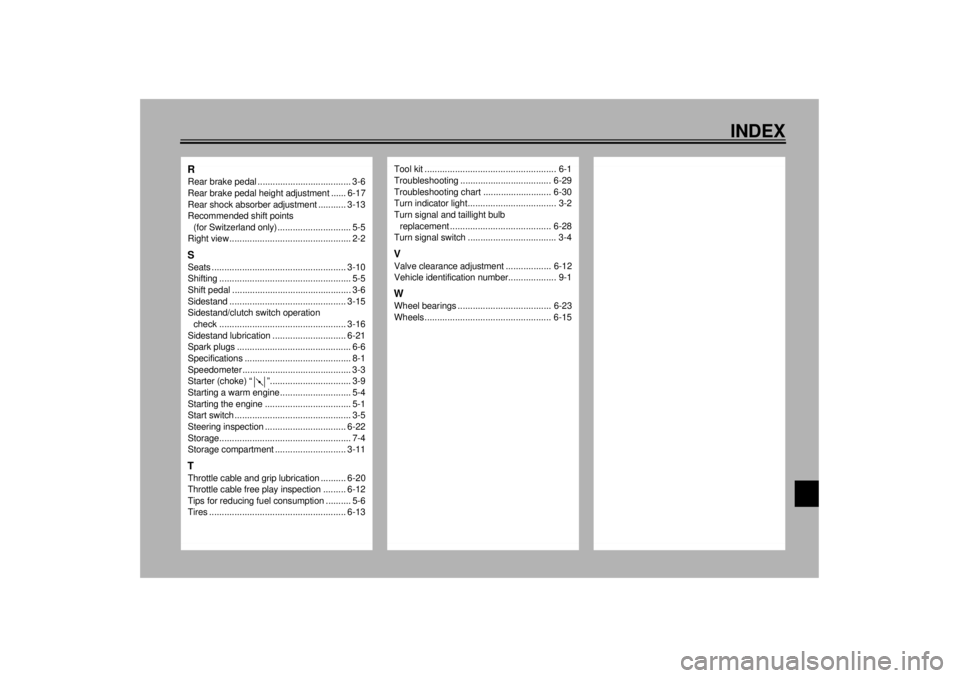
INDEX
RRear brake pedal ..................................... 3-6
Rear brake pedal height adjustment ...... 6-17
Rear shock absorber adjustment ........... 3-13
Recommended shift points
(for Switzerland only)............................. 5-5
Right view................................................ 2-2SSeats ..................................................... 3-10
Shifting .................................................... 5-5
Shift pedal ............................................... 3-6
Sidestand .............................................. 3-15
Sidestand/clutch switch operation
check .................................................. 3-16
Sidestand lubrication ............................. 6-21
Spark plugs ............................................. 6-6
Specifications .......................................... 8-1
Speedometer ........................................... 3-3
Starter (choke) “ ”................................ 3-9
Starting a warm engine ............................ 5-4
Starting the engine .................................. 5-1
Start switch .............................................. 3-5
Steering inspection ................................ 6-22
Storage.................................................... 7-4
Storage compartment ............................ 3-11TThrottle cable and grip lubrication .......... 6-20
Throttle cable free play inspection ......... 6-12
Tips for reducing fuel consumption .......... 5-6
Tires ...................................................... 6-13
Tool kit .................................................... 6-1
Troubleshooting .................................... 6-29
Troubleshooting chart ........................... 6-30
Turn indicator light................................... 3-2
Turn signal and taillight bulb
replacement ........................................ 6-28
Turn signal switch ................................... 3-4VValve clearance adjustment .................. 6-12
Vehicle identification number................... 9-1WWheel bearings ..................................... 6-23
Wheels .................................................. 6-15
E_5elIX.fm Page 2 Monday, May 1, 2000 9:48 AM