Oil YAMAHA XVS125 2000 User Guide
[x] Cancel search | Manufacturer: YAMAHA, Model Year: 2000, Model line: XVS125, Model: YAMAHA XVS125 2000Pages: 86, PDF Size: 3.07 MB
Page 54 of 86
6-24
1
2
3
4
5
6
7
8
9
PERIODIC MAINTENANCE AND MINOR REPAIR
EAU00731
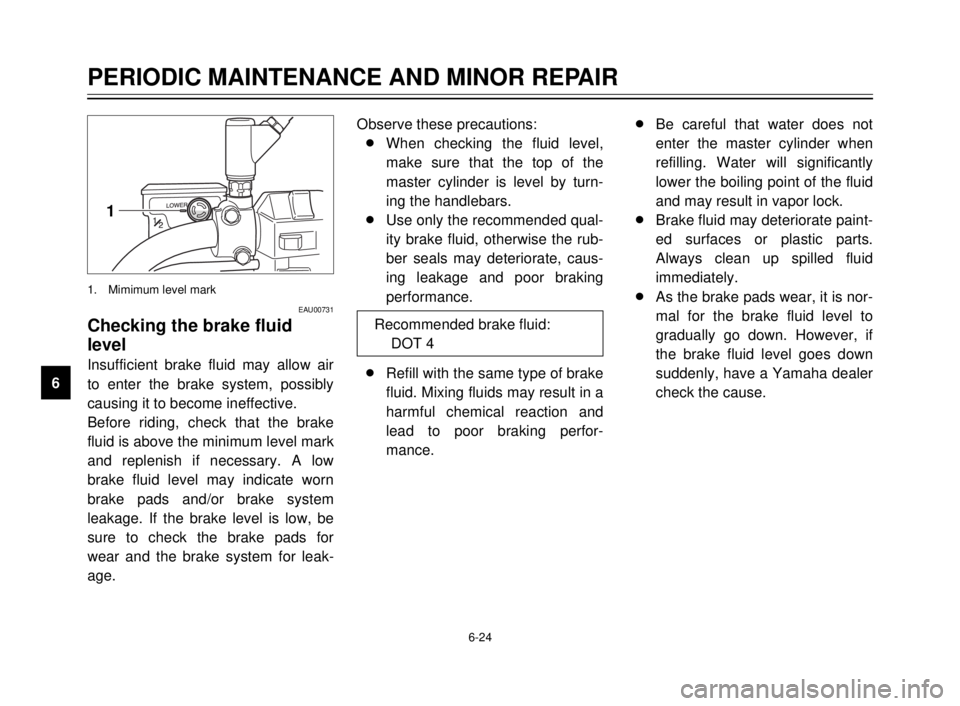
Checking the brake fluid
level
Insufficient brake fluid may allow air
to enter the brake system, possibly
causing it to become ineffective.
Before riding, check that the brake
fluid is above the minimum level mark
and replenish if necessary. A low
brake fluid level may indicate worn
brake pads and/or brake system
leakage. If the brake level is low, be
sure to check the brake pads for
wear and the brake system for leak-
age.
1. Mimimum level mark
1
Observe these precautions:
8When checking the fluid level,
make sure that the top of the
master cylinder is level by turn-
ing the handlebars.
8Use only the recommended qual-
ity brake fluid, otherwise the rub-
ber seals may deteriorate, caus-
ing leakage and poor braking
performance.
8Refill with the same type of brake
fluid. Mixing fluids may result in a
harmful chemical reaction and
lead to poor braking perfor-
mance.8Be careful that water does not
enter the master cylinder when
refilling. Water will significantly
lower the boiling point of the fluid
and may result in vapor lock.
8Brake fluid may deteriorate paint-
ed surfaces or plastic parts.
Always clean up spilled fluid
immediately.
8As the brake pads wear, it is nor-
mal for the brake fluid level to
gradually go down. However, if
the brake fluid level goes down
suddenly, have a Yamaha dealer
check the cause. Recommended brake fluid:
DOT 4
5JX-9-E0 4/9/0 4:11 AM Page 52
Page 55 of 86

1
2
3
4
5
6
7
8
9
6-25
PERIODIC MAINTENANCE AND MINOR REPAIR
EAU03238
Changing the brake fluid
Have a Yamaha dealer change the
brake fluid at the intervals specified in
the periodic maintenance and lubrica-
tion chart. In addition, have the oil
seals of the brake master cylinder
and caliper as well as the brake hose
replaced at the intervals listed below
or whenever it is damaged or leaking.
8Oil seals: Replace every two
years.
8Brake hose: Replace every four
years.2. Shift the transmission into the
neutral position.
3. Move the rear wheel by pushing
the motorcycle to locate the tight-
est portion of the drive chain,
and then measure the drive
chain slack as shown.
4. If the drive chain slack is incor-
rect, adjust it as follows.
EAU00744
Drive chain slack
The drive chain slack should be
checked before each ride and adjust-
ed if necessary.
To check the drive chain slack
1. Place the motorcycle on a level
surface and hold it in an upright
position.
NOTE:
When checking and adjusting the
drive chain slack, the motorcycle
should be positioned straight up and
there should be no weight on it.
a. Drive chain slack
a
Drive chain slack:
30–40 mm
5JX-9-E0 4/9/0 4:11 AM Page 53
Page 57 of 86
1
2
3
4
5
6
7
8
9
6-27
PERIODIC MAINTENANCE AND MINOR REPAIR
EAU03006
Lubricating the drive chain
The drive chain must be cleaned and
lubricated at the intervals specified in
the periodic maintenance and lubrica-
tion chart, otherwise it will quickly
wear out, especially when riding in
dusty or wet areas. Service the drive
chain as follows.
EC000097
cC
The drive chain must be lubricated
after washing the motorcycle or
riding in the rain.
1. Clean the drive chain with
kerosene and a small soft brush.
ECA00053
cC
To prevent damaging the O-rings,
do not clean the drive chain with
steam cleaners, high-pressure
washers or inappropriate solvents.
EC000096
cC
Improper drive chain slack will
overload the engine as well as
other vital parts of the motorcycle
and can lead to chain slippage or
breakage. To prevent this from
occurring, keep the drive chain
slack within the specified limits.
3. Tighten both locknuts, and then
tighten the axle nut to the speci-
fied torque.
4. Adjust the brake pedal free play.
(See page 6-22 for brake pedal
free play adjustment proce-
dures.)
EW000103
w
After adjusting the brake pedal
free play, check the operation of
the brake light.
Tightening torque:
Axle nut:
104 Nm (10.4 m·kg)
2. Wipe the drive chain dry.
3. Thoroughly lubricate the drive
chain with a special O-ring chain
lubricant.
ECA00052
cC
Do not use engine oil or any other
lubricants for the drive chain, as
they may contain substances that
could damage the O-rings.
5JX-9-E0 4/9/0 4:11 AM Page 55
Page 58 of 86

6-28
1
2
3
4
5
6
7
8
9
PERIODIC MAINTENANCE AND MINOR REPAIR
EAU02962
Checking and lubricating the
cables
The operation of all control cables
and the condition of the cables
should be checked before each ride,
and the cables and cable ends
should be lubricated if necessary. If
a cable is damaged or does not move
smoothly, have a Yamaha dealer
check or replace it.
EW000112
w
Damage to the outer sheath may
interfere with proper cable opera-
tion and will cause the inner cable
to rust. Replace a damaged cable
as soon as possible to prevent
unsafe conditions.
EAU03199
Checking and lubricating the
brake and shift pedals
The operation of the brake and shift
pedals should be checked before
each ride, and the pedal pivots
should be lubricated if necessary.
Recommended lubricant:
Lithium-soap-based grease
(all-purpose grease)
Recommended lubricant:
Engine oil
5JX-9-E0 4/9/0 4:11 AM Page 56
Page 59 of 86

1
2
3
4
5
6
7
8
9
6-29
PERIODIC MAINTENANCE AND MINOR REPAIR
EAU03164
Checking and lubricating the
brake and clutch levers
The operation of the brake and clutch
levers should be checked before
each ride, and the lever pivots should
be lubricated if necessary.
EAU03165
Checking and lubricating the
sidestand
The operation of the sidestand
should be checked before each ride,
and the sidestand pivot and metal-to-
metal contact surfaces should be
lubricated if necessary.
EW000113
w
If the sidestand does not move up
and down smoothly, have a
Yamaha dealer check or repair it.
EAU02939
Checking the front fork
The condition and operation of the
front fork must be checked as follows
at the intervals specified in the peri-
odic maintenance and lubrication
chart.
To check the condition
EW000115
w
Securely support the motorcycle
so that there is no danger of it
falling over.
Check the inner tubes for scratches,
damage and excessive oil leakage.
Recommended lubricant:
Lithium-soap-based grease
(all-purpose grease)
Recommended lubricant:
Lithium-soap-based grease
(all-purpose grease)
5JX-9-E0 4/9/0 4:11 AM Page 57
Page 65 of 86

1
2
3
4
5
6
7
8
9
6-35
PERIODIC MAINTENANCE AND MINOR REPAIR
1
3. Unhook the headlight bulb hold-
er, and then remove the defec-
tive bulb.
EW000119
w
Headlight bulbs get very hot.
Therefore, keep flammable prod-
ucts away from a lit headlight bulb,
and do not touch the bulb until it
has cooled down.
4. Place a new bulb into position,
and then secure it with the bulb
holder.
1. Bulb holder
EC000105
cC
Do not touch the glass part of the
headlight bulb to keep it free from
oil, otherwise the transparency of
the glass, the luminosity of the
bulb, and the bulb life will be
adversely affected. Thoroughly
clean off any dirt and fingerprints
on the headlight bulb using a cloth
moistened with alcohol or thinner.
5. Install the bulb cover, and then
connect the coupler.
1. Do not touch this area
1
6. Install the headlight unit by
installing the screws.
7. Have a Yamaha dealer adjust
the headlight beam if necessary.
5JX-9-E0 4/9/0 4:11 AM Page 63
Page 73 of 86

1
2
3
4
5
6
7
8
9
7-1
EAU03224*
MOTORCYCLE CARE AND STORAGE
Care
While the open design of a motorcy-
cle reveals the attractiveness of the
technology, it also makes it more vul-
nerable. Rust and corrosion can
develop even if high-quality compo-
nents are used. A rusty exhaust pipe
may go unnoticed on a car, however,
it detracts from the overall appear-
ance of a motorcycle. Frequent and
proper care does not only comply
with the terms of the warranty, but it
will also keep your motorcycle looking
good, extend its life and optimize its
performance.Before cleaning
1. Cover the muffler outlets with
plastic bags after the engine has
cooled down.
2. Make sure that all caps and cov-
ers as well as all electrical cou-
plers and connectors, including
the spark plug caps, are tightly
installed.
3. Remove extremely stubborn dirt,
like oil burnt onto the crankcase,
with a degreasing agent and a
brush, but never apply such
products onto seals, gaskets,
sprockets, the drive chain and
wheel axles. Always rinse the dirt
and degreaser off with water.CleaningECA00010
cC
8Avoid using strong acidic
wheel cleaners, especially on
spoked wheels. If such prod-
ucts are used on hard-to-
remove dirt, do not leave the
cleaner on the affected area
any longer than instructed.
Also, thoroughly rinse the area
off with water, immediately dry
it, and then apply a corrosion
protection spray.
8Improper cleaning can damage
windshields, cowlings, panels
and other plastic parts. Use
only a soft, clean cloth or
sponge with mild detergent
and water to clean plastic.
5JX-9-E0 4/9/0 4:11 AM Page 71
Page 75 of 86

MOTORCYCLE CARE AND STORAGE
7
7-3
After cleaning
1. Dry the motorcycle with a
chamois or an absorbing cloth.
2. Immediately dry the drive chain
and lubricate it to prevent it from
rusting.
3. Use a chrome polish to shine
chrome, aluminum and stainless-
steel parts, including the exhaust
system. (Even the thermally
induced discoloring of stainless-
steel exhaust systems can be
removed through polishing.)
4. To prevent corrosion, it is recom-
mended to apply a corrosion pro-
tection spray on all metal, includ-
ing chrome- and nickel-plated,
surfaces.
5. Use spray oil as a universal
cleaner to remove any remaining
dirt.
6. Touch up minor paint damage
caused by stones, etc.7. Wax all painted surfaces.
8. Let the motorcycle dry complete-
ly before storing or covering it.
EWA00001
w
8Make sure that there is no oil
or wax on the brakes or tires.
If necessary, clean the brake
discs and brake linings with a
regular brake disc cleaner or
acetone, and wash the tires
with warm water and a mild
detergent.
8Before operating the motorcy-
cle test its braking perfor-
mance and cornering behav-
ior.
ECA00013
cC
8Apply spray oil and wax spar-
ingly and make sure to wipe
off any excess.
8Never apply oil or wax to any
rubber and plastic parts, but
treat them with a suitable care
product.
8Avoid using abrasive polish-
ing compounds as they will
wear away the paint.
NOTE:
Consult a Yamaha dealer for advice
on what products to use.
5JX-9-E0 4/9/0 4:11 AM Page 73
Page 76 of 86

7
7-4
MOTORCYCLE CARE AND STORAGE
Storage
Short-term
Always store your motorcycle in a
cool, dry place and, if necessary, pro-
tect it against dust with a porous
cover.
ECA00014
cC
8Storing the motorcycle in a
poorly ventilated room or cov-
ering it with a tarp, while it is
still wet, will allow water and
humidity to seep in and cause
rust.
8To prevent corrosion, avoid
damp cellars, stables (because
of the presence of ammonia)
and areas where strong chemi-
cals are stored.
Long-term
Before storing your motorcycle for
several months:
1. Follow all the instructions in the
“Care” section of this chapter.
2. Drain the carburetor float cham-
bers by loosening the drain bolts;
this will prevent fuel deposits
from building up. Pour the
drained fuel into the fuel tank.
3. Turn the fuel cock lever to “ON”.
4. Fill up the fuel tank and add fuel
stabilizer (if available) to prevent
the fuel tank from rusting and the
fuel from deteriorating.
5. Perform the following steps to
protect the cylinders, piston
rings, etc. from corrosion.
a. Remove the spark plug caps and
spark plugs.
b. Pour a teaspoonful of engine oil
into each spark plug bore.c. Install the spark plug caps onto
the spark plugs, and then place
the spark plugs on the cylinder
head so that the electrodes are
grounded. (This will limit spark-
ing during the next step.)
d. Turn the engine over several
times with the starter. (This will
coat the cylinder walls with oil.)
e. Remove the spark plug caps
from the spark plugs, and then
install the spark plugs and the
spark plug caps.
EWA00003
w
To prevent damage or injury from
sparking, make sure to ground the
spark plug electrodes while turn-
ing the engine over.
6. Lubricate all control cables and
the pivoting points of all levers
and pedals as well as of the
sidestand/centerstand.
5JX-9-E0 4/9/0 4:11 AM Page 74
Page 78 of 86
7
EAU01038
SPECIFICATIONS
8-1
Specifications
Model XVS125
Dimensions
Overall length 2,320 mm
Overall width 910 mm
Overall height 1,075 mm
Seat height 670 mm
Wheel base 1,530 mm
Ground clearance 150 mm
Minimum turning radius 2,900 mm
Basic weight (with oil and full
fuel tank)156 kg
Engine
Engine type Air-cooled 4-stroke, SOHC,
gasoline
Cylinder arrangement V-type 2-cylinder
Displacement 124 cm
3
Bore ´Stroke 41.0 ´47.0 mm
Compression ratio 11:1
Starting system Electric starter
Lubrication system Wet sumpEngine oil
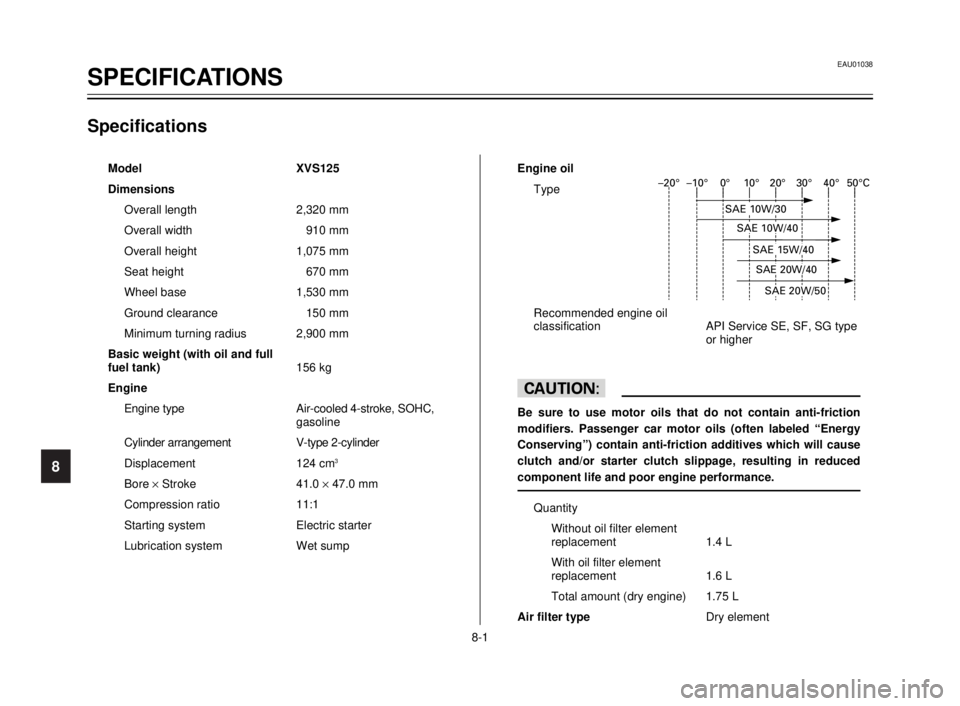
Type
Recommended engine oil
classification API Service SE, SF, SG type
or higher
cC
Be sure to use motor oils that do not contain anti-friction
modifiers. Passenger car motor oils (often labeled “Energy
Conserving”) contain anti-friction additives which will cause
clutch and/or starter clutch slippage, resulting in reduced
component life and poor engine performance.
Quantity
Without oil filter element
replacement 1.4 L
With oil filter element
replacement 1.6 L
Total amount (dry engine) 1.75 L
Air filter typeDry element
–10° 0° 10° 20° 30°
40°
SAE 10W/30
SAE 10W/40
SAE 20W/40
SAE 20W/50
–20°
SAE 15W/40 50°C
8
5JX-9-E0 4/9/0 4:11 AM Page 76