wheel YAMAHA XVS125 2000 User Guide
[x] Cancel search | Manufacturer: YAMAHA, Model Year: 2000, Model line: XVS125, Model: YAMAHA XVS125 2000Pages: 86, PDF Size: 3.07 MB
Page 61 of 86
1
2
3
4
5
6
7
8
9
6-31
PERIODIC MAINTENANCE AND MINOR REPAIR
EAU01144
Checking the wheel bearings
The front and rear wheel bearings
must be checked at the intervals
specified in the periodic maintenance
and lubrication chart. If there is play
in the wheel hub or if the wheel does
not turn smoothly, have a Yamaha
dealer check the wheel bearings.
EAU01271
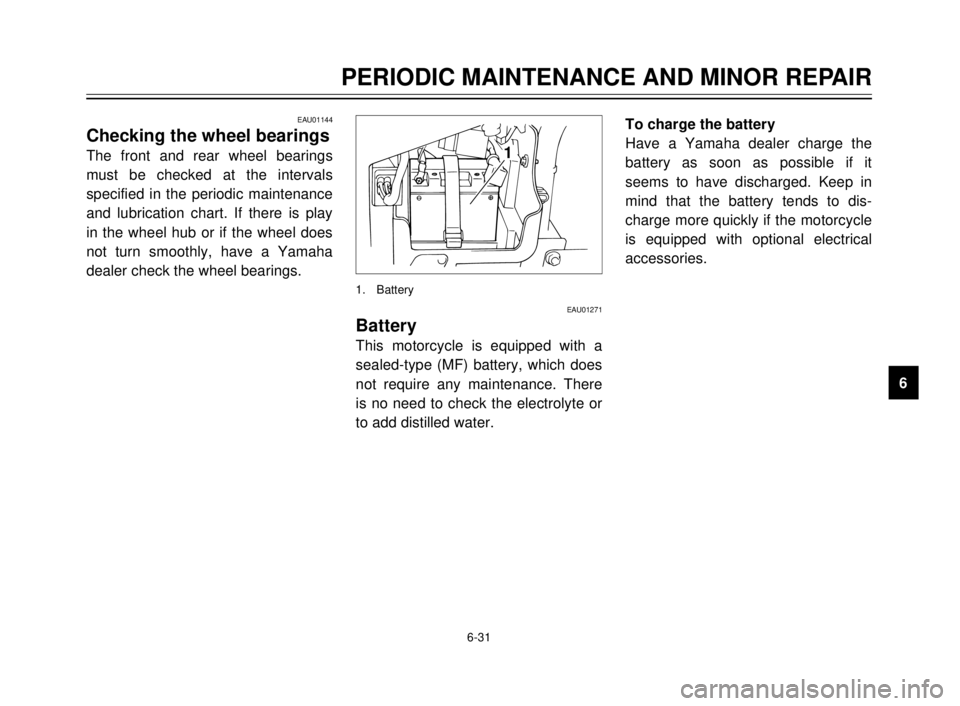
Battery
This motorcycle is equipped with a
sealed-type (MF) battery, which does
not require any maintenance. There
is no need to check the electrolyte or
to add distilled water.
1. Battery
1
To charge the battery
Have a Yamaha dealer charge the
battery as soon as possible if it
seems to have discharged. Keep in
mind that the battery tends to dis-
charge more quickly if the motorcycle
is equipped with optional electrical
accessories.
5JX-9-E0 4/9/0 4:11 AM Page 59
Page 67 of 86

1
2
3
4
5
6
7
8
9
6-37
PERIODIC MAINTENANCE AND MINOR REPAIR
1
2. Remove the defective bulb by
pushing it in and turning it coun-
terclockwise.
3. Insert a new bulb into the socket,
push it in, and then turn it clock-
wise until it stops.
4. Install the lens by installing the
screws.
EC000108
cC
Do not overtighten the screws,
otherwise the lens may break.
1. Bulb
EAU01579
Supporting the motorcycle
Since this model is not equipped with
a centerstand, follow these precau-
tions when removing the front and
rear wheel or performing other main-
tenance requiring the motorcycle to
stand upright. Check that the motor-
cycle is in a stable and level position
before starting any maintenance. A
strong wooden box can be placed
under the engine for added stability.
To service the front wheel
1. Stabilize the rear of the motorcy-
cle by using a motorcycle stand
or, if an additional motorcycle
stand is not available, by placing
a jack under the frame in front of
the rear wheel.
2. Raise the front wheel off the
ground by using a motorcycle
stand.To service the rear wheel
Raise the rear wheel off the ground
by using a motorcycle stand or, if a
motorcycle stand is not available, by
placing a jack either under each side
of the frame in front of the rear wheel
or under each side of the swingarm.
5JX-9-E0 4/9/0 4:11 AM Page 65
Page 68 of 86
6-38
6
PERIODIC MAINTENANCE AND MINOR REPAIR
EAU03239
Front wheel
To remove the front wheelEW000122
w
8It is advisable to have a
Yamaha dealer service the
wheel.
8Securely support the motorcy-
cle so that there is no danger
of it falling over.
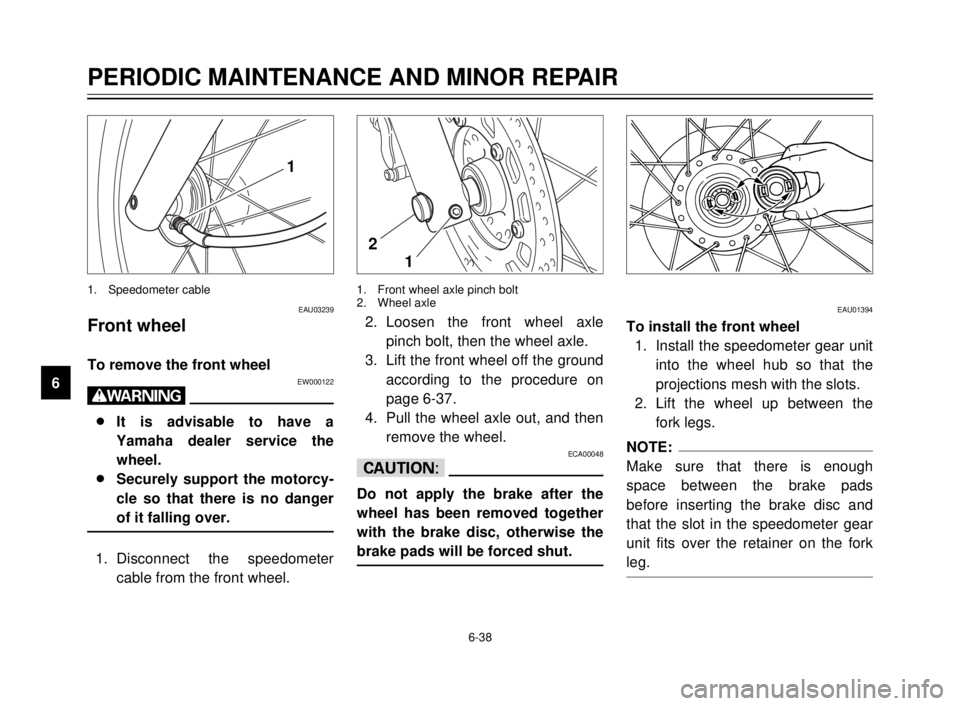
1. Disconnect the speedometer
cable from the front wheel.
1. Speedometer cable
1
2. Loosen the front wheel axle
pinch bolt, then the wheel axle.
3. Lift the front wheel off the ground
according to the procedure on
page 6-37.
4. Pull the wheel axle out, and then
remove the wheel.
ECA00048
cC
Do not apply the brake after the
wheel has been removed together
with the brake disc, otherwise the
brake pads will be forced shut.
1. Front wheel axle pinch bolt
2. Wheel axle
1 2
EAU01394
To install the front wheel
1. Install the speedometer gear unit
into the wheel hub so that the
projections mesh with the slots.
2. Lift the wheel up between the
fork legs.
NOTE:
Make sure that there is enough
space between the brake pads
before inserting the brake disc and
that the slot in the speedometer gear
unit fits over the retainer on the fork
leg.
5JX-9-E0 4/9/0 4:11 AM Page 66
Page 69 of 86

1
2
3
4
5
6
7
8
9
6-39
PERIODIC MAINTENANCE AND MINOR REPAIR
3. Insert the wheel axle.
4. Lower the front wheel so that it is
on the ground.
5. Push down hard on the handle-
bar several times to check for
proper fork operation.
6. Tighten the wheel axle to the
specified torque.
Tightening torque:
Wheel axle:
59 Nm (5.9 m·kg)
7. Install the front wheel axle pinch
bolt, and then tighten it to the
specified torque.
8. Connect the speedometer cable.
EAU03189
Rear wheel
To remove the rear wheelEW000122
w
8It is advisable to have a
Yamaha dealer service the
wheel.
8Securely support the motorcy-
cle so that there is no danger
of it falling over.
1. Loosen the axle nut and the
brake torque rod nut at the brake
shoe plate.
1. Axle nut
1
Tightening torque:
Front wheel axle pinch bolt:
20 Nm (2.0 m·kg)
5JX-9-E0 4/9/0 4:11 AM Page 67
Page 70 of 86

6-40
1
2
3
4
5
6
7
8
9
PERIODIC MAINTENANCE AND MINOR REPAIR
2. Lift the rear wheel off the ground
according to the procedure on
page 6-37.
3. Disconnect the brake torque rod
from the brake shoe plate by
removing the nut and the bolt.
4. Remove the brake pedal free
play adjusting nut, and then dis-
connect the brake rod at the
brake camshaft lever.
1. Brake torque rod
2. Brake torque rod nut
3. Brake rod
4. Brake pedal free play adjusting nut
1
2
34
5. Loosen the locknut and the drive
chain adjusting nut on both ends
of the swingarm.
6. Remove the axle nut, and then
pull the wheel axle out.
7. Push the wheel forward, and
then remove the drive chain from
the rear sprocket.
NOTE:
The drive chain does not need to be
disassembled in order to remove and
install the wheel.
8. Remove the wheel.
1. Wheel axle
2. Drive chain adjusting nut
3. Locknut
312
EAU03190
To install the rear wheel
1. Insert the wheel axle from the
left-hand side, and then install
the drive chain onto the rear
sprocket.
2. Install the axle nut, and then
lower the rear wheel so that it is
on the ground.
3. Install the brake rod onto the
brake camshaft lever, and then
install the brake pedal free play
adjusting nut onto the brake rod.
4. Connect the brake torque rod to
the brake shoe plate by installing
the bolt and the nut, and then
tighten the bolt to the specified
torque.
5. Adjust the drive chain slack.
(See page 6-26 for drive chain
slack adjustment procedures.) Tightening torque:
Brake torque rod bolt:
23 Nm (2.3 m·kg)
5JX-9-E0 4/9/0 4:11 AM Page 68
Page 73 of 86

1
2
3
4
5
6
7
8
9
7-1
EAU03224*
MOTORCYCLE CARE AND STORAGE
Care
While the open design of a motorcy-
cle reveals the attractiveness of the
technology, it also makes it more vul-
nerable. Rust and corrosion can
develop even if high-quality compo-
nents are used. A rusty exhaust pipe
may go unnoticed on a car, however,
it detracts from the overall appear-
ance of a motorcycle. Frequent and
proper care does not only comply
with the terms of the warranty, but it
will also keep your motorcycle looking
good, extend its life and optimize its
performance.Before cleaning
1. Cover the muffler outlets with
plastic bags after the engine has
cooled down.
2. Make sure that all caps and cov-
ers as well as all electrical cou-
plers and connectors, including
the spark plug caps, are tightly
installed.
3. Remove extremely stubborn dirt,
like oil burnt onto the crankcase,
with a degreasing agent and a
brush, but never apply such
products onto seals, gaskets,
sprockets, the drive chain and
wheel axles. Always rinse the dirt
and degreaser off with water.CleaningECA00010
cC
8Avoid using strong acidic
wheel cleaners, especially on
spoked wheels. If such prod-
ucts are used on hard-to-
remove dirt, do not leave the
cleaner on the affected area
any longer than instructed.
Also, thoroughly rinse the area
off with water, immediately dry
it, and then apply a corrosion
protection spray.
8Improper cleaning can damage
windshields, cowlings, panels
and other plastic parts. Use
only a soft, clean cloth or
sponge with mild detergent
and water to clean plastic.
5JX-9-E0 4/9/0 4:11 AM Page 71
Page 74 of 86

7-2
MOTORCYCLE CARE AND STORAGE
1
2
3
4
5
6
7
8
98Do not use any harsh chemical
products on plastic parts. Be
sure to avoid using cloths or
sponges which have been in
contact with strong or abra-
sive cleaning products, sol-
vent or thinner, fuel (gasoline),
rust removers or inhibitors,
brake fluid, antifreeze or elec-
trolyte.
8Do not use high-pressure
washers or steam-jet cleaners
since they cause water seep-
age and deterioration in the
following areas: seals (of
wheel and swingarm bearings,
fork and brakes), electric com-
ponents (couplers, connec-
tors, instruments, switches
and lights), breather hoses
and vents.8For motorcycles equipped
with a windshield: Do not use
strong cleaners or hard
sponges as they will cause
dulling or scratching. Some
cleaning compounds for plas-
tic may leave scratches on the
windshield. Test the product
on a small hidden part of the
windshield to make sure that it
does not leave any marks. If
the windshield is scratched,
use a quality plastic polishing
compound after washing.After normal use
Remove dirt with warm water, a mild
detergent, and a soft, clean sponge,
and then rinse thoroughly with clean
water. Use a toothbrush or bottle-
brush for hard-to-reach areas.
Stubborn dirt and insects will come
off more easily if the area is covered
with a wet cloth for a few minutes
before cleaning.After riding in the rain, near the sea
or on salt-sprayed roads
Since sea salt or salt sprayed on
roads during winter are extremely
corrosive in combination with water,
carry out the following steps after
each ride in the rain, near the sea or
on salt-sprayed roads.
NOTE:
Salt sprayed on roads in the winter
may remain well into spring.
1. Clean the motorcycle with cold
water and a mild detergent, after
the engine has cooled down.
ECA00012
cC
Do not use warm water since it
increases the corrosive action of
the salt.
2. After drying the motorcycle,
apply a corrosion protection
spray on all metal, including
chrome- and nickel-plated, sur-
faces to prevent corrosion.
5JX-9-E0 4/9/0 4:11 AM Page 72
Page 77 of 86

7
MOTORCYCLE CARE AND STORAGE
7-5
7. Check and, if necessary, correct
the tire air pressure, and then lift
the motorcycle so that both of its
wheels are off the ground.
Alternatively, turn the wheels a
little every month in order to pre-
vent the tires from becoming
degraded in one spot.
8. Cover the muffler outlets with
plastic bags to prevent moisture
from entering them.
9. Remove the battery and fully
charge it. Store it in a cool, dry
place and charge it once a
month. Do not store the battery
in an excessively cold or warm
place (less than 0 °C or more
than 30 °C). For more informa-
tion on storing the battery, see
page 6-31.
NOTE:
Make any necessary repairs before
storing the motorcycle.
5JX-9-E0 4/9/0 4:11 AM Page 75
Page 78 of 86
7
EAU01038
SPECIFICATIONS
8-1
Specifications
Model XVS125
Dimensions
Overall length 2,320 mm
Overall width 910 mm
Overall height 1,075 mm
Seat height 670 mm
Wheel base 1,530 mm
Ground clearance 150 mm
Minimum turning radius 2,900 mm
Basic weight (with oil and full
fuel tank)156 kg
Engine
Engine type Air-cooled 4-stroke, SOHC,
gasoline
Cylinder arrangement V-type 2-cylinder
Displacement 124 cm
3
Bore ´Stroke 41.0 ´47.0 mm
Compression ratio 11:1
Starting system Electric starter
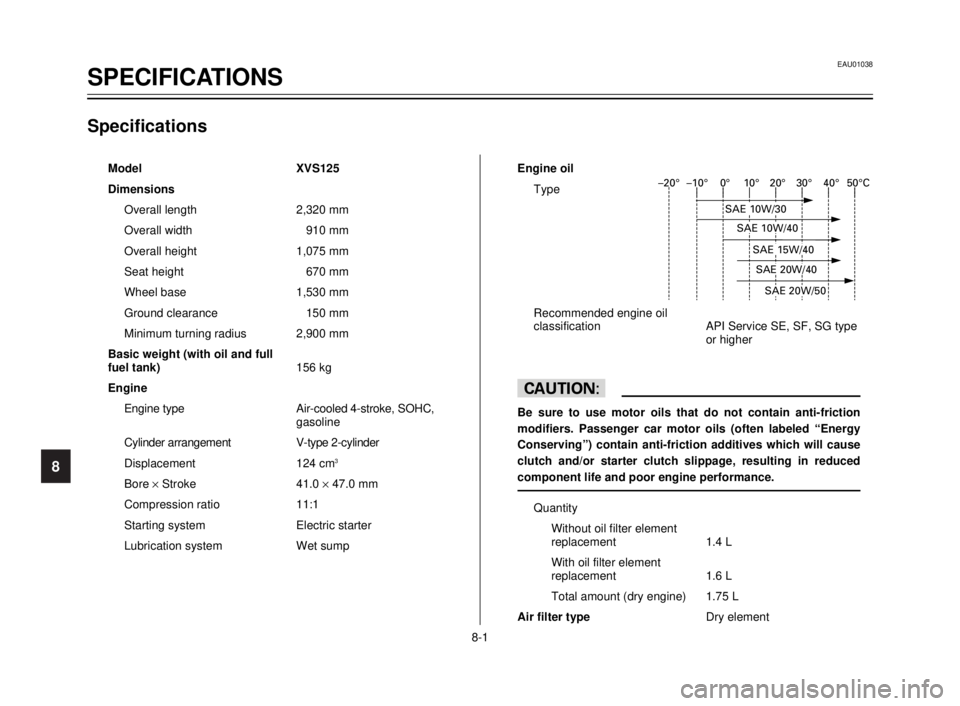
Lubrication system Wet sumpEngine oil
Type
Recommended engine oil
classification API Service SE, SF, SG type
or higher
cC
Be sure to use motor oils that do not contain anti-friction
modifiers. Passenger car motor oils (often labeled “Energy
Conserving”) contain anti-friction additives which will cause
clutch and/or starter clutch slippage, resulting in reduced
component life and poor engine performance.
Quantity
Without oil filter element
replacement 1.4 L
With oil filter element
replacement 1.6 L
Total amount (dry engine) 1.75 L
Air filter typeDry element
–10° 0° 10° 20° 30°
40°
SAE 10W/30
SAE 10W/40
SAE 20W/40
SAE 20W/50
–20°
SAE 15W/40 50°C
8
5JX-9-E0 4/9/0 4:11 AM Page 76
Page 80 of 86

8
SPECIFICATIONS
8-3
Maximum load* 183 kg
Air pressure (cold tire)
up to 90 kg load*
Front
175 kPa (1.75 kg/cm2, 1.75 bar)
Rear200 kPa (2.00 kg/cm2, 2.00 bar)
90 kg load–maximum
load*
Front
225 kPa (2.25 kg/cm2, 2.25 bar)
Rear225 kPa (2.25 kg/cm2, 2.25 bar)
*Load is total weight of cargo, rider, passenger and accessories.
Wheels
Front
Type Spoke wheel
Size 18 ´1.60
Rear
Type Spoke wheel
Size 15 M/C ´MT 3.00
Brakes
Front
Type Single disc brake
Operation Right hand operation
Fluid DOT 4Rear
Type Drum brake
Operation Right foot operation
Suspension
Front
Type Telescopic fork
Rear
Type Swingarm
Shock absorber/spring
Front
Type Coil spring / oil damper
Rear
Type Coil spring / oil damper
Wheel travel
Front 140 mm
Rear 100 mm
Electrical system
Ignition system Transistorized coil ignition
(digital)
Charging system
Type A.C. magneto
Standard output 14 V, 23 A @ 5,000 r/min
5JX-9-E0 4/9/0 4:11 AM Page 78