brake YAMAHA XVS125 2000 Owner's Manual
[x] Cancel search | Manufacturer: YAMAHA, Model Year: 2000, Model line: XVS125, Model: YAMAHA XVS125 2000Pages: 86, PDF Size: 3.07 MB
Page 59 of 86

1
2
3
4
5
6
7
8
9
6-29
PERIODIC MAINTENANCE AND MINOR REPAIR
EAU03164
Checking and lubricating the
brake and clutch levers
The operation of the brake and clutch
levers should be checked before
each ride, and the lever pivots should
be lubricated if necessary.
EAU03165
Checking and lubricating the
sidestand
The operation of the sidestand
should be checked before each ride,
and the sidestand pivot and metal-to-
metal contact surfaces should be
lubricated if necessary.
EW000113
w
If the sidestand does not move up
and down smoothly, have a
Yamaha dealer check or repair it.
EAU02939
Checking the front fork
The condition and operation of the
front fork must be checked as follows
at the intervals specified in the peri-
odic maintenance and lubrication
chart.
To check the condition
EW000115
w
Securely support the motorcycle
so that there is no danger of it
falling over.
Check the inner tubes for scratches,
damage and excessive oil leakage.
Recommended lubricant:
Lithium-soap-based grease
(all-purpose grease)
Recommended lubricant:
Lithium-soap-based grease
(all-purpose grease)
5JX-9-E0 4/9/0 4:11 AM Page 57
Page 60 of 86

6-30
1
2
3
4
5
6
7
8
9
PERIODIC MAINTENANCE AND MINOR REPAIR
To check the operation
1. Place the motorcycle on a level
surface and hold it in an upright
position.
2. While applying the front brake,
push down hard on the handle-
bars several times to check if the
front fork compresses and
rebounds smoothly.
EC000098
cC
If any damage is found or the front
fork does not operate smoothly,
have a Yamaha dealer check or
repair it.
2. Hold the lower ends of the front
fork legs and try to move them
forward and backward. If any
free play can be felt, have a
Yamaha dealer check or repair
the steering.
EAU00794
Checking the steering
Worn or loose steering bearings may
cause danger. Therefore, the opera-
tion of the steering must be checked
as follows at the intervals specified in
the periodic maintenance and lubrica-
tion chart.
1. Place a stand under the engine
to raise the front wheel off the
ground.
EW000115
w
Securely support the motorcycle
so that there is no danger of it
falling over.
5JX-9-E0 4/9/0 4:11 AM Page 58
Page 66 of 86

6-36
1
2
3
4
5
6
7
8
9
PERIODIC MAINTENANCE AND MINOR REPAIR
EAU03218
Replacing a turn signal light
bulb
1. Remove the turn signal lens by
removing the screws.
1. Screw (´2)
1
2. Remove the defective bulb by
pushing it in and turning it coun-
terclockwise.
3. Insert a new bulb into the socket,
push it in, and then turn it clock-
wise until it stops.
4. Install the lens by installing the
screws.
EC000108
cC
Do not overtighten the screws,
otherwise the lens may break.
1. Bulb
1
1
EAU01623
Replacing the tail/brake light
bulb
1. Remove the tail/brake light lens
by removing the screws.
1. Screw (´2)
5JX-9-E0 4/9/0 4:11 AM Page 64
Page 68 of 86
6-38
6
PERIODIC MAINTENANCE AND MINOR REPAIR
EAU03239
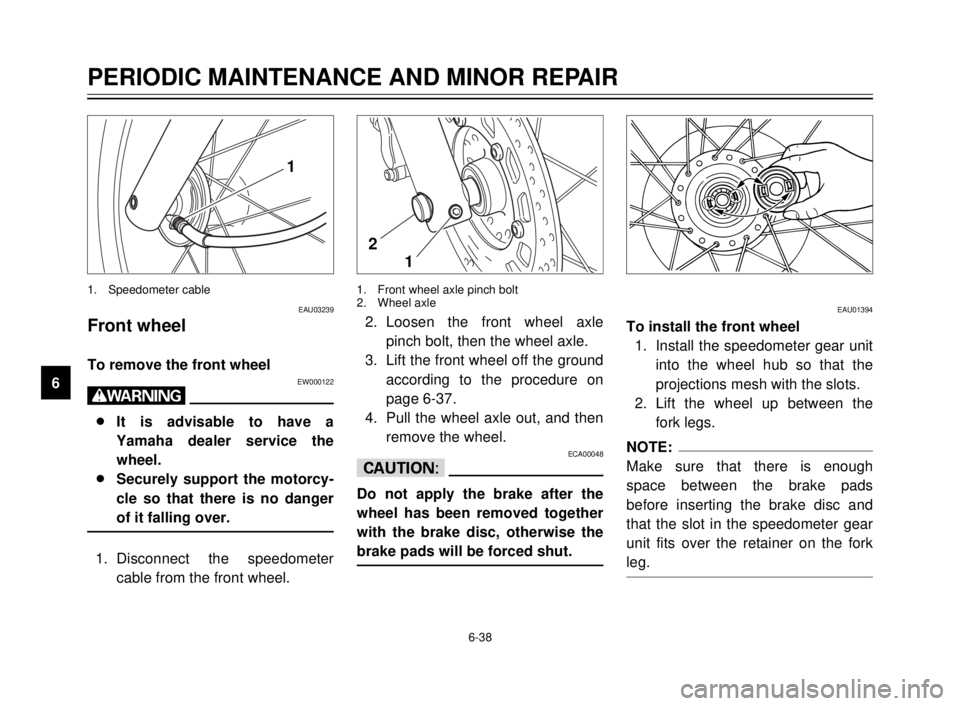
Front wheel
To remove the front wheelEW000122
w
8It is advisable to have a
Yamaha dealer service the
wheel.
8Securely support the motorcy-
cle so that there is no danger
of it falling over.
1. Disconnect the speedometer
cable from the front wheel.
1. Speedometer cable
1
2. Loosen the front wheel axle
pinch bolt, then the wheel axle.
3. Lift the front wheel off the ground
according to the procedure on
page 6-37.
4. Pull the wheel axle out, and then
remove the wheel.
ECA00048
cC
Do not apply the brake after the
wheel has been removed together
with the brake disc, otherwise the
brake pads will be forced shut.
1. Front wheel axle pinch bolt
2. Wheel axle
1 2
EAU01394
To install the front wheel
1. Install the speedometer gear unit
into the wheel hub so that the
projections mesh with the slots.
2. Lift the wheel up between the
fork legs.
NOTE:
Make sure that there is enough
space between the brake pads
before inserting the brake disc and
that the slot in the speedometer gear
unit fits over the retainer on the fork
leg.
5JX-9-E0 4/9/0 4:11 AM Page 66
Page 69 of 86

1
2
3
4
5
6
7
8
9
6-39
PERIODIC MAINTENANCE AND MINOR REPAIR
3. Insert the wheel axle.
4. Lower the front wheel so that it is
on the ground.
5. Push down hard on the handle-
bar several times to check for
proper fork operation.
6. Tighten the wheel axle to the
specified torque.
Tightening torque:
Wheel axle:
59 Nm (5.9 m·kg)
7. Install the front wheel axle pinch
bolt, and then tighten it to the
specified torque.
8. Connect the speedometer cable.
EAU03189
Rear wheel
To remove the rear wheelEW000122
w
8It is advisable to have a
Yamaha dealer service the
wheel.
8Securely support the motorcy-
cle so that there is no danger
of it falling over.
1. Loosen the axle nut and the
brake torque rod nut at the brake
shoe plate.
1. Axle nut
1
Tightening torque:
Front wheel axle pinch bolt:
20 Nm (2.0 m·kg)
5JX-9-E0 4/9/0 4:11 AM Page 67
Page 70 of 86

6-40
1
2
3
4
5
6
7
8
9
PERIODIC MAINTENANCE AND MINOR REPAIR
2. Lift the rear wheel off the ground
according to the procedure on
page 6-37.
3. Disconnect the brake torque rod
from the brake shoe plate by
removing the nut and the bolt.
4. Remove the brake pedal free
play adjusting nut, and then dis-
connect the brake rod at the
brake camshaft lever.
1. Brake torque rod
2. Brake torque rod nut
3. Brake rod
4. Brake pedal free play adjusting nut
1
2
34
5. Loosen the locknut and the drive
chain adjusting nut on both ends
of the swingarm.
6. Remove the axle nut, and then
pull the wheel axle out.
7. Push the wheel forward, and
then remove the drive chain from
the rear sprocket.
NOTE:
The drive chain does not need to be
disassembled in order to remove and
install the wheel.
8. Remove the wheel.
1. Wheel axle
2. Drive chain adjusting nut
3. Locknut
312
EAU03190
To install the rear wheel
1. Insert the wheel axle from the
left-hand side, and then install
the drive chain onto the rear
sprocket.
2. Install the axle nut, and then
lower the rear wheel so that it is
on the ground.
3. Install the brake rod onto the
brake camshaft lever, and then
install the brake pedal free play
adjusting nut onto the brake rod.
4. Connect the brake torque rod to
the brake shoe plate by installing
the bolt and the nut, and then
tighten the bolt to the specified
torque.
5. Adjust the drive chain slack.
(See page 6-26 for drive chain
slack adjustment procedures.) Tightening torque:
Brake torque rod bolt:
23 Nm (2.3 m·kg)
5JX-9-E0 4/9/0 4:11 AM Page 68
Page 71 of 86
1
2
3
4
5
6
7
8
9
6-41
PERIODIC MAINTENANCE AND MINOR REPAIR
6. Tighten the axle nut to the speci-
fied torque.
7. Adjust the brake pedal position
and free play. (See page 6-21 for
brake pedal position and free
play adjustment procedures.)
EW000103
w
After adjusting the brake pedal
free play, check the operation of
the brake light.
EAU01008
Troubleshooting
Although Yamaha motorcycles
receive a thorough inspection before
shipment from the factory, trouble
may occur during operation. Any
problem in the fuel, compression, or
ignition systems, for example, can
cause poor starting and loss of
power.
The following troubleshooting chart
represents a quick and easy proce-
dure for checking these vital systems
yourself. However, should your
motorcycle require any repair, take it
to a Yamaha dealer, whose skilled
technicians have the necessary tools,
experience, and know-how to service
the motorcycle properly.
Use only genuine Yamaha replace-
ment parts. Imitation parts may look
like Yamaha parts, but they are often
inferior, have a shorter service life
and can lead to expensive repair
bills. Tightening torque:
Axle nut:
104 Nm (10.4 m·kg)
5JX-9-E0 4/9/0 4:11 AM Page 69
Page 74 of 86

7-2
MOTORCYCLE CARE AND STORAGE
1
2
3
4
5
6
7
8
98Do not use any harsh chemical
products on plastic parts. Be
sure to avoid using cloths or
sponges which have been in
contact with strong or abra-
sive cleaning products, sol-
vent or thinner, fuel (gasoline),
rust removers or inhibitors,
brake fluid, antifreeze or elec-
trolyte.
8Do not use high-pressure
washers or steam-jet cleaners
since they cause water seep-
age and deterioration in the
following areas: seals (of
wheel and swingarm bearings,
fork and brakes), electric com-
ponents (couplers, connec-
tors, instruments, switches
and lights), breather hoses
and vents.8For motorcycles equipped
with a windshield: Do not use
strong cleaners or hard
sponges as they will cause
dulling or scratching. Some
cleaning compounds for plas-
tic may leave scratches on the
windshield. Test the product
on a small hidden part of the
windshield to make sure that it
does not leave any marks. If
the windshield is scratched,
use a quality plastic polishing
compound after washing.After normal use
Remove dirt with warm water, a mild
detergent, and a soft, clean sponge,
and then rinse thoroughly with clean
water. Use a toothbrush or bottle-
brush for hard-to-reach areas.
Stubborn dirt and insects will come
off more easily if the area is covered
with a wet cloth for a few minutes
before cleaning.After riding in the rain, near the sea
or on salt-sprayed roads
Since sea salt or salt sprayed on
roads during winter are extremely
corrosive in combination with water,
carry out the following steps after
each ride in the rain, near the sea or
on salt-sprayed roads.
NOTE:
Salt sprayed on roads in the winter
may remain well into spring.
1. Clean the motorcycle with cold
water and a mild detergent, after
the engine has cooled down.
ECA00012
cC
Do not use warm water since it
increases the corrosive action of
the salt.
2. After drying the motorcycle,
apply a corrosion protection
spray on all metal, including
chrome- and nickel-plated, sur-
faces to prevent corrosion.
5JX-9-E0 4/9/0 4:11 AM Page 72
Page 75 of 86

MOTORCYCLE CARE AND STORAGE
7
7-3
After cleaning
1. Dry the motorcycle with a
chamois or an absorbing cloth.
2. Immediately dry the drive chain
and lubricate it to prevent it from
rusting.
3. Use a chrome polish to shine
chrome, aluminum and stainless-
steel parts, including the exhaust
system. (Even the thermally
induced discoloring of stainless-
steel exhaust systems can be
removed through polishing.)
4. To prevent corrosion, it is recom-
mended to apply a corrosion pro-
tection spray on all metal, includ-
ing chrome- and nickel-plated,
surfaces.
5. Use spray oil as a universal
cleaner to remove any remaining
dirt.
6. Touch up minor paint damage
caused by stones, etc.7. Wax all painted surfaces.
8. Let the motorcycle dry complete-
ly before storing or covering it.
EWA00001
w
8Make sure that there is no oil
or wax on the brakes or tires.
If necessary, clean the brake
discs and brake linings with a
regular brake disc cleaner or
acetone, and wash the tires
with warm water and a mild
detergent.
8Before operating the motorcy-
cle test its braking perfor-
mance and cornering behav-
ior.
ECA00013
cC
8Apply spray oil and wax spar-
ingly and make sure to wipe
off any excess.
8Never apply oil or wax to any
rubber and plastic parts, but
treat them with a suitable care
product.
8Avoid using abrasive polish-
ing compounds as they will
wear away the paint.
NOTE:
Consult a Yamaha dealer for advice
on what products to use.
5JX-9-E0 4/9/0 4:11 AM Page 73
Page 80 of 86
8
SPECIFICATIONS
8-3
Maximum load* 183 kg
Air pressure (cold tire)
up to 90 kg load*
Front
175 kPa (1.75 kg/cm2, 1.75 bar)
Rear200 kPa (2.00 kg/cm2, 2.00 bar)
90 kg load–maximum
load*
Front
225 kPa (2.25 kg/cm2, 2.25 bar)
Rear225 kPa (2.25 kg/cm2, 2.25 bar)
*Load is total weight of cargo, rider, passenger and accessories.
Wheels
Front
Type Spoke wheel
Size 18 ´1.60
Rear
Type Spoke wheel
Size 15 M/C ´MT 3.00
Brakes
Front
Type Single disc brake
Operation Right hand operation
Fluid DOT 4Rear
Type Drum brake
Operation Right foot operation
Suspension
Front
Type Telescopic fork
Rear
Type Swingarm
Shock absorber/spring
Front
Type Coil spring / oil damper
Rear
Type Coil spring / oil damper
Wheel travel
Front 140 mm
Rear 100 mm
Electrical system
Ignition system Transistorized coil ignition
(digital)
Charging system
Type A.C. magneto
Standard output 14 V, 23 A @ 5,000 r/min
5JX-9-E0 4/9/0 4:11 AM Page 78