Fuel YAMAHA XVS125 2000 Owners Manual
[x] Cancel search | Manufacturer: YAMAHA, Model Year: 2000, Model line: XVS125, Model: YAMAHA XVS125 2000Pages: 86, PDF Size: 3.07 MB
Page 7 of 86
EAU00009
TABLE OF CONTENTS
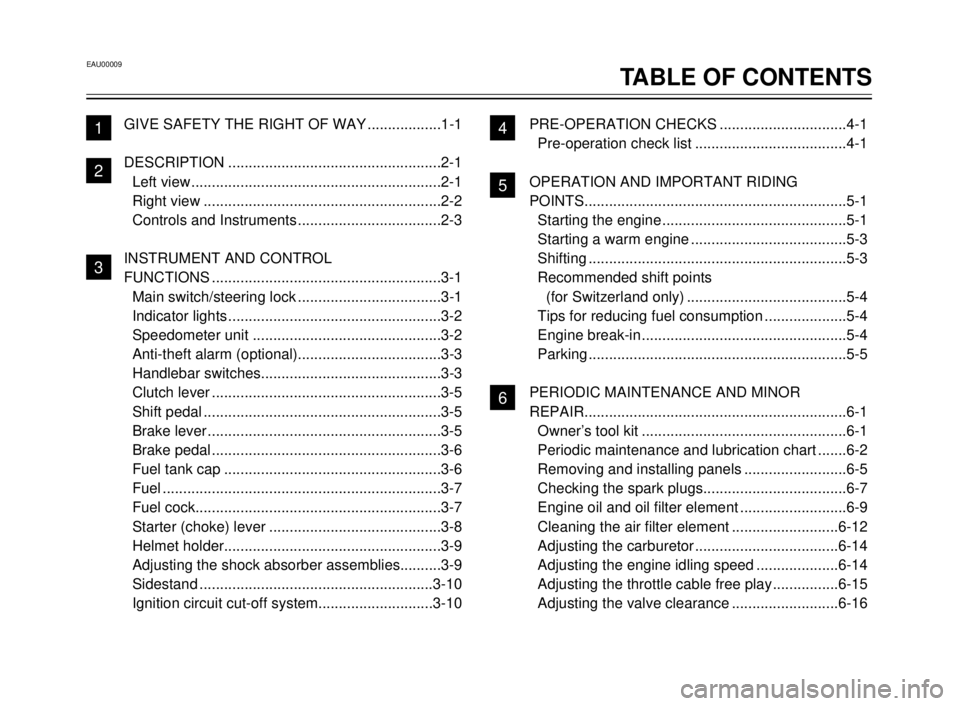
GIVE SAFETY THE RIGHT OF WAY ..................1-1
DESCRIPTION ....................................................2-1
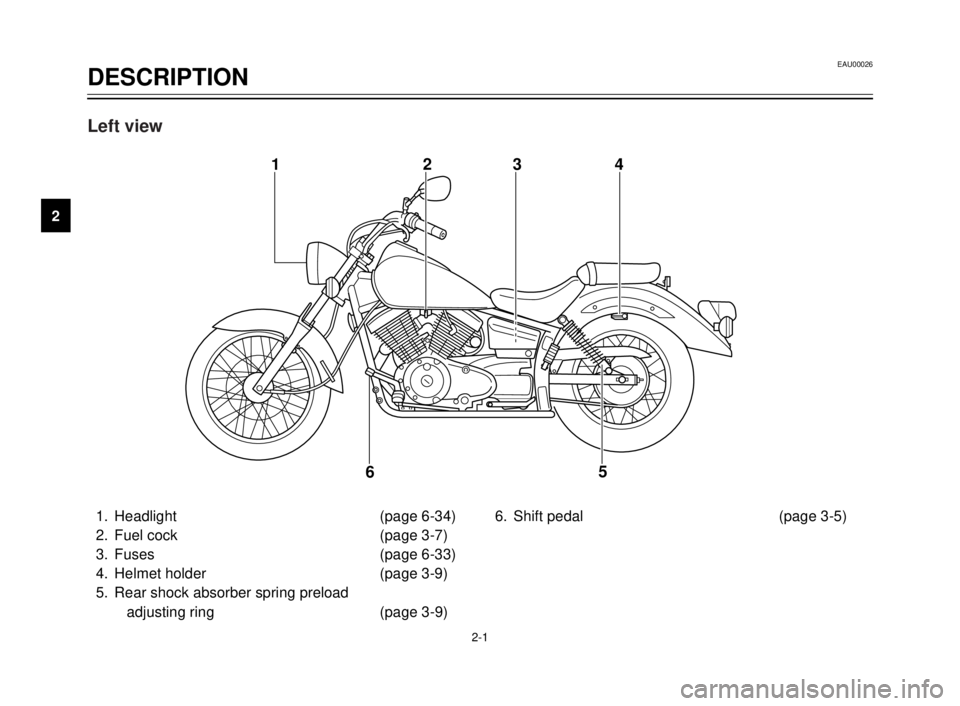
Left view .............................................................2-1
Right view ..........................................................2-2
Controls and Instruments ...................................2-3
INSTRUMENT AND CONTROL
FUNCTIONS ........................................................3-1
Main switch/steering lock ...................................3-1
Indicator lights ....................................................3-2
Speedometer unit ..............................................3-2
Anti-theft alarm (optional)...................................3-3
Handlebar switches............................................3-3
Clutch lever ........................................................3-5
Shift pedal ..........................................................3-5
Brake lever .........................................................3-5
Brake pedal ........................................................3-6
Fuel tank cap .....................................................3-6
Fuel ....................................................................3-7
Fuel cock............................................................3-7
Starter (choke) lever ..........................................3-8
Helmet holder.....................................................3-9
Adjusting the shock absorber assemblies..........3-9
Sidestand .........................................................3-10
Ignition circuit cut-off system............................3-10PRE-OPERATION CHECKS ...............................4-1
Pre-operation check list .....................................4-1
OPERATION AND IMPORTANT RIDING
POINTS................................................................5-1
Starting the engine .............................................5-1
Starting a warm engine ......................................5-3
Shifting ...............................................................5-3
Recommended shift points
(for Switzerland only) .......................................5-4
Tips for reducing fuel consumption ....................5-4
Engine break-in ..................................................5-4
Parking ...............................................................5-5
PERIODIC MAINTENANCE AND MINOR
REPAIR................................................................6-1
Owner’s tool kit ..................................................6-1
Periodic maintenance and lubrication chart .......6-2
Removing and installing panels .........................6-5
Checking the spark plugs...................................6-7
Engine oil and oil filter element ..........................6-9
Cleaning the air filter element ..........................6-12
Adjusting the carburetor ...................................6-14
Adjusting the engine idling speed ....................6-14
Adjusting the throttle cable free play ................6-15
Adjusting the valve clearance ..........................6-161
2
3
4
5
6
5JX-9-E0 4/9/0 4:11 AM Page 5
Page 10 of 86
EAU00026
DESCRIPTION
2
2-1
1. Headlight (page 6-34)
2. Fuel cock (page 3-7)
3. Fuses (page 6-33)
4. Helmet holder (page 3-9)
5. Rear shock absorber spring preload
adjusting ring (page 3-9)6. Shift pedal (page 3-5)
1234
5
6
Left view
5JX-9-E0 4/9/0 4:11 AM Page 8
Page 12 of 86
DESCRIPTION
2
2-3
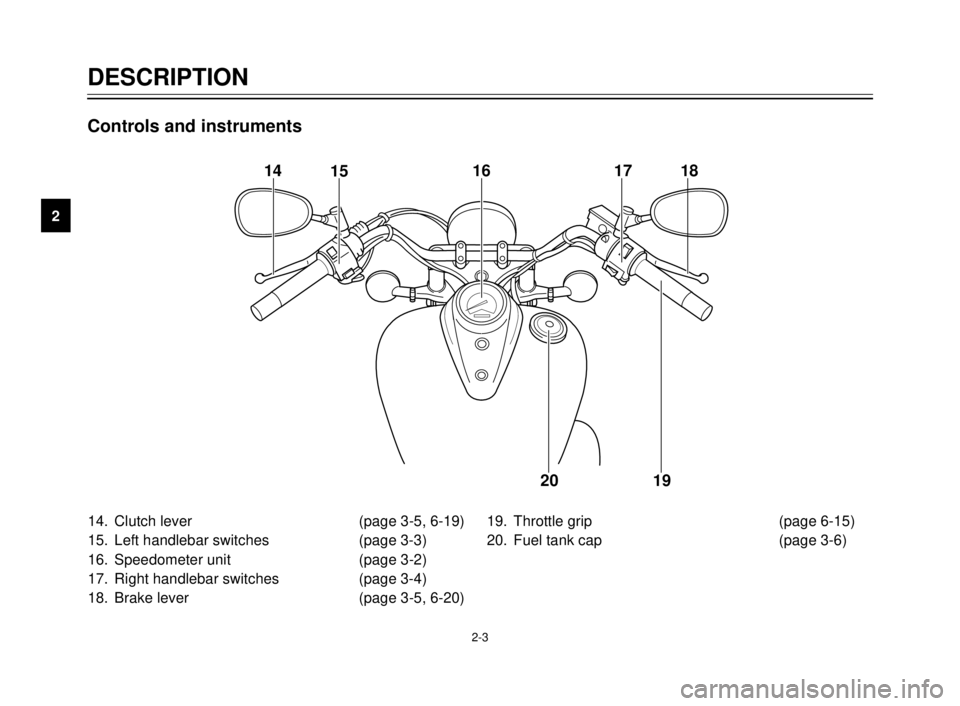
14. Clutch lever (page 3-5, 6-19)
15. Left handlebar switches (page 3-3)
16. Speedometer unit (page 3-2)
17. Right handlebar switches (page 3-4)
18. Brake lever (page 3-5, 6-20)19. Throttle grip (page 6-15)
20. Fuel tank cap (page 3-6)
14
1516 17 18
19 20
Controls and instruments
5JX-9-E0 4/9/0 4:11 AM Page 10
Page 14 of 86
3-2
INSTRUMENT AND CONTROL FUNCTIONS
3
EAU00056
Indicator lights
EAU00063
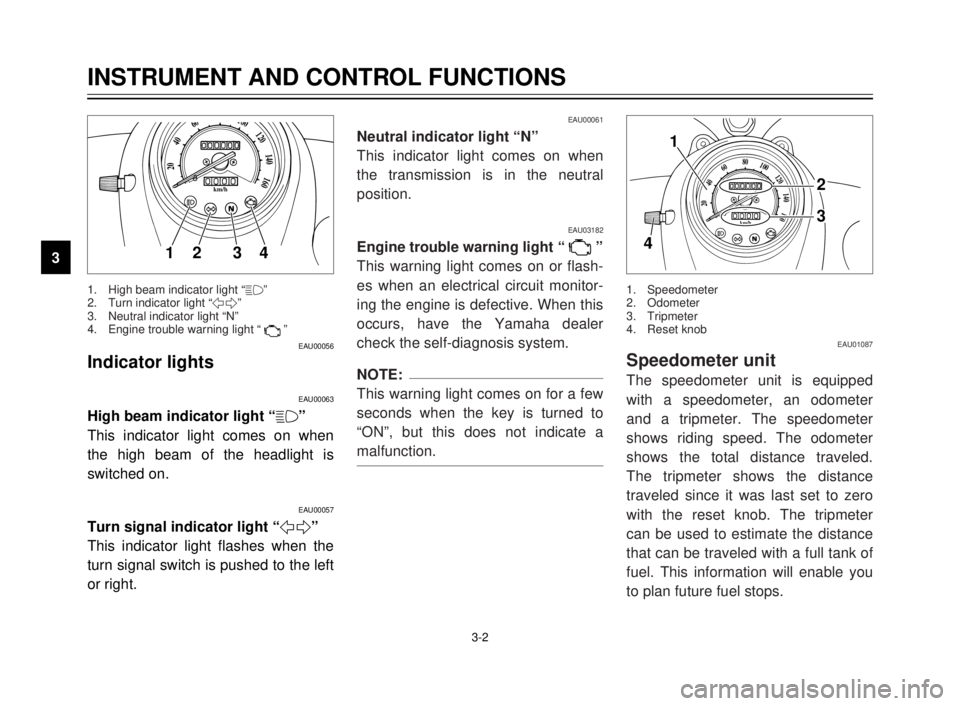
High beam indicator light “&”
This indicator light comes on when
the high beam of the headlight is
switched on.
EAU00057
Turn signal indicator light “5”
This indicator light flashes when the
turn signal switch is pushed to the left
or right.
20
40
60
0km/h
80100120
140
160
12 34
EAU00061
Neutral indicator light “N”
This indicator light comes on when
the transmission is in the neutral
position.
EAU03182
Engine trouble warning light “ ”
This warning light comes on or flash-
es when an electrical circuit monitor-
ing the engine is defective. When this
occurs, have the Yamaha dealer
check the self-diagnosis system.
NOTE:
This warning light comes on for a few
seconds when the key is turned to
“ON”, but this does not indicate a
malfunction.
1. High beam indicator light “&”
2. Turn indicator light “5”
3. Neutral indicator light “N”
4. Engine trouble warning light “ ”
EAU01087
Speedometer unit
The speedometer unit is equipped
with a speedometer, an odometer
and a tripmeter. The speedometer
shows riding speed. The odometer
shows the total distance traveled.
The tripmeter shows the distance
traveled since it was last set to zero
with the reset knob. The tripmeter
can be used to estimate the distance
that can be traveled with a full tank of
fuel. This information will enable you
to plan future fuel stops.
1. Speedometer
2. Odometer
3. Tripmeter
4. Reset knob
20
40
60
0km/h
80100120
140
160
1
2
3
4
5JX-9-E0 4/9/0 4:11 AM Page 12
Page 18 of 86
3-6
INSTRUMENT AND CONTROL FUNCTIONS
3
EAU00162
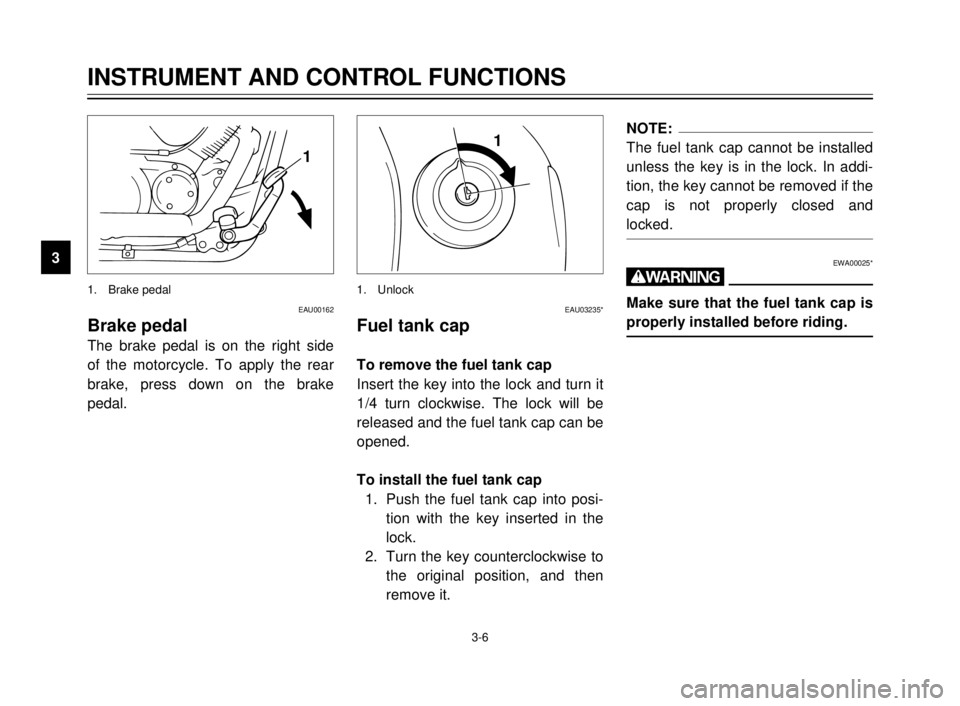
Brake pedal
The brake pedal is on the right side
of the motorcycle. To apply the rear
brake, press down on the brake
pedal.
1. Brake pedal
1
EAU03235*
Fuel tank cap
To remove the fuel tank cap
Insert the key into the lock and turn it
1/4 turn clockwise. The lock will be
released and the fuel tank cap can be
opened.
To install the fuel tank cap
1. Push the fuel tank cap into posi-
tion with the key inserted in the
lock.
2. Turn the key counterclockwise to
the original position, and then
remove it.
1. Unlock
1NOTE:
The fuel tank cap cannot be installed
unless the key is in the lock. In addi-
tion, the key cannot be removed if the
cap is not properly closed and
locked.
EWA00025*
w
Make sure that the fuel tank cap is
properly installed before riding.
5JX-9-E0 4/9/0 4:11 AM Page 16
Page 19 of 86
INSTRUMENT AND CONTROL FUNCTIONS
3
3-7
EAU01183
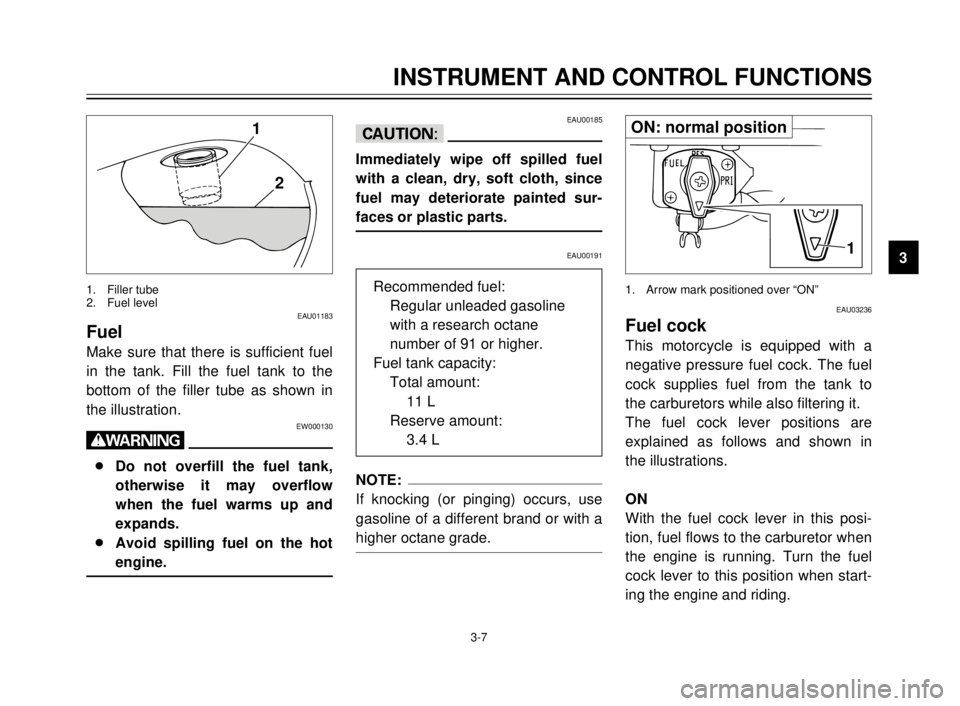
Fuel
Make sure that there is sufficient fuel
in the tank. Fill the fuel tank to the
bottom of the filler tube as shown in
the illustration.
EW000130
w
8Do not overfill the fuel tank,
otherwise it may overflow
when the fuel warms up and
expands.
8Avoid spilling fuel on the hot
engine.
1. Filler tube
2. Fuel level
EAU00185
cC
Immediately wipe off spilled fuel
with a clean, dry, soft cloth, since
fuel may deteriorate painted sur-
faces or plastic parts.
EAU00191
NOTE:
If knocking (or pinging) occurs, use
gasoline of a different brand or with a
higher octane grade.
1
2
Recommended fuel:
Regular unleaded gasoline
with a research octane
number of 91 or higher.
Fuel tank capacity:
Total amount:
11 L
Reserve amount:
3.4 L
EAU03236
Fuel cock
This motorcycle is equipped with a
negative pressure fuel cock. The fuel
cock supplies fuel from the tank to
the carburetors while also filtering it.
The fuel cock lever positions are
explained as follows and shown in
the illustrations.
ON
With the fuel cock lever in this posi-
tion, fuel flows to the carburetor when
the engine is running. Turn the fuel
cock lever to this position when start-
ing the engine and riding.
1. Arrow mark positioned over “ON”
1
ON: normal position
5JX-9-E0 4/9/0 4:11 AM Page 17
Page 20 of 86
3-8
INSTRUMENT AND CONTROL FUNCTIONS
3
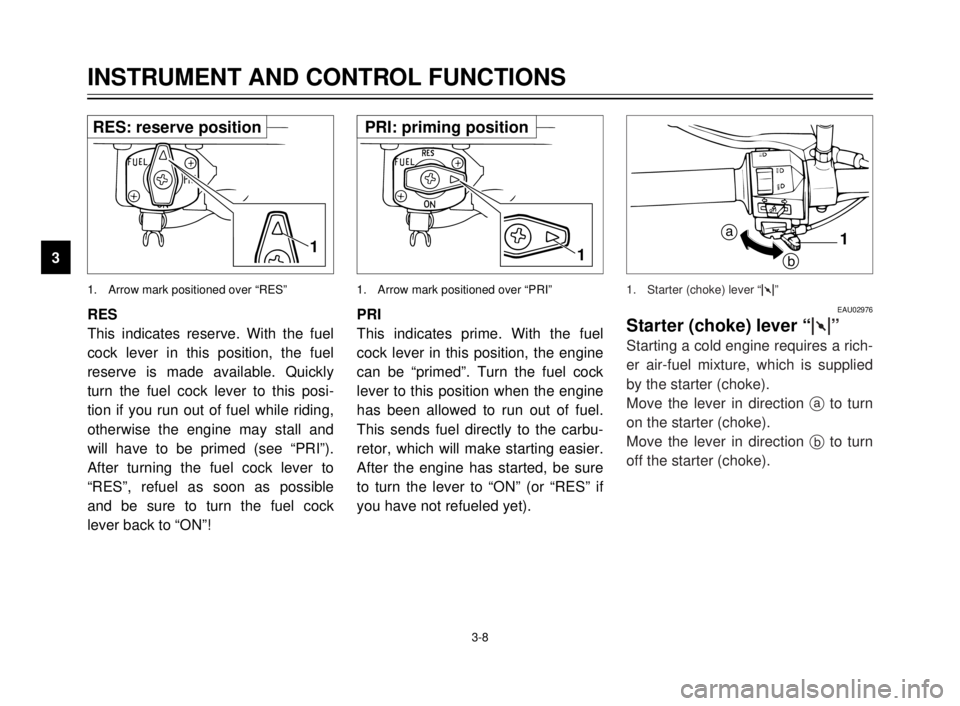
RES
This indicates reserve. With the fuel
cock lever in this position, the fuel
reserve is made available. Quickly
turn the fuel cock lever to this posi-
tion if you run out of fuel while riding,
otherwise the engine may stall and
will have to be primed (see “PRI”).
After turning the fuel cock lever to
“RES”, refuel as soon as possible
and be sure to turn the fuel cock
lever back to “ON”!
1. Arrow mark positioned over “RES”
1
PRI
This indicates prime. With the fuel
cock lever in this position, the engine
can be “primed”. Turn the fuel cock
lever to this position when the engine
has been allowed to run out of fuel.
This sends fuel directly to the carbu-
retor, which will make starting easier.
After the engine has started, be sure
to turn the lever to “ON” (or “RES” if
you have not refueled yet).
1. Arrow mark positioned over “PRI”
1
RES: reserve positionPRI: priming position
EAU02976
Starter (choke) lever “1”
Starting a cold engine requires a rich-
er air-fuel mixture, which is supplied
by the starter (choke).
Move the lever in direction ato turn
on the starter (choke).
Move the lever in direction bto turn
off the starter (choke).
1. Starter (choke) lever “1”
1a
b
5JX-9-E0 4/9/0 4:11 AM Page 18
Page 25 of 86

PRE-OPERATION CHECKS
1
2
3
4
5
6
7
8
9
4-2 ITEM CHECKS PAGE
Sidestand pivot9Check smooth operation.
6-29
9Lubricate if necessary.
Chassis fasteners9Make sure that all nuts, bolts, and screws are properly tightened.
—
9Tighten if necessary.
Fuel tank9Check fuel level.
3-6–3-7
9Add fuel if necessary.
Lights, signals and
9Check proper operation. 3-3–3-4, 6-34–6-37
switches
NOTE:
Pre-operation checks should be made each time the motorcycle is used. Such an inspection can be accomplished in a
very short time; and the added safety it assures is more than worth the time involved.
w
If any item in the Pre-operation check list is not working properly, have it inspected and repaired before operat-
ing the motorcycle.
5JX-9-E0 4/9/0 4:11 AM Page 23
Page 26 of 86
5-1
EAU00372
OPERATION AND IMPORTANT RIDING POINTS
1
2
3
4
5
6
7
8
9
EAU00373
w
8Become thoroughly familiar
with all operating controls and
their functions before riding.
Consult a Yamaha dealer
regarding any control or func-
tion that you do not thorough-
ly understand.
8Never start the engine or oper-
ate it in a closed area for any
length of time. Exhaust fumes
are poisonous, and inhaling
them can cause loss of con-
sciousness and death within a
short time. Always make sure
that there is adequate ventila-
tion.
8Before starting out, make sure
that the sidestand is up. If the
sidestand is not raised com-
pletely, it could contact the
ground and distract the opera-
tor, resulting in a possible loss
of control.
EAU03237
Starting the engine
In order for the ignition circuit cut-off
system to enable starting, one of the
following conditions must be met:
8The transmission is in the neutral
position.
8The transmission is in gear with
the clutch lever pulled and the
sidestand up.
EW000054
w
8Before starting the engine,
check the function of the igni-
tion circuit cut-off system
according to the procedure
described on page 3-10.
8Never ride with the sidestand
down.
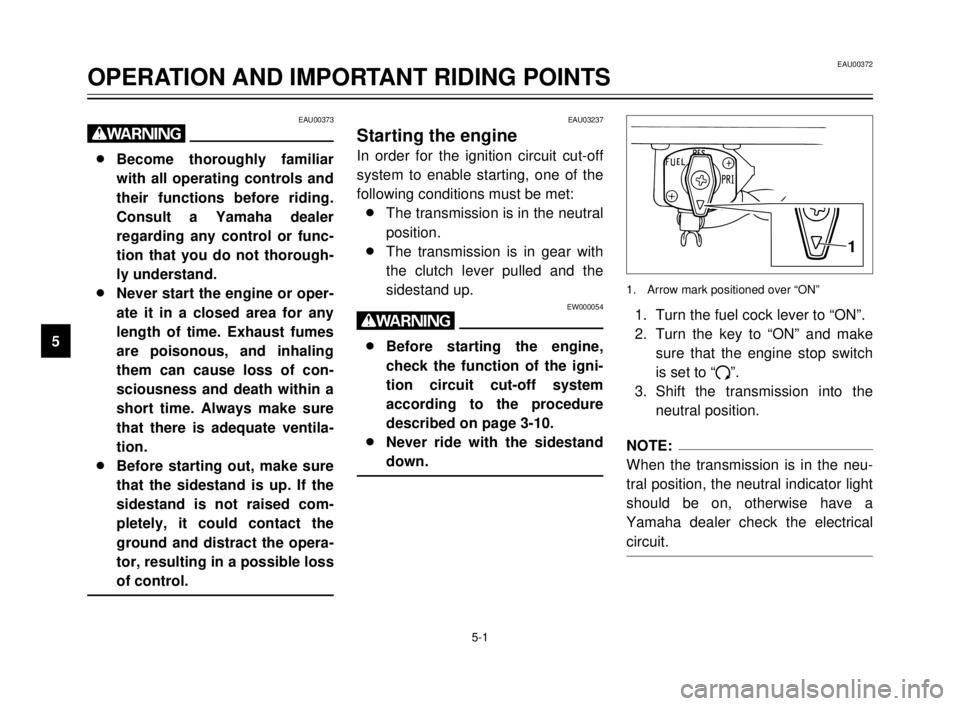
1. Turn the fuel cock lever to “ON”.
2. Turn the key to “ON” and make
sure that the engine stop switch
is set to “#”.
3. Shift the transmission into the
neutral position.
NOTE:
When the transmission is in the neu-
tral position, the neutral indicator light
should be on, otherwise have a
Yamaha dealer check the electrical
circuit.
1. Arrow mark positioned over “ON”
1
5JX-9-E0 4/9/0 4:11 AM Page 24
Page 29 of 86
OPERATION AND IMPORTANT RIDING POINTS
1
2
3
4
5
6
7
8
9
5-4
EAU02941
Recommended shift points
(for Switzerland only)
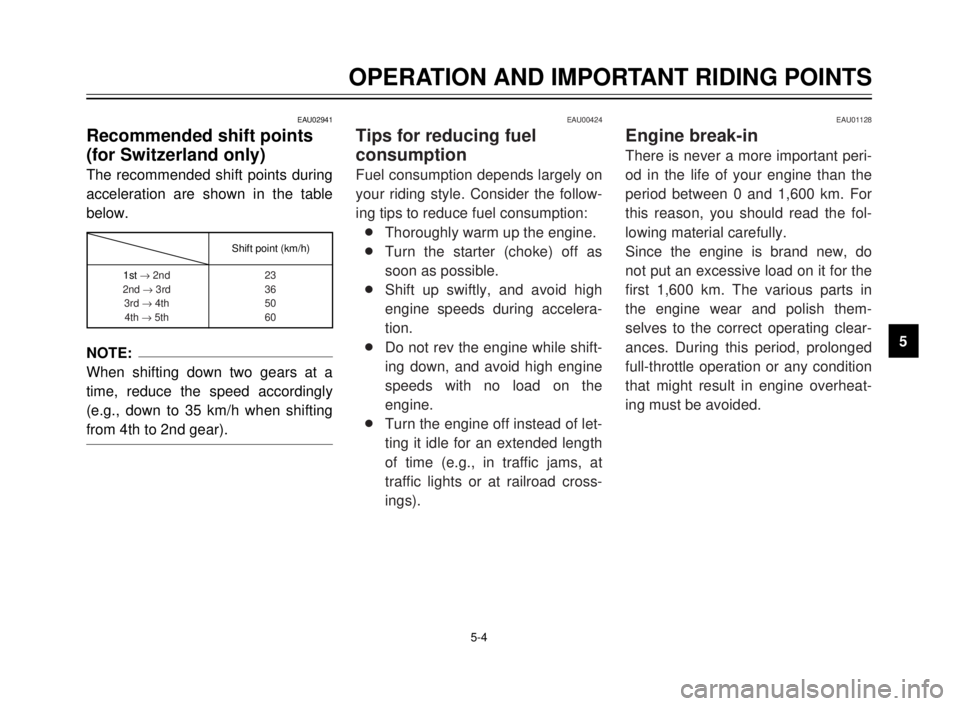
The recommended shift points during
acceleration are shown in the table
below.
NOTE:
When shifting down two gears at a
time, reduce the speed accordingly
(e.g., down to 35 km/h when shifting
from 4th to 2nd gear).
Shift point (km/h)
1st ®2nd 23
2nd ®3rd 36
3rd ®4th 50
4th ®5th 60
EAU00424
Tips for reducing fuel
consumption
Fuel consumption depends largely on
your riding style. Consider the follow-
ing tips to reduce fuel consumption:
8Thoroughly warm up the engine.
8Turn the starter (choke) off as
soon as possible.
8Shift up swiftly, and avoid high
engine speeds during accelera-
tion.
8Do not rev the engine while shift-
ing down, and avoid high engine
speeds with no load on the
engine.
8Turn the engine off instead of let-
ting it idle for an extended length
of time (e.g., in traffic jams, at
traffic lights or at railroad cross-
ings).
EAU01128
Engine break-in
There is never a more important peri-
od in the life of your engine than the
period between 0 and 1,600 km. For
this reason, you should read the fol-
lowing material carefully.
Since the engine is brand new, do
not put an excessive load on it for the
first 1,600 km. The various parts in
the engine wear and polish them-
selves to the correct operating clear-
ances. During this period, prolonged
full-throttle operation or any condition
that might result in engine overheat-
ing must be avoided.
5JX-9-E0 4/9/0 4:11 AM Page 27