fuel pressure YAMAHA XVS125 2001 Owners Manual
[x] Cancel search | Manufacturer: YAMAHA, Model Year: 2001, Model line: XVS125, Model: YAMAHA XVS125 2001Pages: 86, PDF Size: 1.35 MB
Page 18 of 86
INSTRUMENT AND CONTROL FUNCTIONS
3
3-7
EAU03753
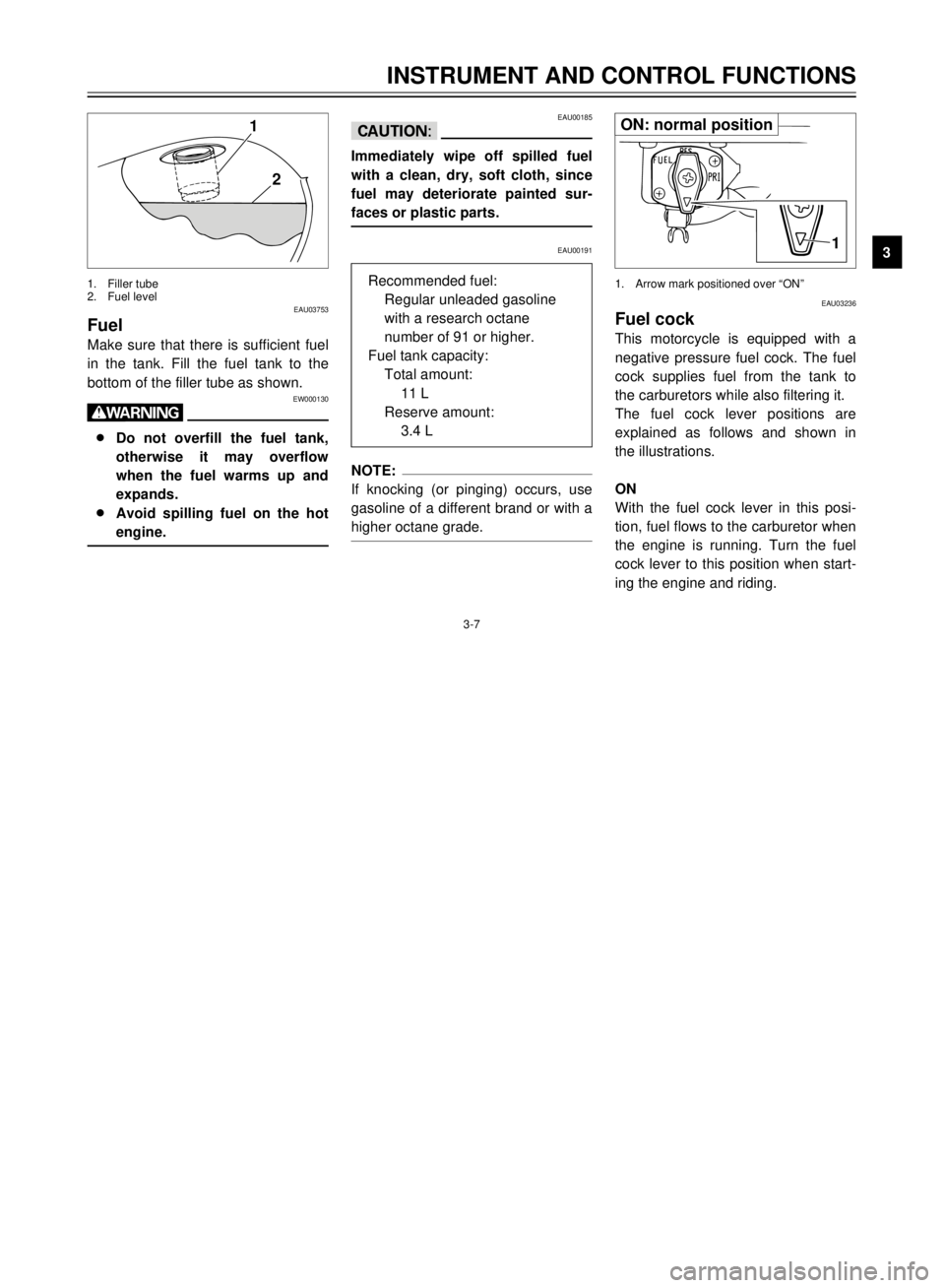
FuelMake sure that there is sufficient fuel
in the tank. Fill the fuel tank to the
bottom of the filler tube as shown.
EW000130
w8Do not overfill the fuel tank,
otherwise it may overflow
when the fuel warms up and
expands.
8Avoid spilling fuel on the hot
engine.1.Filler tube
2.Fuel level
EAU00185
cCImmediately wipe off spilled fuel
with a clean, dry, soft cloth, since
fuel may deteriorate painted sur-
faces or plastic parts.
EAU00191
NOTE:
If knocking (or pinging) occurs, use
gasoline of a different brand or with a
higher octane grade.
1
2
Recommended fuel:
Regular unleaded gasoline
with a research octane
number of 91 or higher.
Fuel tank capacity:
Total amount:
11 L
Reserve amount:
3.4 L
EAU03236
Fuel cockThis motorcycle is equipped with a
negative pressure fuel cock. The fuel
cock supplies fuel from the tank to
the carburetors while also filtering it.
The fuel cock lever positions are
explained as follows and shown in
the illustrations.
ON
With the fuel cock lever in this posi-
tion, fuel flows to the carburetor when
the engine is running. Turn the fuel
cock lever to this position when start-
ing the engine and riding.1.Arrow mark positioned over ÒONÓ
1
ON: normal position
5JX-9-E1 9/27/00 10:45 AM Page 17
Page 23 of 86
EAU01114
PRE-OPERATION CHECKS
1
2
34
5
6
7
8
9
4-1
The condition of a vehicle is the ownerÕs responsibility. Vital components can start to deteriorate quickly and unexpect-
edly, even if the vehicle remains unused (for example, as a result of exposure to the elements). Any damage, fluid leak-
age or loss of tire air pressure could have serious consequences. Therefore, it is very important, in addition to a thor-
ough visual inspection, to check the following points before each ride.
EAU03439
Pre-operation check list
ITEMCHECKSPAGE
Fuel¥Check fuel level in fuel tank.
¥Refuel if necessary.
¥Check fuel line for leakage.3-6Ð3-7
Engine oil¥Check oil level in engine.
¥If necessary, add recommended oil to specified level.
¥Check vehicle for oil leakage.6-9Ð6-12
Front brake¥Check operation.
¥If soft or spongy, have Yamaha dealer bleed hydraulic system.
¥Check lever free play.
¥Adjust if necessary.
¥Check fluid level in reservoir.
¥If necessary, add recommended brake fluid to specified level.
¥Check hydraulic system for leakage.3-5, 6-20,
6-22Ð6-24
Rear brake¥Check operation.
¥Check pedal free play.
¥Adjust if necessary.3-6, 6-20Ð6-23
Clutch¥Check operation.
¥Lubricate cable if necessary.
¥Check lever free play.
¥Adjust if necessary.3-5, 6-19
5JX-9-E1 9/27/00 10:45 AM Page 22
Page 45 of 86
6-15
PERIODIC MAINTENANCE AND MINOR REPAIR
1
2
3
4
56
7
8
9
EAU00635
Adjusting the throttle cable
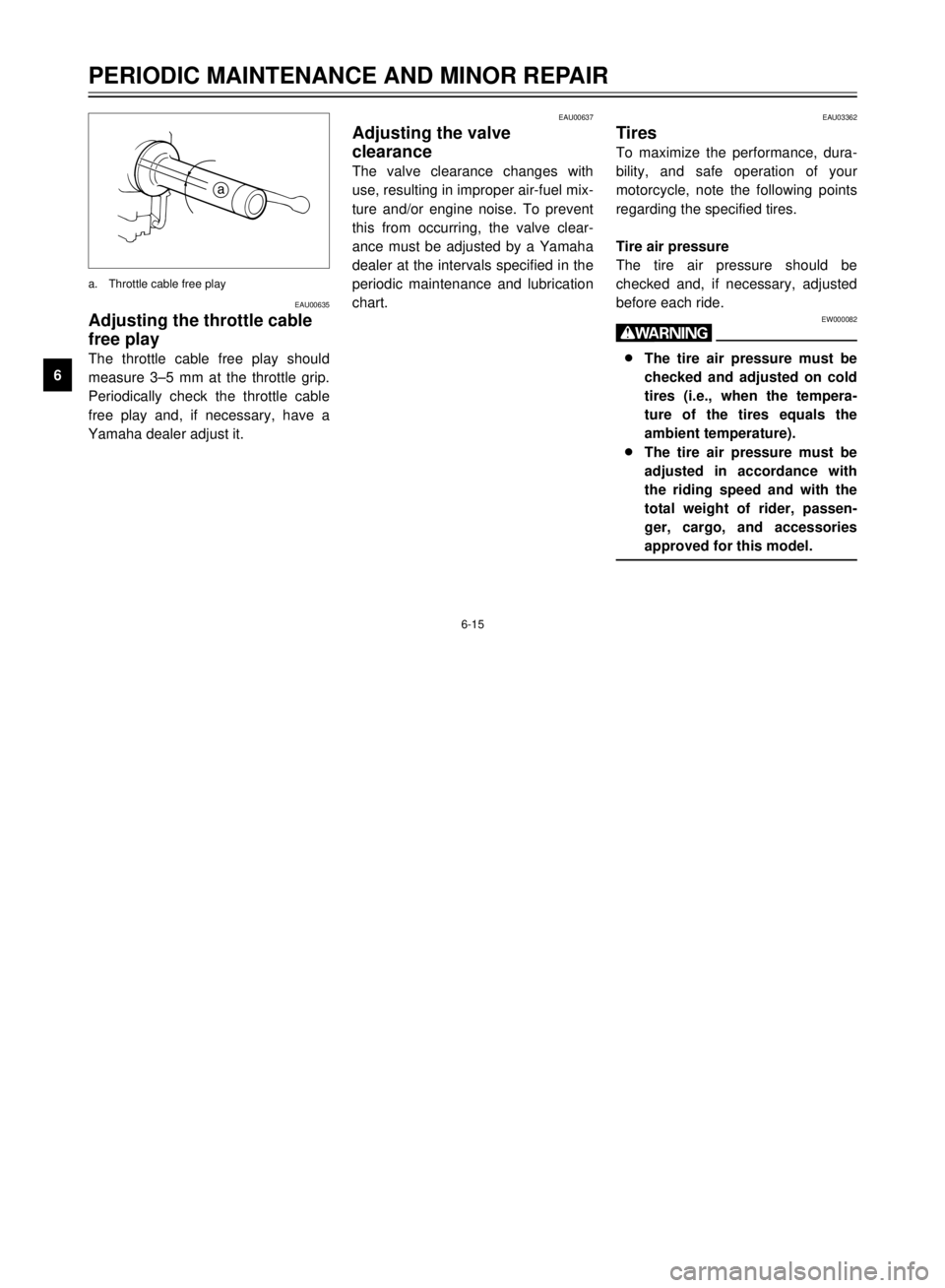
free playThe throttle cable free play should
measure 3Ð5 mm at the throttle grip.
Periodically check the throttle cable
free play and, if necessary, have a
Yamaha dealer adjust it.a.Throttle cable free play
a
EAU00637
Adjusting the valve
clearanceThe valve clearance changes with
use, resulting in improper air-fuel mix-
ture and/or engine noise. To prevent
this from occurring, the valve clear-
ance must be adjusted by a Yamaha
dealer at the intervals specified in the
periodic maintenance and lubrication
chart.
EAU03362
TiresTo maximize the performance, dura-
bility, and safe operation of your
motorcycle, note the following points
regarding the specified tires.
Tire air pressure
The tire air pressure should be
checked and, if necessary, adjusted
before each ride.
EW000082
w8The tire air pressure must be
checked and adjusted on cold
tires (i.e., when the tempera-
ture of the tires equals the
ambient temperature).
8The tire air pressure must be
adjusted in accordance with
the riding speed and with the
total weight of rider, passen-
ger, cargo, and accessories
approved for this model.
5JX-9-E1 9/27/00 10:45 AM Page 44
Page 74 of 86

1
2
3
4
5
67
8
9
7-2
MOTORCYCLE CARE AND STORAGE
8Do not use any harsh chemical
products on plastic parts. Be
sure to avoid using cloths or
sponges which have been in
contact with strong or abra-
sive cleaning products, sol-
vent or thinner, fuel (gasoline),
rust removers or inhibitors,
brake fluid, antifreeze or elec-
trolyte.
8Do not use high-pressure
washers or steam-jet cleaners
since they cause water seep-
age and deterioration in the
following areas: seals (of
wheel and swingarm bearings,
fork and brakes), electric com-
ponents (couplers, connec-
tors, instruments, switches
and lights), breather hoses
and vents.8For motorcycles equipped
with a windshield: Do not use
strong cleaners or hard
sponges as they will cause
dulling or scratching. Some
cleaning compounds for plas-
tic may leave scratches on the
windshield. Test the product
on a small hidden part of the
windshield to make sure that it
does not leave any marks. If
the windshield is scratched,
use a quality plastic polishing
compound after washing.
After normal useRemove dirt with warm water, a mild
detergent, and a soft, clean sponge,
and then rinse thoroughly with clean
water. Use a toothbrush or bottle-
brush for hard-to-reach areas.
Stubborn dirt and insects will come
off more easily if the area is covered
with a wet cloth for a few minutes
before cleaning.After riding in the rain, near the sea
or on salt-sprayed roadsSince sea salt or salt sprayed on
roads during winter are extremely
corrosive in combination with water,
carry out the following steps after
each ride in the rain, near the sea or
on salt-sprayed roads.NOTE:
Salt sprayed on roads in the winter
may remain well into spring.1.Clean the motorcycle with cold
water and a mild detergent, after
the engine has cooled down.
ECA00012
cCDo not use warm water since it
increases the corrosive action of
the salt.2.After drying the motorcycle,
apply a corrosion protection
spray on all metal, including
chrome- and nickel-plated, sur-
faces to prevent corrosion.
5JX-9-E1 9/27/00 10:45 AM Page 73