lock YAMAHA XVS1300A 2014 Owners Manual
[x] Cancel search | Manufacturer: YAMAHA, Model Year: 2014, Model line: XVS1300A, Model: YAMAHA XVS1300A 2014Pages: 92, PDF Size: 2.05 MB
Page 6 of 92

TABLE OF CONTENTSSAFETY INFORMATION.................. 1-1
DESCRIPTION .................................. 2-1
Left view ......................................... 2-1
Right view ....................................... 2-2
Controls and instruments ............... 2-3
INSTRUMENT AND CONTROL
FUNCTIONS ...................................... 3-1
Immobilizer system......................... 3-1
Main switch/steering lock............... 3-2
Indicator lights and warning lights............................................ 3-4
Multi-function meter unit ................ 3-6
Handlebar switches ........................ 3-9
Clutch lever .................................. 3-11
Shift pedal .................................... 3-11
Brake lever.................................... 3-12
Brake pedal .................................. 3-12
Fuel tank cap ................................ 3-12
Fuel ............................................... 3-13
Fuel tank breather hose and overflow hose ............................ 3-14
Catalytic converter ....................... 3-15
Rider seat ..................................... 3-15
Helmet holder ............................... 3-16
Adjusting the shock absorber assembly ................................... 3-17
Sidestand ..................................... 3-18
Ignition circuit cut-off system ....... 3-18 FOR YOUR SAFETY –
PRE-OPERATION CHECKS
............. 4-1
OPERATION AND IMPORTANT
RIDING POINTS ................................ 5-1
Starting the engine .......................... 5-1
Shifting ............................................ 5-2
Tips for reducing fuel consumption ................................ 5-3
Engine break-in ............................... 5-3
Parking ............................................ 5-4
PERIODIC MAINTENANCE AND
ADJUSTMENT ................................... 6-1
Owner’s tool kit ............................... 6-2
Periodic maintenance chart for the emission control system .............. 6-3
General maintenance and lubrication chart ........................... 6-4
Removing and installing the
panel ............................................ 6-8
Checking the spark plugs ............... 6-8
Engine oil and oil filter cartridge.... 6-10
Coolant.......................................... 6-13
Replacing the air filter element ..... 6-14
Checking the throttle grip free play ............................................ 6-15
Valve clearance ............................. 6-15
Tires .............................................. 6-15
Cast wheels................................... 6-17 Adjusting the clutch lever free
play ............................................ 6-18
Checking the brake lever free play ............................................ 6-19
Brake light switches ..................... 6-19
Checking the front and rear brake
pads .......................................... 6-20
Checking the brake fluid level ...... 6-21
Changing the brake fluid .............. 6-22
Drive belt slack ............................. 6-22
Checking and lubricating the
cables ........................................ 6-23
Checking and lubricating the throttle grip and cable ............... 6-24
Checking and lubricating the brake and shift pedals............... 6-24
Checking and lubricating the
brake and clutch levers ............. 6-25
Checking and lubricating the sidestand................................... 6-25
Lubricating the rear suspension ... 6-26
Lubricating the swingarm pivots......................................... 6-26
Checking the front fork ................. 6-26
Checking the steering................... 6-27
Checking the wheel bearings ....... 6-28
Battery .......................................... 6-28
Replacing the fuses ...................... 6-29
Replacing the headlight bulb ........ 6-31
Replacing a turn signal light bulb or the tail/brake light bulb ......... 6-32U1CSE1E0.book Page 1 Friday, September 13, 2013 9:33 AM
Page 13 of 92
DESCRIPTION
2-1
2
EAU10411
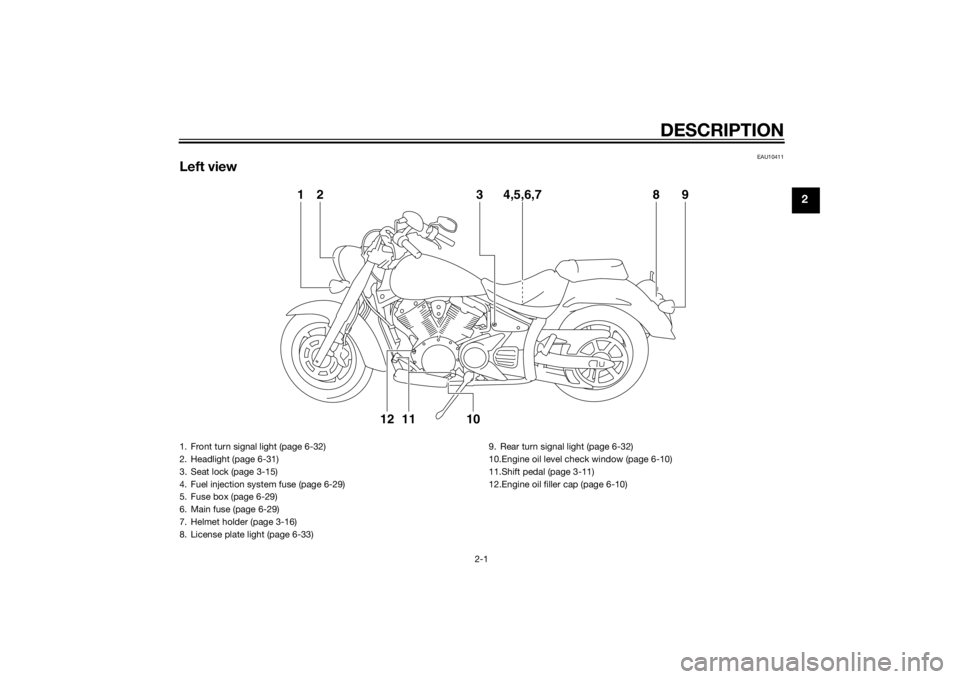
Left view
1238 9
4,5,6,7
10
1112
1. Front turn signal light (page 6-32)
2. Headlight (page 6-31)
3. Seat lock (page 3-15)
4. Fuel injection system fuse (page 6-29)
5. Fuse box (page 6-29)
6. Main fuse (page 6-29)
7. Helmet holder (page 3-16)
8. License plate light (page 6-33) 9. Rear turn signal light (page 6-32)
10.Engine oil level check window (page 6-10)
11.Shift pedal (page 3-11)
12.Engine oil filler cap (page 6-10)
U1CSE1E0.book Page 1 Friday, September 13, 2013 9:33 AM
Page 15 of 92

DESCRIPTION
2-3
2
EAU10431
Controls and instruments
12 3 4 567
1. Clutch lever (page 3-11)
2. Left handlebar switches (page 3-9)
3. Multi-function meter unit (page 3-6)
4. Main switch/steering lock (page 3-2)
5. Right handlebar switches (page 3-9)
6. Throttle grip (page 6-15)
7. Brake lever (page 3-12)
U1CSE1E0.book Page 3 Friday, September 13, 2013 9:33 AM
Page 17 of 92
INSTRUMENT AND CONTROL FUNCTIONS
3-2
3
Keep other immo bilizer system
keys away from the main switch
as they may cause si gnal inter-
ference.
EAU10473
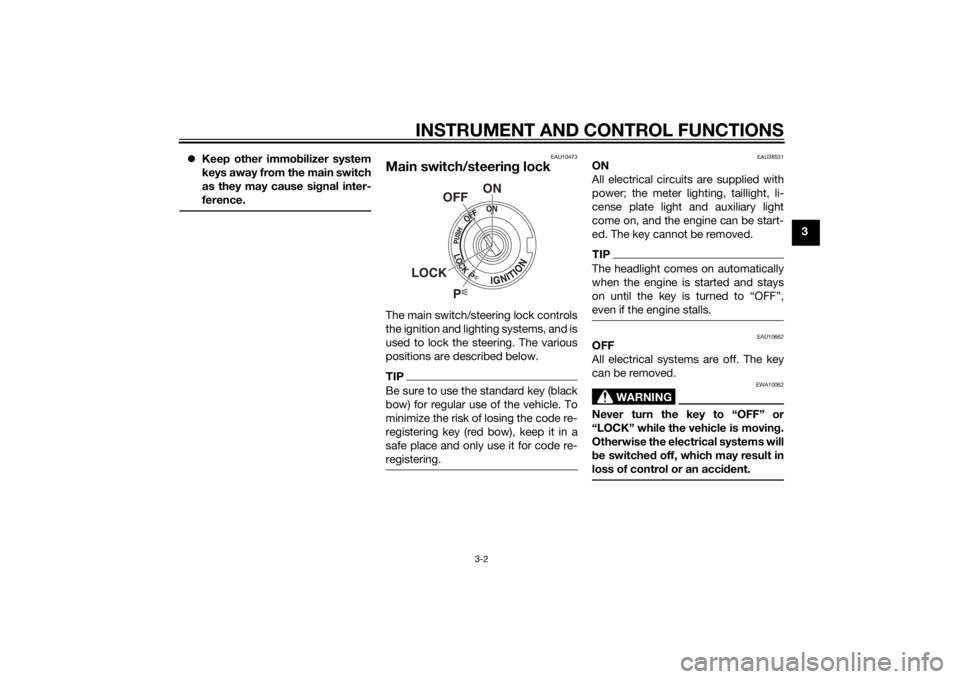
Main switch/steerin g lockThe main switch/steering lock controls
the ignition and lighting systems, and is
used to lock the steering. The various
positions are described below.TIPBe sure to use the standard key (black
bow) for regular use of the vehicle. To
minimize the risk of losing the code re-
registering key (red bow), keep it in a
safe place and only use it for code re-
registering.
EAU38531
ON
All electrical circuits are supplied with
power; the meter lighting, taillight, li-
cense plate light and auxiliary light
come on, and the engine can be start-
ed. The key cannot be removed.TIPThe headlight comes on automatically
when the engine is started and stays
on until the key is turned to “OFF”,
even if the engine stalls.
EAU10662
OFF
All electrical systems are off. The key
can be removed.
WARNING
EWA10062
Never turn the key to “OFF” or
“LOCK” while the vehicle is movin g.
Otherwise the electrical systems will
b e switche d off, which may result in
loss of control or an acci dent.
P
ON
OFF
LOCK
U1CSE1E0.book Page 2 Friday, September 13, 2013 9:33 AM
Page 18 of 92

INSTRUMENT AND CONTROL FUNCTIONS
3-3
3
EAU10685
LOCK
The steering is locked, and all electrical
systems are off. The key can be re-
moved.
To lock the steering1. Turn the handlebars all the way tothe left.
2. Push the key in from the “OFF” position, and then turn it to
“LOCK” while still pushing it.
3. Remove the key. To unlock the steering
Push the key in, and then turn it to
“OFF” while still pushing it.
EAU34342
(Parkin
g)
The steering is locked, and the taillight,
license plate light and auxiliary light are
on. The hazard lights and turn signal
lights can be turned on, but all other
electrical systems are off. The key can
be removed.
The steering must be locked before the
key can be turned to “ ”.
NOTICE
ECA11021
Do not use the parkin g position for
an exten ded len gth of time, other-
wise the battery may d ischarge.
1. Push.
2. Turn.12
1. Push.
2. Turn.12
U1CSE1E0.book Page 3 Friday, September 13, 2013 9:33 AM
Page 21 of 92
INSTRUMENT AND CONTROL FUNCTIONS
3-6
3
If the indicator light does not come on
initially when the key is turned to “ON”,
or if the indicator light remains on, have
a Yamaha dealer check the electrical
circuit.
When the key is turned to “OFF” and
30 seconds have passed, the indicator
light will start flashing indicating the im-
mobilizer system is enabled. After 24
hours have passed, the indicator light
will stop flashing, however the immobi-
lizer system is still enabled.
The self-diagnosis device also detects
problems in the immobilizer system
circuits. (See page 3-8 for an explana-
tion of the self-diagnosis device.)
EAU4290A
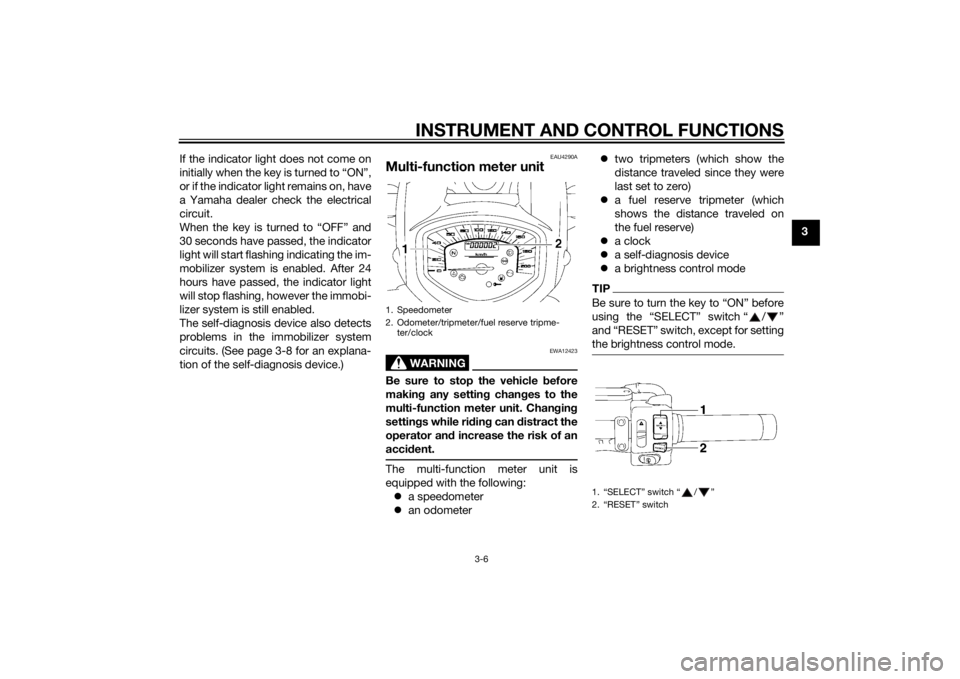
Multi-function meter unit
WARNING
EWA12423
Be sure to stop the vehicle
before
makin g any settin g chan ges to the
multi-function meter unit. Chan gin g
settin gs while ri din g can distract the
operator an d increase the risk of an
acci dent.The multi-function meter unit is
equipped with the following:
a speedometer
an odometer
two tripmeters (which show the
distance traveled since they were
last set to zero)
a fuel reserve tripmeter (which
shows the distance traveled on
the fuel reserve)
a clock
a self-diagnosis device
a brightness control mode
TIPBe sure to turn the key to “ON” before
using the “SELECT” switch “ / ”
and “RESET” switch, except for setting
the brightness control mode.
1. Speedometer
2. Odometer/tripmeter/fuel reserve tripme-
ter/clock
1. “SELECT” switch “ / ”
2. “RESET” switch
U1CSE1E0.book Page 6 Friday, September 13, 2013 9:33 AM
Page 22 of 92
INSTRUMENT AND CONTROL FUNCTIONS
3-7
3Speed
ometer
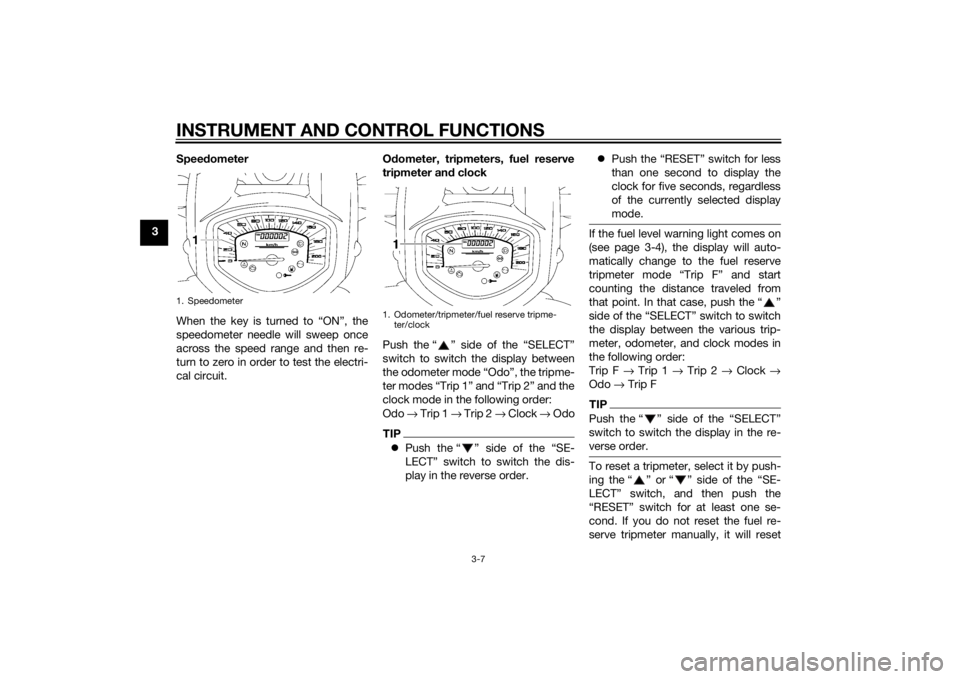
When the key is turned to “ON”, the
speedometer needle will sweep once
across the speed range and then re-
turn to zero in order to test the electri-
cal circuit. O
dometer, tripmeters, fuel reserve
tripmeter an d clock
Push the “ ” side of the “SELECT”
switch to switch the display between
the odometer mode “Odo”, the tripme-
ter modes “Trip 1” and “Trip 2” and the
clock mode in the following order:
Odo → Trip 1 → Trip 2 → Clock → Odo
TIPPush the “ ” side of the “SE-
LECT” switch to switch the dis-
play in the reverse order.
Push the “RESET” switch for less
than one second to display the
clock for five seconds, regardless
of the currently selected display
mode.
If the fuel level warning light comes on
(see page 3-4), the display will auto-
matically change to the fuel reserve
tripmeter mode “Trip F” and start
counting the distance traveled from
that point. In that case, push the “ ”
side of the “SELECT” switch to switch
the display between the various trip-
meter, odometer, and clock modes in
the following order:
Trip F → Trip 1 → Trip 2 → Clock →
Odo → Trip FTIPPush the “ ” side of the “SELECT”
switch to switch the display in the re-
verse order.To reset a tripmeter, select it by push-
ing the “ ” or “ ” side of the “SE-
LECT” switch, and then push the
“RESET” switch for at least one se-
cond. If you do not reset the fuel re-
serve tripmeter manually, it will reset
1. Speedometer
1. Odometer/tripmeter/fuel reserve tripme-
ter/clock
U1CSE1E0.book Page 7 Friday, September 13, 2013 9:33 AM
Page 23 of 92
INSTRUMENT AND CONTROL FUNCTIONS
3-8
3
itself automatically, and the display will
return to the prior mode after refueling
and traveling 5 km (3 mi).
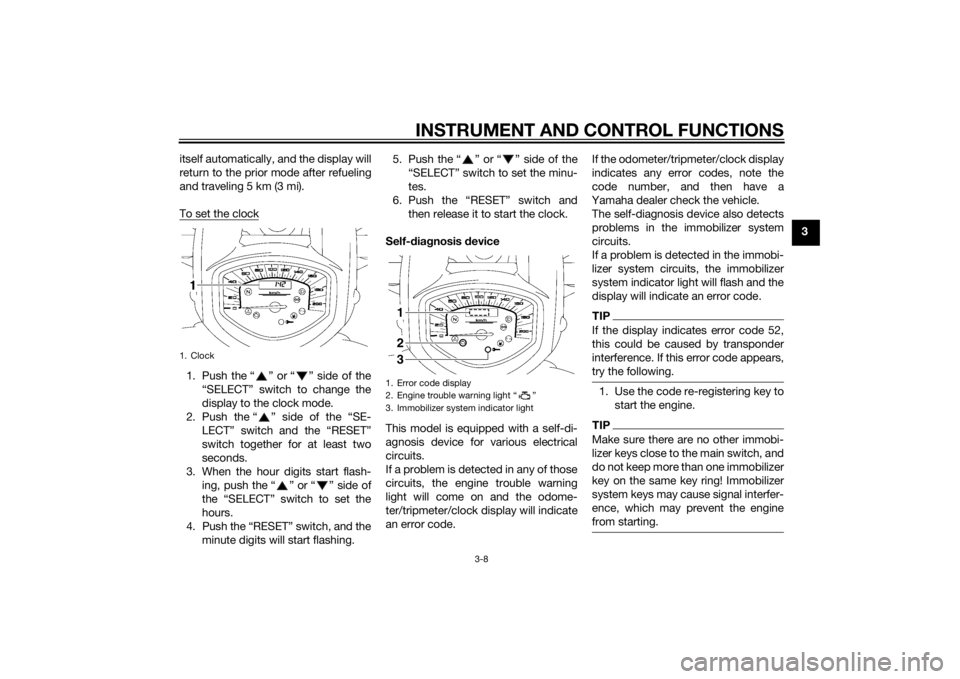
To set the clock
1. Push the “ ” or “ ” side of the
“SELECT” switch to change the
display to the clock mode.
2. Push the “ ” side of the “SE- LECT” switch and the “RESET”
switch together for at least two
seconds.
3. When the hour digits start flash- ing, push the “ ” or “ ” side of
the “SELECT” switch to set the
hours.
4. Push the “RESET” switch, and the minute digits will start flashing. 5. Push the “ ” or “ ” side of the
“SELECT” switch to set the minu-
tes.
6. Push the “RESET” switch and then release it to start the clock.
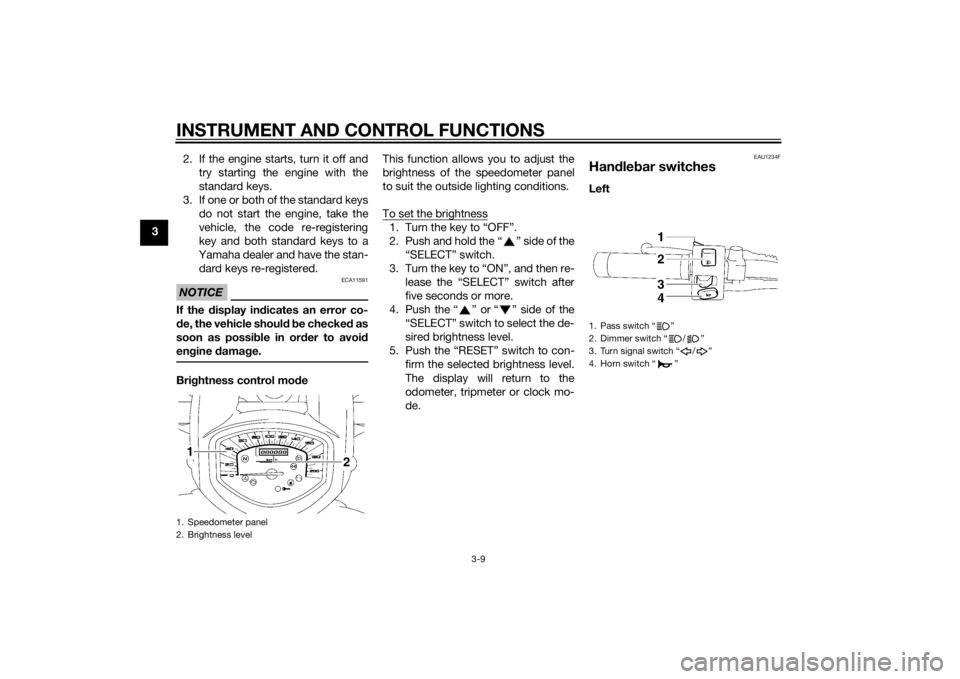
Self-d iagnosis device
This model is equipped with a self-di-
agnosis device for various electrical
circuits.
If a problem is detected in any of those
circuits, the engine trouble warning
light will come on and the odome-
ter/tripmeter/clock display will indicate
an error code. If the odometer/tripmeter/clock display
indicates any error codes, note the
code number, and then have a
Yamaha dealer check the vehicle.
The self-diagnosis device also detects
problems in the immobilizer system
circuits.
If a problem is detected in the immobi-
lizer system circuits, the immobilizer
system indicator light will flash and the
display will indicate an error code.
TIPIf the display indicates error code 52,
this could be caused by transponder
interference. If this error code appears,
try the following.1. Use the code re-registering key to
start the engine.TIPMake sure there are no other immobi-
lizer keys close to the main switch, and
do not keep more than one immobilizer
key on the same key ring! Immobilizer
system keys may cause signal interfer-
ence, which may prevent the engine
from starting.
1. Clock
1. Error code display
2. Engine trouble warning light “ ”
3. Immobilizer system indicator light123
U1CSE1E0.book Page 8 Friday, September 13, 2013 9:33 AM
Page 24 of 92
INSTRUMENT AND CONTROL FUNCTIONS
3-9
32. If the engine starts, turn it off and
try starting the engine with the
standard keys.
3. If one or both of the standard keys do not start the engine, take the
vehicle, the code re-registering
key and both standard keys to a
Yamaha dealer and have the stan-
dard keys re-registered.
NOTICE
ECA11591
If the display in dicates an error co-
d e, the vehicle shoul d b e checked as
soon as possi ble in or der to avoi d
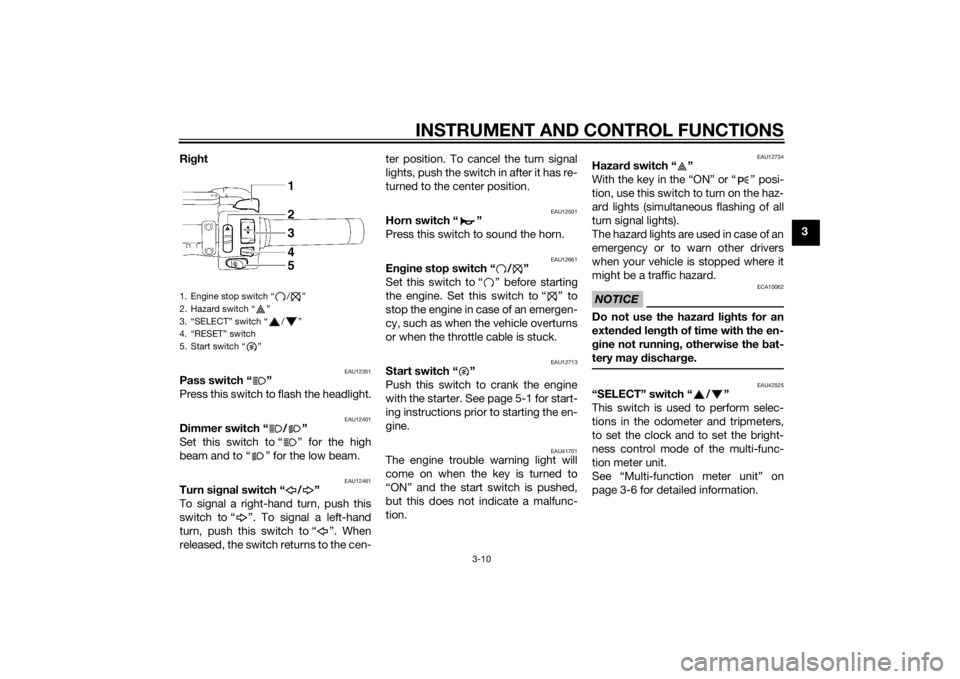
en gine damag e.Brightness control mo de This function allows you to adjust the
brightness of the speedometer panel
to suit the outside lighting conditions.
To set the brightness
1. Turn the key to “OFF”.
2. Push and hold the “ ” side of the
“SELECT” switch.
3. Turn the key to “ON”, and then re- lease the “SELECT” switch after
five seconds or more.
4. Push the “ ” or “ ” side of the “SELECT” switch to select the de-
sired brightness level.
5. Push the “RESET” switch to con- firm the selected brightness level.
The display will return to the
odometer, tripmeter or clock mo-
de.
EAU1234F
Han dle bar switchesLeft
1. Speedometer panel
2. Brightness level1
2
1. Pass switch “ ”
2. Dimmer switch “ / ”
3. Turn signal switch “ / ”
4. Horn switch “ ”
U1CSE1E0.book Page 9 Friday, September 13, 2013 9:33 AM
Page 25 of 92
INSTRUMENT AND CONTROL FUNCTIONS
3-10
3
Ri
ght
EAU12351
Pass switch “ ”
Press this switch to flash the headlight.
EAU12401
Dimmer switch “ / ”
Set this switch to “ ” for the high
beam and to “ ” for the low beam.
EAU12461
Turn si gnal switch “ / ”
To signal a right-hand turn, push this
switch to “ ”. To signal a left-hand
turn, push this switch to “ ”. When
released, the switch returns to the cen- ter position. To cancel the turn signal
lights, push the switch in after it has re-
turned to the center position.
EAU12501
Horn switch “ ”
Press this switch to sound the horn.
EAU12661
En
gine stop switch “ / ”
Set this switch to “ ” before starting
the engine. Set this switch to “ ” to
stop the engine in case of an emergen-
cy, such as when the vehicle overturns
or when the throttle cable is stuck.
EAU12713
Start switch “ ”
Push this switch to crank the engine
with the starter. See page 5-1 for start-
ing instructions prior to starting the en-
gine.
EAU41701
The engine trouble warning light will
come on when the key is turned to
“ON” and the start switch is pushed,
but this does not indicate a malfunc-
tion.
EAU12734
Hazar d switch “ ”
With the key in the “ON” or “ ” posi-
tion, use this switch to turn on the haz-
ard lights (simultaneous flashing of all
turn signal lights).
The hazard lights are used in case of an
emergency or to warn other drivers
when your vehicle is stopped where it
might be a traffic hazard.NOTICE
ECA10062
Do not use the hazar d lig hts for an
exten ded len gth of time with the en-
g ine not runnin g, otherwise the bat-
tery may d ischarge.
EAU42525
“SELECT” switch “ / ”
This switch is used to perform selec-
tions in the odometer and tripmeters,
to set the clock and to set the bright-
ness control mode of the multi-func-
tion meter unit.
See “Multi-function meter unit” on
page 3-6 for detailed information.
1. Engine stop switch “ / ”
2. Hazard switch “ ”
3. “SELECT” switch “ / ”
4. “RESET” switch
5. Start switch “ ”
U1CSE1E0.book Page 10 Friday, September 13, 2013 9:33 AM