lock YAMAHA XVS1300CU 2016 User Guide
[x] Cancel search | Manufacturer: YAMAHA, Model Year: 2016, Model line: XVS1300CU, Model: YAMAHA XVS1300CU 2016Pages: 88, PDF Size: 2.02 MB
Page 29 of 88

Instrument and control functions
3-14
3
EAU50681
SeatTo remove the seat
1. Insert the key into the seat lock, turn it counterclockwise, and then
lift the front of the seat up.
2. Pull the seat forward as shown to unhook it from the center seat
holder. 3. Pull the seat rearward to unhook it
from the rear seat holder, and then
pull it off.
To install the seat 1. Insert the projection on the rear of the seat into the rear seat holder. 2. Slide the seat rearward to fit the
slot in its bottom over the center
seat holder.
3. Push the front of the seat down to lock it in place.
4. Remove the key.
TIPMake sure that the seat is properly se-
cured before riding.
1. Seat lock
2. Unlock.
2
1
1. Center seat holder
1. Rear seat holder1
1
1. Projection
2. Rear seat holder
3. Slot
4. Center seat holder12
3
4
U2SSE2E0.book Page 14 Monday, July 20, 2015 2:28 PM
Page 57 of 88

Periodic maintenance an d a djustment
6-17
6
ageing. Old and aged tires shall be
checked by tire specialists to ascertain
their suitability for further use.
WARNING
EWA10462
The front an
d rear tires shoul d b e of
the same make an d d esi gn, other-
wise the han dlin g characteristics of
the vehicle may be different, which
coul d lea d to an acci dent.After extensive tests, only the tires list-
ed below have been approved for this
model by Yamaha.
EAU21963
Cast wheelsTo maximize the performance, durabil-
ity, and safe operation of your vehicle,
note the following points regarding the
specified wheels.
The wheel rims should be
checked for cracks, bends, warp-
age or other damage before each
ride. If any damage is found, have
a Yamaha dealer replace the
wheel. Do not attempt even the
smallest repair to the wheel. A de-
formed or cracked wheel must be
replaced.
The wheel should be balanced
whenever either the tire or wheel
has been changed or replaced. An
unbalanced wheel can result in
poor performance, adverse han-
dling characteristics, and a short-
ened tire life.
EAU50701
Adjustin g the clutch lever free
playThe clutch lever free play should mea-
sure 5.0–10.0 mm (0.20–0.39 in) as
shown. Periodically check the clutch
lever free play and, if necessary, adjust
it as follows.
1. Loosen the locknut at the clutch lever.
2. To increase the clutch lever free play, turn the clutch lever free play
adjusting bolt in direction (a). To
decrease the clutch lever free
play, turn the adjusting bolt in di-
rection (b).
Front tire:Size:120/70 21M/C 62H
Manufacturer/model: BRIDGESTONE/EXEDRA G721 G
Rear tire:
Size:210/40R18M/C 73H
Manufacturer/model:
BRIDGESTONE/EXEDRA G852
RADIAL G
1. Clutch lever free play
2. Locknut
3. Clutch lever free play adjusting bolt
3(a)(b)
2
1
U2SSE2E0.book Page 17 Monday, July 20, 2015 2:28 PM
Page 58 of 88

Periodic maintenance an d a djustment
6-18
6
TIPIf the specified clutch lever free play
could be obtained as described above,
skip steps 3–6.3. Fully turn the adjusting bolt in di-
rection (a) to loosen the clutch ca-
ble.
4. Slide the rubber covers apart, and then loosen the locknut.
5. To increase the clutch lever free play, turn the clutch lever free play
adjusting nut in direction (a). To
decrease the clutch lever free
play, turn the adjusting nut in di-
rection (b). 6. Tighten the locknut at the clutch
cable, and then slide the rubber
covers to their original positions.
7. Tighten the locknut at the clutch lever.
EAU37914
Checkin g the brake lever free
playThere should be no free play at the
brake lever end. If there is free play,
have a Yamaha dealer inspect the
brake system.
WARNING
EWA14212
A soft or spon gy feelin g in the brake
lever can in dicate the presence of
air in the hy draulic system. If there is
air in the hy draulic system, have a
Yamaha dealer blee d the system b e-
fore operatin g the vehicle. Air in the
hy draulic system will d iminish the
1. Rubber cover
2. Locknut
3. Clutch lever free play adjusting nut
(a)
1
(b)
1
2
3
1. No brake lever free play
1
U2SSE2E0.book Page 18 Monday, July 20, 2015 2:28 PM
Page 61 of 88

Periodic maintenance an d a djustment
6-21
6
Use only the specifie d b rake flu-
i d ; otherwise, the ru bber seals
may deteriorate, causin g leak-
a g e.
Refill with the same type of
brake flui d. A ddin g a brake flui d
other than DOT 4 may result in a
harmful chemical reaction.
Be careful that water d oes not
enter the brake flui d reservoir
when refillin g. Water will si gnifi-
cantly lower the boilin g point of
the flui d an d may result in vapor
lock.
NOTICE
ECA17641
Brake flui d may d amage painte d
surfaces or plastic parts. Always
clean up spille d flui d imme diately.As the brake pads wear, it is normal for
the brake fluid level to gradually go
down. A low brake fluid level may indi-
cate worn brake pads and/or brake
system leakage; therefore, be sure to
check the brake pads for wear and the
brake system for leakage. If the brake fluid level goes down suddenly, have a
Yamaha dealer check the cause before
further riding.
EAU22733
Chan
gin g the brake flui dHave a Yamaha dealer change the
brake fluid at the intervals specified in
the periodic maintenance and lubrica-
tion chart. In addition, have the oil seals
of the master cylinders and calipers as
well as the brake hoses replaced at the
intervals listed below or whenever they
are damaged or leaking.
Oil seals: Replace every two
years.
Brake hoses: Replace every four
years.
U2SSE2E0.book Page 21 Monday, July 20, 2015 2:28 PM
Page 69 of 88
Periodic maintenance an d a djustment
6-29
6
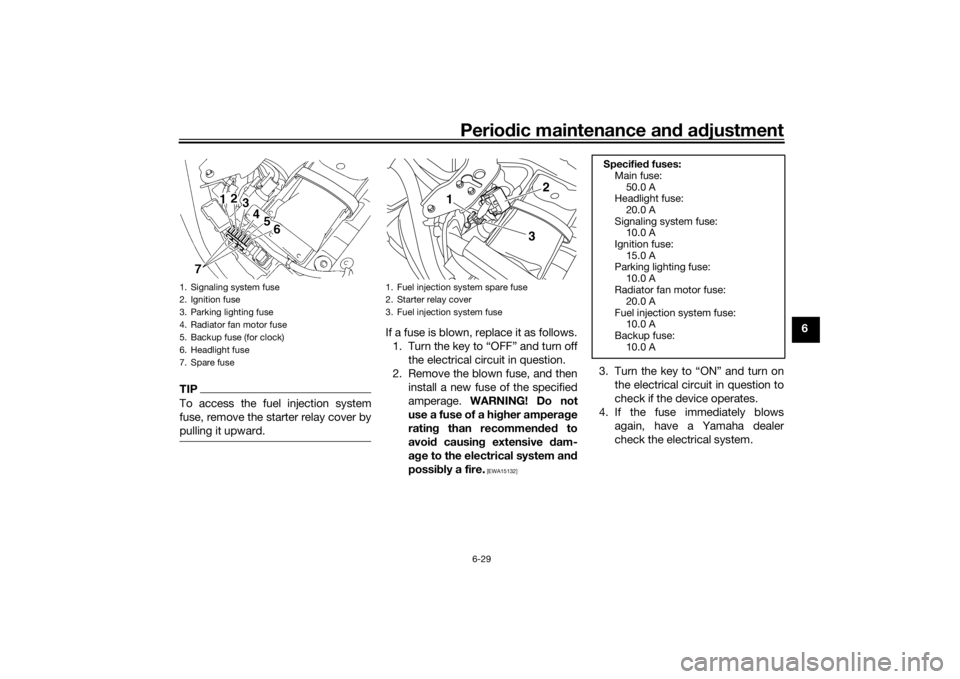
TIPTo access the fuel injection system
fuse, remove the starter relay cover by
pulling it upward.
If a fuse is blown, replace it as follows.
1. Turn the key to “OFF” and turn off the electrical circuit in question.
2. Remove the blown fuse, and then install a new fuse of the specified
amperage. WARNING! Do not
use a fuse of a hi gher ampera ge
ratin g than recommen ded to
avoi d causin g extensive dam-
a g e to the electrical system an d
possi bly a fire.
[EWA15132]
3. Turn the key to “ON” and turn on
the electrical circuit in question to
check if the device operates.
4. If the fuse immediately blows again, have a Yamaha dealer
check the electrical system.
1. Signaling system fuse
2. Ignition fuse
3. Parking lighting fuse
4. Radiator fan motor fuse
5. Backup fuse (for clock)
6. Headlight fuse
7. Spare fuse
1. Fuel injection system spare fuse
2. Starter relay cover
3. Fuel injection system fuse
32
1
Specified fuses:
Main fuse:
50.0 A
Headlight fuse:
20.0 A
Signaling system fuse: 10.0 A
Ignition fuse: 15.0 A
Parking lighting fuse:
10.0 A
Radiator fan motor fuse: 20.0 A
Fuel injection system fuse: 10.0 A
Backup fuse:
10.0 A
U2SSE2E0.book Page 29 Monday, July 20, 2015 2:28 PM
Page 75 of 88

Periodic maintenance an d a djustment
6-35
6
En
gine overheatin g
WARNING
EWAT1041
Do not remove the ra diator cap when the en gine an d ra diator are hot. Scal din g hot flui d an d steam may be
b lown out un der pressure, which coul d cause serious injury. Be sure to wait until the en gine has coole d.
Place a thick ra g, like a towel, over the ra diator cap, an d then slowly rotate the cap counterclockwise to the
d etent to allow any resi dual pressure to escape. When the hissin g soun d has stoppe d, press down on the cap
while turnin g it counterclockwise, an d then remove the cap.TIPIf coolant is not available, tap water can be temporarily used instead, provided that it is changed to the recommended cool-
ant as soon as possible.
Wait until the
engine has cooled.
Check the coolant level in the
reservoir and radiator.
The coolant level
is OK.The coolant level is low.
Check the cooling system
for leakage.
Have a Yamaha dealer checkand repair the cooling system.Add coolant. (See TIP.)
Start the engine. If the engine overheats again,
have a
Yamaha dealer check
and repair the cooling system.
There is
leakage.
There is
no leakage.
U2SSE2E0.book Page 35 Monday, July 20, 2015 2:28 PM
Page 85 of 88

10-1
10
Index
AAir filter element, replacing ................... 6-14
Auxiliary light bulb, replacing ............... 6-31BBattery .................................................. 6-27
Brake and clutch levers, checking and
lubricating........................................... 6-24
Brake and shift pedals, checking and lubricating........................................... 6-23
Brake fluid, changing............................ 6-21
Brake fluid level, checking.................... 6-20
Brake lever............................................ 3-10
Brake lever free play, checking ............ 6-18
Brake light switches ............................. 6-19
Brake pedal .......................................... 3-10CCables, checking and lubricating ......... 6-23
Care ........................................................ 7-1
Catalytic converter ............................... 3-13
Clutch lever............................................. 3-9
Clutch lever free play, adjusting ........... 6-17
Coolant ................................................. 6-13
Coolant temperature warning light ......... 3-3DDimmer switch........................................ 3-8
Drive belt slack ..................................... 6-22EEngine break-in ...................................... 5-3
Engine oil and oil filter cartridge ........... 6-10
Engine serial number .............................. 9-1
Engine stop switch ................................. 3-8
Engine trouble warning light ................... 3-4FFront and rear brake pads, checking ... 6-19 Front fork, checking ............................. 6-26
Fuel ...................................................... 3-11
Fuel consumption, tips for reducing ...... 5-3
Fuel level warning light........................... 3-3
Fuel tank breather/overflow hose ........ 3-13
Fuel tank cap........................................ 3-11
Fuses, replacing ................................... 6-28
HHandlebar switches ............................... 3-8
Hazard switch ........................................ 3-9
Headlight bulb, replacing ..................... 6-30
Helmet holder....................................... 3-15
High beam indicator light ....................... 3-3
Horn switch ............................................ 3-8IIdentification numbers ........................... 9-1
Ignition circuit cut-off system .............. 3-17
Indicator lights and warning lights ......... 3-2LLicense plate light ................................ 6-32MMain switch/steering lock ...................... 3-1
Maintenance and lubrication, periodic... 6-4
Maintenance, emission control
system ................................................. 6-3
Matte color, caution ............................... 7-1
Model label............................................. 9-1
Multi-function meter unit ........................ 3-4NNeutral indicator light ............................. 3-2OOil level warning light ............................. 3-3PPanel, removing and installing ............... 6-8 Parking.................................................... 5-4
Part locations.......................................... 2-1
Pass switch............................................. 3-8
RRear suspension, lubricating ................ 6-25
RESET switch ......................................... 3-9SSafety information................................... 1-1
Seat....................................................... 3-14
SELECT switch ....................................... 3-9
Shifting.................................................... 5-2
Shift pedal............................................. 3-10
Shock absorber assembly, adjusting ... 3-15
Sidestand.............................................. 3-16
Sidestand, checking and lubricating .... 6-25
Spark plugs, checking ............................ 6-8
Specifications ......................................... 8-1
Starting the engine ................................. 5-1
Start switch ............................................. 3-8
Steering, checking ................................ 6-26
Storage ................................................... 7-3
Supporting the motorcycle ................... 6-32
Swingarm pivots, lubricating ................ 6-25TThrottle grip and cable, checking and
lubricating ........................................... 6-23
Throttle grip free play, checking ........... 6-15
Tires ...................................................... 6-15
Tool kit .................................................... 6-2
Troubleshooting .................................... 6-33
Troubleshooting charts ......................... 6-34
Turn signal indicator light ....................... 3-2
Turn signal light and brake/tail light...... 6-32
Turn signal switch ................................... 3-8
U2SSE2E0.book Page 1 Monday, July 20, 2015 2:28 PM