fuel YAMAHA XVS1300CU 2016 Owners Manual
[x] Cancel search | Manufacturer: YAMAHA, Model Year: 2016, Model line: XVS1300CU, Model: YAMAHA XVS1300CU 2016Pages: 88, PDF Size: 2.02 MB
Page 6 of 88

Table of contentsSafety information ............................ 1-1
Description ....................................... 2-1
Left view ......................................... 2-1
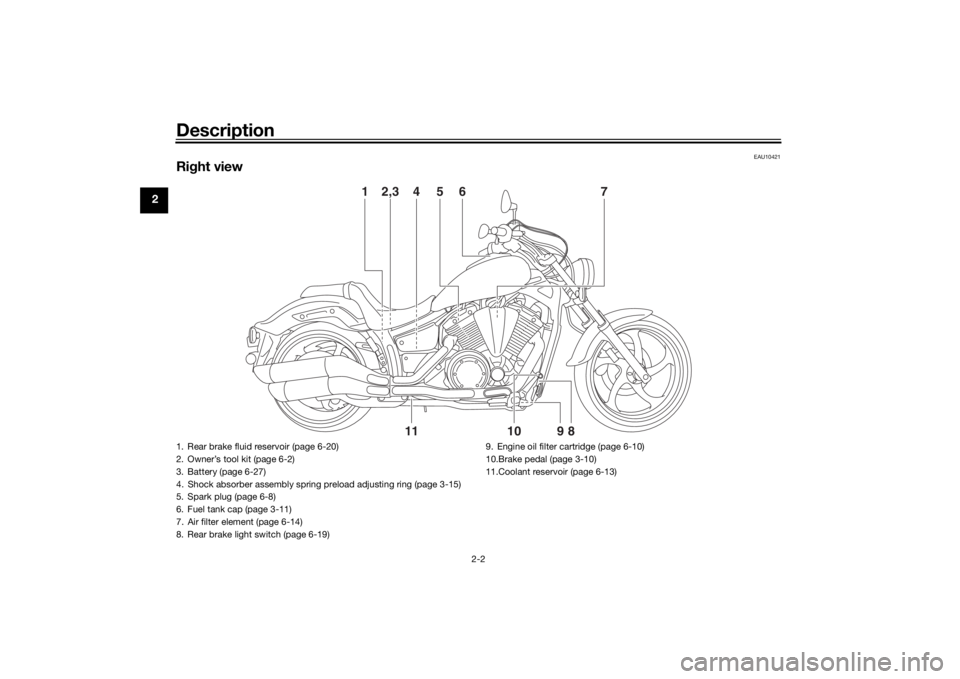
Right view ....................................... 2-2
Controls and instruments ............... 2-3
Instrument an d control functions ... 3-1
Main switch/steering lock............... 3-1
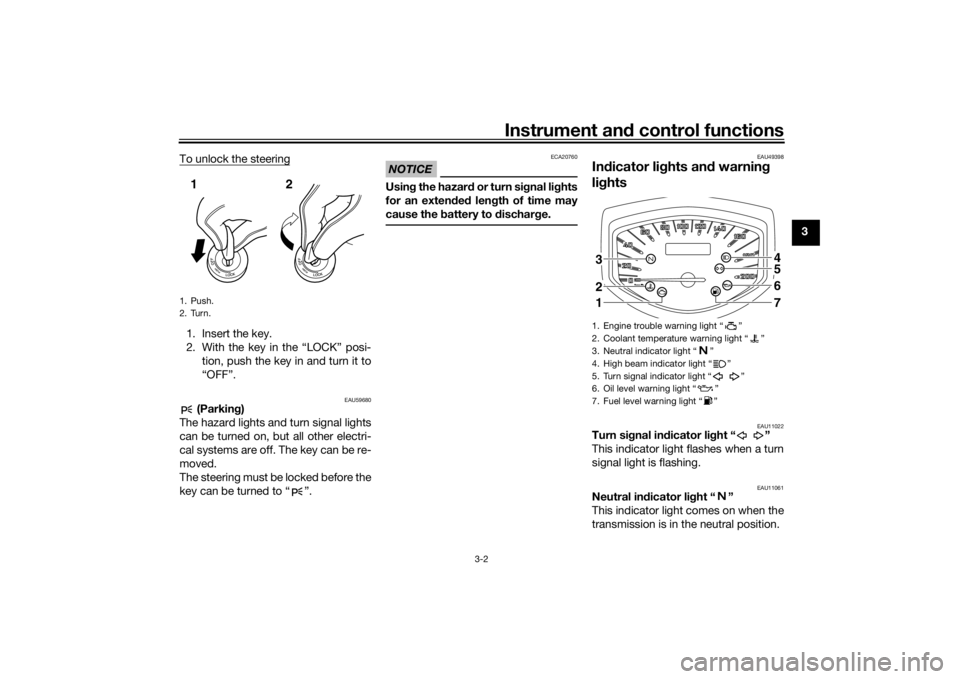
Indicator lights and warning lights............................................ 3-2
Multi-function meter unit ................ 3-4
Handlebar switches ........................ 3-8
Clutch lever .................................... 3-9
Shift pedal .................................... 3-10
Brake lever.................................... 3-10
Brake pedal .................................. 3-10
Fuel tank cap ................................ 3-11
Fuel ............................................... 3-11
Fuel tank breather/overflow hose .......................................... 3-13
Catalytic converter ....................... 3-13
Seat .............................................. 3-14
Helmet holder ............................... 3-15
Adjusting the shock absorber assembly ................................... 3-15
Sidestand ..................................... 3-16
Ignition circuit cut-off system ....... 3-17 For your safety – pre-operation
checks
............................................... 4-1
Operation an d important ri din g
points ................................................. 5-1
Starting the engine .......................... 5-1
Shifting ............................................ 5-2
Tips for reducing fuel consumption ................................ 5-3
Engine break-in ............................... 5-3
Parking ............................................ 5-4
Perio dic maintenance an d
a d justment ........................................ 6-1
Owner’s tool kits ............................. 6-2
Periodic maintenance chart for the emission control system .............. 6-3
General maintenance and lubrication chart ........................... 6-4
Removing and installing the
panel ............................................ 6-8
Checking the spark plugs ............... 6-8
Engine oil and oil filter cartridge.... 6-10
Coolant.......................................... 6-13
Replacing the air filter element ..... 6-14
Checking the throttle grip free play ............................................ 6-15
Valve clearance ............................. 6-15
Tires .............................................. 6-15
Cast wheels................................... 6-17 Adjusting the clutch lever free
play ............................................ 6-17
Checking the brake lever free play ............................................ 6-18
Brake light switches ..................... 6-19
Checking the front and rear
brake pads ................................ 6-19
Checking the brake fluid level ...... 6-20
Changing the brake fluid .............. 6-21
Drive belt slack ............................. 6-22
Checking and lubricating the
cables ........................................ 6-23
Checking and lubricating the throttle grip and cable ............... 6-23
Checking and lubricating the brake and shift pedals............... 6-23
Checking and lubricating the
brake and clutch levers ............. 6-24
Checking and lubricating the sidestand................................... 6-25
Lubricating the rear suspension ... 6-25
Lubricating the swingarm pivots......................................... 6-25
Checking the front fork ................. 6-26
Checking the steering................... 6-26
Checking the wheel bearings ....... 6-27
Battery .......................................... 6-27
Replacing the fuses ...................... 6-28
Replacing the headlight bulb ........ 6-30
Replacing the auxiliary light bulb .......................................... 6-31U2SSE2E0.book Page 1 Monday, July 20, 2015 2:28 PM
Page 12 of 88

Safety information
1-5
1operator and may limit control
ability, therefore, such accesso-
ries are not recommended.
Use caution when adding electri-
cal accessories. If electrical ac-
cessories exceed the capacity of
the motorcycle’s electrical sys-
tem, an electric failure could re-
sult, which could cause a
dangerous loss of lights or engine
power.
Aftermarket Tires an d Rims
The tires and rims that came with your
motorcycle were designed to match
the performance capabilities and to
provide the best combination of han-
dling, braking, and comfort. Other
tires, rims, sizes, and combinations
may not be appropriate. Refer to page
6-15 for tire specifications and more in-
formation on replacing your tires.
Transportin g the Motorcycle
Be sure to observe following instruc-
tions before transporting the motorcy-
cle in another vehicle. Remove all loose items from the
motorcycle.
Check that the fuel cock (if
equipped) is in the “OFF” position
and that there are no fuel leaks.
Point the front wheel straight
ahead on the trailer or in the truck
bed, and choke it in a rail to pre-
vent movement.
Shift the transmission in gear (for
models with a manual transmis-
sion).
Secure the motorcycle with tie-
downs or suitable straps that are
attached to solid parts of the mo-
torcycle, such as the frame or up-
per front fork triple clamp (and not,
for example, to rubber-mounted
handlebars or turn signals, or
parts that could break). Choose
the location for the straps carefully
so the straps will not rub against
painted surfaces during transport.
The suspension should be com-
pressed somewhat by the tie-
downs, if possible, so that the mo-
torcycle will not bounce exces-
sively during transport.
U2SSE2E0.book Page 5 Monday, July 20, 2015 2:28 PM
Page 14 of 88
Description
2-2
2
EAU10421
Right view
2,3
4
6
7
5
1
11
9
10
8
1. Rear brake fluid reservoir (page 6-20)
2. Owner’s tool kit (page 6-2)
3. Battery (page 6-27)
4. Shock absorber assembly spring preload adjusting ring (page 3-15)
5. Spark plug (page 6-8)
6. Fuel tank cap (page 3-11)
7. Air filter element (page 6-14)
8. Rear brake light switch (page 6-19) 9. Engine oil filter cartridge (page 6-10)
10.Brake pedal (page 3-10)
11.Coolant reservoir (page 6-13)U2SSE2E0.book Page 2 Monday, July 20, 2015 2:28 PM
Page 17 of 88
Instrument and control functions
3-2
3
To unlock the steering
1. Insert the key.
2. With the key in the “LOCK” posi-
tion, push the key in and turn it to
“OFF”.
EAU59680
(Parkin g)
The hazard lights and turn signal lights
can be turned on, but all other electri-
cal systems are off. The key can be re-
moved.
The steering must be locked before the
key can be turned to “ ”.
NOTICE
ECA20760
Usin g the hazar d or turn si gnal lig hts
for an exten ded len gth of time may
cause the b attery to discharge.
EAU49398
In dicator li ghts an d warnin g
lig hts
EAU11022
Turn si gnal in dicator li ght “ ”
This indicator light flashes when a turn
signal light is flashing.
EAU11061
Neutral in dicator li ght “ ”
This indicator light comes on when the
transmission is in the neutral position.
1. Push.
2. Turn.12
1. Engine trouble warning light “ ”
2. Coolant temperature warning light “ ”
3. Neutral indicator light “ ”
4. High beam indicator light “ ”
5. Turn signal indicator light “ ”
6. Oil level warning light “ ”
7. Fuel level warning light “ ”
4567
321
U2SSE2E0.book Page 2 Monday, July 20, 2015 2:28 PM
Page 18 of 88
Instrument and control functions
3-3
3
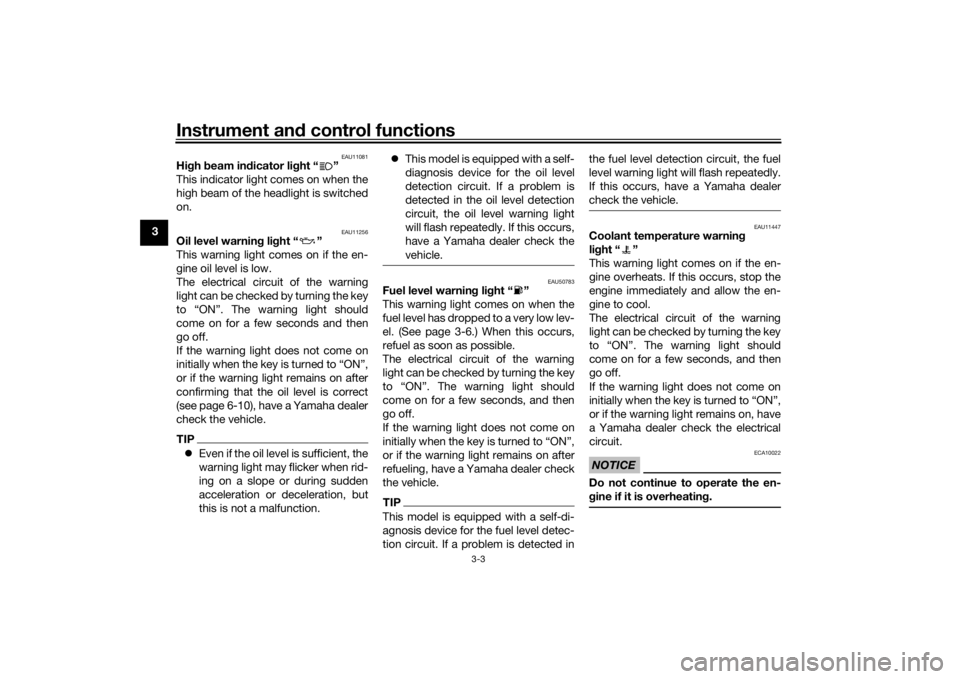
EAU11081
Hi gh beam in dicator li ght “ ”
This indicator light comes on when the
high beam of the headlight is switched
on.
EAU11256
Oil level warnin g li ght “ ”
This warning light comes on if the en-
gine oil level is low.
The electrical circuit of the warning
light can be checked by turning the key
to “ON”. The warning light should
come on for a few seconds and then
go off.
If the warning light does not come on
initially when the key is turned to “ON”,
or if the warning light remains on after
confirming that the oil level is correct
(see page 6-10), have a Yamaha dealer
check the vehicle.TIP Even if the oil level is sufficient, the
warning light may flicker when rid-
ing on a slope or during sudden
acceleration or deceleration, but
this is not a malfunction.
This model is equipped with a self-
diagnosis device for the oil level
detection circuit. If a problem is
detected in the oil level detection
circuit, the oil level warning light
will flash repeatedly. If this occurs,
have a Yamaha dealer check the
vehicle.
EAU50783
Fuel level warnin g li ght “ ”
This warning light comes on when the
fuel level has dropped to a very low lev-
el. (See page 3-6.) When this occurs,
refuel as soon as possible.
The electrical circuit of the warning
light can be checked by turning the key
to “ON”. The warning light should
come on for a few seconds, and then
go off.
If the warning light does not come on
initially when the key is turned to “ON”,
or if the warning light remains on after
refueling, have a Yamaha dealer check
the vehicle.TIPThis model is equipped with a self-di-
agnosis device for the fuel level detec-
tion circuit. If a problem is detected in the fuel level detection circuit, the fuel
level warning light will flash repeatedly.
If this occurs, have a Yamaha dealer
check the vehicle.
EAU11447
Coolant temperature warnin
g
li g ht “ ”
This warning light comes on if the en-
gine overheats. If this occurs, stop the
engine immediately and allow the en-
gine to cool.
The electrical circuit of the warning
light can be checked by turning the key
to “ON”. The warning light should
come on for a few seconds, and then
go off.
If the warning light does not come on
initially when the key is turned to “ON”,
or if the warning light remains on, have
a Yamaha dealer check the electrical
circuit.NOTICE
ECA10022
Do not continue to operate the en-
g ine if it is overheatin g.
U2SSE2E0.book Page 3 Monday, July 20, 2015 2:28 PM
Page 20 of 88
Instrument and control functions
3-5
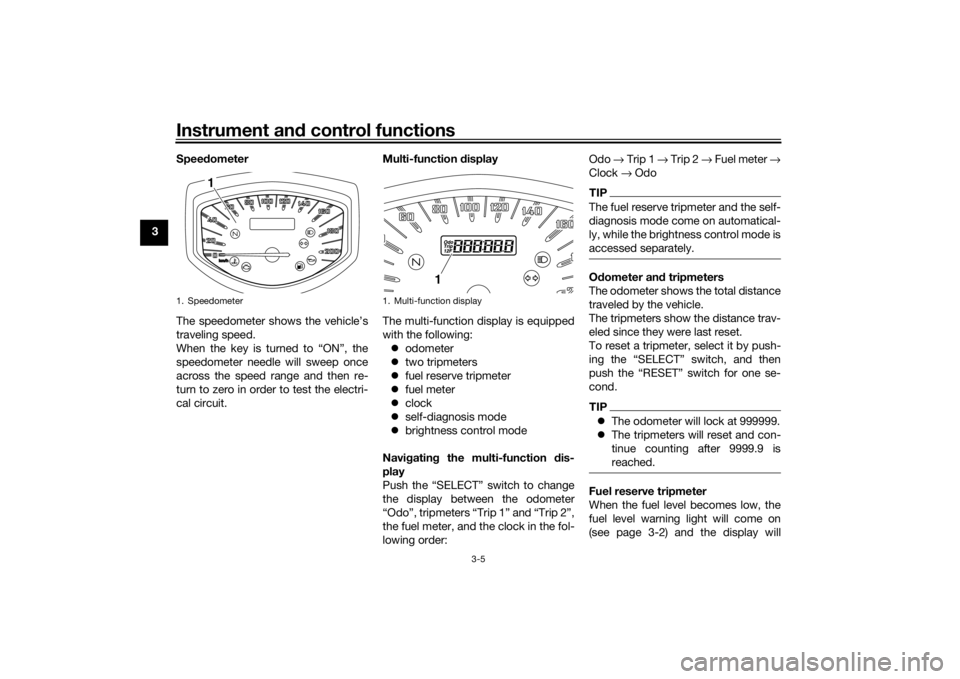
3 Speed
ometer
The speedometer shows the vehicle’s
traveling speed.
When the key is turned to “ON”, the
speedometer needle will sweep once
across the speed range and then re-
turn to zero in order to test the electri-
cal circuit. Multi-function
display
The multi-function display is equipped
with the following: odometer
two tripmeters
fuel reserve tripmeter
fuel meter
clock
self-diagnosis mode
brightness control mode
Navi gatin g the multi-function d is-
play
Push the “SELECT” switch to change
the display between the odometer
“Odo”, tripmeters “Trip 1” and “Trip 2”,
the fuel meter, and the clock in the fol-
lowing order: Odo
→ Trip 1 → Trip 2 → Fuel meter →
Clock → Odo
TIPThe fuel reserve tripmeter and the self-
diagnosis mode come on automatical-
ly, while the brightness control mode is
accessed separately.Odometer an d tripmeters
The odometer shows the total distance
traveled by the vehicle.
The tripmeters show the distance trav-
eled since they were last reset.
To reset a tripmeter, select it by push-
ing the “SELECT” switch, and then
push the “RESET” switch for one se-
cond.TIP The odometer will lock at 999999.
The tripmeters will reset and con-
tinue counting after 9999.9 is
reached.Fuel reserve tripmeter
When the fuel level becomes low, the
fuel level warning light will come on
(see page 3-2) and the display will
1. Speedometer
1
1. Multi-function display
1
U2SSE2E0.book Page 5 Monday, July 20, 2015 2:28 PM
Page 21 of 88

Instrument and control functions
3-6
3
change to the fuel reserve tripmeter
“Trip F” and start counting the distance
traveled from that point. In this case,
push the “SELECT” switch to change
the display in the following order:
Trip F
→ Trip 1 → Trip 2 → Fuel meter
→ Clock → Odo → Trip F
TIPYou can manually reset the fuel reserve
tripmeter, or after refueling and travel-
ing 5 km (3 mi), it will reset automatical-
ly and disappear from the display.Fuel meter The fuel meter indicates the amount of
fuel in the fuel tank. The display seg-
ments of the fuel meter disappear from
“F” (full) towards “E” (empty) as the fuel
level decreases.
When the fuel meter changes from two
segments to only one segment, ap-
proximately 4.1 L (1.08 US gal,
0.90 Imp.gal) of fuel remains in the fuel
tank. Be sure to refuel as soon as pos-
sible.
Clock
The clock uses a 12-hour time system. To set the clock
1. Push the “SELECT” switch to
change the display to the clock
mode.
2. Push the “SELECT” and “RESET” switches together for three sec-
onds. The hour digits will start
flashing.
3. Push the “SELECT” switch to set the hours.
4. Push the “RESET” switch, and the minute digits will start flashing.
5. Push the “SELECT” switch to set the minutes.
6. Push the “RESET” switch and then release it to start the clock.
1. Fuel meter
2. Segment
1
2
1. Clock
1
U2SSE2E0.book Page 6 Monday, July 20, 2015 2:28 PM
Page 26 of 88
Instrument and control functions
3-11
3
EAU13125
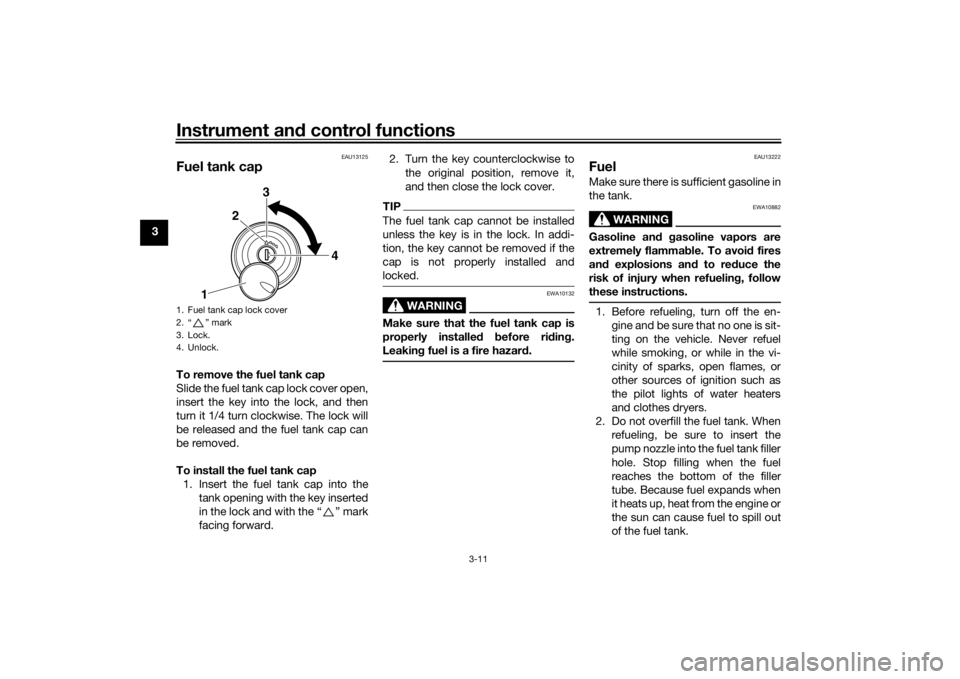
Fuel tank capTo remove the fuel tank cap
Slide the fuel tank cap lock cover open,
insert the key into the lock, and then
turn it 1/4 turn clockwise. The lock will
be released and the fuel tank cap can
be removed.
To install the fuel tank cap
1. Insert the fuel tank cap into the tank opening with the key inserted
in the lock and with the “ ” mark
facing forward. 2. Turn the key counterclockwise to
the original position, remove it,
and then close the lock cover.
TIPThe fuel tank cap cannot be installed
unless the key is in the lock. In addi-
tion, the key cannot be removed if the
cap is not properly installed and
locked.
WARNING
EWA10132
Make sure that the fuel tank cap is
properly installe d before ri din g.
Leakin g fuel is a fire hazar d.
EAU13222
FuelMake sure there is sufficient gasoline in
the tank.
WARNING
EWA10882
Gasoline an d g asoline vapors are
extremely flamma ble. To avoi d fires
an d explosions an d to re duce the
risk of injury when refuelin g, follow
these instructions.1. Before refueling, turn off the en- gine and be sure that no one is sit-
ting on the vehicle. Never refuel
while smoking, or while in the vi-
cinity of sparks, open flames, or
other sources of ignition such as
the pilot lights of water heaters
and clothes dryers.
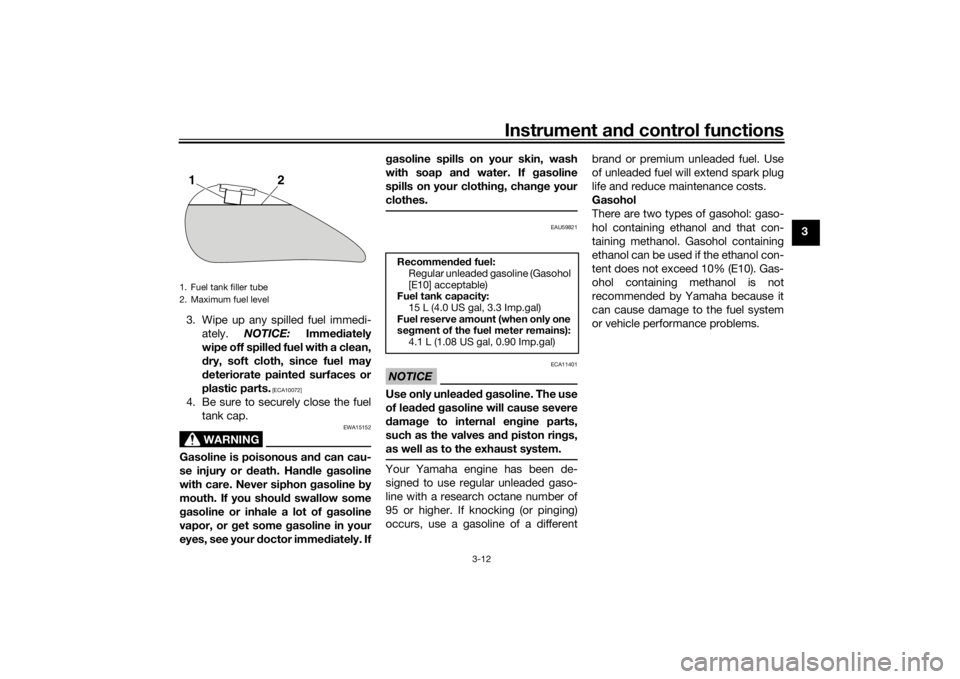
2. Do not overfill the fuel tank. When refueling, be sure to insert the
pump nozzle into the fuel tank filler
hole. Stop filling when the fuel
reaches the bottom of the filler
tube. Because fuel expands when
it heats up, heat from the engine or
the sun can cause fuel to spill out
of the fuel tank.
1. Fuel tank cap lock cover
2. “ ” mark
3. Lock.
4. Unlock.
1 2
3
4
U2SSE2E0.book Page 11 Monday, July 20, 2015 2:28 PM
Page 27 of 88
Instrument and control functions
3-12
3
3. Wipe up any spilled fuel immedi- ately. NOTICE: Immediately
wipe off spille d fuel with a clean,
d ry, soft cloth, since fuel may
d eteriorate painte d surfaces or
plastic parts.
[ECA10072]
4. Be sure to securely close the fuel tank cap.
WARNING
EWA15152
Gasoline is poisonous an d can cau-
se injury or death. Han dle gasoline
with care. Never siphon gasoline by
mouth. If you shoul d swallow some
g asoline or inhale a lot of gasoline
vapor, or get some g asoline in your
eyes, see your d octor immediately. If g
asoline spills on your skin, wash
with soap an d water. If gasoline
spills on your clothin g, chan ge your
clothes.
EAU59821
NOTICE
ECA11401
Use only unlea ded g asoline. The use
of lead ed g asoline will cause severe
d amag e to internal en gine parts,
such as the valves an d piston rin gs,
as well as to the exhaust system.Your Yamaha engine has been de-
signed to use regular unleaded gaso-
line with a research octane number of
95 or higher. If knocking (or pinging)
occurs, use a gasoline of a different brand or premium unleaded fuel. Use
of unleaded fuel will extend spark plug
life and reduce maintenance costs.
Gasohol
There are two types of gasohol: gaso-
hol containing ethanol and that con-
taining methanol. Gasohol containing
ethanol can be used if the ethanol con-
tent does not exceed 10% (E10). Gas-
ohol containing methanol is not
recommended by Yamaha because it
can cause damage to the fuel system
or vehicle performance problems.
1. Fuel tank filler tube
2. Maximum fuel level1
2
Recommen
ded fuel:
Regular unleaded gasoline (Gasohol
[E10] acceptable)
Fuel tank capacity:
15 L (4.0 US gal, 3.3 Imp.gal)
Fuel reserve amount (when only one
se gment of the fuel meter remains):
4.1 L (1.08 US gal, 0.90 Imp.gal)
U2SSE2E0.book Page 12 Monday, July 20, 2015 2:28 PM
Page 28 of 88
Instrument and control functions
3-13
3
EAU39453
Fuel tank breather/overflow
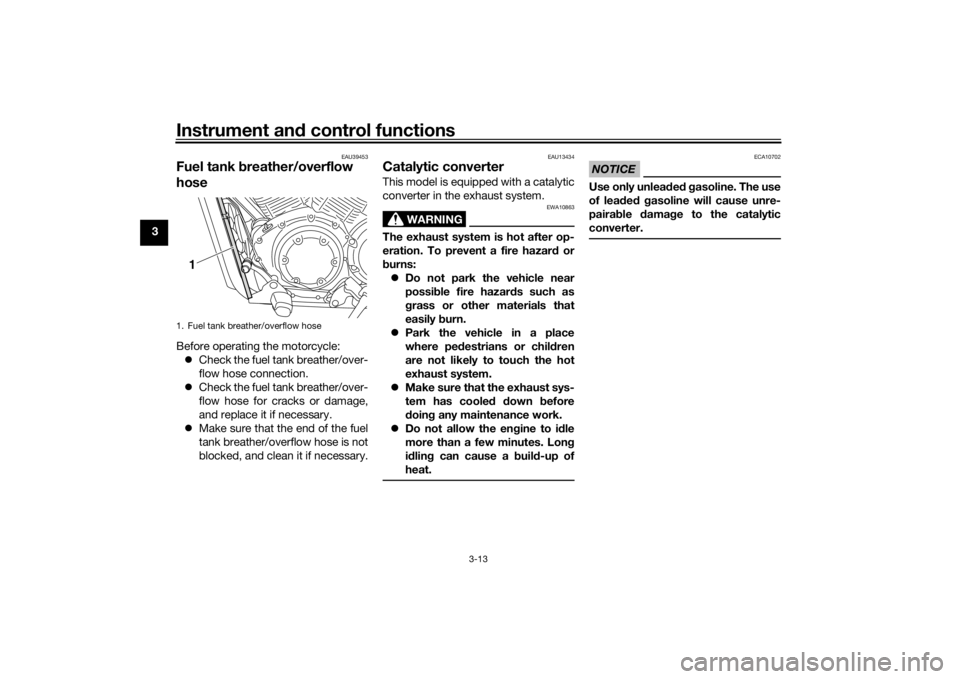
hoseBefore operating the motorcycle:
Check the fuel tank breather/over-
flow hose connection.
Check the fuel tank breather/over-
flow hose for cracks or damage,
and replace it if necessary.
Make sure that the end of the fuel
tank breather/overflow hose is not
blocked, and clean it if necessary.
EAU13434
Catalytic converterThis model is equipped with a catalytic
converter in the exhaust system.
WARNING
EWA10863
The exhaust system is hot after op-
eration. To prevent a fire hazar d or
b urns:
Do not park the vehicle near
possi ble fire hazard s such as
g rass or other materials that
easily burn.
Park the vehicle in a place
where ped estrians or chil dren
are not likely to touch the hot
exhaust system.
Make sure that the exhaust sys-
tem has coole d down before
d oin g any maintenance work.
Do not allow the en gine to i dle
more than a few minutes. Lon g
i d lin g can cause a b uild-up of
heat.
NOTICE
ECA10702
Use only unlea ded g asoline. The use
of lead ed g asoline will cause unre-
pairab le damag e to the catalytic
converter.
1. Fuel tank breather/overflow hose
1
U2SSE2E0.book Page 13 Monday, July 20, 2015 2:28 PM