light YAMAHA XVS650 2000 User Guide
[x] Cancel search | Manufacturer: YAMAHA, Model Year: 2000, Model line: XVS650, Model: YAMAHA XVS650 2000Pages: 101, PDF Size: 6.77 MB
Page 54 of 101

6-8
PERIODIC MAINTENANCE AND MINOR REPAIR
1
2
3
4
5
6
7
8
9
1. Spark plug wrench
Inspection
The spark plug is an important engine
component and is easy to inspect. The
condition of the spark plug can indicate
the condition of the engine. Normally,
all spark plugs from the same engine
should have the same color on the
white insulator around the center elec-
trode. The ideal color at this point is a
medium-to-light tan color for a motor-
cycle that is being ridden normally. If
one spark plug shows a distinctly dif-
ferent color, there could be something
wrong with the engine. Do not attempt
to diagnose such problems yourself.
Instead, take the motorcycle to a
Yamaha dealer. You should periodi-cally remove and inspect the spark
plugs because heat and deposits will
cause any spark plug to slowly break
down and erode. If electrode erosion
becomes excessive, or if carbon and
other deposits are excessive, you
should replace the spark plug with the
specified plug.
Specified spark plug:
DPR7EA-9 (NGK)
X22EPR-U9 (DENSO)
a. Spark plug gap
Installation
1. Measure the electrode gap with a
wire thickness gauge and, if nec-
essary, adjust the gap to specifi-
cation.
2. Clean the gasket surface. Wipe
off any grime from the threads.
3. Install the spark plug and tighten it
to the specified torque. Spark plug gap:
0.8 ~ 0.9 mm
Page 55 of 101

6-9
PERIODIC MAINTENANCE AND MINOR REPAIR
1
2
3
4
5
6
7
8
9
NOTE:
If a torque wrench is not available
when you are installing a spark plug, a
good estimate of the correct torque is
1/4 to 1/2 turn past finger tight. Have
the spark plug tightened to the speci-
fied torque as soon as possible.Tightening torque:
Spark plug:
20 Nm (2.0 m·kg)
1. Maximum level mark
2. Minimum level mark
EAU01326*
Engine oil
Oil level inspection
1. Place the motorcycle on a level
place and hold it in an upright po-
sition. Warm up the engine for
several minutes.
NOTE:
Be sure the motorcycle is positioned
straight up when checking the oil level.
A slight tilt toward the side can result in
false readings.
1. Engine oil drain bolt
2. With the engine stopped, check
the oil level through the level win-
dow located at the lower part of
the left side crankcase cover.
NOTE:
Wait a few minutes until the oil level
settles before checking.
3. The oil level should be between
the maximum and minimum
marks. If the level is low, fill the
engine with sufficient oil to the
specified level.
Page 58 of 101
6-12
PERIODIC MAINTENANCE AND MINOR REPAIR
1
2
3
4
56
7
8
9
NOTE:“GL-4” is a quality and additive rating.
Hypoid gear oils rated “GL-5” or “GL-6”may also be used.
5. Install and tighten the filler bolt to
the specified torque.
6. After replacing the final gear oil,
be sure to check for oil leakage. Final gear oil quantity:
0.19 L
Recommended oil:
SAE 80 API GL-4 Hypoid gear oil
If desired, an SAE 80W90 hypoid
gear oil may be used for all
conditions.
Tightening torque:
Oil filler bolt:
23 Nm (2.3 m·kg)
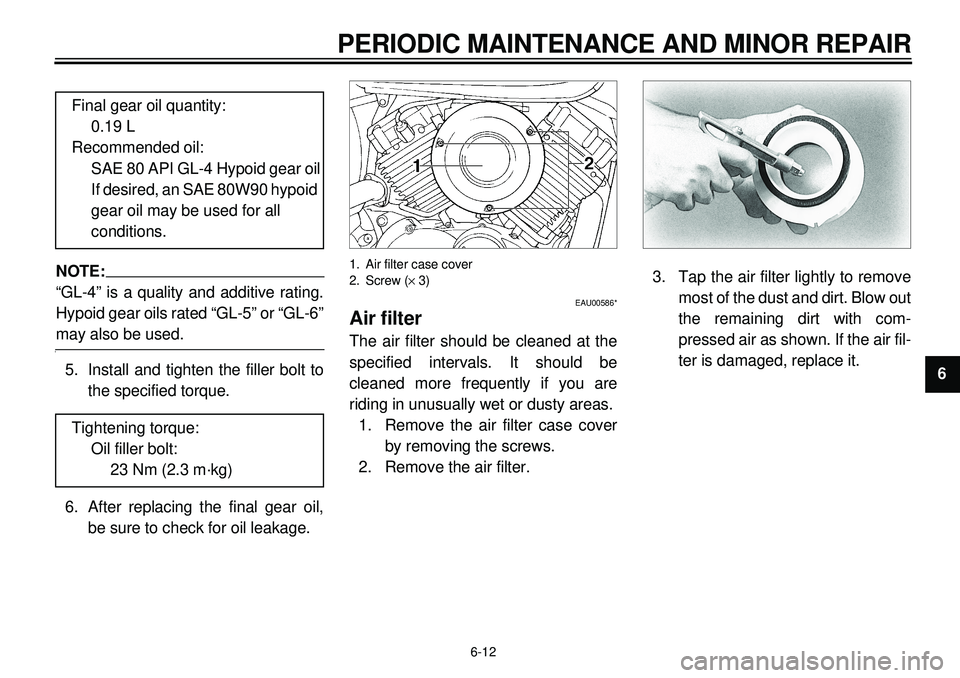
1. Air filter case cover
2. Screw (´ 3)
EAU00586*
Air filterThe air filter should be cleaned at the
specified intervals. It should be
cleaned more frequently if you are
riding in unusually wet or dusty areas.
1. Remove the air filter case cover
by removing the screws.
2. Remove the air filter.
3. Tap the air filter lightly to remove
most of the dust and dirt. Blow out
the remaining dirt with com-
pressed air as shown. If the air fil-
ter is damaged, replace it.
Page 67 of 101

6-21
PERIODIC MAINTENANCE AND MINOR REPAIR
1
2
3
4
56
7
8
9
1. Brake light switch
2. Adjusting nut
EAU00713
Brake light switch adjustmentThe rear brake light switch is activated
by the brake pedal and is properly ad-
justed when the brake light comes on
just before braking takes effect. To ad-
just the rear brake light switch, hold the
switch body so it does not rotate while
turning the adjusting nut. Turn the ad-
justing nut in direction a to make the
brake light come on earlier. Turn the
adjusting nut in direction b to make
the brake light come on later.
1. Wear indicator grooves
EAU00720
Checking the front brake
pads and rear brake shoes
EAU01119
Front brake
Wear indicator grooves are provided
on each brake pad. These indicators
allow checking of brake pad wear with-
out disassembling the brake. Inspect
the grooves. If they have almost disap-
peared, ask a Yamaha dealer to re-
place the pads.
1. Wear limit line
2. Wear indicator
EAU00727
Rear brake
Apply the brake and inspect the wear
indicator.
If the indicator reaches the wear limit
line, ask a Yamaha dealer to replace
the shoes.
Page 73 of 101
6-27
PERIODIC MAINTENANCE AND MINOR REPAIR
1
2
3
4
56
7
8
9Battery storage
When the motorcycle is not used for a
month or longer, remove the battery,
fully charge it and store it in a cool, dry
place.
EC000102
CAUTION:l
Completely recharge the bat-
tery before storing. Storing a
discharged battery can cause
permanent battery damage.
l
Use a battery charger designed
for a sealed-type (MF) battery.
Using a conventional battery
charger will cause battery
damage. If you do not have a
sealed-type battery charger,
contact your Yamaha dealer.
l
Always make sure the connec-
tions are correct when reinstall-ing the battery.
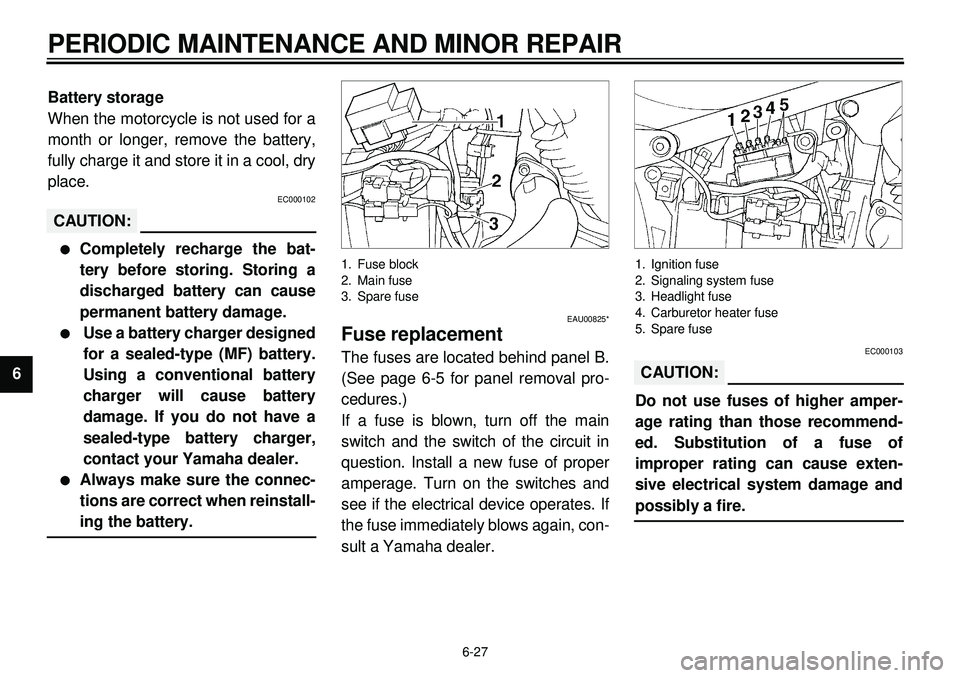
1. Fuse block
2. Main fuse
3. Spare fuse
EAU00825*
Fuse replacementThe fuses are located behind panel B.
(See page 6-5 for panel removal pro-
cedures.)
If a fuse is blown, turn off the main
switch and the switch of the circuit in
question. Install a new fuse of proper
amperage. Turn on the switches and
see if the electrical device operates. If
the fuse immediately blows again, con-
sult a Yamaha dealer.
1. Ignition fuse
2. Signaling system fuse
3. Headlight fuse
4. Carburetor heater fuse
5. Spare fuse
EC000103
CAUTION:
Do not use fuses of higher amper-
age rating than those recommend-
ed. Substitution of a fuse of
improper rating can cause exten-
sive electrical system damage andpossibly a fire.
Page 74 of 101
6-28
PERIODIC MAINTENANCE AND MINOR REPAIR
1
2
3
4
56
7
8
9 Specified fuses:
Main fuse: 30 A
Ignition fuse: 10 A
Signaling system fuse: 10 A
Headlight fuse: 15 A
Carburetor heater fuse: 15 A
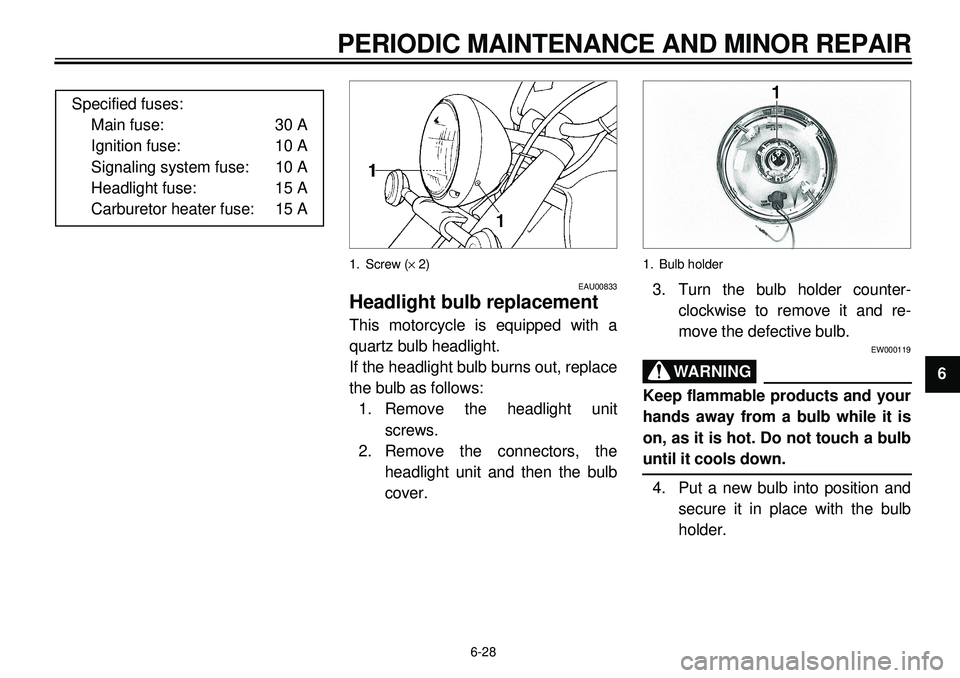
1. Screw (´ 2)
EAU00833
Headlight bulb replacementThis motorcycle is equipped with a
quartz bulb headlight.
If the headlight bulb burns out, replace
the bulb as follows:
1. Remove the headlight unit
screws.
2. Remove the connectors, the
headlight unit and then the bulb
cover.
1. Bulb holder3. Turn the bulb holder counter-
clockwise to remove it and re-
move the defective bulb.
EW000119
WARNING
Keep flammable products and your
hands away from a bulb while it is
on, as it is hot. Do not touch a bulbuntil it cools down.
4. Put a new bulb into position and
secure it in place with the bulb
holder.
Page 75 of 101

6-29
PERIODIC MAINTENANCE AND MINOR REPAIR
1
2
3
4
56
7
8
9
EC000105
CAUTION:
Avoid touching the glass part of a
bulb. Keep it free from oil; other-
wise, the transparency of the glass,
life of the bulb, and luminous flux
will be adversely affected. If oil gets
on a bulb, thoroughly clean it with a
cloth moistened with alcohol or lac-quer thinner.
5. Install the bulb cover, connectors
and headlight unit. Ask a Yamaha
dealer to adjust the headlight
beam if necessary.
1. Screw (´ 2)
EAU00855
Turn signal and taillight bulb
replacement1. Remove the screws and the lens.
2. Push the bulb inward and turn it
counterclockwise.
XVS6501. Screw (´ 2)3. Place a new bulb in the socket.
Push the bulb inward and turn it
clockwise until it engages into the
socket.
4. Install the lens and the screws.
Page 84 of 101

7-2
MOTORCYCLE CARE AND STORAGE
1
2
3
4
5
6
7
8
9
ECA00010CAUTION:
l
Avoid using strong acidic
wheel cleaners, especially on
spoked wheels. If you do use
such products for hard-to-re-
move dirt, do not leave it on any
longer than instructed, then
thoroughly rinse it off with wa-
ter, immediately dry the area
and apply a corrosion protec-
tion spray.
l
Improper cleaning can damage
windshields, cowlings, panels
and other plastic parts. Use
only a soft, clean cloth or
sponge with mild detergent and
water to clean plastic.
l
Do not use any harsh chemical
products on plastic parts. Be
sure to avoid using cloths or
sponges which have been in
contact with strong or abrasive
cleaning products, solvent or
thinner, fuel (gasoline), rust re-
movers or inhibitors, brake flu-
id, antifreeze or electrolyte.
l
Do not use high-pressure
washers or steam-jet cleaners
since they cause water seep-
age and deterioration in the fol-
lowing areas: seals (of wheel
bearings, swingarm bearings,
forks and brakes), electric com-
ponents (couplers, connectors,
instruments, switches and
lights), breather hoses and
vents.
l
For motorcycles equipped with
a windshield: Do not use strong
cleaners or hard sponges as
they will cause dulling or
scratching. Some cleaning
compounds for plastic may
leave scratches on the wind-
shield. Test the product on a
small hidden part of the wind-
shield to make sure they do not
leave any marks. If the wind-
shield is scratched, use a quali-
ty plastic polishing compound
after washing.
After riding in the rain, near the sea or
on salt-sprayed roadsSince sea salt or salt sprayed on the
roads in the winter are extremely corro-
sive in combination with water, carry
out the following steps after each ride
in the rain, near the sea or on salt-
sprayed roads. (Salt sprayed in the
winter may remain on the roads well
into spring.)
Page 93 of 101
8-5
SPECIFICATIONS
1
2
3
4
5
6
7
8
9
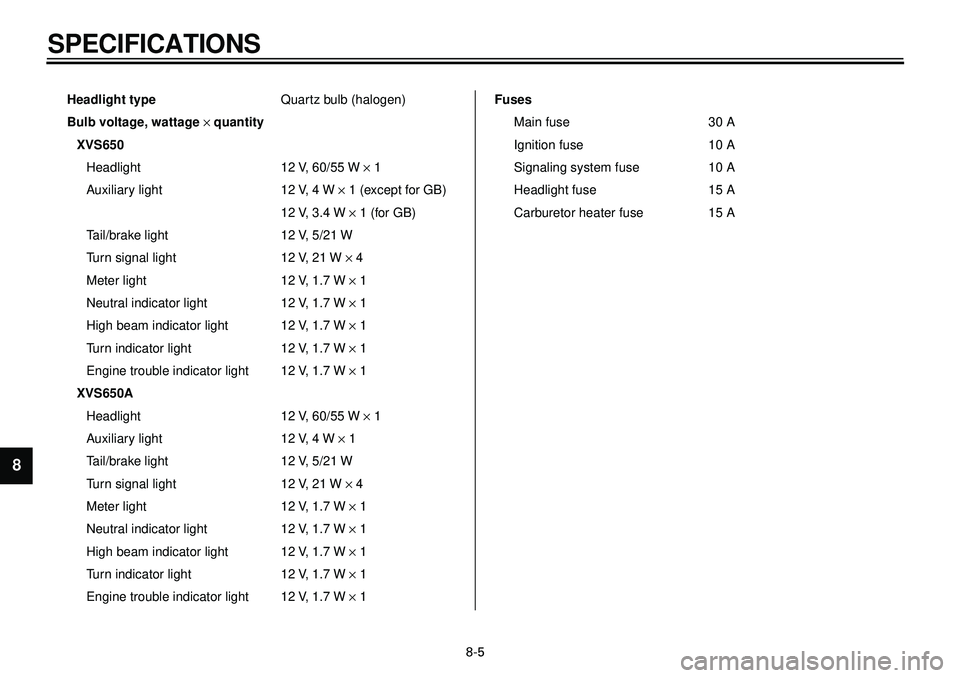
Headlight type
Quartz bulb (halogen)
Bulb voltage, wattage
´
quantity
XVS650
Headlight 12 V, 60/55 W
´
1
Auxiliary light 12 V, 4 W
´
1 (except for GB)
12 V, 3.4 W
´
1 (for GB)
Tail/brake light 12 V, 5/21 W
Turn signal light 12 V, 21 W
´
4
Meter light 12 V, 1.7 W
´
1
Neutral indicator light 12 V, 1.7 W
´
1
High beam indicator light 12 V, 1.7 W
´
1
Turn indicator light 12 V, 1.7 W
´
1
Engine trouble indicator light 12 V, 1.7 W
´
1
XVS650A
Headlight 12 V, 60/55 W
´
1
Auxiliary light 12 V, 4 W
´
1
Tail/brake light 12 V, 5/21 W
Turn signal light 12 V, 21 W
´
4
Meter light 12 V, 1.7 W
´
1
Neutral indicator light 12 V, 1.7 W
´
1
High beam indicator light 12 V, 1.7 W
´
1
Turn indicator light 12 V, 1.7 W
´
1
Engine trouble indicator light 12 V, 1.7 W
´
1
Fuses
Main fuse 30 A
Ignition fuse 10 A
Signaling system fuse 10 A
Headlight fuse 15 A
Carburetor heater fuse 15 A
Page 99 of 101
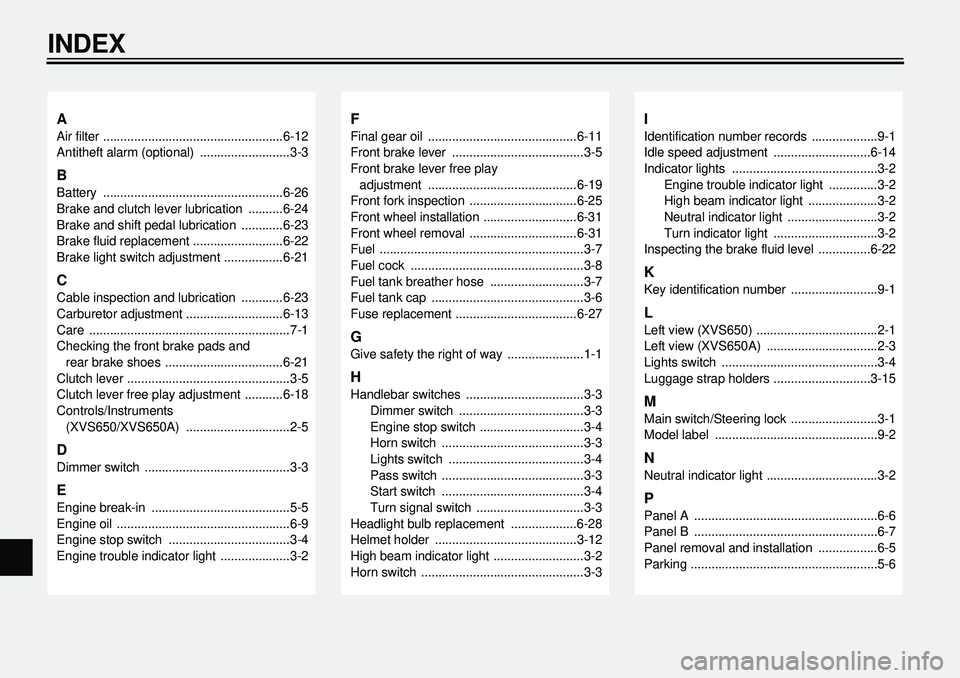
INDEX
A
Air filter ....................................................6-12
Antitheft alarm (optional) ..........................3-3
B
Battery ....................................................6-26
Brake and clutch lever lubrication ..........6-24
Brake and shift pedal lubrication ............6-23
Brake fluid replacement ..........................6-22
Brake light switch adjustment .................6-21
C
Cable inspection and lubrication ............6-23
Carburetor adjustment ............................6-13
Care ..........................................................7-1
Checking the front brake pads and
rear brake shoes ..................................6-21
Clutch lever ...............................................3-5
Clutch lever free play adjustment ...........6-18
Controls/Instruments
(XVS650/XVS650A) ..............................2-5
D
Dimmer switch ..........................................3-3
E
Engine break-in ........................................5-5
Engine oil ..................................................6-9
Engine stop switch ...................................3-4
Engine trouble indicator light ....................3-2
F
Final gear oil ...........................................6-11
Front brake lever ......................................3-5
Front brake lever free play
adjustment ...........................................6-19
Front fork inspection ...............................6-25
Front wheel installation ...........................6-31
Front wheel removal ...............................6-31
Fuel ...........................................................3-7
Fuel cock ..................................................3-8
Fuel tank breather hose ...........................3-7
Fuel tank cap ............................................3-6
Fuse replacement ...................................6-27
G
Give safety the right of way ......................1-1
H
Handlebar switches ..................................3-3
Dimmer switch ....................................3-3
Engine stop switch ..............................3-4
Horn switch .........................................3-3
Lights switch .......................................3-4
Pass switch .........................................3-3
Start switch .........................................3-4
Turn signal switch ...............................3-3
Headlight bulb replacement ...................6-28
Helmet holder .........................................3-12
High beam indicator light ..........................3-2
Horn switch ...............................................3-3
I
Identification number records ...................9-1
Idle speed adjustment ............................6-14
Indicator lights ..........................................3-2
Engine trouble indicator light ..............3-2
High beam indicator light ....................3-2
Neutral indicator light ..........................3-2
Turn indicator light ..............................3-2
Inspecting the brake fluid level ...............6-22
K
Key identification number .........................9-1
L
Left view (XVS650) ...................................2-1
Left view (XVS650A) ................................2-3
Lights switch .............................................3-4
Luggage strap holders ............................3-15
M
Main switch/Steering lock .........................3-1
Model label ...............................................9-2
N
Neutral indicator light ................................3-2
P
Panel A .....................................................6-6
Panel B .....................................................6-7
Panel removal and installation .................6-5
Parking ......................................................5-6