ABS YAMAHA XVS950 2015 Owners Manual
[x] Cancel search | Manufacturer: YAMAHA, Model Year: 2015, Model line: XVS950, Model: YAMAHA XVS950 2015Pages: 88, PDF Size: 2.28 MB
Page 6 of 88

TABLE OF CONTENTSSAFETY INFORMATION.................. 1-1
DESCRIPTION .................................. 2-1
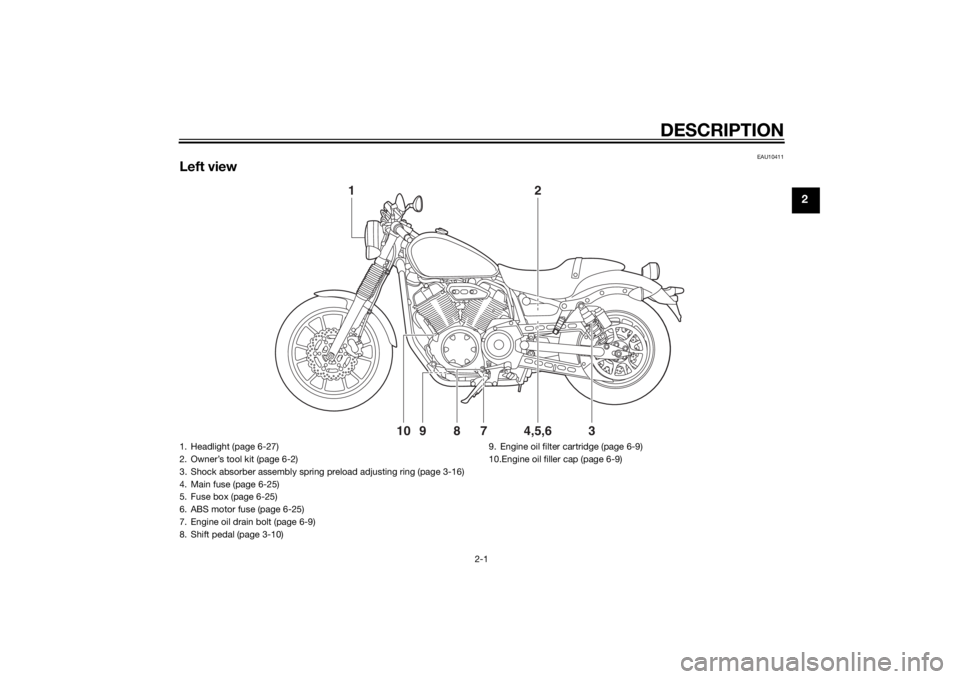
Left view ......................................... 2-1
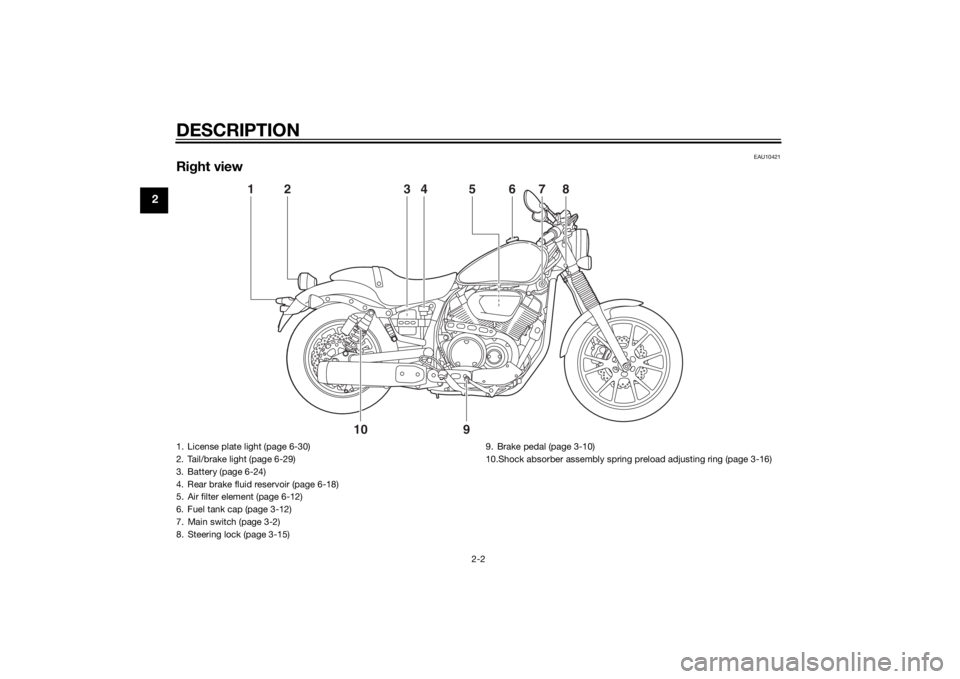
Right view ....................................... 2-2
Controls and instruments ............... 2-3
INSTRUMENT AND CONTROL
FUNCTIONS ...................................... 3-1
Immobilizer system......................... 3-1
Main switch .................................... 3-2
Indicator lights and warning lights............................................ 3-3
Multi-function meter unit ................ 3-5
Handlebar switches ........................ 3-8
Clutch lever .................................... 3-9
Shift pedal .................................... 3-10
Brake lever.................................... 3-10
Brake pedal .................................. 3-10
ABS .............................................. 3-11
Fuel tank cap ................................ 3-12
Fuel ............................................... 3-12
Fuel tank breather/overflow
hose .......................................... 3-14
Catalytic converter ....................... 3-14
Steering lock................................. 3-15
Seat .............................................. 3-15
Adjusting the shock absorber assemblies ................................ 3-16
Sidestand ..................................... 3-17
Ignition circuit cut-off system ....... 3-18 FOR YOUR SAFETY –
PRE-OPERATION CHECKS
............. 4-1
OPERATION AND IMPORTANT
RIDING POINTS ................................ 5-1
Starting the engine .......................... 5-1
Shifting ............................................ 5-2
Tips for reducing fuel consumption ................................ 5-4
Engine break-in ............................... 5-4
Parking ............................................ 5-5
PERIODIC MAINTENANCE AND
ADJUSTMENT ................................... 6-1
Owner’s tool kit ............................... 6-2
Periodic maintenance chart for the emission control system .............. 6-3
General maintenance and lubrication chart ........................... 6-4
Removing and installing the
panel ............................................ 6-8
Checking the spark plugs ............... 6-8
Engine oil and oil filter cartridge...... 6-9
Replacing the air filter element ..... 6-12
Checking the throttle grip free play ............................................ 6-13
Valve clearance ............................. 6-13
Tires .............................................. 6-13
Cast wheels................................... 6-15
Adjusting the clutch lever free play ............................................ 6-15 Checking the brake lever free
play ............................................ 6-16
Brake light switches ..................... 6-17
Checking the front and rear brake pads .......................................... 6-17
Checking the brake fluid level ...... 6-18
Changing the brake fluid .............. 6-19
Drive belt slack ............................. 6-19
Checking and lubricating the cables ........................................ 6-20
Checking and lubricating the
throttle grip and cable ............... 6-20
Checking and lubricating the brake and shift pedals............... 6-21
Checking and lubricating the brake and clutch levers ............. 6-21
Checking and lubricating the
sidestand................................... 6-22
Lubricating the swingarm pivots......................................... 6-22
Checking the front fork ................. 6-23
Checking the steering................... 6-23
Checking the wheel bearings ....... 6-24
Battery .......................................... 6-24
Replacing the fuses ...................... 6-25
Replacing the headlight bulb ........ 6-27
Replacing the auxiliary light bulb .......................................... 6-28
Tail/brake light .............................. 6-29
Replacing a turn signal light
bulb ........................................... 6-29UB33E0E0.book Page 1 Monday, December 1, 2014 4:49 PM
Page 13 of 88
DESCRIPTION
2-1
2
EAU10411
Left view
1
2
3
4,5,6
7
8
9
10
1. Headlight (page 6-27)
2. Owner’s tool kit (page 6-2)
3. Shock absorber assembly spring preload adjusting ring (page 3-16)
4. Main fuse (page 6-25)
5. Fuse box (page 6-25)
6. ABS motor fuse (page 6-25)
7. Engine oil drain bolt (page 6-9)
8. Shift pedal (page 3-10)9. Engine oil filter cartridge (page 6-9)
10.Engine oil filler cap (page 6-9)
UB33E0E0.book Page 1 Monday, December 1, 2014 4:49 PM
Page 14 of 88
DESCRIPTION
2-2
2
EAU10421
Right view
1
2
3
4
5
6
7
8
9
10
1. License plate light (page 6-30)
2. Tail/brake light (page 6-29)
3. Battery (page 6-24)
4. Rear brake fluid reservoir (page 6-18)
5. Air filter element (page 6-12)
6. Fuel tank cap (page 3-12)
7. Main switch (page 3-2)
8. Steering lock (page 3-15) 9. Brake pedal (page 3-10)
10.Shock absorber assembly spring preload adjusting ring (page 3-16)UB33E0E0.book Page 2 Monday, December 1, 2014 4:49 PM
Page 18 of 88
INSTRUMENT AND CONTROL FUNCTIONS
3-3
3
WARNING
EWA10073
Never turn the key to “OFF” while
the vehicle is moving, otherwise the
electrical systems will be switched
off, which may result in loss of con-
trol or an acci dent.
EAU62271
(Parkin g)
The hazard lights and turn signal lights
can be turned on, but all other electri-
cal systems are off. The key can be re-
moved.
The key must be pushed in from the
“OFF” position to be turned to “ ”.
NOTICE
ECA20760
Usin g the hazar d or turn si gnal li ghts
for an exten ded len gth of time may
cause the battery to d ischarge.
EAU49398
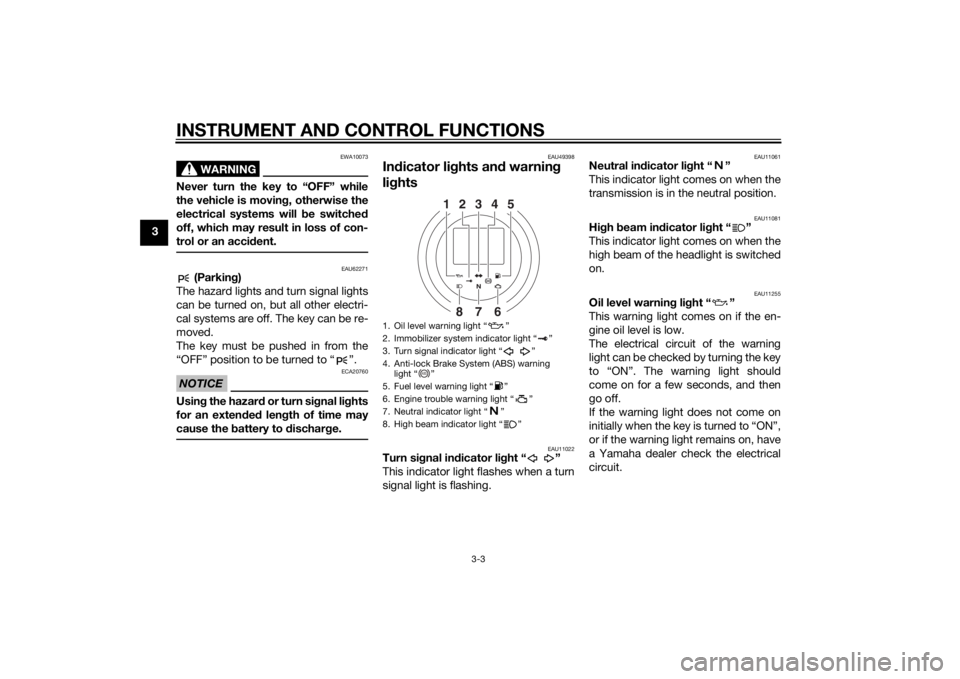
In dicator li ghts an d warnin g
li g hts
EAU11022
Turn si gnal in dicator li ght “ ”
This indicator light flashes when a turn
signal light is flashing.
EAU11061
Neutral in dicator li ght “ ”
This indicator light comes on when the
transmission is in the neutral position.
EAU11081
Hi gh beam in dicator li ght “ ”
This indicator light comes on when the
high beam of the headlight is switched
on.
EAU11255
Oil level warnin g li ght “ ”
This warning light comes on if the en-
gine oil level is low.
The electrical circuit of the warning
light can be checked by turning the key
to “ON”. The warning light should
come on for a few seconds, and then
go off.
If the warning light does not come on
initially when the key is turned to “ON”,
or if the warning light remains on, have
a Yamaha dealer check the electrical
circuit.
1. Oil level warning light “ ”
2. Immobilizer system indicator light “ ”
3. Turn signal indicator light “ ”
4. Anti-lock Brake System (ABS) warning light “ ”
5. Fuel level warning light “ ”
6. Engine trouble warning light “ ”
7. Neutral indicator light “ ”
8. High beam indicator light “ ”
1
35 42
8
7
6
ABS
UB33E0E0.book Page 3 Monday, December 1, 2014 4:49 PM
Page 19 of 88
INSTRUMENT AND CONTROL FUNCTIONS
3-4
3
TIPEven if the oil level is sufficient, the
warning light may flicker when rid-
ing on a slope or during sudden
acceleration or deceleration, but
this is not a malfunction.
This model is also equipped with a
self-diagnosis device for the oil
level detection circuit. If a problem
is detected in the oil level detec-
tion circuit, the following cycle will
be repeated until the malfunction
is corrected: The oil level warning
light will flash ten times, then go
off for 2.5 seconds. If this occurs,
have a Yamaha dealer check the
vehicle.
EAU11367
Fuel level warnin g li ght “ ”
This warning light comes on when the
fuel level drops below approximately
2.8 L (0.74 US gal, 0.62 Imp.gal). When
this occurs, refuel as soon as possible.
The electrical circuit of the warning
light can be checked by turning the key
to “ON”. The warning light should
come on for a few seconds, and then
go off. If the warning light does not come on
initially when the key is turned to “ON”,
or if the warning light remains on, have
a Yamaha dealer check the electrical
circuit.
TIPThis model is also equipped with a self-
diagnosis device for the fuel level de-
tection circuit. If a problem is detected
in the fuel level detection circuit, the
following cycle will be repeated until
the malfunction is corrected: The fuel
level warning light will flash eight times,
and then go off for 3.0 seconds. If this
occurs, have a Yamaha dealer check
the vehicle.
EAU46443
En
gine trou ble warnin g li ght “ ”
This warning light comes on if a prob-
lem is detected in the electrical circuit
monitoring the engine. If this occurs,
have a Yamaha dealer check the self-
diagnosis system. (See page 3-7 for an
explanation of the self-diagnosis de-
vice.) The electrical circuit of the warning
light can be checked by turning the key
to “ON”. The warning light should
come on for a few seconds, and then
go off.
If the warning light does not come on
initially when the key is turned to “ON”,
or if the warning light remains on, have
a Yamaha dealer check the electrical
circuit.
TIPThis warning light will come on when
the key is turned to “ON” and the start
switch is pushed, but this does not in-
dicate a malfunction.
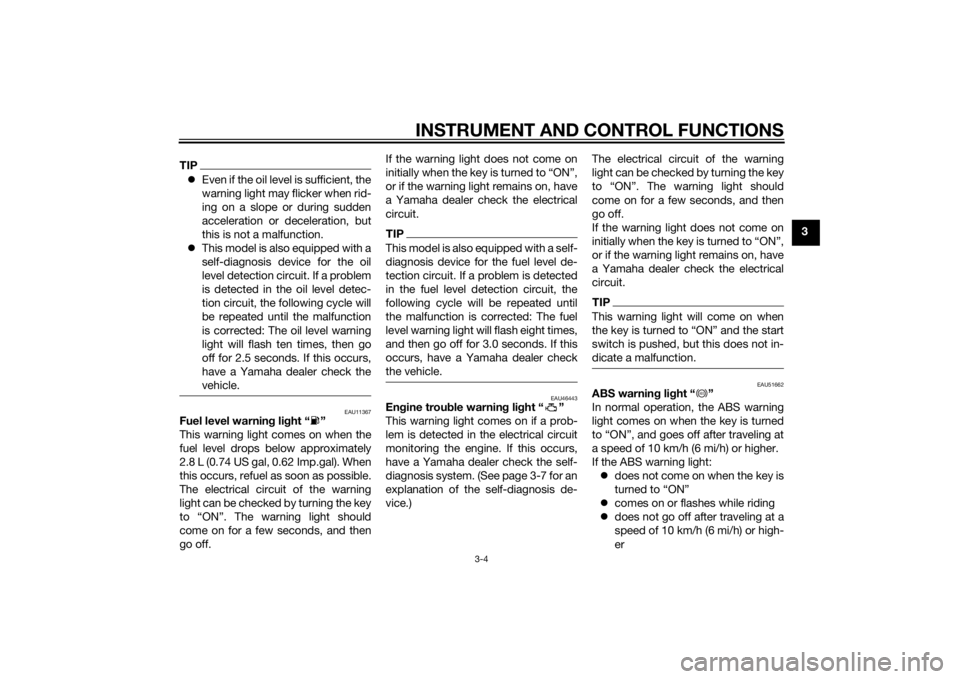
EAU51662
ABS warnin
g lig ht “ ”
In normal operation, the ABS warning
light comes on when the key is turned
to “ON”, and goes off after traveling at
a speed of 10 km/h (6 mi/h) or higher.
If the ABS warning light: does not come on when the key is
turned to “ON”
comes on or flashes while riding
does not go off after traveling at a
speed of 10 km/h (6 mi/h) or high-
er
ABS
UB33E0E0.book Page 4 Monday, December 1, 2014 4:49 PM
Page 20 of 88
INSTRUMENT AND CONTROL FUNCTIONS
3-5
3The ABS may not work correctly. If any
of the above occurs, have a Yamaha
dealer check the system as soon as
possible. (See page 3-11 for an expla-
nation of the ABS.)
WARNING
EWA16041
If the ABS warnin
g li ght does not go
off after travelin g at a speed of 10
km/h (6 mi/h) or hi gher, or if the
warnin g li ght comes on or flashes
while ri din g, the b rake system re-
verts to conventional brakin g. If ei-
ther of the ab ove occurs, or if the
warnin g li ght does not come on at
all, use extra caution to avoi d possi-
b le wheel lock during emer gency
b rakin g. Have a Yamaha d ealer
check the brake system an d electri-
cal circuits as soon as possi ble.TIPIf the start switch is pushed while the
engine is running, the ABS warning
light will come on, but this is not a mal-
function.
EAU54682
Immo bilizer system in dicator
li g ht “ ”
When the key is turned to “OFF” and
30 seconds have passed, the indicator
light will start flashing indicating the im-
mobilizer system is enabled. After 24
hours have passed, the indicator light
will stop flashing, however the immobi-
lizer system is still enabled.
The electrical circuit of the indicator
light can be checked by turning the key
to “ON”. The indicator light should
come on for a few seconds, and then
go off.
If the indicator light does not come on
initially when the key is turned to “ON”,
or if the indicator light remains on, have
a Yamaha dealer check the electrical
circuit.
The self-diagnosis device also detects
problems in the immobilizer system
circuits. (See page 3-7 for an explana-
tion of the self-diagnosis device.)
EAU66640
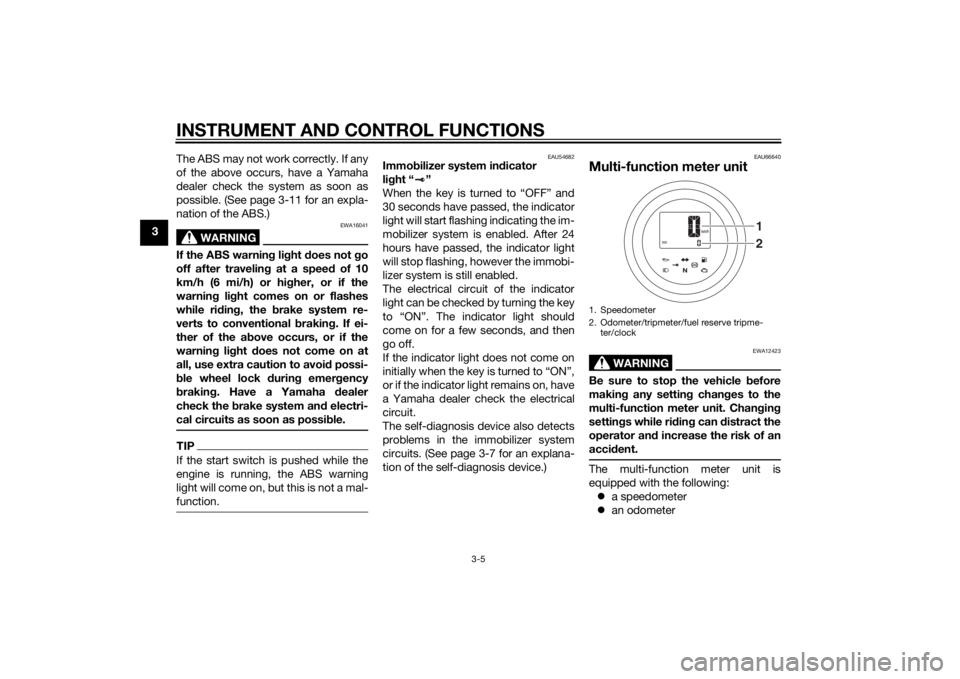
Multi-function meter unit
WARNING
EWA12423
Be sure to stop the vehicle before
makin g any settin g chan ges to the
multi-function meter unit. Chan gin g
settin gs while ri din g can distract the
operator an d increase the risk of an
acci dent.The multi-function meter unit is
equipped with the following:
a speedometer
an odometer1. Speedometer
2. Odometer/tripmeter/fuel reserve tripme-
ter/clock
21
UB33E0E0.book Page 5 Monday, December 1, 2014 4:49 PM
Page 26 of 88

INSTRUMENT AND CONTROL FUNCTIONS
3-11
3
EAU67580
ABSThe Yamaha ABS (Anti-lock Brake
System) features a dual electronic con-
trol system, which acts on the front and
rear brakes independently.
Operate the brakes with ABS as you
would conventional brakes. If the ABS
is activated, a pulsating sensation may
be felt at the brake lever or brake ped-
al. In this situation, continue to apply
the brakes and let the ABS work; do
not “pump” the brakes as this will re-
duce braking effectiveness.
WARNING
EWA16051
Always keep a sufficient distance
from the vehicle ahea d to match the
ri din g speed even with ABS.
The ABS performs best with
lon g b rakin g d istances.
On certain surfaces, such as
rou gh or g ravel roa ds, the b rak-
in g d istance may b e longer with
the ABS than without.The ABS is monitored by an ECU,
which will revert the system to conven-
tional braking if a malfunction occurs.
TIP The ABS performs a self-diagno-
sis test each time the vehicle first
starts off after the key is turned to
“ON” and the vehicle has traveled
at a speed of 10 km/h (6 mi/h) or
higher. During this test, a “click-
ing” noise can be heard from the
hydraulic control unit, and if the
brake lever or brake pedal is even
slightly applied, a vibration can be
felt at the lever and pedal, but
these do not indicate a malfunc-
tion.
This ABS has a test mode which
allows the owner to experience
the pulsation at the brake lever or
brake pedal when the ABS is op-
erating. However, special tools are
required, so please consult your
Yamaha dealer.NOTICE
ECA20100
Be careful not to damag e the wheel
sensor or wheel sensor rotor; other-
wise, improper performance of the
ABS will result.
1. Rear wheel hub
2. Front wheel hub1
2
UB33E0E0.book Page 11 Monday, December 1, 2014 4:49 PM
Page 31 of 88
INSTRUMENT AND CONTROL FUNCTIONS
3-16
3
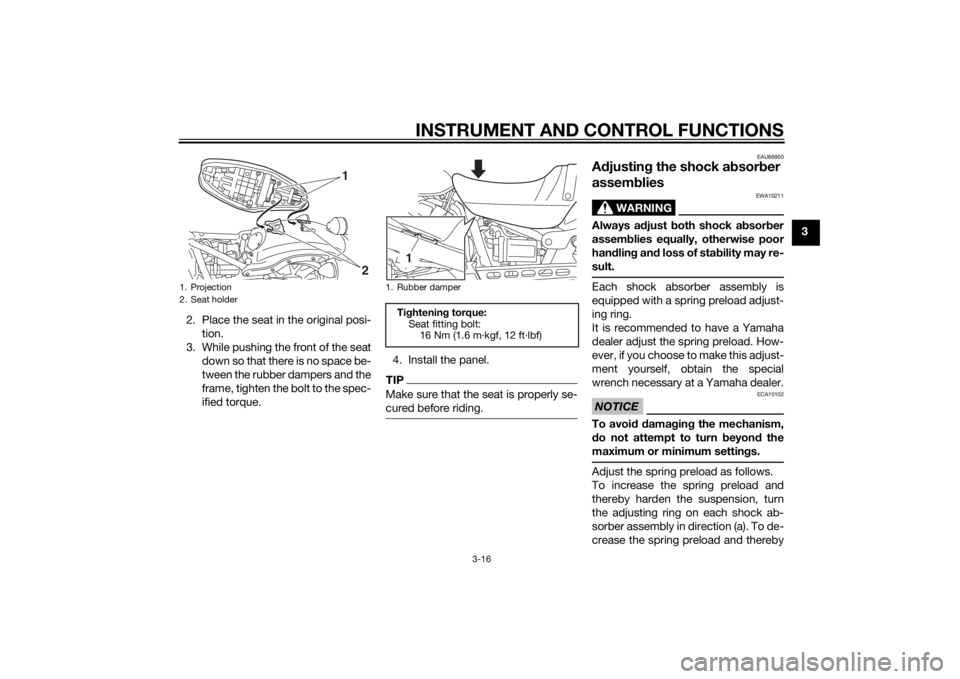
2. Place the seat in the original posi- tion.
3. While pushing the front of the seat down so that there is no space be-
tween the rubber dampers and the
frame, tighten the bolt to the spec-
ified torque. 4. Install the panel.
TIPMake sure that the seat is properly se-
cured before riding.
EAU66950
A
djustin g the shock a bsor ber
assem blies
WARNING
EWA10211
Always a djust both shock ab sorber
assem blies equally, otherwise poor
han dlin g an d loss of sta bility may re-
sult.Each shock absorber assembly is
equipped with a spring preload adjust-
ing ring.
It is recommended to have a Yamaha
dealer adjust the spring preload. How-
ever, if you choose to make this adjust-
ment yourself, obtain the special
wrench necessary at a Yamaha dealer.NOTICE
ECA10102
To avoi d d amag ing the mechanism,
d o not attempt to turn beyon d the
maximum or minimum settin gs.Adjust the spring preload as follows.
To increase the spring preload and
thereby harden the suspension, turn
the adjusting ring on each shock ab-
sorber assembly in direction (a). To de-
crease the spring preload and thereby
1. Projection
2. Seat holder
1
2
1. Rubber damper
Ti ghtenin g torque:
Seat fitting bolt: 16 Nm (1.6 m·kgf, 12 ft·lbf)1
UB33E0E0.book Page 16 Monday, December 1, 2014 4:49 PM
Page 32 of 88
INSTRUMENT AND CONTROL FUNCTIONS
3-17
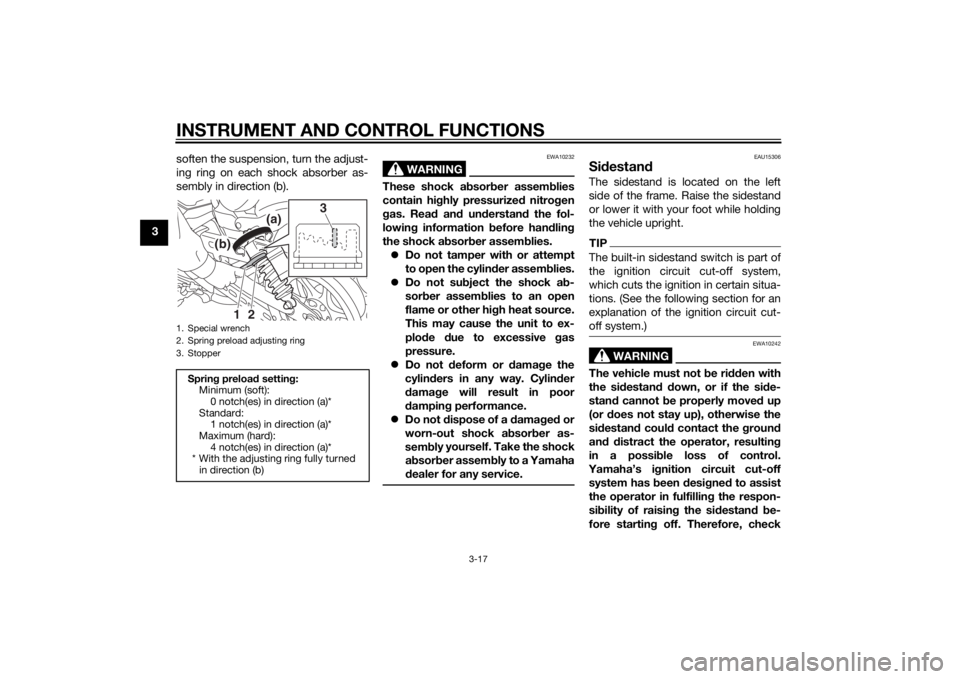
3soften the suspension, turn the adjust-
ing ring on each shock absorber as-
sembly in direction (b).
WARNING
EWA10232
These shock ab
sorber assem blies
contain hi ghly pressurize d nitro gen
g as. Rea d an d un derstan d the fol-
lowin g information b efore handlin g
the shock a bsor ber assem blies.
Do not tamper with or attempt
to open the cylin der assem blies.
Do not su bject the shock a b-
sor ber assem blies to an open
flame or other hi gh heat source.
This may cause the unit to ex-
plo de due to excessive gas
pressure.
Do not deform or d amage the
cylin ders in any way. Cylin der
d amag e will result in poor
d ampin g performance.
Do not dispose of a damag ed or
worn-out shock a bsor ber as-
sem bl
y yourself. Take the shock
a b sor ber assem bly to a Yamaha
d ealer for any service.
EAU15306
Si destan dThe sidestand is located on the left
side of the frame. Raise the sidestand
or lower it with your foot while holding
the vehicle upright.TIPThe built-in sidestand switch is part of
the ignition circuit cut-off system,
which cuts the ignition in certain situa-
tions. (See the following section for an
explanation of the ignition circuit cut-
off system.)
WARNING
EWA10242
The vehicle must not be ri dden with
the si destan d d own, or if the si de-
stan d cannot b e properly moved up
(or does not stay up), otherwise the
si destan d coul d contact the groun d
an d d istract the operator, resultin g
in a possi ble loss of control.
Yamaha’s i gnition circuit cut-off
system has been desi gne d to assist
the operator in fulfillin g the respon-
si bility of raisin g the si destan d b e-
fore startin g off. Therefore, check
1. Special wrench
2. Spring preload adjusting ring
3. StopperSprin g preloa d setting :
Minimum (soft):
0 notch(es) in direction (a)*
Standard: 1 notch(es) in direction (a)*
Maximum (hard): 4 notch(es) in direction (a)*
* With the adjusting ring fully turned
in direction (b)
2
(a)
(b)
1
3
UB33E0E0.book Page 17 Monday, December 1, 2014 4:49 PM
Page 39 of 88
OPERATION AND IMPORTANT RIDING POINTS
5-2
5
d
icator li ght remains on, see pa ge
3-3 for the correspon din g warnin g
an d in dicator li ght circuit check.
The ABS warning light should
come on when the key is turned to
“ON” and then go off after travel-
ing at a speed of 10 km/h (6 mi/h)
or higher.
NOTICE
ECA17682
If the ABS warnin g li ght does not
come on an d then go off as ex-
plaine d a bove, see pa ge 3-3 for the
warnin g li ght circuit check.2. Shift the transmission into the
neutral position. The neutral indi-
cator light should come on. If not,
ask a Yamaha dealer to check the
electrical circuit.
3. Start the engine by pushing the “ ” side of the start/engine
stop switch.
If the engine fails to start, release
the start/engine stop switch, wait
a few seconds, and then try again.
Each starting attempt should be
as short as possible to preserve the battery. Do not crank the en-
gine more than 10 seconds on any
one attempt.
NOTICE
ECA11043
For maximum en
gine life, never ac-
celerate har d when the en gine is
col d!
EAU16673
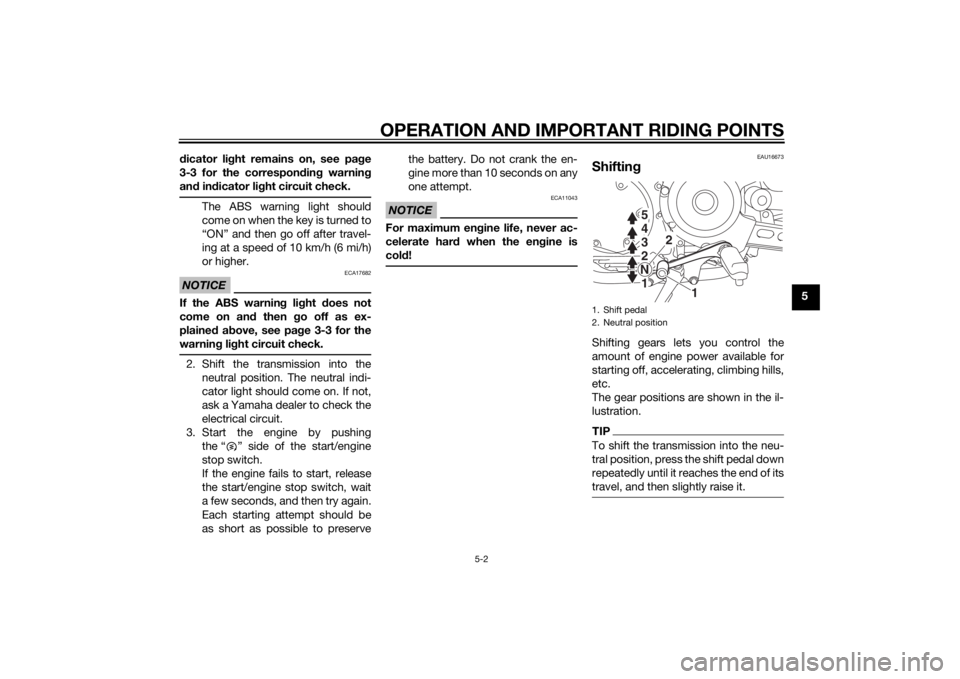
Shiftin gShifting gears lets you control the
amount of engine power available for
starting off, accelerating, climbing hills,
etc.
The gear positions are shown in the il-
lustration.TIPTo shift the transmission into the neu-
tral position, press the shift pedal down
repeatedly until it reaches the end of its
travel, and then slightly raise it.1. Shift pedal
2. Neutral position
1
2
5
4
3
2
N 1 5
4
3
2
N 1
UB33E0E0.book Page 2 Monday, December 1, 2014 4:49 PM