clutch YAMAHA XVS950 2015 Owners Manual
[x] Cancel search | Manufacturer: YAMAHA, Model Year: 2015, Model line: XVS950, Model: YAMAHA XVS950 2015Pages: 88, PDF Size: 2.28 MB
Page 6 of 88

TABLE OF CONTENTSSAFETY INFORMATION.................. 1-1
DESCRIPTION .................................. 2-1
Left view ......................................... 2-1
Right view ....................................... 2-2
Controls and instruments ............... 2-3
INSTRUMENT AND CONTROL
FUNCTIONS ...................................... 3-1
Immobilizer system......................... 3-1
Main switch .................................... 3-2
Indicator lights and warning lights............................................ 3-3
Multi-function meter unit ................ 3-5
Handlebar switches ........................ 3-8
Clutch lever .................................... 3-9
Shift pedal .................................... 3-10
Brake lever.................................... 3-10
Brake pedal .................................. 3-10
ABS .............................................. 3-11
Fuel tank cap ................................ 3-12
Fuel ............................................... 3-12
Fuel tank breather/overflow
hose .......................................... 3-14
Catalytic converter ....................... 3-14
Steering lock................................. 3-15
Seat .............................................. 3-15
Adjusting the shock absorber assemblies ................................ 3-16
Sidestand ..................................... 3-17
Ignition circuit cut-off system ....... 3-18 FOR YOUR SAFETY –
PRE-OPERATION CHECKS
............. 4-1
OPERATION AND IMPORTANT
RIDING POINTS ................................ 5-1
Starting the engine .......................... 5-1
Shifting ............................................ 5-2
Tips for reducing fuel consumption ................................ 5-4
Engine break-in ............................... 5-4
Parking ............................................ 5-5
PERIODIC MAINTENANCE AND
ADJUSTMENT ................................... 6-1
Owner’s tool kit ............................... 6-2
Periodic maintenance chart for the emission control system .............. 6-3
General maintenance and lubrication chart ........................... 6-4
Removing and installing the
panel ............................................ 6-8
Checking the spark plugs ............... 6-8
Engine oil and oil filter cartridge...... 6-9
Replacing the air filter element ..... 6-12
Checking the throttle grip free play ............................................ 6-13
Valve clearance ............................. 6-13
Tires .............................................. 6-13
Cast wheels................................... 6-15
Adjusting the clutch lever free play ............................................ 6-15 Checking the brake lever free
play ............................................ 6-16
Brake light switches ..................... 6-17
Checking the front and rear brake pads .......................................... 6-17
Checking the brake fluid level ...... 6-18
Changing the brake fluid .............. 6-19
Drive belt slack ............................. 6-19
Checking and lubricating the cables ........................................ 6-20
Checking and lubricating the
throttle grip and cable ............... 6-20
Checking and lubricating the brake and shift pedals............... 6-21
Checking and lubricating the brake and clutch levers ............. 6-21
Checking and lubricating the
sidestand................................... 6-22
Lubricating the swingarm pivots......................................... 6-22
Checking the front fork ................. 6-23
Checking the steering................... 6-23
Checking the wheel bearings ....... 6-24
Battery .......................................... 6-24
Replacing the fuses ...................... 6-25
Replacing the headlight bulb ........ 6-27
Replacing the auxiliary light bulb .......................................... 6-28
Tail/brake light .............................. 6-29
Replacing a turn signal light
bulb ........................................... 6-29UB33E0E0.book Page 1 Monday, December 1, 2014 4:49 PM
Page 15 of 88
DESCRIPTION
2-3
2
EAU10431
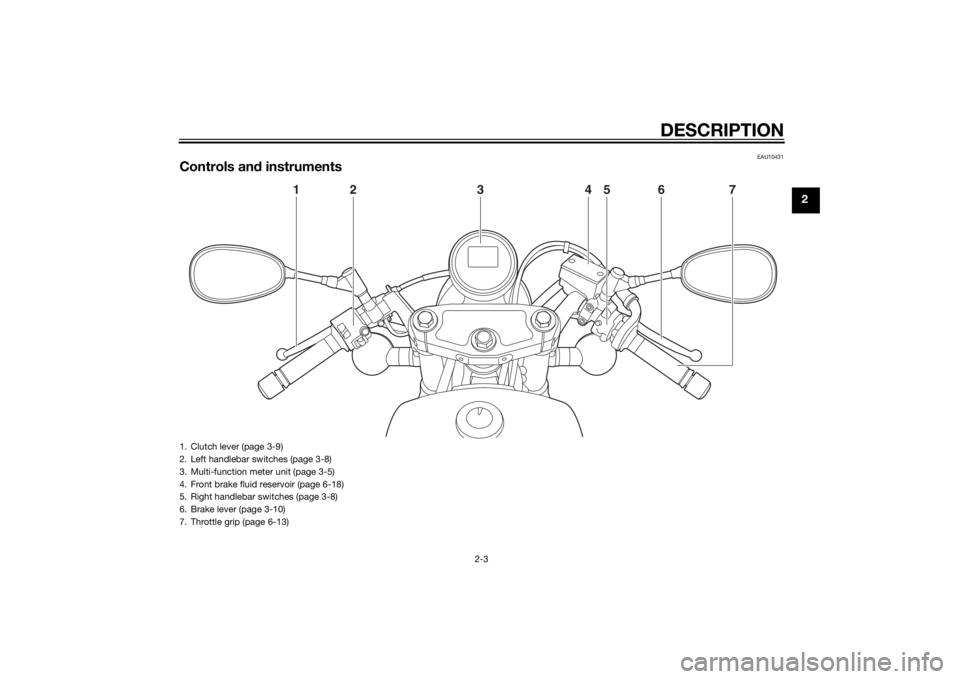
Controls and instruments
1
2
3
4
5
6
7
1. Clutch lever (page 3-9)
2. Left handlebar switches (page 3-8)
3. Multi-function meter unit (page 3-5)
4. Front brake fluid reservoir (page 6-18)
5. Right handlebar switches (page 3-8)
6. Brake lever (page 3-10)
7. Throttle grip (page 6-13)
UB33E0E0.book Page 3 Monday, December 1, 2014 4:49 PM
Page 24 of 88
INSTRUMENT AND CONTROL FUNCTIONS
3-9
3ter position. To cancel the turn signal
lights, push the switch in after it has re-
turned to the center position.
EAU12501
Horn switch “ ”
Press this switch to sound the horn.
EAU54211
Start/En
gine stop switch “ / / ”
To crank the engine with the starter,
set this switch to “ ”, and then push
the “ ” side of the switch. See page
5-1 for starting instructions prior to
starting the engine.
Set this switch to “ ” to stop the en-
gine in case of an emergency, such as
when the vehicle overturns or when the
throttle cable is stuck.
EAU41701
The engine trouble warning light will
come on when the key is turned to
“ON” and the start switch is pushed,
but this does not indicate a malfunc-
tion.
EAU12735
Hazar d switch “ ”
With the key in the “ON” or “ ” posi-
tion, use this switch to turn on the haz-
ard lights (simultaneous flashing of all
turn signal lights).
The hazard lights are used in case of an
emergency or to warn other drivers
when your vehicle is stopped where it
might be a traffic hazard.NOTICE
ECA10062
Do not use the hazard lights for an
exten ded len gth of time with the en-
g ine not runnin g, otherwise the bat-
tery may dischar ge.
EAU55701
“SELECT” switch
This switch is used to perform selec-
tions in the odometer and tripmeters
and to set the clock of the multi-func-
tion meter unit.
See “Multi-function meter unit” on
page 3-5 for detailed information.
EAU12821
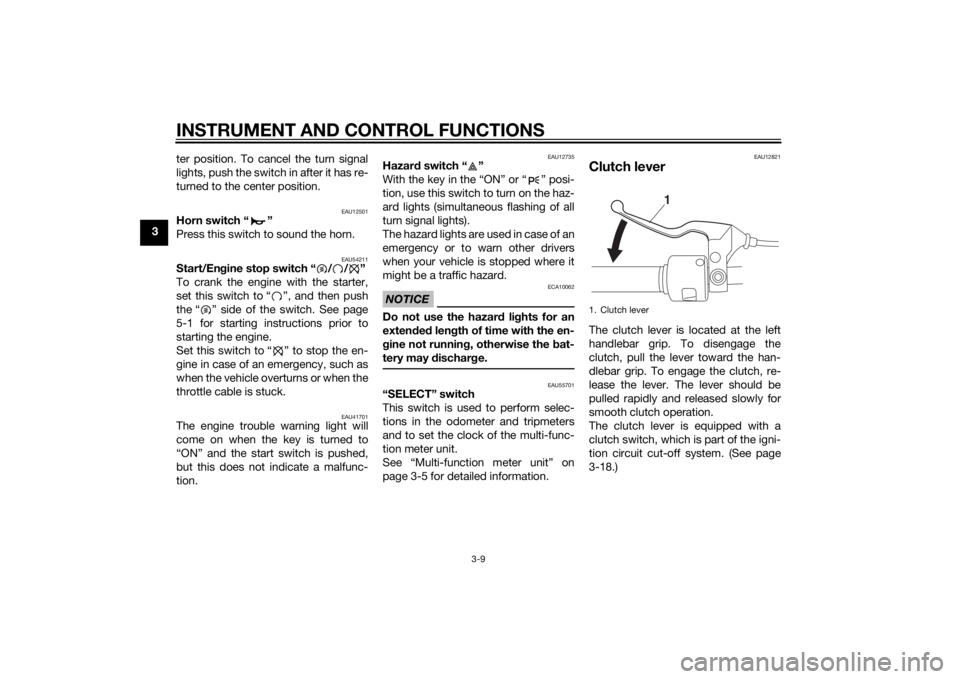
Clutch leverThe clutch lever is located at the left
handlebar grip. To disengage the
clutch, pull the lever toward the han-
dlebar grip. To engage the clutch, re-
lease the lever. The lever should be
pulled rapidly and released slowly for
smooth clutch operation.
The clutch lever is equipped with a
clutch switch, which is part of the igni-
tion circuit cut-off system. (See page
3-18.)1. Clutch lever
1
UB33E0E0.book Page 9 Monday, December 1, 2014 4:49 PM
Page 25 of 88
INSTRUMENT AND CONTROL FUNCTIONS
3-10
3
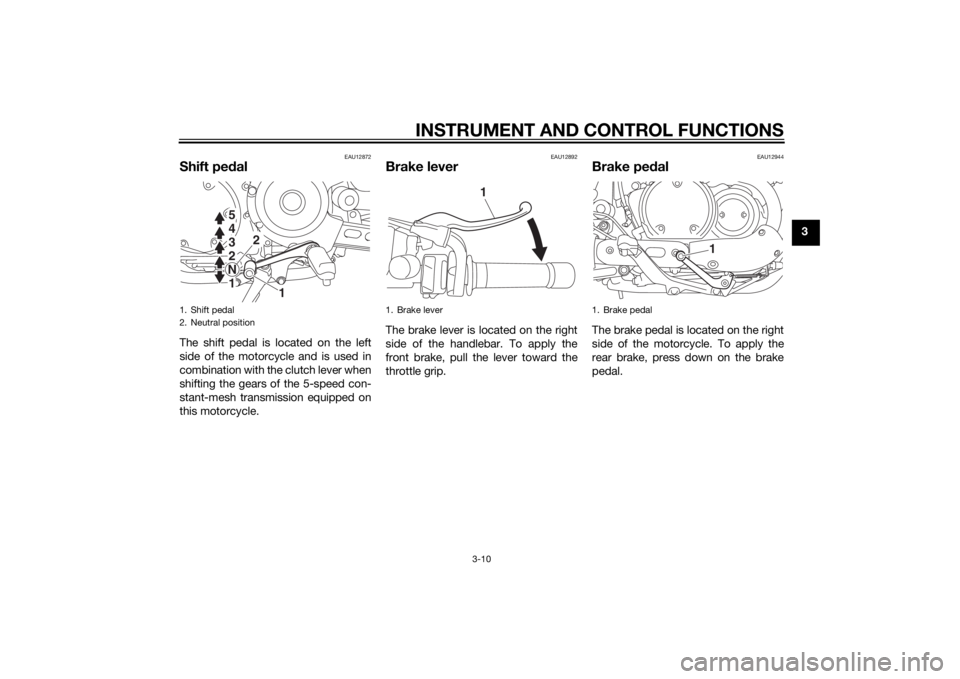
EAU12872
Shift pedalThe shift pedal is located on the left
side of the motorcycle and is used in
combination with the clutch lever when
shifting the gears of the 5-speed con-
stant-mesh transmission equipped on
this motorcycle.
EAU12892
Brake leverThe brake lever is located on the right
side of the handlebar. To apply the
front brake, pull the lever toward the
throttle grip.
EAU12944
Brake pe dalThe brake pedal is located on the right
side of the motorcycle. To apply the
rear brake, press down on the brake
pedal.
1. Shift pedal
2. Neutral position
1
2
5
4
3
2
N 1 5
4
3
2
N 1
1. Brake lever
1
1. Brake pedal
1
UB33E0E0.book Page 10 Monday, December 1, 2014 4:49 PM
Page 33 of 88

INSTRUMENT AND CONTROL FUNCTIONS
3-18
3
this system re
gularly an d have a
Yamaha dealer repair it if it does not
function properly.
EAU57950
I g nition circuit cut-off systemThe ignition circuit cut-off system
(comprising the sidestand switch,
clutch switch and neutral switch) has
the following functions.
It prevents starting when the
transmission is in gear and the
sidestand is up, but the clutch le-
ver is not pulled.
It prevents starting when the
transmission is in gear and the
clutch lever is pulled, but the side-
stand is still down.
It cuts the running engine when
the transmission is in gear and the
sidestand is moved down.
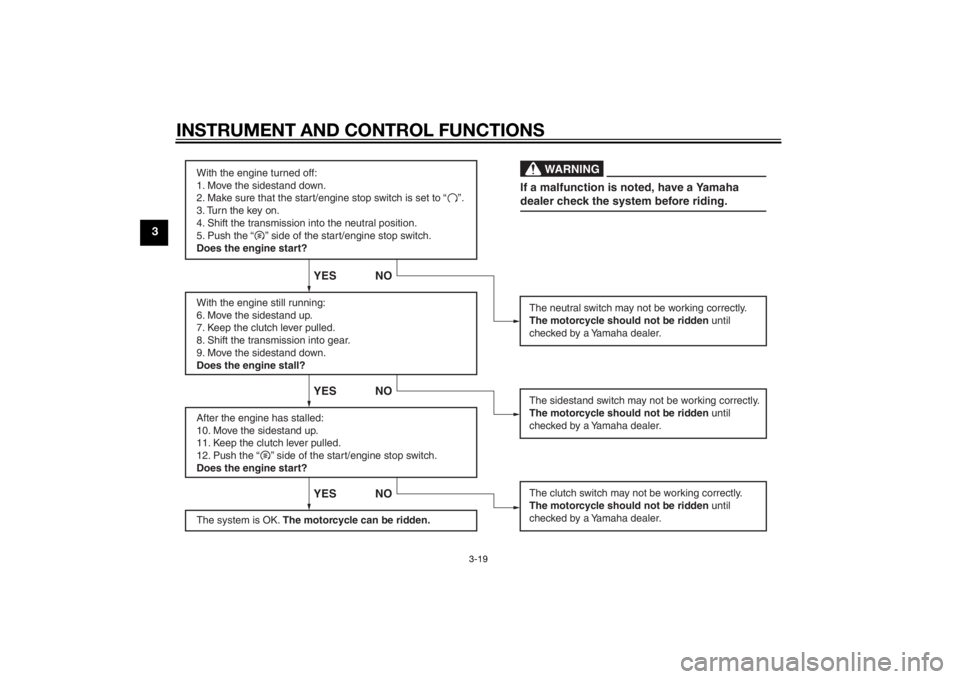
Periodically check the operation of the
ignition circuit cut-off system accord-
ing to the following procedure.
UB33E0E0.book Page 18 Monday, December 1, 2014 4:49 PM
Page 34 of 88
INSTRUMENT AND CONTROL FUNCTIONS
3-19
3
With the engine turned off:
1. Move the sidestand down.
2. Make sure that the start/engine stop switch is set to “ ”.
3. Turn the key on.
4. Shift the transmission into the neutral position.
5. Push the “ ” side of the start/engine stop switch.
Does the engine start?
With the engine still running:
6. Move the sidestand up.
7. Keep the clutch lever pulled.
8. Shift the transmission into gear.
9. Move the sidestand down.
Does the engine stall?
After the engine has stalled:
10. Move the sidestand up.
11. Keep the clutch lever pulled.
12. Push the “ ” side of the start/engine stop switch.
Does the engine start?
The system is OK. The motorcycle can be ridden.
YES NO YES NO YES NO
The neutral switch may not be working correctly.
The motorcycle should not be ridden until
checked by a Yamaha dealer.
The clutch switch may not be working correctly.
The motorcycle should not be ridden until
checked by a Yamaha dealer.The sidestand switch may not be working correctly.
The motorcycle should not be ridden until
checked by a Yamaha dealer.If a malfunction is noted, have a Yamaha
dealer check the system before riding.
WA R N I N G
UB33E0E0.book Page 19 Monday, December 1, 2014 4:49 PM
Page 36 of 88

FOR YOUR SAFETY – PRE-OPERATION CHECKS
4-2
4
Rear brake • Check operation.
• If soft or spongy, have Yamaha dealer bleed hydraulic system.
• Check brake pads for wear.
• Replace if necessary.
• Check fluid level in reservoir.
• If necessary, add specified brake fluid to specified level.
• Check hydraulic system for leakage. 6-17, 6-18
Clutch • Check operation.
• Lubricate cable if necessary.
• Check lever free play.
• Adjust if necessary.
6-15
Throttle g rip • Make sure that operation is smooth.
• Check throttle grip free play.
• If necessary, have Yamaha dealer adjust throttle grip free play and lubricate ca-
ble and grip housing. 6-13, 6-20
Control ca bles • Make sure that operation is smooth.
• Lubricate if necessary. 6-20
Wheels an d tires •Check for damage.
• Check tire condition and tread depth.
• Check air pressure.
• Correct if necessary.
6-13, 6-15
Brake an d shift pe dals • Make sure that operation is smooth.
• Lubricate pedal pivoting points if necessary.
6-21
Brake an d clutch levers • Make sure that operation is smooth.
• Lubricate lever pivoting points if necessary. 6-21
Si destan d • Make sure that operation is smooth.
• Lubricate pivot if necessary.
6-22
Chassis fasteners • Make sure that all nuts, bolts and screws are properly tightened.
• Tighten if necessary.
—
Instruments, li ghts, si gnals
an d switches • Check operation.
• Correct if necessary.
—
ITEM
CHECKS PAGE
UB33E0E0.book Page 2 Monday, December 1, 2014 4:49 PM
Page 38 of 88
OPERATION AND IMPORTANT RIDING POINTS
5-1
5
EAU15952
Read the Owner’s Manual carefully to
become familiar with all controls. If
there is a control or function you do not
understand, ask your Yamaha dealer.
WARNING
EWA10272
Failure to familiarize yourself with
the controls can lead to loss of con-
trol, which coul d cause an acci dent
or injury.
EAU48712
TIPThis model is equipped with: a lean angle sensor to stop the en-
gine in case of a turnover. In this
case, the display will indicate error
code 30, but this is not a malfunc-
tion. Turn the key to “OFF” and
then to “ON” to clear the error
code. Failing to do so will prevent
the engine from starting even
though the engine will crank when
pushing the start switch.
an engine auto-stop system. The
engine stops automatically if left
idling for 20 minutes. If the engine
stops, simply push the start
switch to restart the engine.
EAU67591
Startin g the en gineIn order for the ignition circuit cut-off
system to enable starting, one of the
following conditions must be met:
The transmission is in the neutral
position.
The transmission is in gear with
the clutch lever pulled and the
sidestand up.
See page 3-18 for more informa-
tion.
1. Turn the key to “ON” and make sure that the start/engine stop
switch is set to “ ”.
The following warning lights and
indicator light should come on for
a few seconds, then go off. Oil level warning light
Fuel level warning light
Engine trouble warning light
Immobilizer system indicator
lightNOTICE
ECA11834
If a warnin g or in dicator li ght does
not come on initially when the key is
turne d to “ON”, or if a warning or in-
UB33E0E0.book Page 1 Monday, December 1, 2014 4:49 PM
Page 40 of 88
OPERATION AND IMPORTANT RIDING POINTS
5-3
5
NOTICE
ECA10261
Even with the transmission in
the neutral position, do not
coast for lon g period s of time
with the en gine off, an d d o not
tow the motorcycle for lon g d is-
tances. The transmission is
properly lu bricated only when
the en gine is runnin g. Ina de-
quate lu brication may damag e
the transmission.
Always use the clutch while
chan gin g g ears to avoi d d am-
a g in g the en gine, transmission,
an d d rive train, which are not
d esi gne d to withstan d the
shock of force d shifting .
EAU16682
To start out an d accelerate
1. Pull the clutch lever to disengage the clutch.
2. Shift the transmission into first gear. The neutral indicator light
should go out.
3. Open the throttle gradually, and at the same time, release the clutch
lever slowly. 4. At the recommended shift points
shown in the following table, close
the throttle, and at the same time,
quickly pull the clutch lever in.
5. Shift the transmission into second gear. (Make sure not to shift the
transmission into the neutral posi-
tion.)
6. Open the throttle part way and gradually release the clutch lever.
7. Follow the same procedure when shifting to the next higher gear.
TIPWhen shifting gears in normal operat-
ing conditions, use the recommended
shift points.
EAU16701
To decelerate
1. Apply both the front and the rear brakes to slow the motorcycle.
2. Shift the transmission into first gear when the motorcycle reaches
25 km/h (16 mi/h). If the engine is
about to stall or runs very roughly,
pull the clutch lever in and use the
brakes to stop the motorcycle. 3. Shift the transmission into the
neutral position when the motor-
cycle is almost completely
stopped. The neutral indicator
light should come on.
EAU16721
Recommen ded shift points
The recommended shift points during
acceleration and deceleration are
shown in the table below.Shift up points: 1st → 2nd: 20 km/h (12 mi/h)
2nd → 3rd: 30 km/h (19 mi/h)
3rd → 4th: 40 km/h (25 mi/h)
4th → 5th: 50 km/h (31 mi/h)
Shift down points:
5th → 4th: 25 km/h (16 mi/h)
4th → 3rd: 25 km/h (16 mi/h)
3rd → 2nd: 25 km/h (16 mi/h)
2nd → 1st: 25 km/h (16 mi/h)
UB33E0E0.book Page 3 Monday, December 1, 2014 4:49 PM
Page 46 of 88

PERIODIC MAINTENANCE AND ADJUSTMENT
6-4
6
EAU1770M
General maintenance and lu brication chartNO. ITEM CHECK OR MAINTENANCE JOB ODOMETER READING
ANNUAL
CHECK
1000 km
(600 mi) 10000 km
(6000 mi) 20000 km
(12000 mi) 30000 km
(18000 mi) 40000 km
(24000 mi)
1 Air filter element • Replace. √
2Clutch • Check operation.
•Adjust.
√√√√√
3 *Front brake • Check operation, fluid level and
vehicle for fluid leakage. √√√√√√
• Replace brake pads. Whenever worn to the limit
4 *Rear brake • Check operation, fluid level and
vehicle for fluid leakage. √√√√√√
• Replace brake pads. Whenever worn to the limit
5 *Brake hoses • Check for cracks or damage.
• Check for correct routing and
clamping. √√√√√
• Replace. Every 4 years
6 *Brake flui d • Replace. Every 2 years
7 *Wheels • Check runout and for damage. √√√√
8 *Tires • Check tread depth and for dam-
age.
• Replace if necessary.
• Check air pressure.
• Correct if necessary. √√√√√
9 *Wheel bearin gs • Check bearings for looseness or
damage. √√√√
UB33E0E0.book Page 4 Monday, December 1, 2014 4:49 PM