ABS YAMAHA XVS950CU 2017 Owners Manual
[x] Cancel search | Manufacturer: YAMAHA, Model Year: 2017, Model line: XVS950CU, Model: YAMAHA XVS950CU 2017Pages: 88, PDF Size: 2.38 MB
Page 6 of 88

Table of contentsSafety information ............................ 1-1
Description ....................................... 2-1
Left view ......................................... 2-1
Right view ....................................... 2-2
Controls and instruments ............... 2-3
Instrument an d control functions ... 3-1
Immobilizer system......................... 3-1
Main switch .................................... 3-2
Indicator lights and warning lights............................................ 3-3
Multi-function meter unit ................ 3-5
Handlebar switches ........................ 3-7
Clutch lever .................................... 3-9
Shift pedal ...................................... 3-9
Brake lever...................................... 3-9
Brake pedal .................................. 3-10
ABS .............................................. 3-10
Fuel tank cap ................................ 3-11
Fuel ............................................... 3-12
Fuel tank breather/overflow hose .......................................... 3-13
Catalytic converter ....................... 3-14
Steering lock................................. 3-14
Rider seat ..................................... 3-15
Adjusting the shock absorber assemblies ................................ 3-16
Sidestand ..................................... 3-17
Ignition circuit cut-off system ....... 3-18 For your safety – pre-operation
checks
............................................... 4-1
Operation an d important ri din g
points ................................................. 5-1
Starting the engine .......................... 5-1
Shifting ............................................ 5-2
Tips for reducing fuel consumption ................................ 5-3
Engine break-in ............................... 5-3
Parking ............................................ 5-4
Perio dic maintenance an d
a d justment ........................................ 6-1
Owner’s tool kits ............................. 6-2
Periodic maintenance chart for the emission control system .............. 6-3
General maintenance and lubrication chart ........................... 6-5
Removing and installing the
panel ............................................ 6-9
Checking the spark plugs ............... 6-9
Canister ......................................... 6-11
Engine oil and oil filter cartridge.... 6-11
Replacing the air filter element ..... 6-14
Checking the throttle grip free play ............................................ 6-15
Valve clearance ............................. 6-15
Tires .............................................. 6-16
Cast wheels................................... 6-17 Adjusting the clutch lever free
play ............................................ 6-18
Checking the brake lever free play ............................................ 6-19
Brake light switches ..................... 6-19
Checking the front and rear
brake pads ................................ 6-20
Checking the brake fluid level ...... 6-20
Changing the brake fluid .............. 6-22
Drive belt slack ............................. 6-22
Checking and lubricating the
cables ........................................ 6-23
Checking and lubricating the throttle grip and cable ............... 6-23
Checking and lubricating the brake and shift pedals............... 6-23
Checking and lubricating the
brake and clutch levers ............. 6-24
Checking and lubricating the sidestand................................... 6-25
Checking the front fork ................. 6-25
Checking the steering................... 6-26
Checking the wheel bearings ....... 6-26
Battery .......................................... 6-26
Replacing the fuses ...................... 6-28
Replacing the headlight bulb ........ 6-29
Replacing the auxiliary light bulb .......................................... 6-30
Brake/tail light............................... 6-31
Replacing a turn signal light
bulb ........................................... 6-31UBS5E0E0.book Page 1 Wednesday, October 19, 2016 10:21 AM
Page 13 of 88
Description
2-1
2
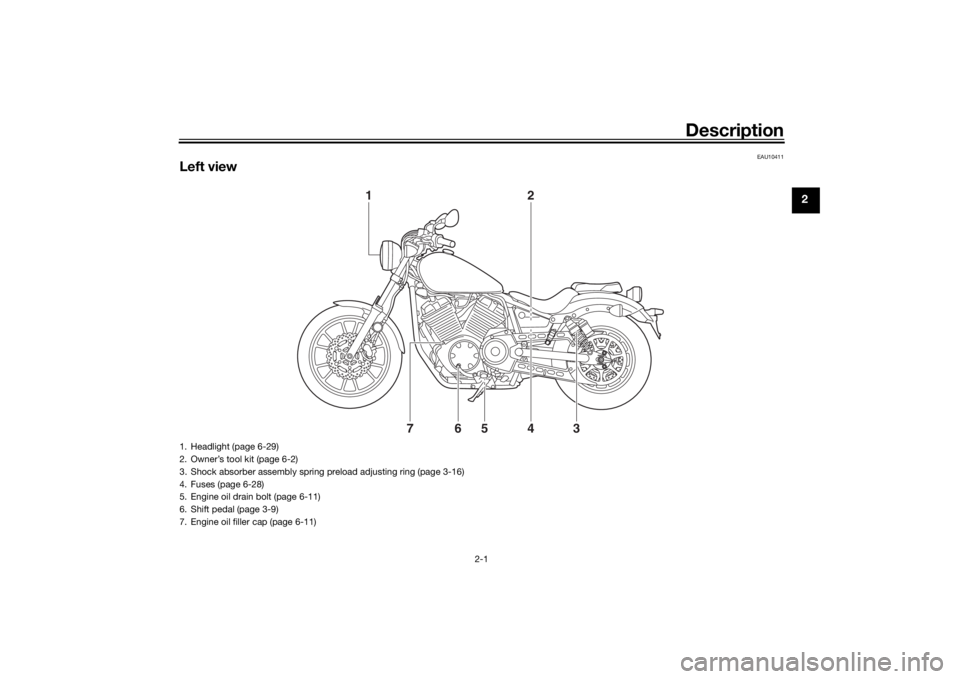
EAU10411
Left view
1
24
5
6
7
3
1. Headlight (page 6-29)
2. Owner’s tool kit (page 6-2)
3. Shock absorber assembly spring preload adjusting ring (page 3-16)
4. Fuses (page 6-28)
5. Engine oil drain bolt (page 6-11)
6. Shift pedal (page 3-9)
7. Engine oil filler cap (page 6-11)
UBS5E0E0.book Page 1 Wednesday, October 19, 2016 10:21 AM
Page 18 of 88

Instrument and control functions
3-3
3
WARNING
EWA10073
Never turn the key to “OFF” while
the vehicle is movin g, otherwise the
electrical systems will be switched
off, which may result in loss of con-
trol or an acci dent.
EAU62271
(Parkin g)
The hazard lights and turn signal lights
can be turned on, but all other electri-
cal systems are off. The key can be re-
moved.
The key must be pushed in from the
“OFF” position to be turned to “ ”.
NOTICE
ECA20760
Usin g the hazar d or turn si gnal li ghts
for an exten ded len gth of time may
cause the battery to d ischarge.
EAU4939C
In dicator li ghts an d warnin g
li g hts
EAU11022
Turn si gnal in dicator li ght “ ”
This indicator light flashes when a turn
signal light is flashing.
EAU11061
Neutral in dicator li ght “ ”
This indicator light comes on when the
transmission is in the neutral position.
EAU11081
Hi gh beam in dicator li ght “ ”
This indicator light comes on when the
high beam of the headlight is switched
on.
EAU11256
Oil level warnin g li ght “ ”
This warning light comes on if the en-
gine oil level is low.
The electrical circuit of the warning
light can be checked by turning the key
to “ON”. The warning light should
come on for a few seconds and then
go off.
If the warning light does not come on
initially when the key is turned to “ON”,
or if the warning light remains on after
confirming that the oil level is correct
(see page 6-11), have a Yamaha dealer
check the vehicle.
1. Oil level warning light “ ”
2. Immobilizer system indicator light “ ”
3. Turn signal indicator light “ ”
4. Anti-lock Brake System (ABS) warning light “ ”
5. Fuel level warning light “ ”
6. Engine trouble warning light “ ”
7. Neutral indicator light “ ”
8. High beam indicator light “ ”
1
35 42
8
7
6
ABS
UBS5E0E0.book Page 3 Wednesday, October 19, 2016 10:21 AM
Page 19 of 88

Instrument and control functions
3-4
3
TIP Even if the oil level is sufficient, the
warning light may flicker when rid-
ing on a slope or during sudden
acceleration or deceleration, but
this is not a malfunction.
This model is equipped with a self-
diagnosis device for the oil level
detection circuit. If a problem is
detected in the oil level detection
circuit, the oil level warning light
will flash repeatedly. If this occurs,
have a Yamaha dealer check the
vehicle.
EAU11368
Fuel level warnin g li ght “ ”
This warning light comes on when the
fuel level drops below approximately
2.8 L (0.74 US gal, 0.62 Imp.gal). When
this occurs, refuel as soon as possible.
The electrical circuit of the warning
light can be checked by turning the key
to “ON”. The warning light should
come on for a few seconds and then
go off. If the warning light does not come on
initially when the key is turned to “ON”,
or if the warning light remains on after
refueling, have a Yamaha dealer check
the vehicle.
TIPThis model is equipped with a self-di-
agnosis device for the fuel level detec-
tion circuit. If a problem is detected in
the fuel level detection circuit, the fuel
level warning light will flash repeatedly.
If this occurs, have a Yamaha dealer
check the vehicle.
EAU73171
En
gine trou ble warnin g li ght “ ”
This warning light comes on if a prob-
lem is detected in the engine or other
vehicle control system. If this occurs,
have a Yamaha dealer check the on-
board diagnostic system.
The electrical circuit of the warning
light can be checked by turning the key
to “ON”. The warning light should
come on for a few seconds, and then
go off. If the warning light does not come on
initially when the key is turned to “ON”,
or if the warning light remains on, have
a Yamaha dealer check the vehicle.
EAU69891
ABS warnin
g lig ht “ ”
In normal operation, this warning light
comes on when the key is turned to
“ON”, and goes off after traveling at a
speed of 10 km/h (6 mi/h) or higher.
If the ABS warning light: does not come on when the key is
turned to “ON”
comes on or flashes while riding
does not go off after traveling at a
speed of 10 km/h (6 mi/h) or high-
er
The ABS may not work correctly. If any
of the above occurs, have a Yamaha
dealer check the system as soon as
possible. (See page 3-10 for an expla-
nation of the ABS.)
WARNING
EWA16041
If the ABS warning light does not go
off after travelin g at a speed of 10
km/h (6 mi/h) or hi gher, or if the
warnin g lig ht comes on or flashes
ABS
UBS5E0E0.book Page 4 Wednesday, October 19, 2016 10:21 AM
Page 25 of 88

Instrument and control functions
3-10
3
EAU12944
Brake ped alThe brake pedal is located on the right
side of the motorcycle. To apply the
rear brake, press down on the brake
pedal.
EAU63040
ABSThe Yamaha ABS (Anti-lock Brake
System) features a dual electronic con-
trol system, which acts on the front and
rear brakes independently.
Operate the brakes with ABS as you
would conventional brakes. If the ABS
is activated, a pulsating sensation may
be felt at the brake lever or brake ped-
al. In this situation, continue to apply
the brakes and let the ABS work; do
not “pump” the brakes as this will re-
duce braking effectiveness.
WARNING
EWA16051
Always keep a sufficient d istance
from the vehicle ahea d to match the
ri din g speed even with ABS.
The ABS performs best with
lon g b rakin g d istances.
On certain surfaces, such as
rou gh or g ravel roa ds, the b rak-
in g d istance may be lon ger with
the ABS than without.The ABS is monitored by an ECU,
which will revert the system to conven-
tional braking if a malfunction occurs.
TIP The ABS performs a self-diagno-
sis test each time the vehicle first
starts off after the key is turned to
“ON” and the vehicle has traveled
at a speed of 10 km/h (6 mi/h) or
higher. During this test, a “click-
ing” noise can be heard from the
hydraulic control unit, and if the
brake lever or brake pedal is even
slightly applied, a vibration can be
felt at the lever and pedal, but
these do not indicate a malfunc-
tion.
This ABS has a test mode which
allows the owner to experience
the pulsation at the brake lever or
brake pedal when the ABS is op-
erating. However, special tools are
required, so please consult your
Yamaha dealer.NOTICE
ECA20100
Be careful not to d amage the wheel
sensor or wheel sensor rotor; other-
wise, improper performance of the
ABS will result.
1. Brake pedal
1
UBS5E0E0.book Page 10 Wedne sday, October 19, 2016 10:21 AM
Page 31 of 88
Instrument and control functions
3-16
3
4. Install the panel.
TIPMake sure that the rider seat is proper-
ly secured before riding.
EAU57770
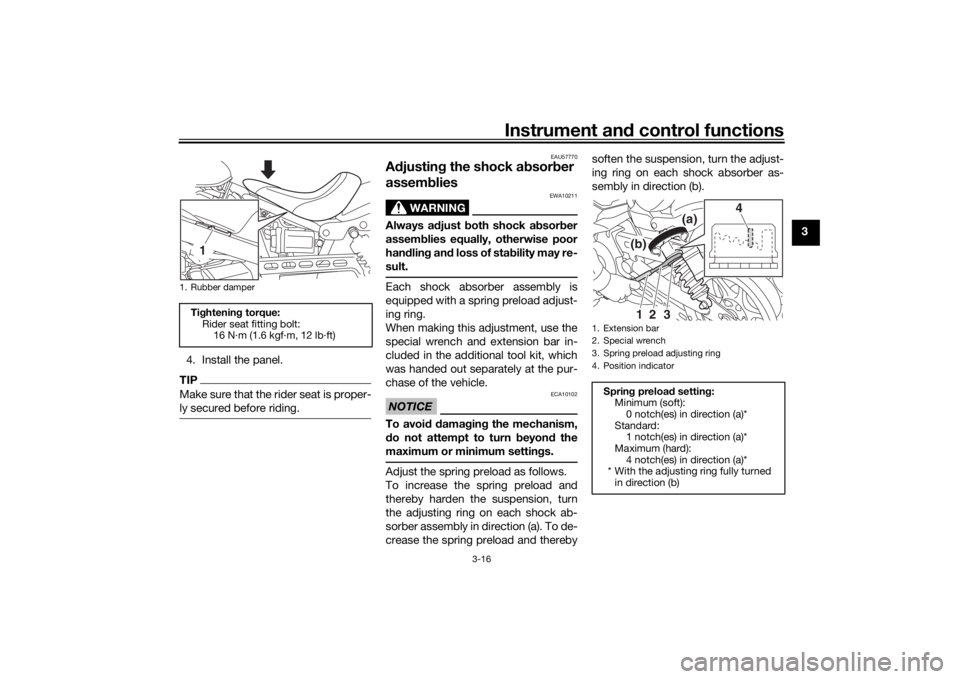
A djustin g the shock a bsor ber
assem blies
WARNING
EWA10211
Always a djust both shock ab sorber
assem blies equally, otherwise poor
han dlin g an d loss of sta bility may re-
sult.Each shock absorber assembly is
equipped with a spring preload adjust-
ing ring.
When making this adjustment, use the
special wrench and extension bar in-
cluded in the additional tool kit, which
was handed out separately at the pur-
chase of the vehicle.NOTICE
ECA10102
To avoi d d amag ing the mechanism,
d o not attempt to turn b eyond the
maximum or minimum settin gs.Adjust the spring preload as follows.
To increase the spring preload and
thereby harden the suspension, turn
the adjusting ring on each shock ab-
sorber assembly in direction (a). To de-
crease the spring preload and thereby soften the suspension, turn the adjust-
ing ring on each shock absorber as-
sembly in direction (b).
1. Rubber damperTi
ghtenin g torque:
Rider seat fitting bolt: 16 N·m (1.6 kgf·m, 12 lb·ft)1
1. Extension bar
2. Special wrench
3. Spring preload adjusting ring
4. Position indicator
Sprin g preloa d settin g:
Minimum (soft): 0 notch(es) in direction (a)*
Standard: 1 notch(es) in direction (a)*
Maximum (hard):
4 notch(es) in direction (a)*
* With the adjusting ring fully turned in direction (b)
3
(a)
(b)
2
1
4
UBS5E0E0.book Page 16 Wedne sday, October 19, 2016 10:21 AM
Page 39 of 88

Operation and important ri din g points
5-2
5
on, see pa
ge 3-3 for the correspond -
in g warnin g an d in dicator li ght cir-
cuit check.
The ABS warning light should
come on when the main switch is
turned to “ON” and then go off af-
ter traveling at a speed of 10 km/h
(6 mi/h) or higher.
NOTICE
ECA17682
If the ABS warnin g li ght does not
come on an d then go off as ex-
plaine d a bove, see pa ge 3-3 for the
warnin g li ght circuit check.2. Shift the transmission into the
neutral position. The neutral indi-
cator light should come on. If not,
ask a Yamaha dealer to check the
electrical circuit.
3. Start the engine by pushing the start switch.
If the engine fails to start, release
the start switch, wait a few sec-
onds, and then try again. Each
starting attempt should be as
short as possible to preserve the battery. Do not crank the engine
more than 10 seconds on any one
attempt.
NOTICE
ECA11043
For maximum en
gine life, never ac-
celerate har d when the en gine is
col d!
EAU16673
Shiftin gShifting gears lets you control the
amount of engine power available for
starting off, accelerating, climbing hills,
etc.
The gear positions are shown in the il-
lustration.TIPTo shift the transmission into the neu-
tral position, press the shift pedal down
repeatedly until it reaches the end of its
travel, and then slightly raise it.1. Shift pedal
2. Neutral position
1
2
5
4
3
2
N 1 5
4
3
2
N 1
UBS5E0E0.book Page 2 Wednesday, October 19, 2016 10:21 AM
Page 62 of 88
Periodic maintenance an d a djustment
6-21
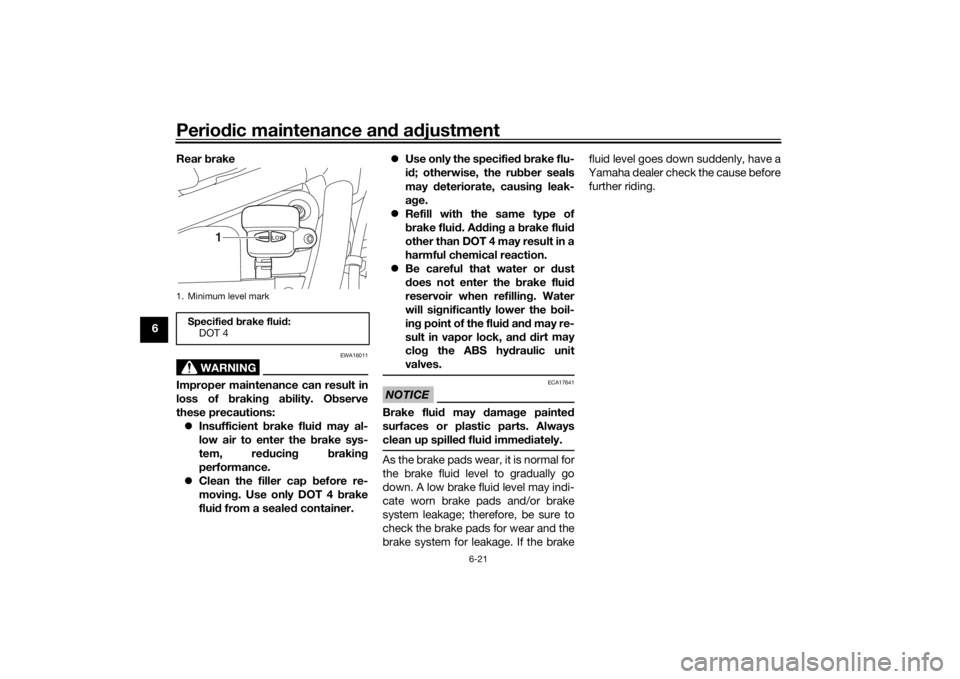
6 Rear
brake
WARNING
EWA16011
Improper maintenance can result in
loss of brakin g a bility. O bserve
these precautions: Insufficient brake flui d may al-
low air to enter the b rake sys-
tem, re ducin g brakin g
performance.
Clean the filler cap before re-
moving . Use only DOT 4 b rake
flui d from a seale d container.
Use only the specified b rake flu-
i d ; otherwise, the ru bber seals
may deteriorate, causin g leak-
a g e.
Refill with the same type of
brake flui d. A ddin g a brake flui d
other than DOT 4 may result in a
harmful chemical reaction.
Be careful that water or dust
d oes not enter the brake flui d
reservoir when refillin g. Water
will si gnificantly lower the boil-
in g point of the flui d an d may re-
sult in vapor lock, an d d ir
t may
clo g the ABS hy draulic unit
valves.
NOTICE
ECA17641
Brake flui d may damag e painted
surfaces or plastic parts. Always
clean up spille d flui d imme diately.As the brake pads wear, it is normal for
the brake fluid level to gradually go
down. A low brake fluid level may indi-
cate worn brake pads and/or brake
system leakage; therefore, be sure to
check the brake pads for wear and the
brake system for leakage. If the brake fluid level goes down suddenly, have a
Yamaha dealer check the cause before further riding.
1. Minimum level markSpecifie d b rake flui d:
DOT 4
1
UBS5E0E0.book Page 21 Wedne sday, October 19, 2016 10:21 AM
Page 69 of 88
Periodic maintenance an d a djustment
6-28
6
EAU57711
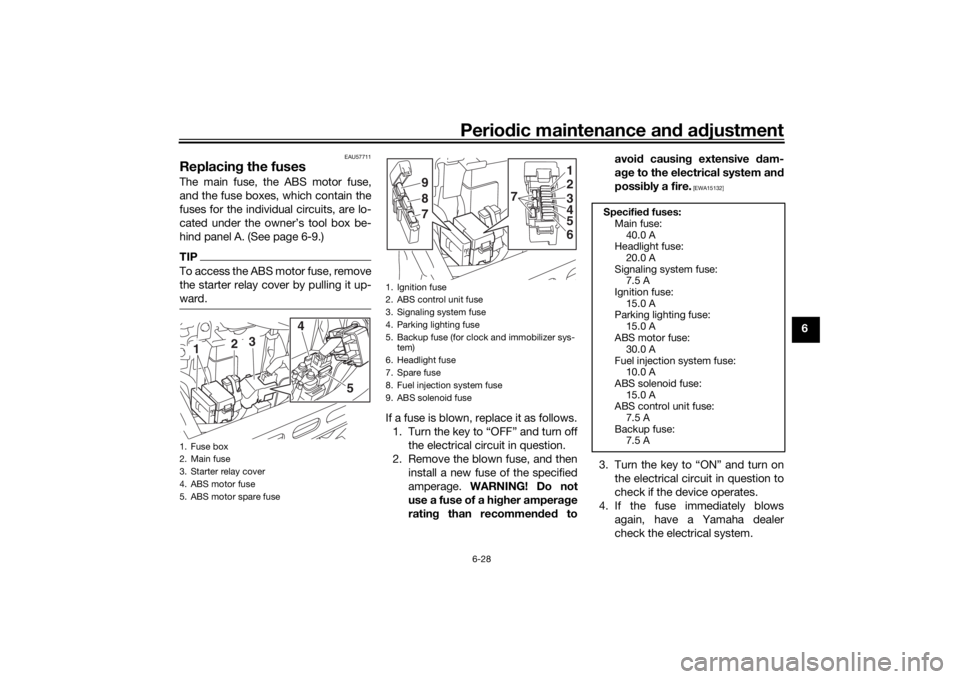
Replacin g the fusesThe main fuse, the ABS motor fuse,
and the fuse boxes, which contain the
fuses for the individual circuits, are lo-
cated under the owner’s tool box be-
hind panel A. (See page 6-9.)TIPTo access the ABS motor fuse, remove
the starter relay cover by pulling it up-
ward.
If a fuse is blown, replace it as follows.
1. Turn the key to “OFF” and turn off the electrical circuit in question.
2. Remove the blown fuse, and then install a new fuse of the specified
amperage. WARNING! Do not
use a fuse of a hi gher ampera ge
ratin g than recommen ded to avoi
d causin g extensive dam-
a g e to the electrical system an d
possi bly a fire.
[EWA15132]
3. Turn the key to “ON” and turn on
the electrical circuit in question to
check if the device operates.
4. If the fuse immediately blows again, have a Yamaha dealer
check the electrical system.
1. Fuse box
2. Main fuse
3. Starter relay cover
4. ABS motor fuse
5. ABS motor spare fuse
3
2
1
4
5
1. Ignition fuse
2. ABS control unit fuse
3. Signaling system fuse
4. Parking lighting fuse
5. Backup fuse (for clock and immobilizer sys-tem)
6. Headlight fuse
7. Spare fuse
8. Fuel injection system fuse
9. ABS solenoid fuse
2 1
4
5
6
7
789
3
Specified
fuses:
Main fuse: 40.0 A
Headlight fuse:
20.0 A
Signaling system fuse: 7.5 A
Ignition fuse: 15.0 A
Parking lighting fuse:
15.0 A
ABS motor fuse: 30.0 A
Fuel injection system fuse: 10.0 A
ABS solenoid fuse:
15.0 A
ABS control unit fuse: 7.5 A
Backup fuse: 7.5 A
UBS5E0E0.book Page 28 Wedne sday, October 19, 2016 10:21 AM
Page 77 of 88

Motorcycle care and stora ge
7-2
7
off any
deter gent resi due usin g
plenty of water, as it is harmful
to plastic parts.
Do not use any harsh chemical
prod ucts on plastic parts. Be
sure to avoi d usin g cloths or
spon ges which have b een in
contact with stron g or a brasive
cleanin g prod ucts, solvent or
thinner, fuel ( gasoline), rust re-
movers or inhi bitors, brake flui d,
antifreeze or electrolyte.
Do not use hi gh-pressure wash-
ers or steam-jet cleaners since
they cause water seepag e and
d eterioration in the followin g ar-
eas: seals (of wheel an d swin g-
arm bearin gs, fork an d b rakes),
electric components (couplers,
connectors, instruments,
switches an d li ghts), breather
hoses an d vents.
For motorcycles equippe d with
a win dshiel d: Do not use stron g
cleaners or har d spon ges as
they will cause dullin g or
sc
ratchin g. Some cleanin g
compoun ds for plastic may
leave scratches on the win d- shiel
d. Test the pro duct on a
small hi dden part of the win d-
shiel d to make sure that it does
not leave any marks. If the win d-
shiel d is scratche d, use a quality
plastic polishin g compoun d af-
ter washing .
After normal useRemove dirt with warm water, a mild
detergent, and a soft, clean sponge,
and then rinse thoroughly with clean
water. Use a toothbrush or bottlebrush
for hard-to-reach areas. Stubborn dirt
and insects will come off more easily if
the area is covered with a wet cloth for
a few minutes before cleaning.
After riding in the rain, near the sea oron salt-sprayed roadsSince sea salt or salt sprayed on roads
during winter are extremely corrosive
in combination with water, carry out
the following steps after each ride in
the rain, near the sea or on salt-
sprayed roads.
TIPSalt sprayed on roads in the winter
may remain well into spring.1. Clean the motorcycle with cold
water and a mild detergent, after
the engine has cooled down.
NOTICE: Do not use warm wa-
ter since it increases the corro-
sive action of the salt.
[ECA10792]
2. After drying the motorcycle, apply a corrosion protection spray on all
metal, including chrome- and
nickel-plated, surfaces to prevent
corrosion.
After cleanin g
1. Dry the motorcycle with a chamois or an absorbing cloth.
2. Use a chrome polish to shine chrome, aluminum and stainless-
steel parts, including the exhaust
system. (Even the thermally in-
duced discoloring of stainless-
steel exhaust systems can be re-
moved through polishing.)
UBS5E0E0.book Page 2 Wednesday, October 19, 2016 10:21 AM