fuel YAMAHA XVS950CU 2017 Owners Manual
[x] Cancel search | Manufacturer: YAMAHA, Model Year: 2017, Model line: XVS950CU, Model: YAMAHA XVS950CU 2017Pages: 88, PDF Size: 2.38 MB
Page 6 of 88

Table of contentsSafety information ............................ 1-1
Description ....................................... 2-1
Left view ......................................... 2-1
Right view ....................................... 2-2
Controls and instruments ............... 2-3
Instrument an d control functions ... 3-1
Immobilizer system......................... 3-1
Main switch .................................... 3-2
Indicator lights and warning lights............................................ 3-3
Multi-function meter unit ................ 3-5
Handlebar switches ........................ 3-7
Clutch lever .................................... 3-9
Shift pedal ...................................... 3-9
Brake lever...................................... 3-9
Brake pedal .................................. 3-10
ABS .............................................. 3-10
Fuel tank cap ................................ 3-11
Fuel ............................................... 3-12
Fuel tank breather/overflow hose .......................................... 3-13
Catalytic converter ....................... 3-14
Steering lock................................. 3-14
Rider seat ..................................... 3-15
Adjusting the shock absorber assemblies ................................ 3-16
Sidestand ..................................... 3-17
Ignition circuit cut-off system ....... 3-18 For your safety – pre-operation
checks
............................................... 4-1
Operation an d important ri din g
points ................................................. 5-1
Starting the engine .......................... 5-1
Shifting ............................................ 5-2
Tips for reducing fuel consumption ................................ 5-3
Engine break-in ............................... 5-3
Parking ............................................ 5-4
Perio dic maintenance an d
a d justment ........................................ 6-1
Owner’s tool kits ............................. 6-2
Periodic maintenance chart for the emission control system .............. 6-3
General maintenance and lubrication chart ........................... 6-5
Removing and installing the
panel ............................................ 6-9
Checking the spark plugs ............... 6-9
Canister ......................................... 6-11
Engine oil and oil filter cartridge.... 6-11
Replacing the air filter element ..... 6-14
Checking the throttle grip free play ............................................ 6-15
Valve clearance ............................. 6-15
Tires .............................................. 6-16
Cast wheels................................... 6-17 Adjusting the clutch lever free
play ............................................ 6-18
Checking the brake lever free play ............................................ 6-19
Brake light switches ..................... 6-19
Checking the front and rear
brake pads ................................ 6-20
Checking the brake fluid level ...... 6-20
Changing the brake fluid .............. 6-22
Drive belt slack ............................. 6-22
Checking and lubricating the
cables ........................................ 6-23
Checking and lubricating the throttle grip and cable ............... 6-23
Checking and lubricating the brake and shift pedals............... 6-23
Checking and lubricating the
brake and clutch levers ............. 6-24
Checking and lubricating the sidestand................................... 6-25
Checking the front fork ................. 6-25
Checking the steering................... 6-26
Checking the wheel bearings ....... 6-26
Battery .......................................... 6-26
Replacing the fuses ...................... 6-28
Replacing the headlight bulb ........ 6-29
Replacing the auxiliary light bulb .......................................... 6-30
Brake/tail light............................... 6-31
Replacing a turn signal light
bulb ........................................... 6-31UBS5E0E0.book Page 1 Wednesday, October 19, 2016 10:21 AM
Page 12 of 88

Safety information
1-5
1operator and may limit control
ability, therefore, such accesso-
ries are not recommended.
Use caution when adding electri-
cal accessories. If electrical ac-
cessories exceed the capacity of
the motorcycle’s electrical sys-
tem, an electric failure could re-
sult, which could cause a
dangerous loss of lights or engine
power.
Aftermarket Tires an d Rims
The tires and rims that came with your
motorcycle were designed to match
the performance capabilities and to
provide the best combination of han-
dling, braking, and comfort. Other
tires, rims, sizes, and combinations
may not be appropriate. Refer to page
6-16 for tire specifications and more in-
formation on replacing your tires.
Transportin g the Motorcycle
Be sure to observe following instruc-
tions before transporting the motorcy-
cle in another vehicle. Remove all loose items from the
motorcycle.
Check that the fuel cock (if
equipped) is in the “OFF” position
and that there are no fuel leaks.
Point the front wheel straight
ahead on the trailer or in the truck
bed, and choke it in a rail to pre-
vent movement.
Shift the transmission in gear (for
models with a manual transmis-
sion).
Secure the motorcycle with tie-
downs or suitable straps that are
attached to solid parts of the mo-
torcycle, such as the frame or up-
per front fork triple clamp (and not,
for example, to rubber-mounted
handlebars or turn signals, or
parts that could break). Choose
the location for the straps carefully
so the straps will not rub against
painted surfaces during transport.
The suspension should be com-
pressed somewhat by the tie-
downs, if possible, so that the mo-
torcycle will not bounce exces-
sively during transport.
UBS5E0E0.book Page 5 Wednesday, October 19, 2016 10:21 AM
Page 14 of 88

Description
2-2
2
EAU10421
Right view
1
2
3
4
5
6
7
8
9
10
1. License plate light (page 6-32)
2. Brake/tail light (page 6-31)
3. Battery (page 6-26)
4. Rear brake fluid reservoir (page 6-20)
5. Air filter element (page 6-14)
6. Fuel tank cap (page 3-11)
7. Main switch (page 3-2)
8. Steering lock (page 3-14) 9. Engine oil filter cartridge (page 6-11)
10.Brake pedal (page 3-10)UBS5E0E0.book Page 2 Wednesday, October 19, 2016 10:21 AM
Page 18 of 88

Instrument and control functions
3-3
3
WARNING
EWA10073
Never turn the key to “OFF” while
the vehicle is movin g, otherwise the
electrical systems will be switched
off, which may result in loss of con-
trol or an acci dent.
EAU62271
(Parkin g)
The hazard lights and turn signal lights
can be turned on, but all other electri-
cal systems are off. The key can be re-
moved.
The key must be pushed in from the
“OFF” position to be turned to “ ”.
NOTICE
ECA20760
Usin g the hazar d or turn si gnal li ghts
for an exten ded len gth of time may
cause the battery to d ischarge.
EAU4939C
In dicator li ghts an d warnin g
li g hts
EAU11022
Turn si gnal in dicator li ght “ ”
This indicator light flashes when a turn
signal light is flashing.
EAU11061
Neutral in dicator li ght “ ”
This indicator light comes on when the
transmission is in the neutral position.
EAU11081
Hi gh beam in dicator li ght “ ”
This indicator light comes on when the
high beam of the headlight is switched
on.
EAU11256
Oil level warnin g li ght “ ”
This warning light comes on if the en-
gine oil level is low.
The electrical circuit of the warning
light can be checked by turning the key
to “ON”. The warning light should
come on for a few seconds and then
go off.
If the warning light does not come on
initially when the key is turned to “ON”,
or if the warning light remains on after
confirming that the oil level is correct
(see page 6-11), have a Yamaha dealer
check the vehicle.
1. Oil level warning light “ ”
2. Immobilizer system indicator light “ ”
3. Turn signal indicator light “ ”
4. Anti-lock Brake System (ABS) warning light “ ”
5. Fuel level warning light “ ”
6. Engine trouble warning light “ ”
7. Neutral indicator light “ ”
8. High beam indicator light “ ”
1
35 42
8
7
6
ABS
UBS5E0E0.book Page 3 Wednesday, October 19, 2016 10:21 AM
Page 19 of 88

Instrument and control functions
3-4
3
TIP Even if the oil level is sufficient, the
warning light may flicker when rid-
ing on a slope or during sudden
acceleration or deceleration, but
this is not a malfunction.
This model is equipped with a self-
diagnosis device for the oil level
detection circuit. If a problem is
detected in the oil level detection
circuit, the oil level warning light
will flash repeatedly. If this occurs,
have a Yamaha dealer check the
vehicle.
EAU11368
Fuel level warnin g li ght “ ”
This warning light comes on when the
fuel level drops below approximately
2.8 L (0.74 US gal, 0.62 Imp.gal). When
this occurs, refuel as soon as possible.
The electrical circuit of the warning
light can be checked by turning the key
to “ON”. The warning light should
come on for a few seconds and then
go off. If the warning light does not come on
initially when the key is turned to “ON”,
or if the warning light remains on after
refueling, have a Yamaha dealer check
the vehicle.
TIPThis model is equipped with a self-di-
agnosis device for the fuel level detec-
tion circuit. If a problem is detected in
the fuel level detection circuit, the fuel
level warning light will flash repeatedly.
If this occurs, have a Yamaha dealer
check the vehicle.
EAU73171
En
gine trou ble warnin g li ght “ ”
This warning light comes on if a prob-
lem is detected in the engine or other
vehicle control system. If this occurs,
have a Yamaha dealer check the on-
board diagnostic system.
The electrical circuit of the warning
light can be checked by turning the key
to “ON”. The warning light should
come on for a few seconds, and then
go off. If the warning light does not come on
initially when the key is turned to “ON”,
or if the warning light remains on, have
a Yamaha dealer check the vehicle.
EAU69891
ABS warnin
g lig ht “ ”
In normal operation, this warning light
comes on when the key is turned to
“ON”, and goes off after traveling at a
speed of 10 km/h (6 mi/h) or higher.
If the ABS warning light: does not come on when the key is
turned to “ON”
comes on or flashes while riding
does not go off after traveling at a
speed of 10 km/h (6 mi/h) or high-
er
The ABS may not work correctly. If any
of the above occurs, have a Yamaha
dealer check the system as soon as
possible. (See page 3-10 for an expla-
nation of the ABS.)
WARNING
EWA16041
If the ABS warning light does not go
off after travelin g at a speed of 10
km/h (6 mi/h) or hi gher, or if the
warnin g lig ht comes on or flashes
ABS
UBS5E0E0.book Page 4 Wednesday, October 19, 2016 10:21 AM
Page 20 of 88
Instrument and control functions
3-5
3 while ri
din g, the b rake system re-
verts to conventional brakin g. If ei-
ther of the ab ove occurs, or if the
warnin g li ght does not come on at
all, use extra caution to avoi d possi-
b le wheel lock during emer gency
b rakin g. Have a Yamaha d ealer
check the brake system an d electri-
cal circuits as soon as possi ble.
EAU73120
Immo bilizer system in dicator
li g ht “ ”
When the key is turned to “OFF” and
30 seconds have passed, the indicator
light will flash steadily to indicate the
immobilizer system is enabled. After 24
hours have passed, the indicator light
will stop flashing, however the immobi-
lizer system is still enabled.
The electrical circuit of the indicator
light can be checked by turning the key
to “ON”. The indicator light should
come on for a few seconds, and then
go off.
If the indicator light does not come on
initially when the key is turned to “ON”,
if the indicator light remains on, or if the
indicator light flashes in a pattern (if a problem is detected in the immobilizer
system, the immobilizer system indica-
tor light will flash in a pattern), have a
Yamaha dealer check the vehicle.
TIPIf the immobilizer system indicator light
flashes in the pattern, slowly 5 times
then quickly 2 times, this could be
caused by transponder interference. If
this occurs, try the following. 1. Make sure there are no other im- mobilizer keys close to the main
switch. Other immobilizer system
keys may cause signal interfer-
ence and prevent the engine from
starting.
2. Use the code re-registering key to start the engine.
3. If the engine starts, turn it off, and try starting the engine with the
standard keys.
4. If one or both of the standard keys do not start the engine, take the
vehicle and all 3 keys to a Yamaha
dealer to have the standard keys
re-registered.
EAU57683
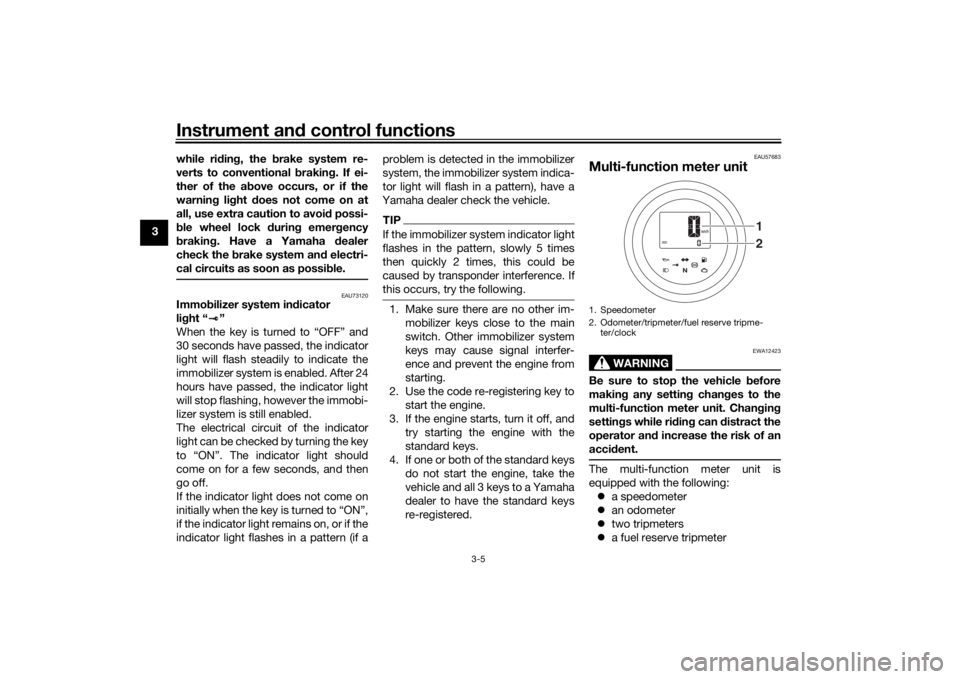
Multi-function meter unit
WARNING
EWA12423
Be sure to stop the vehicle before
makin g any settin g chan ges to the
multi-function meter unit. Chan gin g
settin gs while ri din g can distract the
operator an d increase the risk of an
acci dent.The multi-function meter unit is
equipped with the following:
a speedometer
an odometer
two tripmeters
a fuel reserve tripmeter1. Speedometer
2. Odometer/tripmeter/fuel reserve tripme-
ter/clock
21
UBS5E0E0.book Page 5 Wednesday, October 19, 2016 10:21 AM
Page 21 of 88
Instrument and control functions
3-6
3
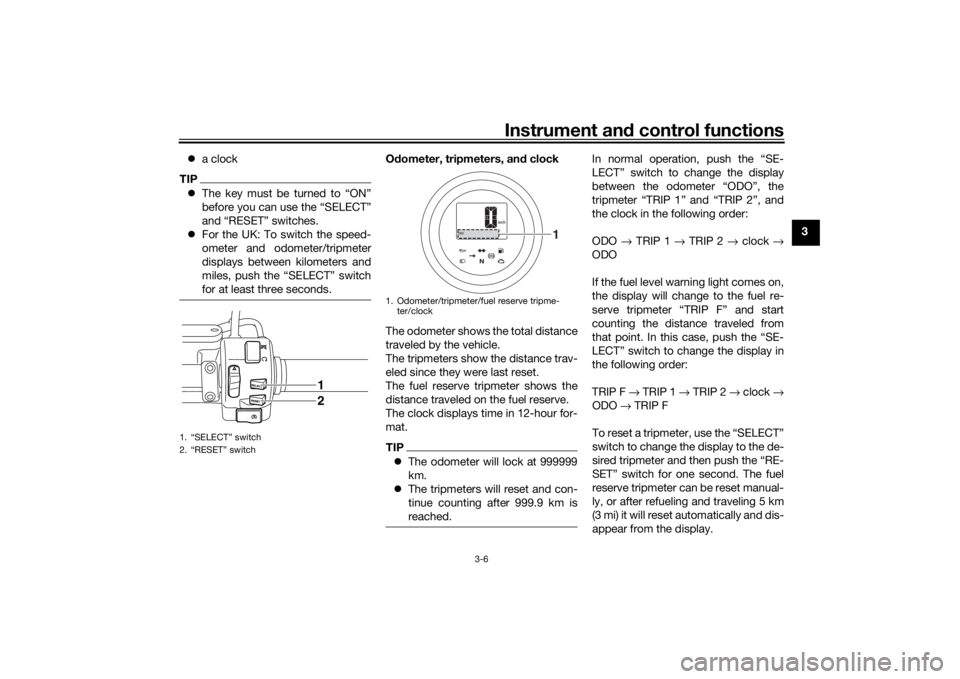
a clock
TIPThe key must be turned to “ON”
before you can use the “SELECT”
and “RESET” switches.
For the UK: To switch the speed-
ometer and odometer/tripmeter
displays between kilometers and
miles, push the “SELECT” switch
for at least three seconds.
Odometer, tripmeters, an d clock
The odometer shows the total distance
traveled by the vehicle.
The tripmeters show the distance trav-
eled since they were last reset.
The fuel reserve tripmeter shows the
distance traveled on the fuel reserve.
The clock displays time in 12-hour for-
mat.TIP The odometer will lock at 999999
km.
The tripmeters will reset and con-
tinue counting after 999.9 km is
reached.
In normal operation, push the “SE-
LECT” switch to change the display
between the odometer “ODO”, the
tripmeter “TRIP 1” and “TRIP 2”, and
the clock in the following order:
ODO → TRIP 1 → TRIP 2 → clock →
ODO
If the fuel level warning light comes on,
the display will change to the fuel re-
serve tripmeter “TRIP F” and start
counting the distance traveled from
that point. In this case, push the “SE-
LECT” switch to change the display in
the following order:
TRIP F → TRIP 1 → TRIP 2 → clock →
ODO → TRIP F
To reset a tripmeter, use the “SELECT”
switch to change the display to the de-
sired tripmeter and then push the “RE-
SET” switch for one second. The fuel
reserve tripmeter can be reset manual-
ly, or after refueling and traveling 5 km
(3 mi) it will reset automatically and dis-
appear from the display.
1. “SELECT” switch
2. “RESET” switch
1
2
1. Odometer/tripmeter/fuel reserve tripme- ter/clock
1
UBS5E0E0.book Page 6 Wednesday, October 19, 2016 10:21 AM
Page 26 of 88

Instrument and control functions
3-11
3
EAU13125
Fuel tank capTo remove the fuel tank cap
Slide the fuel tank cap lock cover open,
insert the key into the lock, and then
turn it 1/4 turn clockwise. The lock will
be released and the fuel tank cap can
be removed.
To install the fuel tank cap
1. Insert the fuel tank cap into the tank opening with the key inserted
in the lock and with the “ ” mark
facing forward. 2. Turn the key counterclockwise to
the original position, remove it,
and then close the lock cover.
TIPThe fuel tank cap cannot be installed
unless the key is in the lock. In addi-
tion, the key cannot be removed if the
cap is not properly installed and
locked.
WARNING
EWA10132
Make sure that the fuel tank cap is
properly installe d before ri din g.
Leakin g fuel is a fire hazar d.
1. Front wheel sensor rotor
2. Front wheel sensor
1. Rear wheel sensor rotor
2. Rear wheel sensor1
21
2
1. Fuel tank cap lock cover
2. “ ” mark
3. Lock.
4. Unlock.1
2 4
3
UBS5E0E0.book Page 11 Wedne
sday, October 19, 2016 10:21 AM
Page 27 of 88
Instrument and control functions
3-12
3
EAU13222
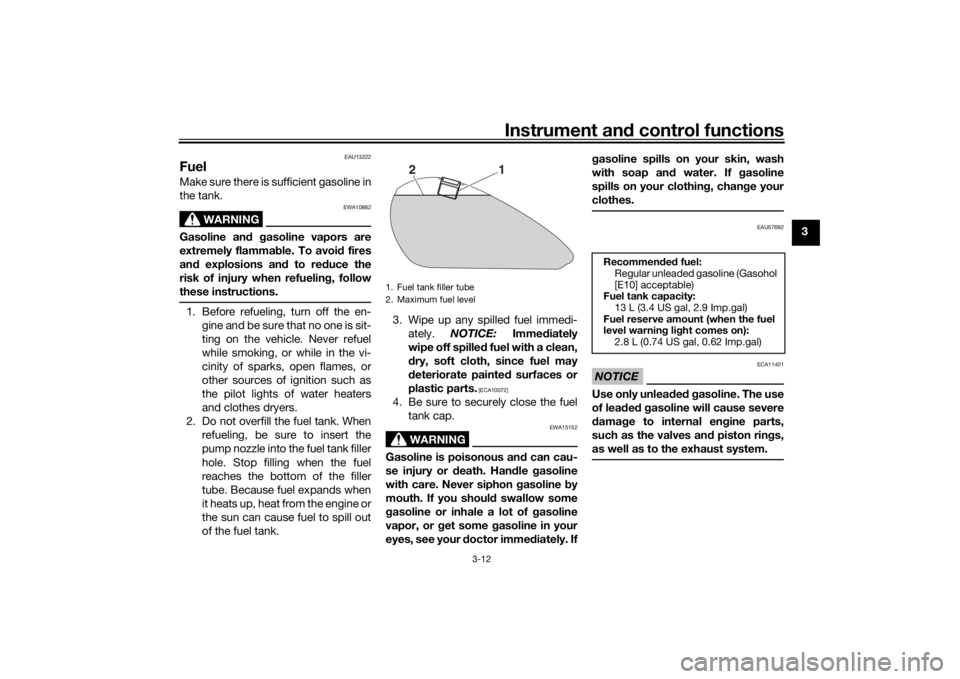
FuelMake sure there is sufficient gasoline in
the tank.
WARNING
EWA10882
Gasoline an d gasoline vapors are
extremely flammab le. To avoid fires
an d explosions an d to re duce the
risk of injury when refuelin g, follow
these instructions.1. Before refueling, turn off the en- gine and be sure that no one is sit-
ting on the vehicle. Never refuel
while smoking, or while in the vi-
cinity of sparks, open flames, or
other sources of ignition such as
the pilot lights of water heaters
and clothes dryers.
2. Do not overfill the fuel tank. When refueling, be sure to insert the
pump nozzle into the fuel tank filler
hole. Stop filling when the fuel
reaches the bottom of the filler
tube. Because fuel expands when
it heats up, heat from the engine or
the sun can cause fuel to spill out
of the fuel tank. 3. Wipe up any spilled fuel immedi-
ately. NOTICE: Immediately
wipe off spille d fuel with a clean,
d ry, soft cloth, since fuel may
d eteriorate painte d surfaces or
plastic parts.
[ECA10072]
4. Be sure to securely close the fuel tank cap.
WARNING
EWA15152
Gasoline is poisonous an d can cau-
se injury or death. Han dle gasoline
with care. Never siphon gasoline by
mouth. If you shoul d swallow some
g asoline or inhale a lot of gasoline
vapor, or get some g asoline in your
eyes, see your d octor immediately. If g
asoline spills on your skin, wash
with soap an d water. If g asoline
spills on your clothin g, chan ge your
clothes.
EAU57692
NOTICE
ECA11401
Use only unlea ded g asoline. The use
of lead ed g asoline will cause severe
d amag e to internal en gine parts,
such as the valves an d piston rin gs,
as well as to the exhaust system.
1. Fuel tank filler tube
2. Maximum fuel level
2
1
Recommen ded fuel:
Regular unleaded gasoline (Gasohol
[E10] acceptable)
Fuel tank capacity:
13 L (3.4 US gal, 2.9 Imp.gal)
Fuel reserve amount (when the fuel
level warnin g li ght comes on):
2.8 L (0.74 US gal, 0.62 Imp.gal)
UBS5E0E0.book Page 12 Wedne sday, October 19, 2016 10:21 AM
Page 28 of 88

Instrument and control functions
3-13
3
TIPThis mark identifies the recom-
mended fuel for this vehicle as
specified by European regulation
(EN228).
Check that gasoline nozzle has
the same identifier when fueling.Your Yamaha engine has been de-
signed to use regular unleaded gaso-
line with a research octane number of
95 or higher. If knocking (or pinging)
occurs, use a gasoline of a different
brand or premium unleaded fuel. Use
of unleaded fuel will extend spark plug
life and reduce maintenance costs. Gasohol
There are two types of gasohol: gaso-
hol containing ethanol and that con-
taining methanol. Gasohol containing
ethanol can be used if the ethanol con-
tent does not exceed 10% (E10). Gas-
ohol containing methanol is not
recommended by Yamaha because it
can cause damage to the fuel system
or vehicle performance problems.
EAU77630
Fuel tank breather/overflow
hoseBefore operating the motorcycle:
Check the fuel tank breather/over-
flow hose connections.
Check the hose for cracks or dam-
age, and replace it if necessary.
Make sure that the canister
breather is not blocked, and clean
it if necessary.TIPSee page 6-11 for canister information.
E5
E10
1. Fuel tank breather/overflow hose
1
UBS5E0E0.book Page 13 Monday, May 21, 2018 5:59 PM