brake YAMAHA XVZ1300A 2000 User Guide
[x] Cancel search | Manufacturer: YAMAHA, Model Year: 2000, Model line: XVZ1300A, Model: YAMAHA XVZ1300A 2000Pages: 91, PDF Size: 15.45 MB
Page 59 of 91
PERIODIC MAINTENANCE AND MINOR REPAIR
6-17
6
EAU00696
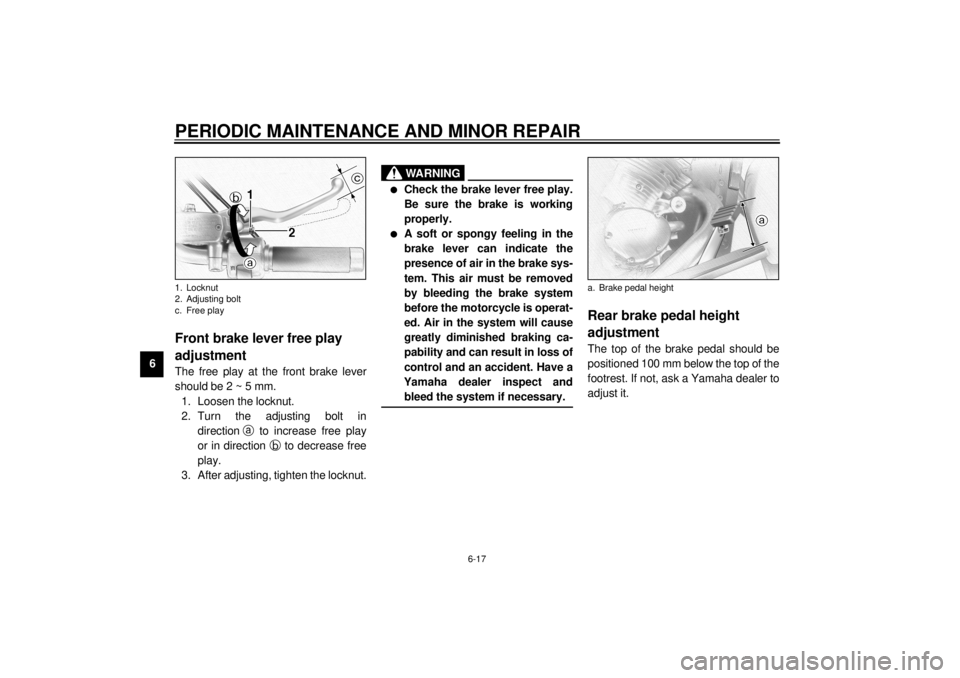
Front brake lever free play
adjustmentThe free play at the front brake lever
should be 2 ~ 5 mm.
1. Loosen the locknut.
2. Turn the adjusting bolt in
direction
a to increase free play
or in direction
b to decrease free
play.
3. After adjusting, tighten the locknut.
EW000099
WARNING
@ l
Check the brake lever free play.
Be sure the brake is working
properly.
l
A soft or spongy feeling in the
brake lever can indicate the
presence of air in the brake sys-
tem. This air must be removed
by bleeding the brake system
before the motorcycle is operat-
ed. Air in the system will cause
greatly diminished braking ca-
pability and can result in loss of
control and an accident. Have a
Yamaha dealer inspect and
bleed the system if necessary.
@
EAU00712
Rear brake pedal height
adjustmentThe top of the brake pedal should be
positioned 100 mm below the top of the
footrest. If not, ask a Yamaha dealer to
adjust it.
1. Locknut
2. Adjusting bolt
c. Free play
a. Brake pedal height
E_4YP_Periodic.fm Page 17 Wednesday, October 6, 1999 10:05 AM
Page 60 of 91
PERIODIC MAINTENANCE AND MINOR REPAIR
6-18
6
EW000109
WARNING
@ A soft or spongy feeling in the brake
pedal can indicate the presence of
air in the brake system. This air
must be removed by bleeding the
brake system before the motorcycle
is operated. Air in the system will
cause greatly diminished braking
capability and can result in loss of
control and an accident. Have a
Yamaha dealer inspect and bleed
the system if necessary. @
EAU00713
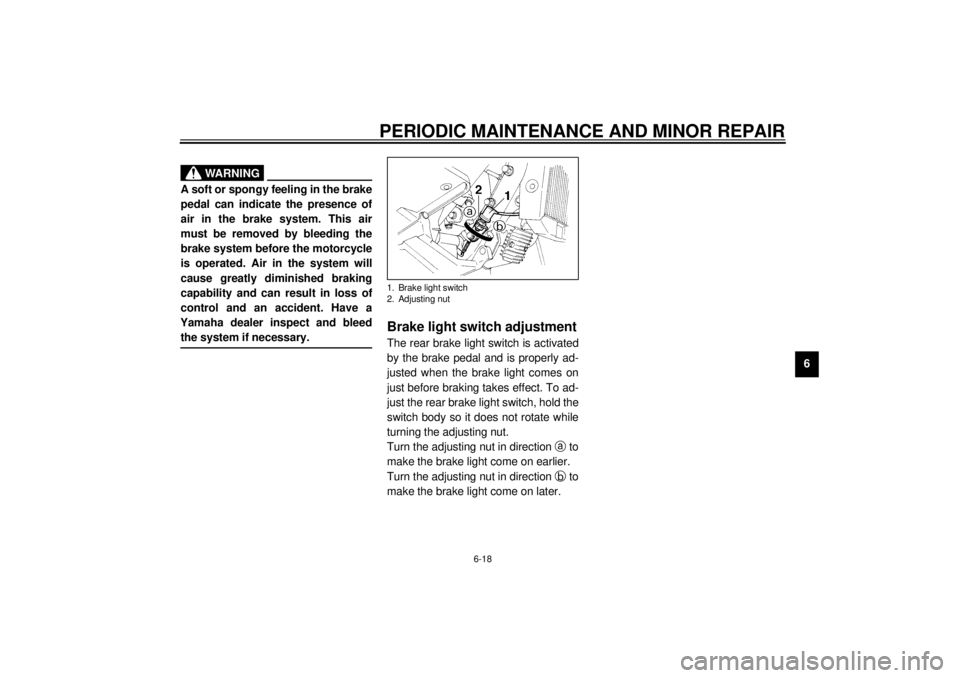
Brake light switch adjustmentThe rear brake light switch is activated
by the brake pedal and is properly ad-
justed when the brake light comes on
just before braking takes effect. To ad-
just the rear brake light switch, hold the
switch body so it does not rotate while
turning the adjusting nut.
Turn the adjusting nut in direction
a to
make the brake light come on earlier.
Turn the adjusting nut in direction
b to
make the brake light come on later.1. Brake light switch
2. Adjusting nut
E_4YP_Periodic.fm Page 18 Wednesday, October 6, 1999 10:05 AM
Page 61 of 91
PERIODIC MAINTENANCE AND MINOR REPAIR
6-19
6
EAU00721
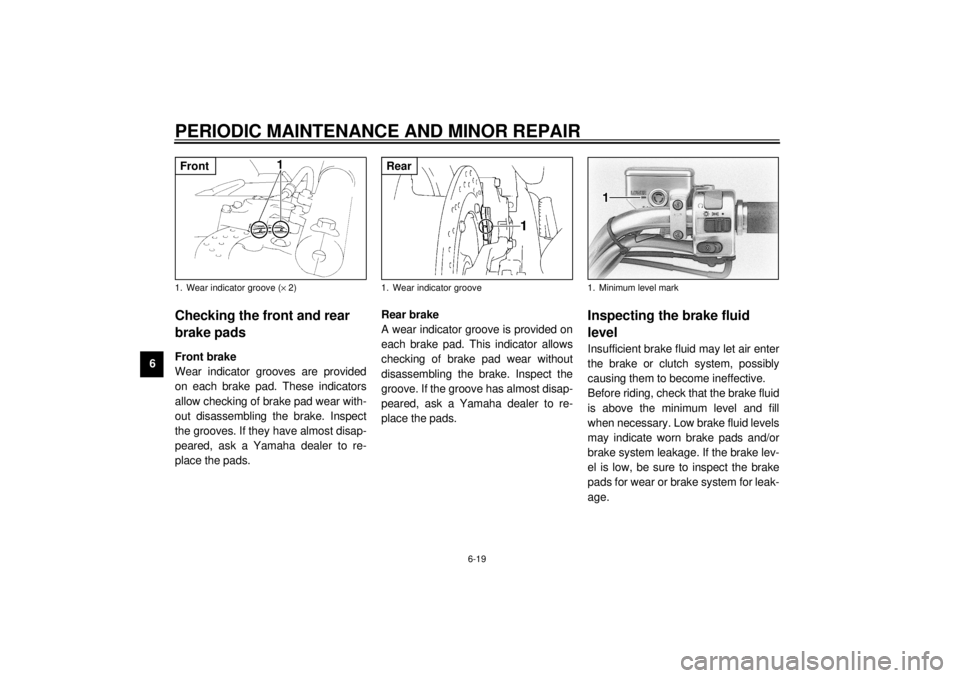
Checking the front and rear
brake pads
EAU01119
Front brake
Wear indicator grooves are provided
on each brake pad. These indicators
allow checking of brake pad wear with-
out disassembling the brake. Inspect
the grooves. If they have almost disap-
peared, ask a Yamaha dealer to re-
place the pads.
EAU01198
Rear brake
A wear indicator groove is provided on
each brake pad. This indicator allows
checking of brake pad wear without
disassembling the brake. Inspect the
groove. If the groove has almost disap-
peared, ask a Yamaha dealer to re-
place the pads.
EAU01800
Inspecting the brake fluid
levelInsufficient brake fluid may let air enter
the brake or clutch system, possibly
causing them to become ineffective.
Before riding, check that the brake fluid
is above the minimum level and fill
when necessary. Low brake fluid levels
may indicate worn brake pads and/or
brake system leakage. If the brake lev-
el is low, be sure to inspect the brake
pads for wear or brake system for leak-
age.
1. Wear indicator groove (´ 2)Front
1. Wear indicator grooveRear
1. Minimum level mark
E_4YP_Periodic.fm Page 19 Wednesday, October 6, 1999 10:05 AM
Page 62 of 91
PERIODIC MAINTENANCE AND MINOR REPAIR
6-20
6 Observe these precautions:
l
When checking the fluid level,
make sure the top of the master
cylinder is level by turning the han-
dlebars.
l
Use only the designated quality
brake fluid. Otherwise, the rubber
seals may deteriorate, causing
leakage and poor brake or clutch
performance.
l
Refill with the same type of brake
fluid. Mixing fluids may result in a
harmful chemical reaction and
lead to poor brake or clutch perfor-
mance.
l
Be careful that water does not en-
ter the master cylinder when refill-
ing. Water will significantly lower
the boiling point of the fluid and
may result in vapor lock.
l
Brake fluid may deteriorate paint-
ed surfaces or plastic parts. Al-
ways clean up spilled fluid
immediately.
l
Have a Yamaha dealer check the
cause if the brake fluid level goes
down.
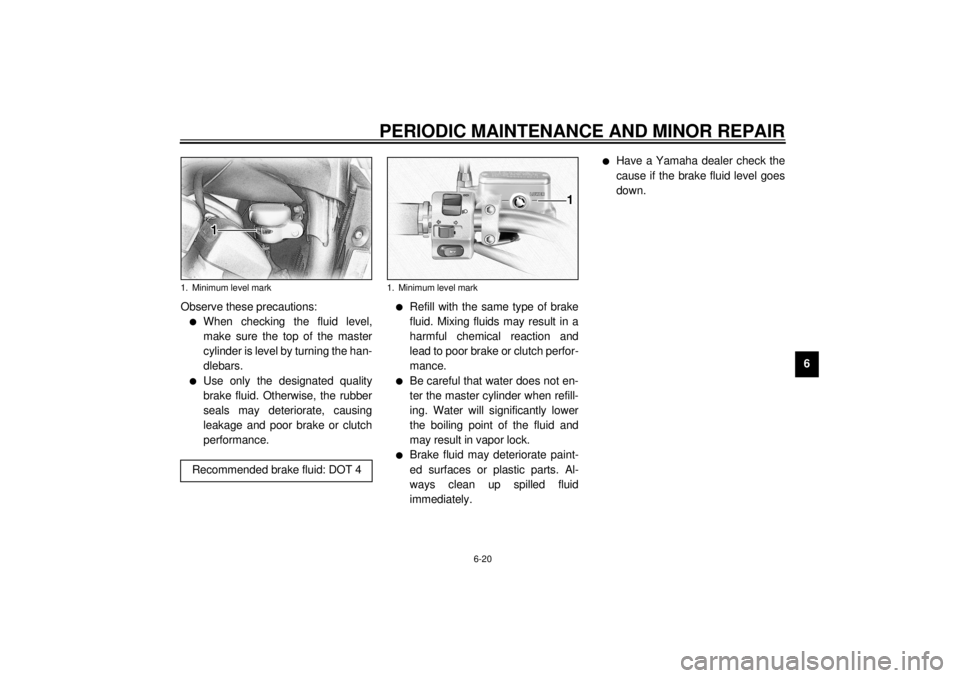
1. Minimum level mark
Recommended brake fluid: DOT 4
1. Minimum level mark
E_4YP_Periodic.fm Page 20 Wednesday, October 6, 1999 10:05 AM
Page 63 of 91
PERIODIC MAINTENANCE AND MINOR REPAIR
6-21
6
EAU00742
Brake fluid replacementThe brake fluid should be replaced only
by trained Yamaha service personnel.
Have the Yamaha dealer replace the
following components during periodic
maintenance or when they are dam-
aged or leaking:l
oil seals (every two years)
l
brake hoses (every four years)
EAU02984
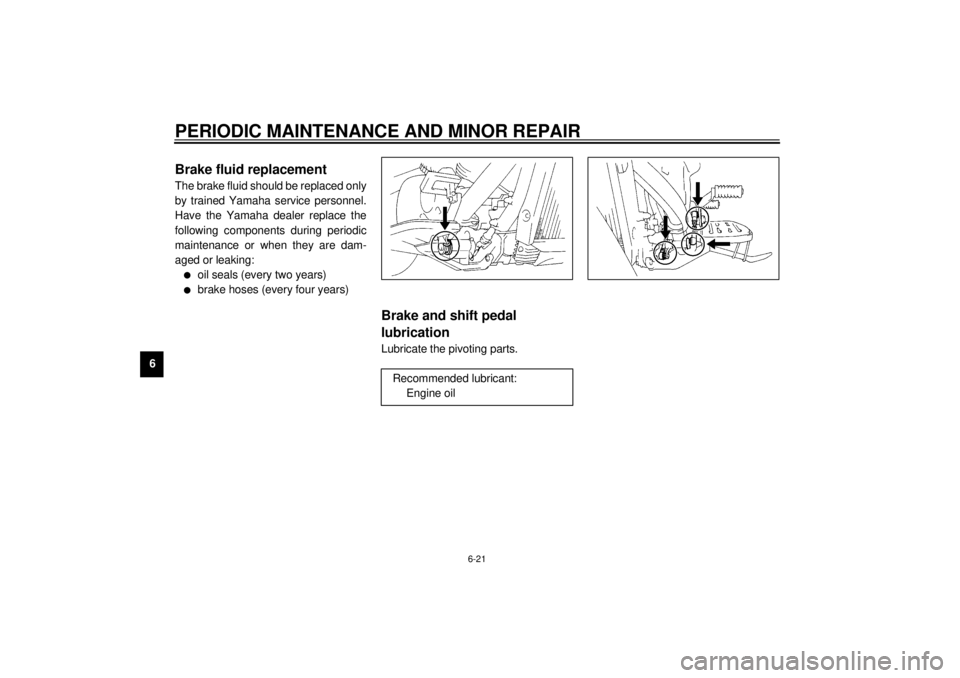
Brake and shift pedal
lubricationLubricate the pivoting parts.
Recommended lubricant:
Engine oil
E_4YP_Periodic.fm Page 21 Wednesday, October 6, 1999 10:05 AM
Page 64 of 91
PERIODIC MAINTENANCE AND MINOR REPAIR
6-22
6
EAU02985
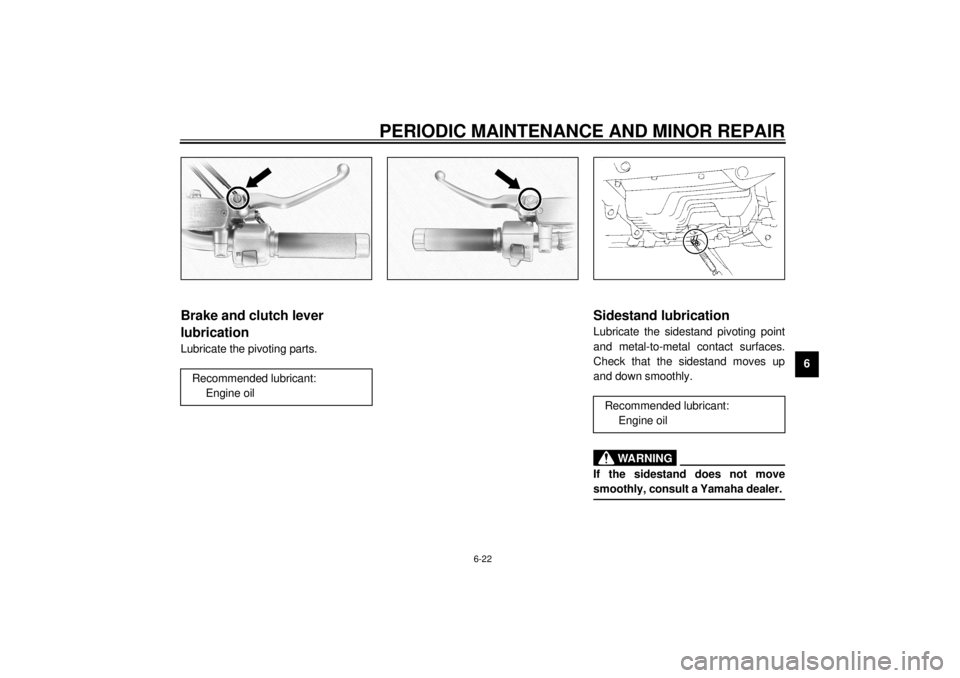
Brake and clutch lever
lubricationLubricate the pivoting parts.
EAU02986
Sidestand lubricationLubricate the sidestand pivoting point
and metal-to-metal contact surfaces.
Check that the sidestand moves up
and down smoothly.
EW000113
WARNING
@ If the sidestand does not move
smoothly, consult a Yamaha dealer. @
Recommended lubricant:
Engine oil
Recommended lubricant:
Engine oil
E_4YP_Periodic.fm Page 22 Wednesday, October 6, 1999 10:05 AM
Page 65 of 91
PERIODIC MAINTENANCE AND MINOR REPAIR
6-23
6
EAU02939
Front fork inspectionVisual check
EW000115
WARNING
@ Securely support the motorcycle so
there is no danger of it falling over. @Check for scratches or damage on the
inner tube and excessive oil leakage
from the front fork.
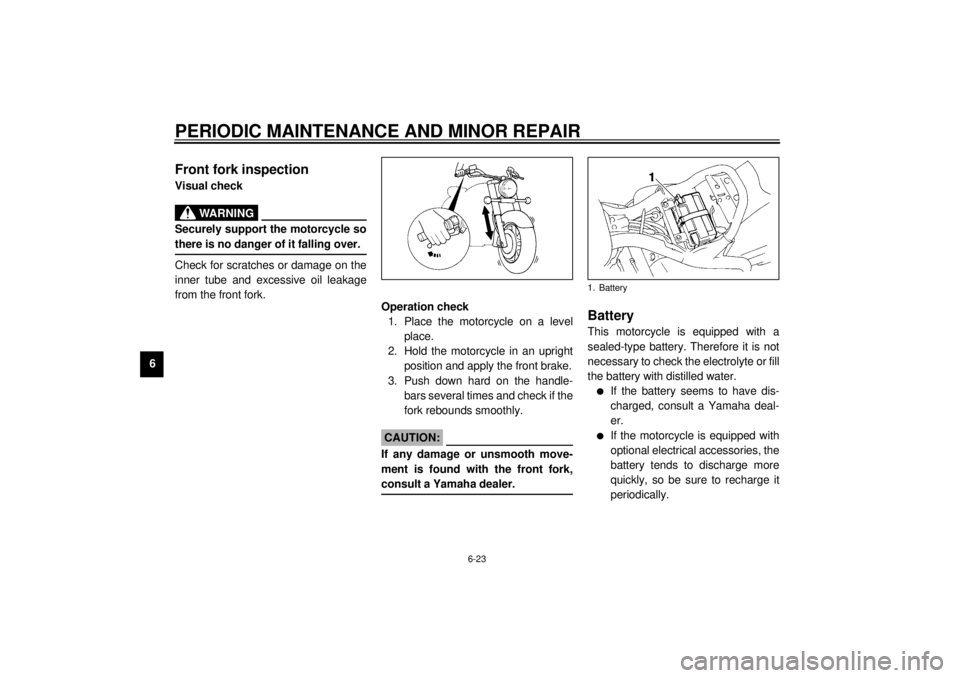
Operation check
1. Place the motorcycle on a level
place.
2. Hold the motorcycle in an upright
position and apply the front brake.
3. Push down hard on the handle-
bars several times and check if the
fork rebounds smoothly.
EC000098
CAUTION:@ If any damage or unsmooth move-
ment is found with the front fork,
consult a Yamaha dealer. @
EAU00800
BatteryThis motorcycle is equipped with a
sealed-type battery. Therefore it is not
necessary to check the electrolyte or fill
the battery with distilled water.l
If the battery seems to have dis-
charged, consult a Yamaha deal-
er.
l
If the motorcycle is equipped with
optional electrical accessories, the
battery tends to discharge more
quickly, so be sure to recharge it
periodically.
1. Battery
E_4YP_Periodic.fm Page 23 Wednesday, October 6, 1999 10:05 AM
Page 76 of 91
MOTORCYCLE CARE AND STORAGE
7-2
7
ECA00010
CAUTION:@ l
Avoid using strong acidic wheel
cleaners, especially on spoked
wheels. If you do use such
products for hard-to-remove
dirt, do not leave it on any long-
er than instructed, then thor-
oughly rinse it off with water,
immediately dry the area and
apply a corrosion protection
spray.
l
Improper cleaning can damage
windshields, cowlings, panels
and other plastic parts. Use
only a soft, clean cloth or
sponge with mild detergent and
water to clean plastic.
l
Do not use any harsh chemical
products on plastic parts. Be
sure to avoid using cloths or
sponges which have been in
contact with strong or abrasive
cleaning products, solvent or
thinner, fuel (gasoline), rust re-
movers or inhibitors, brake flu-
id, antifreeze or electrolyte.
l
Do not use high-pressure wash-
ers or steam-jet cleaners since
they cause water seepage and
deterioration in the following ar-
eas: seals (of wheel bearings,
swingarm bearings, forks and
brakes), electric components
(couplers, connectors, instru-
ments, switches and lights),
breather hoses and vents.
l
For motorcycles equipped with
a windshield: Do not use strong
cleaners or hard sponges as
they will cause dulling or
scratching. Some cleaning
compounds for plastic may
leave scratches on the wind-
shield. Test the product on a
small hidden part of the wind-
shield to make sure they do not
leave any marks. If the wind-
shield is scratched, use a quali-
ty plastic polishing compound
after washing.
@After riding in the rain, near the sea oron salt-sprayed roadsSince sea salt or salt sprayed on the
roads in the winter are extremely corro-
sive in combination with water, carry
out the following steps after each ride
in the rain, near the sea or on salt-
sprayed roads. (Salt sprayed in the
winter may remain on the roads well
into spring.)
E_4YP_Cleaning.fm Page 2 Wednesday, October 6, 1999 10:06 AM
Page 77 of 91
MOTORCYCLE CARE AND STORAGE
7-3
71. Clean your motorcycle with cold
water and soap after the engine
has cooled down.
ECA00012
CAUTION:@ Do not use warm water since it in-
creases the corrosive action of the
salt. @2. Be sure to apply a corrosion pro-
tection spray on all (even chrome-
and nickel-plated) metal surfaces
to prevent corrosion.After cleaning
1. Dry the motorcycle with a chamois
or an absorbing cloth.
2. Use a chrome polish to shine
chrome, aluminum and stainless-
steel parts, including the exhaust
system. (Even the thermally in-
duced discoloring of stainless-
steel exhaust systems can be re-
moved through polishing.)
3. To prevent corrosion, it is recom-
mended to apply a corrosion pro-
tection spray on all (even chrome-
and nickel-plated) metal surfaces.
4. Use spray oil as a universal clean-
er to remove any remaining dirt.
5. Touch up minor paint damage
caused by stones, etc.
6. Wax all painted surfaces.
7. Let the motorcycle dry completely
before storing it or covering it.
EWA00001
WARNING
@ Make sure that there is no oil or wax
on the brakes and tires. If neces-
sary, clean the brake discs and lin-
ings with a regular brake disc
cleaner or acetone, and wash the
tires with warm water and mild soap.
Then, carefully test the motorcycle
for its braking performance and cor-
nering behavior. @
E_4YP_Cleaning.fm Page 3 Wednesday, October 6, 1999 10:06 AM
Page 83 of 91

SPECIFICATIONS
8-3
8
Maximum load* 203 kg
Air pressure (cold tire)
Up to 90 kg load*
Front 250 kPa (2.50 kg/cm
2, 2.50 bar)
Rear 250 kPa (2.50 kg/cm2, 2.50 bar)
90 kg load ~ maximum load*
Front 250 kPa (2.50 kg/cm2, 2.50 bar)
Rear 280 kPa (2.80 kg/cm2, 2.80 bar)
* Load is the total weight of cargo, rider, passenger and accesso-
ries.
Wheels
Front
Ty p e C a s t
Size 16 ´ MT3.50
Rear
Ty p e C a s t
Size 15M/C ´ MT4.00
Brakes
Front
Type Dual disc brake
Operation Right hand operation
Fluid DOT 4Rear
Type Single disc brake
Operation Right foot operation
Fluid DOT 4
Suspension
Fr o n t
Ty p e Te l e s c o p i c f o r k
Rear
Type Swingarm (link suspension)
Shock absorber
Front Coil-air spring / oil damper
Rear Coil spring / gas-oil damper
Wheel travel
Front 140 mm
Rear 95 mm
Electrical sysyem
Ignition system T.C.I. (digital)
Charging system
Type A.C. magneto
Standard output 14 V, 23 A @ 5,000 r/min
Battery
Type YTX20L-BS
Voltage, capacity 12 V, 18 AH
E_4YP_Spec.fm Page 3 Wednesday, October 6, 1999 10:06 AM