tow YAMAHA XVZ1300TF 2000 Owners Manual
[x] Cancel search | Manufacturer: YAMAHA, Model Year: 2000, Model line: XVZ1300TF, Model: YAMAHA XVZ1300TF 2000Pages: 121, PDF Size: 19.23 MB
Page 23 of 121
INSTRUMENT AND CONTROL FUNCTIONS
3-9
3
EAU01779
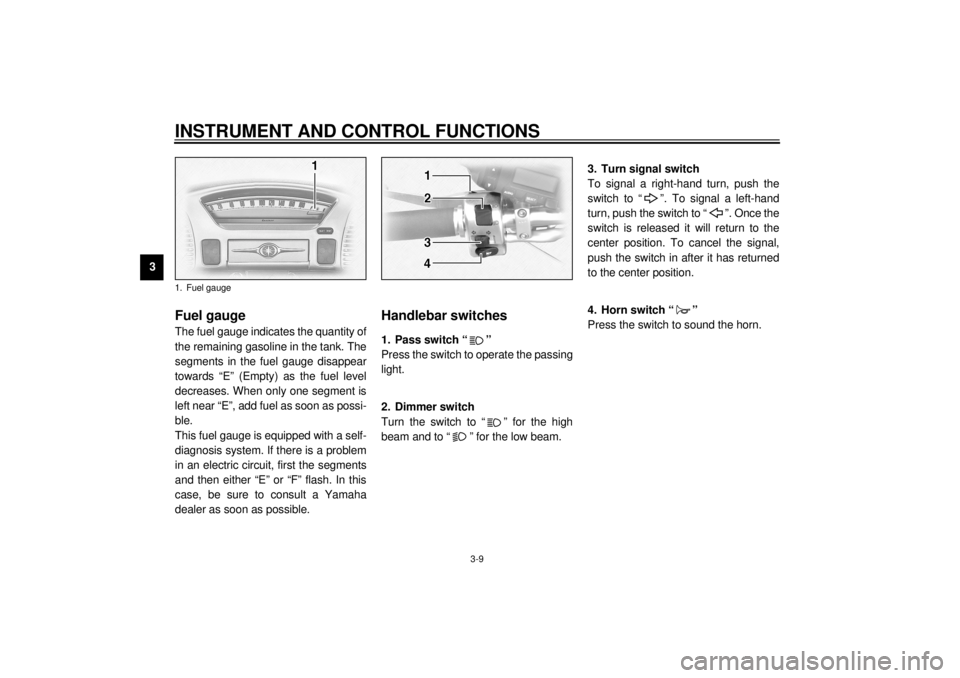
Fuel gaugeThe fuel gauge indicates the quantity of
the remaining gasoline in the tank. The
segments in the fuel gauge disappear
towards “E” (Empty) as the fuel level
decreases. When only one segment is
left near “E”, add fuel as soon as possi-
ble.
This fuel gauge is equipped with a self-
diagnosis system. If there is a problem
in an electric circuit, first the segments
and then either “E” or “F” flash. In this
case, be sure to consult a Yamaha
dealer as soon as possible.
EAU00118
Handlebar switches
EAU00119
1. Pass switch “ ”
Press the switch to operate the passing
light.
EAU00121
2. Dimmer switch
Turn the switch to “ ” for the high
beam and to “ ” for the low beam.
EAU00127
3. Turn signal switch
To signal a right-hand turn, push the
switch to “ ”. To signal a left-hand
turn, push the switch to “ ”. Once the
switch is released it will return to the
center position. To cancel the signal,
push the switch in after it has returned
to the center position.
EAU00129
4. Horn switch “ ”
Press the switch to sound the horn.
1. Fuel gaugeE_5jc_Functions.fm Page 9 Saturday, October 16, 1999 1:08 PM
Page 25 of 121
INSTRUMENT AND CONTROL FUNCTIONS
3-11
3
EAU01215
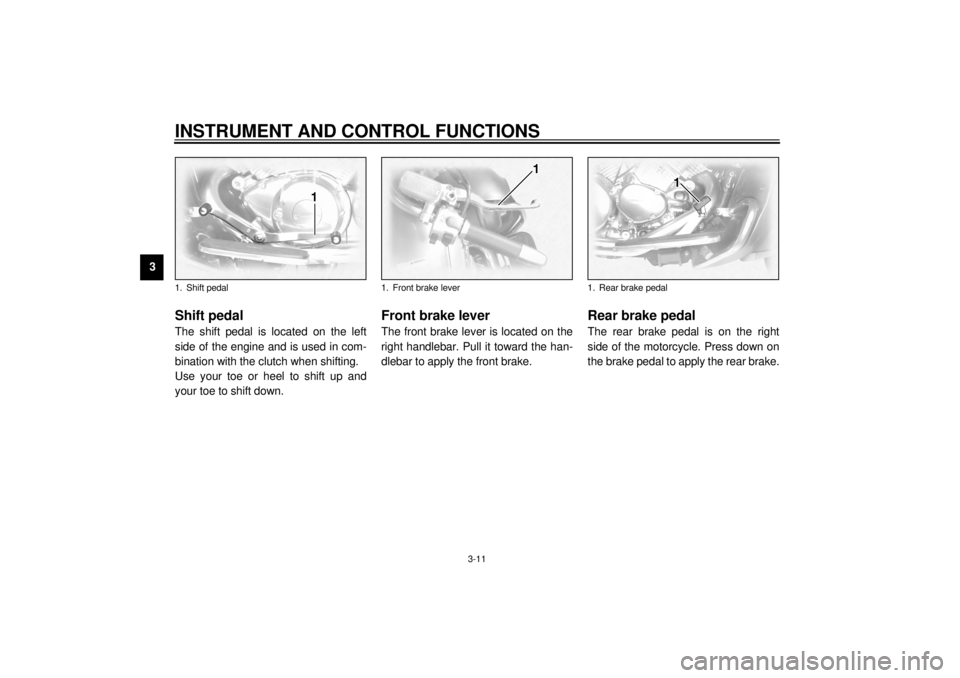
Shift pedalThe shift pedal is located on the left
side of the engine and is used in com-
bination with the clutch when shifting.
Use your toe or heel to shift up and
your toe to shift down.
EAU00158
Front brake leverThe front brake lever is located on the
right handlebar. Pull it toward the han-
dlebar to apply the front brake.
EAU00162
Rear brake pedalThe rear brake pedal is on the right
side of the motorcycle. Press down on
the brake pedal to apply the rear brake.
1. Shift pedal
1. Front brake lever
1. Rear brake pedal
E_5jc_Functions.fm Page 11 Saturday, October 16, 1999 1:08 PM
Page 63 of 121
OPERATION AND IMPORTANT RIDING POINTS
6-3
6
EAU01258
Starting a warm engineThe starter (choke) is not required
when the engine is warm.
EC000046
CAUTION:@ See the “Engine break-in” section
prior to operating the motorcycle for
the first time. @
EAU00423
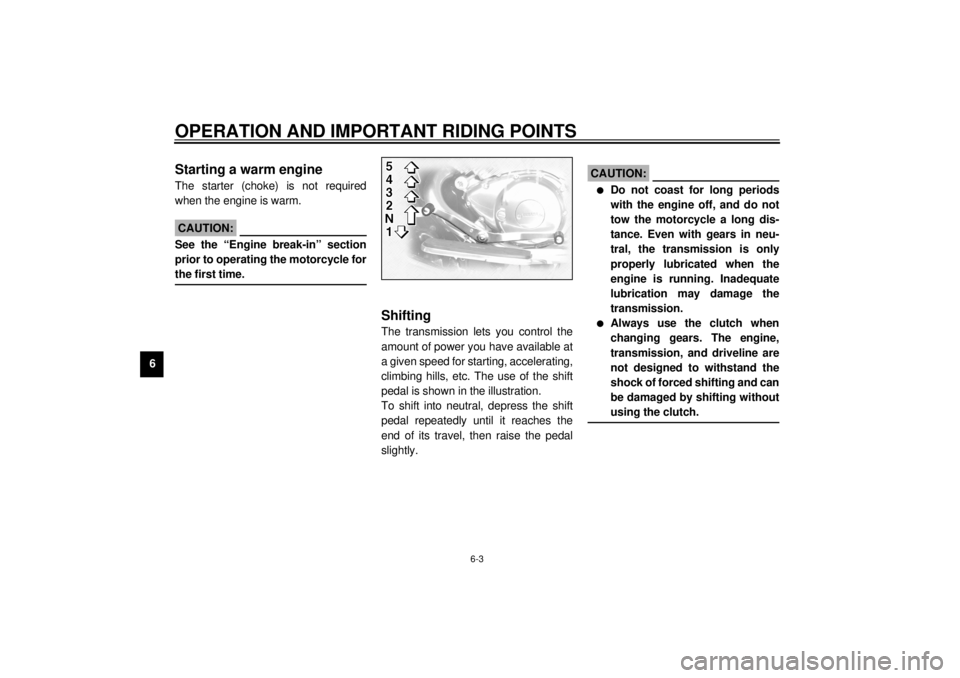
ShiftingThe transmission lets you control the
amount of power you have available at
a given speed for starting, accelerating,
climbing hills, etc. The use of the shift
pedal is shown in the illustration.
To shift into neutral, depress the shift
pedal repeatedly until it reaches the
end of its travel, then raise the pedal
slightly.
EC000048
CAUTION:@ l
Do not coast for long periods
with the engine off, and do not
tow the motorcycle a long dis-
tance. Even with gears in neu-
tral, the transmission is only
properly lubricated when the
engine is running. Inadequate
lubrication may damage the
transmission.
l
Always use the clutch when
changing gears. The engine,
transmission, and driveline are
not designed to withstand the
shock of forced shifting and can
be damaged by shifting without
using the clutch.
@
E_5jc_Operation.fm Page 3 Saturday, October 16, 1999 1:10 PM
Page 77 of 121
PERIODIC MAINTENANCE AND MINOR REPAIR
7-11
7
EAU01703
Engine oilOil level inspection
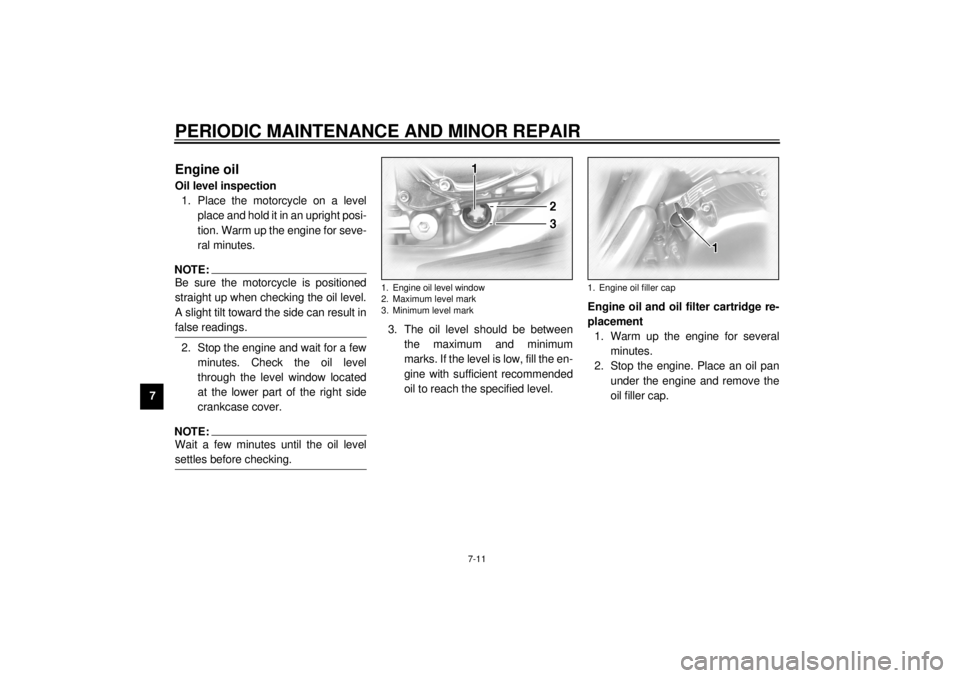
1. Place the motorcycle on a level
place and hold it in an upright posi-
tion. Warm up the engine for seve-
ral minutes.NOTE:@ Be sure the motorcycle is positioned
straight up when checking the oil level.
A slight tilt toward the side can result in
false readings. @2. Stop the engine and wait for a few
minutes. Check the oil level
through the level window located
at the lower part of the right side
crankcase cover.NOTE:@ Wait a few minutes until the oil level
settles before checking. @
3. The oil level should be between
the maximum and minimum
marks. If the level is low, fill the en-
gine with sufficient recommended
oil to reach the specified level.Engine oil and oil filter cartridge re-
placement
1. Warm up the engine for several
minutes.
2. Stop the engine. Place an oil pan
under the engine and remove the
oil filler cap.1. Engine oil level window
2. Maximum level mark
3. Minimum level mark
1. Engine oil filler cap
E_5jc_Periodic.fm Page 11 Saturday, October 16, 1999 1:10 PM
Page 102 of 121
PERIODIC MAINTENANCE AND MINOR REPAIR
7-36
7
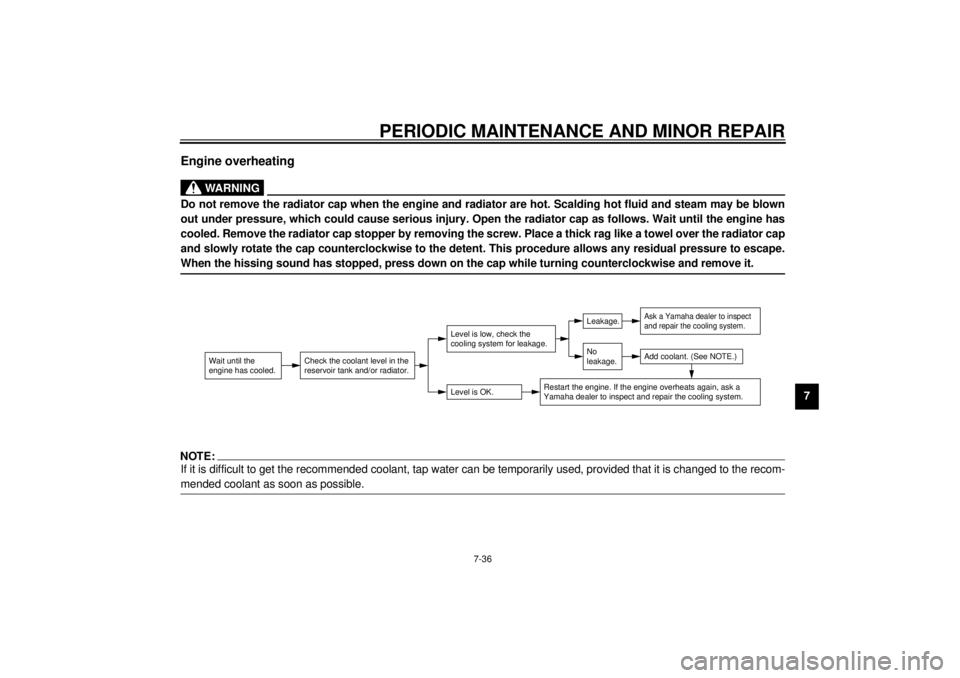
Engine overheating
EW000070
WARNING
@ Do not remove the radiator cap when the engine and radiator are hot. Scalding hot fluid and steam may be blown
out under pressure, which could cause serious injury. Open the radiator cap as follows. Wait until the engine has
cooled. Remove the radiator cap stopper by removing the screw. Place a thick rag like a towel over the radiator cap
and slowly rotate the cap counterclockwise to the detent. This procedure allows any residual pressure to escape.
When the hissing sound has stopped, press down on the cap while turning counterclockwise and remove it. @NOTE:@ If it is difficult to get the recommended coolant, tap water can be temporarily used, provided that it is changed to the recom-
mended coolant as soon as possible. @
Wait until the
engine has cooled.
Check the coolant level in the
reservoir tank and/or radiator.
Level is OK.Level is low, check the
cooling system for leakage.
No
leakage.Leakage.
Ask a Yamaha dealer to inspect
and repair the cooling system.Add coolant. (See NOTE.)
Restart the engine. If the engine overheats again, ask a
Yamaha dealer to inspect and repair the cooling system.
E_5jc_Periodic.fm Page 36 Saturday, October 16, 1999 1:10 PM