check engine YAMAHA XVZ1300TF 2001 User Guide
[x] Cancel search | Manufacturer: YAMAHA, Model Year: 2001, Model line: XVZ1300TF, Model: YAMAHA XVZ1300TF 2001Pages: 132, PDF Size: 20.8 MB
Page 70 of 132
OPERATION AND IMPORTANT RIDING POINTS
6-5
6
EAU01128
Engine break-in There is never a more important period
in the life of your engine than the period
between 0 and 1,600 km. For this rea-
son, you should read the following ma-
terial carefully.
Since the engine is brand new, do not
put an excessive load on it for the first
1,600 km. The various parts in the en-
gine wear and polish themselves to the
correct operating clearances. During
this period, prolonged full-throttle oper-
ation or any condition that might result
in engine overheating must be avoided.
EAU01171*
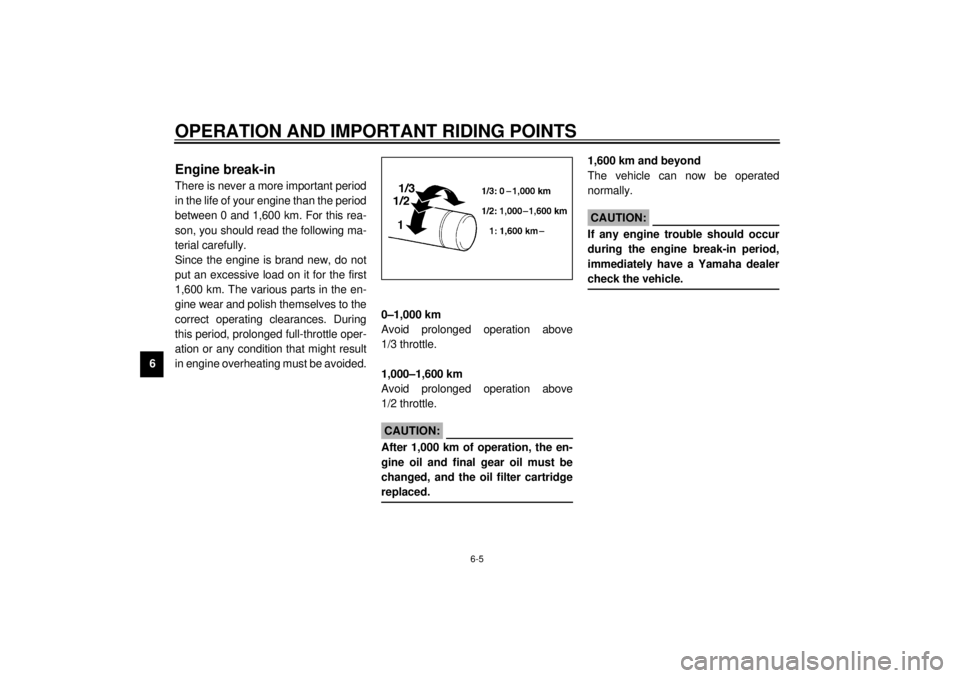
0–1,000 km
Avoid prolonged operation above
1/3 throttle.
1,000–1,600 km
Avoid prolonged operation above
1/2 throttle.
EC000056*
CAUTION:@ After 1,000 km of operation, the en-
gine oil and final gear oil must be
changed, and the oil filter cartridge
replaced. @
1,600 km and beyond
The vehicle can now be operated
normally.
EC000049
CAUTION:@ If any engine trouble should occur
during the engine break-in period,
immediately have a Yamaha dealer
check the vehicle. @
E_5jc.book Page 5 Monday, January 22, 2001 12:12 PM
Page 73 of 132
7
PERIODIC MAINTENANCE AND MINOR REPAIR
Owner’s tool kit .................................................... 7-1
Periodic maintenance and lubrication chart ......... 7-3
Removing and installing cowlings and panels ..... 7-6
Checking the spark plugs .................................. 7-11
Engine oil and oil filter cartridge ........................ 7-12
Final gear oil ...................................................... 7-15
Checking the coolant level ................................. 7-15
Cleaning the air filter elements .......................... 7-17
Adjusting the carburetors ................................... 7-19
Adjusting the engine idling speed ...................... 7-20
Adjusting the throttle cable free play .................. 7-21
Adjusting the valve clearance ............................ 7-21
Tires ................................................................... 7-21
Cast wheels ....................................................... 7-24
Clutch lever free play ......................................... 7-25
Adjusting the brake lever free play ..................... 7-25
Adjusting the brake pedal position ..................... 7-26
Adjusting the rear brake light switch .................. 7-26Checking the front and rear brake pads ............ 7-27
Checking the brake and clutch fluid levels ........ 7-28
Changing the brake and clutch fluids ................ 7-29
Checking and lubricating the brake and
shift pedals ...................................................... 7-29
Checking and lubricating the brake and
clutch levers .................................................... 7-30
Checking and lubricating the sidestand ............ 7-30
Checking the front fork ...................................... 7-31
Checking the steering ....................................... 7-31
Battery ............................................................... 7-32
Replacing the fuses .......................................... 7-33
Replacing the headlight bulb ............................. 7-35
Replacing a turn signal light bulb or the
tail/brake light bulb .......................................... 7-36
Replacing the license plate light bulb ................ 7-37
Troubleshooting ................................................. 7-37
Troubleshooting charts ...................................... 7-38
E_5jc.book Page 1 Monday, January 22, 2001 12:12 PM
Page 77 of 132

PERIODIC MAINTENANCE AND MINOR REPAIR
7-4
7
10
*Wheels• Check runout and for damage.ÖÖÖÖ
11*Tires• Check tread depth and for damage.
• Replace if necessary.
• Check air pressure.
• Correct if necessary.ÖÖÖÖ
12*Wheel bearings• Check bearing for looseness or damage.ÖÖÖÖ
13*Swingarm• Check operation and for excessive play.ÖÖÖÖ
• Lubricate with lithium-soap-based grease. Every 50,000 km
14*Steering bearings• Check bearing play and steering for roughness.ÖÖÖÖÖ
• Lubricate with lithium-soap-based grease. Every 50,000 km
15*Chassis fasteners• Make sure that all nuts, bolts and screws are properly tightened.ÖÖÖÖ Ö
16 Sidestand• Check operation.
• Lubricate.ÖÖÖÖ Ö
17*Sidestand switch• Check operation.ÖÖÖÖÖ Ö
18*Front fork• Check operation and for oil leakage.ÖÖÖÖ
19*Shock absorber
assembly• Check operation and shock absorber for oil leakage.ÖÖÖÖ
20*Rear suspension relay
arm and connecting arm
pivoting points• Check operation.ÖÖÖÖ
• Lubricate with lithium-soap-based grease.ÖÖ
21*Carburetors• Check starter (choke) operation.
• Adjust engine idling speed and synchronization.ÖÖÖÖÖ Ö
22 Engine oil• Change.ÖÖÖÖÖ Ö
23 Engine oil filter cartridge• Replace.ÖÖÖ
24*Cooling system• Check coolant level and vehicle for coolant leakage.ÖÖÖÖ Ö
• Change. Every 3 years NO. ITEM CHECK OR MAINTENANCE JOBODOMETER READING (´1,000 km)
ANNUAL
CHECK
1 10203040
E_5jc.book Page 4 Monday, January 22, 2001 12:12 PM
Page 84 of 132
PERIODIC MAINTENANCE AND MINOR REPAIR
7-11
7
EAU01880
Checking the spark plugs The spark plugs are important engine
components, which should be checked
periodically, preferably by a Yamaha
dealer. Since heat and deposits will
cause any spark plug to slowly erode,
they should be removed and checked
in accordance with the periodic mainte-
nance and lubrication chart. In addition,
the condition of the spark plugs can re-
veal the condition of the engine.
The porcelain insulator around the cen-
ter electrode of each spark plug should
be a medium-to-light tan (the ideal col-
or when the motorcycle is ridden nor-
mally), and all spark plugs installed in
the engine should have the same color.
If any spark plug shows a distinctly dif-
ferent color, the engine could be defec-
tive. Do not attempt to diagnose such
problems yourself. Instead, have a
Yamaha dealer check the motorcycle.
If a spark plug shows signs of electrode
erosion and excessive carbon or other
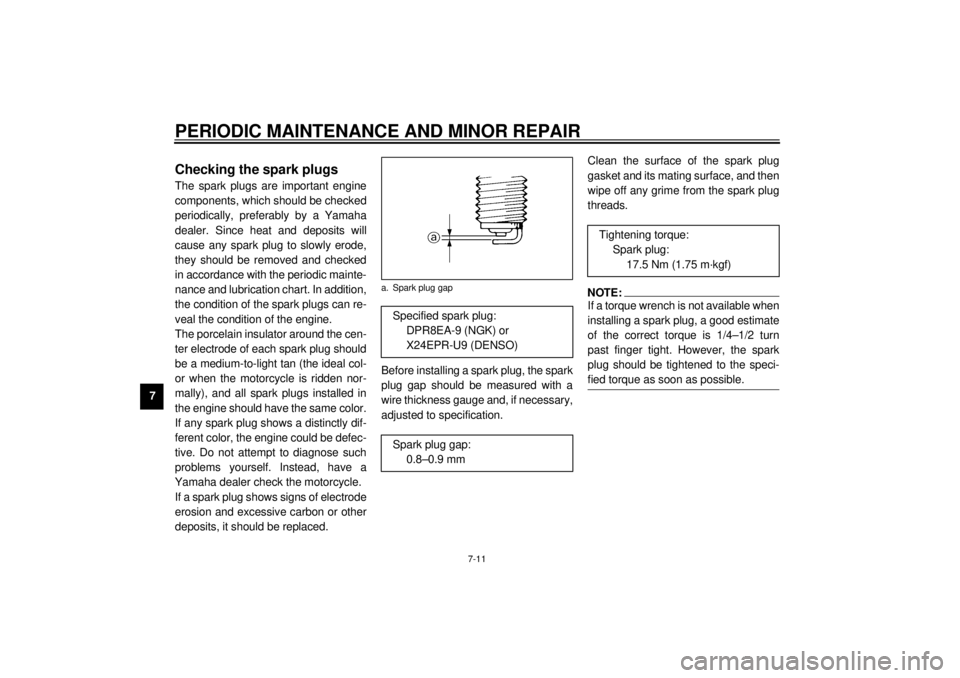
deposits, it should be replaced.Before installing a spark plug, the spark
plug gap should be measured with a
wire thickness gauge and, if necessary,
adjusted to specification.Clean the surface of the spark plug
gasket and its mating surface, and then
wipe off any grime from the spark plug
threads.
NOTE:@ If a torque wrench is not available when
installing a spark plug, a good estimate
of the correct torque is 1/4–1/2 turn
past finger tight. However, the spark
plug should be tightened to the speci-
fied torque as soon as possible. @
a. Spark plug gap
Specified spark plug:
DPR8EA-9 (NGK) or
X24EPR-U9 (DENSO)
Spark plug gap:
0.8–0.9 mm
Tightening torque:
Spark plug:
17.5 Nm (1.75 m·kgf)
E_5jc.book Page 11 Monday, January 22, 2001 12:12 PM
Page 85 of 132
PERIODIC MAINTENANCE AND MINOR REPAIR
7-12
7
EAU01703
Engine oil and oil filter
cartridge The engine oil level should be checked
before each ride. In addition, the oil
must be changed and the oil filter car-
tridge replaced at the intervals speci-
fied in the periodic maintenance and
lubrication chart.
To check the engine oil level
1. Place the motorcycle on a level
surface and hold it in an upright
position.NOTE:Make sure that the motorcycle is posi-
tioned straight up when checking the oil
level. A slight tilt to the side can result in
a false reading. @2. Start the engine, warm it up for
several minutes, and then turn it
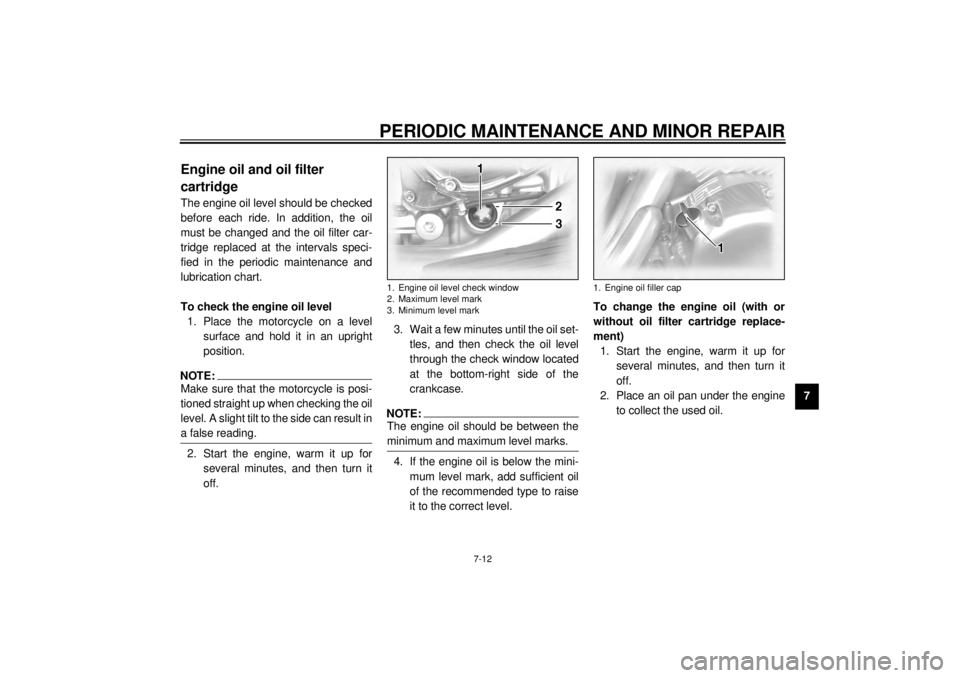
off.3. Wait a few minutes until the oil set-
tles, and then check the oil level
through the check window located
at the bottom-right side of the
crankcase.
NOTE:@ The engine oil should be between the
minimum and maximum level marks. @4. If the engine oil is below the mini-
mum level mark, add sufficient oil
of the recommended type to raise
it to the correct level.To change the engine oil (with or
without oil filter cartridge replace-
ment)
1. Start the engine, warm it up for
several minutes, and then turn it
off.
2. Place an oil pan under the engine
to collect the used oil.1. Engine oil level check window
2. Maximum level mark
3. Minimum level mark
1. Engine oil filler cap
E_5jc.book Page 12 Monday, January 22, 2001 12:12 PM
Page 87 of 132
PERIODIC MAINTENANCE AND MINOR REPAIR
7-14
7 8. Add the specified amount of the
recommended engine oil, and
then install and tighten the oil filler
cap.
EC000072
CAUTION:@ l
In order to prevent clutch slip-
page (since the engine oil also
lubricates the clutch), do not
mix any chemical additives with
the oil or use oils of a higher
grade than “CD”. In addition, do
not use oils labeled “ENERGY
CONSERVING II” or higher.
l
Make sure that no foreign mate-
rial enters the crankcase.
@9. Start the engine, and then let it idle
for several minutes while checking
it for oil leakage. If oil is leaking,
immediately turn the engine off
and check for the cause.NOTE:@ After the engine is started, the engine
oil level warning light should go off if the
oil level is sufficient. @
EC000067
CAUTION:@ If the oil level warning light flickers
or remains on, immediately turn the
engine off and have a Yamaha deal-
er check the vehicle. @10. Turn the engine off, and then
check the oil level and correct it if
necessary. Recommended engine oil:
See page 9-1.
Oil quantity:
Without oil filter cartridge
replacement:
3.5 L
With oil filter cartridge
replacement:
3.7 L
Total amount (dry engine):
4.3 L
E_5jc.book Page 14 Monday, January 22, 2001 12:12 PM
Page 88 of 132
PERIODIC MAINTENANCE AND MINOR REPAIR
7-15
7
EAU01220
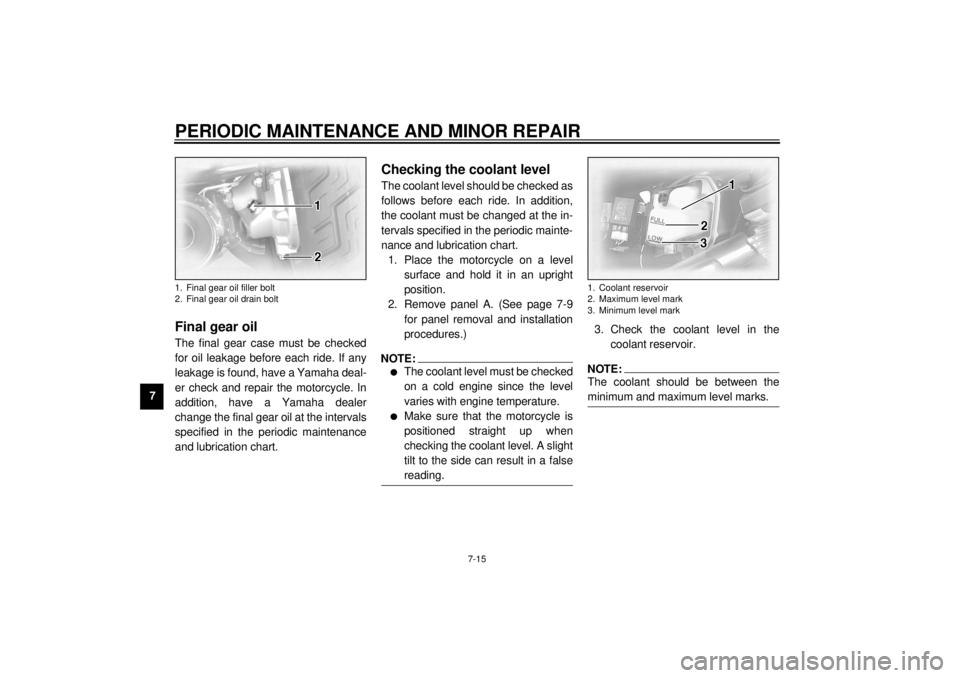
Final gear oil The final gear case must be checked
for oil leakage before each ride. If any
leakage is found, have a Yamaha deal-
er check and repair the motorcycle. In
addition, have a Yamaha dealer
change the final gear oil at the intervals
specified in the periodic maintenance
and lubrication chart.
EAU03974
Checking the coolant level The coolant level should be checked as
follows before each ride. In addition,
the coolant must be changed at the in-
tervals specified in the periodic mainte-
nance and lubrication chart.
1. Place the motorcycle on a level
surface and hold it in an upright
position.
2. Remove panel A. (See page 7-9
for panel removal and installation
procedures.)NOTE:_ l
The coolant level must be checked
on a cold engine since the level
varies with engine temperature.
l
Make sure that the motorcycle is
positioned straight up when
checking the coolant level. A slight
tilt to the side can result in a false
reading.
_
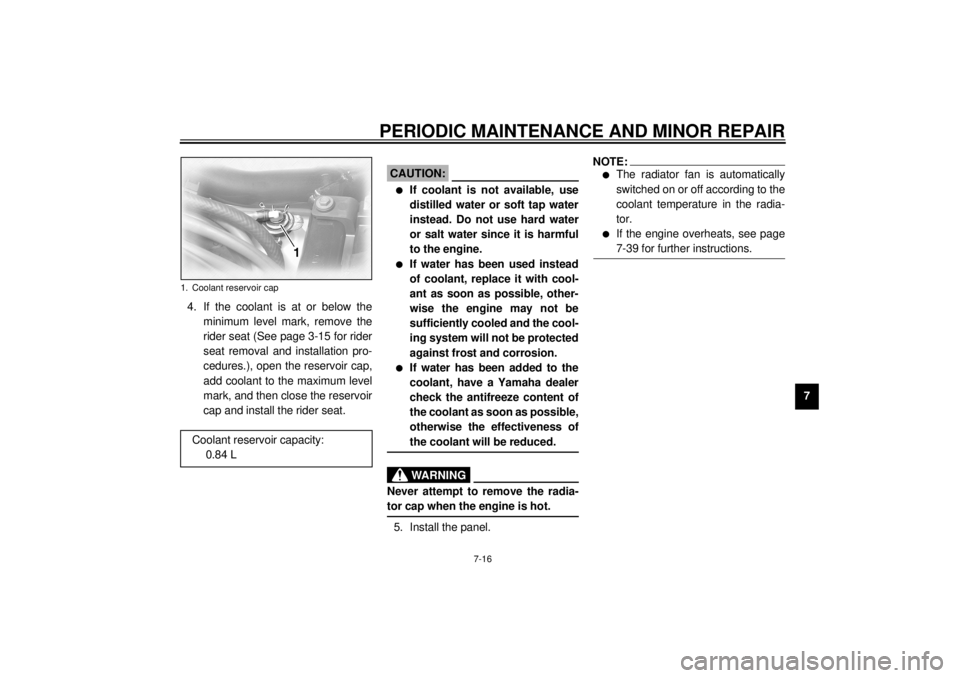
3. Check the coolant level in the
coolant reservoir.NOTE:_ The coolant should be between the
minimum and maximum level marks. _
1. Final gear oil filler bolt
2. Final gear oil drain bolt
1. Coolant reservoir
2. Maximum level mark
3. Minimum level mark
E_5jc.book Page 15 Monday, January 22, 2001 12:12 PM
Page 89 of 132
PERIODIC MAINTENANCE AND MINOR REPAIR
7-16
7 4. If the coolant is at or below the
minimum level mark, remove the
rider seat (See page 3-15 for rider
seat removal and installation pro-
cedures.), open the reservoir cap,
add coolant to the maximum level
mark, and then close the reservoir
cap and install the rider seat.
EC000080
CAUTION:_ l
If coolant is not available, use
distilled water or soft tap water
instead. Do not use hard water
or salt water since it is harmful
to the engine.
l
If water has been used instead
of coolant, replace it with cool-
ant as soon as possible, other-
wise the engine may not be
sufficiently cooled and the cool-
ing system will not be protected
against frost and corrosion.
l
If water has been added to the
coolant, have a Yamaha dealer
check the antifreeze content of
the coolant as soon as possible,
otherwise the effectiveness of
the coolant will be reduced.
_
EW000067
WARNING
_ Never attempt to remove the radia-
tor cap when the engine is hot. _5. Install the panel.
NOTE:_ l
The radiator fan is automatically
switched on or off according to the
coolant temperature in the radia-
tor.
l
If the engine overheats, see page
7-39 for further instructions.
_
1. Coolant reservoir cap
Coolant reservoir capacity:
0.84 L
E_5jc.book Page 16 Monday, January 22, 2001 12:12 PM
Page 93 of 132
PERIODIC MAINTENANCE AND MINOR REPAIR
7-20
7
EAU01168
Adjusting the engine idling
speed The engine idling speed must be
checked and, if necessary, adjusted as
follows at the intervals specified in the
periodic maintenance and lubrication
chart.NOTE:_ A diagnostic tachometer is needed to
make this adjustment. _1. Attach the tachometer to the spark
plug lead.
2. Start the engine and warm it up for
several minutes at 1,000–2,000 r/min
while occasionally revving it to 4,000–
5,000 r/min.NOTE:_ The engine is warm when it quickly re-
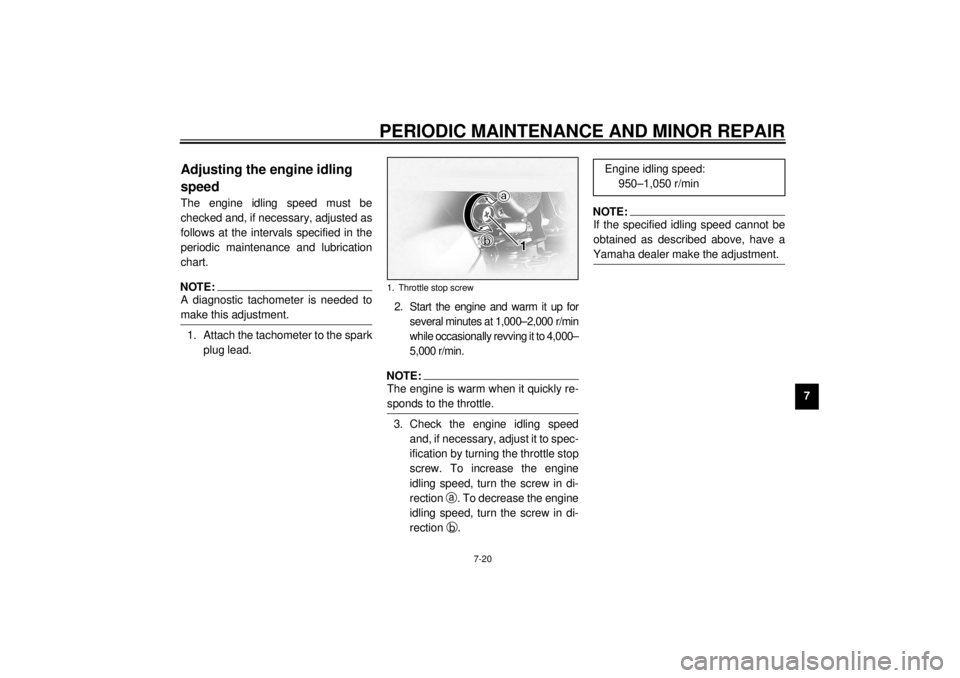
sponds to the throttle. _3. Check the engine idling speed
and, if necessary, adjust it to spec-
ification by turning the throttle stop
screw. To increase the engine
idling speed, turn the screw in di-
rection
a. To decrease the engine
idling speed, turn the screw in di-
rection
b.
NOTE:_ If the specified idling speed cannot be
obtained as described above, have a
Yamaha dealer make the adjustment. _
1. Throttle stop screw
Engine idling speed:
950–1,050 r/min
E_5jc.book Page 20 Monday, January 22, 2001 12:12 PM
Page 94 of 132
PERIODIC MAINTENANCE AND MINOR REPAIR
7-21
7
EAU00635
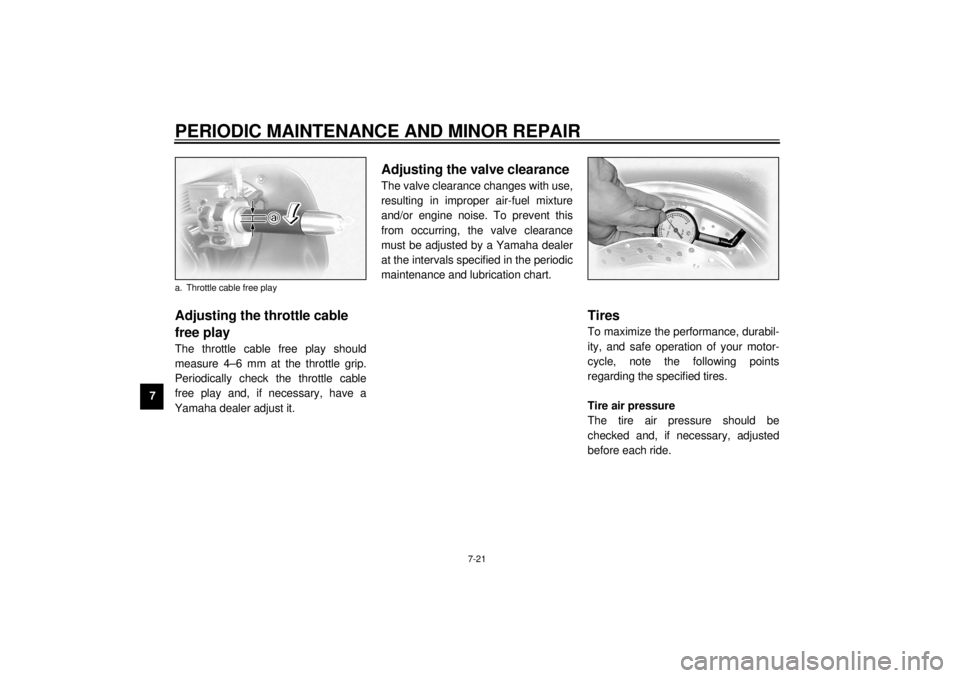
Adjusting the throttle cable
free play The throttle cable free play should
measure 4–6 mm at the throttle grip.
Periodically check the throttle cable
free play and, if necessary, have a
Yamaha dealer adjust it.
EAU00637
Adjusting the valve clearance The valve clearance changes with use,
resulting in improper air-fuel mixture
and/or engine noise. To prevent this
from occurring, the valve clearance
must be adjusted by a Yamaha dealer
at the intervals specified in the periodic
maintenance and lubrication chart.
EAU03975
Tires To maximize the performance, durabil-
ity, and safe operation of your motor-
cycle, note the following points
regarding the specified tires.
Tire air pressure
The tire air pressure should be
checked and, if necessary, adjusted
before each ride.
a. Throttle cable free playE_5jc.book Page 21 Monday, January 22, 2001 12:12 PM